Proactively “From the Sea”; an agent of change leveraging the littoral best practices for a paradigm breaking six-sigma best business case to synergize a consistent design in the global commons, rightsizing the core values supporting our mission statement via the 5-vector model through cultural diversity.
Jonathan Eyal of RUSI, a defence think-tank, (says) demographic factors and changing social attitudes in China suggest that there would be little popular appetite for conflict with America, despite the sometimes nationalistic posturing of state media. Like other developed countries, the country has very low birth rates, fast-decreasing levels of violence and large middle classes who define success by tapping the latest smartphone or putting down a deposit on a new car. In a culture of coddling children prompted by the one-child policy, Chinese parents would probably be extremely reluctant to send their precious “snowflakes” off to war.
It outlines well what we have described here over the years as the Most Likely COA for the Chinese - and the most smart; the Chinese Porcupine.
The risk that the West will run into a major conflict with China is lower than with Russia, but it is not negligible and may be growing. China resents the American naval presence in the western Pacific, and particularly the “freedom of navigation” operations that the US Seventh Fleet conducts in the South China Sea to demonstrate that America will not accept any Chinese claims or actions in the region that threaten its core national interests or those of its allies.
For its part, China is planning to develop its A2/AD capabilities, especially long-range anti-ship missiles and a powerful navy equipped with state-of-the-art surface vessels and a large submarine force. The idea is first to push the US Navy beyond the “first island chain” and ultimately make it too dangerous for it to operate within the “second island chain” (see map). Neither move is imminent, but China has already made a lot of progress. If there were a new crisis over Taiwan, America would no longer send an aircraft-carrier battle group through the Taiwan Strait to show its resolve, as it did in 1996.
How such tensions will play out depends partly on America’s allies. If Japan’s recently re-elected prime minister, Shinzo Abe, succeeds in his ambition to change the country’s pacifist constitution, the Japanese navy is likely to increase its capabilities and more explicitly train to fight alongside its American counterpart. At the same time other, weaker allies such as Vietnam, the Philippines, Malaysia and Indonesia may conclude that bowing to Chinese military and economic power is a safer bet than hoping for a declining America to fight their corner.
The greatest danger lies in miscalculation through a failure to understand an adversary’s intentions, leading to an unplanned escalation that runs out of control. Competition in the “grey zone” between peace and war requires constant calibration that could all too easily be lost in the heat of the moment.
It is this that we need to be preparing for with our friends around China's maritime borders. WESTPAC is their "Gulf of Mexico" and VACAPES, and we should keep that in mind as we travel in those areas. The Chinese are bold, and we are looking weak, that is also something to remember given the Chinese culture of how the weak should be treated by the strong.
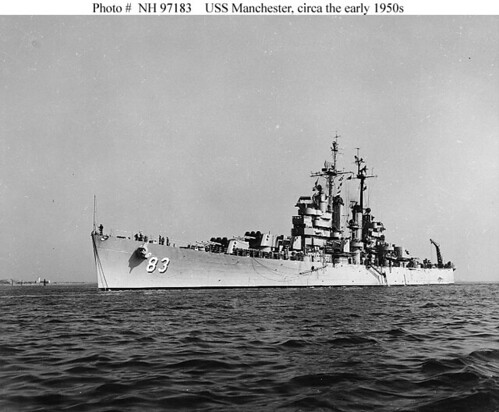
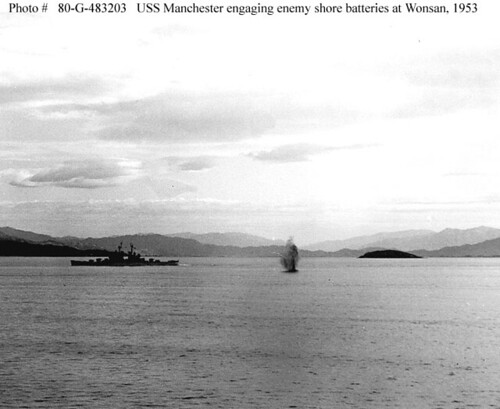
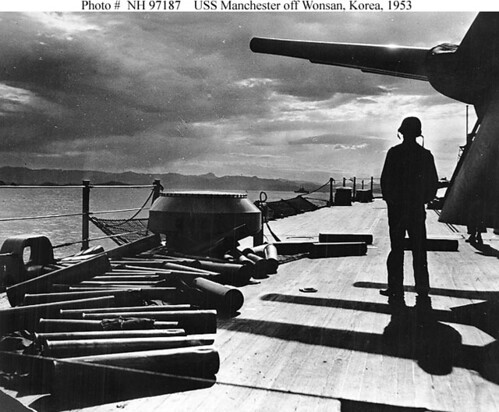
Sometimes you have to bring up a ship that did just solid, warship duty. For example, I give you the USS MANCHESTER (CL-83).
That is all for FbF today - but I leave you with something to ponder.
As we discuss what is or is not littoral warfare - check out this picture. All the stealth in the world won't help you here --- and a lack of damage control will kill Sailors wholesale. That is why the selling of LCS is almost a crime.
Are you up to speed on the latest issues with the USS FORD (CVN 78) and EMALS? I've got the goods for 'ya over at USNIBlog. Come visit and give it a read.
Security is being recast as international logistics systems and supply chains contribute to the reshaping of the global order, and strategic policy intertwines itself with economics and industrial power to create objectives for the military forces protecting national interests (it has, of course, been ever thus). The growing logistics needs of combat forces creates pressures at a time where ‘small wars’ are being fought on a shoestring budget, where the increasing outsourcing of military activities binds operational success with the fortunes of commercial opportunity, and the growing complexity and diversity of supply creates troubling issues for military security.
...
There is little discussion – nearly a complete absence – of how logistics shaped the Western counter-insurgency operations which followed. With forces ‘hoping for the best, and planning for the best’, small logistics footprints and inadequate strategic consideration severely curtained British Army operations in Basra in the early years of its deployment in Iraq. The need to secure supply-routes and distribution tasks restricted the frequency of combat patrols, and entrenched forces into ‘forward operating bases’ thus reducing the tactical mobility of the force. Similar experiences in Helmand, Afghanistan, were encountered. More and more significant resources had to be directed to logistics missions, drawing upon helicopters to overcome lacking equipment and the state of lowering materiel readiness as the supply chain failed to keep up.
Keep an eye on him for logistics with an Aussie accent. Hopefully, with very little slang.
If you haven't checked with the latest imagery of what China is building in the South China Sea, then you've missed a sea change. What was at one time little more than sandbars with a shack and a spotty pier, are now a series of scaled down Diego Garcias. Via the UK Daily Mail;
The dramatic military build-up is shown in pictures taken from a height of 1,500m (4,920 feet) in the last six months of 2017, according to the Philippine Daily Inquirer.
One of the fortresses is situated on Panganiban, a reef which a United Nations-backed court has previously ruled belongs to the Philippines, it is reported.
On the three largest reefs, Kagitingan, Panganiban and Zamora, runways appeared to be ready to receive military aircraft.
As an old TLAM guy, I fully recognize a nice target set when I see one - but there is a lot more to coercive power in peace than what might happen in full war;
China had in December defended its construction on disputed islands as 'normal' after a US think tank released new satellite images showing the deployment of radar and other equipment.
The military expansion also ties into a broader Chinese initiative, called One Belt One Road.
The vast infrastructure project, launched by Chinese President Xi Jinping, is set to build a 'new Silk Road' of ports, railways and roads to expand trade across an arc of countries through Asia, Africa and Europe.
As we enter our 17th of ongoing conflict in Afghanistan and the global struggle against terrorism, why is this war taking so long? Where are we making progress, where are we stalled, and where are we falling back? There are no easy answers to these questions, if there were they wouldn’t need to be asked. We will discuss these and related issues for the full hour this Sunday from 5-6pm Eastern with author Dr. Daniel R. Green, a Defense Fellow at The Washington Institute for Near East Policy focusing on counter-terrorism, counter-insurgency, and stability operations in the Middle East and Central Asia. He is a reserve officer with the U.S. Navy with multiple deployments to both Iraq and Afghanistan, along with holding several senior advisory positions dealing with the Middle East, Central Asia, and NATO/Europe in the Office of the Secretary of Defense and the State Department. Dr. Green recently completed his third book, In the Warlords' Shadow: Special Operations Forces, the Afghans, and their Fight with the Taliban that we will use as a stepping off point for our conversation.
No one will attack you. No one has a reason to. You are neutral. You have not armed yourself with anything aggressive that might provoke them. Your unit is not finished training. You are nowhere near the front. You have plenty of time before you have to confront the enemy. You are in a modern city full of civilians. There is no reason for anyone to attack you. You are only 17 in 1940. You have made it to 2018. You've had a full life - one whose experience is a witness to the false assumptions of others. If you pardon the rough translation, I give you Corporal William 'Bill' Ramakers, Royal Netherlands Marines, the last veteran of the Battle for the Maasbruggen as the Dutch call it - or the 1940 Battle for Rotterdam in the Anglosphere. Bill recently passed away after 95 years;
As a 17-year-old marine, Bill and his comrades fought for days against the German invasion force in Rotterdam during May of 1940. Because of their steadfast resistance, the marines, dressed in dark blue uniforms, were nicknamed by the Germans the "schwarzen Teufel": the Black Devils.
What an interesting path he took.
Ramakers became prisoner of war after the battle, but managed to escape a short time later. After the liberation of the south of the Netherlands in 1944, Ramakers left Scotland and Camp Lejeune in the United States for marine training.
After extensive training, with with the Marine Brigade he was supposed to participate in the invasion of Japan if that country did not surrender. With no invasion, Ramakers left for the former Dutch East Indies, and returned to the Netherlands in 1948. In 1951 with his young family, Ramakers emigrated to Canada.
Fullbore Corporal ... and congrats on a long and well lived life. The pic is from his return to The Netherlands in 2014 with a visit by the King and Queen. As for the Battle of Rotterdam, this is a great video overview of a brief part of WWII mostly unknown outside The Netherlands.