Proactively “From the Sea”; an agent of change leveraging the littoral best practices for a paradigm breaking six-sigma best business case to synergize a consistent design in the global commons, rightsizing the core values supporting our mission statement via the 5-vector model through cultural diversity.
It is so easy to let some parts of history fade ... but there are other parts of history that need to be kept at the front of everyone's mind. As I was 23 and a recently minted Ensign, I remember - but to many it is as old to them as the Cuban Missile Crisis is to me. Sadly, we teach but a sliver of this event - but people should remember more. If for no other reason than to honor the thousands upon thousands of nameless Chinese heroes who - when the time came - stood for their nation to turn towards freedom. They failed. History does not have a right side or wrong side - it only records which side had the greater will can capability;
Diplomatic archives recently declassified by the U.K. government have shed further light on the horror of the military crackdown on student-led protests in Tiananmen Square, describing troops of the People's Liberation Army (PLA) 27th army as being ordered to "spare no-one" as they used dum-dum bullets, automatic weapons and armored vehicles to carry out mass killings in Beijing.
...
"On arrival at Tiananmen troops from [the northeastern city of Shenyang] had separated students and residents," then British ambassador Alan Donald wrote in a diplomatic cable dated June 1989 detailing how the Shenyang troops had been sent in unarmed to disperse the crowd, followed up by a fully armed 27th Army that rampaged through the city killing civilians and other soldiers alike.
"Students understood they were given one hour to leave square but after five minutes [armored personnel carriers] APCs attacked," the cable said. "Students linked arms but were mown down, including soldiers."
"APCs then ran over bodies time and time again to make "pie" and remains collected by bulldozer. Remains incinerated and then hosed down drains," it said.
The cable, which described the 27th Army as illiterate "primitives" from the northern province of Shanxi, commanded by the nephew of then Chinese President Yang Shangkun, said the heavily armed troops were kept without news for 10 days and told they were to take part in a military exercise.
The article has more, but here is some of the horror reported not by some propagandist ... but in a British diplomatic cable; There was more resistance than just at the square;
The documents also describe pitched battles between "enraged" crowds and troops in the western suburb of Muxidi, and Shilipu, to the east of the diplomatic quarter in Jianguomenwai.
"The first three waves were held by the demonstrators and [Shenyang] troops tried to push back the crowds to let 27 Army through," the cable says. "They failed and 27 Army opened fire on the crowd (both civilians and soldiers) before running over them in their APCs."
...
At Muxidi, "the enraged masses followed ignoring machine-gun fire to next battle at Liubukou," the description reads, in a reference to a district of Beijing just west of Tiananmen Square.
"APCs ran over troops and civilians at 65 kilometers/hour in same manner," it said. "One APC crashed and driver (a captain) got out and was taken by crowd to hospital. He is now deranged and demands death for his atrocities."
It said the 27th Army was ordered to spare no-one, and "shot wounded Shenyang soldiers."
In Liubukou, "four wounded girl students begged for their lives but were bayoneted," it said.
...
"1,000 survivors were told they could escape via Zhengyi Lu but were then mown down by specially prepared machine-gun positions," it says, adding that any ambulances trying to rescue the wounded were also attacked and their crews killed.
"With medical crew dead, wounded driver attempted to ram attackers but was blown to pieces with anti-tank weapon," it says. "In further attack APCs caught up with Shenyang military straggler trucks, rammed and overturned them and ran over troops."
It said a 27th Army officer was shot dead by his own troops, "apparently because he faltered."
"Troops explained they would be shot if they hadn't shot officer," according to the cable, which said the Chinese leadership was protected by two rings of tanks and armored personnel carriers, one inside the walls of Zhongnanhai, and another outside.
The Chinese had 100,000 soldiers surrounding the city. Not all were willing to go against the students. There was the seed that never had a chance to germinate;
The embassy said the 27th Army were likely used because they were the most "reliable and obedient," adding that many in China believed civil war was an imminent possibility.
"Some considered other armies would attack 27 Army but they had no ammunition," Donald's cable reads, adding that many military commanders had refused to respond to a summons to a meeting with President Yang Shangkun, while the Beijing military commander had refused to supply outside armies with food, water or barracks.
Sometimes freedom's flame is only a flicker. With no tinder and in a harsh wind, it cannot last.
...a persistent list to starboard and the fact that the ship is dramatically overweight, which would limit its performance, increase its cost of operation, and most importantly, negatively impact the Deutsche Marine's ability to add future upgrades to the somewhat sparsely outfitted vessel.
Now the German Navy has officially declined to commission the vessel and will be returning it to Blohm+Voss shipyard in Hamberg.
Tell me if you recognize a common thread here...
The decision to do so was based on a number of "software and hardware defects" according to German media reports. The noted software deficiencies are of particular importance because these destroyer-sized vessels will supposedly be operated by a crew of just 120-130 sailors—just half that of the much smaller Bremen class frigates they replace—continuously for months at a time. On top of that, the design's reliability is paramount as the four ships in the class are supposed to deploy far from German shores for up to two years at a time.
Looks like another navy fell for the yes-man defense consultant snake oil. Fewer Sailors deploying for longer periods of time, and all will be made up by automation. How is that concept working out for everyone? Speaking of echoing bad ideas;
Complicating things further is the fact that the fourth and final F125 frigate, the Rheinland-Pfalz, was already christened last Spring. Because of the concurrent construction and testing procurement strategy, these vessels are likely to suffer from at least some of the same issues as the lead ship in the class.
Did we have two different breeds of Good Idea Fairies pop up at the same time, or did the Germans believe our own transformational voodoo? Hope they have a Plan-B.
A little encore FBF from the first year of the Obama Administration. The schadenfreude of irony ... Please, my fine, wise, and loyal readers from the Left - don't leave me this FbF - stick with me.
Ya'll remember the gift exchange train wreck, right? Well, regardless of your political persuasion, let this put a smile on your face. Via Ted Bromund,
The ironies here are wonderful, though Obama doesn't seem likely to appreciate them. Of course, the reference to the anti-slavery mission is a nod to Obama's fascination, fervent but not deep, with Abraham Lincoln.
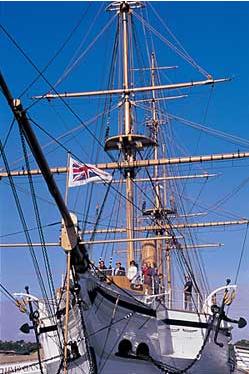
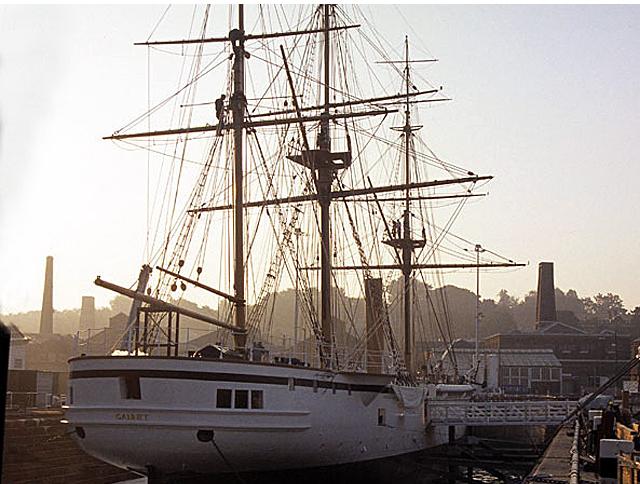
But HMS Gannet was not, as a casual reader might guess, employed against the trade of slaves from Africa to the New World, and since it was built in 1878, it has nothing to do with Lincoln or slavery in the United States. It sailed the Mediterranean and the Red Sea, patrolling against Islamist slavers. In the Red Sea, the Africans it saved would have come, among other places, from Kenya. Obama has made mention of his grandfather's antipathy to Britain, stemming from his experiences in colonial Kenya. It is quite possible that grandfather's ancestors would, had it not been for the Royal Navy, have been carried away to slavery in Arabia.
The British campaign against the slave trade is instructive for another, more important, reason. By volume of business, it was the Foreign Office's most important concern for much of the 19th century. In the courts of Europe and the New World, Britain sought to negotiate effective treaties against the trade. But Britain did not restrict itself to diplomacy. Far too often, treaties were negotiated and then not enforced. Britain's first response to this was usually to negotiate again, but its patience was not infinite,
Then we get to the FbF part - seriously, imagine being on the deck during this action - a little before her time, but what set the purpose for HMS Gannet when she came along.
[In June 1850], British warships entered Brazilian ports to flush out vessels being fitted for the slave trade. The subsequent burning and scuttling of suspected slave ships, and exchanges with coastal batteries, resulted in a predictable outcry in Brazil, including a call for the government to consider war with Britain. Wiser counsels prevailed, and in the summer of 1850 new legislation placed a comprehensive ban on the importation of slaves and measures for the seizure of vessels fitted for the trade. Unlike previous acts, these provisions were rigorously enforced and within twelve months the Brazilian slave trade was effectively extinct.
...
In short, Britain's campaign against the slave trade combined diplomacy and unilateral force in a highly effective and sustained way. Diplomacy provided legitimacy, but the British were not willing to be bound by treaties that did not bind the other side: if they felt they were being made fools of, they acted. Negotiations were meant to achieve a distinct aim: they were a means of policy, not an end in itself.
How unlike the current administration, which congratulates Hugo Chávez on winning his "dictator for life" referendum, has responded with "utter passivity" to a series of Russian, Pakistani, and Iranian provocations, and which cannot wait to stab Eastern Europe in the back by selling them out on missile defense. Maybe that pen holder is Brown's way of encouraging Obama to show a little of the old-fashioned British spirit, and to recognize that endless negotiations not backed by steel are a mistake if they come at the cost of the nation's values and honor.
Zen. I love history and fact - it clears the mind and brightens the soul. Regardless of today's politics. what a Fullbore action by a Fullbore nation.
As a side-bar, the HMS Gannet is still around - that is her modern day picture on the right and below - and a link to her here.
I think no better picture captures the blinkered mindset of many designing cutting edge weapon systems than the DDG-1000 advertising poster of the last decade. There she is, alone and unafraid - attacking an unpopulated, supine, and defensiveless coast in the tropical regions of Shangri-La. In the real world, it is crowded and messy. Our world is teeming with people and those people go about their business as best they can to feed their families. In most of the world, the coastal regions are full of small boats either plying some trade or attempting to catch what few fish the Chinese left behind. In those waters, we plan to send out unmanned systems. Have we in any way designed them to hide themselves, defend themselves, or at least evade? Once again, it appears not. As reported by Ben over at USNINews;
Houthi forces have captured a U.S. Navy research unmanned underwater vehicle off the coast of Yemen, according to a video released on Monday.
In the video posted online by local media on Monday, four men described as members of the “Houthi Navy” in dive gear are surrounding what appears to be a REMUS 600 UUV with the name “Smokey” printed on the body. According to the AMN News web posting, the Houthis discovered the UUV within the past week somewhere off the coast of Yemen.
Good googly moogly - as the below video shows, we even have it painted in "capture me yellow."
Go east old alliance. The ground and air parts of NATO have already moved their lines east towards the bear - but on the maritime side of the house we don't even have our old lines of defense ready. What do we need to do and where do we need to go? I'm pondering over at USNIBlog. Come on by.
If there is a bill sponsored by Senators Feinstein and Leahy, and it involves the military, you pretty much know what direction it is going in;
In April of this year (2017), Feinstein and Sen. Patrick Leahy, D-Vt., introduced the Cluster Munitions Civilian Protection Act to bind the Defense Department to the 1 percent maximum failure rate for cluster bomb detonation. It is also intended to put the U.S. on the path toward compliance with the Convention on Cluster Munitions.
No, it is designed to remove a capability the US needs to win in future conflicts without funding a replacement capability. The push against cluster munitions has a long history, and the concerns are valid.
The Convention on Cluster Munitions, an international treaty, prohibits the use or stockpiling of this weapon. Significantly, Russia, China, North Korea, and Iran have not ratified the treaty.
The George W. Bush administration, recognizing the continuing importance of cluster munitions to U.S. defense needs, also refused to sign the treaty, but set a deadline of 2018 for the U.S. to move to cluster munitions with a very high degree of reliability.
This policy sought to eliminate cluster bombs whose sub-munitions detonate less than 99 percent of the time. This reduces the risk that unexploded ordnance poses to noncombatants.
There is another need out there that is of more importance than feeling good among the well-healed at Davos; in time of war, we will need cluster munitions. That capability is essential to how we fight wars agains numerically superior ground forces. Until we have enough war reserve to cover the capability clusters bring - especially in a GPS contested environment - we need to keep them.
The Pentagon has cluster munitions that meet this degree of reliability, the Sensor Fuzed Weapon, for example, but its large stockpiles of legacy cluster munitions would be useless at the 2018 deadline as legacy munitions do not meet that standard.
Though the 2018 deadline was set 10 years ago, the Obama administration showed no urgency in developing adequate replacements.
Today, those replacements are still under development. The military therefore took the only viable course of action by delaying the ban and keeping this weapon, while continuing to work toward developing new munitions that pose no risk of leaving any unexploded ordnance.
If the West is going to lean on the USA to provide the bulk of its combat power in case of significant conflict - which it does - then serious nations abroad, and serious leaders here, need to give our nation the room it needs to be ready. If Feinstein and Leahy are really that concerned, then they should have sponsored a bill back when their party was in power in both the legislative and executive branches of government to fully fund a replacement. Of course, they didn't because that would not signal their brand of virtue. Given the resources it has been provided, as Thomas Wilson and James Di Pane outline, the military has done the best as could be expected;
...most critiques of the Pentagon’s compromise policy ignore the fact that it now requires new purchases of cluster munitions to either have a less than 1 percent failure rate, or have self-destruct mechanisms that will be triggered after firing.
The Pentagon’s new policy has not, therefore, departed from the original goal of designing safer and more reliable cluster munitions. The policy rightly allows the U.S. military to maintain the capabilities necessary to counter masses of conventional forces should a future wartime scenario require it.
This is a prudent and defensible approach. The United States has used cluster munitions sparingly in recent decades, but they could be vital in a military situation involving large concentrations of conventional forces.
It would be reckless to destroy a valuable and well-established asset before its replacement is deployed.
Serious people will come up with serious alternatives - but that takes money and an understanding that war is a nasty and destructive business. If you want more scoped nastiness and destructiveness, then provide resources. If all you do is take away capabilities, all you really do is signal your willingness to sacrifice the lives of your countrymen tomorrow for you to be able to feel good about your self-righteousness today.
Remember how 2017 was supposed to be the year where everything went off the rails? When Trump's election had everyone who didn't vote for him, and some who did, in a funk? Look around you. 2018 is here and we are remarkably well. The Long War is not getting worse. The economy is the best its been in a decade. Sure, you can pick around the edges for some not so great stuff, but the bold faced items are more than not OK. Regardless if you give this politician or political party no, some, partial or all credit - it does not matter. Take some time and simply enjoy the fact that you are alive in one of the best times in human history. Last week, Jonah Goldberg said it well;
If you were hovering above Earth looking to be born randomly into any time period in human history, you’d pick now if you had any brains. And if you could pick a place, you’d pick a Western liberal democracy, and probably the United States of America (though as much as it pains me to say it, you wouldn’t be crazy to pick Canada or the U.K. or Holland). Sure, if you could pick being rich, white, and male — and didn’t really care too much about the plight of others — you might take the 1950s. But even then, your choices for food, entertainment, etc. would be terribly curtailed compared to today. If you chose to be a billionaire in 1917, you could still die from a minor infection, and good Thai food would be entirely unknown to you. You’d certainly never enjoy watching a Star Wars movie on an IMAX screen in air conditioning. In other words, while your homes would be bigger and cooler if you were a billionaire in 1917, a typical orthodontist in Peoria in 2017 is in many respects much richer than a billionaire a century earlier. Still, that’s not the deal on offer. You have to buy an incarnation lottery ticket, and the results would be random. I’m not big on dividing people up by abstract categories, and I certainly don’t mean them to be pejorative. But as a historical matter, being born poor, gay, black, Jewish, ugly, weird, handicapped, etc. today may certainly come with some problems or challenges, but on the whole those traits are less of a shackle or barrier than at any time in the past. The only trait where I think it might be a closer call is dumbness. All other things being equal, a not-terribly-intelligent person with a good work ethic and some decent values might have had more opportunities before machines replaced strong backs. But even here, I can think of lots of exceptions.
As I bask in my day off doing a bunch of nothing, I will try to keep that in mind as I look forward to 2018. Sure, the wheels may come off at some point - but they probably won't any time soon. I've done all I can do, so why not enjoy the good while it is here? The bad times will come back - they always do - but for now, it is time to enjoy. Here's to what I hope, for you and me and ours, will be a great year.