
I'm pondering over at USNIBlog if you'd like to stop by and give it a read.


A suicide bomber drove a motorcycle into a joint convoy of U.S., NATO and Afghan forces on Monday, blowing himself up and killing six Americans, a brutal sign of deteriorating security in a region where Western troops are trying to help locals overtake the Taliban.Why? Because they can - and because the need to continue to have us bleed.
The explosion marked the deadliest day for American troops in Afghanistan since an October helicopter crash, and the worst attack on Americans since six died in a July 2012 roadside bombing, according to the website iCasualties.
The Taliban overran a strategic district in Helmand the same day the deputy governor warned that the southern Afghan province was in danger of collapsing. Sangin District fell to the Taliban despite the involvement of US and British special operations forces as well as US air support in the province.It gets worse. Though they are doing well, the Taliban are probably looking at the need for a branch plan because there is an unexpected by-product from other fecklessness via the US national security decision making leadership.
Afghan officials confirmed that the Taliban overran the Sangin district center and seized control of all of its administrative buildings and the police headquarters over the past 24 hours, Pajhwok Afghan News reported. An estimated 150 Afghan policemen retreated from the district center to a different area and remained surrounded by the Taliban. A member of Afghanistan’s parliament told the news agency that all police and military bases in Sangin are now under the Taliban’s control.
The Taliban has targeted Sangin for takeover since mid-2014. By August 2014, the situation in the district had deteriorated so dramatically that the Afghan military was negotiating with the Taliban to avoid being ejected from its administrative center. Last month, 65 Afghan soldiers and several of their officers in Sangin laid down their weapons and surrendered to the Taliban after their outpost was besieged for weeks without receiving reinforcements or supplies.
The Taliban seized control of Sangin the same day that Mohammad Jan Rasulyar, Helmand’s deputy governor, issued a plea for President Ashraf Ghani to take immediate action in the province. Rasulyar made his dramatic statement in a post on Facebook.
“Your Excellency, Helmand is standing on the brink and there is a serious need for you to come,” Rasulyar wrote, according to Reuters.
Rasulyar also issued a scathing indictment of the Afghan government, the military, and the international coalition, all of which have failed to support Helmand’s troops and policemen in the field.
“We don’t provide food and ammunition to our forces on time, do not evacuate our wounded and martyred soldiers from the battle field, and foreign forces only watch the situation from their bases and don’t provide support,” he wrote.
Rasulyar claimed 44 soldiers and policemen were killed in the fighting in Sangin, and another 90 were killed during recent fighting in Gereshk, a town in Nahr-i-Sarraj district that is in danger of falling to the Taliban. He explained that such high casualties are commonplace.
Islamic State militants are gaining a foothold in Afghanistan’s Nangarhar Province, stoking concern among U.S. military leaders and fundamentally changing the nature of the insurgency here, top defense officials said.SECDEF is giving you happy talk ... seriously, that is the positive spin. There is more info out there;
Defense Secretary Ash Carter on Friday made an unannounced visit to this remote base, one of the primary U.S. military outposts in eastern Afghanistan and one of the few slated to remain open indefinitely in this war-torn nation.
Carter came to talk with some of the 500 U.S. troops deployed here and to meet with senior military leaders for an up-close update on the mission during the wintertime fighting lull. It was one of his last stops on a week-long trip across the U.S. Central Command area of operations, where he is talking to commanders on the ground about progress in the fight against the Islamic State group.
Carter warned that Afghanistan faces many extremist and insurgent threats that include the Taliban, the remnants of al-Qaida, and most recently the Islamic State group, also known as ISIS, ISIL or D’aesh.
“They are trying to create little nests wherever they feel there is an opportunity,” Carter said of ISIS. “We have some information that suggests they seem to find an opportunity here in Nangarhar. That is really good information to have because it will allow us to focus our efforts on what they are doing in Nangarhar and make sure they don’t have a nest here.”
Malaika, vigorous in her late 50s, is one of three women who decided to stay behind to try to keep their homes.So much that we did - and the core of the very doable "Shape Clear Hold Build" strategy that we had set up was all designed to avoid what is now happening.
“The poor woman is guarding the windows and the planks of the two rooms that remain,” her husband, Mullah Jan, said last month. Mr. Jan was held by the militants for two months until he paid them $500 ransom. “We had 10 goats and one cow. They took all of it.”
Dr. Joanne Liu, the president of Doctors Without Borders, spoke on Wednesday in Geneva.Obama Issues Rare Apology Over Bombing of Doctors Without Borders Hospital in AfghanistanOCT. 7, 2015
When reports began emerging last year that some Afghan militants had shifted their allegiance to the Islamic State, also known as ISIS or ISIL, the government and international response remained measured. Experts noted that in Afghanistan, the Islamic State represented more of a splintering of the Taliban than a major expansion of the core group out of Syria and Iraq.
...
But even as the Taliban are winning major victories against the government this year, including a 15-day takeover of Kunduz, they are not exerting monolithic control. The Islamic State has made major inroads in turf battles against Taliban commanders, particularly in places in Nangarhar Province like the Maamand Valley. And the result, rather than weakening the overall insurgency, has mostly been to inflict more chaos and misery for Afghan civilians.
The people in eastern Afghanistan were not sure what to make of it at first. To them, the shaggy-haired militants were largely the same old Taliban under a new black flag.
But one big difference soon became obvious: The fighters were suddenly flush with cash. Rumors circulated that they were paying a signing bonus of $400 to $500,...
The provincial deputy director for the Refugees and Repatriation Ministry, Ewaz Khan Basharat, said initial data showed that more than 17,000 families in Nangarhar had been displaced by the new group’s violence. Other officials and tribal elders estimate that the number is much higher.We are at the point that it would have been better had we done nothing. All that was gained was thrown away and now we will just sit here and watch all the blood and treasure that we and our allies invested just fade in to fetid, pink mist.
Some of the worst atrocities have been reported in Achin District, where the Maamand Valley and Malaika’s village, Bagh, are.
The raiders demanded that villagers in the district submit a list of widows and unmarried girls. In some parts, they declared that marriages that had happened under government recognition were suddenly invalid, according to Zaiullah Amaray, a member of the Nangarhar Provincial council. At first, women were allowed to leave the house in burqas, but then were told not to leave at all.
“They said, ‘If anyone has young women or widows, we want to marry them off,’ ” recalled Aslam Jan, 60, who finally fled Achin this summer after decades of weathering every intrusion to come through. “The Russians invaded, I didn’t leave my home. The Americans invaded, I didn’t leave,” he said. “We had held up through everything. But we couldn’t give up our children.”
Early one evening in Bagh, Islamic State fighters marched dozens of elders up a mountain, where most of them remained captive for two months on charges of helping the Taliban and trying to rally a fight against the Islamic State. About two weeks in, 10 of them — including Malaika’s brother-in-law, Mohamed Younus — were taken to a lush hillside. More fighters arrived on horseback and began digging a large trench that was lined with explosives. The prisoners, hands tied and eyes covered, were herded in.What can be done at this point?
Their last moments, and the aftermath of the explosion that killed them, were captured by the militants’ video cameras from at least three angles. Two fighters can be seen igniting a long fuse at each of its ends before running out of the frame. A huge blast sends flesh and dirt flying against the camera lenses.
The Islamic State brutality in Achin was so extreme that some local Taliban commanders surrendered to the government, and some moved their families to displacement camps in government-controlled areas.
One man there, Laal Zaman, 55, said he had been with the Taliban “from the beginning.” But he insisted that his cell of the insurgency remained local, his guns strictly aimed against foreign forces. Even as he fought the international coalition, he said, four of his sons served in the Afghan Army in the country’s south.
Now, Mr. Zaman says he is doubly a target for the Islamic State: for being Taliban, and for having sons who are soldiers.

What accounts for the failure of ‘The War on Terror’ and associated efforts to counter the spread of violent extremism? The failure starts with reacting in anger and revenge, engendering more savagery without stopping to grasp the revolutionary character of radical Arab Sunni revivalism. This revival is a dynamic, countercultural movement of world-historic proportions spearheaded by ISIS, (the Islamic State of Iraq and Syria, also known as ISIL, or the Islamic State of Iraq and the Levant). In less than two years, it has created a dominion over hundreds of thousands of square kilometres and millions of people. And it possesses the largest and most diverse volunteer fighting force since the Second World War.Exactly. We continue to look at this from a Western point of view. Worse yet, from a Western faculty lounge point of view.
What the United Nations community regards as senseless acts of horrific violence are to ISIS’s acolytes part of an exalted campaign of purification through sacrificial killing and self-immolation: Know that Paradise lies under the shade of swords, says a hadith, or saying of the Prophet; this one comes from the Sahih al-Bukhari, a collection of the Prophet’s sayings considered second only to the Qu’ran in authenticity and is now a motto of ISIS fighters.
Although attacked on all sides by internal and external foes, the Islamic State has not deteriorated to any appreciable degree, while rooting ever stronger in areas it controls and expanding its influence in deepening pockets throughout Eurasia and Africa. Despite recent White House reassurances, US intelligence tells us that ISIS is not being contained. Repeated claims that ISIS is being degraded and on the way to inevitable defeat ring hollow for almost anyone who has had direct experience in the field. Only Kurdish frontline combatants and some Iranian-led forces have managed to fight ISIS to a standstill on the ground, and only with significant French and US air support.I feel the need to just put this out there at the end of 2015 - this is nothing new. Many of us have been trying to get everyone to understand what this was all about well over a decade before ISIS/ISIL/Daesh even existed. We should take it as a victory that more and more are coming around to it - but when will they accept the next cards under the deck?
Despite our relentless propaganda campaign against the Islamic State as vicious, predatory and cruel – most of which might be right – there is little recognition of its genuine appeal, and even less of the joy it engenders. The mainly young people who volunteer to fight for it unto death feel a joy that comes from joining with comrades in a glorious cause, as well as a joy that comes from satiation of anger and the gratification of revenge (whose sweetness, says science, can be experienced by brain and body much like other forms of happiness).
...
What the ISIS revolution is not, is a simple desire to return to the ancient past. The idea that ISIS seeks a return to medieval times makes no more sense than the idea that the US Tea Party wants to return to 1776.
In our liberal democracy, intentional mass bloodshed is considered evil, an expression of human nature gone awry. But across most of human history and cultures, violence against other groups was considered a moral virtue, a classification necessary for killing masses of people innocent of harming others.Over-reaction comes from panic. Panic spreads due to one primary cause; poor leadership.
Besides, brutal terror scares the hell out of enemies and fence-sitters. Kurdish leaders told my research group that when 350-400 Islamic State fighters came in a convoy of some 80 trucks to free Sunni captives (and massacre more than 600 Shia inmates) from Badoush prison in Iraq’s second largest city Mosul, a relatively well-equipped Iraqi army of some 18,000 troops under US-trained leaders immediately disappeared or ran away. When I asked one Arab Sunni soldier embedded with a Kurdish Peshmerga force on the Mosul-Erbil front why fellow soldiers fled, he simply said: ‘They wanted to keep their heads.’
The shutdown of Brussels in the wake of the Paris attacks, or of Boston in the aftermath of the marathon bombings in 2013, speaks to a comparable fear, and contributes to an underlying lack of faith in our own societies and values, something that terror attacks are designed to promote. During the Second World War, not even the full might of the German Luftwaffe at the height of the Blitz could compel the UK government and the people of London to cower so. Today, mere mention of an attack on New York in an ISIS video has US officials scurrying to calm the public. Media exposure, which is the oxygen of terror in our age, not only amplifies the perception of danger but, in generating such hysteria, makes the bloated threat to society real.
This is especially true today because the media is mostly designed to titillate the public rather than inform it. Thus, it has become child’s play for ISIS to turn our own propaganda machine, the world’s mightiest, into theirs – boosting a novel, highly potent jujitsu style of asymmetric warfare that we could counter with responsible restraint and straight-up information, but we won’t.
The outcome is dangerous and preposterous. The US Justice Department, with overwhelming support from Congress and the media, now considers the common kitchen pressure cooker to be a ‘weapon of mass destruction’ if used for terrorism. This ludicrously levels a cooking pot with a thermonuclear bomb that has many billions of times greater destructive power. It trivialises true weapons of mass destruction, making their acceptance more palatable and their use more conceivable. In this present hyperreality, messaging is war by other means. ISIS’s manipulation of our media creates a sense of foreboding of mass destruction where it isn’t really possible, and at the same time obscures any real future threat.
Asymmetric operations involving spectacular killings to destabilise the social order is a tactic that has been around as long as recorded history. Violent political and religious groups routinely provoke their enemies into overreacting, preferably by committing atrocities to get the others to drive in the sheep and collect the wool.
The chasm between values is compounded by alternate historical arcs. The West and the Arab and Muslim world have long lived mostly separate and parallel histories. In the West, people generally believe history began with Ancient Sumeria around the 26th Century BCE. Centred in the southern part of modern-day Iraq, Sumeria was birthplace to written law and literature, and to Abraham and his monotheistic creed. Civilisation then moved west to Greece and Rome. After the fall of Rome, came the Middle Ages, the Renaissance, the Industrial Revolution and the Enlightenment, the first political revolutions, the world wars and the Cold War. Human rights and democracy became triumphant and seemingly inevitable.Ideas matter. Your ideas, and the ideas of the enemy. In a war of ideas, how much is offence, how much is defense. What can be done if only one side is fully engaged in both?
The Arab and Muslim world also begins with Sumeria but, until the world wars, Rome, Greece and the rest were peripheral. Christian Europe was the dark continent; Muslim heroes, myths, legends and references were all basically different. Sure there is Moses and Alexander and Jesus, but their profiles in Islam are distinct: Musa’s (Moses’s) life paralleled Mohammed’s and foretold the Prophet’s coming; Iskandar (Alexander) or Dhul-Qarnayn (Arabic for ‘The Two-Horned One’) was a religious figure to whom Allah gave great power and the ability to build a wall of civilisation to provisionally keep out the forces of chaos and evil. And Isa, or Jesus, was Allah’s righteous messenger, not his son, who did not die on the cross but, like Mohammed, was raised to heaven.
All of the European political imports and even nationalism itself (except maybe for Turkey, Egypt and Iran, which are still more built around ethnicity and faith than national identity per se) have failed in the Middle East, and miserably so. People are longing for something in their history, in their traditions, with their heroes and their morals; and the Islamic State, however brutal and repugnant to us and even to most in the Arab-Muslim world, is speaking directly to that.
As I told the UN Security Council this spring, what inspires the most lethal assailants in the world today is not so much the Quran or religious teachings but rather a thrilling cause and a call to action that promises glory and esteem in the eyes of friends. Foreign volunteers for the Islamic State are often youth in transitional stages in their lives – immigrants, students, people between jobs and before finding their mates. Having left their homes, they seek new families of friends and fellow travellers to find purpose and significance.Another item we simply refuse to address seriously - the role of the Saudi monarchy in promoting this radicalization. Decades ago, it was Saudi money that sponsored mosques throughout the Western world, exporting the Wahhabi and Salafist radicalism with it;
France’s Centre for the Prevention of Sectarian Drift Related to Islam estimates that 80 per cent come from non-religious families; West Point’s Center for Combating Terrorism finds that their average age is 25. For the most part, they have no traditional religious education and are ‘born again’ to religion through the jihad. About one in four, often the fiercest followers, are converts. Self-seekers who have found their way to jihad reach out through private gatherings or the internet. They might be people who feel uncomfortable with binge-drinking or casual sex, or have seen their parents humiliated by employers or the government, or their sisters insulted for wearing a headscarf. Most do not follow through to join the jihad, but some do. More than 80 per cent who join the Islamic State do so through peer-to-peer relationships, mostly with friends and sometimes family. Very few join in mosques or through recruitment by anonymous strangers.
Adherents of this pure Caliphate are violently opposed to the idea of greater jihad as an inner spiritual struggle. They consider this bogus notion of jihad to be the heart of the Sufi heresy introduced in the later Abbasid Caliphate, which corrupted the pure Arab-led form of the Caliphate and led to its decay and downfall.The seeds bore fruit.
At the East Asia summit in Singapore last April, some people insisted that the Caliphate was nothing more than a myth masking traditional power politics. Our research in Europe and North Africa shows this to be a dangerous misconception. The Caliphate has re‑emerged as a mobilising cause in the minds of many Muslims, and even has some appeal to Muslims who favour interfaith cooperation. ‘I am against the violence of Al‑Qaeda and ISIS,’ said an imam in Barcelona who helps to run an interfaith dialogue initiative with Christians and Jews, ‘but they have put our predicament in Europe and elsewhere on the map. Before, we were just ignored. And the Caliphate… We dream of it like the Jews long dreamed of Zion. Maybe it can be a federation, like the European Union, of Muslim peoples. The Caliphate is here, in our hearts, even if we don’t know what real form it will finally take.’
‘The Extinction of the Grayzone’, a 12-page editorial published in ISIS’s online magazine Dabiq in early 2015, describes the twilight area occupied by most Muslims between good and evil – in other words, between the Caliphate and the Infidel, which the ‘blessed operations of September 11’ brought into relief. The editorial quotes Osama bin Laden, for whom ISIS is the true heir: ‘The world today is divided. Bush spoke the truth when he said, “Either you are with us or you are with the terrorists”’, with the actual ‘terrorist’ being the Western Crusaders. Now, ‘the time had come for another event to… bring division to the world and destroy the Grayzone.’No center is their goal. What are we doing to grow the Grayzone?
Civilisations rise and fall on the vitality of their cultural ideals, not their material assets alone. History shows that most societies have sacred values for which their people would passionately fight, risking serious loss and even death rather than compromise. Our research suggests this is so for many who join ISIS, and for many Kurds who oppose them on the frontlines. But, so far, we find no comparable willingness among the majority of youth that we sample in Western democracies. With the defeat of fascism and communism, have their lives defaulted to the quest for comfort and safety? Is this enough to ensure the survival, much less triumph, of values we have come to take for granted, on which we believe our world is based? More than the threat from violent jihadis, this might be the key existential issue for open societies today.History does not always progress. The future belong to those who show up and fight for it.
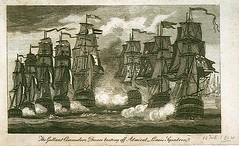
During the Napoleonic Wars, the British economy depended on its ability to trade with the British Empire, particularly the valuable colonies in British India. The intercontinental trade was conducted by the governors of India, the Honourable East India Company (HEIC), using their fleet of large, well armed merchant vessels known as East Indiamen. These ships weighed between 500 long tons (508 t) and 1,200 long tons (1,219 t) and could carry up to 36 guns for defence against pirates, privateers and small warships. They were not, however, capable under normal circumstances of fighting off an enemy frigate or ship of the line. Their guns were usually of inferior design, and their crew smaller and less well trained than those on a naval ship.
The East Indiamen sought to ensure the safety of their cargo and passengers, not defeat enemy warships in battle. Despite these disadvantages, the size of East Indiamen meant that from a distance they appeared quite similar to a small ship of the line, a deception usually augmented by paintwork and dummy cannon. The East Indiamen would gather at ports in India and the Far East and from there set out for Britain in large convoys, often carrying millions of pounds worth of trade goods.
The journey would usually take six months and the ships would subsequently return carrying troops and passengers to augment the British forces stationed in India. "Country ships", smaller merchant vessels chartered for local trade, sometimes independently from the HEIC, would often join the convoys. To protect their ships from the depredations of pirates, the HEIC also operated its own private navy of small armed vessels. In combination, these ships were an effective deterrent against smaller raiders, but were no match for a professional warship.What was Commodore Dance working with?
Understanding the importance of the Indian Ocean trade and seeking to threaten it from the start of the inevitable war, First Consul Napoleon Bonaparte ordered a squadron to sail for India in March 1803. This force was under the command of Contre-Admiral Charles-Alexandre Durand Linois and consisted of the ship of the line Marengo and three frigates.
The China Fleet was a large annual British merchant convoy that gathered at Canton in the Pearl River during the winter before sailing for Britain, via India. As the convoy passed through the East Indies, it was joined by vessels sailing from other European ports in the region on the route to India, until it often numbered dozens of ships. The 1804 fleet departed in late January, and by the time it reached the approaches to the Strait of Malacca it had swelled to include 16 East Indiamen, 11 country ships, a Portuguese merchant ship from Macau and a vessel from Botany Bay in Australia.
Although the HEIC had provided the small, armed brig Ganges as an escort, this vessel could only dissuade pirates; it could not hope to compete with a French warship. There was no military escort: news of the outbreak of war had reached Canton before reinforcements had arrived from the squadron in India. Spies based in Canton had passed the composition and date of departure of the China Fleet to Linois in Batavia, and he set out to intercept it. However, Dutch informants at Canton had also passed on false reports that Royal Navy warships were accompanying the convoy, reports that may have been deliberately placed by British authorities.
The convoy was an immensely valuable prize, its cargo of tea, silk and porcelain valued at over £8 million in contemporary values (the equivalent of £541,000,000 as of 2009). Also on board were 80 Chinese plants ordered by Sir Joseph Banks for the royal gardens and carried in a specially designed plant room.
The HEIC Select Committee in Canton had been very concerned for the safety of the unescorted convoy, and had debated delaying its departure. The various captains had been consulted, including Henry Meriton, who in his ship Exeter had captured a frigate during the Action of 4 August 1800, a disastrous French attack on a convoy of East Indiamen off Brazil. Meriton advised that the convoy was powerful enough in both appearance and reality to dissuade any attack. He was opposed by John Farquharson of Alfred, who considered that the crews of East Indiamen were so badly trained that they would be unable to mutually defend one another if faced with a determined enemy.
Eventually the Committee decided that it could delay the convoy no longer and awarded command to the most experienced captain, Commodore Nathaniel Dance in the East Indiaman Earl Camden, an officer of over 45 years service at sea.Not perfect - not even good; but what does a leader do? Improvise, adapt - overcome.
Dance had been taken seriously ill at Bombay during the outward voyage, but had recovered in time to sail with the convoy. The fleet did not have any naval escorts, and though the East Indiamen were heavily armed for merchants, carrying nominal batteries of between 30 and 36 guns, they were no match for disciplined and professional naval forces. Not all of their listed armament was always carried, but to give the illusion of greater strength, fake gunports were often painted on the hulls, in the hope of distant observers mistaking them for 64-gun ships of the Royal Navy...Maneuver and Deceive...
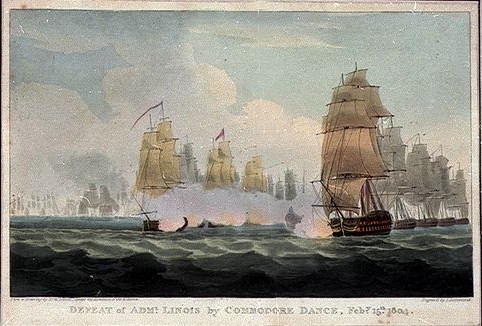
At dawn on 15 February, both the British and French forces raised their colours. Dance hoped to persuade Linois that his ships included some fully armed warships and he therefore ordered the brig Ganges and the four lead ships to hoist blue ensigns, while the rest of the convoy raised red ensigns. By the system of national flags then in use in British ships, this implied that the ships with blue ensigns were warships attached to the squadron of Admiral Rainier, while the others were merchant ships under their protection. Dance was unknowingly assisted by the information that had reached Linois at Batavia, which claimed that there were 23 merchant ships and the brig in the convoy. Dance had collected six additional ships during his journey, and the identity of these were unknown to the French, who assumed that at least some of the unidentified vessels must be warships, particularly as several vessels had been recently painted at Canton to resemble ships of the line.
At 09:00 Linois was still only observing the convoy, reluctant to attack until he could be sure of the nature of his opponents. Dance responded to the reprieve by reforming the line of battle into sailing formation to increase his convoy’s speed with the intention of reaching the Straits ahead of Linois.
With the convoy a less intimidating target, Linois began to slowly approach the British ships. By 13:00 it was clear that Linois's faster ships were in danger of isolating the rear of the convoy, and Dance ordered his lead ships to tack and come about, so that they would cross in front of the French squadron. The British successfully executed the manoeuvre, and at 13:15 Linois opened fire on the lead ship, Royal George, under the command of John Fam Timmins.
The Royal George and the next four ships in line, the Indiaman Ganges, Dance's Earl Camden, the Warley and the Alfred, all returned the fire, Ganges initially attacking the Royal George in error. Captain James Prendergrass in Hope, the next in line, was so eager to join the battle that he misjudged his speed and collided with Warley, the ships falling back as their crews worked to separate their rigging. Shots were then exchanged at long range for 43 minutes, neither side inflicting severe damage.
Royal George had one man killed: a sailor named Hugh Watt, another man wounded, and suffered some damage to her hull. None of the other British ships or any of the French reported anything worse than superficial damage in the engagement.
At 14:00, Linois abandoned the action and ordered his squadron to haul away with the wind and sail eastwards, away from the convoy, under all sail. Determined to maintain the pretence of the presence of warships, Dance ordered the ships flying naval ensigns, including his flagship Earl Camden, to chase the French. None of the merchant ships could match the French speed, but an attempt at a chase would hopefully dissuade the French from returning.
For two hours, Dance's squadron followed Linois, Hope coming close to catching Aventurier but ultimately unable to overtake the brig. At 16:00, Dance decided to gather his scattered ships and return to his former heading rather than risk attack from other raiders or lose sight of his convoy in the darkness. By 20:00, the entire British convoy had anchored at the entrance to the Straits of Malacca. On 28 February the British ships of the line HMS Sceptre and HMS Albion joined them in the Strait and convoyed them safely to Saint Helena in the South Atlantic, from where the convoy returned to Britain without further incident.The attitude and conduct of the French Admiral is telling as an example of how not to fight war at sea.
The French admiral later attempted to explain his conduct during the engagement:That is pathetic.
The ships which had tacked rejoined those which were engaging us, and three of the engaging ships manoeuvred to double our rear, while the remainder of the fleet, crowding sail and bearing up, evinced an intention to surround us. By this manoeuvre the enemy would have rendered my situation very dangerous. The superiority of his force was ascertained, and I had no longer to deliberate on the part I should take to avoid the consequence of an unequal engagement: profiting by the smoke, I hauled up to port, and steering east-north-east, I increased by distance from the enemy, who continued the pursuit of the squadron for three hours, discharging at it several broadsides.
—Linois, quoted in translation in William James' The Naval History of Great Britain during the French Revolutionary and Napoleonic Wars, Volume 3, 1827,
Placed, by the adventitious circumstances of seniority of service and absence of convoy, in the chief command of the fleet intrusted to my care, it has been my good fortune to have been enabled, by the firmness of those by whom I was supported, to perform my trust not only with fidelity, but without loss to my employers. Public opinion and public rewards have already far outrun my deserts; and I cannot but be sensible that the liberal spirit of my generous countrymen has measured what they are pleased to term their grateful sense of my conduct, rather by the particular utility of the exploit, than by any individual merit I can claim.

The US Navy's fight to buy 52 variants of its littoral combat ship (LCS) from two shipbuilders may have taken a fatal blow this week after the secretary of defense directed the service to cap its buy at 40 ships and pick only one supplier. The directive also orders the Navy to buy only one ship annually over the next four years, down from three per year.I owe Ash Carter another beer. This isn't PLAN SALAMANDER, but this a compromise that I can live with. Fewer is better. He seems to understand sunk cost more than most. Good. It looks like we are going to do something more useful with the money.
Defense Secretary Ash Carter, in a Dec. 14 memo to Navy Secretary Ray Mabus, told the Navy to "reduce the planned LCS/FF procurement from 52 to 40, creating a 1-1-1-1-2 profile, for eight fewer ships in the FYDP, and then downselect to one variant by FY 2019."
Carter, in the Dec. 14 memo, directs the Navy to reallocate savings from the LCS/FF cuts to buy more F/A-18 and F-35 aircraft, more SM-6 surface-to-air missiles, and support Virginia Payload Module (VPM) development for future Virginia-class submarines.Read all of Chris Cavas's article at DefenseNews - but now I'm going to rage a little against the machine, if you would be so kind to indulge me in a little self-serving preening as well;
The directive to cut the LCS comes in the face of strenuous Navy objections. The service has argued that building a ship takes much longer than ordering a new aircraft or missile.Well Big Navy, this is your fault, Shipmate. You elected to create a "too big to fail" shipbuilding program that had no Plan-B when LCS proved what people started to say over a decade ago. You did that in order to meet you own selfish career goals - the needs of the warfighter be damned. You decided to throw more money and hard work of Sailors at a program that was known to be a failure by everyone you refused to listen to. No, scratch that - those you eliminated from the conversation.
"It's unfortunate that we find ourselves in this situation, because the Navy needs both an increase in ship numbers and a bump in warfighting capability," the defense official said Dec. 16. "In this case there is no right or wrong answer."What does that second part even mean? Sh1t or get off the pot. We don't just need numbers (however, the reason we have Commanders commanding warships of 100+/- has everything to do with CDR Command numbers so the surface community can make more CAPT) we need numbers that can do something besides feeding money into a corrupt military industrial complex. Making CDR Commands and creating as little bang for the most buck? Sure, LCS is C1 in those two Primary Mission Areas.
The Navy has long argued it needs ship numbers to keep up worldwide posture and presence. The fleet today stands at 272 ships, but the latest fleet plan shows a rise to 308 ships in the 2020s. The LCS fleet is a major component in keeping to that goal.A single barely partially mission capable LCS cannot even conduct presence OPS without hundreds of support staff in foreign ports - and one LCS is about as imposing as a USCG medium endurance cutter; and has a worse paint job. It's posture is one of a tubercular asthmatic. It couldn't even fight against a WWII Q-Ship.
Two years ago, the Navy fought hard to fend off LCS cuts. Mabus personally made his case to Hagel to beat back acting defense under secretary Christine Fox's attempt to cut the program. Mabus saved the ships, but Hagel countered with a directive to develop a more heavily armed frigate version. The Navy is working through decisions of the frigate variant, and is expected to make some of those details public in the president's 2017 budget submission to Congress.We should all have a small shrine to Christine Fox. The fact that she does not have Mabus's job should make us all weep for our collective loss.
The Pentagon's Office of Cost Assessment and Program Evaluation (CAPE) also has repeatedly evaluated the program, often proposing alternative designs. At one point, CAPE reportedly favored a version of Norway's 5,400-ton Spanish-designed Fridtjof Nansen-class missile frigates fitted with a lightweight Aegis combat system.Oh really, Nansen eh? Isn't that cute? That was called for first ... when was it? That is right, over eight years ago.
"In the last two months, the third deck has gone in two directions, generally to cut the program," said the Pentagon source, speaking of Carter's offices on the building's third floor.Of course we are. The message is clear. No one has any confidence in this ship. Why should they?
"In the last year we went through a study to upgrade the ship, make it more capable. Now in CAPE some are arguing for a less-capable hull."
...
Additionally, the Pentagon source said, "the cuts will have industrial base impacts. And we are sending a message to Saudi, for example, of our confidence in the ship."
One political arena where the cuts are likely to quickly reverberate is in the presidential election. Most Republican candidates have cited a shrinking Navy is a critical need that needs to be addressed, and the factually-correct claim that "the Navy is the smallest since it's been since World War I" has become almost a mantra. A Democratic budget that reduces ship numbers is likely to become a lightning rod.You are over thinking it. Done correctly - keeping LCS this long could easily be crafted as an albatross to wrap around the Democrat defense policy leadership - but that isn't what is important.


