Showing posts sorted by date for query NLOS. Sort by relevance Show all posts

Monday, February 07, 2022

The FORD's Helmets-Only Football practice


This is kind of strange and different ... so of course, it is kind of growing on me.

Via Megan Eckstein at Defense News;

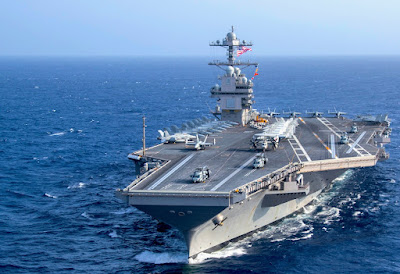
The U.S. Navy has promised a first deployment for its new aircraft carrier Gerald R. Ford by this fall — but that deployment won’t be a typical one, the head of Naval Air Force Atlantic told Defense News.

Ford won’t fall under the operational command of a regional combatant commander. Rather, it will conduct a “service-retained early employment” period where the Navy keeps full control over the ship’s activities and schedule, Rear Adm. John Meier said.

The Navy keeping COCOM hands off their ships for awhile ... good. Nice habit. We should do this more.

The carrier and its strike group will operate on both sides of the Atlantic Ocean alongside a long list of foreign navies, he said. But the operations will be outside the typical Global Force Management-dictated deployment in support of the joint force.

...

Meier told Defense News after the panel that this represented the best way to make use of Ford as it comes out of its first planned incremental availability in 2022, ahead of when the long-range Global Force Management plans begin to incorporate the new carrier. GFM is an approach meant to help oversee the allocation of forces.

Editorial note: in the name of all that is holy, please stop using GFM. For those of us with mild dyslexia, it is way too close to FGM and we have too many acronyms already. That and it sounds excessively bureaucratic. Same vibe as NLOS, NGAG, LSCvsLCS etc.

Under the new plan Meier laid out, the first GFM deployment could take place, roughly, on that 2024 timeline, meaning the Navy would squeeze in an operational employment of the carrier in 2022 without throwing off the joint force plan that dictates ships’ maintenance, training and deployment schedules.

Nice, but here is what I like about it;

Meier told Defense News the new carrier already has about 8,200 catapult launches and arrested landings — or cats and traps — from the extensive time the ship spent at sea in 2020 and 2021 for air wing integration, trials, new pilot carrier qualifications and more. Still, Meier said, the Navy has been unable to fully operate a carrier air wing the way it wants to: doing cyclical operations, with jet wings loaded up with missiles for mission training.

Solid. Just a solid idea as presented. In general, I'm a big fan of giving things to the fleet and let them try to work it. We learn a lot, find out what doesn't work like we thought it would, and as our Sailors always do - once they start to work with it they find things out - good and bad - that no one had thought of or appreciated sufficiently. The results at the end are hard to spin if you have the right leadership mindset and culture. 

We're going to go through the playbook, but at a slightly lower level of effort and with not everything fully testing the ship and our Sailors. Good, just like a pre-game helmets-only football practice. Good.

No downside here. Learn a lot ... and less chance for unnecessary injuries before the big game.


Tuesday, November 28, 2017

So, what do you put in the NLOS void?

One of the many original sins of the LCS program was the assumption that there would actually be a NLOS missile. As such, there is on both classes a void forward where the never was has been NLOS was supposed to be.

As a stop gap - still using the two decades old thinking about what threat is what - ideas have come up to include Hellfire missiles or other short-legged anti-surface options.

Well, we are sneaking up on 2018, and do we really need to worry about the threat that NLOS was supposed to take care of?

What about area denial problems coming from the air? As presently configured, LCS can barely protect itself while doing its best to stay out of the way. RIM-116 RAM/SEA-RAM is a nice bit of kit, but is a last ditch defense.

Let's put to the side how you would support the radar and take a peek at what the Israeli Navy has come up with to take to sea their combat proven IRON DOME system. My guess would be to give some support to their new offshore gas fields.

A proved medium range anti-missile, anti-artillery, "if it flies it dies" capability. A bit more range than RIM-116.

I'd love to give the problem to some good naval architects and engineers and just ask them, "Tell me how you make this work on an LCS using the NLOS void."

Maybe the answer is, "you can't" - but if I were tasked to tool around WESTPAC in one of these Tiffany gunboats, I would not be worried about Boghammars from the Bill Clinton administration.


Tuesday, January 26, 2016

If This is Defending LCS, You're Doing it Wrong

The events of the last year have, in a way, been a Pyrrhic victory for long standing LCS critics. It would have been the best thing for our Navy and its nation if we had been wrong - and as I mentioned years ago, I wished I were proven wrong - but the facts are clear; this sub-optimal platform will saddle our Navy for the next three decades with lost opportunity, China doll deathtraps that will remind everyone of the cost of the Transformationalists' Tiffany Navy.

In the global marketplace of ideas, the verdict is in. No one is trying to replicate the LCS concept. While we have been making excuses during the long, slow rollout of both LCS variants, the Dutch, Danes, Germans, French, Russians and others have commissioned and deployed superior sub-7,000 ton warships that, unlike LCS, are ready to go to war tomorrow. They are very real, self-deployable warships with provable performance metrics that LCS can't seem to get off the PPT.

Other nations' mocking performance in their rollouts do not stop our blinkered LCS advocates who just won't let go. They cannot accept that their beautiful little theory has been destroyed by a rampaging gang of facts and experience.

They yell louder, they call people names, but the facts continue to be what they are.

If you are new here and to the argument against LCS, just click the LCS tag. There is over a decade of commentary here on it - with links that go back even further. A little more than half decade ago when I realized we had moved past the tipping point to execute Plan Salamander and mitigate much of the negative 2nd and 3rd order effects from this snakebit program, I settled on just hoping that with enough time and money, we could salvage something of use from this program.

SECNAV Mabus & SECDEF Carter have helped in the last year. In not letting the perfect be the enemy of the good, most of us had welcomed the stage whisper admission of the failure that led to the redesign of the LCS in to a kind of FF inline with the previous decades LCS-(I) concept, and finally the premature ending of the run. A half-decade late, but a welcome end to the bleeding.

Now, as we have repeated often the last few years, the great effort is to see what can be done to make these ships of some use. You have the Navy you are given, not the one you want.

Does that mean we should stop beating up on LCS/FF? No, not at all. The horrible shortcomings of this program need to be brought out and gibbeted on a regular basis as a warning to future program managers and leaders as to what no to do. It is also needed as now and then, some members of the rapidly decreasing member of the Cult of LCS step out of the shadows and once again try to convince the unwashed masses that LCS is really all that and a box of chocolates. Everyone, you see, are just too stupid, ignorant, or compromised to see its perfection. Have they not seen the PPT? Have they not read the CONOPS? Do they not tasted its awesomesauce?

Well, over at WOTR, our old buddy Steven has dusted off the LCS Tent Revival Handbook to enlighten the heathens. It has kind of a old-timey feel to it, but as the ball is tee'd up, let's grab an old Big Bertha and give a whack at it.

He is a true believer and means well ... but he's wrong, and here's why.

Let's start with the title;
WHY CHOOSE THE LITTORAL COMBAT SHIP? BECAUSE IT IS THE BEST OPTION
What? Is it still 2007? Shipmate, we are way past the "choose" point. The choice was made, measured, found wanting, regretted, and then retracted. By design, at this point it is our only option - and we've already rejected it with seven servings of buyer's regret.

How is that working out for us?
USS Fort Worth, successfully deployed to Singapore in a variety of missions suffered an engineering casualty that appears similar to that of Milwaukee.
Outline all those PMA it performed, ifyoudontmind. "Successful." I'm sorry - is this successful?
The USS Fort Worth, a Navy littoral combat ship, has suffered extensive gear damage while docked at a port in Singapore. The Navy is blaming the incident on a crew error.

According to reports, the crew failed to use sufficient lube oil, leading to excessively high temperatures on the gears. Debris also found its way into the lubrication system, which also contributed to failure, Defense News reports. The crew did not follow standard operating procedures.
I have yet to see a deployment debrief where gross maintenance neglect is in the "successful" slide. Makes for a rough end of tour award write-up.

Silly. Let's see what else is being thrown up against the wall.
The relatively small size of America’s fleet means that a much higher percentage of ships must be forward-based in order to meet demands for both presence and war fighting missions articulated in the 2015 Cooperative Maritime Strategy.
Relative to who? "What" is forward based and "where" is more important than a number, especially in transition to war. For the foreseeable future, LCS will not be able to conduct any more meaningful war fighting missions than the USN gunboats of COMYANGPAT could after Dec. 7th 1941.
The LCS remains the best program to pursue a modular small combatant.
How long do we pursue until we actually achieve? LCS-1 was commissioned ~8 years ago, 1/3 of its service life. I think we have the answer. With the transition to FF, bolt-on ASCM, and truncated production ... I think the pursuit has turned in to acceptance of failure.
The LCS program has been plagued with legitimate problems to be sure, but defense media sources would rather garner headlines for reporting problems such as the Milwaukee and recent Fort Worth engineering problems rather than analyze why the Defense Department and the Navy chose and have retained the LCS concept.
Blaming the messenger is not a way to progress. I'm sorry, but as per the below, this is simply false. If LCS concept was good, there would be no FF, you would get full production, and other navies would be producing their own versions.

LCS is a peacetime concept that has not even met its minimum theoretical wartime utility requirements for ASUW, MIW, or ASW. As long as we don't have to go to war, LCS will do fine. As long as we continue to shovel money and excuses at it, LCS will do fine. As long as we continue to set lower standards for it to meet, LCS will do fine.
The 2015 Cooperative Maritime Strategy states that 300 ships will be required to provide both presence and war fighting capability in forward operating areas.
Well, no, we don't live in that universe. With the huge debt bomb ticking away, land powers of Russian and China stretching, domestic budget requirements expanding, and the need to recapitalize our SSBN fleet ... well, no. We are not going to get as many ships as we want, or for that matter we need. We also should not just go for numbers for numbers sake. That is a false economy.
Given the success of the Fort Worth deployment and the potential capability of its anti-ship missile armament, the LCS supports both presence and warfighting as required by the Cooperative Maritime Strategy.
Everything is "potential" with this class of ships. A bolt-on, non-integrated, high RCS box launcher on deck is better than nothing (a moment of quiet reflection for the wasted space where NLOS was supposed to be), but again ... long range ASCM was not in the LCS CONOPS. That is simply trying to get something out of it - a move I approve of for what is is worth. You can bolt those on anything, so why not LCS?
A Reasonable Price
For what? A self-propelled 57mm gun and some bolt on 1-off weapons? Give me three accountants and they will give me four different cost estimations for each Unicorn Class FMC LCS (including contractor shore support etc), but this is just silly at this stage of the game. If you want to go there, then here is a question. Is it better to have 10 ships that have limited capability or 6 ships that are fully mission capable through their primary mission areas?

Which is better; to buy 10 $1 items that give you $.85 utility, or to buy 5 $2 items that give you $2.2 utility in return?
Intelligence and/or future strategic requirements may suggest a larger frigate than the modified LCS with greater range, but unlike the late 1970s there is no need for an escort with a destroyer’s armament to plug a gap in overall U.S. surface force capabilities.
Actually, intelligence and future strategic requirements already suggest a larger frigate than the modified LCS, and as for convoy escort ... a secondary mission, sure. Who is asking for a primarily designed convoy escort? PEO Strawman would like their job back.
The LCS, through its system of modular capabilities resident on a common hull offers an affordable solution to the problem of how to field multiple low-end capabilities and rapidly and affordably update them over time. Each LCS mission package is an assembly of sensors, weapons, associated equipment, and the sailors needed to operate them. The mission module list currently features surface warfare, antisubmarine warfare and mine warfare packages. An LCS can only support one module at a time. LCS represents a compromise in a common hull for all three missions that it is larger than the MCM and PC units, but smaller than the Perry class frigates it replaces.
Oh just stop. Mission modules remain only PPT deep. None are even close to being ready to deploy, much less prove their worth under operational conditions. Also, LCS-1 is ~85% the displacement of a Perry class frigate, and only 30' shorter.
One wonders how the FFG-7 or DD 963 classes, both labeled as under-armed and unsurvivable, or the excessively expensive AEGIS system would have fared in an Internet age of instant criticism and anonymous condemnation.
ISWYDT. I love when it becomes about me, but back to the game. 

First of all, we need to stop even trying to parallel LCS with OHP, but if you so wish, we can. Eight years in to the Perry class, we had commissioned 50 of them and they were conducting global fleet operations in all mission areas.

For the SPRUCANS, eight years in to the program and all 31 had been commissioned, and ditto performance at sea as the OHP.

TICO? 20 ships and the AEGIS bugs well worked out with refinements ongoing. 
The LCS program represents a reasonable attempt to field a common small combatant that meets present U.S. requirements and fits within the force structure of the 2nd decade of the 21st century. Its cost remains significantly lower than other proposed solutions from the analysis community. It has suffered unremitting criticism from an analysis community unhappy with the Navy’s choice of small combatant, from a defense press eager to publish bad news stories, from a retired community unfamiliar with its concept, and from legions of “hobbyists” who heretofore never had access to the age-old, messy process of compromise involved in producing a warship. In spite of criticisms, the LCS still represents the best way forward to produce a small combatant that meets multiple mission requirements in the 21st century.
Actually, no. LCS is a failed attempt. By reinforcing failure until recently, we have only damaged our navy and unnecessarily hazarded its Sailors when future conflict at sea comes. 

The best compromise with LCS has been the attempt to make a marginally better warship with the FF modification and the decision to stop throwing good money at a failed program by ending the buy early.

If you are looking for good news in the sad story that is LCS, that is it.

It would be great for our Navy and the nation it serves if one day I can go over to Steven and the other LCS advocates and say, "Folks, the next three rounds are on me. I was wrong about LCS. You were right. I should have seen this for what it is."

We are not there, and not heading there. As a matter of fact, I feel quite comfortable that day will never come.

The beatings, however, will continue.

Wednesday, December 30, 2015

LCS Fitted With Decorative Dental Implants

Ok, everyone calm down;
The littoral combat ship is going to grow teeth in 2016 when ships Freedom and Coronado are armed with over-the-horizon anti-ship missiles.

Both ships will deploy next year with either the venerable Harpoon missile or the Naval Strike Missile, a Norwegian-developed missile with a greater range than 100 nautical miles.

The missiles will likely be strapped onto the decks of the ships in box launchers and not fully integrated into the ship's combat system, ...
Yes, I will accept more, "you were right" ticker-tape parades ... but please, no more stripper-grams, they make Mrs. Salamander grumpy.

The money is that even though the Naval Strike Missile was tested in a one-off earlier this year, in the end it will be the less capable Harpoon. We have them, we have the equipment, training and support. That would be good for Phase 1. If we really want NSM, then we can do that in the next spiral. Well ... that is what I would do. Good now, perfect later and all that jazz.

We need to be upfront with each other about what this represents:
- First, this is an admission that we have a surface warship that cannot fight a surface battle. As we have discussed for roughly a decade here, LCS will be asked to do missions the transformationalists wished would go away, but those with a respect for historical reality knew would not. Even if the short range NLOS was made flesh, the LCS would still ...
- Even with this bolt-on weapon, LCS is at best a "shoot and scoot" platform in a surface battle. Once its missiles are gone, it has nothing else to effectively fight anything from a light corvette up. That is OK, if you don't mind having a ship the size of a WWII destroyer with with a smaller gun, fewer ASCM and less speed than a 1970s Pegasus Class hydrofoil. 
- Low observability is gone. You can do a lot with an arc welder, bags of cash, and electrical cable duct-tapped to the deck, but when you do that, your RCS dramatically increases. You are also screaming beacons throughout the electromagnetic spectrum as you coordinate your non-integrated weapon in to a coordinated attack or at least getting a targeting solution locally or through your RC/manned helo.
- Irony is that Harpoon and NSM are not "littoral" weapons. They are designed for open ocean fighting for reasons your JAG can explain to you in detail. So, just CS not LCS.
- LCS was an exquisitely designed platform without much "white space" to make up for its many conceptual flaws. As such, no VLS, just bolt on and hope. This is something that will work, and in that note, we should be satisfied with.

On a positive note:
- As one of the worst kept secret in our Navy is that many of our DDG can only use a Harpoon if it is made of wood and steal and thrown by the BM1, having some additional ASCM shooters - shoot and scoot or not - is a great addition to any Strike Group Commander. It gives you more options, and makes the enemy's job more difficult.
- It give the crew of LCS something to actually fight with if called on to do it. As it stands right now, all they can do is order their helo det to commit suicide while they do a Banzai charge pop'n away with their 57mm saluting gun hoping it ricochets off of a wave and hits something. We don't do such things, so the crew can only go hide as everyone else fights. We don't do such things like that well either - hence the need to give Sailors something to fight with besides PPT slides.

James Holmes got it just about right a few days ago when it comes to the best that LCS/FF can ever hope to be;
Frigate-like combatants like the LCS, which fall into the cruiser or flotilla contingents under Corbett’s taxonomy, have their place in maritime strategy. In safe times they’re implements of choice. But these aren’t safe times. Low-end warships may not be enough to police important waterways in an age when great powers—not nonstate lawbreakers—pose the main threat to the maritime legal order. Rounding up Captain Jack Sparrow is one thing. Facing down the Chinese, Russian, or Iranian navy is quite another.

By all means, let’s station littoral combat ships or their ilk in, say, Singapore for constabulary and alliance-building duty. They’re fine for missions in permissive settings. But they do need a backstop in embattled settings, manifest in a vibrant, hard-hitting U.S. Navy battle force arrayed nearby. Without that backstop—without a fleet able to prevail in contested seas and skies—we’re trusting to China not to make trouble in places where it’s been doing precisely that. We’re assuming the United States, its allies, and its friends can enjoy the fruits of maritime command without defending it.

That’s a flimsy—and ahistorical, and counter-Corbettian—assumption.

Tuesday, August 26, 2014

Naval Guns - Now More Than Ever

Whose up for some good gun talk? I thought so ...

I could spend a whole week just commenting section by section on this 2013 post from the blog UK Armed Forces Commentary.

So much of this is just plain common sense that seems to be lost in much of the commentary about naval gunnery, naval surface fire support, or whatever we are calling it now days.

Let's just mention some of my favorites, and I'll let you dig out the rest.

First, a well designed and proven 5" (127mm) round should be the minimum - air, surface - just an all around multipurpose mount - if you want to keep swarms at bay ... I love that pic to the right;
... firing trials of the 127/64 of the FREMM frigate Carlo Bergamini. The first image shows the excellent capability of engagement at very short range, which can seriously ruin the day for suicide boats and similar threats.
Let's ponder that gun for a moment;
On the FREMM frigates of the Italian navy, the AAHS is installed over two decks (deck 2 and deck 3) and can hold 350 rounds in addition to the 56 held in the feeding drums.
The 127/64 gun system is thus able to fire 30 and up to 35 rounds per minute. The Naval Fire Control System calculates the ballistic trajectories, programs the fuzes and, when the GPS-guided VULCANO rounds is used, sets up the GPS data before launch. It can be easily integrated via LAN onto any kind of Combat System, in a Plug and Play fashion. Thanks to the NFCS, the 127/64 is also very effective in anti-air role.

The VULCANO, differently from LRLAP, ERGM and SGP is not a rocket-propelled munition, but an under-calibre, rocket-shaped dart with a diameter of 90 mm. VULCANO employs a discarding sabot to be fired out of the barrel at extremely high speed while avoiding two of the main complexities of full-calibre rocket-propelled rounds: increased barrel wear and tear, and difficult deployment of the folding fins used for guidance. These problems, along with huge cost escalation, were the factors which killed the ERGM.

VULCANO is a steerable sub-munition with tail fins and canards. The submunition is the same in both the naval 127mm variant and in the land 155mm variant. The difference comes down to the sole sabot and launch charge assembly: the naval shell is an all-up round compatible with any NATO 5’’ gun, while the army variant is modified to employ land-specific modular launch charges.
The VULCANO family comprises the BER (Ballistic Extended Range) variant, which is not guided and only has fixed winglets: it uses aerodynamics and ballistic trajectory to extend its reach to 70 km, and it is useful for a long range bombardment in which pin-point accuracy is not needed.
OK, URR ... gird your loins and be prepared to swoon ...
The most interesting VULCANO variants are, however, the Guided Long Range (GLR) ones. These include:

- GPS / Inertial Navigation System
- GPS / INS / Semi Active Laser
- GPS / INS / Infra-red Imaging
...
The addition of a SAL seeker to the GPS and inertial navigation guidance makes this variant of the round extremely accurate. With external laser designation of the target, it can engage with high accuracy even moving targets.

The GPS/INS ammunition is mostly suited to use against fixed targets, whenever high accuracy is needed to reduce the risk of collateral damage. The Circular Error Probable for this round variant is inferior to 20 meters. This is possible thanks to the steerable canards and fins which guide the ammunition on the target with a near-vertical descent, which maximizes both accuracy and lethality.
The addition of a SAL seeker makes the VULCANO capable to engage small, fixed, moving and relocatable targets (including vehicles and small boats) with extreme accuracy, with a CEP reduced to a handful of meters. The Semi Active Laser seeker guides the shell on a target illuminated by an external laser marker, which could be “painted” on the objective by a UAV or by observers on the ground.

The IIR seeker is instead meant primarily for anti-ship role. ... The anti-ship VULCANO is meant to be fired over the area where an enemy ship is known to be sailing, and engage the target on its own.
Take a look at what our Italian friends have done to our little buddy, the 76mm Oto Melara ... now with extra Super Rapido;
With a rate of fire of up to 120 rounds per minute, the 76/62 can put a thick wall of iron and fire in the face of any threat aiming for the warship, but it is with the DAVIDE model (STRALES for the export market) that the CIWS capability of the 76mm gun was really achieved.

STRALES is a guidance kit, installed within the gun turret and comprising a radio frequency beam antenna which is normally hidden under a sliding panel in the gun shield, to the side of the barrel. The covering panel slides upwards to reveal the radio frequency antenna when it is time to employ the DART (Driven Ammunition Reduced Time of flight), a guided, sabot-discarding high speed round meant to shot down airplanes and missiles as well as take off FIACs and suicide boats. The DART is an hyper velocity munition capable to cover a 5 km distance in less than five seconds, with enough energy to perform up to 40 manoeuvers and course corrections.
I know this is all, ahem, "old think" ... but, well, get your SWO on!
The most impressive feature, however, is the possibility to employ both STRALES and VULCANO, from the same gun mount, giving the small 76/62 a formidable mission flexibility. ... Thanks to the Multi Feeding system, it is possible to modernize a SUPER RAPIDO or COMPATTO mount, with minimum impact on weights, so that it can simultaneously employ standard ammunition, guided DART rounds when it is necessary to shot down incoming threats, and the whole variety of VULCANO rounds for shore bombardment and anti-ship attacks.
I think that Deputy Secretary of Defense Bob Work should call his office. Here is something involving LCS that gets the Salamander seal of approval;
The evolution of the 76/62 has caught the interest of the US Navy, which during 2012 conducted an extensive design review of the Littoral Combat Ships which noted that the Bofors MK110 light gun is not as effective as would be desirable. One of the most interesting options on the table is the possible future fitting of the 76/62, replacing the MK110. ... It would be very easy to fit the 76/62 on the Lockheed Martin/Marinette Marine monohull LCS, the FREEDOM sub-class. A bit more complex, but not impossible, would be the retrofit of the trimaran LCS of the INDEPENDENCE sub-class, built by General Dynamics/Austal. With the larger caliber, the longer range, and the availability of the multi feeding system, with DART and VULCANO ammunition, the 76/62 would represent a dramatic improvement in firepower for the LCS.
Why couldn't we replace the 57mm with the 76/22 instead of the 30mm on DDG-1000? Because "exquisite" engineering, I presume. Sigh.

As for LCS, I'm not sure what the weight penalty would be, but with the NLOS area empty, there may be some options to ponder.

They have an nice write up about the DDG-1000 AGS 155mm ... with a few jewels that I haven't see in our press releases. Ponder this a bit;
... the more complex and time consuming loading process reduces the rate of fire of the AGS to just 10 rounds per minute, which means that a DDG1000 Zumwalt, with two AGS mounts, can fire around 20 rounds in a minute, against as many as 25 VULCANO rounds fired from a single 127/64 gun.

The LRLAP is also less accurate: the rocket booster is not the best friend of high accuracy, and the CEP is expected to routinely sit somewhere between 20 and 50 meters. The addition of a Semi Active Laser seeker to the LRLAP is reportedly being considered for the future to address this problem and expand the engagement capability, but this is all yet to come.
Of course, the combination AGS/Zumwalt makes for an impressive “bomber”: the 14.000 tons warship carries more ammunition (600 rounds in 2 magazines) than any likely 127/64-equipped vessel, and each shell is much larger, heavier and carries a lot more explosive. The massive gun is capable to fire them over greater distances, as well. However, the AGS is an extremely complex, massive and expensive solution which might never appear on platforms other than the Zumwalt, despite BAE’s effort in marketing an AGS-Lite.
Yes, exquisite.

There is also a depressing discussion of the ERGM and the US MK-45 Mod 4 and all that lost opportunity. Why are we getting our butts handed to us by the Italians of all people?

Really. 

Enough grumbling ... read the whole thing. There are some very exciting things going on in the naval gun arena. Not the PPT thick, theory, or "expected IOC by 2025" stuff ... but the very much "now" that can be used today.

Tuesday, April 01, 2014

Must have been the tiddledeewinks of wargames

Once more unto the breach. 

Why does this bit from Michael Fabey over at AviationLeak give me flashbacks to breathless Russian commentary about the latest Soviet presidential election?

Awwww, heck; EagleOne took a swipe at it, so let's give it a swipe;
In the coming decade, enemy forces that focus on aircraft carriers, destroyers and other ships of a carrier strike group and ignore the little Littoral Combat Ship (LCS) will do so at their own peril.

Thus dismissed, the LCS will be able to sneak up on the opposition and deliver quite a punch with a surface-to-surface missile from more than 100 nautical miles out.

So much for questions about lethality.

That’s just a taste of what some of the U.S. Navy’s best and brightest wargamers are discovering in the last week of March during some sophisticated simulated action involving LCS models in production now.

Yes – now. The wargamers are not using some modified LCS or new small surface combatant as was ordered recently by the Pentagon.

“The ships we are playing are the ships we are building today,” says Rear Adm. Thomas Rowden, director of surface warfare.
Wait for it ... wait for it ...
The LCS, he says, could swing out from the group, nearly unobserved, and deliver a sneak attack with missiles that can hit a target 120 to 130 nautical miles away. There are missiles now, he says, available or in development, that the Navy is confident will work with the ships.
Bawahahahahah!


Good googly moogly, where does one start.


First of all, "nearly unobserved" is like being "nearly pregnant." LCS is not a small ship by any measure. "Smaller" yes, but small? No. Depending on which version you are talking about, that huge wake is visible from space. While being part of the glorious "Battle Network" and controlling its drones, it is leaking enough stuff in to the electromagnetic spectrum that a 1980s RadioShack fuzz-buster could detect it. 

You don't need LCS to do a multi-axis attack. That whole paragraph is straight from the "teenager thinks he's discovered s3x" category of innovation.

That isn't even the funny part.

The funny part is,
... attack with missiles that can hit a target 120 to 130 nautical miles away. There are missiles now, he says, available or in development, that the Navy is confident will work with the ships.
Notional missiles do not count. We aspire to have such a missile, but we don't have it, and won't for quite awhile in any appreciable number. We aspire to have any post-NLOS ASUW missile on LCS, but we don't even have one with a longer range than the, ahem, primary gun. "Fairy Dust" is not a program of record. Yes, a new ASCM is in the works, but let's let it make it to the Fleet before we declare victory in WestPac and come home.

"...confident will work." Weren't we confident NLOS would work on LCS? You know, in 1987 I was fairly confident that the University of Georgia cheerleader would stick with me as I went to get a pitcher refill, but that didn't quite work out for me either - though at least I had a fresh pitcher of beer for my troubles.
LCS could be tasked to do some destroyer-type missions to free up the DDGs for other jobs.
Ouch, that whiplash hurts! Didn't we spend almost a decade telling everyone that LCS was transformational and didn't need to do the work that frigates do, because, well, we don't need frigates? We knew that it couldn't function as a multi-mission frigate anyway ... now we're going to jump an entire class of ships and say it can perform as a DDG? You and what spare displacement?

Or ... could it be that it is going to do some of the frigate missions that we have DDG doing right now because we don't have frigates in the numbers we need? OK, I will buy that. LCS will do some of the frigate missions that DDG are doing because we don't have frigates because we don't need frigates because we have LCS; and that LCS will do the DDG's frigate missions so our DDG can do CG missions as we aren't building CG anymore. Did I get that right?
...they can take a punch and deliver one.

“Are they lethal and survivable? Absolutely.”
OK, I'll take the whiplash from the other direction. I thought the LCS speed was its greatest weapon so it could run away and let its wake do the killing for it? I thought it isn't designed to take a hit, it isn't manned to take a hit, as a matter of fact - the CNO has even discussed the need to keep it out of the fight because ... it can't take a hit? What happened?
Other thing that’s also supposed to be interchangeable are the mission module packages and he says the gaming proves that out as well. But now the Navy is looking at making even quicker changes by swapping out whole crew sets – that is to move one module crew onto another ship with that module already in place.

“Say you have a crack ASW crew,” he says. In that case, it may be better to swap out crews instead of modules.
Now we're moving in to unicorn poop'n skittles territory.

All those who have actually done ASW, non-permissive ASW, I want you to ponder that a bit. Take awhile longer. Feel free to ponder equipment, crew coordination, crew fatigue ... go ahead; take your time ...

This gets kind of embarrassing to read.
And, despite concerns to the contrary, he says the ships are up to the job. The naysayers, he says, are just being unrealistic.

But the naysaying has had an impact on the program. The Navy had planned for an LCS fleet of 52. Defense Secretary Chuck Hagel, though, has told the service to halt contract negotiations at 32 ships because of concerns over survivability and lethality and he directed the Navy to look at a more frigate-like vessel for future small surface combatant needs.

Even a Frigate can be vulnerable, though.

“You put a missile into any ship, that ship is going to have a bad day,” Rowden says. “In any open-ocean fight, any ship – alone and unafraid – is vulnerable.”

Given the right conops, LCS will be a force to be reckoned with, he says.

“I see no issue with the survivability of these ships. The idea is to reach out and touch someone before they reach out touch you. With a destroyer, the LCS becomes very lethal.”
Unrealistic? What is unrealistic is to be this far in to a program and still not have one that can do anything more than permissive surface search with the reach of a patrol gun boat. What is unrealistic is to ask the taxpayer to trust a program that from NLOS, to manning, to not-even-IOC mission modules are at, "trust us, they're great on PPT" stage. What is unrealistic to run best-case-enemy-doesn't-get-a-vote wargames using notional weapons and then declaring victory. Can we ask LtGen Van Riper to play OPFOR at least?

A level-1 ship, optimally manned, and as thin skinned as it is - and you have "no issue with the survivability." I'm sorry, that beggars belief.

Wait, what? That quote again, "With a destroyer, the LCS becomes very lethal."

That when the LCS will, "...swing out from the group, nearly unobserved, and deliver a sneak attack with missiles that can hit a target 120 to 130 nautical miles away."

Anyone can click the LCS tab below and go back almost a decade - we don't need to rehash it all. This spin is a textbook example of when the customer (Navy) starts to speak like an industry spokesman.

It not only hurts the credibility of the person saying it, it hurts the credibility of the Navy.

Anyone who has been through a few wargames knows how it works. We play "what if" with imaginary weapons with assumed capabilities all the time, but we don't pretend they reflect revealed truth. To use it in this way ... sad. Might as well use the magazine capacity of Harpoon 1.0 as your benchmark.

One more article, this one from the recent Senate Armed Services Committee gaggleex;
Greenert explained that LCS meets or exceeds the same standards of those elements of survivability and recoverability. He said the attributes of survivability in the LCS is comparable to frigates and better than the ships it is designed to replace such as mine countermeasures (MCM) and patrol craft (PC). 


"We can work on the susceptibility, and we do have a plan in place," said Greenert. "I want better survivability.

 The LCS is an important small surface combatant the Navy needs now and in the future," said Greenert. 
Although he supports the overall LCS design, he indicated he is open to modifications that would increase both survivability and flexibility of the platform. 


In responding to more questions about the need for a small surface combatant, Greenert described that the next ship after LCS could look quite different although maybe the same LCS hull. Greenert compared it to the evolution of Hornets and destroyers. He pointed out that the Navy is coming up on a fourth flight Arleigh Burke destroyer which the Navy is very, very, satisfied with.


At least the CNO is with those who DO have an issue with survivability.

... but,
Soon after the hearing the Director of Surface Warfare, Rear Adm. Thomas Rowden, confirmed this with interested media.

"There's no doubt we're continually learning more about how we can best employ the ship as part of the integrated force, but the bottom line is that it meets the mission it was intended to do," said Rowden. "We have to remember that the overarching question when looking at survivability is 'how are we going to operate these ships?' LCS has a validated set of requirements - and it meets them."

Sigh. We have no idea if it can meet the mission or not. If the mission is to create enough CDR-Commanders so you can mint more SWO-CAPT, then sure it meets that mission. 

We are commissioning these things left and right and yet don't even have one that has deployed and operated with a single fully mission capable mission module. It can't fight any surface ship half its size even. That one 57-mm; who are you going to seduce into range for that? MIW, ASW, etc. All PPT and still in development.


That last line about survivability and "how we are going to operate these ships" - that is a dodge. That is the "we'll run away," we'll be "stealthy"," "we'll be under the umbrella of a DDG." All spin and smoke.

For the last 18-months or so, I thought we were making clear-eyed progress in trying to find the best way to use the LCS we have to serve the Fleet and provide our Sailors a solid platform. Now, well, we seem to have wandered back in to fantasy land. This does no one any good, and is a set back on multiple fronts.

UPDATE: As he reminded us in comments, I would highly recommend that everyone take time to re-read Sid's LCS Seminar from August of 2008 here.

Monday, July 22, 2013

Norman, Ben - sure, let's pound the dead horse some more. I'm in!

Sydney Freedberg over at BreakingDefence hit the Rolodex for a review of why LCS was, is, and seems to always be what is it; a sub-optimal Little Crappy Ship.

OK front porch, how long have we been tilting against LCS? Eight+ years? How much of the things we raised at the beginning from NLOS to manning to technology risk have we been spot on about? Did it make a difference? No.

Well, we don't need to rehash it all - if people need to review they can always click the LCS tag below. Back to the topic at hand though, what did Sydney hear from the Rolodex? A couple of the heavy guns on our side of the LCS argument who are still on line with us, dented and battered - but lances still ready for the next run - a good team to be on.
Talk about timing. As Congress gears up to grill Navy officials on the much-criticized Littoral Combat Ship program, the fleet’s first LCS suffered yet another power outage that “briefly” shut down its engines near Singapore, where the USS Freedom recently deployed for its first foreign tour. [Click here for the Navy's detailed official explanation]. Freedom had three prior electrical outages in March.

“Sydney, this is ludicrous,” fumed naval historian and LCS critic Norman Polmar. “It’s a relatively simple ship and we can’t get it right. There’s something wrong with the whole approach, the whole program, and it needs to be reviewed at a much higher level,” he said, preferably by a blue-ribbon panel of experts from outside the Navy Department: “It can’t be left in the hands of the people running the program, Navy and civilian.”

“I hate to tell you ‘we told you so’,” said Ben Freeman, who led the charge against LCS at the Project On Government Oversight, POGO. (Freeman is now the national security advisor at Third Way, a centrist Democratic thinktank). “We were talking about these problems two years ago, and we were told at the time …. all this has been dealt with, from the equipment failures to the cracking.”
...
Naval traditionalists, like Polmar, say that even if you can get the ship to work, the basic design is a bad idea, a vulnerable and undergunned warship that provides far less combat power per dollar than foreign designs in the same weight class. The Navy, for its part, argues that it has turned LCS’s early problems around and that the ships’ unusual designs will open bold new possibilities for naval warfare.
LCS-1 should have not deployed to WESTPAC. Good Sailor are doing the best they can with what they have been given; but she was not ready for prime-time. 

Yes, I know - if every ship was hit in the press because of a SSTG issue ... but it is more to it than that. Normen and Ben know it, I know it - and so do you.

She should be in 3rd Fleet being a test bed close to home where she can help so follow-on ships will be better and not stumble like this in front of the whole world, again. They will deploy - they will be in harm's way. Enough dog and pony shows - focus.

I continue to wait to be proven wrong about LCS so I can apologize, but I have a feeling that time will not come. LCS continues to perform as expected; as Norman, Ben, myself and other have expected.

What a waste of time, money, professional reputation, resources and talented careers. Not since the Edsel, not since the Edsel.

Wednesday, June 05, 2013

Bring Out the Gimp

Looks like more news will be coming our way soon on LCS.

LCS just cannot catch a break outside the military-industrial complex.
Congress will take a close look at the Pentagon’s $34 billion Littoral Combat Ship program and may consider restrictions on the Navy’s $2 billion request to buy four vessels in fiscal 2014, Representative Randy Forbes said.

Forbes, chairman of the House Armed Services Committee’s seapower panel, said today that any decisions would await the final report from an LCS review by the Government Accountability Office. A draft of the GAO study said Congress should consider slowing the program’s funding because the Navy is buying ships faster than it can test their design and performance.
That last bit hints on one of the many primary flaws with LCS - it simply is all based on hope, the perfection of foresight, and a negation by will of technology risk.

That isn't a proven record of success, and it is an important lesson for future programs. OHP, SPRU, and TICO were imperfect programs, but the balance of their systems were proven when they got underway underway. Aegis was buggy at the start - but at least TICO had two 5" guns that worked, LWT that functioned, etc ... etc ... etc.

LCS? A void where NLOS used to be, and 57mm and 30mm guns that are still not ready for war at sea. The mission modules? Child please. More promises.

SPRU was designed to grow in to her open spaces - not degrade with each bolt on. As for OHP in her time - her record stands on its own.
Forbes said he’s not prepared to act based on the draft, which the Navy is reviewing. When the final report is published, he said, “we are going to take some action.” Any definitive congressional action is probably months away, he said.

Forbes’s seapower panel approved the Navy’s fiscal 2014 request for four ships on May 21, before the GAO draft said the Navy is buying vessels before it’s completed “technical studies that raise fundamental questions” about the ship.
Actions? Hmmmm ... something tells me we are going to move south again.

For a maritime blogger - LCS: the gift that keeps on giving.

Tuesday, April 02, 2013

Someone Help Allison, Please

I was going to post this yesterday, but I figured that most of you would think I was putting up an April Fool's joke ... but this ain't no joke.

I this is the Yin to last Saturday's - literally - Yang.

Well ... nothing really to do here but say .... BEHOLD!
A fast, maneuverable surface warrior, the Navy's first littoral combat ship USS Freedom has joined the 7th Fleet in the Pacific.
It just goes downhill from there.
... the littoral combat ship (coastal and shallow water areas are called “littoral”) is quick and agile, and loaded with mission packages that can be configured for surface warfare, countering sea mines and anti-submarine warfare.
Ummm ... PMC, NMC, & NMC. Next.
Freedom will initially be manned by her crew of 91 sailors, who include mission package personnel and an aviation detachment to operate its MH-60 helicopter.

Freedom can provide critical access and dominance in coastal water battlespaces.
What press release is she cribb'n from? Access ... dominance ... battlespaces? Oh, for the sake of all that is holy, it hurts ... it burns ... and Beavis says, "She said package."
Should a battle erupt, Freedom can act as a hub to tie together sea, air and land assets.
Yes, I am quite sure it will tie together sea, air and land assets .... the same way a limping zebra ties together a pride of lions.
Let's say the mission required weapons systems to defeat enemy subs. An anti-submarine package would include an MH-60 Romeo carrying an active dipping sonar, sonobuoys and heavy-weight torpedoes.
OK ... will one of my photoshop SME's please produce a Seahawk carrying a MK-48 in a sling, please .... and if you can do it while it is dragging the mine hunting sled, that would be great. Chop, chop - humor isn't patient.
What if the enemy had littered the coastal waters with mines? Freedom’s countermeasures package can search twice as quickly as earlier systems. It requires only two operators and would include tech like the Remote Multi-Mission Vehicle and Raytheon’s airborne SONAR mine countermeasure detection system, AQS-20A.
Oh yes ... two people clearing a minefield. Only in Millington. There isn't enough caffeine in Christendom to make that watch bill work.
Freedom’s tech could include the Gun Mission Module MK 50 MOD, a Non-Line of Sight Launch System Mission Module, a MH-60R helicopter and vertical takeoff drones.
Enhanced ... of course, by the stern-mounted partridge in a pear tree MOD 1, natch.
Led by prime contractor Lockheed Martin, ...
Wait ... that is the third time LMT mentioned in this article ... Ken .... do you have a new girlfriend? I hear she is quite nimble ... but I digress;
USS Fort Worth, the team’s second littoral combat ship, was delivered two months early last year and included improved fuel efficiency and speed, reduced weight, improved satellite and launch, recovery and handling systems and landing aids with advanced night vision capability.
Hey! How come no one told me about the SpaceX Mission Module ... errrr ... I mean "package."

Photoshop pros ... here is another. I need a SpaceX Falcon-Heavy on the stern of LCS-1 (with appropriate LCS'esqe camo with the black to hide any exhaust stains) - and where the late-not-so-great NLOS void is, we need that little remote arm on the ISS that grabs stuff. That way it can launch a satellite ... and recover it while handling it at night.

Allison ... please ... reach out. We are legion that can help you will all things maritime ... we're here for you, especially LT B. He would like to start with a tour of one of our battleship memorials.

Little Crappy Ship™ - the gift that keep on giving.

UPDATE: While SJS works on his migraine .... front porch for the win!

Hat tip BB.


Hat tip JR.

Thursday, December 20, 2012

LCS, Griffin, and the Swarm

From almost day-one of the LCS saga, the turrets-like response to any criticism to the capabilities of this sub-optimal platform has been, “Swarm attack, swarm attack, swarm attack, boobies, pee pee” – or something like that.

When the never-was-has-been that was NLOS was deleted from the PPT, about the only reasonable thing that could fill the literal gaping holes was the Griffin missile. After all, we all know in hushed tones the limitations of sensor to shooter of the single … yes single .. 57-mm “main” gun and they had to get something. An OK something now is always better than a perfect thing that may never arrive. The key is to know you just have an OK and act accordingly.

Thank goodness that we have the 30-mm and .50-cal onboard, as that really is the best response against swarms as it stands going in to 2013. We also know that history tells us that when actually faced with such attacks, like the Royal Navy did in San Carlos Water (but from the air), you will have Sailors with small arms shooting as well – all the while cursing that you are on a ship that, simply, does not have enough easily added medium caliber general purpose guns.

Every war starts with ships getting additional small/medium caliber weapons added; so it will be with the next. But … let’s move on to the Griffin.

Something is better than nothing, but we need to be clear that Griffin is simply not the answer. It is useful, but as sub-optimal for its needed purpose as LCS is.

From a well known expert in weaponeering, I got the nod to share his thoughts and observations on Griffin. The balance of the below is a paraphrase with a few modifications and additions from his email.

Assuming that Griffin is the Navy's answer to swarming tactics, there's a drawback. Griffin uses semi-active laser homing. That means the target has to remain painted by the laser so that the Griffin's seeker can home on the reflected laser light (visible or invisible to the human eye). Meanwhile, what about multiple bogeys? Unless you have multiple laser designators for the other bogeys, a swarming attack can overwhelm this kind of system. That's what the Iranians and others are training to do.

Weather also affects laser targeting. Water droplets in the air (low cloud, rain, fog, mist) or smoke particles will scatter the laser beam to the point the missile cannot identify its target (unless it has some kind of "home on last good fix"). Those who have had to fly in the Arabian/Persian Gulf know what a nightmare the atmospherics can be in that place.  The problem with the "last good fix" is the target is moving so it will be gone when the missile gets there.

What is needed is a missile that has its own guidance system that's fire and forget once target lock is established. Once you get "tone", fire and switch to a new target. The Israeli Spike MR or ER is a fire and forget type of missile that's perfect for swarming attacks. Comparing Griffin to Spike, the better missile is the Israeli Spike MR or ER. The Spike guidance uses both imaging infrared and charge coupled device sensors for guidance. Countermeasures that work against lasers don't work against this kind of guidance.

The above is the Executive Summary of the sub-optimal missile we play on putting on our sub-optimal platform.

More work needed, and LCS are still in production ... and will be filled with Sailors who will be put in harm's way. We need to do the best we can with what we have.

Still ... in many ways the LCS drama kind of reminds me of  ....


UPDATE: Our weaponeer has a few more thoughts.
...as I re-read the article, one thing seemed to jump out at me and I thought it worth commenting upon.

The demise of Raytheon's NLOS-LS PAM with a range of 21 miles resulted in the Griffin-B with a 3.5 mile range and is semi-active laser guided.

I discussed the limitations of the SALG method of targeting on CDR Salamander's blog, but then I banged into this range issue. "3 Griffin missiles were fired from a sea-based launcher at 3 separate speeding-boat targets more than ... 1.2 miles away." This is TOO close! We are talking .50 caliber machine gun range here. What happened to the 3.5 miles?

Both Rafael's Spike MR and ER are fire and forget missiles with ranges of 1.5 miles and 5 miles respectively. Given my choice, I'd like to engage at 5 miles rather than 3.5 or 1.5 or 1.2 miles. Since the USN is already testing Spike MR, why don't we upgrade to the longer range bird? When engagements happen under real world scenarios, ranges typically get closer. I'd rather start out with a longer range missile to engage at a shorter range, rather than a shorter range missile with an even shorter range. If I could really have Santa give me my wish list, I'd opt for Spike NLOS with a range of 16 miles.

Why are we spending our hard earned money on these short range birds? Longer stand-off distances are our friend. Why not longer range?"

Monday, May 14, 2012

LCS: An Unhelpful Stage in the Argument

From the start of my concerns about LCS, the argument has always been over cost/benefit, utility, bad theory, and the general symptom it represents of a larger acquisition process..

The argument has always been a healthy one which to this point has been one of professionals on a professional subject, for all the right reasons.

Good people can disagree on LCS as the core of the argument goes down to "are we being smart with our money; are we doing a good job managing our programs; are we basing our Fleet design on sound concepts. "

That is healthy and good. I think what has made this even more interesting is that for the most part, both sides of the argument have been on the "Sea Power Team." If a Sen. McCain or Rep. Forbes is busting your chops over LCS, you know they are doing so for the same reason you are trying to defend LCS - a desire for a sound, well formed Fleet.

As the argument has grown and the clear problems with all things LCS from delays, design, quality, cost, CONOPS, NLOS, down-select, .... do I need to keep going? .... have come to the front, I am afraid that the blood in the water has attracted other entities.

POGO & Rep. Speier (D-CA) laid down gauntlet on LCS ... and I'm not all that happy.
The Navy's close-to-shore combat ship just hit some rougher seas. An amendment requiring the Government Accountability Office (GAO) to conduct a review of the Littoral Combat Ship (LCS) program passed during the House Armed Services Committee (HASC) markup of the National Defense Authorization Act (NDAA) yesterday. The amendment, introduced by Representative Jackie Speier (D-CA), requires the GAO to investigate cracks, equipment failures, engine breakdowns, weld quality, and other matters related to the ships performance and cost.

If this sounds familiar, it’s because, as Rep. Speier indicated during the markup, the LCS letter we sent to Congress last month was Rep. Speier’s impetus for submitting the LCS amendment.
I smell politics. I smell a standard issue San Francisco Democrat's view of defense. I smell less of going after LCS for the reasons we have covered here for the better part of half a decade - and more of going after LCS for the pot of money it represents.

POGO sometimes seems a little CDI-esque ... but not too much. When they pair up with someone like Rep. Speier though ... I think we have reached a phase where we have moved in to the temple of the money grabbers.

Ungh. In this case Navy - we've made our own luck.

Friday, April 20, 2012

LCS: Confusing Even its Friends

I will have to agree with Phil on this one;
Things got even more confusing:...
As the transition from PPT to pierside continues, the LCS true believers are having to tie themselves in knots to justify and explain their program. If it weren't sad, it would be funny.

The issues with LCS for years are now out of theory and floating next to the pier, so you really can't yell, "Shut up!" to critics like was done for years. Instead, LCS advocates are either turning a bug to a feature, or are playing a game of make believe. A few points from Undersecretary Works comments at SAS12 as reported by Phil.
"It is a WAR-ship,” he said. “A WAR-ship. It is going to make every [small attack craft] out there worry about coming out to sea, because it will kick their ASS — and you can quote me on that.”
That does conflict with the CNO's statement,
"I don't worry per se about its survivability where I would intend to send it," Greenert said of the LCS. "You won't send it into an anti-access area."
... but let's move on.

Define "small craft." Right now, we have a glass jaw, large, underarmed Corvette with a 57mm primary and 30mm secondary armament. It was designed around NLOS that will never see the light of day, and the other backup missiles are rather pathetic and we still are not sure if they will work. Little to no reach, and isn't robust enough to get close. Hyperbole is unattractive when not backed up by anything but hope.
Work said the resistance to LCS reminded him of what people said about the Navy’s plan to convert its first four Ohio-class ballistic missile submarines to carry conventional cruise missiles and large teams of SEAL special operators. “I can’t tell you how many people told me, ‘We have too many Tomahawk hulls, that’s a waste of money, don’t buy that ship. But they didn’t understand the fleet design decision … and now the COCOMs can’t get enough of the SSGNs.”
I don't know who he was talking to - but no one that I discussed SSGNs before, during and after had a problem with the program or concept - just the opposite. I/we absolutely love/loved the SSGN concept, the only non-cheerleading types I talked to were along the "nice-to-have vs. if-we-can't-have-an-arsenal ship-this-is-better-than-nothing" meh - which is in itself positive. As a little bit of a TLAM bubba myself, I have my biases, but anyone who looks at that capability would support it. I'm still trying to think of anyone of substance who didn't like the idea. If you know of one - please ad links in comments. Straw men are not attractive either.
Work said that when Chief of Naval Operations Adm. Jonathan Greenert talked about LCS not being “survivable,” he only meant it wouldn’t be survival “in the strait” — though Work didn’t say which — in a time of war. “But it’s not going into the straits. The only thing that could survive in the straits if a war started would be a submarine.” Then Work said LCS also would “escort combat logistics force ships.” Those ships, the oilers and supply vessels that keep Navy strike groups fueled, fed and ready, are some of the biggest targets in the fleet. So would assigning LCSes to them make them more or less safe?
This is very strange, and I don't agree with the Under that is what the CNO meant. His words, in the quote further in this post, is clear. The Under's "a55 kicking" with small boats is a scenario specifically from narrow straits vignettes. That is where swarms come from. Either LCS are "kicking a55" or they are playing Sir Robbin - it can't be one or the other.

Also the job to “escort combat logistics force ships” - ummmm ... as stated before; that is a frigate's job. Work has stated often before that we don't need frigates .... but he just outlined a requirement for one.

Along those lines, the ability to sprint at 40-kts and "create a wake that is a weapon itself" is one of the features sold for LCS. OK. If you are escorting slow ships - you ain't running away. You are maintaining station and engaging the enemy. You don't run away to fight another day; the best use of your speed is to play not Sir Robbin, but Taffy-3 - turn to and engage the enemy large or small.

With the lack of punch or weapons range - LCS will get one run at that - and it all assumes that it has the right mission module. If your escort is ASUW and you get a message about a SSK ... you can't call a training timeout to change your CONEX box. If you are ASW configured and you find out you have a half-dozen fast attack craft coming your way - hope that you have .... what is that again ... a multi-mission warship nearby to do your work. Any EuroFrigate design - or even the much aligned OHP - would be ready for both. SM-1 in surface attack mode had a fine combat record even if the heavily masked 76mm gun wasn't ideal; but it was good. The modern EuroFrigates are even better than the pre-castration OHP, and just a little bit better than the modernized MK-41VLS Australian OHP.

Speaking of good, let's go back to the CNO. I'm taking this from another article by Phil. Admiral Greenert is going positively Salamander.
“Perfect will not work in the future,” Chief of Naval Operations Adm. Jonathan Greenert said Tuesday. “It’s got to be good enough.” Meanwhile, he is “buying back” sea billets to reverse the dip in crew sizes; increasing live training events and generally trying to make sure the Navy can “shoot straight.” Greenert wants to explore “common hulls” to save money and expects tough talk from vendors about requirements discipline.
How many times have we discussed the "Perfect vs Good" quandary here? Buy back BA/NMP to put back on ships? The Tiffany issue? The exquisite issue? I may never have to pay for beer again - but I will take some off all the beer people owe me and will credit Admiral Greenert. Read that again. He wants evolutionary. He knows ships need Sailors. That my friend, is a radial change from the last decade. A very welcome walk back. I like that trend.

But again; where do we find ourselves with LCS. They are coming to the Fleet - in mass. More show up every few months. No mission modules. No actual proof of concept. Still slathered with technology risk and some things we do know; only 4-months deployable in an 8-11 month new normal .......... all disjointed and still not getting me closer to where I want to be - I want to be proven wrong, but so far I am only being proved right with each passing fiscal quarter. Each fiscal quarter I also see those who careers, reputations and ego are wrapped up in LCS act like the below when they have to explain away hard facts - and rely on hope.


We are a few years past the point of stopping all the damage LCS will cause in opportunity cost ... but not too late to mitigate its full impact. We won't be able to stop at 24, but not too late for 36. If we get all 55, it will be too late. We will have paid Bentley prices for a Yugo.