Showing posts sorted by date for query Bonhomme Richard. Sort by relevance Show all posts

Monday, November 14, 2022

“Hoist the Flag and Sound the Trumpet”

Following is an address delivered by Claude Berube, PhD in which he was asked to address the issue of readiness for war at the Annual Congress of the Naval Order of the United States. I asked him to make it available here.

Claude, over to you!


Thank you, John, for your kind introduction and to my fellow companions of the Naval Order of the United States for having invited me to speak at this annual congress. The views I express today are my own and not those of the Navy or any other organization with which I am affiliated.

When John Shanahan and others invited to address you, they asked me to talk about the navy of yesterday and of today with regard to readiness and discuss themes in some of my recent articles. To be frank, I was stumped. How do you condense our two centuries of history and apply it to today in about 30 minutes? In the end, I realized that I needed to frame this as a former hockey player because where I grew up, there were two houses of worship – the Catholic churches and the hockey rinks.

You see, I had this hockey coach. In the early pre-dawn practices, he’d yell at us to skate faster, hit harder, and pass more accurately. He’d yell at us when we didn’t pass to the right person during a game. He’d yell at me because I was sent to the penalty box - again. He didn’t yell because he didn’t like us. He loved the team. He was there for us. He wanted to improve our game. He wanted us to win. I want the Navy to win. And so, in that vein, ladies and gentlemen, I hope you will allow me to share a few thoughts on the question of readiness yesterday and today out of love – but without the yelling…

Our robust navy is comprised of aviation, submarine, cyber, supply, and other elements, and I fully recognize that any evaluation is incomplete without a quantifiable or qualitative assessment of those elements and their capabilities. Nevertheless, I would like to simply focus on one element – the surface navy – because it provides a unique historical thread. And in the interest of the limits of our time today I appreciate your understanding why I am truncating this to its most basic elements.

I would argue we’ve never been truly ready for war or other operations. We have done the job with what we have and what we would quickly build or assemble. To paraphrase a former secretary of defense, you go to war with the navy you have, not the navy you want.

The need for a navy has been recognized for thousands of years. The Athenian Themistocles said that “he who controls the sea controls everything.” And you cannot control the sea without a sufficient navy. By the American Revolution, we had our own naval advocate in John Paul Jones who said, “in time of peace, it is necessary to prepare, and always be prepared for war by sea…without a respectable navy, alas America.” But how do you do that?

We can go start at the American Revolution when an ad hoc navy was both constructed and procured, when merchant ships became privateers or, like the Bonhomme Richard converted to a warship. We had a continental navy, state navies, privateers, and an ally with the French navy, but coordination was always a challenge. Harassing British seaborne commerce largely fell to the privateers. During the war, 1,700 letters of marque were issued. In the last year of the war alone there were 450 privateers patrolling the Atlantic seeking British merchant ships as prizes. Privateers captured three times as many prizes as the Continental Navy. British shipping insurance, as a result, increased ten-fold to thirty percent of their cargo value. That made merchants take notice who shared their displeasure with their members of Parliament.

Following the war, absent a navy, the young nation faced a new debate about a new Constitution. And in that debate between the Federalists and Anti-Federalists, we find them just as passionate on whether to have a standing navy and the size of the navy as on any other subject. It is Alexander Hamilton in Federalist Paper 11 who argued for a standing navy – a navy of respectable weight including great ships of the line against maritime powers to place a check on them. In Federalist Paper 41, James Madison argued that the Atlantic states and towns would benefit from naval protection, “if they have hitherto been suffered to sleep quietly in their beds.”

And, so, was born a clause in Article 1 Section 8 of the new United States Constitution that Congress must “provide and maintain a navy.” What remained to be determined, however, is what size to make an eventual navy.

In the subsequent Quasi-War against France, we had our first frigates, but we needed more. Along came the subscription ships that were privately funded – the Essex, the Philadelphia, the George Washington, the Boston, and many others.  So too were those privateers, also authorized under the Constitution. The Quasi-War showed the value of a navy and that our frigates could challenge equivalent European ships, but it was supplemented by the private sector.

At the beginning of the War of 1812 the Navy only had some 17 ships. Secretary of the Treasury Albert Gallatin argued America lay up the fleet in New York rather than risk them to the Royal Navy. There were no ships of the line even though naval officers a year before the war argued for a massive building program. Letters of marque were again issued to American privateers which captured approximately 1,200 British prizes.

At the beginning of the Civil War, Secretary of the Navy Gideon Welles inherited a fleet of less than 100 ships, many of which were in disrepair or obsolete. By war’s end the US Navy had more than 600 ships, more than two-thirds of which had been merchant ships converted to wartime operations.

The U.S. had three years to prepare before joining the first world war and when it did, it did so overwhelmingly with its merchant ships, its latest warships, and the ability to transport one million soldiers and Marines without a single loss.

In 1941 the US Navy had 225 surface warships. By war’s end - only 1,370 days later - the arsenal of democracy had built another 600. On December 7, 1941, the navy had a fleet size of 790 ships. By the end of the war, we had a fleet size of 6,768.

We built 2,700 Liberty ships at 18 shipyards, we built 66 Gleaves-class destroyers at 8 shipyards, and 175 Fletcher-class destroyers at 11 shipyards. We build nearly one hundred aircraft carriers and escort carriers. The US lost more than 1,500 merchant ships during the war, but by war’s end had 4,500 ships.

What do these and other conflicts suggest?  No, we were not ready in the number of ships we would need for each conflict. However, the United States had a robust merchant service from which to draw ships and sailors, it had shipyards to quickly build or repair ships if needed, and it had time to recover and respond to the initial phases of military operations. It drew heavily from a private sector industrial base.
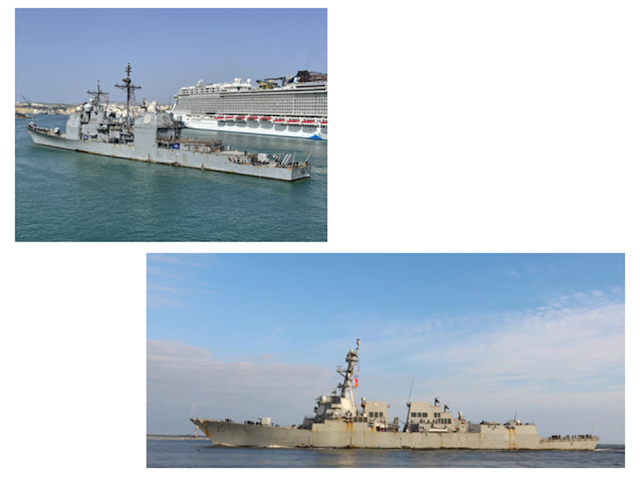


To our second question. Are we ready now?  We do have a tremendously capable Navy, Marine Corps, Coast Guard, and Merchant Marine. When we are at sea, we patrol, conduct humanitarian relief missions, etc. But are we ready? No, we are not ready materially or in the numbers needed to challenge the world’s largest navy in their backyard – that is China’s.

The navy has suffered from the diversion of attention and resources to two lengthy-land wars. It has suffered from costly unforced errors in lives, ships and cost. Gone is a major $750 million ship like the Bonhomme Richard in whose strike group I deployed 17 years ago.  Hundreds of millions in overhaul investment in the USS Miami, a submarine lost in a fire at the Portsmouth Naval Shipyard. Hundreds of millions and two years in the shipyard for the USS Fitzgerald and USS McCain. A mine warfighting ship lost on a reef. We have lost ships before in our history due to accidents and storms, but we don’t have ships to spare now. We need everything.
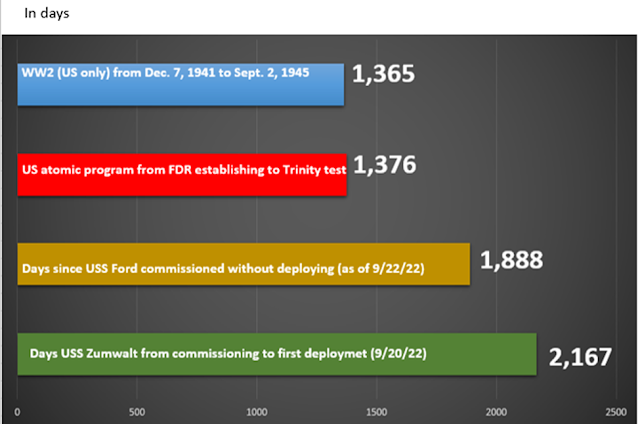

We have had three major shipbuilding programs in the past twenty years that have been a challenge.  Littoral Combat Ships decommissioning in just a few years. And while Zumwalt and Ford have finally deployed, the time from their commissioning to their first deployments is well beyond the length of US participation in the Second World War. The atomic bomb project went from program establishment to bombs on target in 1,376 days. 

Defense news recently reported that the us navy has “spent more than four years repairing one of its amphibious ships, already spending more than $100 million above what was planned. The ship is still not ready to deploy.”  The Navy, after $300 million just wants to decommission it. “Only 45% of the amphibious ship fleet is ready today compared to the navy’s 80 percent goal.”

Has the US Navy had programs that didn’t go according to plan? Of course. Although Robert Fulton built the first steam powered warship in 1815, it would be more than two decades when the technology was reliable enough from the private sector to build dual-powered ships. In 1835, Congress debated naval funding and whether to build the 120-gun ship of the line USS Pennsylvania with 1,000 sailors (that was ten percent of the size of the navy in one ship) or a dozen small sloops. In the end, Pennsylvania was built largely because the congressman who represented the shipyard in Philadelphia where it was to be built was Chair of the Naval Affairs Committee. There was the ram ship USS Katahdin, commissioned in 1896 and decommissioned only a year later.
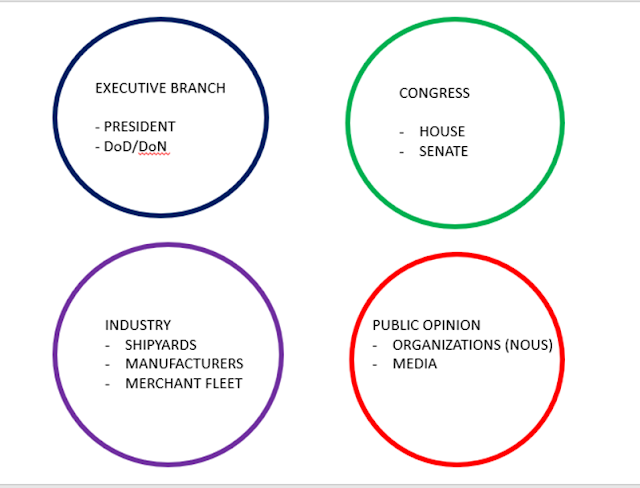


To be ready and sufficiently sized is based on four elements: the executive branch, Congress, industry, and public support. 
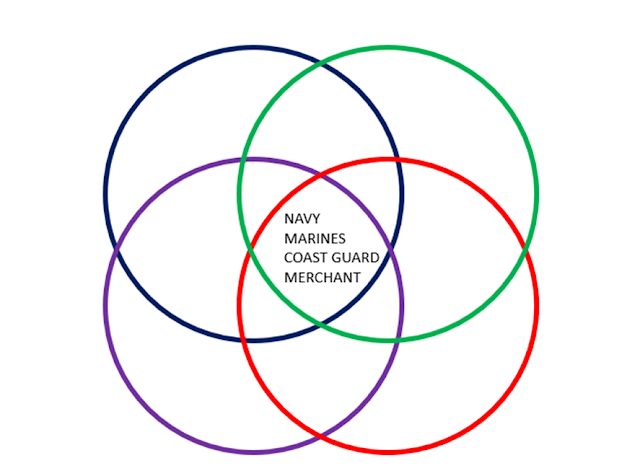


All those elements feed into each other. When all come together, that’s when we see a rejuvenation of the maritime services. Diminish or remove any one of those out and the equation falls apart.

At every period we increased the size and platform diversity, we had an executive branch that provided the vision and support. Even Andrew Jackson whom I wrote about in my latest book, had a recognizable maritime strategy. Others like the two Adams’, the two Roosevelts, Wilson, and Reagan understood the role of a navy and were its supporters. 


How do you quantify administration interest in the Navy? We can start with a simple criterion. Under the current administration, it took more than 200 days for a Secretary of the Navy to be confirmed – that’s a longer period from inauguration to confirmation than any other presidency.

Second, every period has had a critical mass of supporters from the legislative branch which has the Constitutional authority and responsibility to provide and maintain a navy. Absent that critical mass of support, a Navy will not be built or built better.

While watching a House Armed Services Committee hearing this year, I was struck by how a member of congress advocating for the navy was interrupted by the Chairman with this statement about China’s navy. 

“How capable are their ships? How many ships does China have deployed all around the world in any given moment? That’s a very low number from what I understand. And the capability of those ships are not as great either. So, we can all like FREAK ourselves out about all the trillions of dollars a year apparently, we have to spend on our defense budget. I think it would be helpful if we had a realistic understanding of our adversaries and where they’re at.”

He dismissed the threat of China, and he dismissed the idea of building the navy up.

I certainly respect the chairman and his role, but fundamentally disagree with his off-the-cuff assessment. China may have a low deployment rate focusing only on two regions, but it is not dissimilar to the US Navy’s rate of 15 percent in the 1980s especially when you consider it isn’t committing itself – yet – to all the regions of the world. We could do so because we had the numbers. Today our deployment rate is about 35 percent. The pace of China’s shipbuilding has meant that their ships have rarely needed to deploy more than a couple of times. Its growing fleet has allowed China to do more without degrading the material readiness of the ships. Conversely, the has struggled to maintain its ships, which are deploying at a higher rate and for longer periods. 
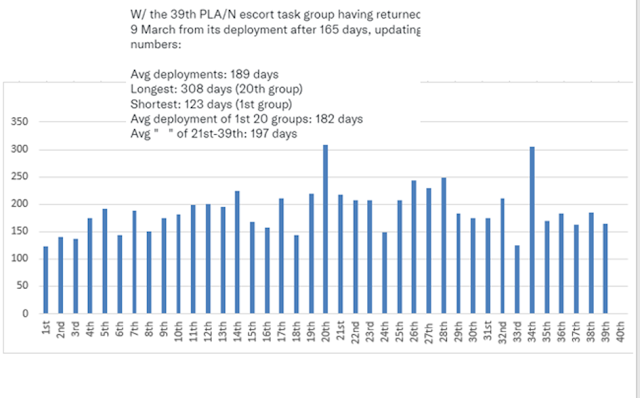
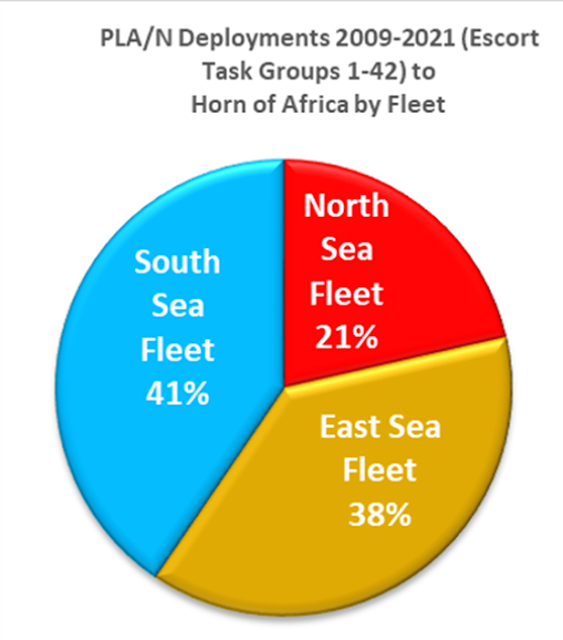
Capability comes from both technology and experience and China’s navy is gaining experience very quickly. In the past decade they’ve been sending squadrons – 42 of them -to the Horn of Africa every three or four months.

They have gained experience close to their shores and ships from every one of their fleets is operating on the other side of the world in deploying to the Horn of Africa.

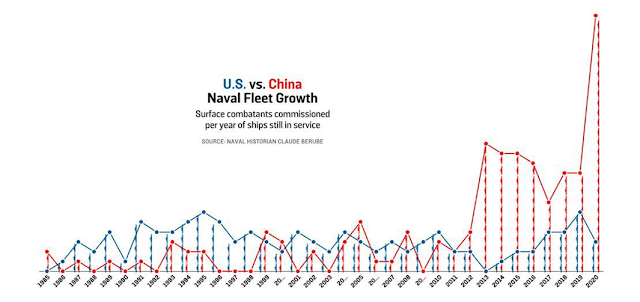
They have vastly outbuilt us in the past 10 years. Yes, that red line is China’s shipbuilding versus the blue of the us navy.
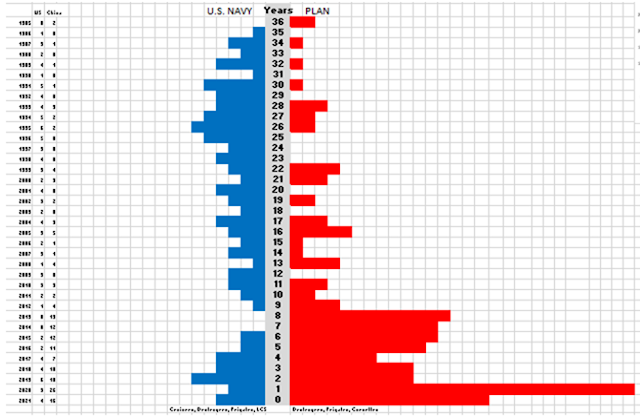

This graph represents all the major surface combatants in our fleet as of last year and their age from commissioning, so the top are the oldest ships in each fleet and the newest at the bottom. Eighty – that’s eight zero – of their surface fleet has been built in the past decade. By contrast only twenty percent of the US fleet is less than a decade old.

Testifying before the Senate Armed Services Committee in June, the Secretary of Defense said we “certainly have the most capable and dominant navy in the world and it will continue to be so going forward.” While the secretary’s sentiment is laudable, it is contrary to quantifiable trends. China isn’t a rising power – it has risen. I think we need to consider another historical example when we casually brush aside the threat of China’s navy. 

Commodore Matthew Perry visited Japan in 1854. That caused Japan to think about a navy of its own, not dissimilar to how China reacted 1996 to the Nimitz battle group transiting the Taiwan strait. In 1874, Japan launched an expedition to Taiwan. That decade their midshipmen began to study at the US Naval Academy. By 1895 their navy defeated China’s fleet in a war. In 1905, they defeated the entire Russian Eastern and Baltic fleets.

For those reasons, I think the chairman’s remarks were either insufficiently informed or intentionally dismissive.

We have incredible advocates in Congress like Elaine Luria [note: this speech was delivered before the 2022 election] and Mike Gallagher. But we need a legislative branch with advocates beyond that and beyond the shipbuilding districts. We are mired in petty partisan politics while China has a distinct advantage – they are forcibly unified and that has enabled them to build the world’s largest fleet. While we need to defend our democratic republic ideals, we need to find a way to unify.

The third element - in nearly every one of our previous conflicts, we relied heavily on the capacity of our industrial base especially shipyards. How many do we have today? To give you the scope of what we face, one shipyard in China has more capacity than all of our shipyards combined. Our shipyard capacity is limited. A 2021 Congressional Budget Office report pointed out that the four submarine shipyards were facing significant delays in completing maintenance because of the amount of work necessary has increased and they are having trouble finding workers. This has affected operational readiness.

Part of that industrial base is the size of the us merchant fleet because it was America’s maritime economy….  China has some 4,500 merchant ships; there are fewer than 80 in the US fleet. Why is this important? Because the maritime economy that built the nation in the 19th century meant shipyard jobs. It meant jobs across the nation which built systems on those ships. It meant that many families had someone who relied on the sea for it or on it. And that merchant fleet needed protection by the US Navy. That is why the public could understand the need for a navy – because it was self-interested in it. Self-interest and passion drives politics and public policy, not reason and data. But the American public has become estranged from the maritime economy that would have been familiar to our forebears.  

Earlier, I mentioned several wars but I saved one for the end. That is the war that really put the United States Navy on a global footing because it demonstrated the power of our industrial base, our ability to build modern ships, the vision of presidents, the support of congress, and an emotional support from the media and general public. That, of course, is the Spanish-American war. It is why I think it a particularly relevant war to discuss today because less than a decade before, the naval order of the United States was established by people who recognized we had a problem, who had a vision, and made the vision of a navy a reality.
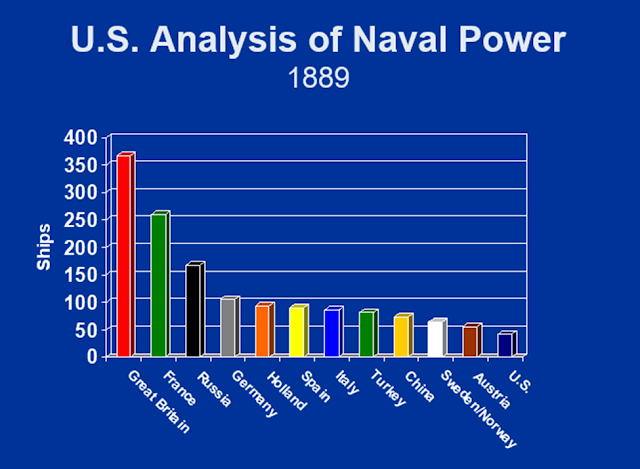

The year before the Naval Order was established, the US Navy was not among the world powers.
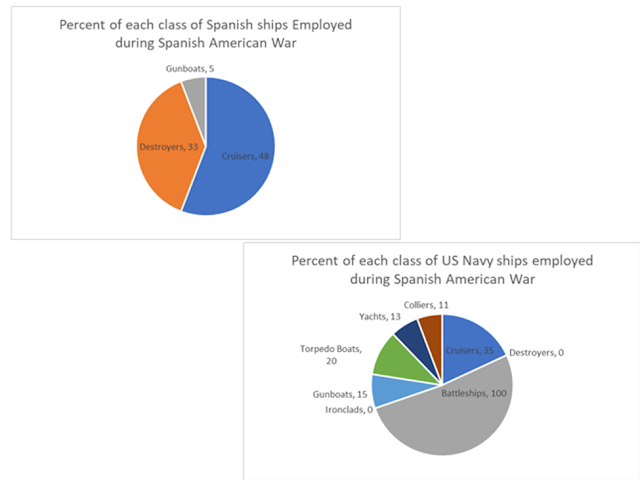

The Spanish navy during the 1890s was a traditional power investing in traditional surface combatants. The young American navy was more diverse in its platforms, understanding the need for logistics ships, etc.
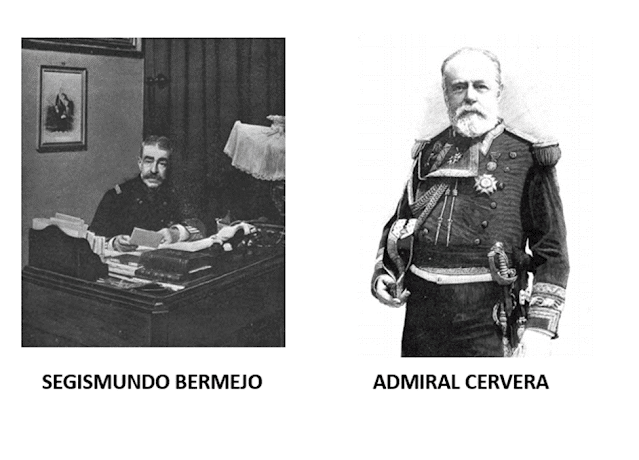
The Spanish Minister of Marine, Segismundo Bermejo had assessed the situation like this: the Spanish navy was experienced and a global power; the US Navy was young and inexperienced. On February 15, 1898 – the day the Maine exploded - he wrote to Admiral Cervera that it was his intent to blockade the American coast. The day after Cervera wrote back that the ships of the Havana station were badly worn out and that the Spanish naval force compared to the United States was approximately one to three, therefore a blockade wasn’t possible.

On April 22, three days after the declaration of war, Cervera wrote to Bermejo that “nothing can be expected of this expedition except the total destruction of the fleet or its hasty and demoralized return.” The Colon didn’t have its big guns. The 5.5 inch ammunition, with the exception of about 300 rounds, was bad. Two other ships had defective guns. They didn’t have a single torpedo. The Vizcaya could no longer steam. There was no plan, which he had much desired and suggested in vain. In short, he wrote, “it is a disaster already, and it is to be feared that it will be a more frightful one before long.” Privately, Cervera had been critical of the state of the Spanish navy before this because of its lack of money and frantically inefficient bureaucracy.”

Regardless, Cervera did his duty and in July would face the American fleet off Santiago. In his last address to his squadron, Cervera said “the solemn moment of fighting has come. The sacred name of Spain and the glorious honor of her flag so demands…the enemy covets our old and glorious hulls. They have sent the whole power of their young navy against us so as to achieve this goal. Hoist the flag and surrender no ship. Sound the trumpet for the combat. May God receive our souls.”

Every ship under his command was lost to the Americans. He and 39 of his officers were then held as prisoners of war at the US Naval Academy and treated as heroes by the American public.

What of Spain’s Asiatic fleet that was defeated at Manila Bay? Admiral George Dewey would write in his autobiography, “the Spanish government attempted to make a scape-goat of poor Admiral Montojo, the victim of their own shortcomings and maladministration.”

We would hope to rely on our allies in war and access to distant waters, but I think there’s another lesson from the Spanish-American war, a concern Admiral Dewey wrote about himself in his autobiography. His biggest concern after his victory at Manila Bay was that he’d face more Spanish. Specifically, a third squadron – a relief squadron – had gotten underway from Spain under Admiral Camara. He expected to resupply in Egypt. If Camara had that coal, Dewey wrote, there would be nothing that stopped him. But the coal was denied and Camara was forced to return to Spain. This isn’t unusual. Think about the start of the Iraq war when an entire infantry division was denied access through Turkey. Can we always rely on other nations great and small especially in a potential conflict with China when nations must act in their self-interest?
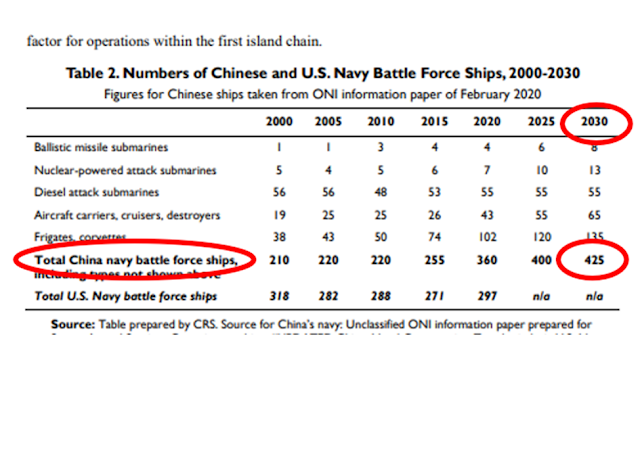
A final point. Some may argue that China’s navy is only slightly larger than ours. But if war comes and it is anywhere near the South China Sea they will be able to bring to bear their entire fleet in a matter of days – by the end of the decade, the Congressional Research Service estimates they will have 425 ships.  

How many of our ships could we get in theater in days or weeks?  100? 150?  That would be a one to three advantage, the same concern Cervera voiced about his proportion to the Americans. We have an incredibly capable force and equally impressive sailors. But we have to assess how unique, innovative technology in small numbers will do against a larger force. When I was a defense contractor in the 1990s, one of my senior colleagues was Bud Rundell, a B-17 bomber pilot shot down over Merzberg on his 13th mission. He told me of seeing a Me-262 during one mission, but there were too many bombers to counter that one innovative jet. What of German advances in tanks, submarines, or V-1 and V-2 rockets during the Second World War? How much did unique, advanced technology impact the result against an overwhelming Soviet and Allied force?

To close out, I mentioned at the beginning of my talk that my town had two houses of worship – the hockey arenas and the Catholic churches.

Fifteen years ago, I was in Ottawa sitting in a chapel - the Rideau Street Chapel. Coincidentally it belonged to the same religious order that founded a hospital in my town and where my family worked. As I sat in a pew, I observed the artistry of the fan-vaulted ceilings and listened to a chorus of forty voices. But the chapel was no longer on Rideau Street. It had been deconstructed and moved to the interior of the National Gallery of Canada where speakers played a recording of the chorus. That morning I read in the paper an article about communion hosts – the center piece of the Catholic mass – had found a resurgent popularity in Quebec as a common, secular snack. Unlike my childhood, the churches in Quebec that had a Catholic faith for three centuries was in steep decline, its churches empty, and its foundations were now viewed as artifacts. 

A similar feeling struck me a few years ago when I was in England visiting the Portsmouth naval museums, recognizing the glory years of the Royal Navy that ruled the seas, and yet the Royal Navy today had less than two dozen destroyers and frigates. It reminded me of an old Rudyard Kipling poem which lamented that “far called, our navies melt away.”

Certainly, in my current professional capacity, I understand the value of museums like those mentioned and teaching our history to the public, but they can too easily be reminders of yesteryear rather than what is needed now and tomorrow. Our country may have grown beyond a symbiotic life with the sea to one of simple indifference, relegated to galleries and exhibits and artifacts.

We as a nation and a navy are not ready because we have chosen not to be. What do we need to prepare for a potential conflict with China?

We need executive vision and action. 

We need congressional interest, oversight and funding. 

We need a navy to build operational platforms. 

We need a much larger industrial base. 

We need a public that has a direct relationship to our maritime services that understands they have skin in this Great Game.

We must become ready. But whether or not we are when the time comes, like Cervera, we will do our duty and go with courage regardless of the fate that awaits us.

Is there hope? Certainly.  

I see it in an incredibly capable Secretary of the Navy. 

I see it with some outstanding admirals.

I see it in the commitment and resiliency of our officers and sailors.

And I see it every day in the creative and energetic midshipmen I teach at the Academy, the future of our naval services. 

Thank you.


Claude Berube, PhD, is the author of “On Wide Seas: The US Navy in the Jacksonian Era” and several other books including his third novel, “The Philippine Pact” (2023). He has worked on Capitol Hill, in the defense industry, and the Office of Naval Intelligence. A Commander in the US Navy Reserve, he is currently assigned to a unit with Navy Warfare Development Center. Since 2005 he has taught in the Political Science and History Departments at the US Naval Academy.


Wednesday, October 05, 2022

Where Does Ryan Mays go to Get His Name and Life Back?


A sad chapter in the loss over two years ago of the USS Bonhomme Richard (LHD 6) has finally come to a close.

With the loss of an almost freshly modernized large amphib and $1.2 billion already being cut in to scrap - the whole story is yet to play out, but one of the saddest chapters is now closed. In a just world there would be scalding Congressional hearings, but alas we do not live in such a world.

Megan Rose at ProPublica put out a superb review and report a couple of weeks ago you really need to read in full.

Considering all the own-goals our Navy has executed the last few years, a navalist can be a little numb to the ineptitude ... but we need to look at.

We need to look at it if for no other reason than it appears that we put the entire weight and resources of the Navy's legal system against a young Sailor for no other reason than - it appears - to force him to be the Navy's sin eater.

The only good thing that has come from this sad tale is that at least Seaman Recruit Ryan Mays, USN is a free man. Damaged and poor, but wiser and free;

Update, Sept. 30, 2022: A military judge found Seaman Recruit Ryan Mays not guilty on Friday of setting fire to the USS Bonhomme Richard. Mays, 21, had stood trial on charges of aggravated arson and willfully hazarding a vessel for the four-day blaze that destroyed the amphibious assault ship in 2020.

As we've discussed it often since the fire here, follow the link if you need to catch up on my thoughts in detail.

As regulars here know, over the last three decades+ I have seen too many acquaintances and friends be destroyed - in some cases personally in addition to professionally - by frivolous or just plain slanderous IG/NCIS investigations. 

When they arrested Mays, while accepting they may have the guilty party, in the back of my mind came up something Ensign Salamander thought was BS at the time, and combined with what I saw after Tailhook 91, cemented a healthy suspicion of the Navy's investigatory services that time proved wise; 

To some, the Navy’s actions were reminiscent of an ugly piece of its history. In 1989 an explosion on a turret of the USS Iowa killed 47 sailors, and the Navy tried to pin it on one of the dead sailors, who leaders suspected was gay. Only after Congress stepped in did the Navy acknowledge there was no evidence for its assertions.

Command Investigations I have faith in ... if it involves a hotline complaint, IG or NCIS ... notsomuch;

The service immediately launched two parallel investigations into what went wrong and why.

The command investigation, led by a three-star admiral, sent a team of investigators on a prodigious and methodical examination of the fire. As the months passed, the investigators uncovered in exhaustive detail an astonishing array of failures — broken or missing fire hoses, poorly trained sailors, improperly stored hazardous material — that had primed the ship for a calamitous fire.

A separate investigation by the Naval Criminal Investigative Service, for its part, focused on whether anyone was criminally responsible. As the months passed, NCIS investigators appeared to operate in isolation, discounting the damning findings of the command investigation to pursue a case of arson, despite scant evidence.

Six weeks into both inquiries, the Navy told the command investigation to accept at face value what NCIS and federal fire investigators judged to be the fire’s origin. Both investigations concluded in 2021.

...

The command investigation traced the problems back to when the Bonhomme Richard docked for maintenance and Navy leaders throughout the ranks abandoned responsibility for the ship’s safety. Risks mounted, and nobody paid attention. All told, investigators determined that the actions of 17 sailors and officers directly led to the loss of the ship, and those of 17 more, including five admirals, contributed. The long list was a staggering indictment of everyone from sailors to top admirals who had failed in their jobs.

The NCIS investigation, however, laid the blame at the feet of a single young sailor. The true culprit, the one who bore responsibility for the billion-dollar loss, the Navy said, was then-20-year-old Ryan Mays. And for that, he should face life in prison.

The Navy continued its pursuit of Mays, even as a military judge recommended against it, bluntly calling out the lack of evidence and citing the findings of the Navy’s own command investigation.

...

After a dayslong probable cause hearing for Mays in December 2021, the judge said she wasn’t persuaded of Mays’ guilt. A nuclear-trained surface warfare officer who later became a Navy lawyer and then judge, Capt. Angela Tang is known for being thorough.

“Given the state of the evidence presented to me, I do not believe there is a reasonable likelihood of conviction at trial. Therefore I do not recommend referral of these charges even though there is probable cause to support them,” Tang wrote in her findings. 

Accountability for a $1.2 billion loss of what for other navies would be considered a capital ship? Huh.

The details in Meghan's article is just, well, depressing. Just one paragraph should drive any navalists to the end of their line;

The investigators soon discovered an astonishing list of ways the ship was at risk, so many that cataloging the bad decisions day after day became depressing, the person involved said. For long stretches, all the ship’s heat sensors, sprinklers and other emergency systems were turned off, investigators wrote in their report. On the day of the fire, just 29 of the ship’s 216 fire stations and 15 of 807 portable fire extinguishers were in standard working order.

This is what we put one of our Sailors through;

The ATF’s Beals and an NCIS agent questioned Mays in a recorded interview for nearly 10 hours. He told them more than 150 times that he didn’t set the ship on fire.

The morning of the fire, Mays should have had a broom and dustpan in his hand, cleaning the back of the ship. Mays told agents he was instead just hanging out there, scrolling through his phone. With 24 hours of duty and not much to do, he wasn’t in a hurry right after roll call, and besides, he told ProPublica later, the general culture of the ship on its second extension in the yards was lackadaisical.

On a recording of the interview, Mays, wearing a brown uniform T-shirt and occasionally sweeping his hair off his forehead, vacillated between confrontation and distress.

In a confident voice, he asked eight times in two minutes if he was being detained.

“I’m not answering your questions, Ryan,” Beals said.

During his interview, Mays crudely put on display his disregard for the fleet Navy, and spoke of his desire to be a SEAL. In the beginning he even asked NCIS agent Albert Porter, a former SEAL, for a recommendation. Porter told Mays he’d never have another shot at the training program: “You’re not going back, dude. It’s not happening.”

Beals pressed him to “just admit to what you’ve done.” At one point, he told Mays they had him on video.

“You’re a liar,” Mays said.

“You’re a liar,” Beals replied.

Several times throughout the day, Mays asked to call his mom. He tried to think of anything he could tell the agents that would show them he was innocent. He begged them to take his DNA, search his phone and use GPS to track his whereabouts at the time.

At one point when the agents left him alone, he exclaimed to the empty room: “I didn’t do it. Let me go.”

Then he laid his head on the table and sobbed.

When Mays learned close to midnight he was going to the brig, a sailor who had been preparing to transport him said she heard Mays say something like “I’m guilty. I did it, I guess,” according to records and testimony.

Agents took the alleged remark as a confession. Mays said he was being sarcastic, expressing disbelief he was being arrested for a crime he didn’t commit.

The Navy booked Mays into the brig on Aug. 20, 2020.

Kafka lacked imagination compared to what we will put our people through. Such a young man. He will never be the same. His family will never be the same. 

Where is justice for him?

The experience, especially his time in the brig, has been “soul crushing,” he said. “A piece of me died in there and I don’t know if I’ll ever get it back.”

Don't think it can't happen to you.

If you find yourself across the table from any law enforcement officer of any stripe - lawyer up. I don't care how innocent you are. Be silent until you have an attorney tell you when to speak and what to say. If you are in uniform, take your JAG, but dig as deep as you can in your pockets for the best civilian lawyer you can find who has experience in this area and will take your case. 

Very often it is not about innocence or guilt, nor is it about right or wrong. It is about what someone can prove or disprove. Nothing more. For ambition or self-preservation - or even ego - individuals of our species will destroy innocents. It is our nature. Acknowledge that and accept it.

No, it isn't fair. No, it isn't cheap - but one thing money is not as valuable as time and your reputation. 

Be a mensch. If you have a friend or a Shipmate who finds themselves under the microscope such as this, do not abandon them. Most will, and the few that remain can make all the difference in the world to ensure that they have a chance to remain grounded and get through this. If you abandon them, you were never a friend or a Shipmate.

Our Navy failed here at multiple levels. 

In a about 2/3 the time it took to fight WWII ... here we are in the fall of 2022 ... with nothing but shame and guilt.

Where is constructive action? 

Wednesday, September 07, 2022

5 Years, 17 Lives, 1 Navy


How long do you wait to see what you purchased with the lives of 17 Sailors?

Back in 2015 I decided we needed a measure of time for things in the Navy, and settled on a measure of time called a WorldWar;

I think "years" does not really tell the best story about how long it takes to get even the most simple ship to displace water after the "go" is given.

Perhaps we need a new measurement - one that provides context. We need one defined in American terms, natch, and I have an idea.

I've used it before; the time from the attack on Pearl Harbor to the signing ceremony on the Mighty Mo.

That is 07DEC41 to 02SEP45. 3-years, 8-months, 26 days. Including the end date, that is 1,366 days.

Five years is a long time. It is about one and a third the time it took for the USA to fight World War II.

5-years = 1.34-WorldWars.

What was mostly anger at the time during the horrible summer of 2017 when the FITZGERALD and MCCAIN collided with merchant ships in the Western Pacific has, for me at least, distilled more in to sadness. Sadness looking towards hope, but sadness nonetheless.

Such an avoidable and predictable waste. Hopefully something good can come from it. 

As I wrote in the fall of that year;

Why would the Surface community want to benchmark an Aviation-centric instruction’s attitude as opposed on focusing on unit level failures? Here are 17 reasons;

- GMSN Kyle Rigsby of Palmyra, Virginia, 19 years old.

- YN2 Shingo Alexander Douglass, of San Diego, California, 25 years old.

- FC1 Carlos Victor Ganzon Sibayan of Chula Vista, California, 23 years old.

- PSC Xavier Alec Martin of Halethorpe, Maryland, 24 years old.

- STG2 Ngoc Turong Huynh of Oakville, Connecticut, 25 years old.

- GM1 Noe Hernandez of Weslaco, Texas, 26 years old.

- FCC Gary Rehm, Jr., of Elyria, Ohio, 37 years old.

- ETC Charles Nathan Findley of Amazonian, Missouri, 31 years old.

- ICC Abraham Lopez of El Paso, Texas, 39 years old.

- ET1 Kevin Sayer Bushell of Gaithersburg, Maryland, 26 years old.

- ET1 Jacob Daniel Drake of Cable, Ohio, 21 years old.

- ITl Timothy Thomas Eckels Jr. of Baltimore, Maryland, 23 years old.

- ITl Corey George Ingram of Poughkeepsie, New York, 28 years old.

- ET2 Dustin Louis Doyon of Suffield, Connecticut, 26 years old.

- ET2 John Henry Hoagland III of Killeen, Texas, 20 years old.

- IC2 Logan Stephen Palmer of Harristown, Illinois, 23 years old.

- ET2 Kenneth Aaron Smith of Cherry Hill, New Jersey, 22 years old.

Not waving bloody shirts around, but this should focus the mind. This is not an academic exercise, or some Black Swan event – this is a scenario x2 that people have been warning about for years. We don’t just have bent steel and bruised egos here – these are lessons written in the blood of 17 Sailors who we like to say are our most important assets.

Over in DefenseNews back in June, Megan Eckstein had a long and well researched article that everyone should take a moment to read. I'm just now getting around to it and it brought up a little anger, a lot of sadness, but a fair measure of hope that well meaning people in hard jobs are trying to claw something back from the completely avoidable deaths from 1.34 WorldWars ago.

Here's a few points ... but this is only a small fraction. You really need to read it all;

The comprehensive review of recent surface force incidents, released in early November 2017, highlighted the root problems Kitchener outlined. A quick scan of the table of contents makes clear there’s a long list of problems: poor seamanship and failure to follow safe navigational practices; erosion of crew readiness; headquarters processes that inadequately identified, assessed and managed operational risks; “can-do” culture that undermined basic watchstanding and safety practices.

The Navy has spent the past five years not just addressing these issues, Kitchener said, but doing so in a data-driven way meant to prevent the Navy from backsliding.

Operational tempo drove many of the problems outlined in the review. Japan-based ships in particular faced such demand that they were constantly too busy, which came at the expense of training and maintenance time. Personnel were yanked from one ship crew to fill in for others, meaning sailors didn’t get downtime and the crews didn’t gel as a unit.

Of course, this is naval leadership 101; none of this is breaking news. This is Vince Lombardi fundamentals...yet we decided we didn't need to remember them.

Well, the naval gods of the copybook headings took their payment.

We are a Surface Navy at peace, and in the Western Pacific - blinkered, overcaffeinated, and overheated N2 types aside - have been with a few minutes of exceptions for decades.

...for all ships in the Pacific — both 7th Fleet in Japan and U.S. 3rd Fleet in San Diego, California — all requests from fiscal 2019 to fiscal 2021 to extend a depot-level repair period — despite potentially delaying a ship’s deployment — were approved. This included 29 extensions in FY19; 27 in FY20; and 30 in FY21, according to data provided by Naval Surface Forces.

There’s a second process in place for ships already deployed. A redline instruction from Naval Surface Forces states a ship cannot remain at sea if certain systems go down, unless it receives a waiver from the operational commander. Even then, the approval must be accompanied by a mitigation plan approved by Kitchener or his East Coast counterpart, Rear Adm. Brendan McLane, who commands Naval Surface Force Atlantic.

...

Additionally, ships are entitled to a certain number of continuous maintenance availability days throughout the year — the type of routine care done pierside to keep ships at peak readiness for operations, as opposed to the major upgrades and repairs done at a depot.

Kitchener said 19% of that work was executed in 2017, as opposed to nearly 90% today. 

Simple things are not simple, but with the right leadership, they stay that way. This is how you save ships, save lives, and increase retention. That would have saved 17 lives in 2017 - of that I am absolutely convinced.

Vasely said the Learning to Action Board will tackle the Fitzgerald and McCain collisions as its next project, looking to ensure the permanent implementation of the 117 recommendations and the translation of those surface-specific recommendations into broader ideas to make the whole Navy safer.

“One of the key things that we realized as we’ve gone through the Bonhomme Richard and the major fires review iteration is that we’re not getting after … the long-term success of what this will look like, which is: How do we get left of bang?” he said. “How do we look at the data … and identify those negative trends that are posing significant risks that, if unchecked, if we don’t surge on them, that basically will result in a potentially catastrophic event or a pinnacle-level event?”

A fifth goal for the board now, he said, is meant to be more proactive, “looking at negative trends that come up — so think about [inspector general] investigations, area assessments, think Naval Safety Command or hazard reports that come through, think about pulse surveys that go out to the fleet that come back — all provide data that, really, there has not been a repository or a mechanism to look at that data to determine the negative trends, to arrest the negative trends from turning into a pinnacle-level event.”

For Kitchener, turning lessons from the past into forward-looking predictive analytics is a critical endeavor.

“We cannot allow those lives that were lost to be in vain,” he said.

Should it take 1.34 WorldWars to get here? I don't know. Maybe I am impatient ... but if this can stick like the lessons Naval Aviation took to heart in the 50s-60s, then perhaps yes.

There's your hope. 

Tuesday, August 02, 2022

How Many Fireboats Can You Buy for $1.2 Billion?

As we go through today's post, I'd like everyone to keep in mind an intangible that impacts not just our Navy in the eyes of the people we serve, but our government as a whole that our Navy is part of: most of our major naval bases are located in the heart of heavily populated urban areas.

The Tidewater Area around Norfolk, VA;

And on the West Coast, San Diego;


For good and bad, what our Navy does impacts the millions of people who are our neighbors, family, and friends who live cheek-to-jowl with the fleet.

When things go wrong, they are downwind.


There is the former USS Bonhomme Richard (LHD 6) burning two years ago and drenching the San Diego with at least two decades of trial lawyer cases.

Do you see it? See that little boat in the bottom right hand corner? That's the subject of today's post.

As one is getting used to, our friends over at gCaptain are bringing up important issues no one else is.

In this case something many assume the Navy has covered but doesn't; fireboats.

Over the past few decades, the United States Navy has increasingly abandoned the unsexy working ships it once mastered and deployed around the world. Previously, the Navy had a large fleet of salvage tugs, but now they only have two, and only two Hospital Ships, two Submarine Tenders, and two Ocean Tugs. Some ship classes have been scrapped altogether including Fireboats or, as the Secretary of the Navy Carlos Del Toro inaccurately called them in a letter to congress, “fire boats.” 

The Unsexy-but-Important™ strike again. This isn't some fancy, surplus, radical idea that only a military might do.

“Modern fireboats are impressive and so essential to protecting ships that Long Beach purchased them even though the next city north, Los Angeles, already had a state-of-the-art fireboat, and even though the construction cost for the two boats exceeded $50 million,” we wrote in July of last year. “Long Beach is not alone. Nearly every large commercial harbor worldwide now has state-of-the-art fireboats on duty, but the world’s largest US Naval Bases doesn’t own a single one.”

Our Admiralty keeps untold thousands of admin personnel burning countless hours processing North Korean levels of medal citations and inventing a new uniform every other POM cycle ... but ... I guess everyone must have priorities.

In the official report attached to Del Toro’s letter to Congress, the Navy states. “We assess that the lack of dedicated fire boats did not have an appreciable effect on the BHR incident or loss of this ship. And, in fact, waterborne firefighting capability, readily available on Navy tug boats, was brought to bear in this incident and has been formally accepted into Navy installation emergency response plans. The Navy does not intend to request or pursue dedicated fire boats at this time.”

As you may have guessed, John Konrad is about to drop a nuke;

The 600 words are not accurate. It contains blatant lies.

“And, in fact, waterborne firefighting capability,” says the report, “Readily available on Navy tug boats, was brought to bear in this incident.”

But Navy tugboats were neither readily available nor used in the BHR fire. Nothing was “brought to bear” in the critical early stage of the fire. Two hours into the incident, civilian captains aboard commercial tugboats owned by a private company, begged to help fight the fire but instead, the Navy brought in laughably small police boats with tiny water cannons built to fight small fires on recreational boats, not 844′ warships.

Read it all and figure out that when you need 50,000, SECNAV is happy to make you think 900 is adequate.

Either you are being lied to, or people are lying to the SECNAV.

As the Bonnie Dick is cut in to tiny pieces, place your bets.

Tuesday, July 05, 2022

VADM Brown; Remembering the Johnston's Turn

There are many fine traditions in the naval service, especially in the Anglosphere. One of the best was summarized by Admiral Nelson, RN.

When in doubt, attack. That bias for action in the face of a threat is an admirable trait, especially when contrasted with a more common human reaction – to freeze. 

As we have evolved as a species, other reactions developed past these Upper-Paleolithic instincts of Homo Sapiens. Indeed, in the modern evolution of Homo Bureaucraticus, scapegoating and blame-shifting have sadly become more common through natural selection. In Ottomanesque bureaucracies, game recognizes game, and such responses are rewarded and passed along generation after generation, eventually being a characteristic trait of a sub-species. 

Megan Eckstein kicks the work week off with a broad ranging, complicated, and important development in the story of the burning of the USS Bonhomme Richard (LHD-6), whose two-year anniversary will arrive at the end of next week.

I see it as two interrelated stories; our Navy’s institutional failure of the fundamentals (Part I), and a gentleman’s response to an attack on his honor (Part II).

We’ll do a “Part-I” and “Part-II” format.

Before we dive in to Part-I, let’s review a few entering arguments which have anchored many conversations here over the last 18-yrs that apply in this case.

1. The Navy’s investigatory and legal system is no longer fit for purpose. It is hopelessly compromised by a culture infected with undue influence, sloth, and self-focus.

2. No one can trust a “Big Navy” investigation. The smart will lawyer-up early with outside counsel, keep meticulous records with secure backups, trust few, and suspect anyone who directly or indirectly will benefit from their downfall. It isn’t always about right and wrong, the longer it goes on it brings out the worst aspects of our adversarial legal system – it is about what can be blamed on whom not in the service of justice, but in service to the career goals of those conducting the investigation and prosecution.

3. We have too many Flag Officers with too few real Flag Officer responsibilities. As such, we have a warped culture where large numbers of ambitious people are underemployed and seek authority yet wish to avoid responsibility as demanded by our present system of incentives and disincentives. 

Part I: C2 Matters

I hope Megan does not mind me pulling so much from her article, but especially for those who have served in staff positions, the core to this story is the C2 diagram (Figure 1) in para 6 of Enclosure (3) of OPNAVINST 3440.18 Dated 13 Nov 2018.


To start out, no, I have no idea what the doctrinally correct definition of a “Bridge Line Command” is. 

I spent 9-yrs of my 21-yr Navy career as a staff officer on USA and NATO staffs with untold hours working on C2 diagrams and relationships. I have never heard of that term, and a little googlefu cannot find it defined anywhere. I only see it referenced directly or indirectly to 3440.18. If you can find anything better, please let us know in comments. 

Additionally, para 6 ends with the phrase “command bridge line.” That is also a term I am not familiar with. I can only find one other Navy use of it in a NAVSEA document referring to communications. I will assume it is related to para. 3 of Encl.(3) but the list there is not fully congruent with the strange dashed box in Figure 1 of Encl.(3) … so, we’ll just put it to bad staff work.

So, yeah … how this ever got approved is beyond me, but it is what we had … and bad staff work usually manifests itself with poor results in the field … and here we are.

So, there is no definition of what the solid lines are in the diagram vs the dot-dash line … there are all sorts of inadequacies with the diagram itself and I’m not going to pick it apart anymore, but the important part is on the previous page in paras 1 and 2:

1. The chain of command is provided graphically in figure 1 of this enclosure. As the in-hull incident commander, the ship’s CO controls all damage control efforts on board the ship. The CO is assisted by a fire department senior fire chief or officer and naval supervising authority project superintendent (if applicable).

2. The area or unified area commander will remain in constant contact with the in-hull incident command. All requests for additional resources, special equipment, or technical expertise will be passed through the area commander. The area commander will man all bridge lines.

This is rather clear, “…the ship’s CO controls all damage control efforts on board the ship.” So is, “All requests for additional resources, special equipment, or technical expertise will be passed through the area commander.” … and the Area Commander reports to the Primary Commander (Fleet Commander).

So, I believe the “Area Commander” here would be CNRSW and the “Primary Commander” would be C3F.  BTW, why does Commander Navy Region Southwest hardly get any mention here? Seriously, I have no idea.

Now that we have this. Behold this mess;

The initial response to the July 2020 fire that destroyed the multibillion-dollar amphibious assault ship Bonhomme Richard was uncoordinated and hampered by confusion as to which admiral should cobble together Navy and civilian firefighters, according to new information from the then-head of Naval Surface Forces.

The discombobulation in those early hours meant sailors may have missed a small window to contain the fire in a storage area. One admiral who said he lacked authority to issue an order pleaded with the ship’s commanding officer to get back on the ship and fight the fire, when the CO and his crew were waiting on the pier. And when that admiral — now-retired Vice Adm. Rich Brown — found the situation so dire that he called on other another command to intervene, it refused, Brown said in an interview.

...

Brown, as the type commander for surface ships, said he should have played a supporting role the morning the fire broke out.

...

So Brown called ship commanding officer, Capt. Gregory Scott Thoroman, who said he and the crew had left the ship and were on the pier. The investigation into the fire noted the crew pulled out of the ship twice during the firefight that morning.

Thoroman should have been coordinating with the base’s Federal Fire Department and the Southwest Regional Maintenance Center, collectively forming the incident command team, according to a 2018 Navy instruction laying out fire prevention and fire response responsibilities for ships in maintenance.

...

With the Navy’s organization falling apart, he called the Expeditionary Strike Group 3 commander, Rear Adm. Phil Sobeck, around 11 a.m.

“Phil, you can tell me to eff off, because I’m not in your chain of command, but you have to get down to that pier and provide leadership and guidance because they’re all sitting at the end of the pier watching the ship burn,” Brown said he told Sobeck. “And he goes, ‘Admiral, I’m getting in the car, I’m on my way.’”

...

Brown directed his staff to contact U.S. 3rd Fleet around 12:30 p.m., but 3rd Fleet’s position was, “The ship’s in maintenance, it’s not our problem.”

Who accepts responsibility? Who avoids it and why? As a friend mentioned earlier today to me, “Quite sure Kimmel did not say “not my job.””

After the staff-level call failed, Brown set up a call with 3rd Fleet Commander Vice Adm. Scott Conn, for the two three-stars to hash it out directly.

“I said, hey, Phil’s down there, but we have to formally establish a new command structure. And he told me he wasn’t going to do it because the ship was in maintenance and it’s not his problem. And I said fine.”

...

He then called the then-Pacific Fleet commander, Adm. John Aquilino.

“I told him what I had done, what I was seeing: the C2 degrading on the pier, there’s no focus of effort, people are off doing their own things. And I told him that I had asked Scott to take command and he said no. And I said ... ‘Phil now works for me, and I’ve got it.’”

“Absolutely, Rich, you got it, put the fire out,” the admiral replied, according to Brown.

At the time we were all wondering what was going on. Chaos, that's what.

A bias for action, again one of our better traditions. In times of crisis, often those who should be responsible do not rise to the occasion, endangering not just themselves and their command, but everyone around them. It is not unheard of for this to be part of a cascading set of failures to act. Below the primary failure no one will do anything absent that direction as they either lack confidence or perspective to see the failure, and those above who should take charge don’t for similar reasons or just plain ignorance.

What did VADM Brown do here as CNSF? No, he was not in the chain of command, but he was a leader who saw a failure to lead and he stepped up to try to get those who are responsible to act, and absent their actions, fill the gap as best he could as a supporting entity outside the chain of command.

Did anything he did make things worse? Did they make them better? Was any other leader showing what we ask our leaders to show – a bias for action? What does our Navy reward? What does it punish?

Part II: Honor Demands

Let’s look a bit at how I framed Part-II at the start of the post, “a gentleman’s response to an attack on his honor.” It should go without saying, but as we live in a tender and reactive age, “gentlemen” can be seen as non-gender specific, but also very specific to men. Interpret that as you wish.

Duty. As an officer in the United States Navy, who do you owe your duty to? There is both a simple and a complicated answer to that. Let’s start with the Oath;

The Oath of Office (for officers): "I, _____ (SSAN), having been appointed an officer in the _____ (Military Branch) of the United States, as indicated above in the grade of _____ do solemnly swear (or affirm) that I will support and defend the Constitution of the United States against all enemies, foreign or domestic, that I will bear true faith and allegiance to the same; that I take this obligation freely, without any mental reservations or purpose of evasion; and that I will well and faithfully discharge the duties of the office upon which I am about to enter; So help me God."

The Constitution first of all, that is pretty much a “Ref. A” answer. We have that document and rafts of judges up to SCOTUS to give us the “Ref. B.” Serious, yet complicated in its simplicity. That is the easy part. Then “the duties of the office.” There is that concept again, “duty.”

In the military context, that definition is rather broad and open to interpretation, but I like the definition the State of Connecticut uses;

…the performance of military service by a member of the armed forces of the state pursuant to competent state military orders, whether paid or unpaid for such military service, including training, performance of emergency response missions and traveling directly to or returning directly from the location of such military service.

In practice, things get complicated from there. Loyalty is talked about a lot, yet abused more often. Are you loyal to people, or institutions? Yourself? Your family? “Ship, Shipmate, Self” is something we throw around a lot, and is a useful entering argument, but it is not a one-way relationship. As in all well-functioning systems, the relationship is interlocked and multi-relational. 

Most will find themselves in situations small and large where they find out that their assumptions about the systems they are a part of are no longer valid. The agreements, spoken and unspoken, that enabled decades of hard work and success, are broken. They are not working. Perhaps they never did.

Then what does one do? Where one may have spent decades taking the burdens of an organization you love on to yourself personally, when does that act of love become more of an acceptance of abuse? When does a man reach a point where the honor of love is replaced by the dishonor of accepted abuse?

Part-II is about a man who found himself in a place many have found themselves in before. An organization he invested his life in, built his reputation on, and most likely loved – turned on him. He sees if not an upcoming assault on his honor, then at least an injustice, a bearing of false witness, and at a minimum an attempt to make flesh an untruth hewn from the body of his reputation.

Some will advise a man to take such things as part of the job, to not make a fuss for … the sake of the institution. Some will counsel to appeal within the system, that regardless of its malperformance to date, one must trust the system regardless and work within it. 

There is another school of thought that forces an answer to a hard question; what do you owe to an institution if that institution breaks its bond with you? What honor is there to give the gift of trust to an untrustworthy organization? If one party breaks spoken and unspoken agreements, what rule under heaven obliges the other party to act as if the break never occurred?

There is a time to accept that you are in a place you never desired to be. That even though you did all you could possibly do in the scope of your authority and responsibility, other entities are shaping your reality. They are stronger, larger, and on paper at least, more powerful. When they have you bracketed you can simply carry on as before in the knowledge that this is the fate you have been dealt, or you can decide that fate is what she is, but there is a way to embrace it with a higher honor based on a higher ethic to embrace that fate on your own terms. 

Call flank-speed, full left rudder, and engage the attacking force head on.

That, in a fashion, is how I read the strange Kafkaesque place Vice Admiral Rich Brown, USN (Ret.) finds himself in. 

Brown said he is sharing his story with Defense News now as he faces a secretarial letter of censure. He was named in the investigation as contributing to the loss of the ship, but was cleared by what’s known as a Consolidated Disposition Authority in December. He said he was not interviewed for the investigation into the fire.

Capt. J.D. Dorsey, a spokesman for Secretary of the Navy Carlos Del Toro, told Defense News “the secretary is still in the process of reviewing the command investigation and has not yet made any final decisions on actions beyond what the CDA has imposed.”

...

Brown didn’t dispute the Navy’s accounting of the rest of the five days of firefighting as laid out in the investigation, but said the investigation’s accounting of how the command and control fell apart during a crisis is incomplete and the investigation itself was “fatally defective” without interviewing him or including a full picture of what will be a key lesson learned.

...

The retired three-star said one of the reasons he wanted to share his perspective about the fire is because the same command and control flaw played a role in the 2017 collisions of destroyers Fitzgerald and McCain and the 2020 fire on Bonhomme Richard. Brown led the McCain investigation and participated in the Fitzgerald investigation, and he said one of the recommendations he made at the time was to reinstate a Cold War-era command structure that had two chains of command: one for ships in maintenance and the basic phase, led by a one-star admiral focused on ensuring they built up their readiness, and one for ships in advanced training and deployments, led by a one-star focused on employing their warfighting capability.

Brown said this setup could have prevented the Fitzgerald and McCain tragedies, and that he had urged the Navy to revamp the command and control setup in 2017.

“I was told, ‘It’s not going to happen; there’s one chain of command.’ That’s what they all kept saying to me, there’s one chain of command, and that’s the operational chain of command, which the [type commanders] are not in.”

...

Had the Navy made Brown’s recommended change in 2017, Bonhomme Richard would have been clearly under Brown’s control in 2020 and he could have taken more aggressive measures when the fire broke out.

Brown said the Navy must learn from this disaster and make the proper reforms to prevent another ship from being destroyed — and the right lessons can’t be learned or the right reforms made if the Navy is working off an incomplete and inaccurate investigation.

...

Brown said, despite the major role he played while the ship was on fire, he was never interviewed. Conn emailed him about a potential interview and to ask five specific questions related to the roles and functions of the type commander. Brown answered the questions, but said Conn never followed up to arrange a formal interview.

Brown said he had no indication he would be named as contributing to the loss of the ship until the report came out.

“I am convinced that there was undue command influence on that investigation at the end, because when you look at the findings of facts, in the findings of facts behind my name, they just don’t make any sense. And why won’t they talk to me?” he added.

...

Pacific Fleet Commander Adm. Sam Paparo serves as the consolidated disposition authority for this incident and sent Brown a short letter in December stating that “I have determined your case warrants no action.”

Brown said he thought the issue was resolved until his lawyer in early June warned him Navy Secretary Carlos Del Toro would be sending a letter of censure.

“I just don’t know what facts changed in the last six months,” he said.

...

Asked what he hoped would happen by talking to the media, Brown said the Navy has a pattern of punishing three-stars for political expediency without examining root causes and making reforms.

Though he planned to let it go before, “now I don’t think I can, because I think the Navy is destined just to make the same mistakes again and again, especially the surface navy, because we don’t have the [command and control] right.”

The more I think about this story, the more it becomes clear that VADM Brown is taking the only possible path honor, at least as I see it, demands. However, in defending his honor, he is creating a greater good for our Navy and the nation it serves.

The Navy bureaucracy and Admiralty of the last few decades continues to fail its Navy and nation. There are exceptional individuals in both, but as a body the system of incentives and disincentives as they have developed are not just underperforming in selection in aggregate, they are damaging the institution, ill-serving its Sailors, and as a result providing an sub-optimal force to defend the maritime and aerospace requirements of the republic.

The Bonnie Dick burned two years ago. In 53% of the time we took to fight WWII, Where are we? We have arrested a junior Sailor who still has not gone to trial. We still do not know what happened and if the Navy has taken pro-active steps to ensure it does not happen again.

Justice delayed is justice denied. Bad investigations protect the guilty, hide the truth, and poison the future. Accountability thrown on the innocent reeks of the vilest institutional decadence. 

Bravo Zulu Vice Admiral Brown. Bravo Zulu.

Thursday, October 21, 2021

Culture, Competition, and Conflict: three rants on the state of Surface Warfare, by Bryan McGrath

The BONHOMME RICHARD fire report has the Surface Force in the news again, and one of our favorite ex-SWOs Bryan McGrath gave a speech to the Surface Navy Association's Washington DC chapter earlier today. He had a few things to get off his chest, and the things he said are worth a broader audience. 

Bryan has been kind enough to send along the text of his remarks for publication here - well worth your time.

Bryan, over to you!


Speech to the DC Chapter of the Surface Navy Association
 21 October 2021
“Three Rants”
As Prepared for Delivery

Thank you for the introduction, Captain Bryans. It was an honor to be asked to be here, and I am grateful for the opportunity.

I hope the folks of this chapter know how lucky we are to have Bob Bryans leading us while he’s doing incredibly important and difficult work over at OPNAV. He’s the best of the best. 

When Bob asked me to do this talk, he requested a theme, and because this isn’t my first rodeo, I knew that the quicker I gave him one the quicker he’d get off my back about giving him one. So, I said, “Culture, Competition, and Conflict”, and we both went on with our lives. And while I have a feeling that I will hit each of those topics during my talk today, I ask that you give me some latitude to meander, and I’ll do so with the structure of three broad areas of concern that I call…the three rants. 

Also, I want to get something out of the way up front. I am a consultant. I happen to have business relationships with the Navy, specifically agreements with the Commander of Naval Surface Forces in San Diego and the Director of Surface Warfare Programs at OPNAV N96. In those jobs, the government pays me to tell Admirals Kitchener and Schlise exactly what I think. And that is what I do. Sometimes they agree with me. Sometimes they don’t. At no point has either one of them or their predecessors ever asked me to change or modify my opinion to suit the Navy line, nor have I ever taken a position publicly that isn’t my own. Nothing I say is carried water for anyone else. Period. Are we clear? 

Ok. Let’s get on with things.

Rant One: Good Competition

Let’s start with rant # 1, and that is, I want to talk about “Competition”. The previous administration centered its national security strategy and national defense strategy around the imperative of renewed great power competition. One doesn’t have to have a doctorate in international relations to see that we are elbow deep in great power competition again, and this was a rational response. Following this policy focus, the sea services promulgated a new maritime strategy, and the CNO updated his NAVPLAN, in BOTH CASES, raising the prominence of what has come to be known as the “competition phase” of the continuum of competition. The other phases of the continuum being “crisis” and “conflict”. 

I believe all four of these documents—NSS, NDS, maritime strategy, and NAVPLAN—were well-aligned to the security environment we face, and all pointed squarely at seapower as a primary tool of action and influence. The fact that all four placed considerable focus on the competition phase led me to several conclusions.

First, competition is different than crisis, or conflict. It is how the United States Navy spends the overwhelming balance of its time. It is where the United States Navy (and seapower more generally), has its greatest impact, acting as it does as the guarantor of America’s security and prosperity. 

The primary products of competition phase seapower are—as I said—security and prosperity, both of which owe their promotion primarily to one factor—the conventional deterrence of those who would disturb the peace.

Conventional deterrence is the ballgame, and as the Navy is the Service that promotes conventional deterrence where it matters and to a larger extent than any other element of American military power, one could and should have expected the Navy to receive more and more consistent resourcing. 

Additionally, and for the interests of this audience and the biases of this speaker, no part of America’s arsenal is as critical to providing conventional deterrence where it matters than the Surface Force. Forward, distributed, networked, lethal, visible, and sustained surface forces. 

Given the emphasis on competition, the focus on conventional deterrence, and the degree to which force structure discussions in 2020 seemed in no small part to be variations on the single theme of growing the Navy, it appeared as if an important point of consensus had been reached. The fact that it was reached after four years of TALKING ABOUT growing a Navy and with little or nothing DONE about it provided many of us with the nagging sense that the clock was running out on the consensus. 

It is now late 2021, and it appears that consensus is dead. The concept of military competition and its desired by-product conventional deterrence has been replaced by something called “integrated deterrence”, a term which strikes me as a means to de-emphasize the military contribution to deterrence while emphasizing other “whole-of-government” contributions, which invariably are less expensive than maintaining proper fleet.

We saw our first evidence of this in the 2022 budget and its approach to shipbuilding, and we continue to see more evidence of it as time goes on. No one at OSD is talking about competition anymore, as we’ve entered the stage of defense planning that goes something like “when there aren’t resources available for both the deterrence of war and the conduct of war, defer to the latter”. In the process, we—the Navy, DoD, the United States—will field a Navy that is marginally better at fighting war and LESS able to deter war. I think this is a troubling and dangerous path, and I urge the Secretary of the Navy and the CNO to take every opportunity they can to advise against it.

I know it is hard to for the numbers people at OSD CAPE and N81 to quantify the benefits of conventional deterrence. I know it is far easier to do force on force analysis and come up with exchange ratios and campaign results. But that whole system ignores what we know to be true—that persistent, powerful naval force forward—specifically, surface forces—is the backbone of our conventional deterrence posture, and if we continue to de-emphasize powerful forward presence that creates doubt in the minds of potential opponents, we will be left with terrible decisions about whether and how to intervene when opportunistic opponents realize we’ve given up on the day-to-day competition. Critics of naval forward presence sometimes suggest that it destabilizes the security situation. Do you want to know what is even more destabilizing? The other guy having the perception that the competition is over. 

A prominent voice in the national security world recently opined that we need to abandon this “cop on the beat” mentality, because we don’t have the forces required to carry it out. So, he’s telling me that instead, we should diminish the fleet while implementing more of an over-the horizon strategy that is an even less powerful deterrent? 

How about we build the Navy we need?

There is talk of yet another force structure assessment in the wind, and my fever dream is that the Navy produces an assessment that is pretty consistent with the work it did in 2020, and then take a new position on that work. Well, not a new position, per se. But the position that the US Marine Corps has taken for much of my life. And that is, do the analysis and state the requirement. If the requirement is affordable within given resources, pursue it. If it is not, let political leadership know what the risks are and then do your best with the resources allocated. But never, NEVER, let available resources be the thing you start with when you seek to derive the requirement. And never, NEVER, change the requirement to fit the available resources. 

Rant Two: Bad Competition

Ok—let’s move on to rant #2. And it is another rant about competition. But a different kind of competition. 

I want to talk a little about the acquisition system by using a couple of examples of where I think the Navy has made grave errors, and then suggest that the time is ripe to make sure we don’t make that same error a third time.

About 11 years ago, the Navy moved forward with the Air and Missile Defense Radar, or AMDR program. A huge and critical effort, AMDR replaces the SPY 1 series of radars in surface combatants going forward, and it represented a franchise win for the company that competed and won the business. 

I don’t know much about this competition, but the urban legend is that Raytheon put a ton of internal investment money into winning this contract. I can imagine the conversation between the business unit lead and the CFO, where the business unit lays out the opportunity, the costs, and upside potential once serial production began. Considerable resources were applied, Raytheon won, and we expect to see the first ship with a SPY 6 AMDR radar commissioned in 2024 or so. Or put another way, we will not see an operational SPY 6 for a couple of years on a ship that won’t deploy until later in the decade.

But that did not stop the visionaries of the Navy Acquisition system from conducting a competition recently to bring on a second source to produce SPY 6 radars?

If I am that Raytheon CFO, I gotta be coming out of my skull. “We invested all that money and before the first one is even fielded the Navy is trying to find someone to undercut our price?”  

I think he or she has a good point. 

Now, I am a political conservative. I am a capitalist. I believe in free and competitive markets.
But defense production is not a free and competitive market. It is skewed by externalities unknown to most businesses in America. It is a monopsony, or at least a near monopsony, with considerable constraints placed on doing business internationally. 

For industry to make the kind of internal investment necessary to create the advanced capabilities that the Navy requires, they need to know that they will be able to get their money out of serial production. I’m all for competing but starting the competition before the first arrays are even placed just makes no sense.

But it isn’t just SPY 6. The same, or a similar move was made on the Navy’s SEWIP Block III program recently, and from what I can discover, similar conditions prevailed. In this case Northrop Grumman won the contract after considerable internal investment. No ship afloat has a fielded SEWIP Block III. Yet Navy acquisition recently sought to compete for serial production.

This is insane, and if this race to the bottom continues, it places the Navy’s Large Surface Combatant or DDG(X) program at serious risk. And here is why.

The Navy needs a sea-based, high-powered laser. For the purposes of this discussion, let’s call it the BAL—or Big-Ass Laser. Why does it need a Big-Ass Laser? Well, it needs a Big-Ass Laser because in a war with a big, aggressive country, after the carnage of an initial series of exchanges, our fleet will have to—as my friend Paul Giarra says—fight its way to the fight, and then fight through to the fight. It will be doing this against a country with a considerable ability to build missiles, and so we need a way to counter them that doesn’t bankrupt the United States.

To my mind, the logical place to put the Big-Ass Laser is on the BAS—or Big-Ass Ship. That is the DDG(X). The folks deriving requirements for this ship and doing trade studies and analyzing hull forms and all that stuff need to understand that the purpose of the Big-Ass Ship is to carry the Big-Ass Laser. 

The case for the Big-Ass Laser is that we will not be able to operate within the contested area NEARLY confidently enough unless we can project power from protected sea space. The Big-Ass Laser will give us that confidence.

Now…back to the whole question of competition. Capable tier-1 defense firms are busy with all manner of research and engineering designed to position themselves to compete for the Big-Ass Laser. It is difficult to conceive of being competitive without spending a considerable amount of internal investment money. So here I am, the VP of Big-Ass Navy Lasers at Acme Big-Ass Laser company, and I am going to talk to my CFO about getting the money necessary to upscale our current efforts to be able to compete for this contract. I deliver my perfectly crafted pitch, and then she looks at me and says, “why would I give you a dime after what the Navy has done with SPY 6 and SEWIP? How can we go to our shareholders and say that this investment is wise, given that EVEN IF WE WIN, the Navy is going to create a competitor before the first unit is fielded?”

How do you answer that? 

The bottom line folks is that if conventional deterrence fails and we get into a shooting war, we’re going to need to project power in order to fight our way back in. The high-power laser is the thing that we need to help us do that, and the real estate, cooling, and power for it will be provided by the DDG(X). Screw up the acquisition of the Big Ass Laser and the Big Ass Ship becomes an expensive luxury. 

We must get this right.

Rant Three: Culture and Systems

Ok—my final rant. I want to talk about culture, or more to the point, the perception that there is something wrong with our culture in Surface Warfare. I’ve been on this rant for four and a half years now since the collisions of 2017.

Those two collisions created and enabled a chorus of critics to charge that the there were “systemic” problems in Surface Warfare, particularly in the Surface Warfare culture. I asserted then, and I continue to believe now, that what others want to attribute to culture or leadership or some other ill-defined systemic failure, can more properly be attributed to a lack of resources. Simply put, the fleet was on the ragged edge because there weren’t enough ships to do what was being asked of them. To the extent that the system contributed to the collisions, it was this. 

But make no mistake about it. Those two ships had collisions because people who knew better, who knew what the rules were, and who knew what the right thing to do was—chose to do otherwise. 

If you want to make the charge of systemic failure, it seems to me you have a responsibility to account for why that failure was confined to one theater and a small number of ships. ADM Davidson, former INDOPACOM Commander, got into some hot water when he suggested as much before Congress. And while that was neither the time nor the place to try and make that case, it is a case that needs to be made. 

We have problems in Surface Warfare. What we do isn’t properly understood by policy-makers, we don’t do a good job in educating them, as a result, we get insufficient funding that results in too few ships, manning problems, deferred maintenance, and sub-optimized training opportunities.  

My inherently testable hypothesis is that if we properly resourced Surface Warfare, you’d hear a hell of a lot less about systemic and cultural problems. We are maintaining nearly a similar number of ships deployed every day with 295 ships that we did thirty plus years ago with twice that number. You want a systemic problem, there it is.

The culture I know is one of mission accomplishment, and I have no desire to see this diluted. 

Every generation has had ridiculous administrative burdens. That’s part of the job. What has changed is that the fleet we own and operate is insufficient to the operational tasks asked of it. Some say we ought to cut back on those tasks, that all this stuff we do around the world should be restrained, that we ought to bring the fleet home and operate it as a surge force with a bit of a cruising mindset, rather than a forward deployed force. 

I’d be happy to go along with this, but only after I was convinced that the American people were content with no longer being top-dog. Because if you’re going to be the world’s dominant political, economic, military, and diplomatic power, you aren’t going to do it from Norfolk and San Diego. The nation that believes itself to be those things is reflected in a powerful, forward deployed Navy protecting and sustaining its security and prosperity, along with that of like-minded nations. At the center of that fleet is the surface force and the professionals who operate it. They are the nation’s primary conventional deterrent, they are the nation’s primary military diplomats, and they are the nation’s primary crisis response force forward. 

It is time to resource them accordingly. 

I only hope that people are listening.

Thank you, and I’d be happy to answer any questions you might have.


Bryan McGrath is the Managing Director of The FerryBridge Group. These views are his and do not represent any client.