Showing posts with label Marines. Show all posts

Thursday, December 22, 2022

Diversity Thursday


Unless you live in a highly isolated environment where you don't spend too much time reading and understanding the nation you serve & live amongst others in the military in these co-ed quasi-monastic cloisters known as government quarters (yes, I'm looking at you DC GOFO community), you are well aware that the last place to look for any advice on issues of "gender" related issues is academia.

Only a fool would ask academia for advice here, or someone who was a true believer and wanted a club to beat the pagans with until they convert.

Maybe a bit of both.

Of course, just like in corporate America where the weakest senior leadership fears their HR department more than the board of directors or shareholders, most of the senior uniformed and civilian leadership fear no one more than the embedded commissars from the diversity industry that infect our N1/personnel shops from Millington to The Pentagon.

Especially over the last 20-years, the nomenklatura has been focused on nothing more than increasing the numbers of their co-religionists in GS/SES billets - it helps their either convert, promote, or destroy uniformed leadership who do or do not align with their diktat. 

With the increasing numbers of these otherwise unemployable people - mostly from academia - absorbing billets and funding, their self-reinforcing power structures are making it almost impossible for all but the best bureaucratic irregular warfare experts to avoid, delay, or say "no" to their latest agenda item.

Like a well placed mine, they wait for the moment to be just right to make a recommendation to send money to their co-religionists to further support their evangelism.  

Just another reminder this week, as it seems a story is breaking above the background noise days that has been around for a few years. Let's give it a quick review because it is just another example to reference in the future.

First of all, some background. 

The USMC was looking for some advice after getting tired of the knife in their back and the lack of top-cover from DOD/DON in the Trump Administration, so what did they do?

As well covered by our friend Hope Hodge Seck;

The independent study was commissioned in 2020 as the Marine Corps faced a directive from Congress to make boot camp training fully coed at both Marine Corps recruit depots within eight years.

University of Pittsburgh’s Neuromuscular Research Laboratory and Warrior Human Performance Research Center was tasked, under a $2 million contract, to “analyze combinations of gender-integrated training and make recommendations for models that integrate genders to the greatest extent possible while continuing to train Marines to established standards,” the service announced at the time. Marine Corps Times obtained the study, completed in June, through a public records request.

Remember, much of what you need to know in life you should have learned from "The Lost Boys;"

The USMC invited the vampires, what did they expect would happen?

Of course, what did the USMC get for their trouble?

Employing gender-neutral identifiers eliminates the possibility of misgendering drill instructors, which can unintentionally offend or cause discord. By teaching recruits to use gender-neutral identifiers for their drill instructors, Services underscore the importance of respecting authoritative figures regardless of gender.”

Hall said the Marine Corps was working to change the training materials highlighted by the University of Pittsburgh study, but expressed concern about making any moves that would put boot camp practices out of step with fleet ones.

“All of a sudden, we change something at recruit training, and recruits start coming in and using a different identifier. It’s not something we would change overnight,” he told Marine Corps Times following the advisory committee meeting. “Again, we’ve got a history of ‘sir, ma’am, sir, ma’am. If we change something at the root level, how do we make the corresponding change at the Fleet Marine Force? So it’s not ours to implement alone.”

Over two+ years and $2-million dollars sent to support, expand, and justify - I am sure - no small number of the least value added Pitt employees to give you a result I could have told you they would give you in 2-days of email exchanges for free. 

The left is so predictable ... but they are also quite good at what they do. 

As is their tradition, they know very well how people who will engage in battle with the enemy with their lives on the line with style and verve will melt in the face of a determined commissar.

In addition to 1980s vampire movies, most of what you need to know about life can be found in Dr. Zhivago - as Comrade Razin reminded us all;

Liberius:

[Liberius and Razin are debating whether or not to allow Zhivago's release]

I command this unit!

Razin, Liberius' Lieutenant:

We command jointly! The Party Bulletin expressly states...

Liberius:

Bah!

[knocks bulletin out of Razin's hands]

Liberius:

I could have you taken out and shot!

Razin, Liberius' Lieutenant:

And could you have The Party taken out and shot? Understand this: as the military struggle draws to a close, the political struggle intensifies. In the hour of victory, the military will have served its purpose - and all men will be judged POLITICALLY - regardless of their military record! Meanwhile, there are still White units in this area - the Doctor stays.

You are either a fool or a co-religionist if you are outsourcing your personnel decisions to academia in this century. Remember, these are the people who are trying to decolonize light

Friday, July 01, 2022

Fullbore Friday


Often we refer to WWII as being "....on the edge of living memory." We are reaching the point where we may need to start saying, "...just outside living memory."

We reached an inflection point at the end of June;

Medal of Honor Recipient and World War II Veteran Hershel “Woody” Williams, 98 has died on Wednesday. Williams was born on Oct. 2, 1923, and grew up in Quiet Dell in Marion County, West Virginia.

Williams was the last living WWII Medal of Honor recipient. He joined the United States Marine Corps and served in the Battle of Iwo Jima with the 21st Marines, 3d Marine Division. Williams received the Medal of Honor on October 5, 1945, from President Harry S. Truman for his “actions, commitment to his fellow service members, and heroism,” the Woody Williams Foundation website says.

Following his service in WWII, Williams worked to serve veterans and their families as a Veterans Service Representative for the Department of Veterans Affairs for 33 years. He also served as the Commandant for the Veterans Nursing Home in Barboursville, West Virginia for almost 10 years and has served on the Governor’s Military Advisory Board for West Virginia.

Attention to citation:

For conspicuous gallantry and intrepidity at the risk of his life above and beyond the call of duty as demolition sergeant serving with the 21st Marines, 3d Marine Division, in action against enemy Japanese forces on Iwo Jima, Volcano Islands, 23 February 1945. Quick to volunteer his services when our tanks were maneuvering vainly to open a lane for the infantry through the network of reinforced concrete pillboxes, buried mines, and black volcanic sands, Cpl. Williams daringly went forward alone to attempt the reduction of devastating machinegun fire from the unyielding positions. Covered only by 4 riflemen, he fought desperately for 4 hours under terrific enemy small-arms fire and repeatedly returned to his own lines to prepare demolition charges and obtain serviced flamethrowers, struggling back, frequently to the rear of hostile emplacements, to wipe out 1 position after another. On 1 occasion, he daringly mounted a pillbox to insert the nozzle of his flamethrower through the air vent, killing the occupants and silencing the gun; on another he grimly charged enemy riflemen who attempted to stop him with bayonets and destroyed them with a burst of flame from his weapon. His unyielding determination and extraordinary heroism in the face of ruthless enemy resistance were directly instrumental in neutralizing one of the most fanatically defended Japanese strong points encountered by his regiment and aided vitally in enabling his company to reach its objective.

Cpl. Williams' aggressive fighting spirit and valiant devotion to duty throughout this fiercely contested action sustain and enhance the highest traditions of the U.S. Naval Service.

A great Marine, an exemplary Shipmate, and a life well lived. Thank you Woody. We were all better for you.


Monday, June 06, 2022

Combined Amphibious Operations in the Indo-Pacific With Maj. Zach Ota, USMC - on Midrats


Along the spectrum from peacetime exercises to wartime combined operations, successfully integrating multinational forces is not a pick-up game. To do it right requires leaders and institutions years of practice, trust, and demonstrated ability.

This is true of all military operations, but especially true when moving forces ashore during amphibious operations.

In our constellation of allies, partners and friends along the shores of the Indo-Pacific theater, since 2015 the United States Marine Forces Pacific has led the multi-national Pacific Amphibious Leaders Symposium.

Today we are going to dive in to not just the symposium itself to the broader topic of combined amphibious operations in the Indo-Pacific with our guest, Major Evan “Zach” Ota, USMC from the International Affairs Branch, U. S. Marine Corps Forces, Pacific.

You can get the podcast here or at the player below.

If you use iTunes, you can add Midrats to your podcast list simply by clicking the iTunes button at the main showpage - or you can just click here. You can find us on almost all your most popular podcast aggregators as well.

Friday, June 03, 2022

Fullbore Friday


Paul Vitello has a nicely done obit in NYT of a quiet hero from the Vietnam War.
Mr. McGinty, who joined the service in 1958 directly after high school, was a drill instructor at the Marine boot camp in Parris Island, S.C., and a brig officer at the Norfolk, Va., naval base before volunteering for duty in Vietnam in 1966.

“I didn’t want to be earning my pay guarding a bunch of AWOL sailors,” he told Edwin F. Murphy, author of the 1987 book “Vietnam Medal of Honor Heroes.”

Mr. McGinty led one of four platoons in Company K of the Third Battalion, Third Marine Division, during a major sortie in July 1966 known as Operation Hastings. The mission was to block North Vietnamese troops from infiltrating the demilitarized zone between the Communist-led North and the American-backed South.

After three days of fighting and severe casualties, American commanders ordered a withdrawal. The four platoons of Company K, led by Capt. Robert J. Modrzejewski, were assigned to provide cover for the pullback.
Attention to Citation:
Citation
For conspicuous gallantry and intrepidity at the risk of his life above and beyond the call of duty. 2d Lt. McGinty's platoon, which was providing rear security to protect the withdrawal of the battalion from a position which had been under attack for 3 days, came under heavy small arms, automatic weapons and mortar fire from an estimated enemy regiment. With each successive human wave which assaulted his 32-man platoon during the 4-hour battle, 2d Lt. McGinty rallied his men to beat off the enemy. In 1 bitter assault, 2 of the squads became separated from the remainder of the platoon. With complete disregard for his safety, 2d Lt. McGinty charged through intense automatic weapons and mortar fire to their position. Finding 20 men wounded and the medical corpsman killed, he quickly reloaded ammunition magazines and weapons for the wounded men and directed their fire upon the enemy. Although he was painfully wounded as he moved to care for the disabled men, he continued to shout encouragement to his troops and to direct their fire so effectively that the attacking hordes were beaten off. When the enemy tried to out-flank his position, he killed 5 of them at point-blank range with his pistol. When they again seemed on the verge of overrunning the small force, he skillfully adjusted artillery and air strikes within 50 yards of his position. This destructive firepower routed the enemy, who left an estimated 500 bodies on the battlefield. 2d Lt. McGinty's personal heroism, indomitable leadership, selfless devotion to duty, and bold fighting spirit inspired his men to resist the repeated attacks by a fanatical enemy, reflected great credit upon himself, and upheld the highest traditions of the Marine Corps and the U.S. Naval Service.
Well done Captain ... well done.

... and yes; any citation that has "attacking hordes" in it is well worthy of FbF.

First posted in JAN2014.

Tuesday, May 17, 2022

Force Design 2030: Futurism, Imbroglio, or Creative Friction?


We haven’t really discussed the imbroglio presently roiling USMC-world around General Berger, USMC and “USMC Force Design 2030.” Well, today we’re going to step in – second hand.

The document itself isn’t as interesting to me per se as the reaction to it.

Berger is trying to look at where we are today, what challenges the nation faces, what the USMC’s role in addressing those challenges are, what resources provided to do it, and has come up with a path he and his staff believes best addresses the challenges.

No plan or vision is perfect. There are always weaknesses and imperfections, but decisions do need to be made.

The old guard, or as Bob Work - Former Deputy Secretary of Defense and Under Secretary, and Col., USMC (Ret.) well known to readers here - calls them in the article we’ll discuss below calls them, the “grandparents,” is not all that happy with the proposals … nor are some people from age 20 on up … and that is the spectator sport we’ve been watching.

You can read Force Design 2030 at the link if you have not already, but if you want to get in to the discussion on today's post, over at 19fortyfive.com take a moment to read Work’s article USMC Force Design 2030: Threat or Opportunity

Be warned, it is a substantial article. It is not a short read, but take the time to read it all anyway.

Work is clearly on Berger’s side (and that's OK) and is a little snarky toward the grandparents – but his article is on balance fair.

I’m not fully aligned with Berger, nor am I with the grandparents. I think both sides have good arguments … and this hesitation on my part is a signal to me that what we have going on here is healthy and good for the Marines and the nation they serve.

Here’s why. There are a few foundation stones to how I look at changes in military postures, CONOPS, and structure.

1. Creative Friction: no one has the right answer. If someone says they do either they are a fool or they think you are one. On both sides of contentious issues, only by the two sides having a good back-and-forth can you get closer to the optimal solution or truth. They won’t get there – you never do – but you can get close. Well meaning people with good intentions – even when in stark opposition – can together create great things through their disagreements. On balance, that is what I see.

2. War is Not New: there is a seductive draw to either signaling or joining in with the idea that you or your group has a unique ability to see a change, a pivot, or dare I say – a transformation. Some advocates and critics of FD2030 are getting a bit over their skis thinking Berger is some prophet on one hand or a starry eyed fool on the other. Neither criticism is valid. In the commentary on FD2030, there is some hedging, self-reflection, and doubt concerning the way forward, but also an acknowledgment that forward one must go. I disagree on a few points here and there, but that is to be expected. I may hedge too much, they may not hedge enough … time will tell. Unlike the Age of Transformationalism we spent the better part of two decades discussing here – while there may be a little of that flavoring in FD2030, not enough to be of concern. I think they avoid that trap … though some of its advocates are a bit too enthusiastic … but people are people and that is to be expected.

3. The Future is Not as Clear as You Think it is: though there is some acknowledgement of uncertainty and our spotty track record on correctly identifying the next conflict, I do worry that FD2030 is too biased towards the expected (but perhaps not the actual) challenge west of Wake and may warp too much the outcome of FD2030. Much of the intellectual effort here was before the Russo-Ukrainian War of 2022, and while I appreciate the case for experimentation, exercises, wargaming, and modeling … there is one hell of a real war going on right now. It might be worth pausing a bit and have some clear-eyed review of the lessons coming out of it. This is especially true when it comes to armor. Regardless of all the T-72 turrets you see flying through the air, remember that Ukraine is taking all the tanks they can get hold of. Ditto tube artillery.

4. You are Wrong More Than You are Right: I think Work brings out the fact that here as well, self-awareness is in the thinking around FD2030. I don’t share his enthusiasm for it as written – though I’m closer to him than to the grandparents – but I do not get the impression Berger and his staff think they have everything perfect. There is humility here. That means there is flexibility. 

Those are my top-4, and I picked that number because Work picked his top-4 areas in FD2030 he wanted to touch on. I’ll pull those out in the below.

Let me grab a few pull quotes and we’ll dive in;

(Berger) is convinced the organization, training, equipment and posture of the service–its overall force design–is not keeping up with the evolving character of war and needs to be changed as a matter of some urgency.

After two decades in a rather bespoke series of low-boil imperial policing actions in Central and Southwest Asia that existed alongside what to some looked as a Cold War concept frozen in intellectual aspic, that is fair. As his job requires, Berger has to make sure the USMC is ready for what is coming, whatever that may be. He owns it;

I am convinced that the defining attributes of our current force design are no longer what the nation requires of the Marine Corps.

So he needed to take action. As Work outlines; 

He made it his top priority to bring the Marine Corps more into alignment with both the changing character of war and international security environment, and he announced a plan called Force Design 2030 to accomplish this aim.

I'm going to take an extended pull quote after this as I know many of you have not "read the syllabus" and may not be fully up to speed on the imbroglio ... so here's the issue;

But today, a group composed primarily of disaffected retired generals vehemently disagree with the General Berger’s overall vision of a future Marine Corps–so much so, that they are mounting a sweeping public relations campaign to stop him from getting it off the drawing board.[iii]  While the Commandant is in no way obligated to listen to their complaints, the thoughts and inputs of retired Marines, particularly general officers, have long been valued by serving Commandants (the same can be said of all service chiefs).  But this campaign takes “input” to an unsettling degree.  The retired generals have made their objections known to General Berger and are expecting him to heed their preferences to preserve the status quo.  Up to this point, Berger has not done so–or at least not enough for their liking. They therefore decided to “seek legislation that would halt the [Commandant’s] ongoing efforts until a more thorough requirements-based future is reviewed.”

There is a term for this approach: a shake down.  There is nothing remotely like this behavior in Marine Corps history. Those who wage the campaign feel their attempts to engage Commandant Berger have either been ignored or rebuffed.  Having failed to force a reversal of the Commandant’s direction that has been carefully designed and tested over the past two years, they feel the only way forward is to relentlessly and publicly denigrate his plans.  Toward this aim, they have published a spate of attacks in numerous fora.  They have gone so far as to engage a lobbying firm to help persuade Congress Berger is on the wrong path.  As a Marine veteran myself, I am stunned, saddened, and embarrassed these respected gentlemen would pursue such drastic, unseemly tactics.

That second paragraph is where Work shows his cards. That is fair, these are big boys playing serious games, they can take some elbows and clear words. I actually wish we had more of this on the Navy side ... but I'll try not to get distracted from the subject at hand.

As promised at the top of the post, Work boiled down the four top judgments from FD2030 that stood out.

Judgment 1: The future Marine Corps must be organized, trained, equipped and postured to conduct distributed operations.

Berger argued that the “character of war in the future will be much different than that of the recent past,”[xi] dominated by what he would later refer to as the “mature precision strike regime.”[xii] At its core, then, his force design effort was a deliberate reaction to the widespread development and fielding of deadly accurate guided munitions fire–directed and controlled by increasingly capable command, control, communications, computer and cyber intelligence, surveillance and reconnaissance networks. 

...

Achieving this end state requires a force that can create the virtues of mass without the vulnerabilities of concentration, thanks to mobile and low-signature sensors and weapons.

That is a good reading, though I shake my head a bit at the transformationalist "character of war" comment. I'm sorry, but that is an exaggeration to make a point. Tools, methods, and procedures, yes - "character" no. That is a semantic critique - as is my curling up my nose every time "pacing" is used, but it isn't minor. Assuming you live in a unique time is a dangerous idea that can get you in all sorts of trouble. This isn't a unique time. Our species has seen this pattern countless times in our history.

Judgment 2: The Chinese anti-access/area denial threat in the Western Pacific is the “pacing threat” for a future naval expeditionary force in the precision strike regime and calls for a different set of amphibious capabilities.

...

the appearance of land based anti-access/area-denial networks in the Western Pacific and beyond made “closer naval integration an imperative.”[xxi]  Large-scale amphibious assaults in the Western Pacific would be far too vulnerable and risky to mount.  As a result, perhaps the biggest bombshell in Berger’s planning guidance was that the Marine Corps would no longer use the longstanding “requirement” (quotation marks in the original) to conduct a 2.0 Marine Expeditionary Brigade (MEB) amphibious assault to help size and shape the force.  In truth, since 9-11, the Marine Corps had been sized and shaped primarily to service the wartime demands in the Central Command area of responsibility.  But the 2.0 MEB requirement provided the foundation for the size of the amphibious fleet (38 ships), the “requisite capacity” for vehicles and ship-to-shore connectors and the Maritime Prepositioning Force.

Partial non-concur here. Over the next 30-years, the challenge west of Wake vignette is not the only vignette we need to be able to respond to. In those cases, our amphibious fleet - as it proves over and over - provides capabilities unmatched by anything else. We cannot be focused on just one vignette more than any other. As you will see below, Berger isn't ... but the conversation needs to be careful here as the usual suspects are making that argument. 

Work mentioned the Korean War in his article. One of the problem we had was the the post-WWII Army was too stuck on the nuclear vignette and let other capabilities fade. That is the big lesson to take away that should inform our hedging - and I would offer that we need to lead with the hedge as nuance is being lost in the headline. 

The Commandant made clear that he did not think amphibious assaults were “irrelevant or an operational anachronism.”[xxiii]  However, the appearance of powerful anti-access-area-denial networks called for different types of amphibious capabilities in support of an integrated naval campaign in the Western Pacific.  Accordingly, Force Design 2030 called for III Marine Expeditionary Force (MEF), forward based in the Pacific, to be transformed into a new “fight tonight, stand in force capability to persist inside an adversary’s weapon system threat range, create a mutually contested space, and facilitate the larger naval campaign.”[xxiv]

I take that as a helpful hedge. We live in a big world with a diverse set of challenges that require an equally diverse set of tools to address them. Be careful, or some accountant will only give you a set of pliers and a roll of duct tape and expect you to carry on.

Judgment 3: Given expected budgets, pursuing any new force design would require the Marine Corps to divest some legacy programs and force structure to invest in needed future capabilities.

Another style note: I am not sure enough people realize how loaded, poisoned, and unhelpful the use of "legacy" and the construct of "invest/divest" has become. It is almost to the level of "do more with less" from the 1990s. Stop using it. You are unnecessarily weakening any argument you are making by using them.

It is relevant to understand that General Berger formulated Force Design 2030 just as the sequestration years were ending.  Demand for resources among the four services and within the Marine Corps itself was still intense. His philosophy was therefore to “seek the affordable and plentiful at the expense of the exquisite and few.”[xxvii]  

Good. Very good. For the stresses of the Terrible 20s, this mindset will serve everyone well.  

Beyond announcing the elimination of the 2.0 MEB amphibious “requirement,” the Commandant did not explicitly list capability divestments in his planning guidance, instead opting to provide general guidance for how future divestment decisions would be made.[xxix] In contrast, he was quite specific about the general investments he was confident 2030 Marine Corps would need.  These included ground-based long-range precision fires;  unmanned systems; command and control capabilities suitable for a degraded environment; air and missile defense; and emerging technologies, such as artificial intelligence.[xxx]

Solid list. These have all been validated the last few months in Ukraine. 

Judgment 4: The urgent requirement to adopt Marine Corps force design for the future operating environment meant change must start immediately; “essential to charting our course in an era of strategic fluidity and rapid change will be the effective integration of professional wargaming in force design…”[xxxi]

...

“While others may wait for a clearer picture of the future operating environment, we will focus our efforts on driving change and influencing future operation environment outcomes” (emphasis mine).[xxxiii]

This is one of the better quotes. I would offer that no one has a clear picture, but you cannot wait or freeze in time as the world advances around you.

General Berger was fully aware he was navigating primarily by dead reckoning through a fog of uncertainty. To mitigate strategic risk, he therefore announced a major focus during his tenure as Commandant would be a “campaign of learning” involving his “direct, personal [and] regular engagement…to drive an integrated process of wargaming and experimentation” that will rapidly produce solutions for further development.”.[xxxv] 

That is the correct mindset. We are also at a great time to learn from Ukraine. As mentioned before, a pause is needed to digest the lessons of Ukraine, especially here. Don't tell me to stop repeating myself, I'll bring it up again a few times before we're done;

Among the document’s more consequential decisions, Berger announced the divestment of one of eight infantry regimental headquarters; the divestment of three of 24 active component infantry battalions, two of six reserve battalions, as well as the redesign of all remaining battalions; a dramatic restructuring of Marine Corps cannon and rocket artillery capabilities; the divestment of all organic tank units;

...

Berger believed he had sufficient evidence to conclude that despite their usefulness in past wars, tanks were “operationally unsuitable for our highest-priority challenges in the future.”[xlvii] Accordingly, all seven companies of active and reserve tanks would be divested. In addition, two of six companies of tracked assault amphibian vehicles and all three bridging companies needed to support sustained armor operations ashore would go. 

Well, we have new evidence this spring. People have been trying to write off expensive and bulky tanks for decades, but when actual war comes, no one wants to divest them or send them to other units. There is a reason for that which cannot be readily dismissed.

Time to return to the one thing that is better than anything else when testing concepts; reality;

(Berger) cautioned that while it was important to remember that “’answers’ are elusive when the task is preparation for an unknowable future,” the three developments he outlined demanded that he not wait for perfect answers before pursuing change in response.  Berger therefore said “the next great challenge” would be analyzing his initial force design decisions “through integrated Naval wargaming and analysis but most importantly in real-world, live experimentation,” and adjusting plans based on their findings.[lvi]

I keep repeating it because it is the 800-lb gorilla. Better than wargaming and experimentation - the actual war going on right now. We cannot pretend it isn't happening. 

Hidden in Work's article is something that really should be a stand-alone article. I'd love to hear him spend an hour on the topic. I know it would be torture to most, but I have been told I am a strange person, so maybe it is just me. As we don't have an hour, we will have to be happy with a two paragraph reality check on the POM cycle.

You've heard me talk about "process" before. This is reality ... and something everyone needs to remember. Work provides on of the most concise executive summaries I've read on it;

Let’s apply some facts to the first part of this premise. Each year, the Commandant of the Marines Corps, like all service chiefs, creates what is called a Program Objective Memorandum (POM). This describes how a service chief wants to allot current and future year funding for a force design that meets both service and defense planning guidance. If a Commandant wants to make significant changes to Marine Corps force structure, they need to prepare a POM that reflects the desired changes. Once developed, the Commandant then briefs and seeks approval of their plans from both the Secretary of the Navy and the Secretary of Defense. If approved, the memorandum becomes a part of an overall defense program assembled by the Secretary of Defense.  The program is then sent to the Office of Management and Budget, to be incorporated in the President’s budget estimate submission to Congress. In essence, OMB’s delivery of the administration’s submission to Congress signals the President’s endorsement of anything included therein. Once delivered, the House and Senate Armed Services Committees unpack Department of Defense plans, study them, and decide whether to authorize and fund them. The former Commandants among the opponents know this process well. They followed it when they held the office.

Force Design 2030 was included in the Marine Corps’ Fiscal Year 2021 (FY 2021) Program Objective Memorandum.  It was approved by then-Secretary of the Navy Richard Spencer and briefed directly to then-Deputy Secretary of Defense David Norquist at the Deputy’s Management Action Group (the organ that reviews service POMs for the Secretary of Defense). Per standard practice, it was then considered by the Director of Cost Analysis and Program Evaluation and endorsed. Based on supportive recommendations from both that director and the Deputy Secretary, Secretary of Defense Mark Esper approved Force Design 2030 and transferred approximately $500 million to the Marine Corps budget to help pay for aspects of it.[lxiii] It was incorporated into the overall defense program and president’s budget request, which was considered and approved by Congress. What Senator Webb described–a wily Commandant sneaking a force structure plan through the Department of Defense and by Congress–literally could never happen.

That will sober you up real fast, won't it?

At the end of this I hope you take a moment to ponder a couple of final thoughts:

1. Don't you wish we had this kind of argument going on right now in the Navy? 

2. 2014 is to 2022 what 2022 is to 2030. It isn't that far way. 

Friday, March 11, 2022

Fullbore Friday

Late. Everything is late.

Just a little more time. All that was needed was a little more time. A few more bits of kits. A few better leaders up the chain, but mostly, just more time.

The war drums could be heard, but people waited too long to accept what the sound was. Once it was accepted, all the right things were done, just not soon enough.

Just a little more time. Just a bit.

Then it came. A message. A pause. Then reports. Then you realize, time no longer matters. You have what you have. You will fight for your island with what you and your Sailors and Marines have. Nothing more. 

Promises and hopes are for fools in war. You do what you can with what you have and let the fates do what they will with it.

Then on the horizon...

Wake's lookouts, like Triton's, had seen flickering lights in the distance. Gunner Hamas, on duty in the battalion command post, received the report of ships offshore from Captain Wesley McC. Platt, commander of the strongpoint on Wilkes, and notified Major Devereux, who, along with his executive officer, Major George H. Potter, stepped out into the moonlight and scanned the southern horizon. Hamas also telephoned Cunningham, who ordered the guns to hold fire until the ships closed on the island.

Cunningham then turned to Commander Keen and Lieutenant Commander Elmer B. Greey, resident officer-in-charge of the construction programs at Wake, with whom he shared a cottage, and told them that lookouts had spotted ships, undoubtedly hostile one, standing toward the atoll. 


At 0522, the Japanese began shelling Wake.

The Marines' guns, however, remained silent as Kajioka's ships "crept in, firing as they came." The first enemy projectiles set the oil tanks on the southwest portion of Wake ablaze while the two converted destroyers prepared to land their Special Naval Landing Force troops. The column of warships advanced westward, still unchallenged. Nearing the western tip of Wake 20 minutes later, Kajioka's flagship, the Yubari, closed to within 4,500 yards, seemingly "scouring the beach" with her 5.5-inch fire. At 0600, the light cruiser reversed course yet again, and closed the range still further.

The Yubari's maneuvering prompted the careful removal of the brush camouflage, and the Marines began to track the Japanese ships. As the distance decreased, and the reports came into Devereux's command post with that information, the major again told Gunner Hamas to relay the word to Commander Cunningham, who, by that point, had reached his command post. Cunningham upon receiving Hamas' report, responded, "What are we waiting for, open fire. Must be Jap ships all right." Devereux quickly relayed the order to his anxious artillerymen. At 0610, they commenced firing.

Barninger's 5-inchers at Peacock Point, Wake's "high ground" behind them, boomed and sent the first 50-pound projectiles beyond their target. Adjusting the range quickly, the gunners soon scored what seemed to be hits on the Yubari. Although Barninger's guns had unavoidably revealed their location, the ships' counterfire proved woefully inaccurate. Kajioka's flagship managed to land only one shell in Battery B's vicinity, a projectile that burst some 150 feet from Barninger's command post. "The fire ... continued to be over and then short throughout her firing," Barninger later reported. "She straddled continually, but none of the salvoes came into the position. "It was fortunate that the Japanese fire proved as poor as it was, for Barninger's guns lay completely unprotected, open save for camouflage. No sandbag protection existed!

...

Platt carefully scrutinized the Japanese ship movements offshore, and noted with satisfaction that McAlister's 5-inchers sent three salvoes slamming into the Hayate. She exploded immediately, killing all of here 167-man crew. McAlister's gunners cheered and then turned their attention to the Oite and the Mochizuki, which soon suffered hits from the same guns. The Oite sustained 14 wounded; the Mochizuki sustained an undetermined number of casualties.

First Lieutenant Kessler's Battery B, at the tip of Peale, meanwhile, dueled with the destroyers Yayoi, Mutsuki and Kisaragi, as well as the Tenryu and the Tatsuta, and drew heavy counterfire that disabled on gun. The crew of the inoperable mount shifted to that of a serviceable one, serving as ammunition passers, and after 10 rounds, Kessler's remaining gun scored a hit on the Yayoi's stern, killing one man, wounding 17, and starting a fire. His gunners then sifted their attention to the next destroyer in column. The enemy's counterfire severed communications between Kessler's command post and the gun, but Battery B—the muzzle blast temporarily disabling the range finder—continued with local fire control. As the Japanese warships stood to the south, Kessler's gun hurled two parting shots toward a transport, which proved to have been out of range.

...

The Yubari's action record reflects that although Wake had been pounded by land-based planes, the atoll's defenders still possessed enough coastal guns to mount a ferocious defense, which forced Kajioka to retire. 

...

Wake's dogged defense caused Vice Admiral Shigeyoshi Inoue, Commander, South Seas Force (Fourth Fleet), to seek help. Admiral Isoroku Yamamoto, the Commander in Chief of the Combined Fleet, responded by assigning a force under the command of Rear Admiral Hiroaki Abe, Commander, 8th Cruiser Division, consisting of carriers Hiryu and Soryu and escorting ships, to reinforce Inoue. At 1630 on 16 December, the two carriers (with 118 aircraft), screened by the heavy cruisers Tone and Chikuma and the destroyers Tanikaze and Urakaze, detached from their Pearl Harbor Striking Force, and headed toward Wake.

...

At 0415, however, a report came into the detachment commander's command post, telling of an enemy landing in progress at Toki Point, at the tip of Peale. Devereux alerted the battalion. Kessler, in the meantime, dispatched a patrol up the lagoon beach toward the PanAm facility, which met a patrol from Battery D. Neither had anything to report. On Wilkes, Captain Platt directed Battery L to move the men of two 5-inch gun sections (equivalent to two rifle squads) to the shore of the lagoon, west of the area of the new channel being dredged across the island. The rest of the men of the battery—fire controlmen and headquarters men under McAlister, who had established his command post near the searchlight section of the battery—moved into positions they had readied along the south shore of Wilkes, between McKinstry's Battery F and the new channel.

...

Other Special Naval Landing Force troops, however, probed westward, toward the 5-inch guns that had so humbled Kajioka's force on the 11th. They ran into heavy fire from gun no. 9, a well-camouflaged .50-caliber Browning, handled skillfully by 20-year old Private First Class Sanford K. Ray and situated some 75 yards west of where the Takano Unit had first swarmed ashore. Ray's fire prevented the enemy from advancing closer than 40 or 50 yards from his sand-bagged position, and his proximity to the beach allowed him not only to harass the enemy but also to report enemy movements. Although Japanese troops had severed most wire communication lines, Platt remained in touch with developments at the shoreline by reports from Ray.

...

Having received a report of Japanese destroyers standing toward Wake's south shore (and well inside the range of the 5-inch batteries that had so vexed the enemy on 11 December), Second Lieutenant Robert M. Hanna, who commanded the machine guns emplaced at the airstrip, clearly perceived the threat. Accompanied by Corporal Ralph J. Holewinski and three civilians, Paul Gay, Eric Lehtola, and Bob Bryan, Hanna set off at a dead run for the 3-inch gun that had been emplaced on the landward side of the beach road, on a slight rise between the beach road and the oiled tie-down area at the airstrip. Up to that point, Major Putnam's grounded airmen, their ground support unit, and the volunteer civilians, had been awaiting further orders. As Hanna and his scratch 3-inch crew sprinted to the then-unmanned gun, Devereux ordered Putnam to support the lieutenant.

...

Hanna and his men, meanwhile, reached the 3-inch gun and set to work. Anxious hands fumbled in the darkness for ammunition while Hanna—since the gun lacked sights—peered down the bore to draw a bead on the beached and stationary Patrol Boat No. 33 that lay less than 500 yards away. The first round tore into the ship's bridge, seriously wounding both the captain and navigator, killing two seamen, and wounding five. Hanna's gun hurled 14 more rounds on target. Some of his projectiles evidently touched off a magazine, and the beached warship began to burn. The illumination provided by the burning ship revealed her sistership, which Hanna and his hard-working gunners bombarded, as well. A short time later three Special naval Landing Force sailors attacked Hanna's exposed position. In the ensuing fight, Hanna coolly shot and killed all three enemy sailors with his pistol and resumed the operation of his 3-incher.

That is just part of the coastal defense battle as outlined in the superb report of The Battle of Wake Island by Robert J. Cressman for the National Park Service linked above. Read it all.

Next week's FbF will have another story of what is a regular occurrence at war - an underestimated and under resourced defense against threats from the sea.

Wednesday, March 09, 2022

How Do You Punch a Ship in the Mouth?


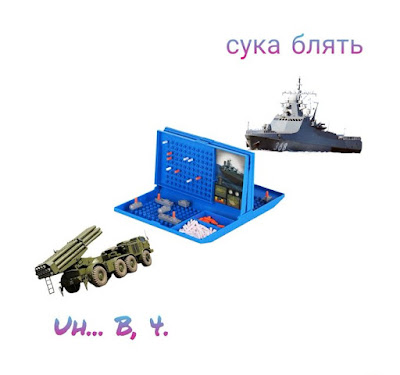
Did the Ukrainians manage to hit a Russian navy patrol boat with Grad rockets?

I'm sure regulars here have been tracking this for a few days;
You need to be careful in this war and when something sounds too good to be true, often it is. Sometimes, it isn't.  Hard to tell;
One of two Russian warships made famous for its attack on Snake Island in the Black Sea last month has been destroyed, according to Ukrainian military officials.

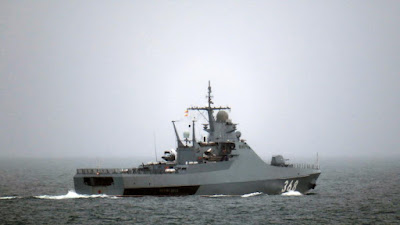
A patrol corvette, identified as the Vasily Bykov, appears to have been hit during a battle early Monday morning near the port city of Odessa. The destruction of the ship, which was commissioned in 2018, has not been independently verified.

As of today, you can find reports that it did and that it did not happen. As for me, I will assume that it did not until we have something a bit more firm ... and if I had to bet $20 I'd say we'll see Vasily floating pretty as can be sooner or later.

That being said, as we are all looking for ways to attack surface ships from shore west of Wake with what we have at hand - smart people were scratching their head if such a cheap and mobile system may be worth looking at...not after this, but years ago.

Back in 2020 we already experimented with the concept with our HIMARS in ... the Black Sea of all places;

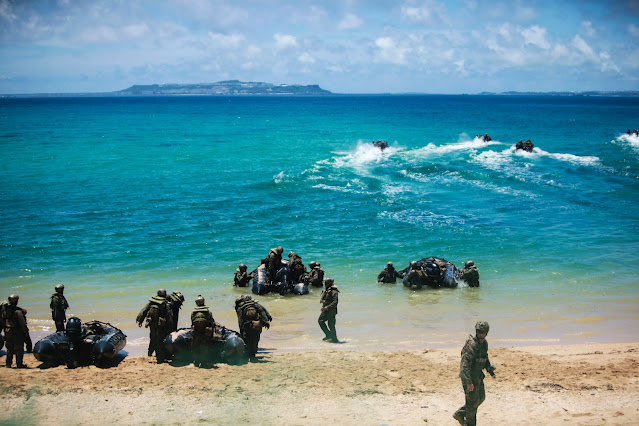
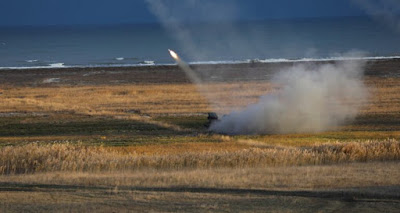
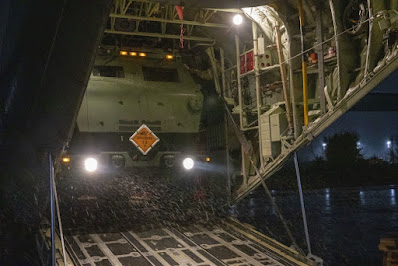
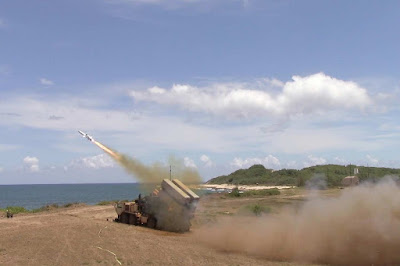
“U.S. and Romanian Forces gather in the staging area after the firing of a U.S. High Mobility Artillery Rocket System and Romanian Multiple Launch Rocket System into the Black Sea as part of Exercise Rapid Falcon Nov. 19, 2020 [see photo above]. This was 1st Battalion, 77th Field Artillery Regiment’s second live fire event since reactivation just 90 days ago and was the first time U.S. forces ever fired HIMARS from land into the Black Sea in cooperation with Romanian allies.”
Was that against a surface ship target? Does not seem so, however...the equipment ...
Two U.S. Army M142 6×6 High Mobility Artillery Rocket Systems (HIMARS) flew from Ramstein Air Force Base, Germany, on Thursday, November 19, 2020, aboard two U.S. Air Force Special Operations Forces (SOF) Commando II MC-130Js, the stretched version of the venerable C-130, and the HIMARS fired their rockets off the coast of the Black Sea that same day. 
If you need to get things on an off small islands, a C-130 is the way to do it.


But is the HIMARS rocket what we're looking for? No, not really - something a bit more, well, you remember...NavalNews sniffed it out too;
With future land-based Anti-Ship Precision Guided Weapons in development and available now, such as the Naval Strike Missile, the U.S. Army’s tracked MLRS, 6×6 HIMARS, and 8×8 Heavy Expanded Mobility Tactical Truck (HEMTT), and the U.S. Marines’ 8×8 Logistic Vehicle System Replacement (LVSR) and HIMARS, when modified and outfitted as Anti-Shipping rocket or missile launchers, are poised to become the “Go to” system for LBASM and LRPFs to prevent enemy ships and amphibious assaults on allied-protected islands and shores.

That was 5-yrs ago. Perfect? No, but something beats nothing and these sure are something. One problem I have is I'm not sure the LVSR in the above pic can fit on a C-130. If we want to have the maximum ability to make every island a porcupine and to have the flexibility to use USA or allied transport to move what we need where it is needed - I would think we would want it C-130 transportable. 

Marines don't have C-17s...

Fix that problem. Find a way to marry NSM to the Army's M142 and I'll take as many as you can produce. Those we don't need, we can sell at cost to our friends.

Time is short...and you know the Ukrainians wish they had a half dozen or so.


UPDATE: A helpful fan of the blog just knocked me on the back of the head with something from just 6-months ago...this. Yes this.
In August, the service was able to demonstrate NMESIS — full name Navy Marine Expeditionary Ship Interdiction System — during the Navy’s Large Scale Exercise off the coast of Kauai in Hawaii. Marines twice fired and hit a decommissioned vessel, as well as practiced loading and unloading NMESIS aboard a C-130 aircraft, according to Joe McPherson, program manager for long range fires at Marine Corps Systems Command.
...
NMESIS is a combination of several proven capabilities, a key reason why the service has managed to bring it online so quickly. The weapon itself uses the anti-ship Naval Strike Missile made by Kongsberg; a control system operated remotely, dubbed ROGUE-Fires; and the chassis of a Joint Light Tactical Vehicle. 

 “Marines can control the ROGUE-Fires with a game-like remote controller or command multiple launchers to autonomously follow behind a leader vehicle,” according to a recent Marine Corps statement. “The ROGUE-Fires vehicle, built on a Joint Light Tactical Vehicle platform, provides the Corps with a robust expeditionary system capable of operating anywhere.”
I've been told you can only get 1 JLTV in a C-130 at a time due to weight. I wonder if it can take the missiles in the same 130, or you need a second?

Anyway, this will work as MOD-0. 

Faster please.

UPDATE: Looks like Vasiliy is OK.

Friday, February 11, 2022

Fullbore Friday

So, how tough will you be in your 50s? Jeff Schogol over at T&P has a benchmark for you;


At 50 years old, (Paul) Douglas arrived at Marine Corps Recruit Depot Parris Island in 1942 to begin boot camp. The economics professor was more than twice as old as the average Marine recruit and Douglas remains the oldest recruit to pass through Parris Island.

...

Initially, Douglas was assigned to the personnel classification section of Parris Island after becoming a Marine, but he was not content with the idea of writing training manuals for the rest of the war, so with the help of his good friend Fred Knox, who was serving as Navy Secretary, Douglas became an infantry officer.

Douglas was commissioned as a captain after spending just seven months as an enlisted Marine and then he shipped out to the Pacific, where he fought in some of the bloodiest battles of the war. ... Douglas, who was serving as a division adjutant, had been allowed to take part in the invasion on the condition that he stay away from combat, yet he routinely volunteered to be a stretcher bearer to evacuate wounded and fallen Marines from the frontlines, Howard Shuman wrote in a 1979 profile of Douglas for Challenge, an economics magazine.

During one of his trips to the front, Douglas saw that the Marines desperately needed a flamethrower and ammunition for rocket launchers, so he grabbed what was needed and braved heavy mortar and small arms fire to deliver it to the front lines.  

...

As a leader, Douglas was credited with putting his men first. Shuman wrote how during one battle, a Navy corpsman refused Douglas’ order to treat wounded Marines who were under heavy fire.

“He said he was a Harvard Medical School graduate with training too valuable to risk his life,” Shuman wrote. “Incensed by his refusal, Douglas took out his weapon, pointed it at the doctor’s head, and marched him to the front lines. Years later he told me he still shuddered when he thought about it: he had been so outraged that he had been prepared to shoot the man if he refused again.”

Read it all ... because if you are well read in American history or quirky economic theory, you may recognize that name. 

He kept serving his nation for a very long time.

Friday, August 27, 2021

Fullbore Friday

When you read military history, you read all the time about "fighting retreats" and "rear guard actions" and with few exceptions, that is about the only mention they get, maybe a paragraph or two. That rarely does justice to the incredible sacrifice a few knowingly make to help save the many.

Those ordered to be the rear guard, or to execute a holding action, know exactly what they are being asked to do - and yet they do it willingly through good discipline or simply duty. Often they are not even ordered to do it, local commanders see the need, know commander's intent, and do it.

There are some well known events, Napoleon's Dutch engineers at Berezina is one, and for the maritime crowd Taffy-3 - but mostly they are footnotes.

I didn't know until this AM what we needed for today's FbF, and then on my commute in, it came to me clear as day.

Ten Marines and at least one Navy hospital corpsman are among the 13 U.S. troops dead following the two suicide bomb attacks on crowds struggling to get into the Hamid Karzai International Airport in Kabul on Thursday, USNI News has learned.

Eighteen U.S. service members were wounded and an unknown number of Afghans were killed and wounded in an attack believed to have been perpetrated by ISIS Khorasan. The military believes a suicide bomb was detonated near the Abbey gate at HKIA and another bomb – which it doesn’t have much information about – was detonated near the Baron Hotel by the airport, U.S. Central Command chief Gen. Frank McKenzie told reporters today at a Pentagon briefing.

Abbey Gate. This is where they were. This was their mission. Yes, “we” are doing an evacuation, but they are conducting the holding action to enable it:


This has been a numbing couple of weeks, but anything I or anyone else is feeling is nothing compared to the few thousands who are in AFG right now giving everything they can to salvage as honorable a departure as possible from this national humiliation.

To get a few ideas what they were doing before the attack, here is a series of short videos from the day prior.


We will know their names and see their faces over the next few days, but it could have been anyone on duty. Fate and luck are what they are in this line of work, but every day our nation's men and women don't ask why, they follow the orders of those appointed over them. They trust that their leaders and the nation they serve will do their best for them, as they do for us. As it was, it is, and will be. 

There will more stories to follow from our fellow Americans, friends, and allies as the best of us make efforts to do the right thing. Here's is just one of many examples we will hear of over the coming weeks and months.
Fullbore.

Thursday, March 25, 2021

Kafka and the Corps

It is time to return to a topic no one likes. It is one of the most damning of the military service and its leaders; the abuse of Command Investigation and the Inspector General process.

Sadly, they often degrade to the lowest motivation from one or two of the players involved. If not properly led and managed, they can quickly devolve in to Star Chamber, Kafkaesque nightmare that no one gets out of alive.

The more I've seen of them, the firmer I hold that no one can survive one intact. If you dig enough, you will run in to something or someone that can give an investigating body enough to destroy in a day what took decades to build.

I give to you another example, this time from the USMC. 

If you read this like I do, you come away with more questions coming out than going in.

Time to take a snapshot via Todd South Marine Corps Times.

You've had a full and successful career and are set up for Major Command;

Following multiple combat deployments after 9/11, by early 2017 Mann had been asked to take over 25th Marine Regiment ― one of only two infantry regiments in the Marine Corps Reserve.

The colonel had accepted the job, overseeing more than 4,500 Marines spread across 23 sites in 11 states and overseas, knowing it would be a different kind of assignment.

A tough but important job - a crown jewel for our best ... and two months after taking over;

...he learned about two equal opportunity complaints from a Marine sergeant in the headquarters company administrative section, which predated his tenure.

We have a NCO, been there a few years, who has a couple of EO complaints already under their belt.

The first of those EO complaints, in August 2016, coincided with a command climate in which Marines claimed there was hostile work environment and that the section, “unhealthy and rife with conflict.”

Look at that again. Having picked apart a few Command Climate Surveys, you cannot automatically assume that those at the top are the ones responsible for creating a section "rife with conflict" - they are responsible for fixing it, but may not have created it. Hard to tell, but the rest of the story may flesh that out.

Though the Marine sergeant’s supervisors listed in those previous complaints had since left the unit, he nevertheless counseled leadership within the section and said he was clear with his expectations.

The EO complaints and the climate survey may not be directly related, but in any event, we have people who "were" the issue who were now gone. That should clear the problem if that were it, right?

Better yet, Col. Mann did exactly the right thing out of Leadership 101. How will that work out?

Remember though, this isn't a happy story.

By late summer, the same Marine sergeant in headquarters company who had made two previously resolved EO complaints before Mann took over, was serving on limited-service status at a civilian doctor’s direction.

The Marine had suffered a health-sensitive medical incident that put the Marine on limited status.

Air conditioning wasn’t working at the time at the Fort Devens, Massachusetts, site of the admin section’s office.

The command allowed the Marine sergeant to wear physical training gear instead of the Marine’s uniform to work. They put portable air conditioners in the office and had previously allowed the Marine to work at an air conditioned site closer to the Marine’s residence, which was out of state.

If you served on active duty long enough, you should be at the point in this story where you can feel what is going.

On July 26, 2017, regimental Sgt. Maj. James Boutin told the Marine sergeant that the Marine needed to be wearing the uniform of the day while on duty. The Marine was in physical training gear instead. At the time of the brief interaction, Boutin did not know that the Marine was under medical orders.

Who could ever think that Sgt. Maj Boutin did anything substantially wrong here? 

Then, after having difficulties tracking down the Marine during duty hours, headquarters staff visited the Marine’s residence on Aug 1, 2017.

Time to make a couple of assumptions here. Like all assumptions, they could be wrong, but you have to make them with what you have at hand. "The Sergeant" in question here is your Mk1-Mod0 administrative burden ... and "The Sergeant" was UA.

[Editorial Note: at the point in the article it is clear that some post-modern journalistic decision was made to spot-weld a new grammatical structure that is as obvious as it is clunky; all steps are being made not to make a gender specific reference to "The Sergeant." No "he" or "she" or any other pronoun used to describe people for centuries since Chaucer. From here on out, I am going to refer to "The Sergeant" as T.S.]

The sergeant’s officer-in-charge, “decided independently to override a medical chit and recall the sergeant to duty, exceeding his authority, and misrepresenting his decision as the commanding officer (Mann’s) decision,” according to a subsequent investigation. The officer sent enlisted Marines to the sergeant’s residence to instruct the sergeant to return to work.

Mann, though unaware of the incident at the time, told Marine Corps Times that while the incident was handled poorly, the Marine was never denied medical care and all medical chits were honored.

From what I can tell, T.S. was never authorized to work from home ... so ... yeah, UA ... and while not perfect in 20/20 hindsight, what was done on balance was fully inside the lines.

So, you know where this is going, right?

The next day, Aug. 2, 2017, the Marine sergeant reported for duty, was counseled and then made a “for your eyes only” request mast to Whitman, commanding general of 4th Marine Division.

...and there we go.

The Aug. 4, 2017, request mast launched a command investigation, ordered by Whitman. Due to the nature of the request, Mann was not aware at this point of either the incident that had triggered the request nor the request itself.

See a pattern?

The subsequent investigation placed blame on the actions of the sergeant’s immediate supervisors and “did not recommend any adverse action be taken” against Mann, according to both the original 2017 investigation and a recent ruling by the Department of Navy Board for Correction of Naval Records.

That is an important point  ... in hindsight ... but that is not what happened.

Mann and Boutin said that Whitman didn’t hold them at fault for the incident would follow the recommendations of the investigating officer, which included counseling of the Marines directly involved and further education and training on EO and medical issues for members of the staff.

But on Oct. 4, 2017, Whitman returned from his talk with McMillian and told the three Marines they were fired.

“I was asked to clear my office space, put on my civilian gear and that was it,” Mann said. “I never put on a uniform again except for my retirement in 2019.”

There you go. Lt. Gen McMillian, USMC. There's your player.

I've seen some take their experience in the Star Chamber lying down ... others, no.

Mann disputed his subsequent adverse fitness report, which dropped him from the very top of the promotion pile to the lowest possible category of “unsatisfactory” for promotion.

The colonel filed multiple rebuttals to the three-star’s decision, all were rebuffed.

Mann countered McMillian’s reasoning directly in his rebuttals.

“Fundamental fairness suggests that a board selected regimental commander be relieved for actual facts that create a clear understanding of the senior commander’s loss of confidence ― I do not feel that has occurred in this instance,” Mann wrote.

The relief was based on the command investigation out of the request mast, McMillian wrote in his fitness report remarks to Mann.

Yet the investigating officer “never directed that (Mann) be a subject of the investigation or that my performance regarding the incident at hand be specifically investigated,” Mann wrote in his rebuttal to McMillan’s fitrep remarks.

Because of the nature of the request mast, Mann didn’t know what had happened involving the sergeant until he was being fired. He essentially reconstructed the event after the fact as he was fighting for his career.

“The Investigating Officer’s exhaustive investigation does not contain a single finding, opinion or recommendation specific to my performance, actions, conducts or decisions as the Commanding Officer; nor does it suggest dereliction or neglect on my part,” Mann wrote.

McMillian stated that the investigation itself was enough reason to consider Mann’s conduct as commander.

In his response to Mann’s rebuttal, McMillian rejected Mann’s reasoning and reiterates that, “the Commander is responsible and accountable for all things the command does and fails to do.”

True. Command is command ... but ... still amazing.

Let's check in with Sergeant Major Moutin.

The fired sergeant major, Boutin, filed a 22-page rebuttal to the report but told Marine Corps Times in March that it had gone nowhere.

“It devastated me,” Boutin said. “It devastated my family. I have dedicated my entire life to the Marine Corps.”

During nearly 30 years, Boutin had served his entire time as an infantryman, seeing five combat tours, and never having had any bad paperwork, he says.

This is what his Corp did for him;

The sergeant major stands by his interaction with the Marine sergeant. The sergeant was not in the assigned uniform of the day and he corrected the situation by telling the sergeant to wear the appropriate uniform, though Boutin was unaware of the Marine sergeant’s medical condition or limited work status at the time.

He was not involved directly in the subsequent house visit. But he was fired, along with the personnel officer and Mann because he was part of leadership, he said.

Boutin had envisioned completing a full 30-year career before saying goodbye to the Corps.

“I didn’t even get a handshake on the way out the door,” Boutin said.

Read the whole thing. I took a lot of pull quotes, but there is a lot more to the story. 

I would offer that there is a lot to this story beyond what is in the article, specifically in two areas.

T.S. and the 3-star decision tree. 

Those are the two stories.

At the end of the day though, as is usually the case in situations like this; how do you get your name back?  

Monday, May 18, 2020

Why Listen to Jim Webb?

There is goodness in the creative friction between Berger’s neo-transformationalist movement within the USMC - you can read the meaty parts here - and the traditionalist pushback whose default head for now seems to be Jim Webb.

There has been a lot of back and forth the last couple of months that I have mostly ignored on the blog. I think the issue has seasoned well enough to start the week on the topic.

I’ve had on and off issues with Webb through the years, and that bias of mine kept me away from reading his article closely. On second reading, his opening stuck with me.

I keep coming back to it.
On September 4, 2002, five months before the invasion of Iraq, this writer warned in an editorial for the Washington Post that “China can only view the prospect of an American military consumed for the next generation by the turmoil of the Middle East as a glorious windfall . . . An ‘American war’ with the Muslims, occupying the very seat of their civilization, would allow the Chinese to isolate the United States diplomatically as they furthered their own ambitions in South and Southeast Asia.”
He was right. From that point, you can see the see of the rage that drove his political action.

On Berger’s neo-transformationalist drive, I think we should pause to consider Webb’s strong and informed warning.
Interestingly, when citing his philosophical inspiration at the outset of his proposal, General Berger chose to ignore two centuries of innovative and ground-breaking role models who guided the Marine Corps through some of its most difficult challenges. The giants of the past—John LeJeune, Arthur Vandegrift, Clifton Cates, Robert Barrow and Al Gray, just for starters—were passed over, in favor of a quote from a professor at the Harvard Business School who never served. Many Marines, past and present, view this gesture as a symbolic putdown of the Corps’ respected leadership methods and the historic results they have obtained.
It is fun an sexy to say that you, or someone you follow, all of a sudden see the future clearly as no one else does … that you are smarter and more perceptive than those who came before. That you are progressive with a new look on a new frontier.

One must move forward, we must evolve. We always do … but it must be grounded on the knowledge of how we got here.

Is Berger right? No.

Is Webb right? No.

The right path is somewhere in between.

What we don’t need are mindless advocacy on behalf of either, as if they received a gilded book from on high.
If history teaches us anything in combat it is that the war you get is rarely the war that you game. As former heavyweight champion, Mike Tyson once put it, “Everyone has a plan until they get punched in the mouth.” In World War I the Germans were convinced they would defeat France in exactly forty-two days. Prior to World War II the French matched this folly by building a string of fortresses along the Maginot Line, leaving open the thickly forested Ardennes, which their war planners decided was impenetrable by a large-scale German attack. In 1941 the British were convinced that no military assault could overcome its shoreline defenses against an attack on their naval base in Singapore, then known as the unassailable “Gibraltar of Asia.” The Japanese army landed far to the north, then bicycled and marched its way down the Malayan Peninsula, attacking Singapore from behind and quickly smashing the stunned British and Australian defenders. Except for General Tomoyuki Yamashita the Japanese high command was not usually that brilliant. Its pre-war plan of fixed defenses on island redoubts throughout Pacific Asia backfired spectacularly, and their inability to adapt after their unexpectedly quick victories at the beginning of the war allowed American resilience and control over the sea and the air to destroy their gains.
... 
None of these debacles were the result of a failure in new technologies. All were the failure of faulty planning and especially of the miscalculations of those at the highest levels of command.