Showing posts sorted by relevance for query stavridis. Sort by date Show all posts

Thursday, July 07, 2011

Admiral Stavridis, don't confuse the issue


Ungh. I wish otherwise smart people would have left this quasi-intellectual tic of Climate Change (nee Global Warming, nee The Coming Ice Age, nee The Population Bomb, nee Bad Air Causes Plague, nee Volcanoes Need Virgins) at the gates of East Anglia University - but alas - a critically important subject is being tied around a bad-science cult.
Admiral James Stavridis, Nato's supreme allied commander in Europe, in a foreword to a recent Whitehall Ppaper published by the Royal United Services Institute for Defence and Security Studies in London, argued: "For now, the disputes in the north have been dealt with peacefully, but climate change could alter the equilibrium over the coming years in the race of temptation for exploitation of more readily accessible natural resources."

Stavridis believes military assets, such as coastguards, have an important role to play with international co-ordination in the area – but mainly for specialist assistance around commercial and other interests.

He added: "The cascading interests and broad implications stemming from the effects of climate change should cause today's global leaders to take stock, and unify their efforts to ensure the Arctic remains a zone of co-operation – rather than proceed down the icy slope towards a zone of competition, or worse a zone of conflict."
Admiral Stavridis, let me help.

Let me see, my little red pen is ... oh, here we go. Try this,
Admiral James Stavridis, Nato's supreme allied commander in Europe, in a foreword to a recent Whitehall Ppaper (sic) published by the Royal United Services Institute for Defence and Security Studies in London, argued: "For now, the disputes in the north have been dealt with peacefully, but economic forces could alter the equilibrium over the coming years in the race of temptation for exploitation of more readily accessible natural resources."

Stavridis believes military assets, such as coastguards, have an important role to play with international co-ordination in the area – but mainly for specialist assistance around commercial and other interests.

He added: "The cascading interests and broad implications stemming from the effects of evolving
economic and security needs should cause today's global leaders to take stock, and unify their efforts to ensure the Arctic remains a zone of co-operation – rather than proceed down the icy slope towards a zone of competition, or worse a zone of conflict."
There - same concern - but founded on real and proven reasons. We don't have to go through the "Climate Change" genuflect to make the point. Smells too much of the Soviet Era use of "Comrade" - just used to show deference to the "correct" people with the "correct" ideas. Unseemly.

Admiral Stavridis has touched on the High North/Arctic issue before, as is good and right for NATO to do.

As resource access, economics, and changing global security systems evolve, access and ownership of the poles will continue to make this a critical area - especially as China tries to find an excuse to play. This requires the clearest, most direct intellectual discussion in order to make sure we get this right.

Throwing the questionable science and clearly political goals of the Global Warming/Climate Change cult will only discredit the very real and very dangerous national security challenge.

When the Arctic ice grows - as it will, and always has - will the Arctic be less important this century? Of course not. Say it was all climate change related will call the importance into question.

As a side-note - I can't find it, but if anyone has a link to the Whitehall Paper, please send it my way so I can see the context of his comments in full. If topic of the Paper was about "Climate Change" then ungh, Admiral Stavridis should have demurred and let someone else do it.

You know me - I am a fan of Admiral Stavridis - but people can disagree. I'm also a 80% man - so I'll just put this in the 20% pile and still smile and move on. Hmmmm .....

Instead of cursing the darkness, perhaps I should light a candle. I bet he hasn't read Watermelons: The Green Movement's True Colors yet.

Tuesday, October 10, 2006

Not everyone is a fan of SOUTHCOM's new J00

SOUTHCOM has a new boss, now VADM and I am sure soon to be ADM James Stavridis.
UPDATE: I don't know what happened, but the last bit of my post didn't make it (argghhhh...blame blogger). But it should have read after the end "...but they are as rare as hen's teeth. Everyone I know likes the guy. The comments (except perhaps Skippy) agree.
UPDATE II: But wait! There is someone out there that doesn't like him. Well, that's not fair; perhaps doesn't like his ideas. Reader "G" sent along an email with the REJECTED letter to Proceedings he says he sent early in the year in response to VADM Stravridis's Proceedings article last DEC.

Heck, you know me - I like nothing more than to invite a skunk to the party. "G" writes like a CDR Salamander reader - I don't endorse all he says, but hit makes some good points, and it's an easy post for me. You send me anything that manages to get fundementals, Hopkirk and PV=nRT in a response to a VADM's published work, you have my attention. "G" you have the floor.
Vice Admiral Stavridis’s Deconstructing War has a fatal flaw in its foundation, but his concluding recommendation is spot on.

Everything new, isn’t. That is the simple response to his fatal flaw. He states, “…new thinking is required.” (VADM Stavridis, Deconstructing War, Proceedings DEC05 pg. 42) Accurate at first blush, but there is actually little new in the “new” he is looking for. What is needed is an expanded understanding of history and our place in it, and a reduction in the minting of new buzz phrases and exaggerated responses to a growing challenge. The opening sections of Deconstruction War is a classic case of the conceit of the now, where all is seen in reference from one’s generational experience. He scripts an unnecessary atmosphere of crisis and confusion – grasping for answers to what seem like previously unknown challenges. While his points on change, chaos, and uncertainty sound daunting; they are not unusual, unique, or for that matter as dramatic as he makes them when taken in the scope of historical experience. This is not a time for panic or distress, but a time for a calm understanding of what needs to be done and to take comfort that other’s have engaged and overcome challenges much greater than we as a Navy and a nation face.
“The world is simply moving so much faster today than at any point in any of our lifetimes; and it appears a good bet that this sense of speed – indeed, this sense of acceleration – will only continue.” (ibid, pg.42)
That statement could have been written in 1869, 1919, 1945, or 1969. The relative change in information flow and technology shift are the same. Those who witnessed the completion of the steam engine, the wireless, the elimination of the bison, the anarchists’ assassinations, the atomic bomb, and the social revolution of the late 1960s saw change as great if not greater than what we see now. Even within the limits of my much shorter lifetime, it is a safe bet that 1967-72 and 1987-92 can more than give 2000-2005 a run for its money.

A Generation X or Baby Boomer’s lifetime, or that of anyone in the last 150 years provide small sample of examples. Those who watched the walls of Athens torn down in 404 B.C., the European armies retreating west to the boarders of present day Austria in the face of unrelenting Mongol victories from 1229-1241, those who fought next to Emperor Constantine XI in May of 1453, the coalition that rode with King John Sobieski of Poland to drive the Ottomans from Vienna in 1683; they would all understand a culture and a society under threat and the seismic shifts that can happen in the life of a man that can force a people, a culture, and a military to rethink established norms. They would not be impressed by the danger the West faces right now. They would understand the problem, but would not see it as drastic, at this phase, as some make it to be. They would counsel aggression no doubt, but exaggeration – no.
“We live in a world of extraordinary technological and scientific change. Adding up all the major discoveries of the first 5,000 years of recorded history, the sum total of accomplishment likely would amount to much less than what we have produced over the past 50 years.” (ibid, pg.43)
Everything that can be invented has been invented.
Charles H. Duell, Commissioner, U.S. patent office, 1899 (attributed)
This comment, more than anything else, is unnecessary hyperbole. From 1955 we have seen much, from the speed of information, to spaceflight, to the genome. As great as these are, they are but flickers of children’s brilliance standing on the shoulders of giants. The giants that brought us from Stone, Bronze, and Iron Ages to where Von Braun dared to help us race the Soviets to the Moon.

Overestimating the degree of our challenges is to invite paralysis, rash action, and poor decisions. Yes, an atomic bomb going off in New York City would be an absolute disaster – Ricin spread by a crop duster over Los Angeles would be a horror; but as a relative impact on the U.S. and our diverse economy, population, an leadership; it would be a hit much easier to absorb for the host culture than the loss of Kiev in 1240, Baghdad in 1253, or Berlin in 1945.

The fall of those cities had an impact on an order of magnitude greater than we would face with the loss of NYC or LA. However hard for the 21st Century mind to grasp, mankind has faced events in the last 5,000 years far beyond anything we face today. Though some challenges may be greater from a static analysis, so is our ability to engage those challenges and pursue them to a result in our favor.
“In many ways, we may have indeed reached the “end of history” that Francis Fukuyama wrote about so eloquently at the conclusion of the 20th Century. The days of massive coalitions of national armies, navies, and air forces contesting each other may be coming to a close.” (ibid, pg.43)
Greater minds than mine have already debunked Fukuyama’s work, but from Alfred Nobel to the delusions of post-Versailles Treaty Europe; those who considered and hoped for an end to major conflict have been crushed by the weight of human nature and history. Though VADM Stavridis did backtrack some on “the end of war” thread, the comment itself calls into question everything else that follows.
“The principles of war operation best in nation-on-nation conflict for which they were developed … the very nature of ‘what war is’ has changed irrevocably with the advent and dispersal of weapons of mass destruction … War has always been chaotic. Now it is pure chaos.” (ibid, pg.43)
No, sir. The legions of Aztec warriors dying of smallpox and still trying to understand the gun and the horse during the siege of Tenochtitlan in 1521 would understand pure chaos. We fight in an ordered world that encounters moments of chaos, not the other way around. To convince yourself that all is “pure chaos” is to preemptively surrender to any opponent that understands the trends, patterns, and habits that have defined human behavior in the last 5,000 years.

Our challenges are much more manageable, but the processes are the same. The only difference is the specific application and the intellectual rigor to address our changing situation.

Intellectual rigor, or Intellectual Capital, is where VADM Stavridis hit the nail on the head. We need to develop the right leadership bench to address developing challenges, the “Unknown Unknowns” as described so well by Secretary Rumsfeld. In the last four years the world has changed, as it always does. Unfortunately, on average the way we detail, promote, select, an reward Navy officers has not changed appreciably since I sat in a simulator as an Ensign learning to track an Echo II off the Azores.

Break the back of the Technical Education Bias. To execute VADM Stavridis’s plan to have the right mix of officers to respond to the changing world we face, we need to prepare to build that team. With the present bias towards technical areas of study, his plan is stillborn. He proposes an officer skill set to produce that new thinking that will not exist in our Navy to any large degree without a radical departure from accepted practices. Our navy needs to break the back of our accession, promotion, and selection process. Not adjust, not tweak, but break it down to parade rest and rebuild it.

The Americans who have the natural skill sets needed for language, business, and theory asked for by VADM Stavridis are being turned away at the door wholesale by a myopic accession bias towards technical areas of study in both undergraduate and post-graduate study. Want to study International Relations or Econometrics – no. Want to study Operational Analysis or Electrical Engineering at Navy Postgraduate School – yes. Though engineers and advanced application of mathematics are important, the excess institutional bias towards these skills results in an imbalance in the navy’s aggregate skill set and a resulting stunted, limited intellectual gene pool to meet emerging challenges. In most wardrooms, especially pre-9/11 you would get and almost unanimous response to “Who has ever seen the formula PV=nRT?” Likewise, 95 percent of the time you would have been greeted by uncomfortable silence by the question, “Who has ever read Hopkirk’s, The Great Game.”

To get the best out of an intellectually diverse population, you encourage an intellectually diverse a population to begin with. Without eliminating of a shortsighted policy that hunts for Physics majors but shuns Classics majors – tearing that policy/habit up root-and-branch – any other efforts will be stillborn – and we will be stuck with Wardrooms full of people indifferent to anything that does not have a formula.

Reconfigure the career path. In his plan, he takes as an example an officer in his “apprenticeman years” and puts him on a different path – the dreaded “non-traditional” career path. If you snap-up front-runners at Length of Service (LOS)-5 inside today’s uncracked, hidebound Millington Diktat, there are barriers that our Navy will throw in that officer’s path every step along the way.

Let’s assume that the officer in question is in aviation. Without fixing the fundamentals, we put him on The Plan. Finishing his first tour at LOS-5, he spends a year at a company of some kind (LOS-6), another non-Navy service tour (LOS-9), and a year at the Joint Command and Staff College or equivalent (LOS-10). You need at least a year in there for wiggle room, language immersion (the only way to be fluent), and PCS, which brings that officer to LOS-11. That gets him to his (assume aviation) Department Head Tour, spitting him out at LOS-13. He is now looking at the CDR and Command Screen Board. A large percentage will not be able to make that timeline. The vast majority will find themselves on the professional sidelines. Some will get through, but as it stands no, most will be set up for failure.

The thing that his immediate Chain of Command will be yelling at him about the proposed career path is, “You will never survive six years of non-competitive FITREPS. You may make CDR, but that will be it. (…and if you come from a non-TACAIR community…) You don’t have a boat tour? Command? Mmmm. If you were the #1 competitive LT your first tour, and my #1 DH, I might see a Special Mission Command.” That translates to an officer that might make CAPT and has an exceptionally limited chance for Flag. As a result, he will not have a significant opportunity to use the skills he spent the better part of a decade and a half developing. If you want to create a cadre of overqualified terminal-Commanders, this is a great plan. If you want a better than average percentage of these officers to screen for Major Command and compete for Flag, you have a pipe dream.

What will that hard-charger (remember, at the LOS-5 point this fresh LT is only in his late 20s) going to choose? What will the Skipper tell his #1 LT? Go the new path, or interview for the Flag LT job in San Diego? Perhaps the FRS Instructor billet? In the real world of the talented and ambitious Junior Officer, what percentage will want to take The Path? Unless the rules of the game and the facts on the ground are changed, what is waiting for that LT as he steps through the door of The Path? What stops the LT from moving on to positions that significantly impact our Navy’s future? These are all things under the control of our Navy. These are the things that need to be addressed first.

What will stop that highly trained officer at LOS-10 from saying to himself, “Forget the Navy. I can do more for my country, have a greater impact on the future, and go further in the FBI with my education and language skills than in the Navy. I didn’t go to Dartmouth and Georgetown to find myself treading water at 42.”

What will stop that officer from leaving is rock-solid truth about his options in the Navy. Not promises, not spin, not salesmanship, not buzzwords, but fact-based truth. To give that officer the right facts so he will make the right decision for both the Navy and himself will require radical, aggressive action.

On par with cleaning the Augean Stables, the Navy needs to clear the field for our future officer corps. Not just with the flavor of the officers it accesses. The selection board system as it exists today works well within its limitations and design, but it has inherent flaws and traditions that will push to the side many of the officers VADM Stavridis wants. We need to kill the stultifying “Select in Their Own Image” habits and career advice. The absolute top of the Navy needs to aggressively prevent the credibility corroding habits of some senior officers who promote their own self-defined priorities and biases attached to individual names. As we saw with the 14 Feb 2006 dissolved Commander Board – this happens. This time it was caught and the right action taken. This was not an isolated event. You can catch written material. It is much more difficult to catch phone calls, emails, and face-to-face “material” given to board members about personnel in front of a board. Additionally, community influence needs to be further reduced to protect those who depart the community stovepipe. A way around the “up or out” nature of our officer corps needs to be developed, nurtured, and expanded.

“New Thinking” is unquestionably needed, but it needs to start with some changes in career fundamentals. Without going after the fundamental problems everything else is simply an entertaining academic exercise.

Grow the skill sets we want. Reward those skills. The rest will follow. This crop takes two decades to grow. 2025 will be here before you know it.

Wednesday, March 18, 2009

Stavridis to SACEUR

I wish him well.
US Defense Secretary Robert Gates said on Wednesday he has recommended the nomination of Admiral James Stavridis to be the next NATO supreme commander.

Stavridis, currently head of Southern Command, "is probably one of the best senior military officers we have," Gates told a news conference.

If nominated by President Barack Obama and confirmed, the admiral would become the first naval officer to take the NATO post.

SACEUR's job is mostly a political one. Hopefully, Admiral Stavridis has gotten past his "war is new" transformationalism - but the nature of the job should blunt much of that thought anyway as there are much more important things for SACEUR to do in order to keep the alliance happy and helpful. The job should play to his strengths.

Hat tip Maggie.

Thursday, June 04, 2015

Stavridis on Putin and Understanding the Russian Mind

On Tuesday over at FP, Admiral James Stavridis, USN (Ret.) offered up some of the best advice I have read in awhile for those who are trying to get their head around Putin and what is going on with Russia.

As I've mentioned here and we've discussed often on Midrats, Russia is neither West nor East ... she is just Russia. To try to understand her as anything else simply will not work.

Given that ... why is Russia being ... Russia?
Want to really understand what’s going on in Russia? Get rid of that CIA report full of dusty Cold War tropes. Forget the NSA intercepts or spy satellite imagery. And drop the jargon-filled scholarly analysis from those political science journals.

Instead, get back to the richest literary gold mine in the Western world: Russian novels and poetry. Read Gogol, Dostoyevsky, Turgenev, Pushkin, Lermontov, Tolstoy, Solzhenitsyn, and Bulgakov. That’s where you’ll really find how Russians think.
Stavridis gives a great series of recommendations.
Begin with Nikolai Gogol’s 1842 masterpiece, Dead Souls. It is the blackest of black humor, a story in which a mysterious businessman moves through the Russian countryside “buying up souls” (i.e., taking away a tax burden from the estate owners).
...
How will Russians fight and what kind of leaders do they follow? Want to understand their patriotism? Go read the master, Leo Tolstoy. His sweeping 1869 epic, War and Peace, shows us how the Russians think about their ability to fight, and illuminates the deep patriotism that fuels today’s nationalist tendencies.
...
Fyodor Dostoyevsky in Crime and Punishment spins a tale that captures the Russian sensibility perfectly: A deeply troubled protagonist chooses to kill, but then is haunted by guilt and — encouraged by the good people around him — eventually confesses. He is then purified and ultimately achieves redemption.
...
Think the Russians will crack under sanctions? Try reading One Day in the Life of Ivan Denisovich, the 1962 novel by dissident Alexander Solzhenitsyn. His protagonist, a convict in a Siberian gulag, finds a hundred ways to scrape through the day, dealing with the petty corruption, laughing at the predicaments, occasionally reveling in the harsh conditions of his imprisonment, and powerfully exhibiting the ability to overcome adversity.
...
For something more modern, try One Soldier’s War by Arkady Babchenko. It’s a foot soldier’s memoir set in Chechnya during the height of the war there in the 1990s waged by the Russian conscript military against the rebellious population. This is counterinsurgency turned upside down — the Russians aren’t trying to win the hearts and minds; they are quite content with putting a bullet into each.
...
And finally, to understand the view of the Russian émigré, the brilliant Russian-American novelist Gary Shteyngart’s Absurdistan captures the post-Soviet space better than any book of non-fiction. Set in Moscow and a thinly disguised Azerbaijan (a former republic of the USSR, in case you forgot), it serves up a portrait of Russian “capitalism” with a huge dose of black humor. It echoes Mikhail Bulgakov’s The Master and Margarita, a magical realist novel written in the 1930s, in its evocation of the Russians’ ability to exist quite happily in a world where everything is half a beat off the music.
...
And what of Russian leaders? Dostoyevsky said about one key character in his masterpiece, The Brothers Karamazov, that “Anger was buried far too early in a young heart, which perhaps contained much good.” A description of the young Putin? Perhaps.
When in doubt, no one could be accused of doing a bad thing if they picked up a book. Or, as simply put by Stavridis;
...pick up a novel and start reading.

Tuesday, December 08, 2009

How is that Global Maritime Partnership working for you?

International naval forces will never be able to completely secure the vast area of ocean where Somali pirates are hijacking ships off East Africa, the commander of the EU Naval Force's counter-piracy efforts said Tuesday.
...
The naval commander said the Maran Centaurus was traveling east of an area that the EU Naval Force advises tankers to steer clear of, so that it wouldn't necessarily have expected to have been attacked. Pirates now hold 11 ships and 264 crew members off the coast of Somalia, said Rear Adm. Peter Hudson.

"The news of a few days ago of a 300,000-ton tanker being seized is illustrative of the problems in protecting and policing an area of the world's oceans that amounts to an area of about 1 million square miles," said Hudson, the commander of the EU Naval Force's counter-piracy operations.

Hudson also said the fact that pirates are now attacking ships as far as 1,000 miles (1,600 kilometers) off the Somali coast presents a large challenge and that the EU force will never fully secure such a large area. The EU Naval Force's strategy in the smaller Gulf of Aden is to lengthen the amount of time it takes pirates to get on board so that a warship or helicopter can be dispatched to the scene.

"The difficulties in an area as large as it is in the Indian Ocean with the short number of assets that we have is that ... the pirate can keep going and keep going and keep going until it's successful in getting on board, because there's nothing there to stop it," he said.
Poor excuse. What weak cheese.

That being said, what did you expect from the EU?

Clearing waters of pirates was done over 200 years ago using wooden sailing ships with limited ISR ... it can be done today. All it takes is will.

Having worked with the EU military structures in Strasbourg .... I can tell you that you won't find the will there.

Not that it means other less supine organizations can't try.

One of the good guys, SACEUR (nee Admiral Stavridis) is
passing the hat.
Adm. Jim Stavridis, new Supreme Allied Commander Europe (SACEUR), said here Dec. 7 that "more ships would be helpful" to counter piracy off Somalia but that "what I'm really after is maritime patrol aircraft, NATO AWACS [Airborne Warning and Control System] and satellite images."
Bingo.

A big, fat, slow Maritime Patrol and Reconnaissance aircraft is about as nonthreatening as you can get. Even the EU shouldn't have trouble getting the vapors from using them. We won't even make them carry weapons.

So, what is ADM Stavridis asking for? First of all, outside some "special" UAS out of The Seychelles - let's go ahead and acknowledge that all the UAS are off doing AFG business. Let's stick with manned aircraft - and cheat by using Wikipedia for our J2.

So, you want a NATO anti-piracy ISR "surge?" How would you do it?

Sticking to large, fixed-wing, long range Maritime Patrol and Reconnaissance aircraft for planning purposes, let's see what we can do. Well, the French have about 22 Atlantique II/III. The Italians I think retired their antique Atlantiques - I can't find an up to date reference - so I guess the Italians can go get a coffee then. The Germans bought the Dutch P-3s and have about 16. Portugal has five, and Spain a half dozen or so P-3s. The Brits have a dozen Nimrods that are still limping around, and even the Norwegians have a half dozen P-3s left.

Expand the scope, and you might even get an Aussie or Kiwi P-3 to help out. In a perfect world, the Japanese would bring theirs out ... but I doubt it.

Enough to choose from. Now, where do they go?

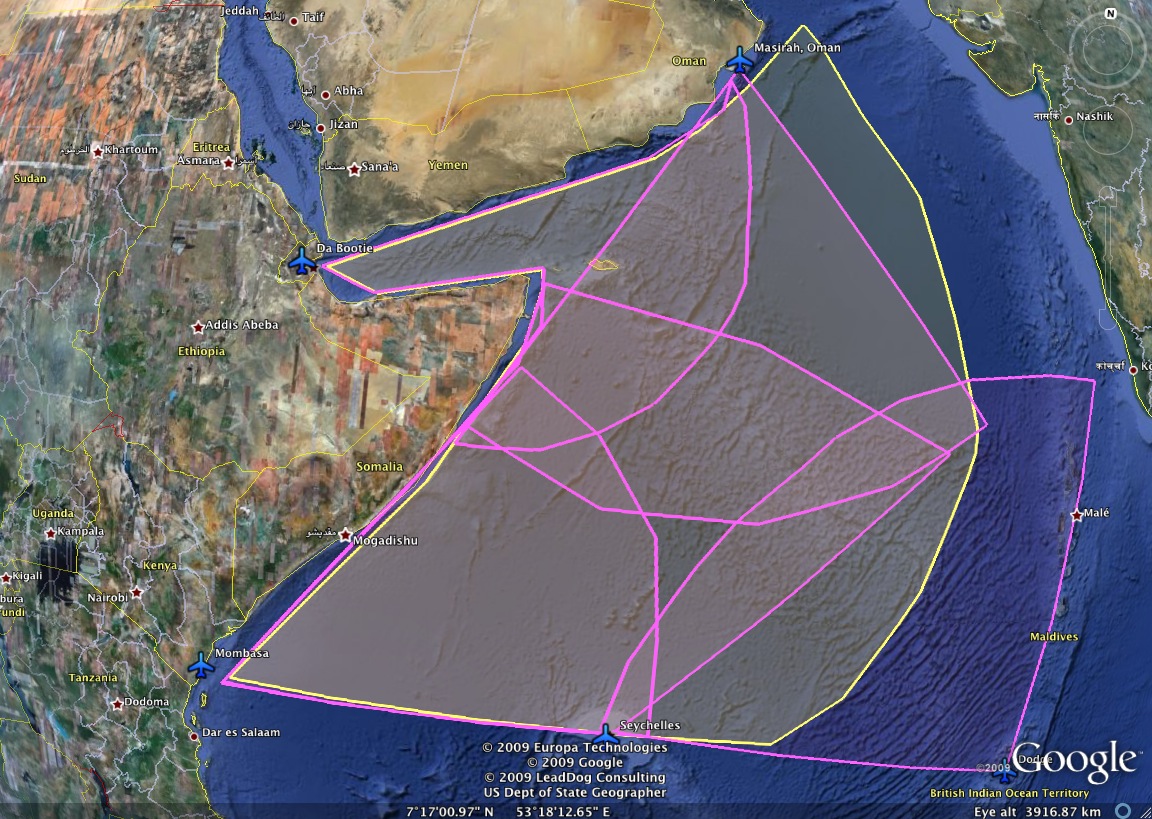
Between Mombasa, Masirah, Dodge, Seychelles, and "Da-bootie" there are plenty of places to park them if you can get the host nations to buy in .... from there all it takes is the Europeans finding the OPTAR. Good luck with that. Everyone is short of money, and one thing MPR aren't are cheap.

The French could take Da-bootie, the Germans have a good history flying out of Kenya - and of course we and the Brits know Masirah like the back of our hands. Ditto Dodge and The Seychelles.

AW1 & MTH, help me out here in case I am totally out of order. What do you need now days to make two missions a day? Three to make two?

OK, I'm digging deep in my brain here - so don't be too picky.

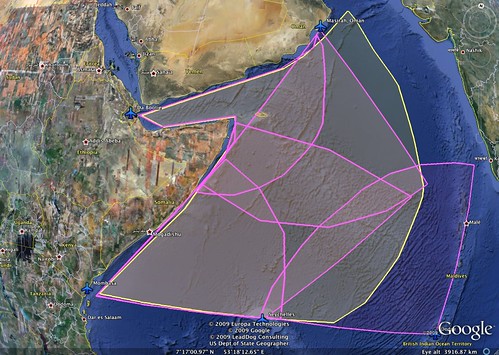
I've had a little fun with GoogleEarth. There are ADM Stavridis's basing options. Only Dodge belongs to a NATO nation - but Da Bootie should be a shoe in via the French and our history with them. From there, in decreasing likelihood of getting an OK; Kenya, Seychelles, and Oman.

From each base I have put a roughly 1,000 arch (in P-3 pink) as the plane flies (yes, you can cover more our of Masirah - don't be so picky I am a one man shop and was in a hurry). The yellow area is a roughly 1,000nm range from the coast of Somalia; pirate country. Here is the map (larger one here.)


Again, AW1 & MTH - help me out. Let's rough out an average of 9-hrs per mission. It would take what, 3 hrs to get to a 1,000 mile onstation point (let's work realistic worst case missions - though some will be much closer to base)? Assume that you don't enter and exit at max distance even for the long runs. Round trip 5 hours. That gives you 4 hours on-station time a mission, minimum (as some missions would be much closer - and with modern EO/radar you don't need to fly by everyone). You guys tell me how much area you could cover in the IO with 4-hrs in 2009. I'll keep moving.

If each base could cover two missions a day - that would be 8-hrs onsta per base. If "3 makes 2" and you have 5 bases operating, that would be 15 P-3s to make 10 missions a day giving the anti-piracy commander (if they could ever get unity of command, which they don't right now) 40 hours a day of MPR onstation time.

We are dealing with NATO here - so best case you get 7 non-USA MPR aircraft flying from two locations giving you 3 missions a day. To fill the gap, you would need a full USN P-3 squadron flying out of two other to do the rest - and even then - you won't get the balance of missions. You might get 4 to 5 from USA. That is 3+5=8 missions, 32 hours a day of MPR onstation time best case. That is one big body of water. When you add it all together - figure a 1,700nm x 1,200nm area for planning purposes. To compare - the Caribbean is about 800nm x 1,400nm

NATO gets Da Bootie and Kenya. USA gets Dodge and Masirah - we'll leave The Seychelles to the snake eaters. That would leave a triangle shaped gap in coverage about 400NM north of The Seychelles - but the surface ships and helos could over that.

So, what 'cha think for a few minutes of pondering? Did I earn a per diem check?

Tuesday, March 29, 2011

SACEUR J2: Please Call Your Office


As we watch the power in Egypt's revolution slide - as I warned you about - towards the Islamist Muslim Brotherhood - we should all think carefully about what SACEUR, Admiral Stavridis, USN has to say as reported by the Washington Examiner.
Appearing before the Senate Armed Services Committee, Stavridis was asked by Republican Sen. James Inhofe to comment on "reports about the presence of al Qaeda among the rebels, among those with whom we are associated." "As you can imagine, we are examining very closely the content, composition, the personalities, who are the leaders in these opposition forces," Stavridis responded. "The intelligence that I am receiving at this point makes me feel that the leadership I am seeing are responsible men and women who are struggling against Colonel Gadhafi. We have seen flickers in the intelligence of potential al Qaeda, Hezbollah, we've seen different things, but at this point I don't have detail sufficient to say that there is a significant al Qaeda presence or any other terrorist presence in and among these folks. We'll continue to look at that very closely. It's part of doing due diligence as we move forward on any kind of relationship."
... if you are still feeling OK about it though, leaven it with this.
The lack of knowledge about the Libyan opposition has become a major question in the Libya conflict. At Monday's Pentagon briefing, Fox News reporter Jennifer Griffin asked another top official, Vice Admiral Bill Gortney, a very simple question: "Do you know who the opposition is, and does it matter to you?" "We're not talking with the opposition," Gortney responded. "We have -- we would like a much better understanding of the opposition. We don't have it. So yes, it does matter to us, and we're trying to fill in those gaps, knowledge gaps." Gortney's answer was another suggestion that the U.S. is doing critical due diligence on the fly in Libya.

Tuesday, June 13, 2017

So, we get Stav and Mattis in a room ....

So, SECDEF Mattis (no, I don't get tired of saying this) put it right out there;
"We are not winning in Afghanistan right now. And we will correct this as soon as possible," Mattis said in testimony to the Senate Armed Services Committee. Mattis acknowledged that he believed the Taliban were "surging" at the moment, something he said he intended to address.

From last month, Jim Stavridis outlined 5 reasons we need more forces in AFG

First, it is a tactical necessity. Over the past two years, the Taliban have been steadily encroaching on Afghan government control of territory, and by some estimates they are now in a position to influence the population in 40% of the country. While Afghan Security forces number over 300,000 and have shown real mettle in many places, they are taking significant casualties and still require effective mentoring down to at least the Battalion level. That means an increase in our overall troop strength is necessary.

Second, the emergence of an Islamic State element in Afghanistan is very concerning. While they have largely been unable to galvanize either the population or create cooperation with the Taliban, they have conducted a series of disruptive terror attacks and add further chaos to an unstable system. A larger NATO force can blunt their impact.

A third key reason is to create political capital that can be very helpful when some portion of the Taliban (who are not a holistic organization to say the least) eventually come to the negotiating table. We will never “win” militarily in Afghanistan, nor can we kill our way to success. Sooner or later we will need to bargain, and a stronger NATO force on the ground will give us better leverage.

Fourth, the additional forces send a signal to the Pakistanis, who are still somewhat playing a “double game” of overtly cooperating with NATO, but in reality supporting some elements of the insurgency. This commitment will tell Pakistan we intend to continue to work for a successful outcome in Afghanistan, and will hopefully encourage them to force the Taliban into negotiations.

Which brings us to another key point: what does success look like? Afghanistan is not going to resemble Singapore anytime soon; but it can have a functioning democratic government, general control over much of its borders, the ability to minimize impact from the insurgency, armed forces with high public approval, and a reduction in both corruption and narcotics — the latter two issues posing a longer term threat to the nation than even the Taliban. Getting to that point of success will require security and thus the additional forces.
I've been writing about AFG from the start of the blog, click the AFG tag below if you're new here and want to catch up.

Both Mattis and Stavridis are spot on. Since Obama's DEC09 West Point speech, we turned over all momentum to the enemies of modernity. 

We had a good, long range plan by 2008, but that was all thrown away. There is a lot to do.

Though we are as a nation tired, and on some days I think we should just all just look for the airhead version of the Friendship Bridge and cover what we leave behind in thermite ... but that isn't how this works.

Mattis was the first General Officer to set foot in AFG as a 1-Star, and Stavridis had to do what he could with the Political Level D&G he received from Obama as SACEUR.

A smart person would defer to their recommendations, or at least give them a fair hearing.

If those two gentlemen are standing up and pointing in a certain direction, I'm lacing up my boots and forming up behind them.

$.02.

Thursday, September 18, 2014

Stavridis tacks right ...

Hmmm ....
"Without question we will see our young men and women engaged in combat. I don't think they'll be given a primary, direct, combat assignment initially, but I think it's entirely possible that as events change and morph, the situation may ultimately require that," said former NATO Supreme Allied Commander Adm. James Stavridis.

"If we're going to be honest, we ought to start by saying we'll send in troops and they're going to advise, train, ,mentor, and they'll stiffen the Iraqi security forces and they'll stiffen the Peshmerga in the north, and we'll do the bombing in the west and initially no combat mission," he said.
You you can watch the full interview here.

Wednesday, August 13, 2008

Admiral Stavridis, I'll meet you half way

Interesting read from this month's Proceedings by Admiral Stavridis on writing and the Navy.
Options for publishing and testing our ideas are also ever-expanding. The Internet and electronic publications afford us ample opportunity to match our ideas against those of others. Blogs and Internet forums are great arenas for testing the waters, sharpening arguments, and crystallizing thoughts. Perhaps these forums even reduce the perceived risk level of publishing, lowering the "whole Navy will read this" anxiety factor.

To a certain extent this is true, and electronic forums serve a great messaging purpose. But military professionals should be cautioned always to keep the conversation above board and to avoid anonymous posting while keeping classification and good judgment in the forefront of our minds. I'm sure we've all learned the lesson of the e-mail we wish we hadn't sent-the one that got forwarded well beyond the lifelines of the ship?and that returned to haunt us. So use all the media available, but do so within the bounds of command sense, policy, regulation, and especially classification.
Sorry Admiral, our experiences WRT publishing and active censorship must be different. I recommend some peer counseling. I'll stay anon, thank you very much.

You should read it all - and there are some solid Officers, CDR Hendrix for one, who are holding their own quite well out of the closet. As for me, I like the extra running room.

Monday, February 08, 2010

ADM Stavridis' Reading List

Though I often find myself on the opposite side of the "Futurist vs. Historian" divide from SACEUR, Admiral Stavridis - I cannot ignore what interests such an obviously curious, inventive, and fertile mind.

During one of his presentations last week at the West2010 Conference, mostly focused on the cyber side of the house, was a PPT slide with a recommended reading list.

Worth your time to ponder, methinks.


BTW - he advertised once again that he needs friends. Pay the good Admiral a visit - and tell him CDR Salamander sent you!

Monday, October 20, 2014

CNO rethinking STEM bias?

Good news on the intellectual capital development front.

After trending in the wrong direction for years towards and unnecessarily skewed, to 85% STEM, bias in officer accessions, it looks like the CNO may reassess.

Via our pal Sam LaGrone at USNINews;
The Department of the Navy funds 4,200 NROTC midshipmen — around 3,300 Navy and about 870 Marine Corps midshipmen. For Navy options, 85 percent of the funds are devoted to STEM majors while 15 percent is left for liberal arts and language degrees.

“It is of great value to revisit this [issue],” said Chief of Naval Operations Adm. Jonathan Greenert at the CSIS and U.S. Naval Institute’s Maritime Security Dialogue on Tuesday in response to a question from a member of the University of George Washington NROTC battalion.
“We should do it periodically and not just sit on it and we’re doing that.”

Greenert said he had met with his strategic advisory group on Monday and the topic has emerged.

As to if the Navy will change the balance of scholarships in the future, Greenert responded with, “well, we’ll see.”
Yea ... I caught that hedge as well. I hope he wasn't just making happy talk to make the uncomfortable question go away. As always, deeds not words will tell the story - but he opened the door for other voices to address the topic.
... retired NATO Supreme Commander Adm. James G. Stavridis suggested the Navy also revisit the scholarship program mix.

Stavridis — who is also the U.S. Naval Institute’s Chair of the Board of Directors and the Dean of the Fletcher School at Tufts University — graduated from the U.S. Naval Academy with a degree in electrical engineering and earned graduate degrees in international relations.

“In all honesty, I found the situations I encountered in the course of my career, I was more benefited by what I had studied about the world international relations and history and all of the other aspects of those disciplines than my electrical engineering background,” he said.

“I don’t know that the balance needs to be fifty-fifty, it is a technical service and that’s part of what we do.”
Spot on.

It is a topic we discussed again for a bit on Midrats yesterday, and one that will not be going away soon.

Sunday, December 26, 2010

Midrats Boxing Day Special: Admiral Stavridis on writing

Ealier this year, I had another opportunity to hear Admiral James Stavridis, USN - Supreme Allied Commander Europe - speak in person. On this occasion it was at the U.S. Naval Institute Honors Night Commemorating the Naval Institute's 137th Anniversary. He gave the keynote speech titled, "Whispers on a Wall."

You can find the text at the link above - but as with most speeches, it is better listened to. For this Christmas, EagleOne and I will provide you this gift.

The audio is a little rough, so be patient; is is worth it. It will be a short show as well, so you'll have plenty of time to get back to cleaning up the post-Christmas mess.

Join us live if you can today Sunday 26 DEC 2010 from 5-5:30EST, and pile in with the usual suspects in the chat room, I'll have it up and running. If you miss the show or want to catch up on the shows you missed - you can always reach the archives at blogtalkradio - or set yourself to get the podcast on iTunes.

We'll have a best of next week's New Year's weekend - but mark your calendars; on January 9th we are going to have a live 2-hr special with an expanded panel discussion you will not want to miss.

Listen to Midrats on Blog Talk Rad

Wednesday, August 13, 2008

Creative editing of the insecure

Who are the most insecure group of people in the Navy? Why, the Diversity Bullies of course! Hey, I keep hitting these guys because based on the email I get, both sides seem to enjoy the spectacle of me pointing out the undefendable being promoted by the mal-educated and forced on the defenseless.

Here is the latest chapter in the foolishness. As a starter and in order to give VADM McCoy the benefit of the doubt that he deserves - I fully understand that all Flag Officers must cow-tow during the Diversity Kabuki Dance. It's OK, we are all a bit afraid of the Commissariat.

One always get one pass on mentioning Diversity - after all, all pagan gods demand their little sacrifices. Out of the box, we get a nice fluffy "First 100 Days" rudder command as he took over NAVSEA. If you look at the video, transcript, and PDF you can see the incantation,
This means recruiting, developing and retaining a high-performing, mission-focused workforce. It means valuing a culture of Diversity.
I guess that just isn't enough for his Diversity Commissar. No - the Party demanded more. In a twisted way of revising and extending his remarks, this line was added to the PDF handout that is being mass-emailed.
Embed diversity as a fundamental operating principle.
Heck, they fiddled with his words even more in the trifold, substituting the above added quote with two things he never actually said. The first we can call a paraphrase and give them a pass, the second though...
Build and value a culture of Diversity.

Continue Diversity awareness, outreach and accountability initiatives.
Nice -- notice the extra goodie? "...accountability initiatives." Very nice --- no threat there, is there? No promotion of job security, now is there?

What, one sacrifice not enough? The spoken word of a 3-star didn't get your quota-mongering fix? Is VADM McCoy aware that there is this difference in his words as published? Why was the change made? Who recommended the changes? Did he approve it, or is his N1 Staff free lancing their own agenda or that of his Diversity Commissar?

I think we know, but it is fun to as the question anyway. If you have not already, you should read it all. Nothing new, nothing shocking, and just a little bit of Non-Stavridis approved verbiage like the almost untranslatable,
...develop an actionable Competency Alignment Implementation strategy...
Heck, I did this post so fast I probably only caught half of it.

We should all wish VADM McCoy the best of luck, as he has taken the Con at a moment of great peril. I hope he brought a Broad-Axe.


Hat tip NAVSEA spy.

Wednesday, October 01, 2008

SECDEF Gates: Uber-Salamander

Oh my stars & garters - my heart is all a-flutter.

NYT, WaPo, LATimes, Reuters, WashTimes - even GovExec are all over SECDEF Gates's (PBUH) remarks at National Defense University. WOW! Is he on target!
...Defense Secretary Robert M. Gates said Monday that the military must understand the limits of combat power and its leaders must be skeptical that technology can bring order to the violent battlefield.
...
also cautioned against efforts at reorganizing the Pentagon around buzzwords like “transformation.” To underscore that point, he challenged those who advocate investing in smaller numbers of higher-technology weapons in a belief that war can be revolutionized, fought at long distance with American forces never getting bloodied.

“Be modest about what military force can accomplish, and what technology can accomplish,” Mr. Gates told an audience of midcareer military, Pentagon, State Department and intelligence officials at the National Defense University here.

“The advances in precision, sensor, information and satellite technology have led to extraordinary gains in what the U.S. military can do,” he said. “But also never neglect the psychological, cultural, political and human dimensions of warfare, which is inevitably tragic, inefficient and uncertain.”
...
Mr. Gates urged his audience to “look askance at idealized, triumphalist or ethnocentric notions of future conflict that aspire to upend the immutable principles of war.” In particular, he said, do not base a war plan on a bet that “adversaries can be cowed, shocked or awed into submission, instead of being tracked down, hilltop by hilltop, house by house, block by bloody block.”
...
“I have expressed frustration,” Mr. Gates said, “over the defense bureaucracy’s priorities and lack of urgency when it came to the current conflicts — that for too many in the Pentagon it has been business as usual, as opposed to a wartime footing and a wartime mentality.
...
"Be skeptical of systems analysis, computer models, game theories," he warned,
...
"Our conventional modernization programs seek a 99 percent solution in years. Stability and counterinsurgency missions -- the wars we are in -- require 75 percent solutions in months," he said.
I want to hear his speech on shipbuilding. Someone, besides Byron (shipfitters fingers are too strong) pinch me; am I dreaming?
The comments amounted to a critique of a military theory called "effects-based operations," which argues in part that the government can carefully craft military interventions to have a predictable effect.
Admiral Stavridis, please call your office.
"My fundamental concern," he said, "is that there is not commensurate institutional support -- including in the Pentagon -- for the capabilities needed to win the wars we are in and of the kinds of missions we are most likely to undertake in the future."
I believe that the Navy is starting to see this, but ohhhhh the lost years and ruined careers.

And our buddy Lolita gets a by-line too!
Still, he said he believes the U.S. government and its elected officials have learned their lesson and will avoid the kind of drastic budget cuts that followed previous military buildups for World War 2, the Korean and Vietnam wars and the Cold War.

"Experience is that ability to recognize a mistake when you make it again," Gates said. "One would hope that the fifth time around that we've learned the lesson."
See next Monday's MarStratMon for the other side of the argument.
In addition, he said, gaining the ability to fight such insurgencies cannot be considered "exotic distractions or temporary diversions. We do not have the luxury of opting out because they do not conform to preferred notions of the American way of war."

Gates also repeated his warning that the Pentagon must not succumb to what he calls "next-war-itis." The military, he said, must not be so preoccupied with preparing for future conflicts that it fails to hone short-term capabilities needed to fight and win the wars the U.S. is fighting today.

In the end, Gates said, America's ability to deal with future threats will depend on its performance in its current wars.

"To be blunt, to fail _ or to be seen to fail _ in either Iraq or Afghanistan would be a disastrous blow to our credibility," Gates said, "both among our friends and allies and among potential adversaries.
Sen. Obama or Sen. McCain - please keep this man. Can I make a shrine to him in my office with a candel or sump'n?

Tuesday, May 26, 2009

Admiral Stavridis - your turnover is complete

Now this is the Cliff's Notes version of a turnover as Commander Supreme Headquarters Allied Powers Europe.

Outgoing COM SHAPE, General Craddock - take it away!
A top NATO leader says the alliance's politicians are effectively absent without leave in the battle against Afghan insurgents.

General John Craddock, the outgoing Supreme Allied Commander, was referring to the fact that countries such as Canada, the United States, Britain, and the Netherlands are doing most of the fighting in Afghanistan's most dangerous regions.

"I'm probably being harsh here, but I also believe that much of this is due to the fact that political leadership in NATO is AWOL," the U. S. Army general told the Atlantic Council of the United States.
Yes, I can hear you, yes Great Caesar - give us more!
More fundamentally, the Alliance has not kept its promises. It has not come close to funding the objectives it set for itself in 2006, upon taking control of the mission, and it is clear that the domestic political interests of NATO member states have been paramount over Alliance goals — even though said goals were achieved through painstaking consensus building. Craddock understands that political leaders in democracies have to consider public opinion. At the same time, however, he said "It's the job of leaders to persuade the citizenry" on important foreign policy goals and that "often, this has not been the case."
Sigh - truth always comes too late. Part of that truth is many nations in the Alliance only contribute enough to get their flag on a pole outside HQ ISAF in Kabul so they can claim to be part of it.

Many don't, in numbers or through caveats, do enough to really contribute so, in the case it fails, they can simple blame the USA. All the benefits of being in a coalition - with none of the responsibility.

Now, go use the head and then get a fresh cup of coffee. This is a great primer.

Watch Video:


Next Monday I'll post some of my personal thoughts on what I see as changing in Afghanistan WRT the Alliance's relationship to the USA. Things are changing - and I don't think anyone with an Atlantist bent to their ideas will like it. The political of you will enjoy the Schadenfreude nature of it.

Thursday, February 24, 2011

Who will replace CJCS Mullen?

Well, I think it is clear that it won't be Gen. Cartwright, USMC.
The Pentagon released a report of the investigation just weeks before Defense Secretary Robert Gates is due to recommend a candidate to succeed the current head of the military, Admiral Mike Mullen, to the White House.

Its timing is thought to have been designed to clear the air as rumours about the investigation circulated around the Pentagon.

Sources who have worked with the general believe the allegations may be part of a vendetta launched by those who do not want General Cartwright to get the post, Fox News reports.

According to the channel, his former aides said his relationship with the woman was closer than usual, but remained appropriate and fitted with his leadership style of having a close-knit circle of allies.
... but ... maybe ...
White House officials said President Obama is aware of the claim and was not deterred by it. Military sources say the general, a former fighter pilot, has a better relationship with Mr Obama than the current chairman of the Joint Chiefs of Staff.

He is thought to be the favourite to succeed Admiral Mullen, although General David Petraeus and Admiral James Stavridis have also been mentioned.

The heavily-redacted report, completed in 2010, clears the general of three of the four allegations made by an anonymous accuser, including one which suggested he had a sexual relationship with the aide.
Mmmmm ... top cover that can get you out of this?
An anonymous accuser claimed Gen. James Cartwright acted inappropriately during a 2009 overseas trip on which the aide traveled as a military assistant. Several sources confirmed that the former aide is a young woman, although her name and pronouns that would reveal her sex are blacked out in the heavily edited Pentagon inspector general's report. The sources spoke on condition of anonymity to describe aspects of the report that were not released.

The inspector general quickly cleared Cartwright of the most serious allegations, which involved claims that he may have had an improper physical relationship with the young woman. The report, completed in March 2010, did find that Cartwright mishandled an incident in which the aide, drunk and visibly upset, visited his Tbilisi, Georgia, hotel room alone and either passed out or fell asleep on a bench at the foot of his bed.

Cartwright claimed he had done nothing wrong and was later cleared of all wrongdoing by the top civilian Navy official.

"The investigation into the anonymous allegations was thorough. He cooperated fully and when it concluded the allegations were not substantiated," Cartwright spokesman Maj. Cliff W. Gilmore said Wednesday. "Gen. Cartwright believes it's important to have a system that allows anonymous complaints to be heard and appropriate for leaders, especially at his level, to be open to this degree of scrutiny."

Cartwright told investigators that he was working in his hotel suite when the woman entered after 11 p.m. the night of March 30, 2009, and began a conversation. She was seated on the bench, where at least one other aide later saw her slumped and apparently asleep, according to the inspector's report and interviews with officials knowledgeable about the trip.

The suite functioned as Cartwright's office, the door was ajar while the woman was inside and security personnel were nearby.

Cartwright, who is 61 and married, told investigators he thought it best to let the woman sleep it off, and she eventually returned to her own room. He said he worked most of the night and got about an hour of sleep.

The inspector general faulted Cartwright for not insisting that the aide leave or be removed. The report says she felt "license" to enter the general's room late at night and drunk, despite being advised by a security agent not to do so.

The report also faulted Cartwright for failing to act on an earlier incident in which the woman also apparently drank too much. In that case, she had a disagreement with a Secret Service agent guarding President Barack Obama at an elite annual dinner given by the Alfalfa Club in Washington.
Yes. Read that again. He does have some top-cover though,
While the investigation cleared Gen. James Cartwright, Vice Chairman of the Joint Chiefs of Staff, of any improper relationship it did recommend nonjudicial punishment for Cartwright's failure to properly discipline the aide and for maintaining an overly friendly relationship.

After reviewing the evidence however, Navy Secretary Ray Mabus cleared Cartwright of any wrongdoing.
OK fellow recidivist Staff Weenies - how many of the Aides you know - or, ahem those of us who have worn a Loop of any kind - would have survived a drunken spat with a Secret Service person guarding the CINC-in-waiting ... in public?

This is neither here nor there - but when I was stationed in HI, we always used to make the observation that it seemed that the USMC female aides were all some of the most attractive women in uniform, bar none. They were sharp, professional - and to a woman drop dead gorgeous ... and we said that when we weren't even 4 months into a deployment.

People are human, and even if you do everything right - an older male General Officer with a much younger female Aide is a dangerous combination if you don't manage things right. People will talk regardless. Never give them fuel. Even if you give Gen. Cartwright the full benefit of the doubt, which I will, if you don't have the right person acting in the right way - you open the door to someone calling you out.

I don't know about you, but I have seen innocent people accused of sexual misconduct and ruined - and I have seen other people get away with open sexual congress with subordinates. Tough and imperfect world we have.

You can make your own luck. Best case for Gen. Cartwright - he exercised poor judgment in his choice and management of his Aide. As a result - I'd put a Franklin on this being his last position. Is that right? Probably not - but such it is as it is.

Decades of great service - stopped by a female aide almost young enough to be his granddaughter and her inability to handle her alcohol ---- and his reaction to it.

Watch and learn. Watch and learn. And no, this would not have happened if she were a he. Knowing the Staffs I was on - one incident of public drunkenness like that and you would be liaison to Thule AB, Greenland the next Monday.

We could also talk about the IG's hotline too if we want .... but .... sigh. What a can of worms that is.

Hat tip d'mole.

Thursday, May 15, 2008

There goes your shipbuilding budget, again


I don't think the SECDEF could be more direct.
“I have noticed too much of a tendency towards what might be called next-war-itis — the propensity of much of the defense establishment to be in favor of what might be needed in a future conflict,” Mr. Gates told a conference here sponsored by the Heritage Foundation.

“Over all,” he added, “the kinds of capabilities we will most likely need in the years ahead will often resemble the kinds of capabilities we need today.”
ADM Stavridis, call your office.

As we continue to want to push the Tiffany Navy against this headwind with exaggerated expectations of money falling out of Congress, we should keep in mind the last sentence.
But he warned any adversary against thinking that the United States had dropped its guard, saying that while the Army and the Marines carried the brunt of the nation’s current combat effort, the Air Force and the Navy would be “America’s main strategic deterrent” against potential adversaries like Iran, North Korea and China. He called for careful spending to modernize and expand both of these services.
The next SECDEF will think the same.

Tuesday, February 16, 2010

Marjah in the long view


Now that things have settled down a bit, I thought it was time to visit the operation in Marjah. I am going to stay away from the Tactical side and try to work the Operational side. First, a quick
overview.

First thing is to understand the context of the operation in light of how we got here, why now, and its place in the larger Operational Design.

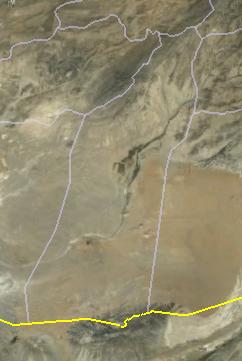
Geographically, the reason to move into this part of Afghanistan and Helmand is obvious from orbit. See that rare swath of green in the satellite photo on the upper right? That is the area around Marjah. Where you find green, you find people. Where you find people, you find your Center of Gravity.

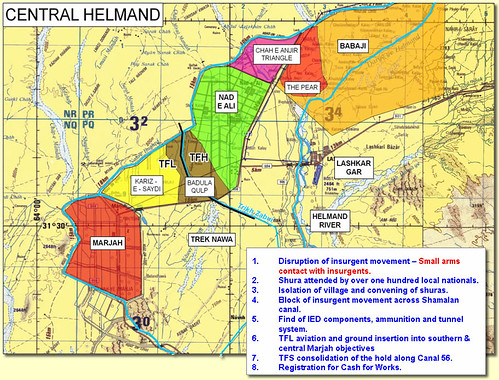
Now look at the close-up picture on the left. For those who have followed the AFG campaign for the last couple of years, I have put a couple of names up there to jog your memory and put Marjan in context of the campaign for the Helmand River Valley from the "Fishhook" in the south moving up to Marjan, Lashkar Gah, Sangin, on to the Kajaki Dam to the NE, and then the heart of Uruzgan Province where the Dutch and Aussie play.

If you remember back in '08 with the 24th MEU first stuck its toe in the waters in Helmand, this is a logical progression in Helmand. The British and other allies in "Helmandshire," the Danes and Estonians mostly, never had the forces they needed to properly secure the population in Helmand. As the USMC arrived in late '08 and through '09 as part of the US forces uplift, there were finally the right density of forces to do what was long been understood needed to be done.

This area is "Indian Country," a large internal safe-haven for the Taliban. Though everyone knew that COIN 101 did not allow large internal safe-havens, without the forces needed to clear them out - you just had to deal with it. There are other safe-havens in AFG - but you can't get them all --- all in due time.

You also need to keep in mind that this goes well back into '07 and was refined and established in '08 by Gen. McKiernan in the framework of "Shape, Clear, Hold, Build" (SCHB).

When it became clear that NATO had culminiated in late '06 through '07 and the US needed to move in as soon as forces became available, the critical failure to address the internal safe-havens became too obvious to ignore. The lack of Afghan National Army and Afghan National Police, in number and quality, was also seen as a critical failure. Just to get NATO to admit that fact was a challenge - and in the end the USA just did what needed to be done and NATO played catch-up as we changed the facts on the ground and took back the keys from an Operational Planning POV in late '08 early '09.

Let's go back to SCHB (you can also see it defined as Shape, Clear, Hold, Build, and Transfer). What you are seeing in Marjan is the end of Shaping and the main body of Clearing. Those are the easy parts. What comes next is the Holding and Building.

Holding will require ANA and ANP at the front - but with a lot of NATO backup to start. If that is done right, then the Hold process can begin ..... and Hold can go on for years and years - as will the Build. Build will begin when you have a safe and secure environment that will allow International Organizations, Governmental Organizations, and Non-Governmental Organizations to do what they do best. Sure, military Civil Affairs are great - but it is the IOs, GOs, and NGOs that will make it happen in the long run. IO, GO, and NGO cannot lead - the military has to create the conditions for them to operate, hence Marjan.

That is where number of forces come into play. This is where we as military professionals tried & failed. At the in-theater Operational side of the house; McChrystal's predecessor McKiernan, and McKiernan's predecessor McNeill - and on the Strategic side of the house Stavridis' predecessor Craddock; all failed to push the political side of the NATO house to admit that there was not enough and produce. They all tried - and in a fashion McKiernan succeeded in getting additional forces. But it took too long as IRQ needed to be fixed first and we put too much faith in NATO keeping its word.

As a result, years were lost. They all knew that more was needed - but we failed in that we let hope - hope that NATO could do what it promised - blind us to what good military practice told us what was proper.

As a result, things got away from us a bit. When we realized that it was time to take back the keys - something covered here through '08 and '09 - we knew that it would take 18 months to get enough additional forces to start to repair the damage. The Taliban grew - their safe-havens got stronger. The job got harder.

Did we pivot in time? I think so, if, and I repeat, if we have the strategic patience to do what needs to be done. This is at least a decade long process. We cannot go home starting in JUL 11 at the same rate we started going home from Iraq in late '08. AFG is not IRQ. No more than Long Island is Mississippi. Actually, Long Island and Mississippi are twin brothers compared to AFG and IRQ.

Watch Marjan and then watch the next move from there. Don't get caught up in the tactical part of the story too much - that leads to short-term thinking. The Marjan operation will take years to go through the SCHB process. There will be more Marjans.

Our Marines in the South, Army in the East, and the scattering of allies about the country can and will do their job if our Center of Gravity will hold. Where the Operational Center of Gravity for the Taliban and NATO is the people of Afghanistan - remember where our Strategic Center of Gravity is - Washington DC for the USA and Brussels for NATO (throw in Islamabad for AfPak if you must).

That is where you need to keep your eyes focused. The political JUL 11 is a significant weakening of the foundation for victory - yes I used the "V" word - watch how that developes. As some are retreating from the JUL 11 date - others are doubling down.

We will win Marjan at the Tactical and Operational - but it will be for nothing if the Political-Strategic collapses.