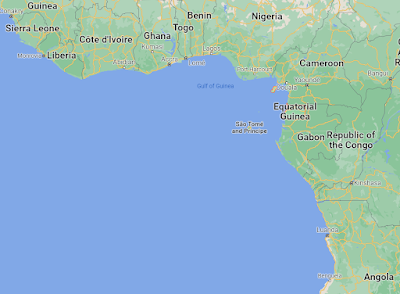
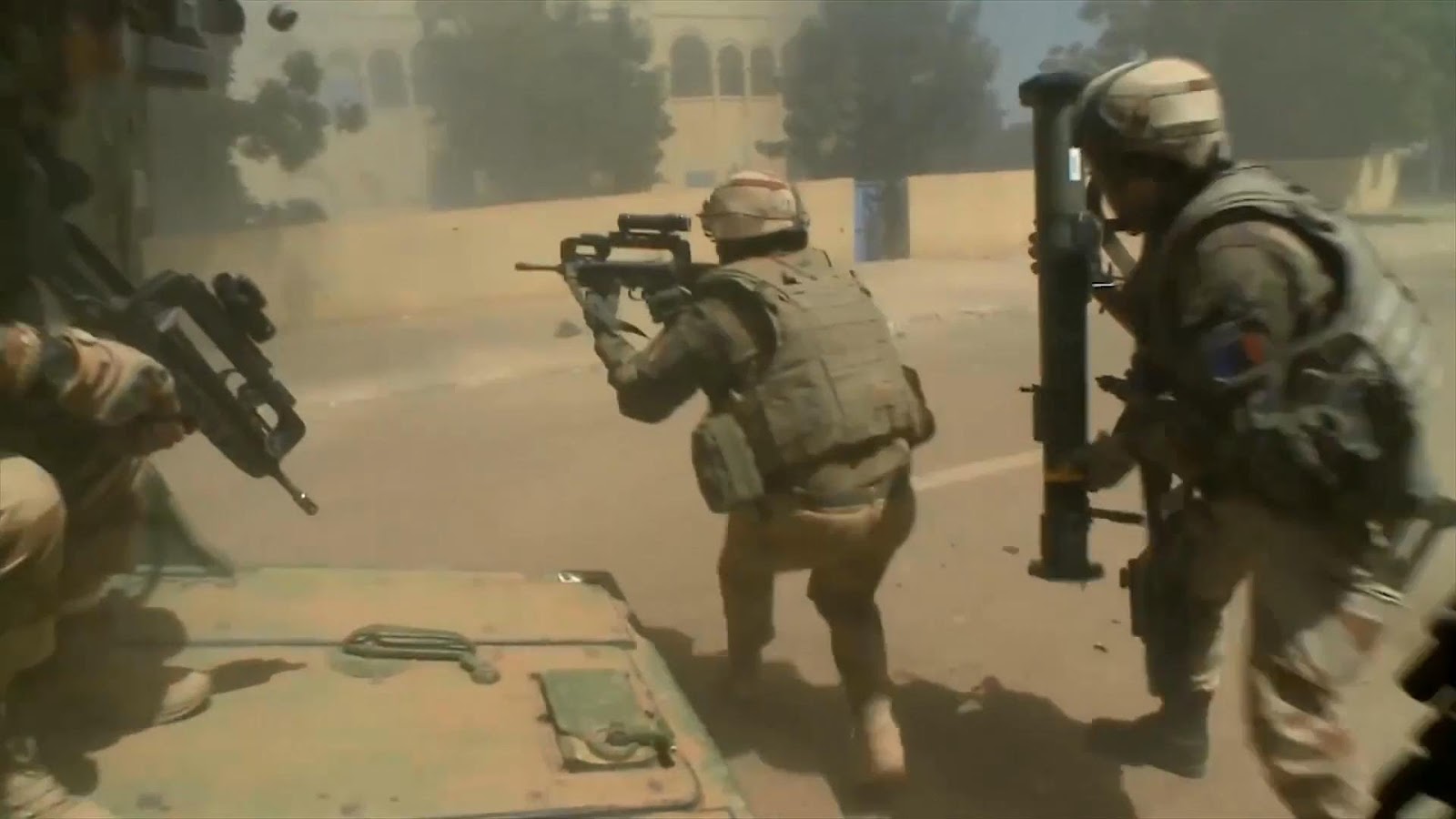
Showing posts with label Africa. Show all posts

Friday, January 20, 2023

Fullbore Friday

 "Hey, we have this bizarre operation that has a shoestring budget, is in the middle of nowhere, and is asking for something to be done that has never been done before. Most likely, if the people sent are ever seen again, it will end in abject failure and humiliation for the officer leading it. Who should we send?"


"Hey, who is that weird 40-yr old LCDR down the hall with all the strange tattoos and whose uniform is all out of wack? I have no idea what he does at that desk, I won't miss him."

"Oh, you mean LCDR Geoffrey Basil Spicer-Simson?"

"Yes, that chap. He has an eclectic background fitting his personality. I think he just might be the fit."

And so starts a story that inspired books, radio programs and movies ... all for a wee spat in an important but relatively forgotten backwater.


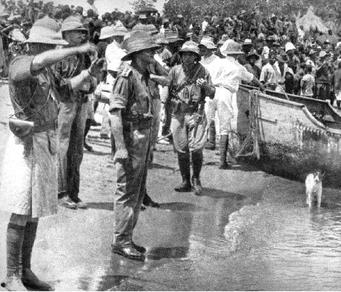
...and below is Spicer-Simpson, right after he captured the German ship Kingani. Yes, he went to war in a skirt.


If you find the naval campaign in Africa interesting, I did another post a few years ago I'd recommend.

Hat tip Campbell. First posted AUG2018.

Monday, December 06, 2021

Keeping an Eye on the Long Game: Part XCI

I found two things curious about the response to this news over the weekend;

China is looking to create its first permanent military presence on the Atlantic Ocean, on the coast of the small African nation Equatorial Guinea, according to a report in The Wall Street Journal based on classified U.S. intelligence.

Though officials did not describe China's plans in detail, they said China's presence on Africa's Atlantic coast would enhance the possible threat to the U.S., as it would give Chinese warships a place to rearm and refit opposite the East Coast, the Journal reported.

Gen. Stephen Townsend, who serves as commander of U.S. Africa Command, told the Senate in April that China's “most significant threat” would be “a militarily useful naval facility on the Atlantic coast of Africa.” 


First of all, I am surprised that it has taken this long for China to militarize her Belt and Road. If you take in to consideration not just her navy but her naval auxiliary and merchant fleet, China can be argued to be the premier naval power in the world right now. 

She does not have the combat reach and capability that the USA has via its carrier and submarine force, but she is getting there.

Her economic requirements, if nothing else, absolutely require her to have naval bases along her sea lines of communication.

Second, some people are getting the vapors over it. Calm down people.

Is this a great threat to the US and her interests? Well, it isn’t helpful, but it isn’t a crisis. Like the various German naval facilities scattered over the Pacific and Africa prior to WWI, in any global war, a little base in Africa will have an operational utility measure in weeks at best.

It is important and we should not brush it off. We should take note of this Decisive Point in her Line of Operation to maintain a global naval presence. China is a rising power and with each year, our relative strength against her weakens. It weakens for two reasons; 

1. China is investing in and building a world class navy.

2. The United States is willingly underinvesting and allowing its world class navy to progressively degrade.

At some point, if you simply look at military power, those lines will cross. If you include all the parts of a maritime power like I did at the start of the post, one could argue that those lines have already crossed – we just haven’t accepted that yet.

Good news, it doesn’t have to be this way. We can, and should, sober up and see the world for what is it in the 3rd decade of the 21st Century and invest accordingly.

We are by nature, geography and requirements, a maritime and aerospace power. We need leaders who will start to speak, act, and invest accordingly. 

If that moment won’t happen now, perhaps it will happen when the Chinese get their first base in the Western Hemisphere.

Tuesday, June 08, 2021

How Far will South Africa be Pulled in to Mozambique?


As we first pointed out here last August, Mozambique needs to be in your scan.

Though we may be pulling back from engaging with global Islamic extremism, it is not pulling back from the world. 

Especially on the African front of the bleeding edge of Dar al-Islam, they are pressing wherever opportunities reveal themselves.

The problem in Mozambique is reaching the point that the regional power, South Africa, may get involved.
South Africa will press for urgent military action by regional body SADC to quell an Islamist insurgency in Mozambique threatening to destabilize neighbouring countries, the foreign minister said on Friday.

It will make this call at a summit of the Southern African Development Community's 16 member states next week, Naledi Pandor told Reuters in a telephone interview.

SADC leaders have been discussing how to tackle the insurgency by Islamic State-linked militants, with an option for force, but this is the first time South Africa has explicitly thrown its weight behind the idea of a military intervention.

Since 2008, SADC has had provision for a standby brigade, part of a regional defence pact that allows military intervention to prevent the spread of conflict.
That was from last month. After the meeting, as reported at the end of last week, things seem closer;
President Cyril Ramaphosa says Southern African Development Community (SADC) countries are prepared to assist Mozambique to fight the insurgency that has destabilised the north of that country. He says leaders of the region are dealing with the situation because if they don’t, the conflict could spill over into their own countries.

Ramaphosa says the SADC Troika has sent technical experts to the troubled Cabo Delgado province to assess Mozambique’s needs in the area.

Ramaphosa, however, would not say what steps are going to be taken.

“You don’t want to be involved in a war situation and tell your adversary that we are coming, get ready for us. You don’t want to do that. I know that the media is interested. When are you going to send boots on the ground? When are you flying over? I am afraid you just have to bear with us. That’s the type of sensitive information that we’ll have to keep quiet about.”
There is a lot of ruin in a nation, and RSA is still consuming a lot of the wealth and civic structures from the apartheid era. The ANC is not as bad as it was thought it would be in government, but it is not good. It isn't in much of a position to do a lot in Mozambique ... but something must be done. 

Another basket case like Zimbabwe on its border will do no good for South Africa - already having ethnic strife from economic refugees. Delicate is a nice way of putting things.

Keep Mozambique in your scan.


Thursday, January 21, 2021

Africa: Let the Pictures Give You the Answer

Do you see the connection?

Ref. A.:

Ref. B.:


How should this impact policy?

Monday, November 02, 2020

Intentionally Choosing to be Deaf and Blind in Africa


More evidence that we need a new "elite" and our defense and diplomacy nomenklatura is worm-ridden with people better suited for anything else.

Few thing are more cost effective and strategically additive than our military attaché cadre. If anything, it should be expanded and being one made a top-shelf career enhancer than its status today.

When done and funded correctly, attachés can be instrumental in helping build partnerships and relationships throughout the world that can pay orders of magnitude greater returns down the road.  

We have a huge military and as a former manpower guy, I see this for exactly what it is - screwed up priorities and myopic leadership.
The Pentagon has quietly begun withdrawing top military officers from U.S. embassies in Africa and downgrading other such posts world-wide, a move officials say is necessary to shift resources to counter China and Russia on the geopolitical stage and meet congressional caps on the number of generals and admirals in the U.S. military. 
The position of defense attaché, the senior U.S. military representative in American diplomatic posts, is being downgraded in rank in eight key allied countries—including the U.K. ...
What a bullsh1t excuse.

I've held for a long time that at the Department of State and The Pentagon, we have too few leaders that have anything but a JPME-thin understanding of demographics and economics. As a result, we have a choppy and spotty record seeing larger trends that should inform our national strategy. Instead of setting a sound framework to prepare for what is clearly coming, we spasmodically run blindly through a field of rakes and wonder why our nose keep getting bloodied and teeth chipped.

Building partnerships in Africa and having our best eyes and ears there are the best ways to "counter China and Russia" on the continent. 

Our GOFO bloat is not from our embassies. In most of our allied countries (NB: those outside Africa), you have to be a General or Flag Officer in order to have any kind of diplomatic heft or to build the relationships you need at that level. Anyone who has served in such a capacity or for someone who has can tell you this, but it appears those people are not driving this clown car.

Give me the charter and a team of 4-6 that I get to choose, all the UIC manning documents I'll request, and I'll find the manpower funding in a weekend to make sure we have what we need to keep and expand this unalloyed positive asset. Better yet, the larger DOD won't even notice what I took away to do it.

A lot of unnecessarily stupid things have been done the last decade or so to hobble the future - you can add this own-goal to the list.

Tuesday, October 06, 2020

The Islamic State Was Defeated; Long Live the Islamic State


If you haven't clued in yet, the Islamic State may have lost its caliphate in Syria and Iraq, but it is far from done. A solid comparison would be to call it a franchise, like its Al Qaeda forerunner.

As we will continue to remind everyone here, you need to keep and eye on Africa - the Islamic States more active franchise. 

Great article from Critical Threats. 

Maj. Gen. Dagvin Anderson, the commander of US Special Operations Command Africa, gave a sobering assessment of the increasing security threats posed by al Qaeda, the Islamic State, and their ilk in Africa in an AEI webinar on September 9 (see the video and transcript here). He warned of African al Qaeda affiliates’ growing responsiveness to their parent organization and highlighted al Qaeda’s “methodical” playbook for coercing and controlling local populations in West Africa while remaining under the US policy radar. Maj. Gen. Anderson acknowledged the US military’s small footprint in Africa and the centrality of non-military challenges in stoking Salafi-jihadi insurgencies, underscoring the need for a clear strategy and more coordination with international partners and the US interagency to combat the Salafi-jihadi threat.
The background problem is that Islamic fundamentalist organizations will take advantage of a continent soaked in poor governance, corruption, unsustainable demographics, environmental devastation, and economic systems that cannot support a modern standard of living for the surging masses.

There are islands of hope here and there in sub-Saharan Africa, but those trend lines are not outpacing the advance of the Islamic State.
The US needs a policy framework for Africa that enables prioritizing and scaling US responses to prevent local conflicts from spiraling into regional crises, as well as rolling back the crises that have already passed this threshold. US Africa Command (AFRICOM) is resource-constrained and likely to face further cuts. In any circumstance, AFRICOM should not be the sole or lead actor for a US approach to African security. The factors that underpin the Salafi-jihadi movement are political, not military. Addressing the fragility that feeds extremism requires a new holistic strategy, and preventing or reducing inflammatory proxy interventions requires both diplomatic leadership and leverage. The US needs to rethink its engagement in Africa — quickly — before the continent’s developing threats are more immediate and more difficult to address.
The USA military cannot "fix" this area of the world, only help. Ultimately, those nations will have to fix themselves. Unfortunately, many of their best and brightest are not staying and working to build a better future, but are moving to Europe and the Americas. The brain drain is a challenge no one really has good metrics on, but it is there.

That too is part of the problem - and a much harder one to fix.

Tuesday, September 01, 2020

Long War in Africa is Tomorrow's War Too

Let's stick with the long war in Africa today, as last night I came across this jewel from the Combating Terrorism Center at West Point, The Islamic State’s Strategic Trajectory in Africa: Key Takeaways from its Attack Claims. 

This heat map is superb and shows that the issue in northern Mozambique is a side show.


From the IS point of view, their main effort is Nigeria and the Sinai.

The Sinai is almost an, "of course..." but everyone should remember that it is the Egyptian military is the only thing keeping Egypt from falling to the Muslim Brotherhood again. As we've seen in Turkey, the West putting faith in modernizing military leadership can only get you so far.  

Nigeria is where the prize is, and not just for oil. Are you up to speed in Nigerian demographics? Let's start with just religion. 

In 2010, the population was 49% Christian and 48% Muslim.  Now?

Where will that stand at 2050?


Now let's look at numbers.


Where will that be by 2050?

~410 million - larger than the United States.


History is far from over and the future has all sorts of horrors it will visit on the planet.

Know the intersection of demographics, economics, and religion and how they relate to future conflict ... and they will all lead you back to Africa.

Monday, August 31, 2020

The Islamic State Terrorists Expand a New Front in Africa

Well, perhaps there should be quotes around "new" because this has been going on - in fits and starts - for over 1,300 years. All that being said, The Long War isn't going anywhere. The question remains where it is flaring up and who is fighting it. 

The "Islamic State's" franchises will continue to pop up all across the bleeding edge of Dar al-Islam. This won't end in any time soon. 

Africa continues to bubble up in any regular scan of trouble caused by Islamic extremism. This violence further handicaps a continent whose demographics and economic development are already setting the condition to create more conflict than can be consumed locally. That is why anyone concerned with global stability needs to keep an eye on Africa. 


Latest example, in a quasi-new front - Mozambique. From two weeks ago;
Militants linked to the Islamic State group have seized a heavily-defended port in Mozambique after days of fighting, according to reports. Local media say government forces that were in the far northern town of Mocimboa da Praia fled, many by boat, after Islamists stormed the port.
The town is near the site of natural gas projects worth $60bn (£46bn).
Where does the situation stand today?
Heavily armed insurgents who seized the strategic port city of Mocimboa da Praia, about 90km away from the commercial gas projects in the Palma district, remain entrenched in the northern Cabo Delgado province of Mozambique. Since the first attack on the area by the Islamic insurgents in late 2017, an estimated 1,500 people have died and about 250,000 have been displaced after numerous attacks and clashes between them and security forces. ...
According to the Bishop of Pemba, Luiz Fernando Lisboa, people displaced from villages attacked by the insurgents do not have humanitarian support. “The entire province of Cabo Delgado — in districts where there are no armed conflicts, is full of displaced people. The most important [need] is food. But it's not just food, there are many types of help that these people need,” said Lisboa. 
... 
A source from a humanitarian aid organisation, said they could not travel to affected areas without the risk of being shot or beheaded. “We are neutral, we cannot be part of the military columns or enter it alone. 
On the one hand it may seem as if we are with the government and on the other hand with the terrorists. There may be this perception. Our aim is simply to support these people in need in various ways.” 
The Citizen Observatory for Health (OCS), a Mozambican NGO, earlier told the media that the closure of 37 health units in districts affected by armed violence in Cabo Delgado had left people there vulnerable.
In the Sahel, France and other European nations are doing what they can there ... but who will help Mozambique if they can't help themselves?

Monday, April 06, 2020

Africa and COVID-19

As we like to do here, as others look away - we like to keep an eye on sub-Saharan Africa. In economic, demographic, radicalism, migration and other areas - Africa will produce more friction by mid-century than it can consume locally.

From the expansion of ISIS in the north, to the crippling secondary effects of HIV/AIDS in the south - anything that further keeps back the continent's progress will make an already challenging present and future more difficult.

COVID-19 is pulling every corner of the world down, Africa will be no exception. As they are already so far down the development ladder, this shock holds the potential to drive negative effects in all directions.

Adding to this already grim prospect is an assumption that COVID-19 will act in a similar way through different populations - with different outcomes relative to the access to and quality of available health care. Africa, even on a good day does not look good with that variable.

Could it be worse? Things can always be worse. 

History shows that some diseases have a predilection to be deadlier to some populations more than other based on shared DNA. Though more research is needed, in the first nation with a significant population of sub-Saharan African extraction, the USA, is fighting through a COVID-19 infection, we are seeing signs that the disease is deadlier to those of sub-Saharan African extraction.

If COVID-19's deadliness can vary among population groups relative to DNA commonality ... what does that hold for Africa?
Some of Uganda’s poorest people used to work here, on the streets of Kampala, as fruit sellers sitting on the pavement or as peddlers of everything from handkerchiefs to roasted peanuts.

Now they’re gone and no one knows when they will return, victims of a global economic crisis linked to the coronavirus that could wipe out jobs for millions across the African continent, many who live hand-to-mouth with zero savings.

“We’ve been through a lot on the continent. Ebola, yes, African governments took a hit, but we have not seen anything like this before,” Ahunna Eziakonwa, the United Nations Development Program regional director for Africa, told The Associated Press. “The African labor market is driven by imports and exports and with the lockdown everywhere in the world, it means basically that the economy is frozen in place.
There is so little flex in Africa, you can assume where this is going. Economic dislocation brings conflict and migration.

Keep an eye here, especially if you live in Europe.

Tuesday, February 25, 2020

Smart Power Doing Smart Things in Africa

As we've covered here and on Midrats through the years, the economic and demographic challenges of sub-Saharan Africa will be - and in many ways already is - one of the primary drivers of national security concerns as we approach mid-century.

Though this so far has failed to break through to the general discussion, where it counts evidence shows that many long-term focused professionals see it.

Of our friends, France sees it most clearly, and we are next in line. On the surface it may seem like wanting to help African nations join the 21st Century's promise - and in many areas it is - but the primary concern is to promote stability and growth to blunt the irresistible desire to migrate north to Europe and all the instability that has already brought with it.

European and North American nations will not be the ones that keep Africa from anarchy and collapse in the face of - what on paper at least - seem like unmanageable challenges, it will be the Africans themselves.

As African GenX and younger leaders start to get hold of levers of power, much of the stale and failed post-colonial, Marxist infused taint that infected so many of the late 20th Century leaders will fade even more. With that, modern ideas and relationships can develop.

That is what the West hopes. Of course, China and Russia are pushing in to Africa as well. Their drivers are more from the last century; power and resource extraction.

It isn't hidden, and it appears that the locals see it.

Good read in the Washington Examiner by Abraham Mahshie,
Forty-two African military chiefs joined U.S. Army officials in Ethiopia for the African Land Forces Summit that ended Friday, underscoring what generals say is the United States's edge over China and Russia in the war of influence playing out on the African continent.

“Partnerships are key to security and stability in Africa,” U.S. Africa Command chief Army Gen. Stephen Townsend, told military leaders at the event’s closing ceremony in Addis Ababa, underscoring that the terrorism fight in East Africa requires partnerships.
...
...according to AFRICOM leaders, the U.S. has a head start countering adversary influence on the continent and helping African nations put down terrorist groups trying to gain a foothold in ungoverned spaces of East Africa.
...
When U.S. and partner nations bring their expertise to the table to meet face-to-face, he (U.S. Army Africa commander Maj. Gen. Roger Cloutier) explained, they build relationships and develop solutions together.

They also show America’s presence on the continent is about more than economics.

China has wooed African nations with an estimated $5 billion per year, according to Johns Hopkins University.
...
Cloutier said the influence of American efforts on the continent is working, telling journalists a story about a recent meeting with a ground commander in Africa who highlighted relations with Russia.

“The senior ground commander said to me, ‘You know what? We've had a longstanding relationship with the Russians,’” he said. "'We know what capability the United States military has. We know what you stand for, and we want to become closer partners with you.'"
Yes, skepticism is in order ... as it always is with such PAO cleared statements, and yes, African military senior leaders do not have the best track record - but this is important.


This effort must continue, European nations should continue to support France's efforts in the Sahel, as should we, even with setbacks and frustrations that always come with operations in Africa.

As long as we do it right and on African terms and timetables, we can mitigate what is coming this century.

Monday, December 09, 2019

France's Long War

The Long War has a lot of fronts and many flavors ... an undertold one is what France is doing in North Africa.

Especially for Europeans, this can be seen as an existential threat. 

If some type of stability is not brought to Africa, then then inevitable pressures of war, famine, and poverty will drive migration north, flooding an already saturated ability of the Europeans to take in migrants ... and all the cultural and societal pressures that will bring with it.
Armed Forces Minister Florence Parly has called on fellow EU governments to despatch special forces to the Sahel, to help curb militant attacks that have killed more than 100 Malian troops in recent weeks.

But France, too, is paying a heavy price for its role in the struggle against Sahel jihadism, with the death of 13 soldiers when two helicopters collided on Monday.

Altogether, it has lost 38 troops in this almost seven-year campaign.

...since 2013 the EU has been retraining the Malian army, while the French anti-terrorism force, Operation Barkhane, deployed across the Sahel is supported by British helicopters, other European allies as well as US surveillance drones.
France and what few partners it can scrape together in Africa can only do so much when their nations invest so little in their military.

They can spend a bit more now, or be swamped later.

For those of us who worked the fight in Afghanistan, this will sound familiar;
Everyone is agreed that military action along cannot bring an end to the violence and restore stability.


Health, education, justice and basic administration are needed to build community support for the Malian state.

More jobs and livelihoods could reduce the risk of disenchanted young men being drawn into jihadist groups or criminal gangs offering money and the status that can come with carrying a weapon.

A wide range of donors have committed large aid budgets to the Sahel, motivated by concern over poverty and climate change in this fragile region so prone to drought - and also by fear of the knock-on impact of terrorism and a potential resurgence in the flow of migrants across the Sahara and Mediterranean.
...
The present military approach being pursued by the Sahel armies and their international partners is not working, at least not sufficiently - and France is well aware of the need for a fresh approach.

This is one of the world's poorest regions and a much greater focus on development is essential. But that still cannot happen without better security.

That is why - despite the shocking loss of 13 men in this week's helicopter crash - President Emmanuel Macron remains committed to the military campaign, in alliance with Sahelian governments.

But Paris is desperate for other European countries to do more to help share the burden.
In dark moments you have to wonder - can Western forces make these peoples and cultures fix themselves? Are we making things better in the short run, if at all, but in the long run it will account for nothing?

Is it worth the attempt? 

 I think so, as the alternative is something I don't think our modern sensibilities are ready for ... though our kids might have to.

Thursday, August 08, 2019

The Bad Vacation Top-10 from ALCED

Armed Conflict Location & Event Data Project (ACLED)'s mid-year Top-10 conflicts to keep an eye on update is out.

Check out their #1, The Sehel.


The French and the USA is there along with a few other European nations in small numbers.

That graph is impressive.

Head on over to ACLED for the rest of their Top-10. More info there.

The Sahel: Most likely to be the geopolitical dilemma of 2019

Yemen: Most likely to induce 2019’s worst humanitarian crisis

Afghanistan: Most likely to suffer from international geopolitics

Iraq: Most at risk of returning to civil war

Myanmar: Most likely to see expanding ethnic armed conflict

South Sudan: Most likely to see second-order conflict problems

Philippines: Most likely to see an increase in authoritarianism

Syria: Most likely to see a shift to mass repression

Libya: Most likely to see non-state armed group fragmentation and alliances

Sudan: Most at risk of government collapse
Can you spot the common thread?

Come on ... you can do it.

Tuesday, July 30, 2019

Keeping an Eye on the Long Game: Part LXXXIII

China has a plan.

It isn't a secret. She isn't hiding anything.

She is persistent, steady, focused, and driven. Like a slow rising tide, she is moving on to the global stage more and more and more.

In just Africa, you can see it. All clear. All for you to see.

Take time to read the superb report from CSIS - but the graphics should be enough to get your attention.

Wednesday, June 26, 2019

The Pirates of the ... Gulf of Guinea

Probably not the most popular attraction as Disney World ... but a good topic for discussion over at USNIBlog this Wednesday.

Come by and pay us a visit.

Friday, May 10, 2019

Fullbore Friday

A reminder that, especially in Africa, the French are at the front - and will remind you that more often than not, they more than earn the title,"Our oldest ally."
An American citizen is among a group of four hostages who have been freed in western Africa following a French special forces military operation that resulted in the deaths of two of their own soldiers, the Elysee announced Friday.

France said the hostages were rescued Thursday night following a battle in Burkina Faso.
...
They were identified as petty officers Cédric de Pierrepont and Alain Bertoncello. A Facebook post by the French Navy added that both men received numerous awards and recognitions throughout their military careers, such as the Gold Level of the National Defense Medal.
As we've discussed here on a regular basis, the bleeding edges of Islam is a growing issue in Africa.
Islamic extremists have become increasingly active in Burkina Faso, raising worries the militants could be infiltrating northern Benin and neighboring Togo as well. While it is not yet clear who abducted the group and why, neighboring Burkina Faso – once considered a beacon of calm in the otherwise terror-teeming region – has been a growing hotbed for some time.
...
The U.S. State Department, in a travel advisory issued in early April, warned Americans to "reconsider travel" to Burkina Faso as "terrorist groups continue plotting attacks and kidnappings... and may conduct attacks anywhere."

Thank you Shipmates.

Tuesday, May 07, 2019

Africa in Three Charts and a Graph

Your regular reminder that you may not be interested in Africa, but Africa is very interested in you.

She is a poor, violent, and desperate continent. Structurally, that will not improve any time soon; probably just the opposite.

I will end my extended commentary there. I will let your higher brain functions and pictures do the rest.

In red, you have the ungoverned spaces;


Next you have religious distribution:


And finally, from the Armed Conflict Location & Event Data Project;


The future belongs to, and will be influenced by, those who show up.

Wednesday, March 20, 2019

I don't miss rains or anything else in Africa ... but I'm watching it

If you aren't already, make sure in your scan are two to three sites that can keep you up to date with national security issues in Africa.

I've been following once recently I recommend with some examples why.

Head on over to USNIBlog for the brief.

Monday, February 18, 2019

Back in Africa: Portugease Edition

It is time to return again to our discussion of Africa.

Time to remind everyone that regardless of how much you may not be interested in Africa's future, Africa's future is very interested in you.

Head on over to the map, Africa is huge.


Size will not be the primary driver of the role she will have this century. It isn't her huge natural resources that is drawing China in that will be the driver either. Nope.

In the background is a topic many don't want to speak too loudly about; Africa has a very long front on the bleeding-edge of Dar al-Islam. That is part of this story, but not the two primary drivers.

This century unless it is managed carefully, Africa it will continue to produce more conflict than can be consumed locally. The causes are clear.

There are two things. First, demographics;


...and the resulting population growth that is on the way.


Second; economics.

As much as I would thoroughly enjoy it, we don't have time for a full seminar of development economics - so I'll give you a back-of-the-napkin summary.

A growing population can only grow its standard of living if its economic growth exceeds its population growth. Economic growth requires political stability and the rule of law. Nations who do not have political stability and the rule of law cannot grow their economy. Nations with high population demographics who cannot create increasing or at least a stable standard of living for their people will create conditions for a mass exodus/emigration. These migrants will move via the easiest path to an area with a high standard of living.

For the very poor in African, that path leads north, to Europe.

The European people have no more desire for migrants from Africa than they already have. In most of their nations, their ruling class lacks the ability to do what they need to do to curtail the incoming masses. The people of Europe, if their present ruling class will not address their concerns, will look to get a new ruling class.

Masses of migrants in to Europe are already warping the political landscape of Europe. If Europe wants to keep domestic political turmoil and conflict - not to mention cultural and economic issues - it must find a way to create conditions in Africa such that the pressure to migrate are at least mitigated or at best eliminated.

Sure, there is a humanitarian impulse in play here ... but in the background is the very real desire to stop mass migration from making the Europeans become a people they don't want to be once again.

That is why you find a nation of 10.6 million that spends only 1.36% GDP on defense sending 180 of their finest military members in to the very heart of Africa.

Via The Defense Post, welcome back to Africa, Portugal;
Decades after Portugal formally ended its more than 500-year-old empire in Africa, the Portuguese military has returned in force. From Mali to Somalia, and now the Central African Republic the state of Portugal has been increasingly active in peacekeeping operations and counter-terrorism efforts in Africa.

A contingent of Portuguese peacekeepers came under fire on April 1 in the capital Bangui. The force had been deployed to PK5, a historically Muslim neighborhood in the Christian majority nation when it came under fire. That incident sparked further operations against armed groups in the neighborhood. In total the operation left as many as 21 civilians dead and injured scores including peacekeepers with the U.N.’s Minusca mission.

Portuguese paratroopers were again called upon to protect civilians during clashes in Bangui on May 1 in which at least 24 people died, and around 170 people were wounded.
The Portuguese get it.
“We have to play an active role in contributing to the defense and security of Portugal, of NATO and part of that is working to ensure stability south of the Mediterranean,” said João Rebelo a member of Portugal’s parliament with the CDS – People’s Party. “I remind my colleagues often it’s only a short flight from Portugal to Libya.”
This weekend a tactical event in C.A.R. involving Portuguese forces broke above the background noise.
Portuguese peacekeepers battled for five hours to protect civilians and restore order after militants killed two police officers in the Central African Republic town of Bambari ahead of a scheduled visit by the country’s president on Thursday, January 10.

The attack came a day after President Faustin-Archange Touadera announced that the government would meet armed groups in African Union-brokered peace talks in Khartoum.

Members of the Union for Peace in the Central African Republic (UPC) ex-Seleka militia and their allies carried out “various attacks” in the town early Thursday, a government statement said.

“Two policemen were killed and another was wounded,” Communications Minister Ange-Maxime Kazagui told AFP.

Medecins Sans Frontieres (Doctors Without Borders) said it was treating 30 people for bullet wounds. MSF later said 26 people were still being treated but one person had died in hospital.

Corbeau News reported that around 10 people were killed, but it was not possible to confirm this toll.

The government later said on Twitter that 20 UPC members were killed and 15 others wounded.

According to an internal U.N. report seen by AFP, a combatant called “General Bello,” in charge of UPC fighters in Bambari, had been wounded.
Take some time to see this exceptional video of the Portuguese paratroopers in contact.

Things that caught my eye:
1. The influence of American special forces in the last 15-yrs has brought the light infantry kit to a refined point. Everyone is starting to look roughly the same.
2. Looks like almost every helmet has a camera, every helmet a number ... as such ... you can really deconstruct every engagement if all are working and recording. The Colonial Marines' kit from "Aliens" was pretty good in telling the future.
3. You may speak your national language to each other if you want, but when you want air support - know your English.


For everyone, especially former colonial powers like Portugal, there will be more Africa in their future.
There may be more such missions in the future.

Security in the former Portuguese colony of Mozambique is a growing international concern. Local Islamist groups in the province of Cabo Delgado have been conducting limited terrorist attacks against the government. It’s a region well-known in Portuguese military history and in Portuguese military circles. It was there in 1964 that Communist guerrillas crossed the border from Tanzania to attack Portuguese forces, an event which for Portugal marked the beginning of the Overseas War, Guerra do Ultramar, in earnest.

Monday, September 17, 2018

Mali and Africa's Past, Now, and Next

The forever war has many fronts - the one in Mali, once OPERATION SERVAL now BARKHANE has France in the lead.

Mali has a historic ties to France, its former colonial ruler. Mali experienced the usual socialist led dysfunction following independence in the later-middle part of the 20th Century, but in the last decade or so has tried, in fits and starts, to become a modern, more-free nation. Sadly, they are right on the bleeding edge of Dar al Islam and all that comes with that. Combined with nightmarish demographics unimaginable to the Western mind - this will not be an easy fix even if they were not facing an aggressive internal threat.

Stability is the key, but due to the above and more factors, instability will be the expected norm for Mali for awhile. All France and her allies can do is to try to mitigate the negative effects, and nurture the positive developments in the country. The more they succeed there, not just in the Long War, the better for everyone from Cape Town in the south, to Bear Island in the north.

As old as human history, as it is now;
His door and iron-sheet roof were missing; his granary was a mound of rubble on the floor. In his hands, the 59-year-old held out a pile of charred groundnuts he had cultivated, before crumbling them into dust.

“It is painful to look at,” he said.

Besides one stoic village chief who sat sharpening his knife on a rock under the baking sun, there is nobody left in Kara. Everybody else fled the ethnic Dogon village one morning in May when armed men from the neighbouring village – populated by Fulani herdsman – climbed over a sand dune shooting wildly in the air.

Everything of value was stolen; the rest was burnt.

Kara is just one among dozens of villages looted and torched in the past few months as a conflict between armed members of Mali’s Dogon and Fulani communities ripples through the heart of the country, claiming hundreds of lives and displacing thousands of people.

Analysts say the conflict has been triggered by the increasing presence of jihadists linked to al-Qaeda in central Mali. They have recruited heavily among Fulani herders, fuelling distrust with other ethnic groups, including the Dogon, some of whom have organised into abusive new self-defence militias.

“Both sides are killing each other,” said Fatou Thiam, head of the Mopti office of the UN peacekeeping mission in Mali, known as MINUSMA.

The conflict underscores Mali’s struggle to restore order three years after a peace deal was signed between the government and armed groups in the north, including separatist Tuareg rebels, who seized large parts of the country following a 2012 military coup in the capital, Bamako.

Islamist militants, who joined forces with the separatists before a French-led intervention pushed them back, have gradually expanded their sphere of influence from the desert north into Mali’s previously peaceful centre.

This year 5.2 million Malians are in need of humanitarian assistance, compared to 3.8 million in 2017. The number of internally displaced people has also doubled since January to 75,000, according to the UN’s emergency aid coordination office, OCHA, the majority in the central Mali.
I know, I know. I am the one who pushes back against getting involved in foreign adventures, but this is not quite like a full-on invasion of a nation with sketchy impact on USA or allied national security.

This is helping our oldest ally who is helping another nation fight our common enemy - radical Islam. Mali itself is a Muslim country, 90% Muslim - but Islam is not the enemy. Radical Islam is.

Africa will never join the rest of the world in a future of promise if its northern half is under the black flag of radical Islam.

Worse, the conflict and death that a Western defeat in Mali would bring would further drive the exodus of millions to Europe - further destabilizing European nations' hard-won democratic systems and social norms.

This is something we should help our French allies with. Not lead; not dominate - this is their backyard. There are things we can do to help.

One example; you know what the US Navy could do to help the French? They have a riverine challenge;
French desert troops recently took to boats to patrol the Niger River in Mali, the first time that the crafts have been used in the Barkhane counter-terrorism operation in the Sahel, the French armed forces said.

Anticipating the rainy season and river flooding, soldiers attached to the French army’s Desert Battle Group – Infantry (GTDI) deployed the boats which enable them to get to areas difficult to reach by land.
Just look at what they are trying to patrol the Niger with.


Remember my post from FEB 2005? France looks to be in a place we were at then.

We have units that would be perfect for this. Additionally, we should call our friends in Colombia who have exceptionally good kit and the best operational riverine experience in the West. Have them join us in an ongoing rotational deployment. This would be a good way to contribute to the good work France is doing in support of the Mali government.