Showing posts sorted by relevance for query kagan. Sort by date Show all posts

Tuesday, January 29, 2008

Bush, McCain and the Surge


A very important piece out by Fred Barnes in the Weekly Standard. It is a very accurate bit, from my POV, of how the Surge was born. It is good that much of this is now coming out. There were small public hints we could share early, but so much more waits to be discussed that you just have to wait to become public record to comment on.

Though only mentioned in one paragraph, I put McCain in the title of this post because you have to give credit where credit is due. In the area of victory in Iraq, few if any have been more right than Sen. McCain (R-AZ). Full stop. End the discussion. Fact. Everything else is mindless politics.

I have no problem saying that as a lapsed Romney guy, Rudy voter, anti-Huckabee Evangelical, (l)ibertarian Dennis Miller Conservative (mostly I guess), but one that tries to keep a VDH sense about things. I am not a McCain guy, that is for sure ... but ..... this steadfastness alone would ensure that if in the end it is him against Obama or Clinton - he will get my money and vote in '08.

Anyway, let's get back to Fred's bit. I want you to read it all, but here are the meaty bits that got attention from my highlighter.
Inside his own administration, Bush had few allies on a surge in Iraq aside from the vice president and a coterie of National Security Council (NSC) staffers. The Joint Chiefs were disinclined to send more troops to Iraq or adopt a new strategy. So were General George Casey, the American commander in Iraq, and Centcom commander John Abizaid. Secretary of State Condoleezza Rice favored a troop pullback. A week earlier, the Iraq Study Group, better known as the Baker-Hamilton Commission, had recommended a graceful exit from Iraq.
He did have some support from the rank and file though.
"If you're going to be a bear, be a grizzly."
Almost the title of this post, but a good concept to use in this line of work - or any for that matter.
"One of the most important jobs of a commander in chief, and particularly in a time of war, is to be thoughtful and sensitive about the U.S. military," he said. Bush believes in persuading the military to embrace his policies rather than simply imposing them. In fact, a senior Pentagon official said Bush hoped the military would use the interagency review to push for a surge on its own. That didn't happen. The chiefs preferred the status quo, which meant sticking to a strategy of training the Iraqi army and leaving it with the job of defeating the insurgency.
Not a shocker. Very few bold ideas will come out of the JCS. Any idea goes through too many filters to get there, and except for the rare bird, no one in this still peacetime military make it that far by being anything but status quo cautious.

Want to know why LTC John Nagl (USA A) is punching out at 20? Simple. Unlike WWII where you could make Col. before your 35th birthday (no JPME req'd); the conveyor belt mentality of peacetime promotion still rules. Sad, but he can fight better in suit and tie in 2008.
Bush agreed that strain was a problem. Then he delivered a sharp rejoinder, touching on a theme he returned to in nearly every meeting on Iraq. "The biggest strain on the force would be a defeat in Iraq," he said. Winning trumped strain. To alleviate the strain, the president committed to enlarging the Army by two divisions and increasing the size of the Marine Corps. The chiefs had two more complaints. The military, practically alone, was carrying the load in Iraq. Where were the civilians from the State Department and other agencies? Again, Bush agreed with their point. He promised to assign more civilians to Iraq. (The number of provincial reconstruction teams was soon doubled.)
Same question many of us have been asking for years. Still a great untold story.
After the bombing, NSC officials were increasingly dubious. They weren't alone. General Keane kept in contact with retired and active Army officers, including Petraeus, who believed the war could be won with more troops and a population protection, or counterinsurgency, strategy--but not with a small footprint. At the American Enterprise Institute (AEI) in Washington, a former West Point professor (and a current WEEKLY STANDARD contributing editor), Frederick Kagan, was putting together a detailed plan to secure Baghdad. But the loudest voice for a change in Iraq was Senator John McCain of Arizona. He and his sidekick, Senator Lindsey Graham of South Carolina, traveled repeatedly to Iraq. McCain badgered Bush and Hadley with phone calls urging more troops and a different strategy. Together, McCain, Keane, Petraeus, the network of Army officers, and Kagan provided a supportive backdrop for adopting a new strategy.
This is the McCain paragraph. Read it again. He has been a lion here. Give him all the credit he deserves.
The four-man panel wasn't stacked. Kagan spoke in favor of additional troops and outlined his plan for pacifying Baghdad with a "clear, hold, and build" strategy. American soldiers, along with Iraqi troops, would do the holding, living in Baghdad and guarding its citizens, Sunni and Shia alike. Robert Kaplan, the foreign correspondent and military writer now teaching at the Naval Academy, talked about successful counterinsurgency campaigns in the past. (Kaplan's books are among Bush's favorites.) Kaplan neither advocated a troop buildup nor opposed it.

Countering Kagan, Michael Vickers, a former Green Beret and CIA operations officer, explained how Iraq could actually be won with fewer troops, not more. Vickers is now an assistant secretary of defense. The fourth panelist was Eliot Cohen, now a State Department adviser. Bush had read his book on wartime leadership, Supreme Command. Cohen reemphasized its theme: Leaders should hold their generals accountable if a war is being lost or won.
A good example of solid leadership. Listen with an open mind to both sides. Not quite the GWB you read about, is it?
In Washington, the president got little satisfaction from the interagency review of Iraq policy. Instead of a surge, the State Department favored a strategy of pulling troops out of Baghdad and allowing the Sunnis and Shia to finish their bloody struggle. When Bush heard about this idea, he rejected it out of hand. "I don't believe you can have political reconciliation if your capital city is burning," he said.
State. Again.
That afternoon, Keane and Frederick Kagan gave Cheney a full briefing, including a slide show, on their surge plan. It had been developed at AEI with help from Keane's network of officers. Cheney didn't need much encouraging. Bush told Cheney biographer (and WEEKLY STANDARD senior writer) Stephen F. Hayes last year that the vice president had always been a "more troops guy." The surge neatly fit Cheney's specifications. Keane and Kagan became a sought-after pair in Washington, a gravelly voiced general and a young professor with a plan to win in Iraq. They gave briefings to Hadley and Pentagon officials, among others.
A little something for those with Cheney Derangement Syndrome.

Wednesday, February 11, 2009

Kagan's 9 principles on Afghanistan

Michael Yon is right, this article by Frederick Kagan needs the widest dissemination.

Read it all for the details, but these "Nine Principles" not only apply to Afghanistan - you could plan almost any operation using them.
  1. Understand why we're there. Afghanistan is not now a sanctuary for al-Qaeda, but it would likely become one again if we abandoned it.
  2. Know what we have to achieve. Success in Afghanistan does not require creating a paradise in one of the poorest countries on earth, but we cannot define victory down.
  3. Understand our enemies and our friends. There is no such thing as “the Taliban” today. Many different groups with different leaders and aims call themselves “Taliban,” and many more are called “Taliban” by their enemies.
  4. Commit to the effort. The consistent unwillingness of the U.S. government to commit to the success of its endeavors in Afghanistan (and Iraq) over the long term is a serious obstacle to progress.
  5. Learn and adapt the right lessons. We cannot dismiss our extensive and painful experiences in Iraq, but we must recognize the differences between that country and Afghanistan.
  6. Consider the human terrain. Pashtuns are not Arabs. They have different traditions, different tribal structures, different ways of resolving differences. One of the most important (and least remarked-upon) differences is that Iraqis fight in their cities and villages while Pashtuns, on the whole, do not.
  7. Understand what we must do, can do, can't do. It is better, in general, for Afghans to take the lead in moving into or through Afghan towns, but this is not always as desirable as we might think.
  8. Have a good plan. Adding more troops to a failing strategy rarely works.
  9. Prioritize efforts. While the situation in Afghanistan is indeed deteriorating, it would be wrong to rush forces out of Iraq this year in response.

Saturday, January 06, 2007

Taking Baghdad: Kagan-Keane OPLAN for '07

Frederick W. Kagan and General Jack Keane (USA, ret.) have created a plan worth your Saturday morning reading. This runs right into the face of the Iraq Studies Group (remember, it was run by retired politicians, diplomats and party functionaries - with the expected results [BTW, I read it, have you?]) and Speaker Pelosi/Senator Reid Surrender Plan.

To keep Darth Skippy happy, it is also a kick in the a55 to the Bush Admin. It sounds like we are heading in the direction this Plan calls for, but we'll see. If I was running the J5 shop at K2's place, I would have called this COA "Double Down." This is unquestionably an Operational Plan (OPLAN). It even covers possible Branches and Sequels. At only 50 pages though, it is about as thorough a "bang for a buck" OPLAN I have seen. I like the compact nature, and feel a little bit of envy that (a little inside baseball here) we don't have the ability to produce something this readable.

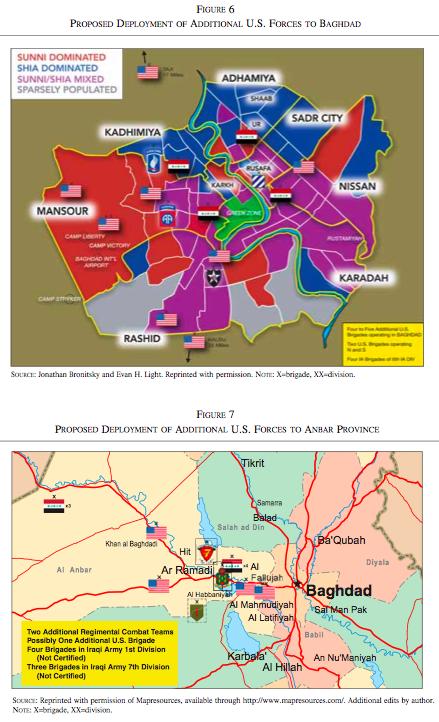
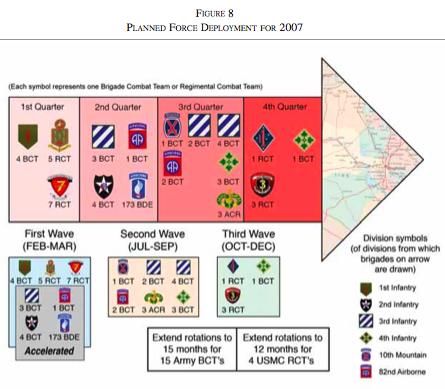
Their OPLAN Executive Summary can be read here and you will find there another link to the full report. It was presented at a Conference yesterday at the American Enterprise Institute. You can get the audio and video downloaded from here. Also speaking are Senators McCain and Lieberman. If you don't want to follow the link, the Executive Summary is below - it is worth the space. The maps in this post outline their recommended deployment plan.

Victory is still an option in Iraq. America, a country of 300 million people with a GDP of $12 trillion and more than 1 million soldiers and Marines, has the resources to stabilize Iraq, a state the size of California with a population of 25 million and a GDP under $100 billion. America must use its resources skillfully and decisively to help build a successful democratically elected, sovereign government in Iraq.

Victory in Iraq is vital to America’s security. Defeat will likely lead to regional conflict, humanitarian catastrophe, and increased global terrorism.

Iraq has reached a critical point. The strategy of relying on a political process to eliminate the insurgency has failed. Rising sectarian violence threatens to break America’s will to fight. This violence will destroy the Iraqi government, armed forces, and people if it is not rapidly controlled.

Victory in Iraq is still possible at an acceptable level of effort. We must adopt a new approach to the war and implement it quickly and decisively.

We must act now to restore security and stability to Baghdad. We and the enemy have identified it as the decisive point.

There is a way to do this.

  • We must balance our focus on training Iraqi soldiers with a determined effort to secure the Iraqi population and contain the rising violence. Securing the population has never been the primary mission of the U.S. military effort in Iraq, and now it must become the first priority.
  • We must send more American combat forces into Iraq and especially into Baghdad to support this operation. A surge of seven Army brigades and Marine regiments to support clear-and-hold operations that begin in the spring of 2007 is necessary, possible, and will be sufficient to improve security and set conditions for economic development, political development, reconciliation, and the development of Iraqi Security Forces (ISF) to provide permanent security.
  • American forces, partnered with Iraqi units, will clear high-violence Sunni and mixed Sunni-Shia neighborhoods, primarily on the west side of the city.
  • After those neighborhoods are cleared, U.S. soldiers and Marines, again partnered with Iraqis, will remain behind to maintain security, reconstitute police forces, and integrate police and Iraqi Army efforts to maintain the population’s security.
  • As security is established, reconstruction aid will help to reestablish normal life, bolster employment, and, working through Iraqi officials, strengthen Iraqi local government.
  • Securing the population strengthens the ability of Iraq’s central government to exercise its sovereign powers.

This approach requires a national commitment to victory in Iraq:

  • The ground forces must accept longer tours for several years. National Guard units will have to accept increased deployments during this period.
  • Equipment shortages must be overcome by transferring equipment from non-deploying active-duty, National Guard, and reserve units to those about to deploy. Military industry must be mobilized to provide replacement equipment sets urgently.
  • The president must request a dramatic increase in reconstruction aid for Iraq. Responsibility and accountability for reconstruction must be assigned to established agencies. The president must insist upon the completion of reconstruction projects. The president should also request a dramatic increase in Commander’s Emergency Response Program (CERP) funds.

  • The president must request a substantial increase in ground forces end strength. This increase is vital to sustaining the morale of the combat forces by ensuring that relief is on the way. The president must issue a personal call for young Americans to volunteer to fight in the decisive conflict of this generation.
  • The president and his representatives in Iraq must forge unity of effort with the Iraqi government.

Other courses of action have been proposed. All will fail.

  • Withdraw immediately. This approach will lead to immediate defeat. The Iraqi Security Forces (ISF) are entirely dependent upon American support to survive and function. If U.S. forces withdraw now, the Iraqi forces will collapse. Iraq will descend into total civil war that will rapidly spread throughout the Middle East.
  • Engage Iraq’s neighbors. This approach will fail. The basic causes of violence and sources of manpower and resources for the warring sides come from within Iraq. Iraq’s neighbors are encouraging the violence, but they cannot stop it.
  • Increase embedded trainers dramatically. This approach cannot succeed rapidly enough to prevent defeat. Removing U.S. forces from patrolling neighborhoods to embed them as trainers will lead to an immediate rise in violence. This rise in violence will destroy America’s remaining will to fight and escalate the cycle of sectarian violence in Iraq beyond anything an Iraqi army could bring under control.

Failure in Iraq today will require far greater sacrifices tomorrow in far more desperate circumstances.

Committing to victory now will demonstrate America’s strength to our friends and enemies around the world.

This is a Plan worthy of our nation. One I support. In their presentation (video and audio link) they also acknowledge the 800# gorilla in the room. Our Army (editor's note: and Marine Corps) is too small for present and future operations. To think or say other is folly.

Monday, March 12, 2007

I'll show you mine - you show me your's

Kagan calls the Democrat's bluff: you want the military's back-up plan if the surge doesn't work - then what is your's if it does?
A front-page story in The Post last week suggested that the Bush administration has no backup plan in case the surge in Iraq doesn't work. I wonder if The Post and other newspapers have a backup plan in case it does.
...
No one is asking American journalists to start emphasizing the "good" news. All they have to do is report what is occurring, though it may conflict with their previous judgments. Some are still selling books based on the premise that the war is lost, end of story. But what if there is a new chapter in the story?

Wednesday, July 25, 2007

The Joint Chiefs of Choice

Another datapoint that Goldwater-Nichols and the Joint Chiefs of Staff/Combatant Commander system/relationship no longer serves the needs of the nation. It is broke, and has reached the point it is actually a road-block to victory.

In The Washington Examiner, Rowan Scarborough reviews how we came up with The Surge – a plan that was way overdue – but that the Military wing of the National Security Structure in-place could not come up with on its own. A view we only saw bits of earlier.

The JCS is not structured to serve such a role - and neither are any of the Combatant Commanders (CENTCOM is in the weeds on IRQ, AFG, HOA, PAK, IRN.... like they have time and continuity to get out of the weeds).


The whole story is a stinging indictment on our National Security Structure that was put in place and supported by both political parties and two generations of Military leaders.
A group of military experts at the American Enterprise Institute, concerned that the U.S. was on the verge of a calamitous failure in Iraq, almost single handedly

They banded together at AEI headquarters in downtown Washington early last December and hammered out the surge plan during a weekend session. It called for two major initiatives to defeat the insurgency: reinforcing the troops and restoring security to Iraqi neighborhoods. Then came trips to the White House by AEIKagan, retired Army Gen. John Keane and other surge proponents.

More and more officials began attending the sessions. Even Vice President Dick Cheney came. "We took the results of our planning session immediately to people in the administration," said AEI analyst Thomas Donnelly, a surge planner. "It became sort of a magnet for movers and shakers in the White House." DonnellyAEI approach won out over plans from the Pentagon and U.S. Central Command. The two Army generals then in charge of Iraq had opposed a troop increase.
...
Keane already had done some ground work. He won a private meeting with then-Defense Secretary Donald Rumsfeld in September. The retired four-star bluntly told him that he would lose the war unless he changed tactics.
...
With its plan in place, the AEI Iraq team is not sitting still. Keane is an adviser to Army Gen. David Petraeus, the top U.S. commander in Iraq. He has inspected war conditions on two visits. Kagan left for Iraq this week.

"It was kind of the 11th hour, 59th minute," Donnelly said of AEI's surge plan.
convinced the White House to change its strategy. military historian Frederick said the
Maybe 12th hour, 1st minute politically. That is The Surge's birth.

As for the National Security Structure's Military wing - way past time to fix it.

Friday, February 03, 2012

AFG: The Disaster to Come


We once had a pretty good plan for AFG, one that began development in late '07 and brought us the uplift in '08/09 and on. It sidelined for a large part the ineffective NATO forces and build a conditions based Shape-Clear-Hold-Build process, slightly modified as time progressed.

In spite of the original sin of Bonn, too much hope, and the unfortunate trusting of NATO to do what it promised - there was a path that gave AFG the best chance to bring security to their nation and as a result, increase our own security.

For years you have read here and over at BigPeace my posts about the importance of Conditions Based planning - the route to victory for thousands of years - vs. Calendar Based planning which has another history to it, one of retreat and defeat.

That is where we are heading. Fred & Kimberly Kagan get close to it.
Everything Secretary Panetta said about the transition approach envisioned at Lisbon is true—that process, excessively binding and bureaucratic in our opinion, does foresee the gradual and conditions-based transition of the task of securing all of Afghanistan to the Afghan security forces. At some point—not specified at Lisbon or in any public statement or document before this one—the mission of the International Security Assistance Force (ISAF), would change from defeating the insurgency alongside the Afghans to assisting the Afghans in securing their own state. Could that point come in late 2013? Perhaps. But there is no way to be sure now. Announcing it as a fixed timeline now, therefore, would be not only foolish but irresponsible. Secretary Panetta said one thing about Afghanistan that is certainly not true: “Consolidating those gains is going to be what we have to do in 2012, ensuring that we continue the transitions, ensuring that we continue to improve the Afghan army during this year.” If those goals are the limits of our campaign in Afghanistan for 2012, then our mission there will fail. The reason is simple: You cannot consolidate gains that have not yet been made.
What Panetta is talking about is Calendar Based wrapped up in Conditions Based dressing.

If that is the case, then we are not in this to win. The present administration has neither the will, the plan, or the patience to get us to a condition we reached in mid-08 in IRQ - the opportunity to declare victory and go home.

Since the President's West Point speech he has been clear - he just wants out. First it was 2011, then 2014, and now 2013 it seems. Since he telegraphed that desire, the enemy has been given a lifeline - a reason to be patient. They know victory is theirs if they wait.

Sure, there is a small chance that AFG will reach some benign limbo - but that is just hope. Hope has a low probability of success. Conditions Based decisions increase the odds of success in the out years - Calendar Based is only focused on the short term check in the block.

We've been here before. Vietnamization worked, and with USA support following the North's invasion in '72, South Vietnam in effect has won its own peace.

Then we had Watergate and the '74 election.

The Left could not let a victory in Vietnam stand, and when they had the chance they cut off the South while their Communist fellow travelers doubled down support to the North so when they had a do-over in '75, the South was lost and so was the war.

So again, we find ourselves with people from the same cloth.

If we are not in this to "win" this, then what exactly are we doing? If you are not in it to win - then what is the morality of asking one more family to sacrifice their son or daughter?

Wednesday, March 24, 2010

Neoexpeditionaryism

There is a real nice companion the last episode of Midrats on the USMC and forcible entry by Frand Hoffman over at the Armed Forces Journal, titled Expeditionary ethos
Shifts in global security landscape demand changes in force posture
.

You need to read the whole thing, of course, but here are a few pull quotes to tease you a bit.
The geo-strategist Halford McKinder once divided major states between Land and Sea Wolves. States that have an expeditionary capability are not limited to either/or status. They crossbreed their wolf packs to swim if needed and conduct operations ashore far from home when called upon. This expeditionary capability allows a state to apply strategic leverage across the physical domains. Most critically, expeditionary capabilities allow powers to deal with or minimize geographical and environmental constraints. Expeditionary forces allow maritime powers the opportunity to exploit their mastery of the seas to their advantage. Equally important, expeditionary forces can help offset the disadvantages of a purely maritime-based approach and provide even Continental Elephants the ability to project power when their interests are served by that capability.
...
It is a safe wager that war will always be with us. What is not a safe bet is the character and frequency of war. The causes, character and consequences of wars in the future will be influenced by many factors. Historical patterns and future trends point to shifts in the character and forms of warfare. Some of these shifts are captured by the interest in “new wars,” net wars, and “n-th generation” warfare. Most of these frameworks reflect an interest in novelty, overlook enduring elements of conflict and are short on prescriptions. A myopic focus on purely conventional threats leads us to dismiss rising challenges and the confluence of modes of conflict that led to 9/11. These two extremes should be avoided when trying to determine how to best posture U.S. forces to cover an expanding threat and mission spectrum in the 21st century.
...
The potential for major interstate warfare has been low, and will remain a rare but ever-present element in the international system. The fashionable presumption that interstate conflict is a thing of the past should be dashed with a clear understanding of history and human nature. “Over the past two centuries,” Donald Kagan noted, “the only thing more common than predictions about the end of wars has been war itself.”
...
The neat distinctions or intellectual bins we make between conventional and irregular warfare are useful, but only to a degree. The future portends potentially aggravating circumstances that will make the neat distinction between state and nonstate moot, and the delineation between conventional and irregular adversaries irrelevant. Thanks in part to globalization and the rapid transmission of ideas and technology, there is a recognizable fusion or blurring of regular and irregular modes of combat, into what might be called “combinational” or hybrid warfare.
...
Of course, “complex expeditionary warfare” implies a notion of complexity presumed to have been absent in the past, but one can look back three and half millennia when the Greeks fought against Troy and find the challenges no less complex. Homer’s “Iliad” dramatizes the complex expeditionary circumstances faced by the Greeks.

The Greek expedition was no simple matter. The assembly of their swift black ships was not a simple task, and the navigator originally landed miles off target. Nothing new here to veterans from Gallipoli or Normandy. Landing and storming Troy’s beaches and boggy plain was not easy. Likewise, sustaining the mission was a logistics nightmare.

Troy’s dense battlements pose no less danger or challenge than the sprawling megacities of Asia or Africa today. Achilles’ debasement of Prince Hector’s corpse should be seen in terms of its influence on the population of Troy. This effective imagery cowed the defenders of the city’s battlements and their families better than a posted video of a beheaded prisoner by al-Qaida. Clearly, the famous Trojan horse represents one of history’s first examples of the cunning inherent to the expeditionary mindset.

Whether the warriors are wearing greaves and bronze helmets, or leather boots and Kevlar headgear, the complexity is always present.
Yep - we need him as a guest.

Thursday, November 03, 2022

Diversity Thursday

Time for a quick revisit to the most important DivThu related Supreme Court case we have seen since we started this series.

We first touched on in 2018, and most recently back in August.  This case has forced everyone to take the mask off concerning what anyone who has served on active duty for the last few decades has known as a truth; the US military actively discriminates based on race and ethnicity.
So, we now have Students for Fair Admission v. President and Fellows of Harvard College & the University of North Carolina. If you need the details of that case, click here. 
We have a 2022 amici curiae for this case as well with Joe Reeder and his law firm again at the front. 
We have this time 35 (33 retired GOFO plus Sen. Kerry and Reeder) signing on vice 36. 
Their Summary of the Argument seven years later from Fisher reads in part;
Prohibiting educational institutions from using modest, race-conscious admissions policies would impair the military’s ability to maintain diverse leadership, and thereby seriously undermine its institutional legitimacy and operational effectiveness. Amici respectfully request that, in considering whether to reverse decades of precedent affirming the constitutionality of such admissions policies, the Court will continue to consider how such policies enable the military to serve our Nation’s security interests.
What a gift to truth. Their policies can never survive the light of day. They can try to defend it – but especially as our nation becomes even more mixed-heritage – as the people are WAY ahead of the entrenched sectarians – fewer people are going to see any positive attribute to having government institutions line up with some outdated “one drop” rule, or look the other way to red in tooth and claw racial self-identification fraud for fun and profit.
Regulars here know all the different angles to this topic, but we have new readers every day. So, for them I will offer to click the “Diversity” tab and catch up if they need to. I’ve not deleted a single DivThu for the well over decade and a half it has been running and stand by every word. Enjoy, or not.

Today I want to ponder the institutions that tie the US military in to the goings on at the admissions office at Harvard and UNC … the service academies.

Those GOFO as linked in the August post who signed on to this have no one to blame but themselves, so here we go.

Here is what they – through injecting themselves and the US military in to this fight – are confirming to everyone; despite the sweet little stories we have told for decades, the half-truths, equivocating, and for that matter just blazon lying by our most senior leaders, the service academies including the US Naval Academy – remember that admissions are a zero-sum game here – actively discriminate for an against +/- 18-year old men and women, all of whom were born in the 21st Century, based on self-reported race and ethnicity.

That my friends is as I like to say, red in tooth and claw racism … and you’re paying for it.

In the legal world, discovery is a wonderful thing. 

Over on twitter, Monitoring Bias has a great pull from discovery in this case.

Make no mistake, this data is available from Annapolis, West Point, and the other service academies. It is also available for the Navy writ large in Millington. It was there 20-years ago, I am positive even better data is there today. It is closely held, very closely held, and won’t be provided outside a Congressional inquiry or something like the US courts. It is there, thousands of us have seen it…and it is damning.

How does this operationalize?  The numbers are stark in their results. I’d offer you to review Harvard’s “45%” number … but the numbers are true. Isn’t there something to be said about not living by lies, but by truth – no matter how hard it might be?


People will say, “It is just one factor…” but as reported by Daniel Di Martino, that simply does not wash.
Harvard lawyer defending affirmative action: "Race, for some highly qualified applicants, can be the determining factor just as...being an oboe player." 
C.J. Roberts: "We didn't fight a civil war about oboe players. We did fight a civil war to eliminate racial discrimination."
We all know how this works. It is a glorious thing to finally see this being dragged out into the light.

That won’t stop them from fighting … and gaslighting everyone including SCOTUS.
Toward the end of the oral argument in what has been a controversial Supreme Court case about the legality of affirmative action, Solicitor General Elizabeth Prelogar echoed a key argument of defenders of the inclusive policy: that a diverse officer corps is necessary for national security.
“Our armed forces know from hard experience that when we do not have a diverse officer corps that is broadly reflective of the diverse fighting force, our strength and cohesion and military readiness suffer,” Prelogar said.
No, actually, we don’t know that to be true. What does negatively impact “strength and cohesion” is any sniff of favoritism or unfairness. Position and promotion gained simply by being part of an approved – or being denied the same for being part of an unapproved – ethic or racial group will destroy any unit’s effectiveness, and is an insult to those of those same groups who got there on their own merit.
“We have had experiences in the past where the officer corps and its racial composition did not reflect the diversity of enlisted service members,” Prelogar said Monday, in an apparent reference to internal conflict during the Vietnam War, “and it caused tremendous racial tension and strife.” 
Responding to a question from Justice Elena Kagan, Prelogar said that the service academies had considered race-neutral alternatives to affirmative action. According to Prelogar, the academies found that, for now, no such alternatives would lead to an officer corps with adequate diversity.
First, read last week's DivThu, secondly – this is not 1972. These people simply cannot leave the Johnson and Nixon Eras.

There is good and bad here;
“With respect to the military, the United States brief on that is long on assertions that race-neutral alternatives are not available to it and would not work, but not actually long on any evidence of that fact,” he said. “We don’t know precisely what race-neutral alternatives they have looked at. We don’t know what has been tried. We don’t know what else could be available to them.”

Strawbridge suggested that the military could try drawing more officers from the enlisted ranks or from military prep schools.
The oral argument in a similar case, one debating affirmative action at the private Harvard College, was held later on Monday. That case is less directly tied to the service academies than the case pertaining to UNC. Still, it could have implications for colleges and universities with ROTC programs.

Prelogar also offered input during the Harvard argument, briefly reiterating her stance on officer corps diversity.
The good here is that once again we have an open acknowledgement that the US military actively discriminates on the basis of race and ethnicity – so throw that back in a GOFO’s face when they throw up a smoke screen – but the bad here is that there appears to be an opening for a carve out for US service academies.

If that happens, Congress could fix that, or we could have another case in a few years. We’ll see. On balance though, this is all great.

Let’s leave this DivThu on a note of optimism;
…Chief Justice John Roberts, has shown no sign of squishiness in race cases. He was after all in dissent in the Court’s last affirmative-action case, Fisher v. UT-Austin II (2016), and in a 2007 school busing case famously wrote, "The way to stop discrimination on the basis of race is to stop discriminating on the basis of race."
You can never go wrong promoting a race-neutral meritocracy, to desire all people to be seen as individuals worthy of the respect to be judged by the content of their character and not the color of their skin.

Tuesday, January 03, 2023

Kaplan's Elegant Decline at 15


Back in the November 2007 issue of The Atlantic, Robert D. Kaplan published an essay that still comes to mind on a regular basis a decade and a half after its publication; America's Elegant Decline. I first mentioned it ten months after its publication while I was in Afghanistan, and then only briefly. 

At 15, I think it is time to see how it holds up.

15 years is a long time - but it also passes quickly. 15 years from now would be January of 2038. You know all that talk about "2040" in the last year, well you're one POM cycle away ... and while some things we think about the future to come will be roughly correct, some will be quite off. That is normal and should be expected. With that benchmark in place, Elegant Decline holds up pretty well.

Before we dive in, let's remember the time and place of 2007. Obama was still the junior Senator from Illinois. The surge in Iraq was almost at its peak and at the time success was iffy. Though we knew at CENTCOM in mid-Summer of 2007 that NATO culminated in Afghanistan and the USA would have to step in soon as we could, in general Afghanistan - the good war - was seen as in good hands with NATO.

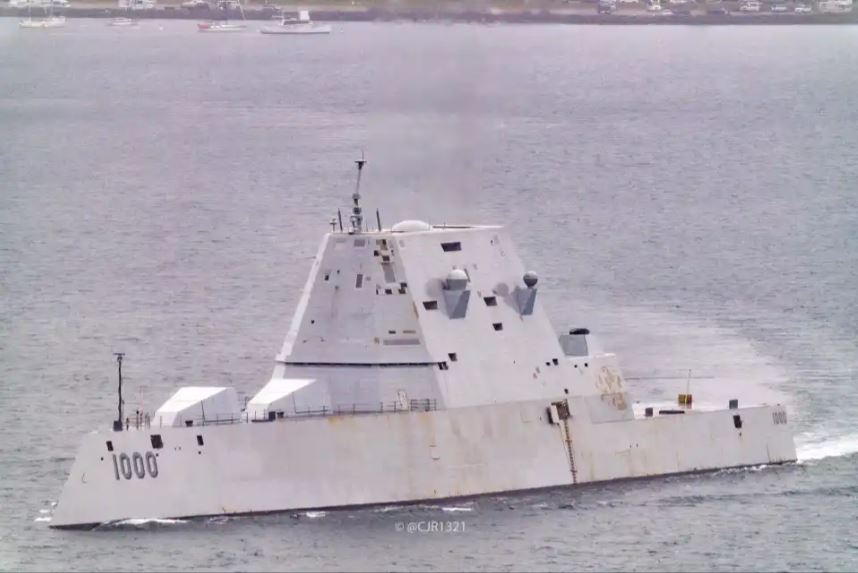
Though the cheap seats were warning otherwise, the Navy let everyone know of the glories of Transformation embodied by LCS, DDG-1000 and CG(X) were going to bring if everyone would just shut up and color ... a period that would end 18-months after Elegant Decline with the truncating to 3-ships of the Zumwalt class ... and you know the rest as we rolled in to the Age of Salamander to prepare everyone for The Terrible 20s.

So, in to that moment Kaplan dedicates the first third of his article reminding everyone of some truths are were as correct in 2007 as they are in 2023;

Beware pendulum swings. Before 9/11, not enough U.S. generals believed that the future of war was unconventional and tied to global anarchy. ... Now the Pentagon is consumed by a focus on urban warfare and counterinsurgency; ... But have we pushed it too far? We may finally master the art of counterinsurgency just in time for it to recede in importance.

...Though counterinsurgency will remain a core part of our military doctrine, the Pentagon does not have the luxury of planning for one military future; it must plan for several.

"Regular wars" between major states could be as frequent in the 21st century as they were in the 20th. ... these future wars will not require any "manifestation of insanity by political leaders," nor even an "aberration from normal statecraft, " but may come about merely because of what Thucydides recognized as "fear, honour, and interest."

..

The current catchphrase is boots on the ground; in the future it could be hulls in the water. 

...

A "peaceful, gain-loving nation" like the United States "is not far-sighted, and far-sightedness is needed for adequate military preparation, especially in these days," warned Navy Captain Alfred Thayer Mahan in 1890..

This is when he transitions to what he, rightfully, sees as a primary indicator of America's decline - its Navy - something that dominates the other 2/3 of the article.

...too few strategists at the time were thinking seriously about sea power. Today we are similarly obsessed with dirty land wars, and our 300-ship Navy is roughly half the size it was in the mid-1980s.

A great navy is like oxygen: You notice it only when it is gone. But the strength of a nation's sea presence, more than any other indicator, has throughout history often been the best barometer of that nation's power and prospects.

I just wanted to take a note to nod at the hard work led by Rep. Mike Gallagher (R-WI) in the changes to Section 8062(a) of USC Title 10, 15-years after Elegant Decline, to put this in to law. 

Our friend Bryan McGrath has a superb summary of the changes and their importance here.

Back to Elegant Decline - where Kaplan does a great job outlining more nuggets of unalloyed truths;

Our sea power allows us to lose a limited war...Army units can't forward-deploy anywhere in significant numbers without a national debate. Not so the Navy. ... Great navies help preserve international stability. 

...

In an age where 90 percent of global commerce travels by sea, and 95 percent of our imports and exports from outside North American do the same (even as that trade volume is set to double by 2020), and when 75 percent of the world's population is clustered within 200 miles of the sea, the relative decline of our Navy is a big, dangerous fact to which our elites appear blind.

Well, it didn't double, but it did go up by 30%.


A lot of you will remember this well;

...in a 1954 article in Proceedings ... a young Harvard academic named Samuel P. Huntington told the Navy not to feel sorry for itself:

The resources which a service is able to obtain in a democratic society are a function of the public support of that service. The service has the responsibility to develop this necessary support, and it can only do this if it posses a strategic concept which clearly formulates its relationship to the national security. 

Emphasis added by me.

Good googly moogly yes. Has our "service" been doing this sales job well? No, no it has not. Why? They have tied themselves to the mast of the archaic, accretion covered Cold War era Goldwater-Nichols and the Cult of the Joint that comes with it. That is why. They have convinced themselves that they have to accept this state of affairs in silence when they don't - it is senior leadership's choice to interpret it as such. Our Navy and the nation it serves suffers as a result.

...by 1997, post Cold War budget cuts had reduced the Navy to 365 ships. (In the Quadrennial Defense Review of that year, the Pentagon established a 'red line' of 300 ships, below which the Navy would not go.)

LOLOLOLOLOL.

Of course the 300-ship Navy could still, in the words of Robert O. Work, ...

BOB!

 ..."pound the snot" out of primitive challengers like Iraq, Iran, and North Korea,

Don't worry, they didn't forget about China completely;

Robert Work told me that he believes the eventual incorporation of Taiwan into China will have the effect that the Battle of Wounded Knee had on the United States: it will psychologically close an era of national consolidation for the Chinese, thereby dramatically redirecting their military energies outward, beyond their coastal waters. Tellingly, whereas the U. S. Navy pays homage to Mahan by naming buildings after him, the Chinese avidly read him; the Chinese are the Mahanians now.

The next bit is something we called at the time wrong-headed and unhelpful and Kaplan is suspicious of at the time as well; then CNO Admiral Mike Mullen, USN (Ret.); 

He (Mike Mullen) went on: "I'm after that proverbial 1,000-ship Navy - a fleet in being, if you will, comprised of all freedom-loving nations, standing watch over the seas, standing watch over each other." Subtract the platitudes, and it's clear that Admiral Mullen is squaring a number of circles to contend with the difficult reality he's up against. 

I continue to hold that this throw away line that became a talking point that was then made flesh was one of the greatest strategic errors this century so far. It gave top cover to those who were looking for reasons not to build the Navy our nation needed. The evils of the Age of Transformationalism only made it worse ... another of Mullen's follies;

This is what the optimists saw right before the rot was unavoidable anymore;

The new DDG-1000 Zumwalt-class destroyer, envisioned in one form or another for 12 years and beset with delays could end up costing $3 billion a ship - if any get built. The new Gerald R. Ford-class aircraft carriers could cost a whopping $8 billion each - not including $6 billion of research-and-development costs.

History can be cruel to such a geologic pace; this slowness is a recipe for vulnerability and nasty strategic surprise. We have a capital-intensive Navy consisting of vessels that cost tens of billions of dollars, and that must therefore each deploy for decades if they are to return the investment. Yet all future peer competitor like China need do to greatly devalue our fleet is to improve its ballistic-missile technology to the point where we're forced to move our carriers, say, 100 miles east of their present positions off the Asian mainland, to keep them out of missile range.

We should be so lucky. Time has found Kagan an optimist here.

...the new Ford-class carriers will be built with laser guns to kill incoming missiles, anti-torpedo torpedoes to deal with supercavitation technology, and electric catapults for launching UAV's in case fight jets, with their human pilots, give way to enhanced remote-controlled Predators that  can be refueled in air.

Well, in 2022 lasers are still the weapon of tomorrow like they always seem to be, anti-torpedoes are a strong maybe to no, and unmanned systems are still a few generations away if ever from there ... so ... technology and future risk can suffer from excessive optimism bias ... as always. Watch 2001: A Space Odyssey for a hint in that regard. 

Meanwhile, as costs drive us towards that 150-ship Navy...

Not yet...we're doing better than that so far. Kaplan was a bit too much of a pessimist on this point. At my darkest in pondering The Terrible 20s I warned of 240 back in 2010.

According to Navy Lieutenant Commander Claude Berube, who teaches at the U.S. Naval Academy, in an emergency we might even issue letters of marque, the way we did during the Revolutionary War, giving privateers the legal authority to act in our defense. Allowing privateers to help with, say, the drug-interdiction effort in the Caribbean would enable uniformed sailors to concentrate on the Pacific and Indian oceans.

Claude!

Today, the United States devotes 4.38 percent of its annual gross domestic product to defense. Before the Iraq War, it was 3.5 percent.

In 2022 it was back to ~3.5%.

Admiral Morgan, the deputy chief of naval operations for information, plans, and strategy, told me that to maintain our naval primacy, we may need to devote close to 5 percent of GDP (assuming a growing economy) to defense. Yet it's unclear whether the American public will abide that.

Spoiler alert; they didn't.

So, there we go; the Elegant Decline at 15. 

Much spot on, some a bit too optimistic, some too pessimistic. On balance though, it aged fairly well in a decade and a half.

It should keep us all humble and it would do everyone well to understand that, on balance, 2023 is not all that different than 2007 ... and 2037 will most likely not be all that different than 2023.

Plan accordingly.