Showing posts sorted by relevance for query Mattis. Sort by date Show all posts

Tuesday, April 27, 2010

The mind of Mattis


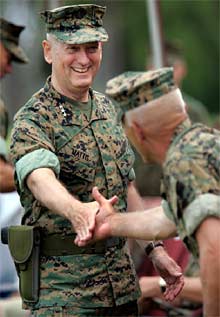
Any chance you have to get into the mind of General James Mattis, USMC, you need to make time to.

John Dickerson over at Slate does us all a great service and through an overview of the core of success in our line of work - risk - as seen through General Mattis. You need to read it all, but here are a few of the highlights.
Any risks—whether, for example, singing onstage, starting a company, or rock climbing—pale compared with the risks a soldier takes in combat. A soldier risks his own life, the lives of his comrades, and the lives of innocent civilians. An officer has this burden, and more, because he also makes the decision to risk the lives of his soldiers, knowing that some of them will come to harm.
Marine Gen. James Mattis, 59, has been making these decisions for almost 40 years since his graduation from Central Washington University. He led combat troops in the first Iraq invasion as a lieutenant colonel. He commanded Marines as a brigadier general in Afghanistan in 2001. In 2003 he was the Marines ground commander in Iraq, leading the 20,000 troops of the 1st Marine Division for 500 miles over 17 days, the longest sustained march in Marine Corps history. He returned to Iraq months later to direct the fight against insurgents in the raging Al-Anbar province. Now a four-star, Mattis is commander of U.S. Joint Forces Command. It's his job to help the Army, Navy, Air Force, and Marines fight in coordination. He has also become a key figure in the debate over how the military should adapt to irregular warfare, the kind in which enemies hide in mosques or deploy computer viruses.
...and we could not have a better man on the job.
Mattis is an evangelist for risk with two core principles. The first is that intellectual risk-taking will save the military bureaucracy from itself. Only by rewarding nonconformist innovators will the services develop solutions that match the threats conceived by an enemy that always adapts. The second is that technology cannot eliminate, and sometimes can't even reduce, risk. Mattis warns about the limitations of sophisticated weapons and communications. They can be seductive, luring military planners into forgetting war's unpredictable and risky nature, leaving troops vulnerable.
If you didn't just want to stand up and yell, "Yes, yes, yes! Great Caesar's ghost, yes! By all that is right and good - YES!" then you are truly lost. See why I am such a fan of Mattis?
Note.
Mattis embodies the risk-taker's mix of head and heart. You can see it on the walls of his library. As one of nine combatant commanders, he was assigned the sprawling 17,000-square-foot Virginia House on Norfolk's huge Navy base. Unmarried, Mattis lives alone (Warrior Monk is one of his many nicknames). Walking into his pristine house I felt like I needed an admission ticket until I got to the two well-used rooms off a back hallway. The library shelves are packed with histories and military manuals. In conversation, Mattis regularly gets up to retrieve a volume—to cite a passage about the insurgency in Algiers or show a table about fuel use in the initial sprint into Iraq.
Two things you will not see on an USN 4-Star's office; especially the last one.
One of his favorite photographs of many from his combat tours shows the men of the platoon he traveled with in Iraq. He did not command from a remote location as some generals do but made regular tours into the thick of the action. (In a five-month period in 2004, 17 of his platoon's 29 members were killed or wounded.) In another photograph, he's a young lieutenant in full combat gear, staring into the screaming mouth of his commanding officer. He is being chewed out for getting into a drunken bar fight the night before.
For any service - the following should be kept for reference - on a wall somewhere preferably. The Sherman quote you would have found on mine.
Drone attacks and PowerPoint presentations give the illusion that war is more manageable than it is, argues Mattis, which is why, as he works to prepare the military for wars of the future, he abolished Effects-Based Operations, a method of planning that sought to determine actions based on quantifiable outcomes. "It is not scientifically possible to accurately predict the outcome of an action," says Mattis in explaining his decision. "To suggest otherwise runs contrary to historical experience and the nature of war."

In making this case, Mattis sounds like the economists who warned against the use of financial instruments like Value-at-risk measurements that sought to quantify risk and make it precise. He quotes Sherman:
"Every attempt to make war easy and safe will result in humiliation and disaster," but he could just as easily quote Nobel Laureate economist Kenneth Arrow, who warned of the same problem in economics: "vast ills have followed a belief in certainty."
Getting tired of Nanny Navy? Well - you have a friend in Mattis.
Maintaining this culture of ferocity is why Mattis bristles about excessive hand-wringing over Marines who might want to ride without motorcycle helmets. Marines need to be risk-takers. That's why the corps advertises at extreme sporting events. Ferocity is part of what the corps works to build in boot camp, and it is central to its storied history and traditions. If that's the kind of spirit you need to fight wars, then you have to accept that the kind of person you want is going to sometimes ride at 120 miles an hour on a bike and hurt himself. "It's not that I'm trying to extol this kind of behavior," says Mattis, "but you have to have people who know that risk-taking sometimes means that people are going to get hurt. If you can't accept that, if your view of warfare is always hurtful and you're psychologically damaged by it, you start putting up guardrails."
Finally I will call for it again - Gen. James Mattis, USMC - the next Chief of Naval Operations.

Hat tip GOH.

UPDATE: Oh, and as if you need another reason to follow Gen. Mattis - here is a quote for 'ya,
“PowerPoint makes us stupid,” Gen. James N. Mattis of the Marine Corps, the Joint Forces commander, said this month at a military conference in North Carolina.

Tuesday, May 06, 2014

General Mattis's Newest Commander's Intent

If you do not know it already, we are living in the presence of giants. General Mattis is one of them.

On active duty, his record speaks for itself. I cannot even start to mention how heartening it is to see one topic he is addressing in retirement - attacking directly a smear that we've been discussing here since 2004.
In a speech last month, Mattis tackled a concern that is on the minds of a number of combat leaders: A public that wants to paint veterans as victims and why that is potentially damaging to the fighting spirit of America's warriors.

"I would just say there is one misperception of our veterans and that is they are somehow damaged goods," Mattis said. "I don't buy it."

"If we tell our veterans enough that this is what is wrong with them they may actually start believing it," he said during questions after a speech at the Marines' Memorial Club in San Francisco.
...
"While victimhood in America is exalted I don't think our veterans should join those ranks," Mattis said.
...
"There is also something called post traumatic growth where you come out of a situation like that and you actually feel kinder toward your fellow man and fellow woman," Mattis said.

Mattis is legendary for his bluntness, but his words are chosen carefully. He is an avid reader of military history, but also literature.

Mattis' point is that warfare often comes down to a clash of wills. Technology and weaponry matter, but war, even on today's battlefield, is often won or lost at the point of a bayonet.

Mattis said the U.S. military must be steeled to fight a fanatical enemy that has a medieval worldview. The enemy must be convinced that it has a warrior class that won't back down.

"We are going to have to have young people in our country who are willing to go toe to toe with this because two irreconcilable wills exist," he said.

"There is no room for military people, including our veterans, to see themselves as victims even if so many of our countrymen are prone to relish that role," he said.
Those who have been subjected to my fits of fanboy stories of the times I worked with General Mattis first in 2001 and last in 2009, know my feelings for the man as a leader and a mensch. Those who have served with him know of what I speak.

This latest effort of his has done the impossible - increased my opinion of him.

To the ends of the earth for this man - the ends of the earth.

Here you go. Get a fresh cup of coffee, put the phone to email. The full speech from the 3rd Annual Salute to Iraq and Afghanistan Veterans with General James N. Mattis, USMC, (Ret.) at the Marines' Memorial Club of San Francisco on April 23, 2014.

He starts by putting those who want to have the USA withdraw from engagement in the world on report. 

At the 25-min point, he goes full Salamander on economics. The PTSD subject starts at the 28:30 point, and comes up again at the 48:30 point.

The last 35 seconds, in context, are sublime in its power..

D@mn, I need to go PT.


Monday, June 22, 2009

Mattis on C2

Let's set some foundational truths. General Mattis, USMC is one if not the premier military minds of his generation. I count as an honor that I have worked with him.

He is also the most senior antitransformationalists we have. Here is what I ask of you. Look at your calendar today. Find an hour - if you don't have one eat your lunch at your desk. If that doesn't work, wait until you get home and the 'lil ones are in bed and the honey-do list is done. Get a cup of coffee or tumbler of good single malt, and then watch the video below.

Be in awe. I am. If you are running short of time, go to the 35:00 point.

Before we get to that though, get the Executive Summary about what he will speak of. Once again, General Mattis, USMC finds the right point of vulnerability.
US Marine Corps General James Mattis, head of US Joint Forces Command, cautioned against the military becoming too reliant on technology and command-and-control (C2) systems, which he believes could increase vulnerability.

During a 1 June speech in Washington, Gen Mattis, who also serves as NATO's Supreme Allied Commander for Transformation, called for moderating "our idea that technology is going to solve this human problem called war".
I really wish I could find a full transcript of this speech. Here is the meat of the article behind the firewall;
"War, he said, is primarily "a human endeavor [and] a social problem", so the US military should be careful in assuming what solutions technology might provide because its enemies have a history of avoiding their foe's strengths and exploiting weaknesses.

Overly relying on technical C2 systems and centralized decision making woudl cause the US military to become the "single most vulnerable military in the world", Gen. Mattis warned. Data and communications networks represent a 'single point of failure' that could be attacked, resulting in disabled command structures.
Exactly, hitting on a theme we touch on here on a regular basis, over reliance on technology is a false economy when you actually have to go to war. If you rely too much on the electronic spectrum and don't have a back-up ready to go - you will be defeated.

Here is the CSIS speech. In a word, awe.


Gen. Mattis is a national treasure. There, I said it.

We literally put our nation at Strategic and National risk by putting all our eggs in transformationalist ideas. Fact trumps theory. Lead and steel trump PPT. I cannot think of a person who understands this better, or makes a better argument about this subject, than Gen. Mattis.


On a larger scale, if you want to know the worst case scenario, out on the tail end of the bell curve, where our arrogant faith in non-robust technology and blinkered view about our critical vulnerabilities can go, check out what I am listening to now, William R. Forstchen's One Second After.

Thursday, February 03, 2005

LT General Mattis - Any further questions?

My regular readers already know I would follow Lieutenant General Mattis about anywhere. Those that know him or his type will understand why.

The
Reuters crowd is all a'titter because they happened to hear the good General speak what is, as blunt as it is direct, true for many - though not all.
Lt. Gen. James Mattis, who led troops in Iraq and Afghanistan, made the comments at a conference Tuesday in San Diego.

"Actually it's quite fun to fight 'em, you know. It's a hell of a hoot. It's fun to shoot some people. I'll be right up front with you, I like brawling," said Mattis.

"You go into Afghanistan, you got guys who slap women around for five years because they didn't wear a veil," Mattis said during a panel discussion. "You know, guys like that ain't got no manhood left anyway. So it's a hell of a lot of fun to shoot them."


His boss (Commandant of the Marine Corps General Hagee) had something to say,
"I have counseled him concerning his remarks and he agrees he should have chosen his words more carefully,"
Ahhhhh, to be a fly on that wall. I'm not sure my feelings are exactly in-line with LT GEN Mattis, but I'm not a Marine.

I will tell you who's feelings LT GEN Mattis is in line with. He looks like him, he kind of talks like him (the real one-not George C. Scott), and if you take time to General Patton's famous speach, you will know what I mean.

Glad he is on our side.

UPDATE: Good news. Both CAPT Ed and Hugh are giving General Mattis some topcover. Chester makes some very valid points as well.

Friday, August 24, 2007

In praise of Lance Cpl Sharratt, USMC

Once again, Lt. Gen Mattis, USMC - shows that is a true Marine, Man, and Mench.
The general in charge of U.S. Central Command Marines praised Lance Cpl. Justin Sharratt in dropping all charges against him this month in the shooting deaths of four Iraqi civilians in Haditha, Iraq, in November 2005.

"The experience in combat is difficult to understand intellectually and very difficult to appreciate emotionally," stated Marine Lt. Gen. James Mattis, the commander, in a letter dismissing all charges against the corporal without prejudice on Aug. 8.

Gen. Mattis quoted former Supreme Court Justice Oliver Wendell Holmes, who said that combat is an "incommunicable experience" and that "detached reflection cannot be demanded in the face of an uplifted knife."

"Marines have a well-earned reputation for remaining cool in the face of enemies brandishing much more than knives," Gen. Mattis said, noting the "brutal reality" of daily life in Iraq.

"Where the enemy disregards any attempt to comply with ethical norms of warfare, we exercise discipline and restraint to protect the innocent caught on the battlefield. Our way is right, but it is also difficult."

Gen. Mattis stated that an exhaustive investigation showed Cpl. Sharratt "acted in accordance with the rules of engagement" in Haditha, and he noted that by dropping the charges, Cpl. Sharratt could "fairly conclude that you did your best to live up to the standards followed by U.S. fighting men throughout our many wars, in the face of life or death decisions made by in a matter of seconds in combat."

The three-star general put the current conflict in context by noting that in Iraq "our nation is fighting a shadowy enemy who hides among the innocent people, does not comply with any aspect of the law of war, and routinely targets and intentionally draws fire toward civilians.

"As you well know, the challenges of this combat environment put extreme pressures on you and your fellow Marines," he said. "Operational, moral and legal imperatives demand that we Marines stay true to our own standards and maintain compliance with the law of war in this morally bruising environment."
Contrast that with, well, you-know-who and what he said.
Gen. Mattis' letter contrasts sharply with comments made in May 2006 by Rep. John P. Murtha, Pennsylvania Democrat, who accused the Marines in Haditha of killing Iraqis "in cold blood" and then covering up the purported atrocity.
Cpl Sharratt - best wished and BZ.

What are the KosKids saying? About what you would think.

For more goodie, head on over to EuphoricReality to get a good review.

UPDATE: Thanks to Red State, though not Lance Cpl Sharratt's IO, here is Lance Cpl Tatum's for review. It does mention Sharratt's actions in House 1 some though. Solid. Here it is.
UPDATE II - Electric Boogaloo: thanks to andrewb, we have the full text of Lt. Gen. Mattis' letter here.

Tuesday, June 13, 2017

So, we get Stav and Mattis in a room ....

So, SECDEF Mattis (no, I don't get tired of saying this) put it right out there;
"We are not winning in Afghanistan right now. And we will correct this as soon as possible," Mattis said in testimony to the Senate Armed Services Committee. Mattis acknowledged that he believed the Taliban were "surging" at the moment, something he said he intended to address.

From last month, Jim Stavridis outlined 5 reasons we need more forces in AFG

First, it is a tactical necessity. Over the past two years, the Taliban have been steadily encroaching on Afghan government control of territory, and by some estimates they are now in a position to influence the population in 40% of the country. While Afghan Security forces number over 300,000 and have shown real mettle in many places, they are taking significant casualties and still require effective mentoring down to at least the Battalion level. That means an increase in our overall troop strength is necessary.

Second, the emergence of an Islamic State element in Afghanistan is very concerning. While they have largely been unable to galvanize either the population or create cooperation with the Taliban, they have conducted a series of disruptive terror attacks and add further chaos to an unstable system. A larger NATO force can blunt their impact.

A third key reason is to create political capital that can be very helpful when some portion of the Taliban (who are not a holistic organization to say the least) eventually come to the negotiating table. We will never “win” militarily in Afghanistan, nor can we kill our way to success. Sooner or later we will need to bargain, and a stronger NATO force on the ground will give us better leverage.

Fourth, the additional forces send a signal to the Pakistanis, who are still somewhat playing a “double game” of overtly cooperating with NATO, but in reality supporting some elements of the insurgency. This commitment will tell Pakistan we intend to continue to work for a successful outcome in Afghanistan, and will hopefully encourage them to force the Taliban into negotiations.

Which brings us to another key point: what does success look like? Afghanistan is not going to resemble Singapore anytime soon; but it can have a functioning democratic government, general control over much of its borders, the ability to minimize impact from the insurgency, armed forces with high public approval, and a reduction in both corruption and narcotics — the latter two issues posing a longer term threat to the nation than even the Taliban. Getting to that point of success will require security and thus the additional forces.
I've been writing about AFG from the start of the blog, click the AFG tag below if you're new here and want to catch up.

Both Mattis and Stavridis are spot on. Since Obama's DEC09 West Point speech, we turned over all momentum to the enemies of modernity. 

We had a good, long range plan by 2008, but that was all thrown away. There is a lot to do.

Though we are as a nation tired, and on some days I think we should just all just look for the airhead version of the Friendship Bridge and cover what we leave behind in thermite ... but that isn't how this works.

Mattis was the first General Officer to set foot in AFG as a 1-Star, and Stavridis had to do what he could with the Political Level D&G he received from Obama as SACEUR.

A smart person would defer to their recommendations, or at least give them a fair hearing.

If those two gentlemen are standing up and pointing in a certain direction, I'm lacing up my boots and forming up behind them.

$.02.

Thursday, December 01, 2016

SECDEF Mattis

An understatement of the year would be "this is great news;"
President-elect Donald Trump will nominate retired Marine Gen. James Mattis as his secretary of defense, he announced Thursday in Cincinnati at the beginning of his post-election tour.

"We are going to appoint 'Mad Dog' Mattis as our secretary of defense. But we're not announcing it until Monday so don't tell anybody," Trump said at his rally, adding later, "They say he's the closest thing to Gen. George Patton that we have and it's about time."
Mattis, 66, would join a Trump national security team that already includes retired Army Lt. Gen. Michael Flynn as national security adviser and Rep. Mike Pompeo as CIA director.
Allow me a little self-indulgence.

Regulars here and at Midrats know my feelings towards Mattis. In summary, I had the pleasure in serving with him on three occasions; once when he was a 1-star and we were both trying to figure things out in C5F AOR in the weeks after 911; once as a 3-star when he was MARCENT, and once as a 4-star when he was the commander of NATO's Allied Command Transformation. I've had the pleasure of talking with him (the first time I thought he was a USMC SNCO for about 30-seconds until I saw his star), briefing him, and watching him work with his Marines. I never saw someone who was such a natural leader that so quickly earned the trust and admiration of those around him. I was a minor player around him on every occasion, but in spit of that - he remembered my name every time we found ourselves face to face again, years apart and he talked to me like it was only yesterday. 

If he built that bond with me, I cannot imagine the feelings of those who served with him day in and day out - but I've heard plenty.

Our nation will be exceptionally well served in any position he finds himself in. All should be at peace with him heading to SECDEF. I am still in awe that he may be heading there, and I hold the greatest hope for his success. I am just slightly saddened that I won't have a 4th chance to work with him - but I will enjoy the opportunity of seeing him from afar.

Some people are voicing concerns about the number of Generals picked so far by Trump. As a small (r) republican, in the back of my head I share that concern, but not with James Mattis.

Nope. Without question I would put the lives of my wife and children in his hands. Very few people on the planet pass that muster. That will do for SECDEF.

Monday, July 17, 2017

The 350 Ship Navy: Don’t Hold Your Breath

Editor's Note: The below is a guest post by Bryan McGrath. 

It was originally posted elsewhere last week, but the editor of that site feared retribution from their sponsors and pulled it down shortly after it was posted.

I offered to post it here, and Bryan accepted the offer.


President Trump has made a large increase in the size of the Navy the centerpiece of his promise to rebuild American military strength, telling audiences on the campaign trail that he would grow the Navy from its current size of 276 deployable battle force ships to 350, to include growing the carrier fleet from 11 to 12 hulls. 

Scheduled to speak at the July 22nd commissioning ceremony for the USS GERALD R FORD (CVN 78) (a ship he had considerable criticism for earlier this year), it is conceivable that he will renew his call for this expanded fleet. This is music to the ears of naval advocates who believe American Seapower occupies a unique place among the components of American military power in its capacity to advance the nation’s prosperity and security. 

The enthusiasm for Trump’s naval buildup was somewhat dampened with the release of his FY18 budget, which did not grow the Navy appreciably over the levels described in his predecessor’s final budget. There was no shortage of criticism of the President for this seeming reversal of a campaign promise, but as I wrote elsewhere, there was wisdom in using the FY17 budget amendment and the FY18 budget submission to shore up anemic readiness and weapons procurement accounts before beginning what would be an expensive, decades long project to grow the Navy by 25%. Secretary of Defense Mattis’ statement of priorities upon assuming office made this emphasis clear.

I am no longer sanguine about the prospects for a 350 ship Navy, and I base my view on the uninspiring testimony yesterday of Richard Spencer, appearing before the Senate Armed Services Committee as the Trump Administration Secretary of the Navy nominee. Spencer was presented with the opportunity to voice full-throated advocacy for the fleet called for by the Commander-in-Chief and buttressed by a recent Navy Force Structure Assessment calling for 355 ships. Instead, he waffled, sounding very much like those in the Obama Administration who argued against a larger fleet, telling the SASC “What I will tell you is that, whether it’s a 355-ship or not, what we also want to get our head around is, can we have a capacity number, but have a capability that’s even greater than that, so have the capability of a 355 that might be a 300-ship Navy.”  

This debate between naval capacity (numbers) and capability (i.e. weapons, sensors, and networking) is evergreen, and every responsible administration must wrestle with it. Resources are not unbounded, and the right mix between numbers and capability is the ultimate aim of Navy budgeteers. But for a Secretary of the Navy nominee—given the gift of Presidential imprimatur upon a vast naval buildup—to make his public debut by questioning the wisdom of such a buildup, something is amiss. That something is, I fear, the Secretary of Defense.

Tucked into Mattis’ statement of priorities linked-to above, is a section in which he points to an ongoing strategic review (the 2018 National Defense Strategy) that will provide a new force sizing methodology to be used to shape the growing force. Presumably, the National Defense Strategy will be used to impact the FY19 defense budget process later this year, to include broad guidance on where additional resources are to be prioritized. Putting it another way, if there were going to be a significant naval buildup, it would be reflected in the strategic narrative advanced by the Secretary of Defense and then codified in the FY19 budget submission.

That Secretary of the Navy nominee Richard Spencer did not get behind the President’s goal appears to indicate lukewarm support for it within the Office of the Secretary of Defense (OSD), especially if it means re-allocating resources from other parts of the Department. Given the ongoing budget stalemate on the Hill, this would appear to be the only way the Navy would get a significant budget increase. And since Spencer is known to be close to Secretary Mattis (but not particularly close to the Trump inner circle) it is not difficult to envision Mattis providing Spencer with clear direction not to enthusiastically ratify the President’s naval buildup, in order to retain sufficient freedom of maneuver while the strategic review is underway. 

A military buildup the size of what Trump called for on the campaign trail would be very expensive. I calculate the annual cost to build, man, maintain, and operate a fleet the size the President desires to exceed $40B a year in FY17 dollars. Trump also wishes an increase in the size of the Army and a stepped up program of fighter procurement for the Air Force. These increases would dramatically raise the defense budget, something the President simply does not possess the political capital to accomplish. Contributing to this lack of political capital is the administration’s seeming inability to frame policy and then harness the Congressional majority to achieve it. Mattis sees this, and I suspect he realizes that there will be no significant buildup, although there will be a modest boost to the DoD topline. 

This bleak outlook for increased defense spending leaves Mattis in very much the same position as his predecessor Ash Carter was, in which expensive programs designed to increase capacity (including shipbuilding) were sacrificed to fund what were considered higher priority needs such as offensive weapons, networking capabilities, cyber capability, and electronic warfare upgrades. This is a reasonable position to take in a severely restricted budget environment, but Trump campaigned on ending that environment to rebuild the military. Success in achieving this goal was always a long-shot, but with the President’s ongoing weakness, it is virtually unachievable. I suspect the Secretary of Defense is aware of this.

Given the theory I have advanced, what can navalists hope for?  

First, it is clear that the operating forces can expect better operations and maintenance funding, enabling ships and aircraft to gain the proficiency they need through at sea and on-range training even as their accumulated maintenance backlogs are worked through. 

Second, I expect there to be significantly higher investment in increasing the capability of the platforms we already have by fielding more and more capable weapons and sensors, and then backfitting them into the current fleet. 

Third, I expect the Navy’s shipbuilding program to increase fleet size at a gradual pace, with much of the growth planned for 10-30 years from now, when future administrations will have to figure out how to pay for it. 

The prospect of a dramatic naval building program was fun while it lasted, but the reality of our modern political milieu has intervened. Unless the Congress steps up and takes control of the naval building effort—in spite of what the Secretary of Defense may desire—we are in for at least four more years of muddling through. 


Bryan McGrath is the Managing Director of The FerryBridge Group LLC, and the Assistant Director of the Hudson Institute Center for American Seapower. 

Monday, March 30, 2015

General Mattis and the Path not Taken


Alternative histories can be instructive - if for no other reason than they reinforce the importance at inflections in time which leaders hold the levers of power. "The Big Man Theory" is not a parlor game, it is how the world works.

Usually, alternative histories in the second decade of the 21st Century involve either the WWII era or the US Civil War. Let's flop that a bit and instead play it a little closer.

Run our own little wargame where at certain decision points, as a nation, we:

- Did not let a vacuum exist where Iran and her lead proxy Hezbollah did not have the white space to step in to preserve the Assad regime in Syria, and instead Russia took that point instead; keeping Iran and her proxies out. Better yet - before the Islamic State grew from just another militia, some other power became the lead anti-Assad force, or none did. As a result, Assad crushed his opposition before the death toll went in to six figures? Bloody civil war as all are and it would not be pretty - but an Assad in power would be a status-quo outcome, but not a raging medieval nightmare spreading a violence of slit-trench executions and barrel bombs that we have now.
- What if we actively went after the arms shipments to the Yemeni Shia rebels early and with vigor, and helped keep them to just a small threat in the mountains? No combined Sunni Arab army massed to slaughter a Shia rebellion wholesale. Not another ink-spot of growing Iranian influence.
- What if instead of Quds Force commander Major General Qasem Soleimani being turned in to a hero in al-Anbar, he was killed by some roadside bomb on in an helicopter crash along with a batch of Iraqi Shia death squad leaders?
- What if we joined in supporting the Sunni Arab nations and Europe to push for harder sanctions on Iran, as opposed to having the USA take the Iranian position on the way to getting a nuclear weapon?

Well, sometimes that isn't the way history turns in a representative republic. You vote for a world view, and you get it good and hard.
Ret. Marine Gen. James Mattis, who oversaw U.S. forces in the Middle East from 2010 to 2013, was among the most insistent voices inside the military pushing for a policy focused on punishing Iran and its proxies.

Mattis lobbied for more interdictions of ships and planes carrying Iranian arms to battlefields such as Yemen and Syria, said former defense officials, who spoke on the condition of anonymity to discuss policy deliberations. And Mattis pressed for more covert actions to capture or kill Iranian operatives, especially after the foiled 2011 plot by Iran to kill the Saudi ambassador at a Washington restaurant.

The former defense officials said plans to punish Tehran were often sidelined over concerns that they could disrupt negotiations to prevent Iran from developing a nuclear weapon.

“The Iranians showed that they could intervene everywhere even as they were negotiating on the nuclear issue,” said Ilan Goldenberg, who served as the Iran Team Chief in the Pentagon. Mattis’s pressing on the issue caused him to fall out of favor with the White House and ultimately led to his leaving command early, the former defense officials said.
Sigh.

Friday, December 07, 2012

New COMCENTCOM is easy to find

As a General Mattis acolyte, his departure from CENTCOM is a sad moment for me, as I don't think he has anywhere higher to go - and for me, you can never have enough Mattis.

However, nothing is constant but change. The largest challenge in the CENTCOM AOR right now is the scheduled withdraw under fire in AFG - something that will be very different than the withdraw after victory in IRQ.

In that situation, someone who has some expertise and experience in that area is important, and it looks like we have made a great choice to follow in Mattis's footsteps.
Army Gen. Lloyd J. Austin III, the last U.S. commander in Iraq, has been tapped to lead the U.S. Central Command, which oversees military operations in the Middle East and the Afghan war, the Pentagon announced Thursday.

“During his final deployment to Iraq, Gen. Austin led our military efforts at a particularly important time, overseeing the drawdown of U.S. forces and equipment while simultaneously helping to ensure that hard-fought security gains were preserved and that Iraqis could secure and govern themselves.
Even more than Mattis, General Austin has not been one to seek the spotlight. One could argue that he has actively avoided it ... and that is good.

He has a tough job to get us through 2014 while looking for 2nd and 3rd order effects in that part of the world that seems to produce more history than can be consumed locally. Best of luck General Austin ... and thank you very much General Mattis.

As a side note, I am especially glad to see someone from my pat of the world moving to COMCENTCOM, sons of the deep South do make the best Generals ... and though I cannot find his stats, it is also good to see after a series of smallish, wiry, triathlonesque types with four stars out there - that we have a good, solid, Grade-A soldier from the General Gray school of body types. John of Argghhh!!! should be pleased.

What is General Austin; 6'5" and about 250lbs? They make parachutes for guys like that? No problem finding him in a crowd. Anyway, I like that. Like the nation it serves, it never hurts to have a military that is as physically intimidating as it is intellectually strong.

You can get a feel for the guy in this DVIDSHUB b-roll.


He also has a great, serious, and humble presence at the podium.

Thursday, July 08, 2010

Mattis to CENTCOM

General Mattis will be the next Commander of US Central Command, CENTCOM.
Defense Secretary Robert Gates says he wants Marine Corps Gen. James Mattis to take over U.S. Central Command.

Mattis would replace Gen. David Petraeus, who is now in Afghanistan as the top U.S. and NATO military officer there.
Outstanding. There is no better commander for Gen Petraeus. More to follow, but know that you cannot ask for a better team.

This is the varsity team.


Gates, Mattis, Petraeus. Give them your support and get out of their way.

Monday, December 24, 2018

On Mattis

First of all, this Christmas Eve, regardless of your confession I wish all peace and happiness. 

As we are all busy, I'll just cut to the chase.

Last Thursday I offered a few points on Syria, and I guess I should make a few points about Secretary Mattis's departure as well.

Slightly modified from some comments I made SEPCOR, here is the Executive Summary:

We're all going to be just fine. I've been a Mattis guy since 2001, but SECDEF is a position for a politician, not a Field Marshall. Even though I have 100% trust in him for any position he may find himself in, Mattis was never quite well suited for the position of SECDEF as it was designed. He had to get a waiver for a reason. I am still a Mattis guy and I wish him well.

As for who should replace him, anyone who can get a nod from the Senate and will continue to promote what Trump has been doing and I have been honking about since Bush43: 
(1) decouple from being the world's policeman, 
(2) get our NATO allies to pull their fair share of the load. 2% isn't exactly asking for a lot.

Again, we're fine. 
- We are mostly in the Middle East due to strategic inertia and to tidy up problems generally of our own creation. We don't need their oil anymore. 
- While our debt issues are huge, we are in better shape than any other major nation on the planet. When the music stops, the world will groan, but we will hurt less than almost anyone else. 
- We feed ourselves. 
- Our entire hemisphere is of zero threat to us. 
- The only real global challenger we have will be China  and we have absolutely ZERO reason to have a land dispute with them on mainland Asia. Any conflict will - if we are smart about it - be mostly an air and sea conflict for us, with any land force hopefully limited to islands.

What we don't need is an expanded universe of nations and regions we are garrisoning in order to secure their peace at the cost of increasing the threat of possible war for us over things that are none of our business.

Specifically WRT Syria, I've said it a hundred and I'll say it a million times; if it were so important to secure - the area of the West most negatively impacted by the Syrian civil war would have a string of divisions lining the eastern banks of the Euphrates - the Europeans. You see a sprinkling of French there (the former colonial power), but that is about it.

It is only our circus and our monkeys if we stay long enough. Time to go. If we need to come back and break more things and kill more people for a few months, then fine - we'll do it.

I can argue the other side of the argument as well ... but I frankly don't care to any more. I save that energy for IRQ and AFG.

Friday, August 04, 2006

USNA Sup. - Draft Lt. Gen. Mattis --- NOW

In the nightmare that has become Annapolis, the only hope is a wholescale clearing of the staff, and a total refocus by a leader of unquestioned clarity. By this one quote alone, the clear choice to save the Unites States Naval Academy is Lt. Gen. Mattis.

The central purpose of this book is to illustrate the qualities that make the study of history so important to military leaders, and at the same time, consider what makes it so difficult and challenging for those who choose to engage in it. Not long after the seizure of Baghdad in April 2003, a Marine Corps instructor at the National War College wrote to his former boss, then Major General James Mattis, commanding the 1st Marine Division during the invasion, asking how Mattis would reply to officers who discount history as having little relevance or utility to their military careers. Mattis wrote back:

Ultimately a real understanding of history means that we face nothing new under the sun. For all the “Fourth Generation of War” intellectuals running around today saying that the nature of war has fundamentally changed, the tactics are wholly new, etc., I must respectfully say: “Not really.” Alex the Great would not be in the least perplexed by the enemy that we face right now in Iraq, and our leaders going into this fight do their troops a disservice by not studying (studying, vice just reading) the men who have gone before us. We have been fighting on this planet for 5000 years and we should take advantage of their experience. “Winging it” and filling body bags as we sort out what works reminds us of the moral dictates and the cost of competence in our profession.
Sold.

Hat tip Sid.

Monday, February 07, 2005

Keeping perspective on LT GEN Mattis

As usual, Mac Owens writing on National Review Online sets the right perspective how everyone should be thinking about this. Those that are attacking a great man and making assumptions about his character should read then-Major General Mattis speech to his troops as they prepared to enter Iraq in March 2003.
For decades, Saddam Hussein has tortured, imprisoned, raped and murdered the Iraqi people; invaded neighboring countries without provocation; and threatened the world with weapons of mass destruction. The time has come to end his reign of terror. On your young shoulders rest the hopes of mankind.

When I give you the word, together we will cross the Line of Departure, close with those forces that choose to fight, and destroy them. Our fight is not with the Iraqi people, nor is it with members of the Iraqi army who choose to surrender. While we will move swiftly and aggressively against those who resist, we will treat all others with decency, demonstrating chivalry and soldierly compassion for people who have endured a lifetime under Saddam's oppression. Chemical attacks, treachery, and the use of the innocent as human shields can be expected, as can unethical tactics. Take it all in stride. Be the hunter, not the hunted: never allow your unit to be caught with its guard down. Use good judgment and act in the best interest of our Nation. "You are part of the world's most feared and trusted force. Engage your brain before you engage your weapon. Share your courage with each other as we enter the uncertain terrain north of the Line of Departure. Keep faith with your comrades on your left and right and Marine Air overhead. Fight with a happy heart and strong spirit.

For the mission's sake, our country's sake, and the sake of the men who carried the Division's colors in past battles — who fought for life and never lost their nerve — carry out you mission and keep your honor clean. Demonstrate to the world that there is 'No Better Friend, No Worse Enemy' than a U.S. Marine.

J.N. Mattis

Major General, US Marines

Commanding

Read Mac Owens article and remember the type of world we live, and the blessings to this country men like LT GEN Mattis represent.

NB: Other entries on LT GEN Mattis here and here.

Tuesday, June 20, 2017

Time for Rev. 1 to SYR PLAN SALAMANDER Dated 15-SEP-2015

A few basics to start with:
- We are years past any easy solution to Syria, if there ever was one.
- The territorial integrity of what on you map is called Syria is not worth the bones on one American.
- The Islamic State as a land holding & governing entity must be destroyed.
- Soldiers of the Islamic State are better killed in place than having them scatter back to their home countries to re-create terror there. 
- In Syria, Russia is not our enemy, and we should not make her one.
- In Syria, Turkey is not our friend, and we should not pretend she is.

As the remnants of the Islamic State are rolled up and out of Iraq and the last holdouts in Mosul are dealt with, attention is turning to the ongoing investment of their capital in Syria, Raqqa.

When it comes to the Islamic State, there is no political solution. Its complete destruction is the only thing in our national interest we should be acting on in Syria.

Let's look back at what I proposed, offhand, 21-months ago;
Let the Iranians and Russians kill Sunni Arab Islamists in the west of Syria while we kill them in the east. How about this: we'll kill them east of the Euphrates and south of road from Nassib in the southwest, through Damascus to Deir ez-Zur on the Euphrates. The Russians, Syrians, and Iranian proxies can kill them in the rest. Once they are done in the north and west, we can just do CAS for the Kurds on the front lines of their frontier as we all push IS forces in to the Iraqi desert.

There, I've deconflicted the airspace for everyone. End game? TBD.
Well, SECDEF Mattis recently gave us the end game.
Defense Secretary James Mattis said Sunday the U.S. has switched to "annihilation tactics" against the Islamic State and is focused on completely surrounding the militants, instead of forcing them to move from place to place.

"Our strategy right now is to accelerate the campaign against ISIS. It is a threat to all civilized nations. And the bottom line is we are going to move in an accelerated and reinforced manner, throw them on their back foot," Mattis said in a televised interview on CBS News' "Face the Nation."

He said the goal was to take out the militants before they could flee to neighboring countries.

"Our intention is that the foreign fighters do not survive the fight to return home to North Africa, to Europe, to America, to Asia, to Africa. We're not going to allow them to do so. We're going to stop them there and take apart the caliphate," Mattis said.
Very well.

We can work with that. 

Now for modifications, as needed in red-bold-italic, but first let's look at a map via Shawn Snow.


That line is about right.

Only a few modifications, here is the D&G for Rev. 1 to PLAN SALAMANDER, bulletized this time for ease of reading.

1. Let the Iranians and Russians kill Sunni Arab Islamists in the west of Syria while we kill them in the east. (no change)

2. We'll kill them east of the Euphrates to include those portions west of the Euphrates in the Raqqa Governorate. and south of road from Nassib in the southwest, through Damascus to Deir ez-Zur on the Euphrates.

3. The Russians, Syrians, and Iranian proxies can kill them in the rest. (no change)

4. We will continue to support Kurdish and allied forces inside the area defined in #2 using airpower and advisory liaison forces as needed. Once they are done in the north and west, we can just do CAS for the Kurds on the front lines of their frontier as we all push IS forces in to the Iraqi desert.

There is no reason, I hope, to concern oneself with a vision of tens of thousands or more Americans trying to occupy Syria. The President's inclination is not to do so, and our leadership in the military from the SECDEF on down knows the last 16-yrs well ... and both know the American people have zero support for such.

Our light footprint on the ground with support from the air is about right for this phase. We should let the locals take, hold, and then bicker over the dirt, as long as they keep taking ground from ISIS.

We need to be content with good enough, and avoid the neocon trap of wanting to make people what they are not in a part of the world where there is no place for the enlightenment to take root.

To wind things up - none of this last part is new. I often say that if you want to understand Syria, then watch Game of Thrones. 

In honor of the show I leave this with you; it is known. This works for both Arab and Kurd in Syria; always remember the great T.E. Lawrence's Art.15;
Do not try to do too much with your own hands. Better the Arabs do it tolerably than that you do it perfectly. It is their war, and you are to help them, not to win it for them. Actually, also, under the very odd conditions of Arabia, your practical work will not be as good as, perhaps, you think it is.

Thursday, September 27, 2012

Mattis and the PONCE

There is a lot of win in this article from BusinessInsider. It starts with a little fanboylove from one of the great military leaders of the last 50-years, General Mattis, USMC.
So when our Navy point of contact in Bahrain stepped in to where the media were waiting for its helicopter ride to the USS Ponce, and said General James "Mad Dog" Mattis was suddenly slated to be aboard, the room picked up an energy it'd been lacking in the heat and delay just a moment before. "The Marines on the ground look at Mattis like a superhero," former Marine and BI writer Geoffrey says. "They love him."
We all love him. Having worked with him remains one of the highlights of my very humble time in the service. Yea, he's that good. Just follow the photo spread ... it shows only 5% of the way the General can work a room. An equally good part of this article is at the end of the photospread, there is a link to a very thorough overview of what the PONCE is doing in the C5F AOR right now, and the people on her civilian and military;
Now listed as an Afloat Forward Staging Base, Interim — the former amphibious assault ship is the first U.S. floating base ever for military and humanitarian operations. These are the things I knew before I arrived on deck of the Ponce early Friday morning packed into a MH-53 Sea Dragon helicopter with about a dozen other people from the media, and a handful of Navy public affairs officers. ... rom what I saw, the military crew is in a state of constant training and readiness for mine countermeasures. From enlisted seamen in the well deck who told me they consistently train with anti-mine hardware, to oceanographers, who hold permanent positions that evaluate data picked up by sophisticated mine sweeping equipment. They do it all on a ship that's more than 40 years old, with what the Ponce's Captain Rogers told us was a modest $60 million worth of upgrades. To build a new ship to do the same thing, the Captain said, would cost billions. Capt. Rogers was good enough to allow us the run of his ship and personally guided us through spaces never before seen by the public.
Follow the pictures from there as well. Very nice bit of journalism. Very well done by Robert Johnson.

Monday, October 11, 2010

Mattis over USAF Mike any day ...

Sorry fella. I know you didn't like my post last week - but I know someone who would.

From
March;
The quest for a low-cost, low-tech, irregular warfare aircraft to provide ground pounders with long loitering, on-call recon and strike got a big boost recently when Joint Forces Command’s Gen. James Mattis threw his support behind the Navy and Air Force “Imminent Fury” effort.

Mattis told the Senate Armed Services Committee last week that he was taking a personal interest in the classified project, being run chiefly out of the Navy’s Irregular Warfare Office, that is looking at small turboprop aircraft for ground support. The sought after design falls somewhere between the Vietnam era OV-10 Bronco and A-1 Skyraider. It must stay aloft for a long time for surveillance needs but also have the punch to provide precise fire support when needed; a true “over the shoulder” aircraft for small ground units doing distributed operations in remote locations.
...
“A LAAR aircraft capability has the potential to shift air support from a reactive threat response, to a more proactive approach that reduces sensor to shooter timelines, with immediate and accurate fires, providing surveillance and reconnaissance throughout a mission, while providing communication and navigation support to troops on the ground,” said Mattis.
What he said.

Hat tip Mike.

Wednesday, July 24, 2013

Greenert v. Mattis

You want a good Navy Relief fund raiser? Heck, I'd buy a half-dozen tickets and fly in for it. 

I get first dibs on Mary as a date though; Mrs. Salamander will give me special dispensation ... I think.

In the blue corner, Admiral Greenert, USN;
The Navy currently has 95 of its 286 ships deployed, along with 3,700 aircraft, but “I’ll tell you, since sequestration sort of set in with the impact of a continuing resolution, we’re down about 10 ships from, say, about a year ago or actually several months ago, forward deployed. So there is an impact,” Greenert said.

Normally, the Navy would have three carriers in reserve stateside to act as a surge force in case of a crisis, but because of sequester the reserve has been reduced to one carrier, Greenert said.
In the gold corner, General Mattis, USMC (Ret.);
Mattis also warned that Admirals and Generals need to "stop sucking their thumbs and whining about sequestration, telling the world we're weak" because it sends a signal to nations such as Iran and North Korea, and they may start to believe it.
I miss smokers.

Who has the odds and is feeling lucky? I've got money in my pocket to burn.

Monday, August 25, 2008

I have not come to praise EBO ....

...but to bury it. Thanks to the good folks over at SmallWarsJournal, we have Gen. Mattis's fully JFCOM memo on EBO. You can and should read the full document available here, but to get you started here is the full intro. If nothing, it should remind you that we live in a time of giants - Gen. Mattis is one of them.
14 August 2008

MEMORANDUM FOR U.S. JOINT FORCES COMMAND

Subject: Assessment of Effects Based Operations

1. Attached are my thoughts and Commander’s guidance regarding Effects Based Operations (EBO). The paper is designed to provide the JFCOM staff with clear guidance and a new direction on how EBO will be addressed in joint doctrine and used in joint training, concept development, and experimentation. I am convinced that the various interpretations of EBO have caused confusion throughout the joint force and amongst our multinational partners that we must correct. It is my view that EBO has been misapplied and overextended to the point that it actually hinders rather than helps joint operations.

2. Therefore, we must return to time honored principles and terminology that our forces have tested in the crucible of battle and are well grounded in the theory and nature of war. At the same time, we must retain and adopt those aspects of effect based thinking that are useful. We must stress the importance of mission type orders that contain clear Commander’s Intent, unambiguous tasks and purpose, and most importantly, links ways and means with achievable ends. To augment these tenets, we must leverage non-military capabilities and strive to better understand the different operating variables that make up today’s more complex operating environments.

3. My assessment is shaped by my own personal experiences and the experience of others in a variety of operational situations. I’m convinced we must keep the following in mind: First, operations in the future will require a balance of regular and irregular competencies. Second, the enemy is smart, and adaptive. Third, all operating environments are dynamic with an infinite number of variables; therefore, it is not scientifically possible to accurately predict the outcome of an action. To suggest otherwise runs contrary to historical experience and the nature of war. Fourth, we are in error when we think that what works (or does not work) in one theater is universally applicable to all theaters. Finally, to quote Sherman, “Every attempt to make war easy and safe will result in humiliation and disaster.” History is replete with such examples and further denies us any confidence that the acute predictability promised by EBO’s long assessment cycle can strengthen our doctrine.

4. The joint force must act in uncertainty and thrive in chaos, sensing opportunity therein and not retreating into a need for more information. JFCOM’s purpose is to ensure that joint doctrine smoothes and simplifies joint operations while reducing friendly friction. My goal is to return clarity to our planning processes and operational concepts. Ultimately, my aim is to ensure leaders convey their intent in clearly understood terms and empower their subordinates to act decisively.

5. While NATO and many Partner Nations have adopted the EBO nomenclature, NATO’s policy focuses on the whole of government/Comprehensive Approach. In short, NATO’s Effects Based Approach to Operations (EBAO) does not fully mirror U.S. EBO. NATO’s use of EBAO is left unaddressed in this USJFCOM Commander’s Guidance.

6. A pre-decisional working draft of this document was prematurely circulated and should be discarded. I regret any confusion resulting from the unintended early release of this draft document.

J. N. MATTIS
General, U.S. Marine Corps

Thursday, June 28, 2007

Not be-dazzled

WASHINGTON — Two years ago, Marines in Iraq asked for an emergency order of

When the lasers hadn't arrived by last fall, a frustrated lieutenant colonel named Marty Lapierre dipped into a special fund and requisitioned 28 of the devices, which temporarily blind — and therefore stop or redirect — unwelcome drivers.

But those handheld lasers, called the CHP Laser Dazzler, didn't make it to the troops, either.
200 nonlethal lasers to keep innocent Iraqis from being killed when they fail to stop at U.S. military checkpoints.
Why?
Just before Christmas, Marine generals told Lapierre and Marine science adviser Franz Gayl to shelve the lasers because they were unsafe — even though the Army and Special Forces were using them.
Something dangerous in the war zone!

What is going on here? Is there a bowl of rice next to a gored bull?
Instead, in March, Marine brass shipped a competing laser called the GBD-III, or Green Beam, which is made by B.E. Meyers & Co. in Redmond.

Gayl and some Marine officers said the Dazzler, with its wider beam, is much better for the Marines' purposes.

E-mails from Lapierre and others question why it took nearly two years to get lasers to Marines in Iraq, and why the Pentagon second-guessed field commanders and rejected the device they wanted.
Good question. Let's dig around some and see what we find.
When Marines wrote an emergency "Urgent Need Statement" asking for Dazzlers in May 2005, they thought they'd found a simple solution to a difficult problem.

"Marine Forces have recently experienced a string of lethal encounters and casualties" in Al Anbar province, they wrote. They wanted to stop Iraqi civilians at checkpoints without shooting them.

At the time, some troops were testing the Dazzler. In Redmond, B.E. Meyers was working to adapt one of its existing military lasers for use at checkpoints.

The Dazzler and the Green Beam operate in similar ways: They shine a green laser beam to temporarily blind a target. If a car is racing toward a checkpoint, troops briefly flash the laser at the windshield.

The Dazzler, which costs about $8,000, is made by LE Systems in Connecticut.

B.E. Meyers, which sells the Green Beam for about $10,000,...

The Army and Special Forces have used the Dazzler since at least last year. But the Navy and Marines have their own requirements.

"I don't care about SOCOM [Special Forces], don't care about the Army," said Raymond Grundy, a Marine combat-development expert who recommended the Green Beam over the Dazzler.
Ah ha! There is the owner of the bull and bowl of rice.

Don't listen to me though; follow one of Phibian's 10 rules for success: when in doubt - follow Lieutenant General Mattis.
In an angry e-mail in February, Lt. Gen. James Mattis, who commands the First Marine Expeditionary Force based at Camp Pendleton, Calif., called the review board "a bunch of smug, safe, stay-at-home" second-guessers. He added that some issues the board raised were "claptrap."
That doesn't do it justice. Read the PDF of the emails in question here. Personally, I like how LtGen Mattis comes out strong .... and I invite solid men like Skippy (when he gets back from his "Men who love to wear thongs" convention) to tell me what word has been blacked out.


Mmmmmm, I think I smell something different out there, how about you?
The 2008 federal budget contains $7 million for B.E. Meyers to improve its Green Beam laser. The money was added to the budget by Reps. Dave Reichert, R-Auburn; Jay Inslee, D-Bainbridge Island; Rick Larsen, D-Lake Stevens; and Adam Smith, D-Tacoma.
Thought so....and if the following is true, this is a crime - and Marines are probably dead and wounded because of it.
"If we had sole-sourced [the Dazzler] in Oct. 2005, and delivered by Jan. 2006, how many innocent IZ [Iraqis] would not have been needlessly killed?" he asked.

One reason it took a year to get the Green Beam to troops after its approval in February is that Marines in Iraq didn't want it. They wanted the Dazzler, said Col. Roger Oltman, a Marine combat-development officer in Quantico.

The Marine command prevailed after warning that money for checkpoint lasers would vanish and troops would end up with nothing.
One final comment; I think if we can train our Marines not to shoot themselves in the foot, we can train them to use a laser, don't you?
Marine officers agreed new equipment should get to the field faster. But the safety of the troops as well as Iraqis is paramount, they said.

"Our Marines are already putting their lives on the line," said Col. Kirk Hymes, who oversees key lasers programs. "I don't want them putting their eyes on the line, too."
Yes Colonel, much better dead.