Showing posts sorted by relevance for query "navy infantry". Sort by date Show all posts

Monday, November 14, 2022

“Hoist the Flag and Sound the Trumpet”

Following is an address delivered by Claude Berube, PhD in which he was asked to address the issue of readiness for war at the Annual Congress of the Naval Order of the United States. I asked him to make it available here.

Claude, over to you!


Thank you, John, for your kind introduction and to my fellow companions of the Naval Order of the United States for having invited me to speak at this annual congress. The views I express today are my own and not those of the Navy or any other organization with which I am affiliated.

When John Shanahan and others invited to address you, they asked me to talk about the navy of yesterday and of today with regard to readiness and discuss themes in some of my recent articles. To be frank, I was stumped. How do you condense our two centuries of history and apply it to today in about 30 minutes? In the end, I realized that I needed to frame this as a former hockey player because where I grew up, there were two houses of worship – the Catholic churches and the hockey rinks.

You see, I had this hockey coach. In the early pre-dawn practices, he’d yell at us to skate faster, hit harder, and pass more accurately. He’d yell at us when we didn’t pass to the right person during a game. He’d yell at me because I was sent to the penalty box - again. He didn’t yell because he didn’t like us. He loved the team. He was there for us. He wanted to improve our game. He wanted us to win. I want the Navy to win. And so, in that vein, ladies and gentlemen, I hope you will allow me to share a few thoughts on the question of readiness yesterday and today out of love – but without the yelling…

Our robust navy is comprised of aviation, submarine, cyber, supply, and other elements, and I fully recognize that any evaluation is incomplete without a quantifiable or qualitative assessment of those elements and their capabilities. Nevertheless, I would like to simply focus on one element – the surface navy – because it provides a unique historical thread. And in the interest of the limits of our time today I appreciate your understanding why I am truncating this to its most basic elements.

I would argue we’ve never been truly ready for war or other operations. We have done the job with what we have and what we would quickly build or assemble. To paraphrase a former secretary of defense, you go to war with the navy you have, not the navy you want.

The need for a navy has been recognized for thousands of years. The Athenian Themistocles said that “he who controls the sea controls everything.” And you cannot control the sea without a sufficient navy. By the American Revolution, we had our own naval advocate in John Paul Jones who said, “in time of peace, it is necessary to prepare, and always be prepared for war by sea…without a respectable navy, alas America.” But how do you do that?

We can go start at the American Revolution when an ad hoc navy was both constructed and procured, when merchant ships became privateers or, like the Bonhomme Richard converted to a warship. We had a continental navy, state navies, privateers, and an ally with the French navy, but coordination was always a challenge. Harassing British seaborne commerce largely fell to the privateers. During the war, 1,700 letters of marque were issued. In the last year of the war alone there were 450 privateers patrolling the Atlantic seeking British merchant ships as prizes. Privateers captured three times as many prizes as the Continental Navy. British shipping insurance, as a result, increased ten-fold to thirty percent of their cargo value. That made merchants take notice who shared their displeasure with their members of Parliament.

Following the war, absent a navy, the young nation faced a new debate about a new Constitution. And in that debate between the Federalists and Anti-Federalists, we find them just as passionate on whether to have a standing navy and the size of the navy as on any other subject. It is Alexander Hamilton in Federalist Paper 11 who argued for a standing navy – a navy of respectable weight including great ships of the line against maritime powers to place a check on them. In Federalist Paper 41, James Madison argued that the Atlantic states and towns would benefit from naval protection, “if they have hitherto been suffered to sleep quietly in their beds.”

And, so, was born a clause in Article 1 Section 8 of the new United States Constitution that Congress must “provide and maintain a navy.” What remained to be determined, however, is what size to make an eventual navy.

In the subsequent Quasi-War against France, we had our first frigates, but we needed more. Along came the subscription ships that were privately funded – the Essex, the Philadelphia, the George Washington, the Boston, and many others.  So too were those privateers, also authorized under the Constitution. The Quasi-War showed the value of a navy and that our frigates could challenge equivalent European ships, but it was supplemented by the private sector.

At the beginning of the War of 1812 the Navy only had some 17 ships. Secretary of the Treasury Albert Gallatin argued America lay up the fleet in New York rather than risk them to the Royal Navy. There were no ships of the line even though naval officers a year before the war argued for a massive building program. Letters of marque were again issued to American privateers which captured approximately 1,200 British prizes.

At the beginning of the Civil War, Secretary of the Navy Gideon Welles inherited a fleet of less than 100 ships, many of which were in disrepair or obsolete. By war’s end the US Navy had more than 600 ships, more than two-thirds of which had been merchant ships converted to wartime operations.

The U.S. had three years to prepare before joining the first world war and when it did, it did so overwhelmingly with its merchant ships, its latest warships, and the ability to transport one million soldiers and Marines without a single loss.

In 1941 the US Navy had 225 surface warships. By war’s end - only 1,370 days later - the arsenal of democracy had built another 600. On December 7, 1941, the navy had a fleet size of 790 ships. By the end of the war, we had a fleet size of 6,768.

We built 2,700 Liberty ships at 18 shipyards, we built 66 Gleaves-class destroyers at 8 shipyards, and 175 Fletcher-class destroyers at 11 shipyards. We build nearly one hundred aircraft carriers and escort carriers. The US lost more than 1,500 merchant ships during the war, but by war’s end had 4,500 ships.

What do these and other conflicts suggest?  No, we were not ready in the number of ships we would need for each conflict. However, the United States had a robust merchant service from which to draw ships and sailors, it had shipyards to quickly build or repair ships if needed, and it had time to recover and respond to the initial phases of military operations. It drew heavily from a private sector industrial base.
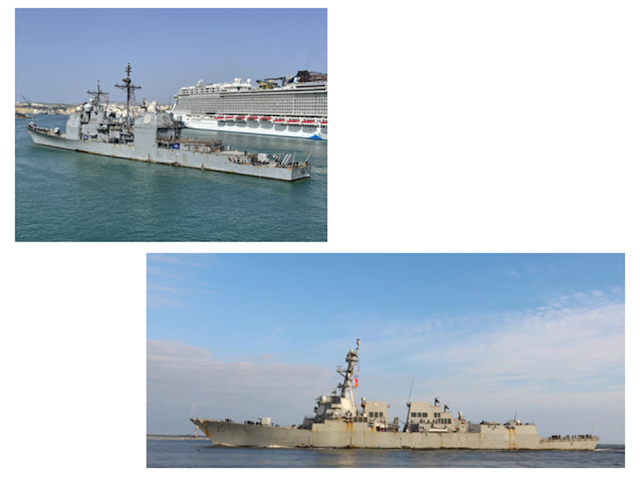


To our second question. Are we ready now?  We do have a tremendously capable Navy, Marine Corps, Coast Guard, and Merchant Marine. When we are at sea, we patrol, conduct humanitarian relief missions, etc. But are we ready? No, we are not ready materially or in the numbers needed to challenge the world’s largest navy in their backyard – that is China’s.

The navy has suffered from the diversion of attention and resources to two lengthy-land wars. It has suffered from costly unforced errors in lives, ships and cost. Gone is a major $750 million ship like the Bonhomme Richard in whose strike group I deployed 17 years ago.  Hundreds of millions in overhaul investment in the USS Miami, a submarine lost in a fire at the Portsmouth Naval Shipyard. Hundreds of millions and two years in the shipyard for the USS Fitzgerald and USS McCain. A mine warfighting ship lost on a reef. We have lost ships before in our history due to accidents and storms, but we don’t have ships to spare now. We need everything.
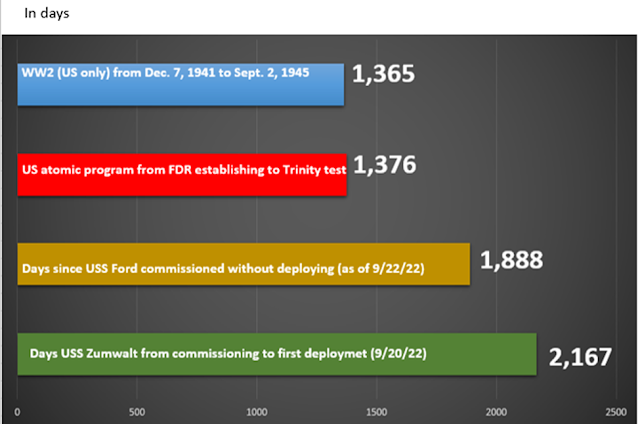

We have had three major shipbuilding programs in the past twenty years that have been a challenge.  Littoral Combat Ships decommissioning in just a few years. And while Zumwalt and Ford have finally deployed, the time from their commissioning to their first deployments is well beyond the length of US participation in the Second World War. The atomic bomb project went from program establishment to bombs on target in 1,376 days. 

Defense news recently reported that the us navy has “spent more than four years repairing one of its amphibious ships, already spending more than $100 million above what was planned. The ship is still not ready to deploy.”  The Navy, after $300 million just wants to decommission it. “Only 45% of the amphibious ship fleet is ready today compared to the navy’s 80 percent goal.”

Has the US Navy had programs that didn’t go according to plan? Of course. Although Robert Fulton built the first steam powered warship in 1815, it would be more than two decades when the technology was reliable enough from the private sector to build dual-powered ships. In 1835, Congress debated naval funding and whether to build the 120-gun ship of the line USS Pennsylvania with 1,000 sailors (that was ten percent of the size of the navy in one ship) or a dozen small sloops. In the end, Pennsylvania was built largely because the congressman who represented the shipyard in Philadelphia where it was to be built was Chair of the Naval Affairs Committee. There was the ram ship USS Katahdin, commissioned in 1896 and decommissioned only a year later.
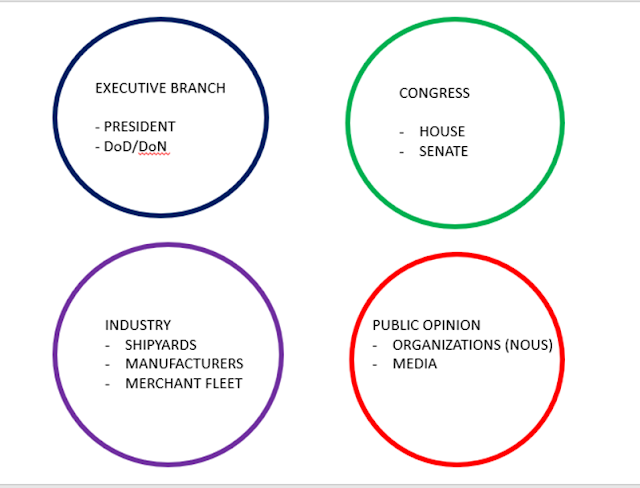


To be ready and sufficiently sized is based on four elements: the executive branch, Congress, industry, and public support. 
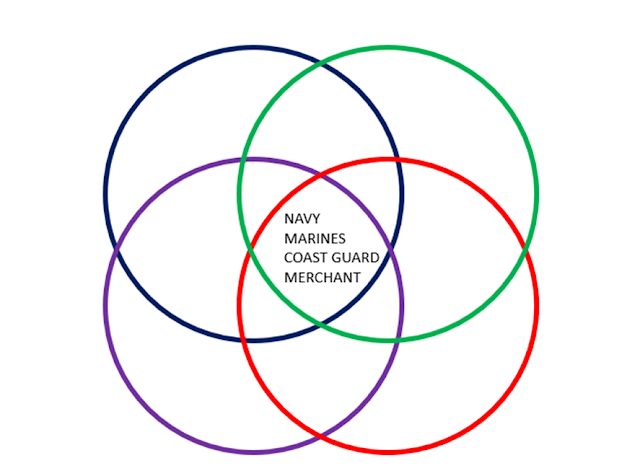


All those elements feed into each other. When all come together, that’s when we see a rejuvenation of the maritime services. Diminish or remove any one of those out and the equation falls apart.

At every period we increased the size and platform diversity, we had an executive branch that provided the vision and support. Even Andrew Jackson whom I wrote about in my latest book, had a recognizable maritime strategy. Others like the two Adams’, the two Roosevelts, Wilson, and Reagan understood the role of a navy and were its supporters. 


How do you quantify administration interest in the Navy? We can start with a simple criterion. Under the current administration, it took more than 200 days for a Secretary of the Navy to be confirmed – that’s a longer period from inauguration to confirmation than any other presidency.

Second, every period has had a critical mass of supporters from the legislative branch which has the Constitutional authority and responsibility to provide and maintain a navy. Absent that critical mass of support, a Navy will not be built or built better.

While watching a House Armed Services Committee hearing this year, I was struck by how a member of congress advocating for the navy was interrupted by the Chairman with this statement about China’s navy. 

“How capable are their ships? How many ships does China have deployed all around the world in any given moment? That’s a very low number from what I understand. And the capability of those ships are not as great either. So, we can all like FREAK ourselves out about all the trillions of dollars a year apparently, we have to spend on our defense budget. I think it would be helpful if we had a realistic understanding of our adversaries and where they’re at.”

He dismissed the threat of China, and he dismissed the idea of building the navy up.

I certainly respect the chairman and his role, but fundamentally disagree with his off-the-cuff assessment. China may have a low deployment rate focusing only on two regions, but it is not dissimilar to the US Navy’s rate of 15 percent in the 1980s especially when you consider it isn’t committing itself – yet – to all the regions of the world. We could do so because we had the numbers. Today our deployment rate is about 35 percent. The pace of China’s shipbuilding has meant that their ships have rarely needed to deploy more than a couple of times. Its growing fleet has allowed China to do more without degrading the material readiness of the ships. Conversely, the has struggled to maintain its ships, which are deploying at a higher rate and for longer periods. 
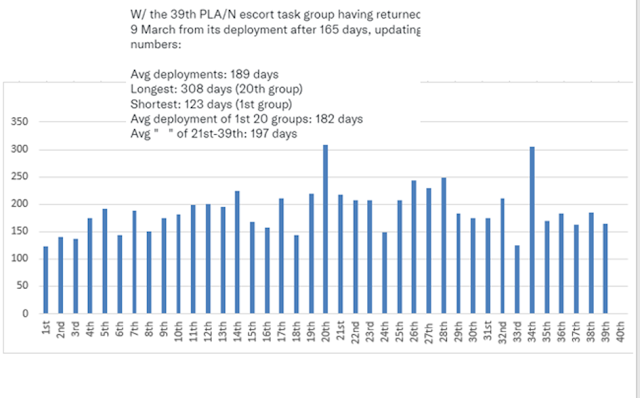
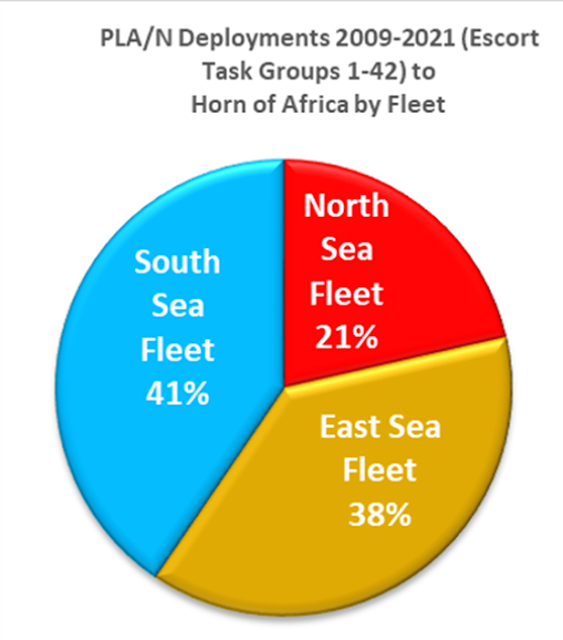
Capability comes from both technology and experience and China’s navy is gaining experience very quickly. In the past decade they’ve been sending squadrons – 42 of them -to the Horn of Africa every three or four months.

They have gained experience close to their shores and ships from every one of their fleets is operating on the other side of the world in deploying to the Horn of Africa.

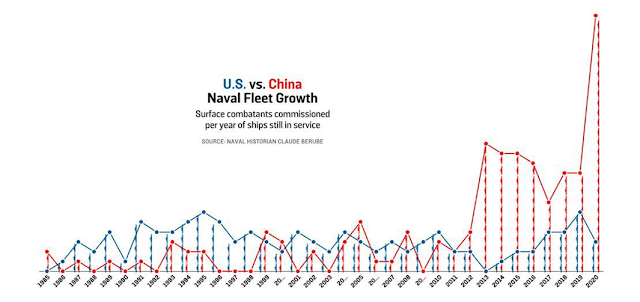
They have vastly outbuilt us in the past 10 years. Yes, that red line is China’s shipbuilding versus the blue of the us navy.
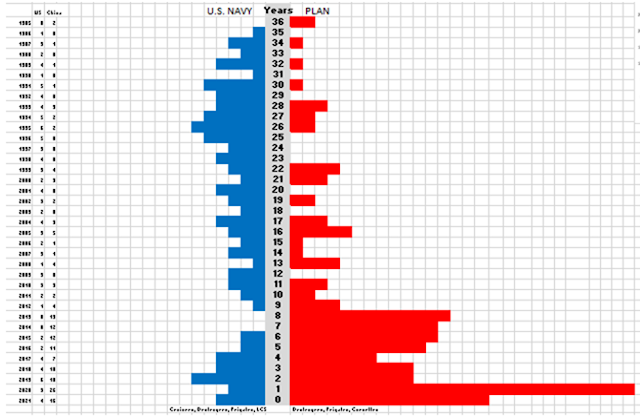

This graph represents all the major surface combatants in our fleet as of last year and their age from commissioning, so the top are the oldest ships in each fleet and the newest at the bottom. Eighty – that’s eight zero – of their surface fleet has been built in the past decade. By contrast only twenty percent of the US fleet is less than a decade old.

Testifying before the Senate Armed Services Committee in June, the Secretary of Defense said we “certainly have the most capable and dominant navy in the world and it will continue to be so going forward.” While the secretary’s sentiment is laudable, it is contrary to quantifiable trends. China isn’t a rising power – it has risen. I think we need to consider another historical example when we casually brush aside the threat of China’s navy. 

Commodore Matthew Perry visited Japan in 1854. That caused Japan to think about a navy of its own, not dissimilar to how China reacted 1996 to the Nimitz battle group transiting the Taiwan strait. In 1874, Japan launched an expedition to Taiwan. That decade their midshipmen began to study at the US Naval Academy. By 1895 their navy defeated China’s fleet in a war. In 1905, they defeated the entire Russian Eastern and Baltic fleets.

For those reasons, I think the chairman’s remarks were either insufficiently informed or intentionally dismissive.

We have incredible advocates in Congress like Elaine Luria [note: this speech was delivered before the 2022 election] and Mike Gallagher. But we need a legislative branch with advocates beyond that and beyond the shipbuilding districts. We are mired in petty partisan politics while China has a distinct advantage – they are forcibly unified and that has enabled them to build the world’s largest fleet. While we need to defend our democratic republic ideals, we need to find a way to unify.

The third element - in nearly every one of our previous conflicts, we relied heavily on the capacity of our industrial base especially shipyards. How many do we have today? To give you the scope of what we face, one shipyard in China has more capacity than all of our shipyards combined. Our shipyard capacity is limited. A 2021 Congressional Budget Office report pointed out that the four submarine shipyards were facing significant delays in completing maintenance because of the amount of work necessary has increased and they are having trouble finding workers. This has affected operational readiness.

Part of that industrial base is the size of the us merchant fleet because it was America’s maritime economy….  China has some 4,500 merchant ships; there are fewer than 80 in the US fleet. Why is this important? Because the maritime economy that built the nation in the 19th century meant shipyard jobs. It meant jobs across the nation which built systems on those ships. It meant that many families had someone who relied on the sea for it or on it. And that merchant fleet needed protection by the US Navy. That is why the public could understand the need for a navy – because it was self-interested in it. Self-interest and passion drives politics and public policy, not reason and data. But the American public has become estranged from the maritime economy that would have been familiar to our forebears.  

Earlier, I mentioned several wars but I saved one for the end. That is the war that really put the United States Navy on a global footing because it demonstrated the power of our industrial base, our ability to build modern ships, the vision of presidents, the support of congress, and an emotional support from the media and general public. That, of course, is the Spanish-American war. It is why I think it a particularly relevant war to discuss today because less than a decade before, the naval order of the United States was established by people who recognized we had a problem, who had a vision, and made the vision of a navy a reality.
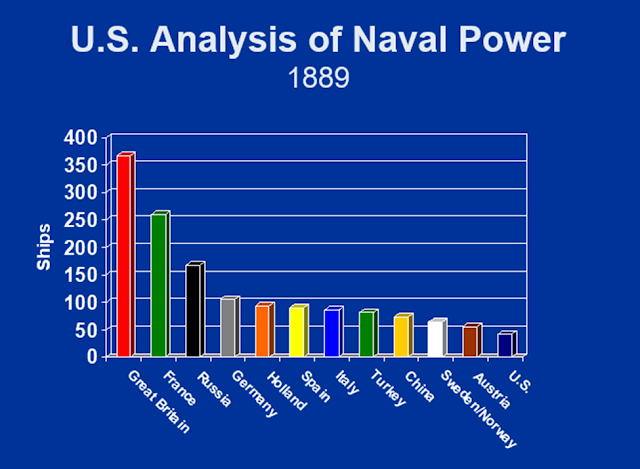

The year before the Naval Order was established, the US Navy was not among the world powers.
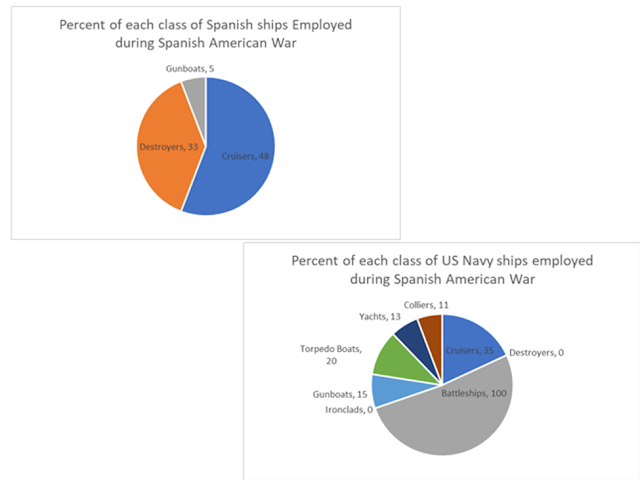

The Spanish navy during the 1890s was a traditional power investing in traditional surface combatants. The young American navy was more diverse in its platforms, understanding the need for logistics ships, etc.
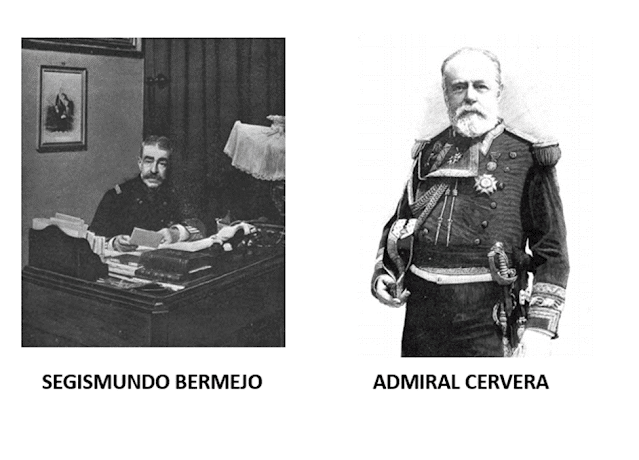
The Spanish Minister of Marine, Segismundo Bermejo had assessed the situation like this: the Spanish navy was experienced and a global power; the US Navy was young and inexperienced. On February 15, 1898 – the day the Maine exploded - he wrote to Admiral Cervera that it was his intent to blockade the American coast. The day after Cervera wrote back that the ships of the Havana station were badly worn out and that the Spanish naval force compared to the United States was approximately one to three, therefore a blockade wasn’t possible.

On April 22, three days after the declaration of war, Cervera wrote to Bermejo that “nothing can be expected of this expedition except the total destruction of the fleet or its hasty and demoralized return.” The Colon didn’t have its big guns. The 5.5 inch ammunition, with the exception of about 300 rounds, was bad. Two other ships had defective guns. They didn’t have a single torpedo. The Vizcaya could no longer steam. There was no plan, which he had much desired and suggested in vain. In short, he wrote, “it is a disaster already, and it is to be feared that it will be a more frightful one before long.” Privately, Cervera had been critical of the state of the Spanish navy before this because of its lack of money and frantically inefficient bureaucracy.”

Regardless, Cervera did his duty and in July would face the American fleet off Santiago. In his last address to his squadron, Cervera said “the solemn moment of fighting has come. The sacred name of Spain and the glorious honor of her flag so demands…the enemy covets our old and glorious hulls. They have sent the whole power of their young navy against us so as to achieve this goal. Hoist the flag and surrender no ship. Sound the trumpet for the combat. May God receive our souls.”

Every ship under his command was lost to the Americans. He and 39 of his officers were then held as prisoners of war at the US Naval Academy and treated as heroes by the American public.

What of Spain’s Asiatic fleet that was defeated at Manila Bay? Admiral George Dewey would write in his autobiography, “the Spanish government attempted to make a scape-goat of poor Admiral Montojo, the victim of their own shortcomings and maladministration.”

We would hope to rely on our allies in war and access to distant waters, but I think there’s another lesson from the Spanish-American war, a concern Admiral Dewey wrote about himself in his autobiography. His biggest concern after his victory at Manila Bay was that he’d face more Spanish. Specifically, a third squadron – a relief squadron – had gotten underway from Spain under Admiral Camara. He expected to resupply in Egypt. If Camara had that coal, Dewey wrote, there would be nothing that stopped him. But the coal was denied and Camara was forced to return to Spain. This isn’t unusual. Think about the start of the Iraq war when an entire infantry division was denied access through Turkey. Can we always rely on other nations great and small especially in a potential conflict with China when nations must act in their self-interest?
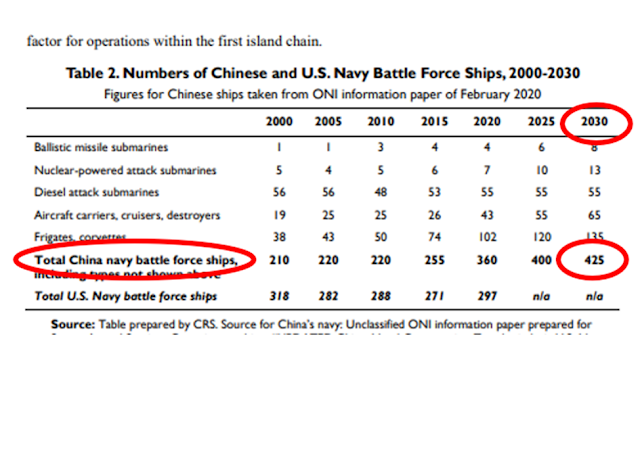
A final point. Some may argue that China’s navy is only slightly larger than ours. But if war comes and it is anywhere near the South China Sea they will be able to bring to bear their entire fleet in a matter of days – by the end of the decade, the Congressional Research Service estimates they will have 425 ships.  

How many of our ships could we get in theater in days or weeks?  100? 150?  That would be a one to three advantage, the same concern Cervera voiced about his proportion to the Americans. We have an incredibly capable force and equally impressive sailors. But we have to assess how unique, innovative technology in small numbers will do against a larger force. When I was a defense contractor in the 1990s, one of my senior colleagues was Bud Rundell, a B-17 bomber pilot shot down over Merzberg on his 13th mission. He told me of seeing a Me-262 during one mission, but there were too many bombers to counter that one innovative jet. What of German advances in tanks, submarines, or V-1 and V-2 rockets during the Second World War? How much did unique, advanced technology impact the result against an overwhelming Soviet and Allied force?

To close out, I mentioned at the beginning of my talk that my town had two houses of worship – the hockey arenas and the Catholic churches.

Fifteen years ago, I was in Ottawa sitting in a chapel - the Rideau Street Chapel. Coincidentally it belonged to the same religious order that founded a hospital in my town and where my family worked. As I sat in a pew, I observed the artistry of the fan-vaulted ceilings and listened to a chorus of forty voices. But the chapel was no longer on Rideau Street. It had been deconstructed and moved to the interior of the National Gallery of Canada where speakers played a recording of the chorus. That morning I read in the paper an article about communion hosts – the center piece of the Catholic mass – had found a resurgent popularity in Quebec as a common, secular snack. Unlike my childhood, the churches in Quebec that had a Catholic faith for three centuries was in steep decline, its churches empty, and its foundations were now viewed as artifacts. 

A similar feeling struck me a few years ago when I was in England visiting the Portsmouth naval museums, recognizing the glory years of the Royal Navy that ruled the seas, and yet the Royal Navy today had less than two dozen destroyers and frigates. It reminded me of an old Rudyard Kipling poem which lamented that “far called, our navies melt away.”

Certainly, in my current professional capacity, I understand the value of museums like those mentioned and teaching our history to the public, but they can too easily be reminders of yesteryear rather than what is needed now and tomorrow. Our country may have grown beyond a symbiotic life with the sea to one of simple indifference, relegated to galleries and exhibits and artifacts.

We as a nation and a navy are not ready because we have chosen not to be. What do we need to prepare for a potential conflict with China?

We need executive vision and action. 

We need congressional interest, oversight and funding. 

We need a navy to build operational platforms. 

We need a much larger industrial base. 

We need a public that has a direct relationship to our maritime services that understands they have skin in this Great Game.

We must become ready. But whether or not we are when the time comes, like Cervera, we will do our duty and go with courage regardless of the fate that awaits us.

Is there hope? Certainly.  

I see it in an incredibly capable Secretary of the Navy. 

I see it with some outstanding admirals.

I see it in the commitment and resiliency of our officers and sailors.

And I see it every day in the creative and energetic midshipmen I teach at the Academy, the future of our naval services. 

Thank you.


Claude Berube, PhD, is the author of “On Wide Seas: The US Navy in the Jacksonian Era” and several other books including his third novel, “The Philippine Pact” (2023). He has worked on Capitol Hill, in the defense industry, and the Office of Naval Intelligence. A Commander in the US Navy Reserve, he is currently assigned to a unit with Navy Warfare Development Center. Since 2005 he has taught in the Political Science and History Departments at the US Naval Academy.


Monday, November 07, 2005

CNO sets "Naval Infantry" straight

The CNO gets straight 5.0s for clarifying the plan for "Naval Infantry" that was dumped in his lap during the turnover. There was a lot of head scratching over "Naval Infantry" - "Riverine" - and the new "Naval Expeditionary Combat Command."

It took awhile, not his fault, but all is clear now - and from the cheap seats, looks like a homerun.

Recognizing a growing need for sailors trained in close combat and security, the Navy has realigned and plans to expand its land-based forces under a single command.

The Naval Expeditionary Combat Command was established last month and will eventually encompass 40,000 sailors around the world. Their headquarters will be at Little Creek Naval Amphibious Base.
...
“The Marines are the naval infantry,” said Rear Adm. Donald C. Bullard, deputy chief of staff for operational readiness and training for Fleet Forces.
...
With heavy combat in the Middle East taxing the Army and Marines, the Navy wants to put more boots and force into the fight. The Navy estimates it has 7,000 sailors on the ground in Afghanistan and Iraq. Sailors guard ports and oil platforms, build roads and buildings and run customs operations, among other duties.
...
The new Naval Expeditionary Combat Command also will include the Naval Construction Forces Command, or Seabees, Naval Expeditionary Logistics Support Force, Maritime Force Protection Command and the Master at Arms force. Bullard, a naval aviator and former skipper of the aircraft carrier Constellation will initially lead the new group.
Here is the thing that makes Phibian's heart pound. I felt so alone all those months ago...but things got better....and better...

The Navy also will re-establish a riverine combat force to close a gap in providing force and protection along rivers in hostile countries. The “brown water Navy” has not been widespread since swift boats fought in Vietnam, although Navy SEALs perform specialized river operations.

Bullard expects a force of more than 700 sailors to fill three units of river combat forces, with the first unit to become operational in 2007.

He said the riverine force could be used around the globe, particularly in Niger and Colombia. A home port or ports for the new force has not been decided.

If I was a young surface warfare officer, I would be tripping over my boss to get in on the ground floor. To hell with the Skipper that gives you the "career impact" statement. Sure, folks select in their own image, but, honestly - you only have one shot at a career. Do what you would be excited about - your career will take care of itself.

Good commentary over at EagleSpeak on the same subject.

Friday, November 25, 2005

Greybeards wanted: Back to Brown Water V

More right thinking and the right words from Navy leadership about taking back a traditional and ill-served warfare area – Riverine.
“We’d like to get a riverine graybeard group together,” he said. “This is an extension of something the Navy has always done. Everyone thinks this is something really new. But this is something we’ve been doing off and on for 230 years.”
Unlike the ALLIANCE, this late arrival shouldn’t be as late or as deadly. Bravo Zulu to my boss the CNO and everyone that is turning towards the sound of gunfire.
The Navy will have three deployment-ready riverine squadrons operational by early 2007, and more than 700 sailors will man the new 36-boat brown-water fleet.

The river raiders will be a key element of the Norfolk-based Navy Expeditionary Combat Command, which stood up Oct. 14. The type-command status of the NECC signals a growing demand for naval expeditionary forces and puts it on the level of the service’s air, surface and submarine forces.

Riverine squadrons

By spring, NECC will identify the manning, equipment and training requirements for three riverine squadrons, Bullard said. By spring of 2007, those new units will be ready to deploy. Details on who can join the force and how command structures will be organized are uncertain, Bullard said. He did say lateral transfers from various commands and ratings likely will be required.

Bullard said NECC planners are working with the Marines, who have a Camp Lejeune-based small boat company patrolling the waterways of Iraq, to develop plans, policies and procedures for the Navy force.

The Corps recently disestablished its small boat companies in a move to free up more infantrymen for deployments, only to see that requirement surface again in Iraq. By spring 2007, the Navy plans to take over that mission, Bullard said.

“We’re working with the U.S. Marine Corps very closely for the Navy to revamp this capability and replace their company in Iraq,” Bullard said Nov. 3. “In fact, we’re going to work with them on our initial training, our initial outfitting and we’re going to stay engaged because they become that combat arms force if we have to put them on a boat.”

Current plans call for three squadrons of 12 boats each. The initial riverine force will total 700 sailors. Bullard could not say how boats will be manned or equipped, as the concept of operations remains under development. It is not known if the boats will be skippered by junior officers or chiefs.

The goal, however, will be to re-establish the Navy’s ability to reach upriver from the littoral or coastal environment.

Although no decision has been made, Bullard’s staff has been looking at several existing boats for riverine operations. The candidates include the Mark V, a large, fast special-operations boat currently in use; the Special Operations Craft-Riverine, in use by special boat units; an enhanced Small Unit Riverine Craft, an armored version of the boat used by Marine small boat units; and the Riverine Assault Craft, a heavily armed and armored fast-attack boat.

“And there are other boats out there,” Bullard said. “Until we do the mission functions and tasks to determine what boat we need, we’ll look at that.”

As Bullard noted, Marines will be the Navy’s “combat arms” force because the Navy will not train sailors as infantry to bolster the expeditionary command. That said, any sailor involved in the new command can expect to spend a lot of time at the weapons range and in the weight room.

“We’re looking for physically fit sailors who will be in harm’s way at times,” he said.
For the rest of the Brown Water series, For review of my thoughts on Riverine Warfare, check things out here, here, here, and here. Sometime you tilt against a windmill and it falls. Whodathunk.

If you Sailors are bored with your Aegis radar and have had enough of a dark, air conditioned duty station - or are fed up with your NEC - and are coming up on your detailing window - NOW IS THE TIME TO CALL YOUR DETAILER.

As for you Greybeards with Riverine experience. If so inclined, get in touch with CFFC and see what the CNO has in mind. Just don’t tell them I told you to call. Snicker.

Thursday, January 15, 2015

Stubby legs and tiny teeth does not a monster make

Sometimes it seems that over the last two decades we have been making every effort to make the CVN more and more vulnerable and its airwing less robust and flexible. Many of the reasons are the same as why the British Army kept the bolt action Lee-Enfield as their primary infantry weapon more than a decade longer than it should have been. 

Add a long fat tail, no armor, with only one ear and blind in one eye ... and good googly moogly, what have we done to long range strike?

At least in the knife fights in DC, unquestionably, there is no slack in light attack.

As we saw in the carrier debate last weekend, here, and many other places - over the course of the last quarter century we have thrown away one of the most effective aspects of TACAIR - its legs.

Gone are the long legs of the F-14 and A-6 - replaced by a deck full of light strike fighters with no organic tanking (sorry, buddy tanking does not count).

At the same time, we have a smaller airwing and possible opponents at sea are forcing our CVN to operate further from shore.

Everyone knows this challenge ... but we still keep making the move to shorter range, less capable assets on our most important force projection asset. Penny stupid and pound stupid.

Here we go. Take it away Sam;
The Navy is will almost certainly select the Bell-Boeing V-22 Osprey tilt-rotor to replace the Northrop Grumman C-2A Greyhound as its next carrier onboard delivery (COD) aircraft, according to a Jan. 5 memo signed by Department of the Navy leadership.

The memorandum of understanding (MOU) — signed by Chief of Naval Operations (CNO) Adm. Jonathan Greenert, Marine Commandant Gen. Joseph Dunford and Secretary of the Navy Ray Mabus — will have the Navy buy four V-22s starting in Fiscal Year 2018 to 2020, according to the document first reported by Breaking Defense.

“The Navy is responsible for modifying these V-22s into an HV-22 configuration for the COD mission,” reads the document.
From David Axe's SEP13 article;
But the V-22 has less range and less payload than the C-2: Northrop’s prop plane can haul five tons of stuff 1,500 miles, but the V-22's range with the same load could be as little as 50 miles, according to Navy statistics and Bell and Boeing’s own literature. That’s in part because the V-22 has just over a third the internal space of a C-2 and in the case of bulkier supplies would likely need to haul them slung by a rope suspended from the fuselage—a huge source of drag.

War is Boring attempted to reach two different Boeing spokespeople for comment, but received no reply.

Extending the tiltrotor’s flying distance would require the constant attention of Air Force aerial tankers, which can cost up to $10,000 per hour to operate. The V-22 is also slightly slower than the C-2, can’t fly as high because it’s unpressurized and costs more: $68 million for a new V-22 compared to an estimated $50 million for a new C-2.
Some of those familiar with the aircraft are already looking at the operational issues that will come with the shoehorning of the V-22 in to the COD role. They have poor reliability, and are so temperamental that the marines who work on her call her the "princess." What will happen after we start riding them hard like we do the C-2s and start chewing up their less than reliable and very expensive prop-boxes.

Via some C-2 Bubbas - here is something that we know a CV-22 will not be able to do that we rely on being SOP today;
Up to about 6,000# load, C-2A cruised at 275-280 ktas between FL190 and FL250 and hit ~290 ktas when we were hauling the chili at 4,000# or less. Above that it dropped off quick and was 255-260 => 8,000#.
Stealing from my own stuff SEPCOR, face it; the Navy painted itself in a corner. This was almost pre-ordained when they CANX the Common
Support Aircraft. It was killed by the worst possible habits of a parochial and blinkered leadership. If you don't like this, yell at Clark, Mullen and Roughead. CSA was slowrolled until it was too late. 

A good HV-22 now will be a better CSA that may never show up I'll grant you that, but really. We should ignore the paid lobbyists and those still in uniform who wish to soon be one - and think this through.

All is not lost. There is hope;
The Navy did not comment on the MOU directly to USNI News and said the final decision would emerge until the budget submission in February.

“The Navy continues to consider acquisition strategies and options to recapitalize the carrier onboard delivery, or COD, capability by 2026,” read the statement provided to USNI News.

“Our recommended way ahead will be submitted as part of the normal budget process.”
Ummmm ... yea. In the end, we'll wind up with a HV-22 and Sailors and aircrew will do the best they can with what their Navy has given them.

We could have done better, but then again - those making the decisions are not the ones who will live or die by them.

Monday, July 18, 2005

Back to Brown Water

In some ways, this makes me think of what would have happened to someone who waited until 1946 to come out and say, “Hey, this Aircraft Carrier concept seems to be of importance, let's invest some more money in it.” ….but that is being a bit too snarky.

In a parting shot, the outgoing CNO put out a memo on 06 JUL outlining where he sees the Navy needs to go to “expand the Navy’s capabilities to prosecute” the war. (NB: look at the timing. OUTGOING CNO. Read, lame-duck, little advocacy until the 1-2-3 star underlings get a reading on what the NEW CNO thinks.)

I am treading on VERY thin ice here, but very respectfully and fully understanding the politics of the Puzzle Palace – WHERE THE HELL WAS THIS MEMO A FEW YEARS AGO!!!!

I’ll take what I can get, but this is just not the way we should do business. That being said, there is some good, some bad, and some ugly to be looked - all that I support 100%. The major areas are covered, and more professional opinion provided, in the
The Navy Enquirer…err….Times.

  • Riverine Forces: We’re getting back in business. More details below.

  • Navy Expeditionary Battalion: Ummmm. Sounds like Naval Infantry, which sounds like Marines; but from what I have gathered, that isn’t what is going on here. I have a friend that was at the briefing at CFFC about this. Nice PowerPoint brief with lots of hand written notes and wire-diagrams about the staff structure. My question: “OK, but what exactly will you do?” Answer, “I’m not sure, but we think we know what the staff structure will look like.” Mmmmm. Bad beginning. You don't build a staff then ask, "OK what are we going to do?" Someone knows what they want the NEB to do, they just need TO TELL SOMEONE. Sigh. Initial look is another excuse for a Flag Staff that puts together a bunch of other already existing organizations under one roof. I’m not sure what value it adds. I’ve asked a few people involved with it at the CDR/CAPT level, they can’t answer it either. Not a good sign. More to follow, but I don’t like the smell.

  • Civil Affairs attached to SeaBees: You mean we don’t already? You’re late.

  • Active/Reserve Integration (ARI) for two Helo Combat Support Special Squadrons: ARI; ARI for all my friends; as long as it is ARI and not a Full Time Support (what TARs call themselves now days) full employment act.

  • Data mining team for the National Maritime Intelligence Center and a center to exploit intelligence from maritime interdictions operations (MIO): Eagle 1 should be all over this, but I will add…..”You mean we don’t already have that?" A world full of pirates, LNG tankers, and terrorists owned merchant fleets that you can fit all sorts of weapons on…..and we don’t have a data mining team? You’re late. Oh well, we have a Navy Diversity Directorate, but we don’t have a data mining team and MIO exploitation team.

  • A sidebar states that Navy endstrength “should not grow.” Well, no kidding. OPNAV already has us going down to 318,000 or so by FY11. Why? It is hard to justify endstrength WHEN YOU ARE FOUR YEARS LATE IN TURNING-TO IN THE NEW THREATS FACING OUR NATION.

    There. I feel better. Of all the above, as
    mentioned before and taunted by John, I would recommend that we lean first and foremost on the expansion of the Riverine plan. Core Competency. That is the most Navy like, and where we already have thousands of Sailors ready to go. We know how to train Coxswains. We have a cadre of Small Boat Specialists. We have plenty of underemployed Gunners Mates. We have plenty of overmanned rates that need gainful employment. And we have plenty of outstanding Surface Warfare Junior Officers who are itching to get in the fight as best as they can.

    Go up to any EP LTJG and ask him, “Do you want to transfer to USS Neverdock, or do you want to lead Riverine forces in Iraq? Get out of the way, because that officer will knock you down trying to get to the phone to call the detailer. As a sidebar, I can think of fewer opportunities to build the leaders of tomorrow more than to put our best LTJGs and LTs leading sailors up the Tigris and Euphrates. Beats the hell out of being 1st LT and OOD on a WestPAC. A great tour, but nothing like directing shore support of ground forces engaged in combat with the enemy. They should give them Joint Credit as well. They would come out of that tour knowing more about Army OPS and USAF coordination than all the JPME in the world could give them.

    Luck for me, I have a reader who knows more about where we stand right now on Riverine forces than about anyone, and he has the gouge. As a snapshot,
    Naval Special Warfare owns all the Navy's Combat Craft; MK V, NSW RHIB, SOC-R, PBL, etc. They are primarily a mobility asset for NSW. Insert and extract SEALs. The last time Special Boats did much 'presence' duty was Gulf War 1. Since then the craft have migrated almost exclusively to SEAL mobility role.

    Almost all the money comes from MFP 11 (SOCOM).

    The PCs that started out as a NSW craft under SOCOM were not the right craft for NSW/SpecOps and have migrated to the Fleet/USCG, and NSW does not currently have a requirement to fulfill LOC control in the Riverine environment.
    Now, if the new CNO takes on what the old CNO stated in his memo, this is going to change. The shame in this all is that until very recently, we had a nascent, but viable Riverine force on life support.
    The Navy Reserve did at one time have an entire command dedicated to Riverine Craft and operations; Special Boat Unit 11. It had PBRs, MATCs, Monitors
    (YEA BABY, Monitors…)
    , etc. It was decommissioned in 1997. Most of its assets were transferred to SBU 22, now SBT 22 (Special Boat Team 22), and to a Reserve Detachment in Sacramento (SBT-Riverine Operations and Training).
    The new structure will have one active and two reserve components. Personally, I would like to see double that, with most all the items C-17 transportable.

    That’s OK. We have a start.

    JULY 12, 2005
    MEMO for Distribution
    From Director, Navy Staff
    Subj; IMPLEMENTATION OF CNO GUIDANCE ON GWOT CAPABILITIES
    1. BLAH BLAH
    2. TAKE FOR ACTION (normal navy language).....
    a. Establish a Riverine Force in Active and Reserve Components. By 24 August 2005, OPNAV N6/N7 will, IAW blah blah blah...provide a plan to establish an AC Riverine Squadron in FY05/06 and 2 RC Riverine Squadrons on 07/08
    To my source, thanks for the tip. It warms the soul to see that things are moving in the right direction.

    Again, this isn’t a rice bowl issue. This is about pulling your load in a war. Riverine OPS is low hanging fruit for the Navy. This memo should have come out three years ago, but I’ll take it now. We need a Riverine presence as long as we have troops on the ground. More importantly, we need them available from day 1 of the next conflict. Almost every country has at least one river. It’s a no-brainer.

    One last thing, there are some special things about Riverine OPS that make it a very unique speciality, one that the USGC isn't set up for. He makes a great reason why we should always have a cadre of Riverine experts around so we don't learn those hard lessons won in earlier conflicts.
    Riverine operations are worlds away from most Navy ops. ... you can not imagine the mind warp required in just navigating, assessing danger close and mission planning. GPS/ Dead Rec navigation doesn't work. Charts? For Iraq/Iran/Kissmyassistan? Not too trustworthy. Situational/Battlespace Awareness? On a narrow river with high banks? Urban environment? Low/no light? Getting kinda sporty.

    USCG Harbor Defense / Port Security has virtually no knowledge in Riverine Ops, nor would I want to use them. There primary mission is Force Protection, a different mission than offensive, combat ops. Different mind set, different tactics, different C3I.
    A growth industry. I'm feeling a bit of envy....

    Friday, October 29, 2021

    Fullbore Friday

     Most everyone knows that the Korean War, though mostly a South Korean and American affair, was a UN action. 

    Students of the war know that many nations contributed forces to the fight, with the United Kingdom and Turkey known by most.

    Just a bit more than half a decade after liberation from a crushing Imperial Japanese occupation, the Philippines joined the fight as well.

    They didn't hide in the rear either. 

    The below won't be a surprise to people who served in the US Navy. We, more than most, know the quality per pound of the people we served with of Philippine extraction.

    Take a moment to acknowledge an underknown battle and the heroism of an unappreciated fighting nation, the Philippine Army at Yultong;

    As reported, in part, by HistoryIsNow;

    ...the Filipino force was assigned to join the Turkish Brigade and the US/Puerto Rican 65th Infantry Regiment into the 3rd Infantry Division.  Soon after, the 3rd Infantry Division faced the Communist North Koreans at the Battle of Miudong, which resulted in their victory. That was the first battle won by Filipinos in a foreign land.


    In the spring of 1951, the 3rd infantry division was deployed along the area of the Imjin River. The 3rd and 2nd Battalions of the US 65th Infantry Regiment positioned facing west along the river, with the Turkish Brigade occupying the east flank, and the 10th BCT was at the center. Unbeknown to these men, a storm was brewing under their noses in the form of the Chinese Spring Offensive. 

    40,000 Communist Chinese troops of the 44th Division of the Chinese People's Volunteer Army under Commander Peng Dehuai planned to attack and surround the 3rd Infantry Division. He deployed the 15th Army in a narrow zone between the Imjin River and Route 33. The 12th and 60th Armies were deployed to attack the positions held by the 10th BCT and the Turkish Brigade through the Pogae-san ridges.

    Chinese Spring Offensive

    20:00, 22/04/1951 – Artillery shells, mortar fire, machine gun, and small arms fire greeted the Turks at the start of the battle. At 23:00, waves of Chinese soldiers assaulted the 10th BCT positions and engaged in a series of close-quarter confrontations.

    Continuous artillery bombardment and some friendly fire cut the communications between troops in the 3rd Infantry Division. Fortunately, communications returned at 00:30, and the Turkish Brigade received an order to retreat to a position on the line south of Hantan River. Intensifying Chinese assaults forced the 65th Infantry Regiment to retreat several hundred yards to regroup and reorganize. The 10th BCT was surrounded and left alone to brave the ocean of Communist Chinese forces.

    The 10th BCT non-combatants such as the chaplain, clerks, medics, cooks, and drivers threw themselves into the fray to bolster the strength of their outnumbered battalion. Men of the 10th fought dispersed and confused because of the lack of communication between the hills. The fighting went on and on where some men were wounded, killed, or captured. Among the captured was Lt. Tomas G. Batilo of the Able Company of the 10th.

    Then Lt. Jose Artiaga Jr. led the Baker (B) Company to defend the strategic hill of Yultong but they were pushed back by the unrelenting Chinese forces. At 03:00, enemy forces penetrated deep into the formation and reached the position of the Charlie Company in the reserves. Unfortunately, the company suffered heavy losses including Lt. Artiaga. 

    While all this was happening, Lt. Col. Dionisio S. Ojeda received an order to withdraw and all units complied except Captain Conrado Yap's Heavy Weapons Company. Captain Yap led his men to counterattack to rescue the wounded and to retrieve the dead. He opened the hatch of his tank and shot at the Chinese with the mounted machine gun with his gun crew firing as fast as they could. Chinese soldiers fell one by one at the rate of 17 to 1 in favor of the 10th. The Heavy Weapons Company succeeded but at the price of Captain Yap's life.

    The 12th President of the Philippines Fidel Ramos, who was also a PEFTOK soldier for the 20th BCT, commented about Captain Yap's actions in his speech during the 42nd Anniversary of the Battle of Yultong: "Captain Yap—his mission accomplished—now ordered a withdrawal. While making a headcount of his boys and directing the withdrawal, he was hit by machinegun fire."

    The 10th held their ground until dawn and by this time the Chinese attack slowed down and this allowed the 3rd Infantry Division to retreat. Then the C Company of the 10th, supported by two M24 Chaffee light tanks of the Recon Company and allied artillery, led a counterattack to restore the lost area of B Company. The Filipinos fought until midday when General Robert Soule fell back to Line Kansas, to a position in Anhung-ri.

    Aftermath

    The battle ended with over 500 dead Chinese soldiers lying dead on the battlefield and 2 of them were captured. On the other hand, the 10th BCT lost only 12 people with 38 wounded and 6 missing. It was a victory for the ‘Fighting Filipinos’.

    For the act of valiance performed by Captain Conrado Yap, he was posthumously awarded the Philippine Medal of Valor, the US Distinguished Service Cross, and was awarded the First Taeguk Cordon of the Order of the Military Merit on the 65th Anniversary of the Korean Armistice Agreement on July 27, 2018. Lieutenant Jose Artiaga Jr. was posthumously awarded the Philippine Distinguished Service Cross. 

    There even appears to be a little rah-rah video.


    Fullbore my Filipino friends; Fullbore.  

    Friday, April 08, 2005

    Keeping an eye on the long game: Part X

    Good to see Eagle1 is keeping an eye on "The Long Game" as well.

    Everyone go over to your handy handy map of the Taiwan Strait. Depending on where you are coming from and where you want to go, you have about 60-120nm to travel. (Lets face it, besides the Spratly Islands, is there anywhere the Chinese might want to take troops by sea? And the Spratly Islands are a haul.)

    To get to where you want, read Taiwan, you have to get men and material there fast, in quantity, and in once piece. The longer you are at sea, the longer you are vulnerable. The PLAN has been working on their amphibious operations at a faster pace as of late.

    And what are they doing? Well, making APD (fast troop transports) out of old destroyers and frigates.
    China will soon have at least eight APDs.....The 1,800 ton Jianghu’s have a top speed of about 46 kilometers an hour. This enables APDs to move quickly, especially during darkness, to reach their destination. Shorter travel time makes the APDs less vulnerable to attack (and easier to defend, especially if you have to keep fighters overhead.) Taiwan is 300 kilometers from the Chinese coast. Each APD could carry several hundred troops, or a few hundred tons of cargo.
    Wait, won't they need Marines to kick the door in?
    China took the “armored regiment” of the 164th infantry division and converted it to the Second Marine Brigade. This brigade is organized using the new format, with one company of each infantry battalion having armored vehicles, in this case amphibious light tanks (Type 63A). The infantry companies have amphibious armored personnel carriers. The brigade artillery battalion has self-propelled 122mm howitzers. The First Brigade is larger, and has five combat battalions (two armored, with amphibious tanks, and three infantry.) The armor battalions have two tank and one infantry companies. In addition to the two brigades, there are two marine recon battalions and two frogman platoons (think “SEALs Lite”). These are usually attached to the First Marine Brigade. There may be a skeleton Marine Brigade in Shanghai, to be used to rebuild a Marine Brigade if one of the other two is destroyed in combat. The total size of the Chinese Marine Corps is over 10,000 troops.
    That's not much, huh. Wait, don't they already have some amphibious capability?
    ...there is sufficient lift for 250 infantry and mechanized (tank and mechanized infantry) battalions. That’s about twenty divisions.
    There's your occupying force. But you need to strike with fast, modern (well, not so modern - remember Narvik) concepts of speed and surprise? Right?
    China appears to be building small amphibious ships in as many as five different shipyards (Lunshan, Huangpu, Jiangnan, Shanghai and Zhonghua). These are ships that could make the run across 300 kilometers of open water, at least in good weather, carrying a tank or two, some trucks, or a company of infantry. Larger amphibious ships, like their new LSD (landing ship dock) are building at a more leisurely pace. In any event, the LSD and LST type ships are also useful for longer range amphibious operations. But the smaller craft have only one target; Taiwan.
    They also have a good plan to keep Taiwan busy as they slog across the strait.

    In case you think APDs are too slow and to few to get the shock troops there, the Chinese are working on more capable units:
    PLA Navy is now building two new types of LSM medium tank and troop landing ships, a total of about 12 since 2002, added to 20 or so ships of the same class. These ships can carry an average of about 10 tanks and 250 troops. The PLA may now be considering building new 15,000 to 20,000 ton LDH class amphibious ships that will use new hovercraft tank and troop conveyers similar to the U.S. LCAC, and large helicopters, allowing assaults from greater distance and against more difficult shore terrain.


    That's why we call it "The Long Game." Not now, not in 5 years; but you're getting close.
    On March 4th the Chinese government announced that its defense spending would increase by 12.6 percent in 2005. Save for 2003, all of the last 15 years has seen Chinese defense spending grow by double-digit percentages.....In 2004 the Pentagon noted that for 2003, overall Chinese military spending ranged between $50 and $70 billion.[1] If we take the Pentagon’s estimate as a baseline, then for 2004, which saw an "official" Chinese increase of 11.6 percent, spending might have risen from $55.8 to $78.1 billion, Similarly modifying the announced Chinese 2005 budget increase of by 12.6 percent yield actual expenditures between $62.8 and $87.9 billion. Other estimates have long held that Chinese military spending has reached or exceeded $100 billion. By comparison, Japan spends $45 billion on defense, and India about $19 billion.
    Get out your Wizz Wheel and lets do some math. Let's say that we need to cover 100nm. If we are doing 30kts, that's 3hr 20min. Yikes, that could be hard to keep your Kung Pao Chicken MRE down. If you can cover half that distance in your hovercraft at 50kts avg, that is 2 hr 40 minutes to the beach. Go in a 150kt helo, and you're there before the bill and fortune cookie.

    Remember, the Chinese have a long term view on things. They know with the way the economy is going, they will soon reach critical mass. Taiwan is, they will remind you, in their backyard, not ours. Mmmmm. Wonder what the Japanese think of this?

    And what do you say comrade?

    Tuesday, July 08, 2014

    When Your Buzzword Becomes a Punchline

    Hopefully you caught the Foggo-Berube back and forth over the last week.

    It started with the CNO, Admiral Greenert and Rear Admiral Foggo, USN's bit in the May Proceedings, Forging a Global Network of Navies

    Sigh. Here we go again. The Bad Idea Ex-Girlfriend is going to make you love her.
    One of our advantages, as a nation and as a Navy, has been our extensive network of alliances, partnerships, and coalitions.

    In 2007, Admiral Mike Mullen addressed more than 100 leaders of the world’s navies gathered at the 18th International Seapower Symposium in Newport, Rhode Island. He challenged the international community to act in concert when responding to threats to the global maritime domain, and he shared his vision of a “1,000-Ship Navy” fueled by the common interest of global stability and economic prosperity. The “1,000-Ship Navy” stimulated much discussion among our partners across the globe. Some wondered how contributions would be solicited, what the command-and-control structure would look like, and how binding the concept would become. The debate prompted Admiral Mullen to explain:

    The ‘1,000-Ship Navy’ is a fleet-in-being of nations willing to participate in global maritime partnerships (GMP). To face the challenges we do today, nobody can do it alone. Many countries are looking for ways to help create security through an international navy. The barriers to entry here are very low. You don’t have to join; you don’t have to sign a treaty.
    I really don't need to do another paragraph by paragraph fisking, do I?

    Much of the article is a collection of well worn concepts, diplo-speak, and aspirational goals. Then end of the above quote shows the feet of clay this all is with, ".. you don't have to sign a treaty.

    Of course not. You can show the flag, but when things get hairy or wet work needs to be done, you'll leave the work to the USN.

    On top of that - some of the transformationalist verbiage is ahistorical and slightly insulting to our heritage;
    GMP was a new approach to cooperation among maritime nations.
    No it isn't. Combined naval operations have been around thousands of years, in peace and war.
    The international community has become an economically hyper-connected global network of independent states pursuing prosperity and security. Trade and commerce transcend borders, while globalization drives interdependence among nations.
    Again, this has been true for thousands of years - in fits and starts - but true. Heck - we hear the same argument about how such condition precluded war .... right before WWI.

    Why am I making such a pedantic fuss over the above? Simple, the transformationalist mumbling cant that "all is new" is deadly to the intellect and any military organization. 

    It is deadly as it gives people the invitation to do the intellectually lazy thing and not read and reference thousands of years of lessons. Equipment and names may change - but by and large, the big picture concepts are exactly the same.

    Many generations have been right where we are. We can save a lot of treasure, and some blood as well, by being humble and discuss what the world was and is - not as we wish it to be.
    As such, the Global Network of Navies provides the opportunity for countries to more effectively meet the challenges of insecurity in the maritime environment in spite of resource constraints. The only requirements are a willingness to collaborate and the creation of a network that is scalable, durable, responsive, flexible, and interoperable. This makes the Global Network of Navies key to the collective future security of all maritime nations.
    They can plug in .. but ... here is the tricky part - what do you do when they unplug and go home?

    The authors do nod to this concern - but continue forward;
    There are those who may say that we cannot, and should not, rely on coalitions or partnerships to solve all of our problems. We have to “go it alone” because coalitions or partnerships are not enduring or binding, and they are sometimes limited by differing perspectives on authorities, rules of engagement, and national caveats. But a Global Network of Navies already exists. No singular response to crisis is ever the same. A network construct must be flexible and adaptable to different circumstances. Not all nations with the requisite maritime capacity or capability will always see it in their best interests to participate. That is their option, but there is compelling evidence that when like-minded nations get together, the whole of their contributions is always greater than the sum of their parts. Several vignettes illustrate how this network is already confronting common threats to our collective security around the globe.
    Who is saying we need to "go it alone?" Who is this cabal? No one I know is asking for a go it alone mindset - what many are saying is, "Prepare to have to go alone." 

    To do otherwise is to give other nations' politicians veto power over the US Navy conducting operations in our strict national interest.

    I know what Greenert and Foggo are trying to do, and I am sure they are heartfelt - but I'm sorry; it is bad theory that puts too much riding of unicorns pooping skittles on the rainbow lines of operation.

    It is an important part of the conversation and part of the solution - but it is an unalloyed vision of the future that does not survive first contact with the past or present.

    They starts off their penultimate paragraph with a strangely off-centerline sentence;
    We are all facing similar fiscal pressure and rising challenges at sea, and no one nation has the ability to be everywhere all the time or to act alone.
    Again, no. First, we are not all facing similar fiscal pressure.
    China announced on Wednesday that it would increase its military budget for 2014 to almost $132 billion, a 12.2 percent rise over last year.
    Second - again,
    "no one nation has the ability ... to act alone"
    Excuse me. The USN can act alone. The Russian Navy can act alone. The Chinese Navy can act alone. What a silly line.

    I like both Greenert and Foggo, but to be frank, I really don't hear their voice here - they and we are better than this.

    The above is my quick jab at a few pull quotes - better minds have been at work at is too.

    Over at WarOnTheRocks, our friend Claude Berube sallied forth - you need to read it all
    ... interconnectivity presents both opportunities and challenges. While the Navy and the country may hope more for the opportunities, they must however resign themselves to the inherent realities of regional and global challenges to partnerships.

    As it has for more than two hundred years, the U.S. Navy works with other navies – whether in underway replenishment, patrols, or other operations. In the late eighteenth century, Thomas Jefferson suggested to John Adams that the U.S. should organize an “international task force comprised of all European nations whose shipping was being victimized” by the Barbary States, although Adams responded that it was an idea whose time had not yet come. During the Barbary War, both the U.S. and Swedish navies cooperated against Tripoli until the latter made peace in 1802 and left America to continue alone. In the early nineteenth century, the U.S. Navy sent warships to West Africa to suppress the slave trade at the same time the Royal Navy had its own Africa Squadron.
    ...
    In a more ideal world where countries do find common cause, it is unclear where the fleets will come from. The article states that there are 12,000 ships in the service of navies globally, only 5,000 of which are blue-water capable. How many of these 5,000 are adequately resourced and maintained? How many crews receive sufficient training? How many could actively deploy on a moment’s, a week’s or even a month’s notice? Most importantly, which of those navies have countries that would have the national interest and political will to conduct out-of-area operations? The authors note that “on any given day 685 [ships] are under way.” However that number does not distinguish between being deployed and being under way, the latter a term used for any day away from the pier which might include exercises or preparing for deployments. For example, the Navy’s own website stated on 30 June 2014 that it has 289 battle force ships with 99 deployed and 29 under way. In addition, the authors admit that 42 percent of international ships under way are ships of less than 1,000 tons and therefore unlikely to contribute to major blue-water operations.
    Those are good questions and hard facts. Items, sadly, not found in depth in Greenert and Foggo's article.

    One of the great things about Berube's insight, is the fact he brings to the table a multi-disciplinary method that looks at an issue from not just a military viewpoint, but a historical, practical, and in this case - political one.
    Political decisions – not naval relationships – will determine what forces to use and when in response to incidents, challenges and crises. The article also fails to address the political realities of multinational operations including funding, compatibility, various rules of engagement and access denial not only by potential adversaries but by allies and partners. For example, as the U.S. Army’s 4th Infantry Division prepared to assault Iraq through Turkey, access through that nation – a NATO ally – was denied despite the offer of billions of dollars. Then-Deputy Chief of Naval Operations Vice Admiral Charles Moore later stated that this was a “glimpse of the future…where Turkey was able to significantly alter our war plan in that they denied access.” Negative perceptions about the United States are on the rise globally further eroding U.S. opportunities and increasing them for peer competitors.
    BZ to RADM Foggo, he jumped in to comments on Berube's post. However, I was very disappointed to see a tired strawman in Foggo's response that we see dragged out now and then, a complete non-starter - especially if you are responding to WOTR and Berube readers,
    "I don’t see America going it alone in the near future unless it is defense of the homeland."
    Eeeek! That again. Just stop.

    Seriously, to repeat again: no one is saying that American should go it alone - though it should be ready too as time and time again, from when Sweden broke formation in the Barbary War, to Veracruz, to Vietnam, to FONOPS in the Gulf of Sidra - sometimes we have to - and it is something the American people demand that we maintain the ability to do.

    The norm is, and our Navy does it every day, to operate in a combined environment.

    Here is the undeniable less of history that Berube holds out;
    ...naval partnerships are important but they aren’t always reliable – not because of the navies with whom we the honor to work with every day but because of the decisions that rest with the political authorities and public opinion among our partners and even ourselves to appropriate invest in their own capabilities.
    From the caveat laden allied forces of flaccidity that we all had to work around in Afghanistan, to the ships-in-being that joined us off the Horn of Africa, that is the hard truth of allied operation.

    Even in the most right wars - even with the best allies - they can just go home. In one of my favorite little gems in Max Hastings Retribution, in moment of indecision and selfishness in the middle of a fight, some allies will just steam out of sight like the HMCS UGANDA off Okinawa.

    To put yourself in Strategic Risk based simply on the promises - especially implied and theoretical - is folly. Or, as Berube puts it,
    In the end, affirming phrases like “global maritime partnerships” cannot rationalize, justify or compensate for the lack of national will to appropriately invest in the country’s own naval capability at the risk of maritime force codependency.
    Amen. I would much rather see the intellect and political capital of Admiral Greenert and Rear Admiral Foggo invested in explaining to the American people how in a period of strategic change after a decade of land combat, the Navy needs more than an even slice of the budgetary pie.

    A little reminder to all. Call it "1,000 Ship Navy" - "Cooperative Maritime Partnership" - or if you must grab your thesaurus and make it a bit more buzzwordy-poetic - "Global Network of Navies," the end effect is the same.

    Let me do one of the few things that brings joy in to my life - quote myself - from 7.5 years ago on this blog;
    "1,000 Ship Navy" with all due respect, is a mirage. When the shooting starts, they will be about as useful as the Italian and Vichy French Fleets were to the Germans in WWII - or NATO in the South and East of Afghanistan.
    A positive note here; the whole interaction with Foggo & Berube specifically is exactly how it should be done. On the more refined side of creative friction, you have two professionals with the same goal, the best maritime forces out nation can provide, working it out tit-for-tat.

    As it should be.