Showing posts with label Carrier. Show all posts

Monday, February 06, 2023

The Old Ways are the Same as the "New Ways" - Except for One


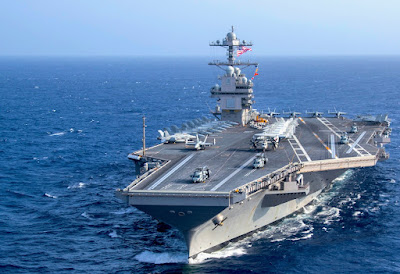
I find it fun, and helpful, to read refreshed think pieces on carrier vulnerability like our friend and always pleasant read Robert Farley put out last week at 19fortyfive, The U.S. Navy’s Nightmare: 5 Ways To Kill An Aircraft Carrier.

From their very birth, carriers have been vulnerable. They are delicate but deadly creatures. Expensive to own and operate, but valuable beyond measure at war. Recall that one of the reason the Guadalcanal Campaign had so many surface actions was because there were just not that many carriers available to sustain casualties because ... well, they're vulnerable. 

Everyone wants to kill them not just because they are so vulnerable, but because they are so useful. As Farley puts at the end of his article,
Aircraft carriers are instruments of geopolitical influence. As long as they serve usefully in that role, nations will seek means to neutralize them. The aircraft-carrier form has proven remarkably flexibly, serving in one way or another for nearly a hundred years. From the USS Forrestal on, the U.S. Navy supercarrier has existed in basically the same form since the 1950s, and is expected to continue operating into the latter half of the twenty-first century. At some point, the game will be up; carriers will no longer pack the offensive punch necessary to justify their vulnerability. It’s not obvious when that day will come, however; we may only find out after the destruction of one of the Navy’s prize possessions.
As almost all threats to carriers are evolutionary in nature - and I tend to be a bit immune to transformationalist hype - I see many of the "new" threats a few excitable people talk about accompanied with the requisite heavy breathing, as simply advances on known threats that will require an appropriate response in defense. No crisis, really ... however, there is one exception.

Farley is sound in this regard, and I encourage you to read it all, but here are 4 of the 5 ways to kill a carrier, and what I consider their evolutionally development from.

1. Undersea Unmanned Vehicles : SSK and sea mines.

2. Cyberattacks : Electronic Warfare and sabotage

3. Unmanned Aerial Vehicles : Old school Kamikaze mass attacks as in the Battle of Leyte Gulf

4. Hypersonic Weapons : Late Cold War ASCM delivered by SSGN & heavy bombers

For every threat - serious as they are - there is a countermeasure. I do wish more people will join the discussion that we need to plan to take losses and continue the fight - which is why we need more than 11 CVN, but one bit of the apple at a time, I guess.

That is 1-4, #5 is something, in a fashion, quite different.
5. Orbital bombardment systems (nicknamed “Rods from God”) can solve that problem. Satellites equipped with tungsten rods, or really any other kind of kinetic weapon, can simultaneously identify aircraft carriers and attack them, without messy problems associated with networked communications. The Rods from God, using kinetic energy alone, could deliver a tremendous blow to a surface target, either sinking a carrier or rendering it useless.
Many moons ago I has a 100# head type explain the math to me, and as Farley outlines, there are not many countermeasures one can have to this once someone launches those puppies downrange. They do have one vulnerability - they are in space and as such fragile (weight is a tax to get in orbit), and should be considered a first strike weapon. You have to get them before they go.

Unlike big-ass-balloons launched from Central China - you can't hide the rockets that will be needed to launch such weapons in to orbit and I have better than average confidence that Space Force will keep a close eye on those should they ever appear. 

That weaponization of space would be a significant escalation globally. If done, that could be countered by "simple" anti-satellite weapons ... again, an escalation - but often you don't seek escalation; escalation seeks you.

Should #5 take place, the steps it would take to get us there informs me that we would have a lot more than just carrier security we would need to be focused on in the global security scene. No one is playing games when you weaponize near-Earth orbit.

The future would be interesting. 

NB: I know many here save yourself the nightmare of twitter, so I just wanted to give everyone a heads up that there is a reason my posting here has been a bit light the last week - and perhaps a bit scattered - I am working my way through COVID. The worse it behind me, but I dodged it for three years, and it finally got me. I managed to recover well at home with minimum side effects besides a lack of appetite and an almost irresistible fatigue and desire to sleep. I will say this about COVID, except for the bone pain, it is worse than my previous worse malady, Dengue Fever. So, enough attention seeking for me. I do appreciate your patience as I attempt to get back up on step.

Monday, February 07, 2022

The FORD's Helmets-Only Football practice


This is kind of strange and different ... so of course, it is kind of growing on me.

Via Megan Eckstein at Defense News;

The U.S. Navy has promised a first deployment for its new aircraft carrier Gerald R. Ford by this fall — but that deployment won’t be a typical one, the head of Naval Air Force Atlantic told Defense News.

Ford won’t fall under the operational command of a regional combatant commander. Rather, it will conduct a “service-retained early employment” period where the Navy keeps full control over the ship’s activities and schedule, Rear Adm. John Meier said.

The Navy keeping COCOM hands off their ships for awhile ... good. Nice habit. We should do this more.

The carrier and its strike group will operate on both sides of the Atlantic Ocean alongside a long list of foreign navies, he said. But the operations will be outside the typical Global Force Management-dictated deployment in support of the joint force.

...

Meier told Defense News after the panel that this represented the best way to make use of Ford as it comes out of its first planned incremental availability in 2022, ahead of when the long-range Global Force Management plans begin to incorporate the new carrier. GFM is an approach meant to help oversee the allocation of forces.

Editorial note: in the name of all that is holy, please stop using GFM. For those of us with mild dyslexia, it is way too close to FGM and we have too many acronyms already. That and it sounds excessively bureaucratic. Same vibe as NLOS, NGAG, LSCvsLCS etc.

Under the new plan Meier laid out, the first GFM deployment could take place, roughly, on that 2024 timeline, meaning the Navy would squeeze in an operational employment of the carrier in 2022 without throwing off the joint force plan that dictates ships’ maintenance, training and deployment schedules.

Nice, but here is what I like about it;

Meier told Defense News the new carrier already has about 8,200 catapult launches and arrested landings — or cats and traps — from the extensive time the ship spent at sea in 2020 and 2021 for air wing integration, trials, new pilot carrier qualifications and more. Still, Meier said, the Navy has been unable to fully operate a carrier air wing the way it wants to: doing cyclical operations, with jet wings loaded up with missiles for mission training.

Solid. Just a solid idea as presented. In general, I'm a big fan of giving things to the fleet and let them try to work it. We learn a lot, find out what doesn't work like we thought it would, and as our Sailors always do - once they start to work with it they find things out - good and bad - that no one had thought of or appreciated sufficiently. The results at the end are hard to spin if you have the right leadership mindset and culture. 

We're going to go through the playbook, but at a slightly lower level of effort and with not everything fully testing the ship and our Sailors. Good, just like a pre-game helmets-only football practice. Good.

No downside here. Learn a lot ... and less chance for unnecessary injuries before the big game.


Friday, January 28, 2022

Fullbore Friday

 ...and there she goes. Laid down when Eisenhower was CINC. Commissioned when Kennedy was CINC. Decommissioned 49 years later when Obama was CINC.


The Vietnam War, most of the Cold War and almost two decades after it ended, was in movies such a Seven Days in May and The Final Countdown, from A-1s to F/A-18s, all the way through to the conflicts in Africa, Southwest and Central Asia of this century.

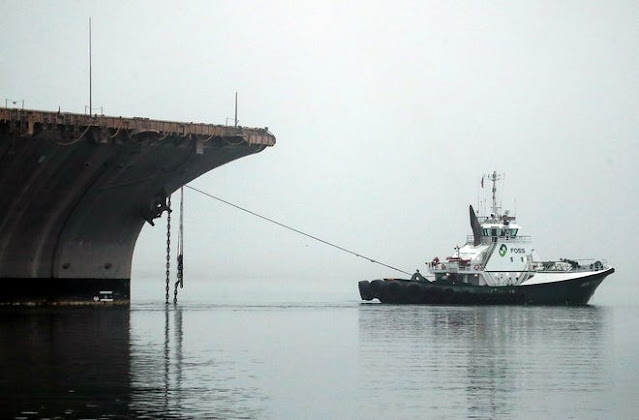
Our last conventional carrier to be decommissioned, and now she's off to the breakers;


 The USS Kitty Hawk, the nation's last oil-fired aircraft carrier, departed Bremerton on Saturday for a 16,000-mile journey around South America for its ultimate fate: scrapping at a Texas shipyard.   

Onlookers, many of them former sailors aboard the "Battle Cat," watched as tugs pulled the rugged warship into Sinclair Inlet on a foggy Saturday morning. At more than 1,000 feet long, the Kitty Hawk won't fit in the Panama Canal, so the warship will be tugged through the Strait of Magellan en route to Brownsville, Texas.

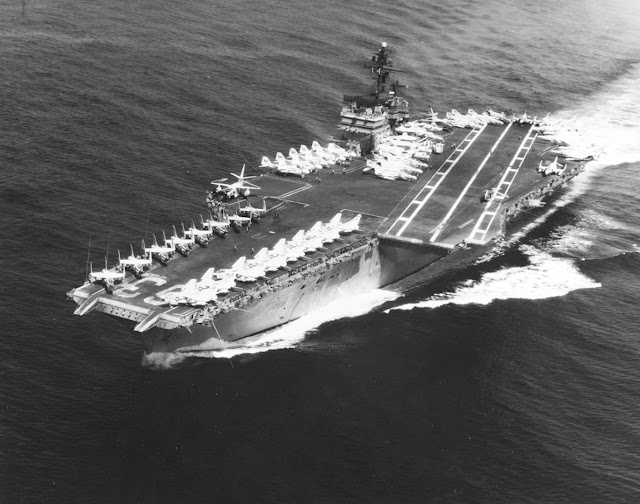
Let's not leave you with that visual of the old girl, here she is with a bone in her teeth; 


Fullbore Battle Kitty ... Fullbore.

Monday, September 21, 2020

Our Greatest National Security Threat is Our National Security Establishment


When David's article went up Sunday, I was amazed; amazed at the audacity of arrogance and betrayal.

Since we, yes we, caused the unnecessary drowning of 17 of our Sailors in their bunks in the summer of 2017, many of us thought at last we have something that will shake our Navy to take an honest self-assessment and change what we were doing.

We were wrong.

I thought after some rather good comprehensive reviews and nice words spoken by very smart and senior people that we would re-prioritize what we were doing.

I was wrong.

The people and their elected representatives hoped that after the international shaming directly resulting from our poor maintenance practices that begat dirty, rusting, and CASREP besotted ships would bring resources to bear, and unnecessary maintenance deferrals to an end.

They were mistaken

We thought we would work towards a better service climate concerning undermanning and undertraining of personnel, and outright abusive personnel policies that consider it a feature not a bug to demand months of 100-hr work weeks from people who can't escape the skin of the ship - and then extended for months at sea without liberty or rest.  We all thought there would be changes to be better stewards of our fleet and its Sailors.

We were lied to.

Yes, that is a strong word - and I mean it.

One again, for the most gossamer thin reasons, we are about to double-pump a carrier and her crew. We are foolishly consuming in peace what we will need for war.

We are not at war. There is no great emerging threat - right now for the next six months - that demands extraordinary efforts, sacrifice, and taking readiness and availability risk tomorrow to gather deployment time today.

And yet - here we are - again;

After shattering the U.S. Navy’s modern record for consecutive time at sea, the carrier Eisenhower is preparing for another deployment early next year just six months after returning.

Two deployments within the same readiness cycle, colloquially known in the fleet as a “double pump” deployment, used to be seen as something of an anomaly: a break-glass-in-case-of-emergency maneuver that puts enormous strain on the crew and the equipment.

But the decision to redeploy Eisenhower early next year is the second double-pump carrier deployment in as many years and will almost certainly send the 43-year-old ship into another extended period of repairs, experts said. Furthermore, the move raises questions about why the deployment is necessary at all, when the military is supposed to be focusing on readiness and moving away from running its forces ragged.

What is driving this?

...the current commander of U.S. Central Command, Marine Gen. Kenneth McKenzie has been vocal about his desire to get carriers in the region.

During testimony on March 10, McKenzie told House lawmakers that the aircraft carrier “has a profound deterring affect principally upon Iran.”

“They know what the carrier is. They track the presence of the carrier. And I view a carrier as a critical part of a deterrent posture effective against Iran,” he said.

McKenzie went on to tell lawmakers he believes that the reduction in Navy carrier presence in early 2019 and years prior may have contributed to the latest cycle of escalation from Iran that came to a head with the U.S. assassination of Iranian Revolutionary Guard commander Gen. Qasem Soleimani and a retaliatory strike from Iran on U.S. bases in Iraq.

The carrier that relieved Eisenhower in Central Command most recently, the Nimitz, entered the Persian Gulf late last week, according to a U.S. 5th Fleet press release.

Of course ... of course - it is another example of the metastasized cancer of the ossified and tottering Cold War Era, Goldwater-Nichols COCOM structure that has each COCOM trying to out crisis each other for forces.

One carrier does not deter Iran from doing what she wants to do. If this is such a world ending requirement, who are we short-pumping next? Where are those Sailors coming from? Will they even get a chance to see the sandbox ashore for 96 hrs, or will this be another exercise is Sestakistic sadism?

Who in uniform in our Navy is willing to step up and stop this abuse? Who? Where is Admiral No?

We haven't even addressed what we all know this will do to retention. This is no longer, "Join the Navy and see the world." It is now, "Join the Navy and never have a home."

Sailors will give everything to her Navy, including their lives, on a simple order. They trust their leadership to make the right call so if asked to sacrifice, be it family time, long hours, or even their life, it will all be for a good reason. The right reason. An important reason.

Sell this. Don't demand it - as an institution if they don't know it yet, our senior leadership spent that professional capital years ago - explain the "why" to our Navy. If you can't do it with substance, then think about what, in the end, your accomplishment of reaching O-10 was really about at the end of the day.

We know where this leads. This is not new territory. 

Read it all.

Wednesday, April 08, 2020

The Sound of Silence

Have you heard what is not there?

How do you define a leadership vacuum?

Are you seeing military leadership, or political manouvering?

Is our Navy better set up for the next decade now than it was 10-yrs ago? 30-yrs ago? When?

Are you any good at acoustic ASW?

Confused and or pissed at what is going on WRT the TR vs. COVID-19?

All those things are wrapped up in one nice little post over at USNIBlog.

Come on by and give it a read!

Wednesday, April 01, 2020

CO of CVN-71 Makes the Call & Goes Public

Simply one of the more remarkable moments for a contemporary navy leader I have seen in awhile.

Captain Brett Crozier, USN, Commanding Officer of the USS Theodore Roosevelt (CVN 71), is doing exactly what we have wanted our leaders to do since we started this blog.

Read his full 4-page letter with a few of my thoughts sprinkled here and there over at USNIBlog and tell me what you think.

Monday, March 02, 2020

It's Always About More Than the Pilots

Pictures are important in telling our story.

We always see the sexy shot of the naval aviator doing their aviator things; the sexy jet with the right visuals, turning tax dollars in to the sound of freedom ... but there is a lot more there to make it happen.

As it was then, it is now. U.S. Naval Air Forces recreated a great picture from out past and updated it for today. 

I think when it comes to what kind of team it takes to get a plane in the air, this one pic does more than a thousand words.


BZ to all involved. Public Affairs messaging done right.

NB: I won't claim credit and all, but check out my tweet from 24 Jan of this year - I'll take the "W." ;)

Monday, December 23, 2019

Carrier Aviation: Personne n'est corrigé; personne n'a su ni rien oublier ni rien apprendre

Thoughts and emotions are all over the place while reading David Larter's weekend article, Amid a heated aircraft carrier debate, the US Navy sees funding slashed for a next-generation fighter.

Effective power projection is the key issue for our Navy. This is nothing new, this has been a standing requirement from its founding. 

You need a diverse tool box for power projection that includes subsurface, surface, and air platforms. The efficiency cult whose modern iteration can be traced back to what  William Perry begat a quarter century ago.  It gave us DDG and SSN without ASCM, a deck of short ranged strike fighters, no organic tanking, and an exquisite collection of Tiffany warships that will never deploy or a decade after Hull-1's commissioning, we still don't know what to do with.

We have an acquisition mindset with three decades of cascading failures - in no small part because of the need to feed the efficiency cult's Vaal on one end, and the nautical obsession with what next fancy buzzword is hiding behind the Bale-Bopp comet that will make all things new on the other.

The carrier debate has been one of the longest running and most frustrating kabuki-dance-meets-Groundhog-Day exercises we have. Their vulnerability is interlinked with their utility. Any student of the Guadalcanal Campaign can tell you how high-demand/low-density/high-utility/hi-vulnerability will drive decisions when it comes to carriers. 

At the dawn of 2020, many arguing this issue seem to have learned nothing of the last 30-years of efficiency and buzzword cults, and what they have done to our naval effectiveness. No one is being held accountable for actions everyone remembers, but no one wants to learn from.

If you assume, rightly, that in a peer conflict, any nearby airbase is just a nice static target, until you have something real and proven, if you want to project national will around the globe from the sea, the carrier is the way to do it. We seem to be hellbent to suboptimize and mitigate that ability, handing advantages to potential enemies without them having to fire a shot.

I think you would be hard pressed to degrade the American comparative advantage at sea any better than we are doing to ourselves through bot gross and petty mal-administration.

With the serial failures to replace deep strike VA capabilities, throwing away heavy fighters of the VF community, abandoning mid-range organic ASW/EW and tanking, we have an unnecessarily shrunk the  strike radius around our carriers. As such, we are long overdue for a new aircraft, and F/A-XX is supposed to be that platform.

It should be a mature design by now, but delay after delay is preventing it from making shadows on a ramp somewhere anytime soon.

At first glance in the article, it looks like Congress is trying to kill it in the cradle.
Congress has gutted funding for the U.S. Navy’s research effort into a next-generation fighter to replace the relatively limited range F/A-18 Super Hornet, an effort experts say could decide the continued relevance of the aircraft carrier in the 21st century.
That is, of course, until you read further.

Remember all the great advantages we would enjoy with delay and design all anchored to the advanced gun system for DDG-1000, the zippy-de-doo-da of LCS's engineering plant, or the all electronic systems on the Ford CGN?

How did that work out for us?

Does this smell familiar?
The Navy had planned to quadruple funding for research and development of the so-called F/A-XX, which was just $5 million in 2019, with most of the increase going toward research into a “Next Generation Advanced Engine effort,” according to the Navy’s budget submission.
OK, reading these tea leaves, I don't think Congress is the problem here. I think the problem is the Navy.

Could Congress be trying to force the Navy to abandon the pursuit of the perfect to embrace the good?

Again, we are fooling ourselves in to thinking if we just believe the industry promises enough and burn enough money a magical dragon will emerge from the stone eggs Santa put in our stocking?

Over and over again, we try to jump a generation but wind up falling on our face and then have to deal with upgrading the previous generation as best as we can.

Billions are spent without anything of tactical use displacing water or making shadows on ramps - putting our nation at strategic risk.

Are we talking big bucks? No.
The Navy’s budget request asked for $20.7 million but was ultimately appropriated just $7.1 million, a 66 percent cut. Congress sent the bill to the President on Thursday, who was expected to sign it.
Perhaps I'm wrong, but could Congress be right here. Are they saying, "No Navy. We don't believe you any more that we need to wait for your magical system to appear. Make something now that works now."

As paraphrased up-post,
Personne n'est corrigé; personne n'a su ni rien oublier ni rien apprendre. "Nobody has been corrected; no one has known to forget, nor yet to learn anything."
Does everyone need to be fired in order to get a change of mindset? Is there anyone not infected with the pathology of the fetid spawn of transformationalism coupling with the efficiency cult?
In May, Defense News reported that the effort to develop a system or “family of systems” to replace the shorter-range F/A-18 Super Hornet is a do-or-die effort that will determine if aircraft carriers remain relevant into the 21st century or will go the way of the chariot and battle elephant.
Ask the Army how their "family of systems" for Armored Systems Modernization program worked out. Hubris unalloyed by experience is a recipe for disaster.

Good people can be wrong here, and we have a lot of that. Case in point, Bob Work.

Correct diagnosis,
Bob Work, former Navy undersecretary and deputy Defense Secretary, told Defense News in May that the F/A-XX is the program the Navy needs to get range back onto the flight deck, which experts tend to agree is imperative. And if they’re going to do it right, they should look to unmanned, Work said.

“The focus should be on the F/A-XX. If you really want range, that has to be the platform you are shooting for,” Work said.
As we have been discussing for a decade and a half here, the Navy's retreat from range is an unforgivable case of self mutilation.

As steps were not made earlier then thing were only difficult, because we now find ourselves out of time, there is is a panic.

As is human nature, when panic steps in, you look for shortcuts, magic, or just blind luck.

A capability that has promise but is not even close to being ready for prime time, unmanned systems, are the latest thing we are grasping at.

For the problem at hand - what do we fight with in 2025 and 2030 - they are the wrong answer.
“Because with the Navy buying the F-35Cs, and the Marine [Corps] buying the F-35Bs, and the Navy buying the Block III Super Hornet, you are not going to be able to afford two or three programs. So, the F/A-XX is the one you need to focus on. And if the analysis shows you need range, that points to unmanned.”
Work is right about a lot of things - but like his stance on frigate's a decade ago, he is wrong here for what we need to do in 2020.

Bandwidth. Ability to takeoff, perform mission, and land in an non-EW or satellite access environment - these are just a few of the things that tell us that at this iteration, unmanned is not the basket we need to throw all our eggs in to. 

We need to take what we have and design from there. We are already a decade late in getting a replacement for the Super Hornet up and running.

We are letting the perfect be the enemy of the good. While we get what we need up and running, we can work on developing what we want - or think we want. We can and must do both ... but trusting on hope backed by hubris will not bring victory in the Sino-American conflict of 2027.

If we are not careful, we will wind up with the aviation version of the kind of perfection seen in DDG-1000. 

Like building DDG-51 until the crack of doom ... we will transform ourselves in to having an open production line of Super Hornets in to the 4th decade of the 21st Century.

We have a lot of people advocating for the wrong direction. We seem to not just be rudderless, but the bridge is empty as we head in to the shipping lanes.

Friday, November 15, 2019

Fullbore Friday

As I mentioned Wednesday, I have a soft spot for the name "Shangri-La" for aircraft carriers. It has a great story to it, and just sounds cool as hell.

Bill Schultz reminded me that there is a simply awesome video available of a unique and underappreciated time in naval aviation; the early 1960s.

What an incredible time of change and advancement ... and a time yet warped by the war that would dominate the rest of the decade.

So, let's take a moment to give tribute to those Sailors of the early-60s ... in glorious technicolor, on the USS Shangri-La (CV 38), circa 1962, somewhere in the Mediterranean Sea.

Crusaders, Skyrays, Skyhawks, Skyraiders ... just glorious.

From the film Flying Clipper, (1962). Narration by Burl Ives.


Wednesday, November 13, 2019

No More Presidents, Please

I don't know what it will take for us to stop naming ships after politicians - but we have some outstanding historical names not being used and no kidding inspirational military people who people would be proud to have on their ball cap ... but politicians?

If we can't have everything, could we at least get back to solid names for our aircraft carriers?

I'm pondering over at USNIBlog and naming names.

Come by and visit - and give it a read.

Thursday, October 31, 2019

When Allies Have Carriers, Everyone Wins

It would be great if France would build another carrier or two. Italy, Spain, and in a perfect world even Germany ... it would be good for them all to either add one or start one ... but the budgets aren't there.

If they did, we could see more of this in the future ... and the world would be a safer place.
HMS Queen Elizabeth is still on track to deploy to the Far East in 2021 – although whether it will actually sail through the South China Sea is yet to be explicitly confirmed – with escorting warships from the US and the Netherlands, according to reports.

The UK Defence Journal recently reported that Big Lizzie will rehearse for live deployments by practising with "two Type 45 destroyers, two Type 23 frigates, a nuclear submarine, a Tide-class tanker and RFA Fort Victoria".

On her maiden operational deployment, the carrier will take around 24 F-35B fighter jets plus helicopters.
...
The Dutch Navy will definitely join the deployment, most likely with a De Zeven Provinciën-class frigate – replacing one of the British Type 23 frigates in the mooted carrier battle group. Similarly, UKDJ reckons that an American destroyer will join the 2021 deployment (named Carrier Strike Group 21), freeing up a British Type 45 destroyer.
Good stuff.

Thursday, October 17, 2019

Ford and the Wages of Transformationalism

If you've been mostly the "close your eyes and breath and hope for the best" when it comes to the FORD, our friend Chris Cavas has a cold bucket of water to throw in your (our) face.

The ship is a long way from being ready to take to the seas in defense of the nation. While construction began in 2005 and the Ford was delivered to the Navy and commissioned in 2017, it’s been back in the shipyard since July 2018 undergoing a series of fixes known as a post-shakedown availability, a planned event all US Navy ships go through but that is more difficult with this first-of-class ship full of new and hitherto untried technologies. It’s hard work for all involved and it will not be nearly finished when the ship comes out of the yard as expected later this month to renew testing and development of its systems whether or not they’re fully functional.

Four major systems in the ship will continue to need work: the Electromagnetic Aircraft Launch System (EMALS), the Advanced Arresting Gear (AAG), the eleven Advanced Weapons Elevators (AWEs) and the Dual-Band Radar (DBR). Issues with those developmental, new-technology systems have been widely reported on for years, ever since Defense Secretary Donald Rumsfeld under the banner of transformation ordered them installed on the first ship in the new class despite deep Navy reservations and recommendations against doing so.

We continue to be saddled with the wages of Transformationalism.

Yes, yes ... first in class has all sorts of issues ... but with time, this is starting to look like it might be a bit more than that.
Less talked about are the ship’s electrical and propulsion systems. The Ford’s more-than-100-megawatt electrical system is far more powerful than the 30 MW systems installed in the ten ships of the previous Nimitz-class carriers, and all that power is crucial to the operation of the four major developmental systems.
...
One issue that was reported involved the failure of main thrust bearings, fixtures that bear the weight of rotating propeller shafts. Twice, in April 2017 and again in January 2018, the Ford suffered main thrust bearing failures while at sea and was required to head back to port. The Navy did not publicize these problems, which were unknown to the public until Bloomberg’s Tony Capaccio reported them in May 2018.

Hope is not a plan, as the phrase goes ... but let's hope we are all pleasantly surprised, and soon, by all the hard work and pallet-loads of cash we seem to be burning to make it happen.

Some of this may come from the unfortunate retreat that started a half-decade ago from persistent public engagement with media and influencers about FORD specifically, and the Navy in general. The Royal Navy, by comparison, has done an exceptional job with the QUEEN ELIZABETH Class development.

As a side note, more background on how we got here can be found in a Midrats from a few years ago we did with Tal Manvel. 

It's embedded below.


Tuesday, July 23, 2019

South Korea Joins the Carrier Club

If carriers were yesterday's news - I don't think more and more people would be joining the club.

First, here is the more recent South Korean flattop, the LPH MARADO, with just a hint of an angled deck.


You can take that and double it.

Via Jeff Joeng at DefenseNews;
South Korea is to launch a new version of a large-deck landing ship from which short-takeoff-and-vertical-landing aircraft can operate by the late 2020s, amid naval buildups in China and Japan.

The decision was made during a July 12 meeting of top brass presided over by Gen. Park Han-ki, chairman of the Joint Chiefs of Staff. Anti-Japanese sentiment in South Korea is gaining traction over Tokyo’s export restrictions on high-tech materials to South Korea.

“The plan of building the LPH-II ship has been included in a long-term force buildup plan,” said a spokesman for the Joint Chiefs, speaking on condition of anonymity and using an acronym for “landing platform helicopter.”

“Once a preliminary research is completed within a couple of years, the shipbuilding plan is expected to be included in the midterm acquisition list,” the spokesman added.

The new LPH is to be refit to displace 30,000 tons, double the capacity of the previous two LPHs — Dokdo and Marado — with 14,500 tons of displacement. The carrier-type vessel is also bigger than the 27,000 tons associated with Japan’s Izumo-class helicopter destroyers.
The iterative vice transformational approach to naval shipbuilding is still being practiced ... and is working.

I look forward to the F-35B orders to join their F-35A buys.

Tuesday, July 02, 2019

Double-Pumping Truman: I Thought we Weren't Doing this Anymore?

Maybe it is just me, but in the self-reflection that the Navy community underwent after the horrible summer of 2017 and the growing realization of issues revolving from undermanned and under-maintained ships, that we were going to do a better job of not "shooting up the horse" by burning out sea-duty Sailors and the ships they serve on.

Already down the memory hole?

Via Megan Eckstein at USNINews, in part;
USS Harry S. Truman (CVN-75) and its carrier strike group are getting ready for another deployment overseas, after completing a two-part deployment last year.

... likely this fall.

USS Dwight D. Eisenhower (CVN-69) would have been the next carrier to head out from the East Coast under previous plans, USNI News understands, but its maintenance availability ran 19 months – more than triple the planned six-month maintenance availability the Navy planned to conduct. USNI News confirmed that the Truman CSG is heading out for its second deployment in the place of the IKE CSG, which will still have to go through its whole training cycle after wrapping up its maintenance and conducting post-maintenance sea trials in early April.

Four sources familar with the planning told to USNI News that the Truman CSG is prepping for this double-pump deployment, which will take place during the strike group’s “sustainment phase” in the Optimized Fleet Response Plan (OFPR) readiness generation model and will not delay the ship from conducting maintenance of its own. The sustainment phase reserves time for the ships to keep their readiness up through home-based training activities or larger exercises in case they are called upon to surge forward or deploy for other reasons.

The Truman Strike Group last year departed in April, returned home in July for a working homeport visit, and then departed again from September to December. Rather than conducting operations in the Middle East, the carrier strike group conducted flight operations north of the Arctic Circle for the first time since the Cold War, operated in Norwegian waters during the Trident Juncture 2018 exercise, and patrolled the Mediterranean Sea.
There will always be a reason to ask more. The USN has a culture of, "can do." It is up to senior leadership to say, "no."

Instead of underlining a new era, it appears we are simply regressing to the mean.

This also calls in to question those who have stated that we have enough carriers that we can not refuel the TRUMAN next decade. 

A lost opportunity resulting in another stew of mixed messaging floating in a bed of cynicism.

Monday, June 10, 2019

The Truman Decision: There is History and Then There is History

We'll start this week with a response to last week's guest post by Bryan McGrath, from a man who should be very familiar to regulars here and Midrats; Robert C. (Barney) Rubel, Captain, USN (Ret).

As you will read below in a guest post from Captain Rubel, the pros and cons of the recent USS Truman refueling is bringing out some of our best minds to understand the argument. 

Barney, over to you.

Bryan McGrath, in his recent post concerning the Navy’s decision to forego refueling USS Truman, attempts to channel CP Snow’s book on the clash of the scientific and humanities cultures as a kind of strawman aimed at criticizing the decision. Contrasting the relative ability of history majors vs operations analysts in thinking broadly about the security environment, he attempts to show why America needs as many carrier battle groups as possible, in the process talking down those who assert the carrier’s vulnerability, asserting that history has refuted them time after time.

Now, truth be told, I was a beer major in college, scraping out a bachelor’s in liberal arts with the minimum required hours at the University of Illinois (anybody seen Risky Business?). The thing is, though, I actually lived some history as a young A-7 pilot aboard USS Independence back in late 1973 when the US Sixth Fleet faced down the Soviet Fifth Escadra in the context of the Yom Kippur War. The Soviets had 96 ships and we had 63. They had anti-ship cruise missiles and war-at-sea tactics and doctrine, we did not. Even as a nugget I could see that if it came to a fight, we were screwed. After that crisis blew over I became my squadron’s weapons and tactics officer and I worked for the next several years on anti-ship tactics. What I found was that even with a launch in the air it took almost 45 minutes to organize a strike against a Soviet formation whereas all they had to do was push a button.

Even with F-18s carrying LRASM, a carrier is way less responsive than a missile-armed surface combatant. So, the first thing a fleet commander does not want to do is place his carrier battle groups within hostile missile arcs during crisis or brink of war situation. When your threat sector is 360 degrees, I don’t care how good your defenses are, you will likely take hits, especially if you can’t fire first.

The history that Bryan cites is wrong; the assertions of carrier vulnerability have not been refuted because it has never come to an actual test. There have been cases of self-inflicted wounds such as on Enterprise and Forrestal, and in each case the crew reacted heroically to limit the damage. The contention has been that despite the damage those carriers were capable of operations within hours. Maybe they could have launched a few aircraft and recovered a few, but whether they could have continued to actually fight is quite another matter. The former USS America absorbed weeks of punishment from various weapons on a sinkex and still had to be scuttled. Again, this does nothing to prove the ship could have continued to be an effective fighting platform after receiving such hits. Remaining afloat and being combat effective are two different things. Because there has been no true test of naval combat we have continued to build carriers because, as Bryan says, they are outstanding presence platforms and they enjoy an almost legendary reputation. But it is well to remember that in 1944/45 the USN put dozens of carriers forward for operations within the range of Japanese land- based aircraft. Despite our carriers escaping harm at the Battle of the Philippine Sea due to excellent fighter defenses, many were subsequently damaged from Leyte onward to the end of the war.

In 2001 I was director of a small analysis cell within the Wargaming Department of the Naval War College. One day a faculty member, a retired Navy intel officer, came to me with a proposal to do an independent project concerning China’s buildup of ballistic missiles in the vicinity of Taiwan. What he proposed to do was count up all their missiles of various types and use this data to try and infer what kind of strategies might be available to them. I liked the idea and made that study his principal function. This led, over the years, to the formation of the Halsey Group, a student advanced research program that conducted iterative wargaming at the top secret level. They focused on high end war with China in various scenarios. I received outbriefs on their results every year for the next thirteen years. While I cannot share much of that information, I can say that it convinced me that the aircraft carrier is the wrong platform to use as the Navy’s principal offensive weapon in that scenario. I subsequently became director of wargaming and had the opportunity to design, direct, umpire and observe any number of games dealing with high end naval war. All of them, in various ways, supported this view. The latest game I observed was Global 8, a game in which Admiral Scott Swift brought key members of his Pacific Fleet staff to play. Again, it was a highly classified game, but I can say that it did not change my outlook on carriers. I contended in an article on wargaming I wrote a number of years ago that properly run wargames are a form of artificial military history. As such they are better evidence than broad assertions based on no test.

The bottom line on all this is that we really do not know how vulnerable aircraft carriers – as ships – are to modern anti-ship missiles. It is one thing to dash into Indian Country, make a strike and then bug out such as Enterprise and Hornet did for the Doolittle raid, and quite another to hang out continuously and support landings on Okinawa. We may wish for a quick, decisive engagement if war over Taiwan breaks out, but we have to be prepared for a drawn out slugfest; wars have a way of going on longer than anyone expects. In that case, the longer the carriers operate within Chinese threat rings, the better their chances of getting hit. If you think that there is no chance of them getting hit or if they do, they can shrug it off and keep fighting, then, in my estimation, which is not uninformed, you are mistaken.

But focusing solely on the hull does not address how vulnerable the airwing is to modern air defense systems. More history. I was a strike leader on USS Eisenhower during the 1980 hostage crisis. As we planned our contingency strikes we found that the Iranians had, among other US-furnished equipment, Hawk missiles. Turned out our warning gear could not see the Hawk continuous wave illumination radar. We ended up putting Fuzz Busters – which could see the Hawk - on our glare shields. However, the missile was good enough that if the Fuzz Buster went off, it just meant you had 20 seconds to live. Our losses would have been such that the wing would have been neutralized after maybe four strikes. Modern Russian SAMs are at least as good as the Hawk; probably much better. In order for the air wing to have any staying power, it will have to employ missiles from outside the considerable envelope of the S-300 and 400 systems, making the F-18 and F-35 expensive booster stages. Why not just use Tomahawk? Recent history shows a preference for Tomahawk strikes on defended targets.

Regarding the goods and others of the aircraft carrier as a presence platform, let me share some more personal history. In the summer of 1990 I was CO of VFA-131 aboard USS Eisenhower. We had been on cruise since February and it had been pretty much a love boat cruise compared to earlier ones I had made. The Soviet Union was in its death throes and everyone around Europe was glad to see us; pretty much in a celebratory mood. Even the French were welcoming. We put thousands of people through the Ike on tours during the Cannes film festival. Most all the crew wore their uniforms ashore in order to increase the chances they would be shanghai-ed by a delegation from a surrounding village, to be feted at a dinner. We were amazed at the reception but proud to show the flag.

Ike was in the Med pretty much due to the strategic momentum left over from the Cold War. Then on 2 August Iraq invaded Kuwait. Within two days we were dispatched to the Red Sea via the Suez Canal. It was eerie as we transited, watching Egyptian MIGs fly cover for us. We were convinced that Saddam would continue south into Saudi Arabia and expected to launch strikes as soon as we issued out the south end of the canal. The Air Force already had F-15s in Riyadh and tankers in Jeddah. The night of the transit we planned our strikes. The best we could come up with, even with USAF tanking, was six aircraft continuously in the Kuwait Theater of Operations, it being almost 700 miles from the ship’s position. At that point Saddam had hundreds of aircraft at his disposal, so the odds looked pretty bad.

We figured that in an all-out fight the wing could sustain losses for three, maybe four days and still have some effect. On the positive side, we were the only game in town from a US perspective. Although the Air Force quickly had jets on the scene, it took them over a week to get ammo up from the storage bunkers down in the UAE. We showed up ready on arrival to operate for at least a week at full bore. USS Independence, operating just outside Hormuz, was farther from the KTO than us; not being able to enter the Gulf because the stub oil platforms had not been surveyed, and hitting a semi-submerged one would be worse than hitting a mine.

But nothing happened. Perhaps our arrival dissuaded him from going further. My shipmates and I like to think so, but it is impossible to say. As the weeks went by, additional carriers showed up, and the Navy decided to send us back to Norfolk in September. The Navy invested six carriers in the operation and planners knew there would be an aftermath to whatever happened in Kuwait. Ike had been on cruise almost eight months at that point and needed maintenance before going back out. If SECDEF wanted a carrier presence in the region after a war, Ike needed to come home. In fact, the war disrupted carrier deployment cycles for several years after. Carriers need lots of maintenance, and any perturbation to the deployment cycle creates readiness ripples and not in a good way.

So let’s review the bidding. On the good side, the Ike was a marvelous naval diplomacy platform, more impressive than anything else the US could deploy. When called to respond to a crisis, she was there in a couple of days and ready to fight in a sustained way with no footprint on the ground in a sensitive country. This is why presidents ask where the carriers are when trouble arises. On the down side, there were very real limits to what the air wing could bring to bear. If the issue could be handled by a one-time Eldorado Canyon-like strike, we were good to go; if the situation required a sustained air campaign in which losses occurred, then a single carrier was not enough. In any case, we needed Air Force refueling in order to reach the area of operations.

Same deal later in OEF. What allowed us to plan for even six aircraft at the end of our “chainsaw” operation was the fact that there was no appreciable threat to the carrier. Had there been real threat (rumors of a missile-toting Lear Jet aside) a significant portion of the air wing would have been tied up in defending the battle group. My point is that as a presence platform the CVN has many advantages, but some very real limitations. Carrier proponents – ones who have not been, say, strike leaders - tend to overlook the details. They assume the CVNs can be moved around the geopolitical chessboard like queens. In an age where the Russians can sell highly sophisticated, land-launched anti-ship missiles to anyone, the limitations start tipping the balance scale toward the others.

Now let me be clear as I can on all this. Saying that the carrier should not be the Navy’s principal offensive weapon in a potential war at sea versus China is not the same as saying they are obsolete or that we should not buy the Ford Class – or even that we should not refuel Truman. What it does mean is that the Navy must come up with a new fleet design for the specific purpose of fighting for sea control in East Asia. In that design I envision the Ford Class – once the bugs have been worked out – as a key enabler for the Navy’s distributed maritime operations (DMO) force, uniquely able to support long-range, high-endurance unmanned aircraft that will perform a number of critical functions. A new air superiority fighter (son of Tomcat?) will keep the DMO force, including the P-8s and MQ-4s, from being shot up by Chinese aircraft. Elsewhere in the world, Nimitz Class CVNs will continue to provide credible US presence. But how many CVNs should we have? Elsewhere I believe Bryan has said, and I agree with him, that we live in a 15 carrier world. If you think about the assessment of goods and others in the previous paragraphs, you can quickly conclude that CVNs should operate at least in pairs. Thirty would thus be a reasonable number. That said, how many can we actually have? Here Bryan and I disagree.

Bryan’s post makes a tacit assumption; that Congress will eventually produce a budget that will support both an 11 carrier fleet and development of the DMO force. So far, there is no indication that is the case, which is why the Navy elected to trade Truman for development of DMO platforms. Certainly there was some number crunching involved, but in the end it was a decision based on forward-looking strategic judgment. In my view, the US cannot afford to let China successfully invade Taiwan or militarily enforce its territorial claims in the South China Sea. If we cave or are driven off, our credibility will be shot and we will be faced with either becoming tributary to China in their version of a new global system or we will have to escalate, probably to nuclear weapons. In 1973 we discussed running west through the Straits of Sicily to get to TACSIT III; untargeted and unlocated. However, that would have ceded the Eastern Med to the Soviets. If we had stood and fought we would have lost two, maybe three carriers. The NCA would have been faced with the unappetizing choice of ceding the Eastern Med or escalating, probably to nuclear. If we had had a DMO-style force we could have faced down the Soviet fleet with confidence. The USN, along with the other Services, MUST be able to win a conventional war at sea in East Asia, and that means a DMO force. That strategic imperative, combined with very real budget limitations, is behind the Truman decision, math or no math.

If Congress coughs up extra funds to refuel Truman, so much the better. If the Navy has to eat the cost, our strategic risk level will go up considerably, as we could find ourselves, as in 1973, ill-equipped to face the naval threat that pops up and as in 1980 when entering certain air defense zones was virtual suicide. That is history rhyming, and I don’t like the sound of it. I may not have majored in history, but I have sure as hell lived it.

Robert C. (Barney) Rubel, Captain, USN (Ret) is a Professor Emeritus at the U.S. Naval War College.

Tuesday, May 28, 2019

The Ships that Sailed you, Switched from Steam, to EMALS, ... Back to Steam?

I expect the following concerning the new FORD Class CVN and its EMALS catapult from President Trump to get some attention from navalists this week;


As with the LCS and DDG-1000, but perhaps not as bad to a degree, the FORD Class is one of the children of the Transformationalists. As such, it has "challenges" that it shouldn't.

If you want to get a handle of the why and how, there are few better places to get educated on the topic than the interview we did on Midrats with Tal Manvel.

Take some time and give it a listen again.


Tuesday, May 14, 2019

Tomorrow's Airwing Needs to be my Father's Airwing

This will do well as a companion piece to Bryan's guest-post yesterday. Take some time and read all of David Larter's Page-1 story in the May 6th Defense News, What's Killing the US Navy's Air Wing.

First, look at these glorious flight decks full of tools for all sorts of jobs - just 14-years apart from 1967 to 1981;


Now, today's deck full of lawn-darts and auxiliaries;


... and then ponder this pull-quote;
The carrier air wing of the future will also need to be able to hunt submarines (serving as a replacement for the S-3 Viking aircraft), provide surveillance and targeting, and destroy ships and land targets with standoff weapons, all while fighting at nearly double the range of today’s air wing, according to the study, which was led by retired submarine officer and analyst Bryan Clark.

If the Navy wants to counter China’s anti-ship cruise missiles and increasing naval capabilities, it must resurrect the Cold War-era “outer-air battle” concept, which focused on longer-range aircraft to counter Russia’s bombers. However, instead of fighting at 200-plus nautical miles, the air wing will have to fight at 1,000 nautical miles, the study found.

“The air wing of the future is going to have to be focused less on attacking terrorist training camps and huts in Syria, and more focused on killing ships and submarines at sea — dealing with naval capabilities and island-based littoral capabilities,” Clark said in a telephone interview. “Those are the challenges: Range and the mission set is changing.”
You don't know what you once had until you lose it, eh? We did it by choice.

It has always been about range, something we discussed here for well over a decade - but that lost the argument for ... still trying to figure that out, though I have ideas.

We have wasted so much time with people who have other priories ... still trying to figure out what they are, though I have ideas ... than investing decision making power with those focused on making sure we can project power ashore without being inshore.

Some smart initial steps are looking right;
In other words, the entire air wing, both the range at which it can fight and the missions it is set up to execute, must be completely overhauled. That’s a big ask that can’t be answered overnight. It starts with committing to the MQ-25 Stingray, Clark said, referring to the unmanned tanker aircraft under development by Boeing following an $805 million contract award last year for the first four aircraft.
Build it. Get it to the fleet. Let our Navy work with it ... they'll help you find out how to make it better ... but let's get it to the fleet and start. Would be nice to ditch the "MQ" and get some answers on the "AQ" and "RQ" once we get the KQ working correctly.

We've also addressed over the years the much delayed F/A-XX and how important it needs to be. Range needs to be top of the spectrum. In my alternative universe we would have two programs going - one on the "F" side and one on the "A" side - other generations have done it - but we don't seem to have that luxury. At least the arc is bending my way;
“So now the focus should be on the F/A-XX. If you really want range, that has to be the platform you are shooting for,” Work said. “Because with the Navy buying the F-35Cs, and the Marine [Corps] buying the F-35Bs, and the Navy buying the Block III Super Hornet, you are not going to be able to afford two or three programs. So the F/A-XX is the one you need to focus on. And if the analysis shows you need range, that points to unmanned.”
The next statement of the obvious is most welcome. When the peer battle comes, we will not own the EW spectrum. We won't have unchallenged access to satellite or terrestrial bandwidth. We will need to be in the fight anyway;
But the study also called for retaining a manned fighter for command-and-control capabilities in environments where communications are jammed or nonexistent, Clark said.

“There is still going to be a need for manned fighters to do close-air support, but mostly to do command and control of other platforms that are perhaps unmanned inside a comms-denied environment,” Clark said. “So you send some loitering missiles or you send UCAVs up forward, you would expect them to be managed by someone who is able to maintain comms with them. That would be a human in a fighter that is able to remain close enough to them to stay in comms.”
...and here is where things go off the rails a bit;
For that, Clark points to a retooled F-35 fighter jet, one that switches out internal payload space for fuel.

“The F-35 folks, when you talk to them about what it would take to make it a longer-range command-and-control aircraft, they’re pretty optimistic because most of the challenge in doing these kinds of changes is in the software,” Clark said. “And the software isn’t dramatically different because it’s really just changing how it manages the fuel, not any of the other functions.”
The F-35 is a single seat aircraft. To do the above you need at least a 2-seater - the human mind can only do so much and fly at the same time. We need to look hard at F/A-XX's scalability.
“The near-term fix is to get more tankers,” he added. “The mid-term fix is to start investing in a longer-range aircraft. Because the idea of having to have 12 or so tankers just so your fighters can get to 1,000 miles means you have to have a lot of your deck and hanger space being taken up by tankers and not strike aircraft. This way you can use the tankers you’ve developed for other missions — either strike or [intelligence, surveillance and reconnaissance] on their own — or free up that deck space for other aircraft.”
Welcome to the party everyone. 

Heavy fighters, they're a thing. We are a couple of decades from needing our own SU-34-like capability. 

Get to work.

Monday, May 13, 2019

Three Cheers for Forward Presence and Aircraft Carriers

We will start out this week with a guest post from our friend Bryan McGrath - focused on what could arguably be the marquee mission our nation asks of its Navy.

Bryan, over to you.

So last week, we were told that the USS Abraham Lincoln (CVN 72) (and other Joint forces) was being re-routed from its activities in the Mediterranean Sea to proceed to the North Arabian Sea in response to “…heightened Iranian readiness to conduct offensive operations.” I have no insight into what that heightened readiness amounts to, but presumably, senior national security decision-makers at the White House, the Department of Defense, and the Central Command determined that there would be utility in moving the carrier and its air wing several thousand miles closer to Iran. In so doing, two virtues of American Seapower much under scrutiny these days are placed front and center for renewed appreciation—forward presence and the large, nuclear-powered aircraft carrier. Let us begin with forward presence.

First, let us dispense with the notion that the re-deployment of the Abraham Lincoln is an example of “Dynamic Fleet Employment”, unless we wish for this important new concept to come to mean “the way we’ve always done it”. Dynamic Fleet Employment—perhaps the biggest and most useful idea to come out of the 2018 National Defense Strategy—suggests innovative and unpredictable force employment, such as was on display last autumn when the Harry S. Truman came back to Norfolk in mid-deployment (or at least what was the predictable deployment pattern) and then re-deployed (without notice) to proceed to the North Atlantic and operate where U.S. naval forces had not routinely sailed in decades.


The redeployment of Abraham Lincoln from the Mediterranean to the North Arabian Sea is neither innovative nor unpredictable. That so many have dipped into the “where are the carriers?” meme in response to these events is proof enough that what we are seeing is not only predictable, but routine. And what is it that has caused this question to be asked and answered over time with such repetition? Is it Dynamic Fleet Employment? No. It is forward presence.


Forward presence means that irrespective of where this country’s national security interests lie, a powerful, integrated, naval response is close at hand. Are there elements of American military power that can arrive on scene more quickly? Absolutely. Are there elements of American military power that can arrive on scene in short order and conduct persistent, combat operations from existing logistics networks? Other than American Seapower, no, there aren’t.


Forward presence provides this country with a repeatable, predictable posture upon which both routine diplomacy and crisis response can rely. The very nature of this predictability contributes to both assurance of allies and deterrence of adversaries. This is not an argument against Dynamic Fleet Employment. Quite the contrary. It is, however, an argument against de-weighting routine forward presence while we chase a shinier operational penny hoping to offset insufficient resources applied to American Seapower. At some point, the virtue of already being there, or much of the way there, cannot be overstated. Can and should we make that presence more effective? Absolutely. But if this nation hopes to achieve the much talked about shift (in the National Security Strategy) from a conventional deterrence posture of punishment to one of denial, it is going to ride on the back of lethal, forward postured naval forces.


As for the large, nuclear-powered aircraft carrier, I find myself imagining its critics shaking their fists at the heavens over the newsworthiness of the (once again, routine) redeployment of CVN-72 from one theater to another. After all, if Presidents and Defense Secretaries and National Security Advisers keep reaching for this tool, the Valhalla of “cheaper and more numerous” (funded of course, from savings reaped from killing the CVN) remains outside our grasp. If only the President did not have the capability of a large, nuclear-powered aircraft carrier and its air wing to call upon, he or she would have to choose from a menu of other capabilities to signal his intent. Assuredly, these alternative measures would suffice.


Or would they? By way of comparison, let’s start with the other elements of the Joint Force that are currently being applied to this problem, forward basing an Army air defense battery and an Air Force bomber task force. Presumably in the absence of a carrier, these tools would be considered. Which of them falls in on an existing logistics network? Which of them is not subject to host-nation veto? Which of them can redeploy to a new location 800 miles away in 24 hours, every day if need be? You know the answers, of course.


Now, let’s move onto future naval capabilities that carrier critics claim are stymied by the Navy’s Neolithic clinging to the obviously past-its-prime and oh-so-vulnerable carrier. Mostly, we hear about longer range and more energetic missiles, many of which advocates wish to employ from our submarine force. Putting aside the inconvenient point that in the ISR environment of the future, EVERYTHING is vulnerable, there is the whole notion of conventional deterrence to answer to. A potential ne’er-do-well, when considering an act of aggression, attempts to determine U.S. capability AND WILL prior to its act. If it believes its aggression would be successful and the reward would be worth whatever response it faces, it may move forward.


How would the Navy contribute to the demonstration of will, if the methods of doing so rely on either the most difficult to detect platforms in the nation’s military arsenal (submarines) or platforms so small that they cannot self-deploy into the theater? If any part of the answer to the second part involves land basing, then the whole question of vulnerability rises again. And if we wish to submerge our conventional deterrent (to go along with our strategic), we will have to deal with the consequences of injecting uncertainty into the mind of the adversary and the loss of certainty. Not that injecting uncertainty (in the form of not knowing where the deterrent is or whether it is in range to accomplish its mission) is in and of itself, a bad thing. It becomes a bad thing when the cost is the greater sense of certainty that being there with visible power provides. An effective conventional deterrent combines both.


If our Navy’s only role were combat operations, and all we wished for it to do was to punish aggressors, a Navy of 150 attack submarines and long-range energetic missiles lobbed from sanctuary would be a reasonable option. But that’s not what navies do, and it is certainly not what the U.S. Navy should do. We must be able to walk and chew gum, and that means that we understand that when the shooting starts, low-signature platforms and high energy missiles will be of great importance. We must further understand that when the shooting starts, the aircraft carrier will likely be the primary method of delivering tactical aviation for such pursuits as strike, ISR, and sea control, and if we believe these missions to be important in future warfare, we need to recognize that doing them from land will be problematic.


Finally, we must realize that unlike any other aspect of American military power, Seapower plays an outsized role in both peace and war, and both forward naval presence and the large, nuclear-powered aircraft carrier are essential to this role. Walking away from either in the unwise pursuit of capability or capacity that only is brought to bear after the shooting starts is a sure-fire path to the start of shooting.


Bryan McGrath is the Managing Director of The FerryBridge Group LLC and the Deputy Director of the Hudson Institute Center for American Seapower.