Showing posts sorted by relevance for query "313 ships". Sort by date Show all posts

Thursday, June 29, 2006

CBO: Fleet plan has fatal flaws

Solid story from NavyTimes by Christopher P. Cavas (subscription required). The Congressional Budget Office has crunched the numbers - no shock to my regular readers - the rest of you have been reading too many "happy Sailor" stories:
The Navy’s plan for a 313-ship fleet is unaffordable and unrealistic, a new report issued May 31 by the Congressional Budget Office says.

The report shows that “the Navy’s plan based on recent historical spending programs and costs is not affordable,” said a congressional naval analyst familiar with the report.
The fat created by others that lesser men have been living off of hoping to get through the next set of orders is coming to an end. This is what happens when people go with the "happy Sailor" option on briefing the boss - or are ordered to.
The Navy has acknowledged problems in the 30-year, 313-ship plan, which was presented to Congress in February after being ordered last summer by Chief of Naval Operations Adm. Mike Mullen.

The service, which already receives about $10 billion annually for new ships, says it needs about $14.4 billion per year to buy the new fleet.

But Eric Labs, the CBO analyst who wrote the report, has testified to Congress that the average annual shipbuilding budget required by the Navy’s plan is more likely to be $19.5 billion — or even $21.6 billion annually if other costs associated with ship construction, such as the purchase of mission modules for new Littoral Combat Ships, refueling of nuclear-powered aircraft carriers and submarines, and the modernization of cruisers and destroyers, are factored in.
A decade of low-balled costs, adding pet projects to ship programs, and wishing for others to fix in the "out years" is blowing up in our face.
The 30-year Navy plan would see the fleet grow from today’s 282 ships to 330 ships in 2019. But the CBO report notes that even if the service gets the money to buy its new fleet, the number will decline to 294 ships in 2035.

“The fleet would not be close to 313 ships at any point after 2025,” the report says.

“It’s really not hard to maintain the fleet until 2020,” the congressional naval analyst said. “The problems come after that, when the submarines and destroyers in particular need replacing. Hence lies the fundamental flaw of the Navy’s plan.”
... and how is our leadership going to try to save money? Admit failure and build some license built European ships until we get our house in order? Oh, no....
The Navy has said it will reduce costs by shrinking the number of sailors needed to operate its ships, then plow the savings back into shipbuilding. The CBO report acknowledges that crew sizes are going down and that the 55 planned new Littoral Combat Ships will be cheaper to operate than submarines and amphibious ships that would be cut under the Navy’s plan. But the report notes that the $14 billion per year the Navy now spends for direct fleet operation and support costs would shrink to $13.1 billion by 2035.
Put your slide-rule away you old fart... that is only $900 million in savings, or 6.5%. Less Damage Control, .....
The 30-year Navy plan would see the fleet grow from today’s 282 ships to 330 ships in 2019. But the CBO report notes that even if the service gets the money to buy its new fleet, the number will decline to 294 ships in 2035.

“The fleet would not be close to 313 ships at any point after 2025,” the report says.

“It’s really not hard to maintain the fleet until 2020,” the congressional naval analyst said. “The problems come after that, when the submarines and destroyers in particular need replacing. Hence lies the fundamental flaw of the Navy’s plan.”
Hmmmm, and what happens around 2020?
Moreover, China plans to improve and expand its capabilities for assault landing and joint logistical support, both of which used to be weak points. This will provide China with necessary capabilities to invade, should China’s rulers wish, Japan’s most remote islands, including the disputed Senkaku Islands, as well as Taiwan. If China’s naval growth continues at its current pace, it may have the world’s largest naval force by 2020.
...and here we are, in a bed we made.
“Saving money on the battle force required buying fewer ships and thus having less capability,” the report says. “Unless the Navy can provide the level of resources necessary to implement the 2006 shipbuilding plan, it will have to make different choices about how to structure its forces in the future.”

The report shows that “there just are no easy answers,” said Bob Work, a naval analyst with the Center for Strategic and Budgetary analysis who reviewed the CBO report before it was published.

“Eric Labs is one of the best in the business as far as trying to ascertain if the Navy’s plan is fiscally executable,” Work said.

The new report “helps people understand the enormous fiscal pressures and the problems facing the Navy in terms of its choices,” he added.
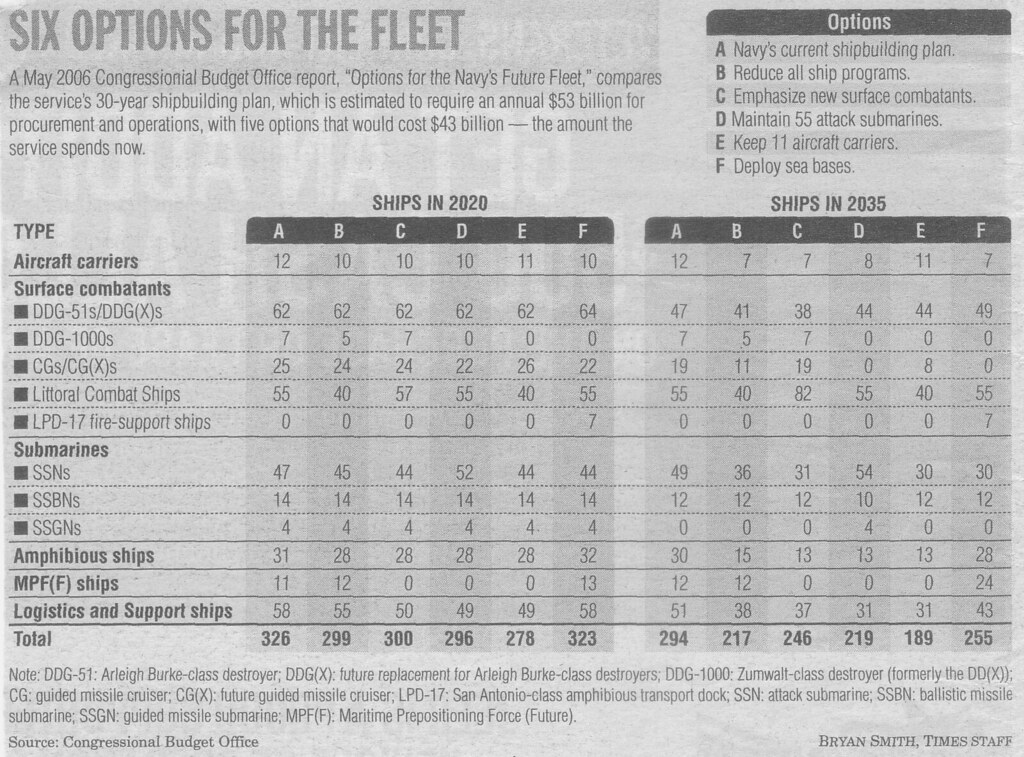
And those plans are below. Pick your flavor - and next time ask harder questions. Higher res here.

If you are a primary source type of guy, you can get the Executive Summary from the CBO here, or I recommend the whole CBO report here. And yes, you see a "7" for DDG-1000. Seven ships. Max. All that....and we have a new "DDG(x)" out there. Another chance to get it right. I hope they do.

Oh, the answer. Build less expensive ships. Stop doing stuff like this:
The Zumwalt program has had a troubled history. Its first incarnation was as the DD-21 land attack destroyer during the Clinton Administration. At that time, the Navy’s goal was to buy the first ship in 2004 and to bring the cost of the destroyer down to $1.1 billion apiece (in 2007 dollars) by the fifth ship. In 2001, the Bush Administration canceled the DD-21 and immediately reconstituted it as the DD(X) program. For several years, the Navy anticipated that the first DD(X) would be purchased in 2004 and that the ships would cost $1.2 billion to $1.4 billion each. Under the 2006 shipbuilding plan, the Navy now envisions buying a total of seven Zumwalt destroyers, at an average cost of $2.8 billion. In contrast, CBO estimates that the average cost of the seven ships will be $3.8 billion each (see Table 2-2). The Navy plans to order the first two Zumwalts in 2007.

Monday, April 07, 2008

Shipbuilding sanity announced at last!

To save you the trouble, I will quote the article in full from the NYT.
WASHINGTON: A program to put the American Navy to 313 ships within three years and built upon a deliberate, well balanced plan designed to produce and maintain a fighting naval force of a size to meet any emergency, a real preparedness program, will be offered to the country within a short time.

It will have the approval of Admiral Roughead and the Naval General Board. The board, of which Admiral Roughead is President, has been working on the plan for the last ten days. Representative Roscoe Bartlett (R-MD) ranking member and Representative Gene Taylor (D-MS) Chairman of the House Seapower & Expeditionary Subcommittee, decided after a Conference with his associates that a five year building program was too slow, as even at the end of that time the United States Navy would probably be trending towards a fleet in the neighborhood of 220-250 ships.

After having reached this decision, Rep. Taylor conferred with Secretary Winter, who agreed to ask the General Board to supply Rep. Taylor with the information desired, such information to be requested by Congress. It was explained to Secretary Daniels that it was the wish of the group of Congressmen desiring to see the United States Navy at 313 ships within three years and to promote such a plan without political considerations. Every effort will be made after the report is presented to Congress to enlist the aid of Congressmen from all parties. Rep. Taylor is not partisan in his effort. The strangest part of the move is that it originates from Rep. Taylor, who is a Democrat and at no time has that party advocated increased armament. Developments in the Pacific, such as the submarine and surface ship building program of China, has convinced Rep. Taylor that the safety of the nation demands a big Navy.

The report being complied by the General Board will answer these questions:
- “What is the fighting force of the navies of the world?”
- “Where does the United States Stand?”
- "What will it cost to build a Fleet of 313 ships?"
- “Can this be done in three years?”
- “What is needed to balance up the present navy?”
-“What should be the complement to the Carriers in the number of Destroyers, Cruisers, Submarines, Amphibious ships, support ships and aircraft”
- “Can our shipyards build all the vessels necessary to place the United States at 313 in three years?”
- “Is it desirable to give the country such a strong fleet?

The replies to these questions will be made public probably at the meeting of the House Seapower & Expeditionary Subcommittee tomorrow. Admiral Roughead and his associates will furnish a great deal of confidential information.

The exact status of the United States among the navies or the world is questionable. Since 911 the United States has lost focus on naval developments around the world. Generally speaking", our navy is credited with being the strongest. Such was the statement of President Bush in a in speech made some months ago in Cleveland.

"You have been told that the Navy of the United States is the greatest in the world and will be unchallenged at sea," said the President. "I am sorry to say that experts do not agree with those who will tell you that.” I believe that it is the largest in the world, but it is getting weaker and faces a tremendous challenge after years of almost criminal neglect and mis-management – much of it on my watch. And you must reckon with the fact that it is necessary that it should be our first arm of defense. We face enemies and potential enemies on every ocean on the Earth. Do you think a Navy sinking to below 250 ships is sufficient?”

The argument advanced by President Bush will be used by the Democrats to compel bi-partisan interest in the program that will be offered to the country and Congress under the auspices of Rep. Taylor and his associates.
Hmmmmm. Would be nice to see this happen this way, no? Boy, things sure seem to work fast....those questions sure seem direct and clear. 3 years? Wish.

In case something seems funny about the article, it is because this isn't the original. I have replaced "second place navy" with "313 ship navy" and changed some of the political and Navy names along with some words that didn't seem "2008." I did leave in "The Navy General Board" as a deference to the irreplaceable Sid, who brought this article from the NYT to my attention. This is from 1916. Read the original here.

The Navy General Board. Discuss.

Monday, January 04, 2010

In DC at 0726 today ....


You should "abandon the concept of darkness."

From
Daniel B. Branch, Jr., National President of The Navy League,
It appears the Obama administration may have abandoned the concept that a 300-plus ship Navy is critical to the security of the United States. If true, this will be the first administration in almost 100 years not to support the concept.

Early signs of this lack of support emerged during the 2008 presidential campaign, when the Navy League asked both candidates — Sen. John McCain, R-Ariz., and then-Sen. Barack Obama, D-Ill. — whether they supported the need to return the fleet to 313 ships, the minimum number the Chief of Naval Operations and the Chairman of the Joint Chiefs of Staff say is needed to meet our national security requirements. The Obama team responded that the “current force structure is adequate to support the Navy’s missions,” referring to a fleet that at the time consisted of 283 ships.
I do not blame President Obama and his team for this - his senior Navy officers gave him this sandwich already made.

This is the logical result of the mismanagement of our shipbuilding program for the entire first decade of the 21st Century. Few in Congress, the press, or the general public believe anymore what uniformed leadership say about what ships will do what, when , and at what cost.

We did this to ourselves - and in the budget environment everyone who wanted to has seen for the last half decade, the simple math that the Tiffany Navy forces us to use tells us that there was no way we would reach 313, 300, or even hold fast at 283.
Further evidence continued to mount last spring, when the administration submitted a shipbuilding budget that would only support the construction of eight ships. In just a few short years, this level of funding will produce a 240-ship fleet, given that a typical Navy warship has an expected life of 30 years.
We will be lucky if we can hold 240 - as we have been discussing here for the last few years.
To maintain a Navy of at least 300 ships, the United States must fund and build at least 11-12 ships per year. Recent estimates from the Congressional Budget Office and the Congressional Research Service indicate it will take from $25 billion to $27 billion per year for the shipbuilding budget to reach and maintain a 313-ship Navy, a minimum number the Navy may even raise. However, the administration submitted a budget of only $14.7 billion for ship construction in fiscal 2010.
And if you think that math is going to get better - you are high.

We would do a lot better if the immediate past CNO Admiral Mullen and the present CNO Admiral Roughead held a very public mea culpa and explained to Congress, the Navy, and more importantly the taxpayer, how we got here. This happened on their watch - they know the problem best.

Enough happy talk.


Hat tip Maggie.

Monday, February 04, 2013

Slowly Adjusting to Reality

As the calendar gets harder to fudge - not to mention the budget, I think we will be seeing more iterations of this - something we have warned you about for years.

Via Chris Cavas at DefenseNews;
The U.S. Navy has revised its overall fleet size requirement from 313 to 306 ships — a modest downscaling that reflects modified operational requirements and is not the result of the ongoing budget crisis.

One of the key changes is a reduction in the long-standing 55-ship littoral combat ship (LCS) requirement to 52 ships — a decrease, the Navy said, resulting from a lessening of the presence requirement to support U.S. Africa Command.

The changes are reflected in a congressionally mandated report sent Jan. 31 to key lawmakers.

The fleet reduction modifies the 313-ship number established in 2005. Navy leaders in recent years have called that figure “about 313 ships,” reflecting several assessments that moved the number up or down, but until now have not settled into a figure officials were willing to declare.

“A 306-ship force structure represents the minimum level of capability and capacity to meet projected threats and support the 2012 Defense Strategic Guidance,” Navy spokeswoman Lt. Courtney Hillson said. “Our operational tempo over the past year reaffirms our need for a minimum of 306 ships. That said, we need to have the right mix of ships in terms of their capabilities that are ready to meet combatant commander demands.”

The new number is not intended as a hard figure the fleet will grow to and then maintain. Rather, it is an overall combat force structure requirement, around which actual numbers are expected to rise or fall.
The fruits of the lost decade. 

Hat tip CIMSEC.

Monday, March 16, 2009

313 was just last Friday - forget any other meaning ...


I stand by my position for the last 3 years or so, we are not going to get to 313 ships. The professional malpractice of this lost decade will guarantee it. This is not the fault of any politician of any Party - this is a failure of program management and capital planning by the Uniformed Leadership.

Perhaps it is my agricultural heritage - but the simple fact is that you have to make hay while the sun is shining. We had 8 years of Republican administration to come up with a sane, executable program and blew it. Full stop. While the sun was shining we played parlor games.
The word within the U.S. Department of Defense is that the White House wants to collect six to eight “scalps” — major program kills — in this year’s Quadrennial Defense Review…

(While) most of the military services are scrambling to protect programs, at least one is getting ready to offer up a signature weapons system. The U.S. Navy will propose removal of one aircraft carrier and air wing from its posture, dropping the number of carriers to the lowest number since 1942…

That step would cut the Navy’s projected shortfall in strike aircraft by half. So billions of dollars are saved by skipping the refueling, cutting the purchase of aircraft, and eliminating the need to sustain 6,000. personnel associated with ship operations and air-wing support.
Well, elections have consequences - suck it up. Lex outlines very well the next chapter of The Hollowing.
Put three ships on deployment, three returning from deployment, three preparing from deployment, two in post-deployment maintenance and one in a complex overhaul, and you get 12 ships. Go to 11 ships and you get seven t0 eight month deployments (and sailors start voting with their feet). Go to ten, and you can find yourself in a position where you take on considerable warfighting risk with exceptionally valuable assets.

Meanwhile, the mission set never changes.
...
Each ship of a class and its associated air wing also come with an aggregate life cycle support tail. When those aircraft and ships are eliminated, the support tail is commensurately reduced. Which means, in effect, that a few years hence we’ll have the same kinds of budget shortfalls Navy faces today, but with less combat capability. Which is how, back in the late 90s, we managed to “recapitalize” the surface fleet down from a Reagan era high of nearly 600 ships to a barely adequate 280 or so.
On target.

Tuesday, February 07, 2012

CNO Goes Salamander on Ship Numbers


Actually - that is being a little like taking credit for water being wet, but considering that as an organization we have gone years telling everyone that water was actually more like lint - I take the following as a very good sign for our Navy. Very good sign.

... the Navy's top officer is telling his sailors that the active fleet will be about the same size in five years as it is now, despite recently announced plans to retire a bunch of ships early and to not build as many new ones as planned.
Adm. Jonathan Greenert, Chief of Naval Operations, told sailors and Marines here that the number of ships in the fleet in 2017 "will be about the same, 285, but it won't be going up as high as we wanted."
The Navy has planned for at least 313 ships in the battle fleet for years, and has counted on rapid procurement of the Littoral Combat Ships (LCS) and serial production of the Arleigh Burke destroyers and Virginia-class attack submarines to help reach that number.
We have been discussing for years that a combination of forces; the high unit-cost Tiffany Navy we spent a decade planning, the predictable results of deferred maintenance and accrued degeneration of existing ships by the reality-ignoring "Optimal Manning Cult," the predictable post-war budget pressures, and in the last 3+ years the clear coming debt crisis - we knew that 313 was going to be a never-was-has-been.

And to make our problem even more acute - Admiral Greenert's predecessor (under his eyes) expended a lot of the Navy's intellectual goodwill and credibility on The Hill by putting out unrealistic, rosy-scenario predictions of our shipbuilding future.

There are more challenges on the way. As outlined in URR's post on the USS ESSEX (LHD-2), the condition of our ships is worse than even the Church of Miss Mary Dark Cloud - which I am an elder of - have warned. This will apply downward pressure on ship numbers in the "out years."

The past is the past - I hope that the 285 is just the start of an open and honest discussion of the actual condition of our Fleet and future force levels. Is 285 is too high? I think so, as we have still not fully digested what will happen in the Terrible 20s. In my dark moments I think of a 2030 Fleet of 220, but 240-50 is probably closer.

Wait until we find that LCS - which will be a huge % of the Fleet when we come out of the Terrible 20s - actually has an average life of 20-25 years as they were never designed to have a long life, will be asked to do more than expected, and will have more and more weight added over time. Let's see. When will LCS start dropping off when they reach 20-25 years service? Oh, thats right; the end of the Terrible 20s.

Ungh. Do we call the next decade; the Torturous 30s? What do do?


Well, we don't have a CG(X). I think DDG(X) is going to be DDG-51 Flt III. LCS will be ... well ... LCS. I don't think we will build a smaller Amphib than LPD-17 - so what do we do? It is FEB 2012 with 285. By OCT 2012 do I have a bid for 275 as new the official number?

Thursday, June 24, 2010

Lean Manning goes Salamander

BZ to Phil Ewing, he has been hounding the Lean Manning FOD for a long time - just as we have here. Let's count this as another Team Salamander WIN!

I expect reports on water being wet any day now. From the 28 JUN NavyTimes and other places;

An independent probe into the state of the U.S. Navy's surface force has found widespread, systemic dysfunction in its manning, readiness and training, and repudiates much of the service's high-level decision-making in the last decade.

The report - commissioned by Adm. John Harvey, the Fleet Forces commander, and produced by a seven-member panel led by retired Vice Adm. Phillip Balisle that included two serving rear admirals - warns that unless the Navy mends its ways, it will continue to see surface ships condemned in inspections and sail unready to fight.

Although sailors and Navy observers have pointed before to many of the problems and trends that Balisle's "fleet review panel" uncovered, the report provides the clearest, most detailed look yet at how a preoccupation with saving money drove the surface Navy to a low point.

"It appears the effort to derive efficiencies has overtaken our culture of effectiveness," the Balisle report says. "The material readiness of the surface force is well below acceptable levels to support reliable, sustained operations at sea and preserve ships to their full service life expectancy. Moreover, the present readiness trends are down."

How did it happen? Driven by top-level pressure to be as efficient as possible, Navy leaders in the early 2000s made a series of interrelated decisions to cut sailors, reform training, "streamline" fleet maintenance and take other steps in keeping with the philosophy then en vogue of "running the Navy like a business."

The fleet organized itself into layers of "enterprises," which thickened already legendary layers of military bureaucracy and made command relationships difficult to understand, the panel found.
Good googly moogly. All the Navy needed to do is pay for Skippy-san and myself to lock ourselves away in a conference room in Singapore for a weekend and we would have told them the same thing years ago for 1/10th the price. Or they could have read our blogs.

In summary; give the COs what they need to take care of their ships. Cut the bloated shore bureaucracy. Stop the happy talk, that is how you got here. Exhibit 1.

Chief of Naval Operations Adm. Gary Roughead said that the move to "optimal manning" made practical sense earlier this decade, but "changes to the structure ashore, changes in some of the oversight functions" have come to hurt ships' ability to train, do maintenance and fight."
That is not clear and direct talk. That ignores facts. Why not just say that we made a mistake? It never made sense. Never at the pier. Never in the wardroom. Clark, Mullen, Roughead - this is your baby; name it and claim it.
Between 1994 and 1999, about 3.5 percent of ships failed inspections by the Board of Inspection and Survey, Balisle's commission found. From 2005 to 2009, almost 14 percent of ships failed. Not only does this hurt the fleet of today, it means the Navy can't keep around the ships it says are vital to building its hoped-for fleet of at least 313.

"Independent reports indicate that if the surface force stays on the course that it is presently on, DDGs will achieve 25-27 years of service life instead of the 30 years planned and 40 years of extended service life desired," the report says.

Even the highest-profile and most vital system aboard the Navy's front-line warships - Aegis - fails much more often than panel members expected; technical problems with cruisers' and destroyers' SPY-1 radars have gone up by 45 percent since 2004, the report said. But because of smaller crews, poor training and the complicated bureaucracy of getting repairs or replacement parts, many ships sail while "consciously accepting degradation."
See that years of service? The Terrible 20s just got worse.

Where is accountability?

For half a decade, there have been outstanding officers, SWO and EDO who have been telling me their tale of woe. If this is a shock to the CNO in 2010 then it is his fault. I am just a garden variety, work-a-day retired CDR. On active duty, I was just the guy stage right on CNO calls - and I knew this. Why did I know this? I watched, listened, and asked.

But Mueller would not comment on specific recommendations in Balisle's report, including precise numbers for how many sailors the panel thinks the Navy needs: 4,496 new sea billets and 2,028 shore and maintenance billets, for a total of 6,524 new billets. Those numbers are based on an overall recommendation that surface ships be automatically manned at 110 percent over their base level, to account for the roughly 8 percent effective loss of crew the committee discovered across the board.
Once again - I can help you find those billets to shift from shore to sea - you just have to be willing to accept some high-freq squealing. Sailors belong on ships; ships belong at sea.

The USMC in the last few years did a scrub of those Marines who had not deployed in the last few years. We should do the same. Examine the billets and designators that they come from. That can help justify what needs to be done. And yes, because it is THU - start by
cutting 66.66% of these billets and related ones throughout the Fleet. You'll save a bundle of money on TAD as well - enough to send more Sailors to schools to do things like teach you fix radars and repair pumps.

What 4-star comes out of this looking good? Admiral Harvey - he is the one that charged Balisle with assessing fleet readiness last September. Methinks he knew this was a problem for years. This is the only way to get the word out without being crushed. We all have our place in the Navy ecosystem. BZ to him as well.

Wednesday, September 23, 2009

Ummm, how to 313 again?

Tony Capaccio at Bloomberg has some friends I wish I had. If nothing else, he has some very blogable RUMINT.

First, let's start with the official line.
Navy Assistant Secretary for Acquisition Sean Stackley told reporters last week the service remains committed to buying 55 littoral ships. Chief of Naval Operations Admiral Gary Roughead told reporters Sept. 15 the service remains committed to a fleet that totals 313 vessels.
You always have to start with the Direction & Guidance from the top - and that ain't ADM Roughead.
The service’s proposal to trim planned spending from 2011 through 2015 to $666.3 billion from $698 billion reflects Defense Secretary Robert Gates’s guidance calling for modest growth with emphasis on improving the security of nuclear weapons and upgrading the capabilities to conduct irregular warfare and cyber defense.
The logical outflow from this are these goodies,
The Navy would trim about $25 billion through 2015 by deferring or canceling weapons programs, including a total of about $18 billion in its shipbuilding account, which includes the littoral ship.
...
The U.S. Navy has proposed a new five-year budget that cuts by almost half its purchases of a new warship that operates close to shore, ... The Navy would buy 15 of these ships through 2015, down from 29 in its plan of a year ago, and trim spending overall by 4.5 percent, according to an unreleased budget document. That’s the goal set by top Defense Department officials
...
...delay purchase of the EP-X replacement for its Lockheed Martin EP-3 Orion surveillance aircraft, according to the document. The program is in a stage of early development, and no contractor has been chosen.

Altogether, $3.4 billion would be cut from research and development, including $1.6 billion for the EP-X program. (editorial note: blame the ACS fiasco)
Further you find - just with ships (more weapon and aircraft numbers in the article), the Navy plan also would cut through 2015:

-- Six of seven planned amphibious warfare ships.

-- Two new ships intended to replace aging command ships such as the USS Mount Whitney.

-- Two of 11 of Jerry's planned JHSV.

-- One of 10 planned SSN.

In addition, the Navy would save as much as $825 million by retiring 20 ships one year ahead of schedule. So much for Byron's FFiG SLEP'n.

The truth changes .... and will change again. These numbers, even if you assume that they are correct, working-draft sourced, will change. From my seat though, this looks about right - and in full alignment with what we have been talking about here for awhile. The gravy train is always shorter then you want it to be - and it passes through before you get your fill. If you don't know that, then you have only yourself to blame.

Do not get mad at the SECDEF. Big Navy p155ed away a decade thinking that war was new, shipbuilding history can be ignored, everything was transformational, it is better to low-ball costs, and generally rely on PPT, happy talk, and the PCS cycle to work through the future fleet.

Tomorrow is yesterday. FY10 is a week away there Shipmate. Learn and adjust - and do your best to rebuild our credibility. A Fleet isn't built in a day - but it can be puttered away in a decade.

Hat tip Gal.

Monday, January 11, 2010

Reforming the Confederate Navy


What characterized the Confederate Navy? Though many things - she was scrappy, inventive, and had some outstanding leaders - in line with many things in the Confederacy though, she suffered a fatal flaw that doomed her. In her case, the Confederate Navy placed her bet on a few grand ships to make the "transformational" break.

When we think of the Confederate Navy, we think of the CSS VIRGINIA, CSS HUNLEY, and at least I think of the CSS SHENANDOAH. Wonderful platforms, but in the end did little but absorb people and resources.

The Confederate Navy adapted where she could, but when faced with having to build a fleet from scratch - she threw her lot in with transformationalism. VIRGINIA and HUNLEY were wonderful ground breaking designs and concepts - built against tremendous odds - but in the end they were like the nation they served - beautiful losers destroyed by their own fatal conceits.

What was their conceit? They thought that a few high technological breakthroughs thrown into a few hulls and applied with a bit of tactical verve could triumph over the many primarily pushing sound fundamentals.

I think alternative history is a goofy subject when real history is so much more interesting, but if Sherman never made it through the Atlanta defensive lines and the Democrats won the '64 election - someone would have had the opportunity to look at the wartime record of the Confederate Navy and set about building a better, more balanced fleet based upon what worked.

Funny the things that will tangentially come into one's mind. When I got through looking over the
PPT and PDF from the exceptionally poorly titled The New Navy Fighting Machine, what came to mind was the conceptual challenge of a post-war Confederate Navy.

Goofy, no? Well, work with me a bit; tell me if you see it.
NPS Professor and retired CAPT Wayne P. Hughes, Jr. and his crew deserve congrats for a very good and thought provoking work - one that if not related, then at least that folds in well with the conversation CDR Henry J. Hendrix, Jr. brought forward in Buy Ford not Ferrari.

You could spend a few thousand words discussing in detail their work - which we don't have time for right now - but let me take some time to point out the good, bad and others.


The good;
First of all, the PDF shows a great focus on China, and the China challenge influences a lot of their ideas. That intellectual honesty and clear headed view of the future makes the discussion in and from the document of much greater use than the 2/3 of our
latest Maritime Strategy that I find so useless. As that touchstone, the China challenge is an important reference when looking at what they offer.
... we anticipate formidable Chinese sea-denial capabilities that will threaten to reduce American influence in East Asia.
Already taking place. I have called it the Porcupine Strategy. They don't have to be the biggest or most dangerous - they just need to make it look too painful to mess with.
Submarines in greater numbers are central to the maritime strategy, but within a constrained budget the larger force cannot be exclusively nuclear powered. We find that diesel submarines with air-independent propulsion not only allow twice as many submarines, but they also nicely complement the SSNs in the critical scenario.
That is for the USA - and I don't think you can buy and maintain twice as many SS as SSN - but perhaps close to 3 to 2. Still a sound concept. If an early 20th Century designed Type VII, then a 21st Century SS can handle a little transit time.
Perhaps most important of all, we emphasize maritime power as the foundation of present American influence and international prosperity. Sea power’s value is well appreciated by our friends around the world, but is taken too much for granted by the American public. The United States is a maritime nation and the United States Navy is its great manifestation.
That last sentence should be put on a bumper sticker and some JOPA DC DET types should put it on cars in all the nice parking spots at the Pentagon.
Concurrent with broad agreement on the new fighting machine’s characteristics, it is necessary to calculate whether its personnel costs will be more or less than the cost of manning, training, and supporting the 313-ship Navy. Our impression is that:
- In numbers, manning 650 mostly smaller ships will be about the same.
- In terms of individual, shipboard team and fleet tactical training, the cost will be somewhat less.
- The cost to support recruiting, assignment, and education will be determined by the outcome of the manning and training calculations.
Here and there we highlight the easier training to competencies for the smaller and more focused warships of the new fighting machine. But, in a different way, the training must be just as sophisticated. Examples are (1) the need to prepare junior commanding officers of patrol craft in the art of theater security and nation building; and (2) the return to professionalism in warships devoted to mine warfare, antisubmarine warfare, and countering swarms of small missile boats—as compared to the well-developed capability to deliver accurate strikes ashore. There is time to change the training as the new fleet is produced, but only if both the different tactics and new training are developed simultaneously with the new operational emphasis.
Manpower. That is the key - sell with sound work manpower considerations.
American nation needs a fleet that is more distributed for flexible presence, adjustable intensities, short and long durations, survival against surprise attack, and which is capable of fighting in tight corners and taking affordable losses. The new fighting machine incorporates many simpler and more single-purposed vessels so that the Fleet can respond more quickly in an unforeseeable direction to a particularly severe threat or rewarding opportunity—what has been called “a Black Swan.” We are arguing against a Navy with warships so hard-wired that an unforeseen surprise will be fatal, because our present fleet is an organization of long lived big warships, some programmed to last 40 years in order to amortize their construction costs.
We are not as hard-wired as we used to be. I think we are already moving in this direction - though we can do better.
Preserving the industrial base for an abrupt expansion is a DoD (Department of Defense) obligation. The industrial base does not appear explicitly in designing the new fighting machine, but an awareness of the need for competition and greater cost controls is implicit everywhere.
Of course, anyone who uses my favorite example of doing it right will always get a gold-star-happy-face. Seriously - this is a story that every officer should know by heart.
Here is an illustration of design experimentation with a happy ending. It is the story of the Treaty Cruisers built under terms of the 1921 Washington Naval Disarmament Treaty. During the 1920s and 1930s, heavy cruiser standard displacement of 10,000 tons was the limiting design factor instead of construction costs. Four classes were designed and built under the treaty, in 1925, 1927, 1929, and 1931-34, each successive class being obviously superior to the previous one. How much superior was a hotly debated question answered in World War II. The first two, supposedly much inferior, ships of the Pensacola class saw as much action as any cruisers, were repaired after battle damage, and survived the war. Looking at the 15 supposedly much improved later cruisers built under treaty limitations, seven—almost half—were sunk. Our impression is that the effectiveness of USS Pensacola and Salt Lake City was about 90% that of the culminating seven-ship USS Astoria class, three of which were destroyed in the Battle of Savo Island in about 15 minutes. Equally important, when the treaty terms were lifted in 1936, we were ready with the design for 17 more heavy cruisers of the magnificent USS Baltimore and Oregon City classes. All were ordered by July 1940 and commissioned before the end of the war. None were sunk.
The following suggestion/compromise about LCS needs to be acted on before we have a few dozen "test beds." As a face-saving move, it iss a good compromise as a chance to move forward with alternatives .... but there isn't much time left to act.
...LCS must not be regarded as a design failure, but as a technological, tactical, and training test bed. The fact that it is suited well neither as a blue water or green water combatant can be useful. On one hand, it can help to design a better armed, less costly blue water frigate. On the other, LCS shows what not to do to develop affordable green water designs to perform inshore patrol missions, clear mines, defeat small missile boats, and screen against coastal submarines.
In a discussion of Green Water, they discuss "Coastal Combatants" ... can we just be clear and call them Corvettes though?
The coastal combatant is not a patrol vessel for theater security operations. It is a small fighting vessel intended to “clear out the clutter” of enemy or neutral vessels in littoral waters. The afloat clutter may be swarms of enemy small craft, fast attack craft carrying surface-to-surface missiles such as the Chinese 220-ton Houbei class, and fishing boats and coastal traders that might serve as reconnaissance posts in a targeting system. Coastal combatants are heavily armed, but small enough to accept affordable losses. They should operate in tactical formations of two, four, eight, or twelve vessels. They carry no surveillance aircraft, so depend on CVLs or shore-based reconnaissance.
Well described, and there are designs already out there (Visby) that fit the bill (BZ to them from bringing up the losing but superior option for LCS). However, as an institution, everyone should stop references the b@st@rd stepchild of Bu11sh1t B1ngo that is Streetfighter and Sealance et al. That buzzword PPT spawn are part of the reason we are where we are in 2010. Use proper naval terms that sound like they are coming form a professional and less like some video game designer. It insults an officer's intelligence and drops everyone's IQ by half a standard deviation every time it goes in the ear.

After the bait and swich snake oil salesmanship of the last decade + that got us where we are today, I am not the only one who is immediately suspicious every time someone starts using too-clever-by-half, cheesy marketing words for what are simply new designs to meet established naval warship niches that have a pedigree which dates back over a century. We should stop trying to be cute - and focus on being professional. Most of the NNFM is good professional work - but the unsightly smear of snake oil degrades its brand a bit ... just a bit.

Off rant and back to the document.

The CVN/CVL discussion is worth almost a specific post in itself. Read the details - but I find this pull quote the best in outlining the argument. Especially if ASBM technology works out in the next decade to the right side of spectrum where we think in will be - having your air assets on more platforms is a progressive risk mitigation strategy that needs much more support.
A calculation of the smaller, but roughly comparable, life-cycle cost of what we argue to be a suitable mix of six CVNs and ten CVLs. The mix carries 620 aircraft, or 12% fewer. We believe the smaller number of aircraft is more than made up for by its flexibility: the CVNs’ powerful short-term punch in a major contingency, complemented by the CVLs’ advantage of greater distributability.

The Navy has service life remaining in many existing CVNs, but a CVL needs to be debated, designed, and built at once to test its compatibility with the F-35B, to develop an early warning aircraft capability, and to explore mixes of aircraft for green water operations, including UAVs. Absent such a CVL, we believe that on affordability grounds alone, the total number of aircraft carriers will shrink to eight within the next two decades and, absent the development of a CVL, with no redress possible.
Like the CVN/CVL discussion, the SSN/SSK discussion is worth a post all its own. The work is VERY Salamanderesque - so you can assume, rightly, that I pretty much agree with 95% of it. They had me at the start when they use a story I tell every time people tell me that that they tell me, "We have plenty of ASW weapons."
The Falklands War of 1982 is a cautionary tale of two submarine fleets having major effects on the enemy in a maritime war. Early in the war, the United Kingdom’s HMS Conqueror, an SSN, sank the aged Argentine cruiser General Belgrano. Seemingly as a result, the Argentine Navy withdrew into port and took itself out of the war, thus isolating the Falklands from substantial reinforcement or resupply. On the other side, one old Argentine submarine harassed the British task force out of all proportion to its nominal combat value. Literally hundreds of ASW torpedoes were fired by the screening destroyers on contacts that proved to be false. Submarines as sea denial systems can influence enemy operations disproportionate to their numbers and cost.
If we go to war - it will be criminal what has happened to our ASW capabilities. It will make the unarmored HUMVEE look like a success. I will leave it at that.

Here is the Salamderesque nature of it squared - sure to upset the
usual suspects, which makes it all the more fun.
A total of 80 submarines, with special emphasis on China.

- Of these, there will be 40 SSNs at $2.5B each (if the price can be reduced, the number can rise) and 40 AIP submarines at $500M-$700M each (we show $700M in Table 2 and make the same comment as to the latter’s price and numbers).
- A set of 100 submarines would be better than 80 to defeat China, but in the absence of detailed operating plans and analysis, 80 seems sufficient and an acceptable risk, especially based on our premise that we must have allies in the unlikely case of a war with China.
Admiral Dönitz nods his head in agreement,
Some submarines should be equipped and trained for minelaying.
Serious, dedicated training - not spitting a few out and running.

On the amphibious side of the house, they outline well the Tiffany Green Eyeshade amphibious problem.
In history, opposed landings involved scores of ships and we expected to lose ships and assault craft as well as troops. Today, the large-capacity, efficient amphibious assault ships—LHAs, LHDs, LPDs, etc., are few in number compared to the LSTs, APAs, and AKAs that were the backbone of the opposed assaults in World War II and Korea. Now, the loss of even one amphibious ship would probably terminate the operation in failure.
The solution - well - call it a "prepare and ponder" strategy. Leesea, call your office.
For $1.0B of annual SCN, a fleet composed of between 100 and 150 ships can be maintained for amphibious lift, delivery and sustainment. Many sealift ships will be large, high-capacity RoRos, container ships, and tankers, constructed or purchased at an average cost of about $500M. Others will be small, simple “HSVs,” to quickly move ground forces to a scene of action demanding swift response. Some will be amphibious ships of 15,000 to 25,000 tons for unopposed delivery across a beach or at an undeveloped landing site. In Table 2, we show a sealift fleet of 125 ships, including propositioning ships. This capability will suffice for any likely conflict involving ground combat overseas. The current numbers are between 80 and 90 reasonably modern, large-capacity vessels, plus 31 large ships for amphibious lift. If a large regional war ensues, the U.S. merchant fleet can be requisitioned, but it is relatively small, so leasing from neutrals around the world might be necessary, as was done for Desert Shield.

We espouse a ten-year holiday in which no high-cost amphibious ships are built. Much of the existing amphibious assault force can serve for many more years in the unlikely case of the need to conduct an opposed Marine assault (e.g., in Lebanon or Syria). The amphibious ships will also serve effectively as interim Global Fleet Station ships.
Almost a punt on their part. I think this part of their plan in not as mature as the others and needs more work. I like the direction they are going in - but it isn't fully baked.

The bad;
Although our green water fleet of about 240 vessels is more attuned to the needs of the nation than anything else we have seen,..
Snerk. Of course you silly geese - it is your proposal. You almost have the confidence of a blogger ......
For example, the green water component also includes an additional 400 affordable and easy-to-operate inshore patrol craft to help build up the capabilities of some countries without navies or coast guards.
Still trying to grasp that concept, and "affordable" needs a lot of defined truth in 2010 as we have destroyed that meaning in Congress and with the taxpayer over the last decade. Also, that is a LOT of LT and LCDR Commands .. might be a good way to break the present officer career path diktat --- and get more sea and Command time -- but to make that happen would require a complete manpower restructure. Also a chance to break a lot of paradigms WRT how we man our Navy ... but that needs a lot more fleshing out and in the end, I think 400 is way too large - at least at the start.
We do not believe the present U.S. Navy organization will achieve a green water force, and so our most important recommendation is to create a new command with the authority to foster professionalism in coastal operations similar to that by which the Navy developed naval aviation in the 1920s and 1930s.
Ungh. No. Only if you kill two U.S. Navy organizations will Emperor Salamander permit you to create a new one. Too much Staff Bloat as it is.
Large, multipurpose warships are not, as is frequently argued, more flexible and adaptable than smaller, more focused warships. We repeatedly found cases in which “single purpose” warships are superior in effectiveness and for swift modernization. As an example, the green water component includes 12 gunfire support ships because we believe embedding guns in DDGs, CGs, or other missile-firing surface ships will not result in effective naval gunfire support.
Ehhhh, maybe. Hedging you bets with a High-Low is a better path, methinks.
The smaller, more distributable ships can free the inevitably fewer high-end warships for more demanding operations.
Correct. Piracy is a perfect example, as we have often discussed - but if you only have a few high-end ships, they aren't going to do much for a global Navy - remember, you can't be at sea forever.
Training and career development of Navy officer and enlisted personnel will be enhanced with more single-minded ships. For example, after 1990, ASW (Antisubmarine Warfare) skills atrophied in the surface navy because of its emphasis on offensive and defensive missile warfare. ASW proficiency will be hard to restore in missile ships. By contrast, the Israeli Navy’s training allowed them to quickly adopt new tactics for its highly focused Sa’ar boats, which defeated Egyptian and Syrian missile boats in the first significant missile war in 1973, despite their Gabriel missiles being seriously outranged by the enemy’s Soviet-built SS-N-2s.
Good point, in parts - but "single-minded" is neither the cure or for Israel the reason.

Neither good nor bad:
A broader area of disagreement I have with the authors is a focus on single purpose ships. As described, especially the Gun Support Ship - I think it is worth looking at, especially if you can give it a basic AAW capability which isn't too hard with the ESSM as described. Then it is a little more multi-purpose that makes me feel better, as when possible - you need multi-mission capability as the enemy decides how he is going to attack you, be ready. My bias is towards multi-mission, but as you get smaller, you have less of that luxury .... though even the WWII face DE's had quite the multi-mission capability .... as did PT boats .... so the "it's too small" argument may need work.

Strange and sad thing though is a desire to remove the gun from CG and DDG. Again, they seem to want to pull away from a multi-mission capability. Uni-mission ships simply do not have a good history.

Remember the quote by LT Copeland? As was amply shown during the Falkland Islands War and 5-inch Friday - a multipurpose gun is needed on every warship that can carry it - the larger the better. A multipurpose gun is the Leatherman of naval warfare - all sorts of uses in one package. I would caution being too binary when it comes to NGFS (nee NSFS)- but following is on balance good - quite good.
These are single-purpose ships carrying two of the best guns available for naval gunfire support (NGFS), such as an advanced gun system (AGS), with 2,000 rounds, precise navigation, countermine underwater search, and evolved sea sparrow missiles (ESSM) combined with softkill defense at short range. The Gunfire Support Ship need have only a small surface search radar (because it will operate in company), no stealth properties (because it will reveal its position in action), and no sonar or ASW (antisubmarine warfare) ordnance (as a cost-saving measure). Hull size will be determined by the minimum space and sturdiness required for two guns and their ammunition, which in turn will determine what form of UAV for reconnaissance it may carry.

Littoral warfare operations ashore can be greatly enhanced by the low cost, high volume, and overall efficiency of naval weaponry over aerial bombing or land attack missiles. When in range, the ships are also superior to land-based artillery, which has a large support tail.

Guns in CGs and DDGs are ill-matched because their land attack missiles reach deep inland but must be fired safely from their maritime sanctuary, which is now sometimes 100 miles or more offshore. Missiles are expensive and so best suited for select, fixed, high-value targets to complement the Gunfire Support ships that produce rapid, high-volume fire in support of the battlefield. ... NGFS is an important responsibility of the Navy and if and when any new technology has been demonstrated, swift introduction is unlikely without a force component dedicated to the mission, the value of which was amply demonstrated in the European and Pacific theaters of World War II, in Korea at the Pusan perimeter, Inchon, and Hungnam, and repeatedly during the long Vietnam War.
The Blue Water discussion is interesting - but has some problems.
An ominous trend (although the data sample is small) is that the success percentages of the attackers have gotten better since 1975. Since it seems predictable that the offense will continue to regain the advantage over a defender’s surface-to-air missiles, it is a mistake to rely heavily on expensive DDGs and CGs with Aegis and SAMs. We do not want to eliminate these capable ships and we think new ones should be added periodically as technology advances. If the ships were more easily and quickly updated to neutralize the natural advantage that is possible with ASCMs and TBMs (Theater Ballistic Missiles), we would be more optimistic about their future value. In the meantime, we propose to let attrition at end of life reduce the number of DDGs to a steady state force of 30.
Sure ---- but no one has ever tried to attack an Aegis ship with a ASCM. The HMS SHEFFIELD and USS STARK that they reference earlier are not Aegis ships. I understand the need to decrease funding of large ships to buy more smaller - but I think they might be going too heavy on the small side than the Blue Water side. Just my opinion. I share their concerns with ASCM and ASBM - but better AAW is the answer, not fewer AAW platforms with legacy systems.

On the lower side of the Blue Water force though, they get it exactly right.
To maintain total surface combatant numbers for offensive action and screening at around 140, we conjecture a new blue water frigate similar to those in the other navies of the world. They emphasize sea control but are capable of escorting large and small carriers, amphibious lift, and delivery and sustainment shipping. They carry at least eight long-range surface-to-surface missiles, a helicopter or UAVs, have a capable ASW suite, and strong, short-range hard and soft kill defenses.
There are many international frigates and corvettes that serve as examples for developing an affordable design, which should be evolutionary, but cost, at most, $400M in series production. These include Turkey’s new MILGEM class corvette, Singapore’s Formidable class frigate, Indonesia’s Sigma class corvette, India’s Project 28 frigate, and the Russian Steregushchiy class frigate.
Airtight. Their concept for dedicated land attack Corvettes - different than the Gun Corvettes, also has some merit for discussion - and I like this "influence squadron."
A compact task group with a land-attack mission might consist of four missile corvettes carrying 200 improved Tomahawk land attack missiles (TLAMs), plus a CVL, a DDG, and two new frigates.
They end up with a proposal. Could I live with this?
- Build DDGs at a limited rate, sufficient to keep one shipbuilder’s line open, and to keep technology current, but with the intent of reducing the Aegis force to 30 warships within 25 years. The steady state force of 30 ships costs $60B, so the SCN per year for a 30-year combat life is $2.0B.
- Introduce several affordable frigate designs of 2,500 to 3,000 tons and about 25 knots, with the goal of creating a force of 90 ships at a unit cost of $400M. Essential features are at least eight upgraded TASMs (tactical Antiship Missiles), strong close-in defense, and a modern ASW suite. The ships will emphasize sea strikes and ASW. Each must carry a helicopter or pair of UAVs.
- Design and build simple corvettes carrying about 50 land-attack missiles—upgraded TLAMs as it were. They are not fast, but 25 knots is desirable. They operate in silence, with any radiating platform being in the air or scores of miles away. Because of their simplicity and American shipbuilder design experience with stealth properties, the first design will probably be very much like the final one.

Merely for completeness we include here a component of 20 auxiliaries. The numbers and costs are unchanged from the 313-ship Navy plan.
Absolutely. This is much better than the mix we have right now.

Why is there so much here I agree with? Well, on balance I think it is because they tried their best to root their program in an understanding of history and a realistic expectation of what technology can gain you in the foreseeable future.
NOT A TRANSFORMATIONAL FLEET

Doubtless the structure herein is jarring to those content with the Navy’s current emphasis on power projection and faith in a continuing sanctuary at sea. Nevertheless, insofar as possible, the new fighting machine comprises only well-developed and tested capabilities responding to current circumstances in the spirit of Bradley Fiske’s goal of unity between policy, strategy, and warship characteristics. We often illustrated the fighting machine’s ship characteristics with existing foreign warships, especially borrowing their ideas for coastal operations. We also drew from nascent domestic attempts to create a more distributed force.

Nowhere does the new fighting machine depend upon technological innovations such as the sensors, SAMs, and command-control for advances in BMD; directed energy weapons, rail guns, robots, dirigibles with surveillance radars, and exotic hull forms.
Radical? No; a refreshingly sound and professional work. You can discuss the ideas in this work as adults because there is a minimal amount of "fairy dust" in here - told with simple and direct language; things often missing in such documents produced over the last 15 years.

Finally, back to the Confederate Navy. What would a Confederate Navy look like if they looked at what did and did not work for them in the war while maintaining their curious intellect? Perhaps in a modern sense, such a POV could produce a scaled down version of this.
- CVLs for both blue and green water operational flexibility.
- Land-attack missile ships, each carrying 50 missiles and numbering about 20 inexpensive vessels that can be deployed in pairs or task forces tailored to the risks and demands.
- A new class of AIP diesel submarines to complement the more expensive SSNs for an increasingly important role in sea denial.
- At least 12 dedicated naval gunfire support corvettes that can quickly and affordably go where the ground action demands, be put at risk according to circumstances on the ground, and more readily embrace new NGFS technology when it is tested and ready to install.
High-speed mine clearance vessels that can be on station quickly to clear the way for the operation.
- A large number of smaller, less expensive frigates to complement a smaller number of DDGs and boost surface combatant numbers at less SCN cost.
- At least nine single-purpose strategic defense BMD-DDGs for deterrence.
In many ways, though the name gives me heartburn - but that is just me. the NNFM document and PPT that go with need to be looked at as the very serious and usefull thought pieces that they are. In my view, they are a much more useful document than the last Maritime Strategy when it comes to looking forward to why we need a Fleet and what we can do with it.

Galrahn's discussion at his place on the work is well worth your time, so give him a visit too.
Tuesday, December 11, 2007

Now THAT is an endorsement

This may shock you, but I can be a contrarian. What I learned over the last 15 years from the CANSLIM method and IBD for investing has treated me quite well, part of that method (look opposite the prevailing mood "bullish/bearish") also applies for what comes out of the mouth of "official spokesmen."

If they call it too sweet, look for the rot. If they call it insane, it just might be the right answer. This piques my interest right away.
“The proposal has not been vetted among the Navy leadership,” said Cmdr. Jeff Davis, a Navy spokesman. “The hypothetical numbers listed in the brief are ludicrous and are not reflective of Navy leadership’s thinking or intent and has no bearing on the budget or POM (Program Objective Memorandum). The brief is based on a 2-year-old war game and is not being used to recommend force structure options.”
Yep, I want to see it (hint; if you have it UNCLAS non-FOUO, please email it). What are they talking about?
The U.S. Navy’s top strategist has floated to the chief of naval operations three alternatives to the service’s current 30-year shipbuilding plan that if adopted would radically reshape American naval power.

The three options are contained in a 26-page briefing titled “Three Futures, One Navy, A Portfolio Analysis” by Vice Adm. John Morgan, the service’s strategy chief, which was e-mailed to Adm. Gary Roughead, the chief of naval operations, just before the Thanksgiving holiday.
Oh, and Jeffy - just a little free career advice - unless you are an, ahem, quasi-anon blogger named after a slimy creature; I wouldn't recommend running around calling an Active Duty VADM "ludicrous" ... and when you think the world revolves around the POM, you have done one tour too many in DC.

Anyway, if it hasn't been pushed through "leadership's thinking" then that doubles the odds that it is worth looking at. The track record of "leadership's thinking" over the last decade has not been something to put on your FITREP. So, I can hear you now, "More details 'Phib, stop y'er blabber'n 'bout yourself!"
The force structure options — a 263-ship fleet optimized for major combat operations against a peer competitor; a 534-ship shaping force tailored for coalition and maritime security operations; and a 474-ship balanced force able to perform high- and low-end missions — would replace the current 30-year shipbuilding plan. Each option is based in part on the findings of a 2005 “table top exercise” involving Lockheed Martin, the maker of the Aegis combat system that equips the Navy’s cruisers and destroyers, as well as one of the two builders of the service’s new Littoral Combat Ship.

The current 30-year plan aims to yield a 313-ship fleet by 2013 — up from 280 currently — assuming projected investment levels remain unchanged and existing programs remain on budget and schedule.
I vote for #3, here is why.
• Balanced force. A fleet of 474 ships able to conduct operations from high-end battle to low-end counterterrorism and maritime security. This force would be composed of nine aircraft carriers, 23 big-deck amphibious helicopter carriers, 46 amphibious ships, 57 cruisers and destroyers, 132 corvettes, 160 patrol craft, 20 riverine squadrons, 15 auxiliaries and 32 submarines of all classes.
Though interesting, the other two options simply have too much Strategic Risk - and I am not arrogant enough to think I have any clue exactly what threat we will face in 10, 20 or 50 years.
• Major combat operations. A force of 263 ships, smaller than the 313-ship fleet that Roughead has said he wants, tailored for battle against a peer competitor. This fleet would be composed of 12 aircraft carriers, 13 big-deck amphibious helicopter carriers, 26 amphibious ships, 81 cruisers and destroyers, 54 corvettes, 21 auxiliaries and 56 submarines including attack, ballistic and cruise missiles boats.

• Shaping force. A fleet of 534 ships, mostly corvettes and patrol boats better suited to littoral, maritime security and partnership operations. This force would be composed of six aircraft carriers, 24 big-deck amphibious helicopter carriers, 48 amphibious ships, 48 cruisers and destroyers, 161 corvettes, 200 patrol craft, 30 riverine squadrons, 15 auxiliaries, and 32 submarines of all classes.
As always, follow the money. It applies here as well. We simply have to watch cost.
The briefing assumes the Navy’s ship construction budgets will remain constant at about $12.5 billion annually over the coming three decades for a total of $377 billion. But that $12.5 billion figure, sources said, is below the roughly $15 billion annual shipbuilding budget that the service has previously said it would achieve over the coming years, which is critical to the execution of the current 30-year plan.

Each of the options assume the following unit costs: nuclear-powered aircraft carriers at $5 billion, big-deck amphibious helicopter carriers of either LHA or LHD classes at $2.5 billion, amphibious ships of LSD or LPD classes at $1 billion, cruisers and destroyers at $1 billion, corvettes of the LCS class at $500 million, patrol craft at $100 million, riverine squadrons at $100 million, submarines at $2.5 billion, and auxiliaries at $500 million.
Galrahn has other thoughts on the article worth reading on this as well - and I will go ahead and start collecting my beers. You will know what I mean when he makes his recommendation.

Another thing to say about this - I like the fact it calls a LCS what it is - a Corvette. More oh Caesar, more!


Speaking of Caesar, this article says good things about the new CNO as well. Here is why,
“Adm. Roughead has created a tone with the senior staff in which he encourages us to provide him thought pieces, and this brief was nothing more than an e-mail sent to the CNO by one of his senior staff to let him know that it was out there,” said Rear Adm. Frank Thorp, the Navy’s chief spokesman.
...
The document was generated to address Roughead’s budget concerns, sources said. During the course of briefings after taking office, sources said Roughead became alarmed about the service’s future budgets and its ability to field the kind of forces it needs to support its new maritime strategy.

Last week, Roughead said the service needs “appetite suppressants” when it comes to its ship requirements. Critics have said that Navy cost overruns are often driven by the service’s inability to control requirements changes in its designs.
And the Salamander did grin; and the Sailors did feast upon the lambs, and the sloths, and the carps, and the anchovies, and the orangutan's, and breakfast cereals, and fruit bats...

Monday, January 16, 2012

Potomac Flotilla PPT Pom-Pom

Do you hear it? Sometimes it is as a whisper; sometimes as through clenched teeth; and sometimes as a warning.

Every professional should somewhere in their nogg'n have Rear Admiral Meyer’s philosophy on memory speed dial; and short little mental audio file of;

Build a Little, Test a Little, Learn a Lot
The Meyer school, like those that developed the cruisers and naval missiles before him, are from one school. That progressive, optimistic, but engineering minded caution which has a great track record.

To truly advance, which they did, that school needed to interact with the type of person perhaps best described as a "futurist"; people who have quick and agile minds; those who try to think 3-4 steps ahead. You know the type. The two types work great together either as a group, or in the best of cases, in the mind of a single person. It works well as long as the Meyer school gets 51% of the vote. When out of balance, sub-optimization happens.

The futurists live in a world of ideas; constantly flowing ideas. They bounce from the possible, to the improbable, to the impossible often in the same paragraph. They don't want to be bothered with the green eye-shade types and their "Cult of the No." They are aggravated by what they see as the obstructionists inertia of the establishmentarian "new-is-different-different-is-scary-scary-is-bad" trolls at the end of the conference table. Those types raise the futurists' blood pressure, elevate an octave of their voice, and most infuriatingly - slow down the inevitable dialectics of technological progress; as the futurists see it.

Futurists are needed, but with too much power and a lack of strong pragmatists to counter them, they soon start to wander from the probable, to the possible in a parallel universe, to the disaster of tomorrow's reality. There is a reason H.G. Wells and Robert A. Heinlein were never given a major decision making position in real institutions doing real things; outside perhaps of Heinlein's worker bee engineering work in WWII.

When a futurist's idea gains an advocate who bets the balance of a professional reputation blended with a healthy bit of ego, you can have problems as truth changes and the laws of physics and math remain.

That is where Undersecretary of the Navy Work comes in to this post. If you were following DoDBuzz's twitter feed last week, there were a couple of interesting tweets about Work's comments at the Surface Navy Association's 24th National Symposium.
Work, in funny high voice, mocked hand-wringing over numbers of ships in fleet: "Is it 313? Is it 310?" Doesn't matter, he sez. Cont (1/2)
...
(2/2) Work says look at capabilities of ships, new systems such as BAMS, NIFC-CA, global placement. That means ship numbers matter less
I would feel better if he were, with a wave of the hand, dismissing concerns of shrinking numbers based upon gains in effeciencey through known, and demonstrated technology - not modeled, presumed, simulated, vignette'd, believed, felt, thought, or hoped.

Known. BAMS, NIFC-CA, global placement, and LCS are all in the believed, felt, thought, or hoped category right now.

Meanwhile, even our shrinking global committments are taking a toll on our present Fleet in both personnel and material condition. Numbers matter - real numbers - when faced with real requirements.

Look at the condition of our ships and manpower needs. If we cannot get the numbers and capabilities we need inside the budget - then as a Navy we need to cut back on our operations and make sure the national command authority knows we can't do X, Y, & Z. The worst thing we can do is say that there is no need to worry, with my bag of pixie dust, 1+1=3 and all is well.

Let's talk about Work's solutions:
1. Broad Area Maritime Surveillance (BAMS): That this the UAS companion to the P-8A. Thank goodness it is built on the Global Hawk platform, so the technology risk is minimum. How it will actually contribute is still only PPT thick. It will augment some of P-8A's lower-end mission areas, that we know. It is just an UAS - and evolutionary UAS at that - and will take all the knows quirks and requirements of UAS with it. That is all. As for ships - it will only help on the margins in some mission areas. Its manpower footprint is not small either. In any analysis, it is a wash given a shrinking fleet.

2. Navy Integrated Fire Control - Counter Air (NIFC-CA): Again, nice system but is just another technical evolution - one that is a bit more than PPT thick - but in the operations we are and will be doing will only impact shrinking numbers on the margins.

3. Global Placement: OK, I'll bite. Is this a new way of saying "Forward Deployed Naval Forces?" DDG to Rota for BMD or LCS to Singapore to .... go to Singapore? Stationing ships overseas. OK, that has been a practice of navies for a few thousand years, but sure - use it if you need to.

4. LCS: Ahhhh yes - LCS the gift that keeps on giving. A short legged, overpriced, undermanned, exquisite bit of Tiffany, heavy, uni-mission, incomplete corvette. Hey, you've all heard my assaults on LCS, let's let someone else speak about it for a moment.
Navy surface requirements boss RADM Rowden says Navy must, must, must get LCS right, as it's make-or-break for surface force.
Thank you RADM Rowden. You are right. We have no idea if we have LCS right - even if Work and others continue to tell us of its wonderful ability to ride rainbows and skittles flow out of its exhaust ports. We are planning based on hope. What is our Branch Plan if our Planning Assumption (getting LCS right) is shown not to be valid? Ahem.

Too bad we don't know if we got it right - we are betting the farm on it. A ship based on a buzz-word, distorted from its original concept founded on an archaic concept, foisted upon a Navy by false vignettes three strategies ago. Even our friends and allies don't want it. It used to be that our "low end" ships were so well designed that in addition to buying USA made ones - our allies built their own versions (see KNOX and OHP). (BTW, we discussed the LCS silliness a bit on Midrats with Bob Killebrew on Sunday.)

Throwing acronyms at a problem is not solving it or addressing concerns it brings; neither does waiving away critics.

Remember at West2011 last year? I am glad that Work mentioned John Patch's article - even if he was dismissive and slightly insulting. No biggie there - I can be dismissive and slightly insulting myself - but it fits a pattern. That is also when we heard him yell that,
"We don't need more frigates, if we need more we can use our allies."
From capabilities to caveats, I think our experience from HOA to the Gulf of Sidra should have reminded everyone, again, the utility of having your own multi-use frigates under your own command.

Again, numbers matter. Look at our deployment stats the last few years. Look at the BATAAN ARG if nothing else.

In the end though, Undersecretary Work is an exceptionally talented patriot and in the short time I have spent across the table from him last year, he seems like someone who would be fun to buy a few pints of Boddingtons with.

Phil calls him a "happy warrior." I think that is fair, and his position is one part of the creative friction that will be needed to get the Navy this nation will need. I don't have the solution (though I would love for Plan Salamander to be run years ago when I first proposed it - what was that - at least 5 years ago) - but neither does he. The answer is somewhere in between.

That being said, I think he is wrong in the way many futurists get lost without the leavening of a good the pragmatist by their side. He sees the problems in front of us, but as solutions to the problems only offers PPT programs, best case scenario outcomes with no backups, and solutions to even partially fix problems identified over a decade ago with what we have now. "Now is bad; and tomorrow will have to sacrifice and accept risk for the perfect next year."
The answer, you see, is always in the out years.
Work admitted that he might be accused of “talking nirvana,” and he acknowledged to reporters afterward that part of Washington’s emphasis on Navy fleet numbers was because of the Navy itself. Two consecutive chiefs of naval operations spent years selling 313 as at least the minimum number of warships the Navy must have, but as we saw Wednesday from Senator Susan Collins, even the Navy’s own projections aren’t very optimistic about that.

Work said he thought the Navy should begin trying to tell Congress a broader story about the Navy as “a total integrated battle force,” as opposed to just a simple number of ships, but he and other top Navy leaders this week did not concede the service should change its official requirements.
Ummmm .... many, including your humble host, have been saying "balderdash" to 313 since it came out - and we were right. Math is funny like that - you can't spin it away once you start paying welders. No one who is serious has accepted 313 as doable for years, much less in the last three years.

As for the Navy being "a total integrated battle force" - what is the news with that again? Is not water wet? Yes, I know he is going down the network-centric hobby horse way; but again that example is a self-parody. Water one day will be wetter they say; one day.

Always,
"Ignore Meyer, your sensors, your instruments, and their reactionary data. The answer to your problems is over the horizon - go faster, you'll get there - ignore the shoal water you are in and the fact we were warned about it two watches ago, and your ears that hear the scraping against the hull - go faster to the future, I can feel it's just over the horizon."