Monday, December 09, 2019

France's Long War

The Long War has a lot of fronts and many flavors ... an undertold one is what France is doing in North Africa.

Especially for Europeans, this can be seen as an existential threat. 

If some type of stability is not brought to Africa, then then inevitable pressures of war, famine, and poverty will drive migration north, flooding an already saturated ability of the Europeans to take in migrants ... and all the cultural and societal pressures that will bring with it.
Armed Forces Minister Florence Parly has called on fellow EU governments to despatch special forces to the Sahel, to help curb militant attacks that have killed more than 100 Malian troops in recent weeks.

But France, too, is paying a heavy price for its role in the struggle against Sahel jihadism, with the death of 13 soldiers when two helicopters collided on Monday.

Altogether, it has lost 38 troops in this almost seven-year campaign.

...since 2013 the EU has been retraining the Malian army, while the French anti-terrorism force, Operation Barkhane, deployed across the Sahel is supported by British helicopters, other European allies as well as US surveillance drones.
France and what few partners it can scrape together in Africa can only do so much when their nations invest so little in their military.

They can spend a bit more now, or be swamped later.

For those of us who worked the fight in Afghanistan, this will sound familiar;
Everyone is agreed that military action along cannot bring an end to the violence and restore stability.


Health, education, justice and basic administration are needed to build community support for the Malian state.

More jobs and livelihoods could reduce the risk of disenchanted young men being drawn into jihadist groups or criminal gangs offering money and the status that can come with carrying a weapon.

A wide range of donors have committed large aid budgets to the Sahel, motivated by concern over poverty and climate change in this fragile region so prone to drought - and also by fear of the knock-on impact of terrorism and a potential resurgence in the flow of migrants across the Sahara and Mediterranean.
...
The present military approach being pursued by the Sahel armies and their international partners is not working, at least not sufficiently - and France is well aware of the need for a fresh approach.

This is one of the world's poorest regions and a much greater focus on development is essential. But that still cannot happen without better security.

That is why - despite the shocking loss of 13 men in this week's helicopter crash - President Emmanuel Macron remains committed to the military campaign, in alliance with Sahelian governments.

But Paris is desperate for other European countries to do more to help share the burden.
In dark moments you have to wonder - can Western forces make these peoples and cultures fix themselves? Are we making things better in the short run, if at all, but in the long run it will account for nothing?

Is it worth the attempt? 

 I think so, as the alternative is something I don't think our modern sensibilities are ready for ... though our kids might have to.

Sunday, December 08, 2019

Holding the Line with Guy Snodgrass - on Midrats

How do you report history as you live it? When, why, and how do you write about it?

When even the most experienced DC watchers are having trouble tracking what is going on in the Trump Administration, what can people expect to learn from first hand accounts?

If you haven't already heard about our next guest and his book - and you count yourself as someone interested in national security - then welcome back on the grid.

Returning to Midrats, our guest for the full hour this Sunday from 5-6pm Eastern to discuss his new book, Holding the Line: Inside Trump's Pentagon with Secretary Mattis, will be Guy Snodgress, CDR USN (Ret.)

Guy is a retired American naval aviator, Topgun instructor, and former commanding officer who served as Jim Mattis's chief speechwriter and communications director during his time as Secretary of Defense. Snodgrass owns and manages a strategic advisory firm in Northern Virginia, serving government and tech industry clients.

You can listen to the show at this link or below, but remember, if you don't already, subscribe to the podcast at Spreaker or any of the other podcast aggregators.

If you use iTunes, you can add Midrats to your podcast list simply by clicking the iTunes button at the main showpage - or you can just click here.

Friday, December 06, 2019

Fullbore Friday

Even though I reposted this 2007 FbF a year ago, they found the Scharnhorst. Worth telling her story again.


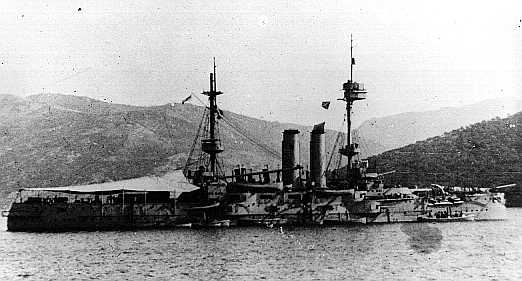
Time for Part 2 ... of 3 of the story of Admiral Graf Maximilian von Spee' glorious and beautiful, but doomed fleet. It is time for a classic story of revenge at sea: The Battle of the Falkland Islands, 8 December 1914. I like to pay a lot of attention to HMS Canopus. If you review Part 1, you will see how you could dismiss this old ship full of Reservists; but it that what a leader does? No, a leader finds a way to make every bit of kit count.
On November 11 1914 the battlecruisers Invincible and Inflexible under Admiral Sturdee left for the Falkland Islands. HMS Princess Royal was dispatched to the Caribbean to guard the Panama Canal. The shock of the defeat at Coronel had made the Royal Navy take decisive action to destroy Spee and the battlecruisers were the chosen means for retribution.

After his victory Spee coaled and then loitered in the Pacific whilst he decided what to do next, little did he realise that this indecision would prove fatal. Eventually he decided to enter the Atlantic and try to make it home. The squadron had passed Cape Horn by December 1 and on the following day they captured the Drummuir carrying coal. They then rested for three days at Pictou Island. Spee wanted to raid the Falkland Islands but his captains were opposed to the idea, however in the end Spee decided to go ahead anyway, another decision he was to regret.
HMS Canopus was now beached at Port Stanley, the capital of the Falklands, as guard ship. On December 7 Sturdee arrived, bringing the British warships at Port Stanley to the pre-dreadnought Canopus, the battlecruisers Invincible and Inflexible, the armoured cruisers Kent, Carnarvon and Cornwall, the light cruisers Bristol and Glasgow and the armed merchant cruiser Macedonia.

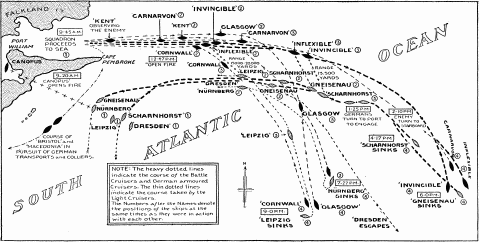
On the morning of December 8 1914 Gneisenau and Nürnberg were detached from the main squadron, which followed about fifteen miles behind, to attack the wireless station and port facilities at Port Stanley. At 0830 they sighted the wireless mast and smoke from Macedonia returning from patrol.

They didn't know that at 0750 they had been sighted by a hill top spotter which signalled Canopus which then signalled Invincible, flagship, via Glasgow. The British ships were still coaling and most ships, including the battlecruisers, would take a couple of hours to get up steam. If the Germans attacked the British ships would be stationary targets and any ship which tried to leave harbour would face the concentrated fire of the full German squadron, if they were sunk whilst leaving harbour the rest of the squadron would be trapped in port. Sturdee kept calm, ordered steam to be raised and then went and had breakfast!

0900 the Germans made out the tripod masts of capital ships. They were unsure of what theses ships were but they knew Canopus was in the area and they hoped that these were pre-dreadnoughts, which they could easily outrun.

Canopus was beached out of site of the German ships, behind hills but had set up a system for targeting using land based spotters. At 13,000 yards her forward turret fired but was well short, the massive shell splashes astonished the German ships who could see no enemy warships. The rear turret then fired using practice rounds which were already loaded for an expected practice shoot later. The blank shells ricocheted off the sea, one of them hitting the rearmost funnel of Gneisenau. The two German ships turned away. Canopus didn't fire again but she saved the British from a perilous situation.
Also a lesson on not pressing the attack and getting spooked. Probably remembering what happened when the British pushed the attack against his Squadron and were sunk for it - Admiral Graf Spee was too cautious by half, perhaps with a bit of "get-home-itis," a disease that will get you killed.
By 0945 Bristol had left harbour, followed 15 minutes later by Invincible, Inflexible, Kent, Carnarvon and Cornwall, Bristol and Macedonia stayed behind. The German squadron had a 15-20 mile lead but with over eight hours of daylight left and fine weather the battlecruisers would be in action in a couple of hours.

The German lookouts could now tell that the tripod masts belonged to battlecruisers which at c25 knots were considerably faster than the 20 knots the in need of refit German ships could manage. Spee set course to the South East in the hope of finding bad weather.

At first the British squadron stayed together but the battlecruisers were being slowed down by the other ships and so pulled ahead on their own.

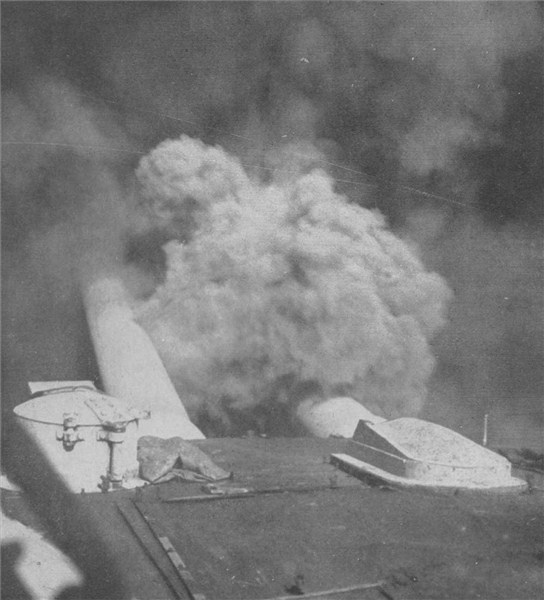
At 1247 at 16,500 yards the battlecruisers opened fire, with little accuracy, taking half an hour to straddle the rear ship, Leipzig. Spee realised he was caught and turned his armoured cruisers to slow the British whilst ordering his light cruisers to try and escape. Sturdee had made contingency plans for this and Invincible, Inflexible and the trailing Carnarvon engaged the armoured cruisers whilst the rest of the force set off after the light cruisers.

The battlecruisers turned onto a parallel course to Scharnhorst and Gneisenau at 14,000 yards. The Germans had the advantage of being in the lee position of the wind, the British gunnery was badly affected by their own smoke. The German shooting was excellent but at this long range their shells did little damage to the battlecruisers. The British also scored a few hits which did more damage but they were unaware of this as the visibility prevented them from seeing these.

In an attempt to gain the lee (smoke free) position Sturdee made a sharp turn to starboard towards Spee's stern. Whilst performing this turn the British were shrouded in their own smoke and Spee took this opportunity to turn south, pulling out of firing range. It took the British another 45 minute stern chase before they could resume firing.

At 1450 the battlecruisers turned to port to bring their broadsides to bear. Spee decided that his only chance was to close the range and use his superior secondary armament but his change of course made the smoke much less of a problem for the British. Their firing became much more accurate and both German ships, but especially Scharnhorst suffered severe damage and casualties. By had received over fifty hits, three funnels were down, she was on fire and listing. The range kept falling and at 1604 Scharnhorst listed suddenly to port and by 1617 she had disappeared. As Gneisenau was still firing no rescue attempts were possible and her entire crew including Spee were lost. Invincible had received 22 hits, over half 8.2 inch, but these caused no serious damage and only one crew member was injured.

Gneisenau kept on alone, zigzagging to the south west. At 1715 she scored her last hit on Invincible before her ammunition ran out. The British stopped firing soon afterwards and the burning German ship ground to a halt, her crew opening the sea-cocks and abandoning ship, 190 crew from a total of 765 were rescued but many of these died from their wounds. Inflexible was only hit 3 times and had 1 killed and 3 injured.
The brutal facts of war at sea. There is little room for caution or pause.
Whilst the big ships were fighting the smaller cruisers were having their own battles. The German light cruisers were in the order Dresden leading followed by Nürnberg and Leipzig whilst the British were led by Glasgow with Cornwall and Kent trying to keep up with her.

At 1445 Glasgow opened fire on Leipzig, Leipzig turning to port to reply, scoring two early ships whilst Glasgow's fell short. Glasgow had to turn away, allowing Leipzig to resume her earlier course. The other German ships had not turned to help Leipzig but had carried on their escape attempt.

Glasgow fired on Leipzig again, but this time the other German cruisers changed course, Dresden to the South West and Nürnberg to the South East. Glasgow's ploy of forcing Leipzig to turn and fire succeeded in slowing her so that at 1617 Cornwall had her in range, Kent setting off after Nürnberg.

Leipzig's firing was good but she didn't hit Glasgow and her shells didn't do much damage to Cornwall. By 1900 Leipzig's mainmast and two funnels were down and she was on fire. When her ammunition was exhausted she made an unsuccessful torpedo attack on Cornwall and then her crew prepared to abandon ship.

Glasgow closed the range to finish her off as her flag was still flying, stopping when two green flares were fired by the crippled German cruiser. At 2120 she rolled over and sank leaving eighteen survivors.

Cornwall had received eighteen hits but no casualties. Glasgow had received no damage after the two early hits which killed one and four wounded. Her boilers were damaged which reduced her speed enough for there to be no chance of catching Dresden which escaped.

Nürnberg had a 10 mile led on Kent and was, on paper, faster, but Nürnberg needed an engine overhaul and Kent's crew worked so hard that the old cruiser exceeded her designed horsepower, reaching 25 knots, being forced to burn all available wood on board and causing the whole ship to vibrate violently.

By 1700 the range was down to 12,000 yards and Nürnberg opened fire with the by now expected superb accuracy. When Kent returned fire ten minutes later her shells fell short. Once the range had fallen to 7,000 yards both sides started to score regular hits and Nürnberg gave up her escape attempt and turned to bring her broadside to action.

By 1730 the range was down to 3,000 yards and Kent's heavier shells and thicker armour gave her the upper hand. An hour later, just as bad weather arrived which may have saved her, two of Nürnberg's boilers exploded, reducing her speed. Kent was now able to easily outmanoeuvre her opponent and within half an hour Nürnberg was dead in the water, at 1926 she rolled over to starboard and sank with only twelve survivors.
Kent had received thirty eight hits but only sixteen casualties.

Whilst these battles had gone on Bristol and Macedonia had sunk Spee's colliers Baden and Santa Isabel, the other collier, Seydlitz escaped, eventually being interned in Argentina.
Even in victory, you will be second guessed by those who don't know; they just don't know but their petty concerns.
Sturdee searched for the Dresden before returning to the UK with the battlecruisers. There was some criticism (mainly from the 1st Sea Lord Fisher) of him for letting Dresden escape and for the heavy ammunition expenditure of his battlecruisers (Invincible 513 12 inch rounds, Inflexible 661 12 inch rounds fired) but generally his clear victory was welcomed. He had destroyed Spee's squadron without any serious damage to any of his ships and their shooting (c.6.5%) was considerably better than was managed by British (and German) battlecruisers at Dogger Bank and Jutland.
Ah, the SMS Dresden. That will be Part 3, with a twist. See you there in March.

Thursday, December 05, 2019

A Review of FRAGO 01/2019: A Design for Maintaining Maritime Superiority

If you want to know what the new CNO is thinking about our Navy, its place today and the direction he wants to lead it, the best thing you can do is read his guidance to the fleet.

In a returning guest post here, Bryan McGrath provides his perspective on the CNO's guidance. Bryan, over to you.


Having assumed the job of Chief of Naval Operations approximately 100 days ago, ADM Mike Gilday has released authoritative guidance informing Navy leadership (and the rest of us) of his priorities. Despite its unwieldy name, FRAGO 01/2019: A Design for Maintaining Maritime Superiority is a clear, concise, and important indicator of how Gilday intends to lead the Navy, and its clarity and purpose should help re-establish confidence in the Navy after a series of newsworthy leadership transgressions in the past few months.

Gilday has retained his predecessor’s approach by issuing a “fragmentary order” to the December 2018 “Design for Maintaining Maritime Superiority 2.0”, likely a gesture designed to reinforce stability and continuity, but one which unfortunately results not only in the aforementioned unwieldy title, but also diminishes its stand-alone qualities. This really is a different document than its predecessor, and it deserves to be recognized as such. Adopting one of the briefing tools of the Naval Aviation community, let’s get to a brief “goods and others” analysis of this document.

Goods

Right out of the chute, this document continues to tie the direction of the Navy firmly to great power contention, primarily on the “high end” of the conflict continuum. Great powers are building and operating fleets that should focus our attention as much as the Navy’s contributions to Joint warfighting and power projection currently do. Gilday recognizes this (as did his predecessor).

Next, it is clear that the CNO and the Commandant of the Marine Corps are closely aligned when it comes to greater integration of their Services. General Berger’s July 2019 “Commandant’s Planning Guidance” broke new ground in naval thinking at the Service Chief level, and Gilday follows up by embracing a concept of “Integrated American Naval Power” that signals his assent to the partnership.

Moreover, Gilday promotes a welcome sense of urgency in his messaging, not the urgency of bureaucrats tracking metrics showing 3% increases in efficiency, but the urgency of a leader who recognizes the security environment demands it of us. One area drawing serious CNO-level attention is ship depot level maintenance, and his dissatisfaction with the poor record of ships completing their maintenance periods on time. The post-Cold War era drove us to an approach to depot level maintenance that stressed efficiency, an approach that seems to have succeeded in defining the minimum industrial base and workforce required to support the fleet, a minimum that is not being met. We must begin to think again in terms of great power competition, a thought process that values effectiveness over efficiency, margin over “just in time”, and redundancy over sufficiency. We are not going to “lean” our way through this.

Gilday recognizes in this document the limitations of the Optimized Fleet Response Plan’s (OFRP) “supply-driven” approach to force generation, which was another triumph of the culture of efficiency over effectiveness. It is clear that the Navy is back in the demand-driven force generation business, with Gilday calling for an assessment of the OFRP in measured tones that seem to spell considerable change on the horizon, the kind of change that is implicit in the direction for Dynamic Force Employment contained in the National Defense Strategy.

Gilday’s sense of urgency extends to the subject of fleet operations, concepts of operations, and large scale naval exercises. We will get a taste of this next year in “Large Scale Exercise (LSE) 2020”, but the CNO seems (rightly) to be calling for extensive exercises of this nature on a recurring basis. Implicit in this fleet-centric approach is the CNO’s dedication to networking and command/control to enable it. His emphasis in this document on digitization and integration of space, cyber, and electronic warfare reveals his understanding that USN/USMC integration will not occur until the Navy can successfully integrate its own forces across the warfighting domains.

Recognizing that shore infrastructure has become a bill-payer for current operations, the FRAGO raises the visibility on crumbling shore-side infrastructure that is an essential part of the greater fleet architecture and signals the CNO’s interest in properly resourcing it.

Others

Well, first, there’s the name. But I repeat myself.

Next (and really, only), there is the elephant in the room, and that is the simple truth that the concepts driving naval integration (Distributed Maritime Operations (DMO), Expeditionary Advanced Base Operations (EABO), and Littoral Operations in a Contested Environment (LOCE) ) are (1) not derived of an Operational Architecture for Fleet Operations, (2) not supported by a coherent systems architecture that allocates functionalities across an ensemble of systems, networks and platforms, and (3) not supported by a set of validated operational requirements. There is no organization in the Department of the Navy with the authority, staffing, and resources to perform any one of these three functions, yet all three must align in order for CNO’s vision of Integrated American Naval Power to become a reality. And if we were to imagine that such organizations existed to carry out the functions above, we would still be without an acquisition organization capable of carrying it all out.

What I’m suggesting is that we are trying to build a 21st Century Navy with a 20th Century bureaucracy, and I’m sorry to say the bureaucracy should be different and larger than it is now. Great power competition merits it. First, OPNAV N9 should subsume all functions currently within the OPNAV N6 portion of N2/N6, as the DCNO for Warfare Systems (N9) surely should sit atop the requirements development process for Fleet Warfighting, and in the process, determine where trades among capabilities should be made at the domain and cross-domain level. The continued distinction among things that are “combat systems” and things that are “intelligence, surveillance, and targeting” systems is no longer relevant in warfighting, system design, or acquisition. Reflecting this merge, the acquisition community must also reform.

Accordingly, the Navy should establish a four-star systems engineering organization akin to what the Missile Defense Agency does within that more narrow set of operational requirements (although the requirements would be derived at OPNAV and USMC). This new command would work hand in hand with both OPNAV N9 and the Marine Corps Combat Development Command (MCCDC) to create and monitor fleet level systems architectures, with authority over all Navy and Marine Corps SYSCOMS and PEOs. The Admiral or General in charge would serve an extended term of office (akin to that of the four-star at the Bureau of Naval Reactors) and would have the authority and resources to move money across the architecture to speed up promising developments, shore up lagging areas, or capitalize unexpected technology maturation.

Because authority, funding, and acquisition responsibility for achieving the vision of a Fleet Tactical Grid or a Naval Operational Architecture is divided among numerous resource sponsors and technical authorities, authority and responsibility are diluted and progress is made in spite of the bureaucracy rather than as a result of it. One sentence on page 7 distills this whole issue for me: “This will include fielding high-return technologies such as directed energy (OPNAV N9) and electronic warfare (OPNAV N2N6).” Why two different organizations are responsible for fielding these two fundamental aspects of modern warfare escapes me.

Conclusion

Other than the one, pretty substantial other, I don’t have much to say bad about this document. I like it better than any of the more recent efforts of this kind by CNOs, and I am very comfortable with the course it sets for the Navy. My criticism of it is of course, unfair, as CNO Gilday did not set out in this document to propose a bureaucratic reorganization of the Navy. I do wish that he had dropped a hook in it for such change, like he did in announcing an assessment of OFRP.

That said, we now have both Service Chiefs in the Department of the Navy aligned on a new, more integrated, and more muscular American Seapower. Both seem to realize that this means changes up and down the chain of command and across their respective service enterprises. The next step is for the two of them and their soon-to-be common superior (the Secretary of the Navy, when confirmed) to get religion and start educating OSD, the Hill, and the American public about what Integrated American Naval Power is and why it is the critical to protecting and sustaining our national interests and continuing prosperity. More, faster, please.


Bryan McGrath is the Managing Director of The FerryBridge Group, and he counts the Navy among his consulting clients. The opinions contained herein are his own.

Wednesday, December 04, 2019

Hughes, Howard and the Passing of Great Men

As most of you know, the military community lost two giants in the last week. No tragedy, they both had great and impactful lives.

I'm throwing some praise and a few questions over at USNIBlog. 

Come on by and give a read.

Tuesday, December 03, 2019

SECNAV: Turnaround Specialist Wanted

Besides getting tripped up at the end, I think on average of the last couple of decades, Spencer did a fine job … but … either stayed too long or was missing a skill set to roll with the zeitgeist.

I maintain that the Navy could do well to have a SECNAV with a political background. It is a very political job, and that is a skill set that is hard to pick up on the fly. Who would I nominate? Not my job – and in any event – I would prefer all the navalists on The Hill stay in their jobs for now. We will need all that expertise in place for as long as we need to get through what the 2020s will feed us.

Perhaps there are some solid folks who were term-limited out from state level positions that might work. Whoever it is – there are a lot of issues that need attention and focus.

Our friend David Larter has a great summary of just a few:
...the firing of the secretary of the Navy means another leadership implosion in an organization that has seen a near-constant stream of them.

In the past four years, scandals, disasters and shoddy performance have cut short the careers of a confirmed chief of naval operations, the Pacific Fleet commander, the head of surface forces, the former head of 5th Fleet, the former head of 7th Fleet, two high-profile task force commanders and a destroyer squadron commander.
…
And that’s on top of the nearly dozen admirals and captains who were reprimanded in the wake of 2013’s revelations about Leonard “Fat Leonard” Francis,
…
The parade of scandals and mishaps, including two collisions with commercial tankers that claimed the lives of 17 sailors, raise deep cultural questions about the service on all fronts.
…
Spencer in August ordered a complete review of the judge advocate general community, and top Navy SEAL Rear Adm. Collin Green has overseen a crackdown on SEAL behavior through a return-to-discipline approach. But some observers say the Navy needs focus more on fixing its culture.
Head on over and read it all. The Two Bryans, Bryan Clark and Bryan McGrath, are seeing the elephant from different sides.

Here is one thing I do know; we need a good SECNAV and we need one now.

No one full of foolish, pie in the sky theories they want to practice. No one who thinks they are smarter than the last few dozen SECNAV’s.

We need one who knows how to identify top problems, and will address them. Will know what are non-value-added accretions from previous administrations that are holding on – and scrapes them off. Will know what a bloated, self-serving bureaucracy looks like, and cuts it. Knows who gets it, and who doesn’t – and fires them.

Someone who has a thick skin, secure ego; is not interested in the post-SECNAV payoff; has a dog and has no need for new friends; … and rents, not buys, in DC.

Monday, December 02, 2019

First ASW Flap of FY20?

No, you can't buy training like this. Of course, this is all speculative. It could just be an amazing coincidence of events that is really just normal training exercises and pilots soaking up extra flight hours.

Or ... it could be ... something else.

Simply some amazing stuff since the end of October for those who follow @MIL_Radar on twitter.

Like what we've seen off Syria and other places, modern technology makes what was once known only to participants, something anyone can see just a percentage of. That is what we have here, so let's run with.

I couldn't take it anymore and decided I needed to put it all together for the Old Cold Warriors on the Front Porch. 

I could have just put you on to the twitter thread linked above, but I had trouble sleeping last night and thought I'd make a quick vid instead.

Now, MTH, you may want to be sitting ... because somewhere someone is just used up most of their FY20 allotment.

Now, off to Bear Island.

Enjoy!