Monday, May 19, 2008

Sorry, Condi


Silvio Berlusconi spent his first day as Italy's new Prime Minister on Tuesday promising to deal swiftly with the country's many pressing problems, from the sale of its troubled national airline Alitalia to the masses of uncollected rubbish swamping Naples. And how does he plan to deal with it all? By appointing a cabinet that will include - if Silvio sticks to his election campaign pledge - a record number of women.

Berlusconi promised to give at least four of his 12 cabinet posts to women. One is expected to be Mara Carfagna (above right), a former Miss Italy contestant, who is in the running for Minister for the Family, while Stefania Prestigiacomo (above left), a member of his Forza Italia party, looks likely to be given the European Affairs portfolio.
Well, the Italians, well, have good taste. Smart, aggressive, and beautiful. Perfection.

If you find Mara Carfanga interesting, you can learn more, ahem, about her here.

Keeping an Eye on the Long Game: Part XXVII

Let's see; we closed and/or converted Charleston, Staten Island, Long Beach, Alameda, and a few others over the last 20 years.

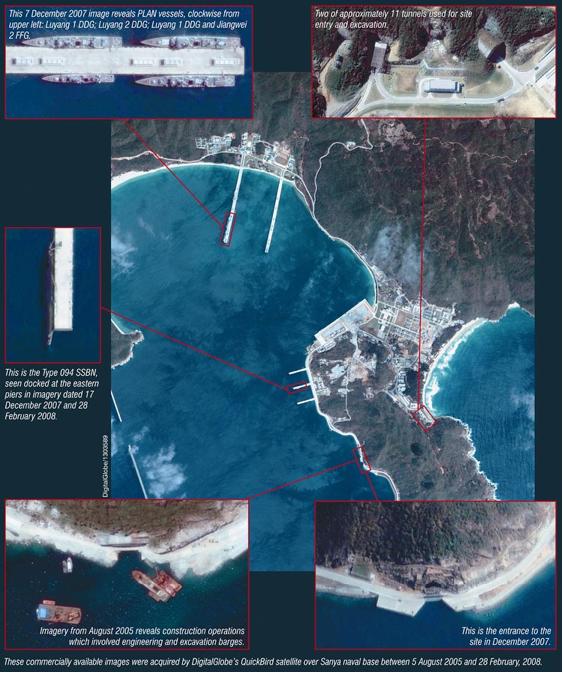
China, however is not. Get ye to GoogleEarth and check it out. This is a varsity football type Navy base - in a tropical paradise as well. Liberty Skippy would love.
China is building a major underground nuclear submarine base on the southern tip of Hainan Island, defence group Jane's said Friday.

Jane's Intelligence Review, a respected defence periodical, said satellite images of the base from imagery provider DigitalGlobe were the first confirmation of its existence.

Although Beijing is displaying no overt aggression, the base could mean an increase in its strategic capability in the South China Sea and considerably further afield, Jane's analysis said.

"Jane's can confirm that the satellite pictures show that China is constructing a major underground nuclear submarine base near Sanya, on Hainan Island off its southern coast," the group said.

', which reported the satellite images, called the base a "vast, James Bond-style edifice capable of concealing up to 20 nuclear-powered submarines, which will enable China to project its power across the region."


Ponder.

Sunday, May 18, 2008

Sunday Funnies

Who ever said having the lead in Flightdeck Follies or being Mr. Vice at a Dining In/Out never prepares you for anything in life?


Could be an add....


Friday, May 16, 2008

What a Dame!


I was in a major funk today - but I think ninme managed to pull me out of it. Joan Collins reminds me of my Mom; and how true her statements are.
My first glimpse of Las Vegas airport was in the early 1960s, when I’d gone to see Sammy Davis at the Sands hotel. The airport was so tiny and primitive that the Las Vegas sign was made with twigs, and there were only two runways and one terminal. The ’strip’ was just a two-lane highway, which had a few two or three-storey hotels - El Rancho, the Sands, the Flamingo and a few others. But the star contingent of performers was fantastically represented, and every name in showbiz competed for their neon place in the sun. No woman would be caught dead after 6pm unless they wore a silk, satin or chiffon cocktail dress over which was slung a mink stole. The men were equally groomed, all tanned, brilliantined and snappily dressed. James Bond was right at home in this environment.

I could hardly believe the transformation recently when I went to visit my friend Judy Bryer. The glamour of Ian Fleming’s Vegas is far, far away from the reality of today, and I can’t picture James Bond trying to pursue the nefarious Blofeld while stuck in a traffic jam on the strip or trying to chase him on foot among the morbidly obese tourists jostling for space on the sidewalk, battling massive swathes of fat wrapped in Lycra.
American in my Mom's prime. Lost world. Lost world.

As for Joan Collins in the 50s and 60s - heck, she looks a lot like my Mom did (that's where I got my good looks).


Teh carrier plan

Medical marijuana legal in DC? Just wondering ....
House officials want to explore the possibility of bringing the USS John F. Kennedy or USS Kitty Hawk back into service in five years to keep the Navy’s carrier fleet at full force.

During debate on their draft of next year’s defense budget authorization, the House Armed Services Committee approved an amendment to study the cost and logistics of reactivating the carriers after their decommissioning over the next few years.

At issue is the Navy’s request to drop below the congressionally mandated 11-carrier fleet in 2012, when the USS Enterprise is taken out of service.
You fix the boilers; I'm going fishing.

Hat tip Mike.

Fullbore Friday


40 years is a long time. BZ.
Not many men in the military are eager to join a brand-new unit, where they don't know people, don't know what they'll be doing and don't have a proud unit lineage.

But the Navy assured the men it would be good for their careers.

So some men volunteered and a lot more were drafted to join Observation Squadron 67, so named because that was the year it was born.

After a while the men took to calling themselves "the Ghost Squadron" because they felt forgotten, participants in a secret war that neither the U.S. nor the North Vietnamese wanted to acknowledge was being waged next door to Vietnam.

Silenced for decades by their classified missions over Laos, the men finally in recent years began to speak publicly of their war, a decision that would ultimately lead to a rare historic correction by the Navy.

Forty years after the squadron's actions, VO-67 has been awarded the Presidential Unit Citation, the highest decoration for combat valor a unit can receive. Some of the surviving 300 members of that squadron will be on hand Wednesday in Washington, D.C., for the ceremony in front of the U.S. Navy Memorial.

"It's special after all these years," said John Forsgren, a young sailor who served in the squadron and lives in Arlington. "But it's also bittersweet. How do you get proud of something that you did 40 years ago? There's a bit of a feeling of 'Why didn't they recognize the unit 30 years ago?'"

The Presidential Unit Citation is reserved only for the most valorous combat units, and it's worth noting that far fewer of them were awarded for the Vietnam War than Medals of Honor. A unit receiving the citation is the equivalent of every man receiving a Navy Cross.

Ensign Laura Stegherr said Navy Secretary Donald Winter received "relevant, new and verified" information about the squadron's actions in Laos that warranted the decoration.

Secret mission

VO-67 wasn't really an observation squadron, though they pretended they were. Their unit patch reflected the ruse, showing an airplane sending signals to the ground. In reality, it was the opposite -- the squadron was listening to what was happening on the ground, not interfering.

"It was so secret that not many top people in the Navy knew the squadron existed or what we did," said Ed Landwehr of Fort Worth, a navigator and bombadier on Crew 4.

The idea came from Defense Secretary Robert McNamara, who was unhappy with the results of the bombing campaign in North Vietnam and wanted some other way to interdict supplies into South Vietnam. His answer was "Igloo White," the code name for his plan to create an "electronic barrier" at the Demilitarized Zone.

The Ho Chi Minh Trail was largely under triple canopy jungle, hard to detect and busiest at night. Using dropped microphones and seismographic sensors would be a way for the military to gain intelligence on what was moving down the trail, when and how much. Then they could call in airstrikes.

"We didn't find out what we would be doing until right before we deployed," said Herb Ganner of Hurst, a navigator and bombadier on Crew 1.

What the pilots and crews had to do sounds simple enough -- take off from an airfield in Thailand, fly a short distance into Laos and drop the camouflaged sensors along the trail.

The men flew only in the day, usually every other day, and could expect to be airborne no longer than a couple of hours.

But the Ho Chi Minh Trail, the lifeblood of the war for the North Vietnamese and Viet Cong, was a very hostile place for air crews, particularly slow-moving, virtually defenseless ones flying at only 500 to 1,000 feet.

"The missions were short-lived, but they were adrenaline-pumped," Ganner said.

The Navy prepared for a loss rate of upward of 60 percent to 70 percent, which the men found out about while they were in Thailand.

"They tried to reassure us that the loss rate was not necessarily those killed," Ganner said, "but that it meant the airplanes would be so damaged that they would be out of commission."

It never got that bad. But within a span of six weeks in 1968, it felt like it was. Twenty men from three crews died in January and February 1968, the time of the huge Tet Offensive.

Painful memories

After all these years, the survivors of VO-67 still wince at the memories of Jan. 11, when the first crew did not come home.

Tony Bissell of Bedford was a petty officer on another plane that day, and he can still remember the awful silence on the radio as Crew 2 did not answer any communication. Later that night, the officers' club was packed wall to wall with men getting stupid drunk. Nine men dead in a second.

"We didn't have to buy a single drink that night," Bissell said. "The Air Force guys were very sympathetic."

Interservice rivalry seemed to take a back seat to the men's shared missions and misery. To this day, the men of VO-67 credit the Air Force forward air controllers in Thailand for saving their hides many times because of their knowledge of the trail.

Each crew had its own identity, and rarely did they ever share with each other their specific missions. The less the men knew, the better.

"We knew how susceptible we were to getting shot down," Ganner said. "I used to carry a Geneva Convention card and my ID tags. I never took my wedding ring, my wallet, anything personal."

At least once the "Ghost Squadron" came out of hiding to participate in the acknowledged war.

In January 1968, the Marines at Khe Sanh were under siege by thousands of North Vietnamese. VO-67 was ordered on low-flying missions to drop sensors around the Marine base, so more accurate fire could be leveled.

Their citation says they "contributed to saving countless lives."

As for their careers in the Navy, the men said VO-67 failed to help them at all. In fact, most of them believed it hurt their promotion chances because no one in the Navy had heard of it.

Still, the belated recognition matters to many of them, for both reasons large and small.

"I've talked about it recently with my wife of 19 years, and she will say, 'I don't believe you,'" Forsgren said, laughing. "This is vindication."

ABOUT THE GHOST SQUADRON

The men flew the Lockheed P-2 Neptune, a 1950s-era anti-submarine patrol airplane. The squadron's planes were heavily modified for the mission, including the addition of M-60 machine guns, an armored belly and a jungle-green paint scheme.

The squadron was based at Nakhon Phanom Royal Thai Air Force Base, just across the Mekong River from Laos. Their primary mission was over the Ho Chi Minh Trail in Laos, but they also performed missions in South Vietnam.

Twenty men of VO-67 died in Southeast Asia in three incidents. One is still missing in action, Cmdr. Paul Milius, who earned a Navy Cross for allowing seven crewmen to bail out of their badly damaged aircraft before going down. The Navy named a destroyer for him in the 1990s.

The squadron flew combat missions for nine months and sustained a 25 percent loss rate. It was disestablished in July 1968, and the Air Force took over the mission until 1972.

Among the North Texas men who served in the unit: Tony Bissell of Bedford, John Forsgren of Arlington, Herb Ganner of Hurst, Ed Landwehr of Fort Worth, Fredrick Rerko of Dallas and Lowell Shaw of Plano.


Thursday, May 15, 2008

There goes your shipbuilding budget, again


I don't think the SECDEF could be more direct.
“I have noticed too much of a tendency towards what might be called next-war-itis — the propensity of much of the defense establishment to be in favor of what might be needed in a future conflict,” Mr. Gates told a conference here sponsored by the Heritage Foundation.

“Over all,” he added, “the kinds of capabilities we will most likely need in the years ahead will often resemble the kinds of capabilities we need today.”
ADM Stavridis, call your office.

As we continue to want to push the Tiffany Navy against this headwind with exaggerated expectations of money falling out of Congress, we should keep in mind the last sentence.
But he warned any adversary against thinking that the United States had dropped its guard, saying that while the Army and the Marines carried the brunt of the nation’s current combat effort, the Air Force and the Navy would be “America’s main strategic deterrent” against potential adversaries like Iran, North Korea and China. He called for careful spending to modernize and expand both of these services.
The next SECDEF will think the same.