Showing posts with label Spain. Show all posts

Monday, November 17, 2014

Seamanship 202: Shouldering as taught by Armada Española

Yes, I have watched it about four times - and I smile more and more.

Greenpeace - I cannot stand those publicity hound poseurs. I actually applied for a summer job with them in the mid-80s - snort. I guess they didn't like that I was in NROTC ...

Anyway, I lost all respect for them in the early 1990s when I was on the receiving end of one of their little photo-ops. Great to see the Spaniards giving them what for. Greenpeace's arrogance expecting everyone to play with their games is just pathetic ... but funny to watch.


Note to Greenpeace - a RHIB is a weapon. When you approach a ship at 20+ knots, you are armed. The Spanish showed more restraint than you deserve.

Oh, and if you are going to play varsity, you may want to get the right gear.
Although we can’t confirm this at this time, the injuries sustained by the Greenpeace activist, an Italian national, occurred after she was knocked out of the boat and was hit by a propeller.

The Spanish Navy acknowledges the incident and was quick to point out that all the propellers on their RHIBs are shrouded, while the Greenpeace activists’ boats did not have shrouds.
Hope you heal up soon and then accept responsibility for your injuries.


Hat tip gCaptain

Tuesday, August 13, 2013

Politics of the insane

Watching this over the last few days, this is just getting silly. If one of the countries involved wasn't mired in what seems like an unrecoverable economic meltdown, perhaps I would let it pass - but bad economics makes nations and people do stupid things.

This is officially stupid. Starting on August 5th;
In a dramatic escalation of the clash over the British territory, Spain has warned that it is ready to impose a new border tax and investigate the affairs of Gibraltans with Spanish economic interests.

Fabian Picardo, Gibraltar’s chief minister, said that Jose Garcia-Margallo, Spanish foreign minister, was acting like General Franco, the former dictator.

Mr Picardo said "hell will freeze over" before the authorities in Gibraltar remove an artificial reef which Madrid claims is harming Spanish fishermen, adding that any border costs would violate European Union freedom of movement rules.
...
Spain claims sovereignty over the strategic outpost, which stands on the southernmost tip of the Iberian peninsula but has been a British Overseas Territory since the Treaty of Utrecht in 1713.
Yes. Gibraltar has been British for longer than the USA has been a nation. It has been British for 300 years. The Spanish only took it from the Moors in 1502. So ... the British have had it for longer than Spain ever had.

Early Monday - this came in the mix;
London mayor Boris Johnson on Monday issued a "hands off" warning to Spain over Gibraltar after Madrid vowed to take "all necessary measures" to defend its interests in the British outpost.

The gaffe-prone Conservative mayor urged the government to "prise Spanish hands off the throat of our colony" after it increased border checks in retaliation for the building of an artificial reef in disputed waters.

"Hands off our Rock, that's what I say," Johnson wrote in Monday's Daily Telegraph.

"I hope that one way or another we will shortly prise Spanish hands off the throat of our colony, because what is now taking place is infamous," he added.
... and later on in the day;
Britain has threatened Spain with legal action over the "politically motivated" imposition of extra checks on the frontier with Gibraltar.

Diplomatic tensions between the two countries continued to grow after Downing Street disclosed it was considering taking the "unprecedented step" on the grounds that the Spanish action breached European Union law.

Sources in London believe the Madrid government is stoking up the issue as a distraction from its political travails, which include accusations of corruption and the continuing pain of austerity measures.
...
Reports in the Spanish media have suggested the row could escalate to the United Nations, with Madrid floating the idea of Spain and Argentina presenting a "united front" over Gibraltar and the Falkland Islands.

Argentina is currently a non-permanent member of the UN's Security Council and could use its position to add Gibraltar to its agenda. Its president, Cristina Kirchner, has already renewed demands for talks over the sovereignty of the Falklands.

Meanwhile, thousands of Royal Navy personnel set sail yesterday for a long-scheduled training exercise in the Mediterranean. The Ministry of Defence stressed the timing was coincidental, but Boris Johnson, the London Mayor, said the deployment should send a clear signal to the Spanish.

"Maybe it's just a fluke that HMS Illustrious is about to bristle into view on the southern coast of Spain, complete with thousands of Royal Marines and other elite commando units," Mr Johnson said.
Really? It is like watching two old men talking smack.

No one do anything stupid.


Wednesday, May 22, 2013

Concept of the Day: Reserve Bouyancy

With contracting budgets bringing discussion of the industrial base to the front, remember that intellectual capital is the most important part of the industrial base, from welders to engineers. 

When your bench is thin, you are more likely to have this happen.
One of Spain’s largest defense splurges may also be one of its most embarrassing. After spending nearly one-third of a $3 billion budget to build four of the world’s most advanced submarines, the project’s engineers have run into a problem: the submarines are so heavy that they would sink to the bottom of the ocean.

Miscalculations by engineers at Navantia, the construction company contracted to built the S-80 submarine fleet, have produced submarines that are each as much as 100 tonnes (110 US tonnes) too heavy. The excess weight sounds paltry compared to the 2,000-plus tonnes (2,205 US tonnes) that each submarine weighs, but it’s more than enough to send the submarines straight to the ocean’s floor.
.... and then you have to call for help.
It’s a costly mistake on many fronts. The state-of-the-art submarines were meant to be the first entirely Spanish-designed and built. Incompetence is likely going to cost the country at least some of the glory. Electric Boat, a subsidiary of US-based technology firm General Dynamics, has already evaluated the project and could be hired as a consultant to save the job.
Hat tip Chap.

Monday, January 21, 2013

Adios SPS Principe de Asturias, Otra Vez

Because he knows I am such a fan of the SPS Principe de Asturias, Commander Luis Nardiz, Spanish Navy (CO of SPS VICTORIA (F-82) ), sent me a couple of pics from the farewell last week off of Cadiz. So sad to see her go so young. 

Nice work by the Armada Española.


Interesting thing about Skipper Nardiz, his background is as a Harrier pilot. Interesting.

For the maritime wonks among us, it is another opportunity to ponder the relative size and utility of the Sea Control Ship, its replacement, the LHD Juan Carlos (L-61), ... and yes ... wait for it .... you'd be disappointed if I didn't bring it up ... but ...

THREE FRACKING OHP's THAT HAVE NOT BEEN CASTRATED!!!

Yes, I feel better.

Tuesday, November 27, 2012

So long, fair Sea Control Ship

The rumors from this summer have come true, the quasi-sexy SPS Príncipe de Asturias (R-11) will be decommissioned.
El portaaviones 'Príncipe de Asturias' de la Armada será desguazado el próximo año en los astilleros de Ferrol, dado que las restricciones presupuestarias han impedido alargar su vida útil, tras 24 años de servicio en las Fuerzas Armadas, han informado fuentes militares.
For you Anglos out there - in summary the broke Spanish government cannot afford to upgrade and next maintenance cycle of €100 million, and at 24-yrs service is going bye-bye. 

Economic downfall has its consequences, but they will have the less sexy but functional LHD, SPS Juan Carlos I (L61) for use as a flagship instead.

Though not what one would consider a successful design, I always liked the PdA and her sister ship HTMS Chakri Naruebet - and for that matter the entire Sea Control Ship concept. An underexplored capability, but such that it is. Their soul-mates, "L type" ships such as JCI and our own Amphib "Small Deck Carriers" are still out there though, and are still trying to prove MIDN Salamander right.

I'm sorry - but PdA (like the many Soviet ships like the UDALOY) just had sexy lines compared to some of the ugly boxes like JC1, the French Mistral (L9013), Royal Navy's topsy HMS OCEAN (L12), and the slightly better but warty Italian CVH Cavour (550).  There is something to be said for a warship having a certain panache (one thing LCS-2 has going for it, BTW).

Maybe the Indians will want to buy PdA. Perhaps Brazil?

Sigh. Maybe I'm just grumpy that PdA was commissioned in 1988 around the same time as ... wait .... harumph.

Hat tip FrontPorch.

Thursday, January 12, 2012

Pirates fail their RECCE quiz ... again


They are real lucky they didn't try this on a US, Chinese or Russian warship.
At first light on 12 January 2012, having just completed the escort of a World Food Programme ship carrying food-aid into Somalia and while operating close to the Somali port of Mogadishu, the EU NAVFOR Flagship, the ESPS PATINO, was approached by one skiff with a group of suspected pirates onboard.

The suspected pirates opened fire with light calibre weapons and tried to board the PATINO. The ship’s force-protection team returned fire in self-defense and the ship’s helicopter was launched.

The skiff broke off the attack and the men surrendered to the helicopter after throwing their weapons, ladder and fuel barrels overboard.Five of the six men who were in the skiff had received injuries, two of which required medical treatment onboard the SPS PATINO.

Monday, October 03, 2011

The Spanish Canary


You don't have to be a futurist to see the future. Unless we get the right leadership - we are just 5 years from Spain ... and not the good parts.
He depends on government handouts of €530 ($702) a month – less than half the amount he needs just to pay his mortgage – and is convinced that the bank is about to repossess the flat where he lives with his wife and three children.

“I am legalised here, but for more than five years I’ve not been working,” says Mr Ekenobaye. “We are trying to do whatever we can.”
...
“In the past four years we have lost 25 per cent of our income,” says José María Fraile, the town’s mayor. “At the moment there’s no liquidity ... The [credit] window has closed.”

Mr Fraile is negotiating with trade unions to fire 190 people, a quarter of the city’s workforce, as a way to save money. One private company responsible for sports facilities has obtained a court order to sequester municipal assets to cover millions of euros of unpaid debts. Valoriza, another company, is owed €80m for years of garbage collection and cleaning.
It's only starting, and it's coming here.

We know about Detroit - but what about States? The first shoe to drop in the USA is already going; California.
“This year the state will directly spend $32 billion on employee pay and benefits, up 65 percent over the past 10 years,” says Crane later. “Compare that to state spending on higher education [down 5 percent], health and human services [up just 5 percent], and parks and recreation [flat], all crowded out in large part by fast-rising employment costs.” Crane is a lifelong Democrat with no particular hostility to government. But the more he looked into the details, the more shocking he found them to be. In 2010, for instance, the state spent $6 billion on fewer than 30,000 guards and other prison-system employees. A prison guard who started his career at the age of 45 could retire after five years with a pension that very nearly equaled his former salary. The head parole psychiatrist for the California prison system was the state’s highest-paid public employee; in 2010 he’d made $838,706. The same fiscal year that the state spent $6 billion on prisons, it had invested just $4.7 billion in its higher education—that is, 33 campuses with 670,000 students. Over the past 30 years the state’s share of the budget for the University of California has fallen from 30 percent to 11 percent, and it is about to fall a lot more. In 1980 a Cal student paid $776 a year in tuition; in 2011 he pays $13,218. Everywhere you turn, the long-term future of the state is being sacrificed.
... I see it in my own town, the taxpayers have become slaves to the public employee retirees - fat boomers tooling around in their Harleys.
"It’s like the housing bubble and the Internet bubble. There were people around who were writing about it. It’s not that there aren’t people telling us that this is crazy. It’s that you refuse to believe that you are crazy.”

He hands me a chart. It shows that the city’s pension costs when he first became interested in the subject were projected to run $73 million a year. This year they would be $245 million: pension and health-care costs of retired workers now are more than half the budget. In three years’ time pension costs alone would come to $400 million, though “if you were to adjust for real life expectancy it is more like $650 million.” Legally obliged to meet these costs, the city can respond only by cutting elsewhere. As a result, San Jose, once run by 7,450 city workers, was now being run by 5,400 city workers. The city was back to staffing levels of 1988, when it had a quarter of a million fewer residents. The remaining workers had taken a 10 percent pay cut; yet even that was not enough to offset the increase in the city’s pension liability. The city had closed its libraries three days a week. It had cut back servicing its parks. It had refrained from opening a brand-new community center, built before the housing bust, because it couldn’t pay to staff the place. For the first time in history it had laid off police officers and firefighters.

By 2014, Reed had calculated, a city of a million people, the 10th-largest city in the United States, would be serviced by 1,600 public workers. “There is no way to run a city with that level of staffing,” he said. “You start to ask: What is a city? Why do we bother to live together? But that’s just the start.” The problem was going to grow worse until, as he put it, “you get to one.” A single employee to service the entire city, presumably with a focus on paying pensions.
...
I n August 2011, the same week that Standard & Poor’s downgraded the debt of the United States government, a judge approved the bankruptcy plan for Vallejo, California. Vallejo’s creditors ended up with 5 cents on the dollar, public employees with something like 20 and 30 cents on the dollar. The city no longer received any rating at all from Moody’s and Standard & Poor’s.
California did not get there by accident. Their bad idea voters, after they soiled their next - have moved.
“Those who have money and can move do so,” Whitney wrote in her report to her Wall Street clients, “those without money and who cannot move do not, and ultimately rely more on state and local assistance. It becomes effectively a ‘tragedy of the commons.’ ”
Behold the nation the Boomers have left their children. California dreaming to a nightmare in a generation - all because of their greed. Is that fair? All I know is that the nation that inherited literally and figuratively the most from their parents are, literally, leaving their children the least. I guess they figured that instead of parenting their children, they medicated them enough that they won't care.

Friday, August 05, 2011

Fullbore Friday

In honor of the USCG's birthday - an encore FbF.

After over three decades of service, you've made LT and screened for Command! Wow! Tell me about your warship!
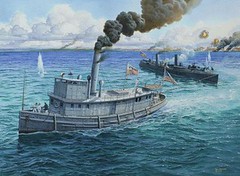
... the ... five-year old unarmed third rate Revenue Cutter Hudson was manned by two officers(one line and one engineer) and nine men and performed routine duties in New York harbor. Her compliment would grow to five officers and sixteen men when taken into Naval service. When ordered to Naval service she steamed first to Norfolk to install new armaments, a 6-pounder fore and aft with a Colt 6mm machine gun on top of the wheel house. Configured as many harbor tugs of the period, she was 128 tons, 96 feet long, 20 feet in the beam, with a 8 foot draft, the 24-inch stroke of her pistons made her slow, her superstructure was high out of the water topped with a large smoke stack.
Oh, come on my dear readers, this is Fullbore Friday. You know better than that.

You go to war with the Fleet you have - and it isn't a ship - it is a tool used by officers and enlisted people. Leadership, training, and the innate martial nature of American mariners when given a mission.

Is anything impossible? No -
just a challenge.
Manned, armed, and armor plate installed across bridge and engine room the Hudson made her way to Key West
...
The Hudson's commander, Massachusetts native First Lieutenant, Frank H. Newcomb, USRCS, was assigned to patrol Cuba's northern coast east of Havana. One of the ports he was to help blockade was Cardenas.
...
On May 11, Newcomb received orders to join the U. S. Navy gunboats Machias and Wilmington and the torpedo boat Winslow.

Machias's, Commander Merry, draft was too deep for the secondary channel and remained outside to give gunfire support. The other three made their way through the mango trees and entered the harbor. Receiving no fire from the Spanish, the three vessels across Cardenas Bay toward the three moored Spanish gunboats.

The Winslow commanded by the brash LT. John B. Bernadou, USN, charged ahead of the others(at a speed of about 24 knots) to cutout a gunboat for a prize and, probably to his surprise, immediately drew heavy fire from hidden Spanish shore batteries and the gunboats that mounted tweleve-pounder guns. The Spanish-American War was the last in which U. S. Naval Officers could receive prize money for captured vessels. Bernadou was the prototype of the brashness needed for the PT boat skippers of World War II and the figher pilots of today. The Winslow returned fire with her three one-pounders on the Spanish gunboats. The Hudson saw the predicament and hurried at best speed (12 knots maximum -- on a good day) to assist the Winslow with her heavier six-pounder guns. The Wilmington , stopped by shoal waters, laid off the mile and one half and gave support with her 4-inch guns. Both the forward vessels sank two of the Spanish gunboats, the Antonio Lopez and Lealtad, at their moorings and then turned their attention to the shore batteries.

Although the Spanish had placed ranging buoys in the bay and both vessels were among the red buoys, the Spanish artillery was not accurate in its fire in part because of the black stack smoke and the fog of cannon smoke. Their shells exploded in the air spraying shrapnel or fell into the water alongside the vessels. The engagement was about twenty minutes old when the Winslow took her first hits. One round hit the bow, entered the captain's cabin and exploded in the paint locker causing a fire. Another round struck the conning tower wounding Bernadou in the leg. Two hits destroyed her steering gear and damaged a boiler, another hit puts the emergency(hand gear) steering out of commission as well as hitting an engine. The Winslow, without power and steering, became a target for the Spanish gunners. Nature too, began to conspire against Winslow and a rising eastward wind began pushing her toward the Spanish batteries but using the remaining undamaged engine Bernadou was able to back away from the shore and ranging buoys.

Lt. Newcomb saw the Winslow's plight and with Spanish shells exploding all around the cutter went to the Winslow's assistance. The Hudson took a position 150 yards inshore of the Winslow to draw Spanish fire and protect the disabled torpedo boat. Newcomb attempted to suppress the Spanish fire, but the Spanish used smokeless powder that did not reveal their positions. However, once the cutter got the range was able to place several rounds near the Spanish batteries.

Newcomb received a report that the Winslow was badly damaged and offered Brenadou assistance but he "declined by a negative shake of his head." However, Brenadou realizing the dangerous position he was in relented to a tow from Hudson. The Winslow, with its seven-foot draft, had shoaled causing the Hudson to literally plow through the bottom silt to reach the Winslow. Brenadou later wrote his account of the action in which he said he directed Hudson to take him in tow. Newcomb had to abandon his inshore position to reach the stricken vessel and when within 100 feet a Spanish shell exploded on board Winslow killing North Carolinian Ensign Bagby( who has the dubious distinction of being the only U. S. Naval officer killed in action during the war) and two others. Two others were mortally wounded.

During Hudson's attempts to attach a tow, the Wilmington fired her guns over both of the other vessels. A number of her shells exploded prematurely showering fragments on Hudson and Winslow. The Winslow passed its heavy tow line, but as Hudson took up the strain to swing the torpedo boat around the line parted. Although some believe the line was shot away, Newcomb reported it was caused by the excessive yawing of the torpedo boat because of the damaged steering gear. Newcomb then tried taking Winslow along side but the bay had become rough and he feared the Winslow would sink because to the water thrown up between the two. The Spanish fire had ceased but the threat was still there as and another line was hastily rigged and the Winslow towed to safety. Somewhat bitterly, Newcomb noted "after a long and laborious chase dead to windward, we finally overtook the Wilmington." Although the Wilmington had a doctor on board, it had not come about to assist with the wounded despite wig-wag signals from both vessels.

The engagement began about 1 PM and lasted until 4 PM when Hudson towed the Winslow out of the bay. The Hudson fired some 135 rounds and although in the midst of the battle she escaped with only minor structural damage.

Friday, May 06, 2011

Fullbore Friday


Last Sunday was the anniversary of the Battle of Manila Bay.

I am going to quote Admiral Dewey in full from his report of the battle - it is so good. I bet he wrote it himself as well.
U.S. NAVAL FORCE ON ASIATIC STATION,
FLAGSHIP "OLYMPIA",

CAVITE, PHILIPPINE ISLANDS, May 4, 1898

SIR:

I have the honor to submit the following report of operations of the squadron under my command: The squadron left Mirs Bay on April 27, immediately on the arrival of Mr. O. F. Williams, United States consul at Manila, who brought important information and who accompanies the squadron. Arrived off Bolinao on the morning of April 30 and, finding no vessels there, proceeded down the coast and arrived off the entrance to Manila Bay on the same afternoon.

The BOSTON and CONCORD were sent to reconnoiter Port Subic, I having been informed that the enemy intended to take position there. A thorough search of the port was made by the BOSTON and CONCORD, but the Spanish fleet was not found, although from a letter afterwards found in the arsenal (inclosed with translation), it appears that it had been their intention to go there.

Entered the Boca Grande, or south channel, at 11.30 P.M., steaming in column at distance at 8 knots. After half the squadron had passed, a battery on the south side of the channel opened fire, none of the shots taking effect, The BOSTON and McCULLOCH returned the fire. The squadron proceeded across the bay at slow speed, and arrived off Manila at daybreak, and was fired upon at 5.15 A.M. by three batteries at Manila and two at Cavite and by the Spanish fleet anchored in an approximately east and west line across the mouth of Bakor Bay, with their left in shoal water in Canacao Bay. The squadron then proceeded to the attack, the flagship OLYMPIA, under my personal direction, leading, followed at distance by the BALTIMORE, RALEIGH, PETREL, CONCORD, and BOSTON, in the order named, which formation was maintained throughout the action. The squadron opened fire at 5.41 A.M. While advancing to the attack, two mines were exploded ahead of the flagship, too far to be effective.

The squadron maintained a continuous and precise fire at ranges varying from 5,000 to 2,000 yards, countermarching in a line approximately parallel to the Spanish fleet. The enemy's fire was vigorous, but generally ineffective. Early in the engagement two launches put out toward the OLYMPIA with the apparent intention of using torpoedoes. One was sunk and the other disabled by our fire and beached before an opportunity occurred to fire torpedoes. At 7 A.M. the Spanish flagship REINA CRISTINA made a desperate attempt to leave the line and come out to engage at short range, but was received with such galling fire, the entire battery of the OLYMPIA being concentrated upon her, that she was barely able to return to the shelter of the point. The fires started in her by our shell at this time were not extinguished until she sank. At 7.35 A.M., it having been erroneously reported to me that only 15 rounds per gun remained for the 5-inch rapid fire battery, I ceased firing and withdrew the squadron for consultation and a redistribution of ammunition, if necessary.

The three batteries at Manila had kept up a continuous fire from the beginning of the engagement, which fire was not returned by this squadron. The first of these batteries was situated on the south mole head at the entrance to the Pasig River, the second on the south bastion of the walled city of Manila, and the third Malate, about one-half mile farther south. At this point a message to the Governor-General to the effect that if the batteries did not cease firing the city would be shelled. This had the effect of silencing them.

At 11.16 A.M., finding that the report of scarcity of ammunition was incorrect, I returned with the squadron to the attack. By this time the flagship and almost the entire Spanish fleet were in flames, and at 12:30 P.M. the squadron ceased firing, the batteries being silenced and the ships sunk, burnt, and deserted. At 12.40 P.M. the squadron returned and anchored off Manila, the PETREL being left behind to complete the destruction of the smaller gunboats, which were behind the point of Cavite. This duty was performed by Commander E. P. Wood in the most expeditious and complete manner possible.

The Spanish fleet lost the following vessels: Sunk - REINA CRISTINA, CASTILLA, DON ANTONIO de ULLOA. Burnt - DON JUAN de AUSTRIA, ISLA de LUZON, ISLA de CUBA, GENERAL LEZO, MARQUES del DUERO, EL CORREO, VELASCO, and ISLA de MINDANAO (transport). Captured - RAPIDO and HERCULES (tugs) and several small launches.

I am unable to obtain complete accounts of the enemy's killed and wounded, but believe their loss to be very heavy. The REINA CRISTINA alone had 150 killed, including her captain, and 90 wounded. I am happy to report that damage done to the squadron under my command was inconsiderable. There were none killed, and only seven men in the squadron very slightly wounded. As will be seen by the reports of the commanding officers which are herewith inclosed, several of the vessels were struck and even penetrated, but the damage was of the slightest, and the squadron is in as good condition now as before the battle. I beg to state to the Department that I doubt if any commander-in-chief, under similar circumstances, was ever served by more loyal, efficient, and gallant captains than those of the squadron now under my command. Captain Frank Wildes, commanding the BOSTON, volunteered to remain in command of his vessel, although his relief arrived before leaving Hongkong. Assistant Surgeon C. P. Kindleberger, of the OLYMPIA, and Gunner J. C. Evans, of the BOSTON also volunteered to remain after orders detaching them had arrived. The conduct of my personal staff was excellent. Commander B. P. Lamberton, chief of staff, was a volunteer for that position, and gave me most efficient aid. Lieutenant T. M. Brumby, flag lieutenant, and Ensign W. P. Scott, aid, performed their duties as signal officers in a highly creditable manner. The OLYMPIA being short of officers for the battery, Ensign H. H. Caldwell, flag secretary volunteered for and was assigned to a subdivision of the 5-inch battery. Mr. J. L. Stickney, formerly an officer in the United States Navy, and now correspondent for the New York Herald, volunteered for duty as my aid, and rendered valuable service.

While leaving to the commanding officers to comment on the conduct of the officers and men under their commands, I desire especially to mention the coolness of Lieutenant C. G. Calkins, the navigator of the OLYMPIA, who came under my personal observation, being on the bridge with me throughout the entire action, and giving the ranges to the guns with an accuracy that was proven by the excellence of the firing. On May 2, the day following the engagement, the squadron again went to Cavite, where it remains. A landing party was sent to destroy the guns and magazines of the batteries there. The first battery, near the end of Sangley Point, was composed of two modern Trubia B. L. rifles of 15 centimeters caliber. The second was one mile farther down the beach, and consisted of a modern Canet 12-centimeter B. L. rifle behind improvised earthworks.

On the 3d the military forces evacuated the Cavite arsenal, which was taken possession of by a landing party. On the same day that RALEIGH and BALTIMORE secured the surrender of the batteries on Corregidor Island, paroling the garrison and destroying the guns. On the morning of May 4 the transport MANILA, which had been aground in Bakor Bay, was towed off and made a prize.

Very respectfully, your obedient servant,

GEORGE DEWEY,
Commodore, U. S. Navy

Commanding U.S. Naval Force on Asiatic Station.

On the other side of the battle was Spanish Admiral Montojo. I don't care too much for his excuse making style - though it may be accurate.

For my LCS friends and those who still defend those who came up with the idea of Optimal Manning (well, it needed to be tried.....) - I do recommend this bit from Admiral Montojo to ponder;
It remains only to say that all the chiefs, officers, engineers, quartermasters, gunners, sailors, and soldiers rivalled one another in sustaining with honor the good name of the navy on this sad day. The inefficiency of the vessels which composed my little squadron, and lack of all classes of the personnel, especially master gunners and seamen gunners; the inaptitude of some of the provisional machinists, the scarcity of rapid-fire cannon, the strong crews of the enemy, and the unprotected character of the greater part of our vessels, all contributed to make more decided the sacrifice which we made for our country and to prevent the possibility of the horrors of the bombardment of the city of Manila, with the conviction that with the scarcity of our force against the superior enemy we were going to certain death and could expect a loss of all our ships.
The lessons of history - all there if you want them. We can also save the USS OLYMPIA - she is right there if we want her.

Monday, September 13, 2010

What does this say about our culture?‏


Ummmmm .... I don't know, but reporters sure have different work outfits in the 21st Century - that's for sure.
A reporter for Azteca TV, Ines Sainz, was reportedly harassed and catcalled when she made a trip to Jets practice yesterday to interview quarterback Mark Sanchez. Now, the NFL is investigating, and the team may be in hot water.
That is what she was wearing at the time. I don't know what a bunch of heterosexual men would find all that special about her .....

I do know what is says about Spanish culture - and I support it.

I don't know - read up on what that young lady caused. Ponder. Print off a copy and take it to read in detail later if you need to.

Helen had a face that launched a thousand ships. I guess Ines is something altogether different.
You're right LT B - more data is required and we have to help Sid keep his job.

Friday, March 12, 2010

Fullbore Friday


After over three decades of service, you've made LT and screened for Command! Wow! Tell me about your warship!
... the ... five-year old unarmed third rate Revenue Cutter Hudson was manned by two officers(one line and one engineer) and nine men and performed routine duties in New York harbor. Her compliment would grow to five officers and sixteen men when taken into Naval service. When ordered to Naval service she steamed first to Norfolk to install new armaments, a 6-pounder fore and aft with a Colt 6mm machine gun on top of the wheel house. Configured as many harbor tugs of the period, she was 128 tons, 96 feet long, 20 feet in the beam, with a 8 foot draft, the 24-inch stroke of her pistons made her slow, her superstructure was high out of the water topped with a large smoke stack.
Oh, come on my dear readers, this is Fullbore Friday. You know better than that.

You go to war with the Fleet you have - and it isn't a ship - it is a tool used by officers and enlisted people. Leadership, training, and the innate martial nature of American mariners when given a mission.

Is anything impossible? No -
just a challenge.
Manned, armed, and armor plate installed across bridge and engine room the Hudson made her way to Key West
...
The Hudson's commander, Massachusett's native First Lieutenant, Frank H. Newcomb, USRCS, was assigned to patrol Cuba's northern coast east of Havana. One of the ports he was to help blockade was Cardenas.
...
On May 11, Newcomb received orders to join the U. S. Navy gunboats Machias and Wilmington and the torpedo boat Winslow.

Machias's, Commander Merry, draft was too deep for the secondary channel and remained outside to give gunfire support. The other three made their way through the mango trees and entered the harbor. Receiving no fire from the Spanish, the three vessels across Cardenas Bay toward the three moored Spanish gunboats.

The Winslow commanded by the brash LT. John B. Bernadou, USN, charged ahead of the others(at a speed of about 24 knots) to cutout a gunboat for a prize and, probably to his surprise, immeadiately drew heavy fire from hidden Spanish shore batteries and the gunboats that mounted tweleve-pounder guns. The Spanish-American War was the last in which U. S. Naval Officers could receive prize money for captured vessels. Bernadou was the prototype of the brashness needed for the PT boat skippers of World War II and the figher pilots of today. The Winslow returned fire with her three one-pounders on the Spanish gunboats. The Hudson saw the perdictament and hurried at best speed (12 knots maximum -- on a good day) to assist the Winslow with her heavier six-pounder guns. The Wilmington , stopped by shoal waters, laid off the mile and one half and gave support with her 4-inch guns. Both the forward vessels sank two of the Spanish gunboats, the Antonio Lopez and Lealtad, at their moorings and then turned their attention to the shore batteries.

Although the Spanish had placed ranging buoys in the bay and both vessels were among the red buoys, the Spanish artillery was not accurate in its fire in part because of the black stack smoke and the fog of cannon smoke. Their shells exploded in the air spraying schrapnel or fell into the water alongside the vessels. The engagement was about twenty minutes old when the Winslow took her first hits. One round hit the bow, entered the captain's cabin and exploded in the paint locker causing a fire. Another round struck the conning tower wounding Bernadou in the leg. Two hits destroyed her steering gear and damaged a boiler, another hit puts the emergency(hand gear) steering out of commission as well as hitting an engine. The Winslow, without power and steering, became a target for the Spanish gunners. Nature too, began to conspire against Winslow and a rising eastward wind began pushing her toward the Spanish batteries but using the remaining undamaged engine Bernadou was able to back away from the shore and ranging buoys.

Lt. Newcomb saw the Winslow's plight and with Spanish shells exploding all around the cutter went to the Winslow's assistance. The Hudson took a position 150 yards inshore of the Winslow to draw Spanish fire and protect the disabled torpedo boat. Newcomb attempted to suppress the Spanish fire, but the Spanish used smokeless powder that did not reveal their positions. However, once the cutter got the range was able to place several rounds near the Spanish batteries.

Newcomb received a report that the Winslow was badly damaged and offered Brenadou assistance but he "declined by a negative shake of his head." However, Brenadou realizing the dangerous position he was in relented to a tow from Hudson. The Winslow, with its seven-foot draft, had shoaled causing the Hudson to literally plow through the bottom silt to reach the Winslow. Brenadou later wrote his account of the action in which he said he directed Hudson to take him in tow. Newcomb had to abandon his inshore position to reach the stricken vessel and when within 100 feet a Spanish shell exploded on board Winslow killing North Carolinian Ensign Bagby( who has the dubious distinction of being the only U. S. Naval officer killed in action during the war) and two others. Two others were mortally wounded.

During Hudson's attempts to attach a tow, the Wilmington fired her guns over both of the other vessels. A number of her shells exploded prematurely showering fragments on Hudson and Winslow. The Winslow passed its heavy tow line, but as Hudson took up the strain to swing the torpedo boat around the line parted. Although some believe the line was shot away, Newcomb reported it was caused by the excessive yawing of the torpedo boat because of the damaged steering gear. Newcomb then tried taking Winslow along side but the bay had become rough and he feared the Winslow would sink because to the water thrown up between the two. The Spanish fire had ceased but the threat was still there as and another line was hastily rigged and the Winslow towed to safety. Somewhat bitterly, Newcomb noted "after a long and laborious chase dead to windward, we finally overtook the Wilmington." Although the Wilmington had a doctor on board, it had not come about to assist with the wounded despite wig-wag signals from both vessels.

The engagement began about 1 PM and lasted until 4 PM when Hudson towed the Winslow out of the bay. The Hudson fired some 135 rounds and although in the midst of the battle she escaped with only minor sturctural damage.

Wednesday, November 18, 2009

USA vs. Spain

Plan Salamander wins again.
Somali pirates attacked the Maersk Alabama on Wednesday for the second time in seven months, though private guards on board the U.S.-flagged ship repelled the attack with gunfire and a high-decibel noise device.

A U.S. surveillance plane was monitoring the ship as it continued to its destination on the Kenyan coast, while a pirate said that the captain of a ship hijacked Monday with 28 North Korean crew members on board had died of wounds.

Pirates hijacked the Maersk Alabama last April and took ship captain Richard Phillips hostage, holding him at gunpoint in a lifeboat for five days. Navy SEAL sharpshooters freed Phillips while killing three pirates in a daring nighttime attack.
Four suspected pirates in a skiff attacked the ship again on Tuesday around 6:30 a.m. local time, firing on the ship with automatic weapons from about 300 yards (meters) away, a statement from the U.S. Fifth Fleet in Bahrain said.
An on-board security team repelled the attack by using evasive maneuvers, small-arms fire and a Long Range Acoustic Device, which can beam earsplitting alarm tones, the fleet said.

Vice Adm. Bill Gortney of the U.S. Naval Forces Central Command, said the Maersk Alabama had followed the maritime industry's "best practices" in having a security team on board.

"This is a great example of how merchant mariners can take proactive action to prevent being attacked and why we recommend that ships follow industry best practices if they're in high-risk areas," Gortney said in a statement.
And how does the submissive lov'n bottom that is Europe respond.
However, Roger Middleton, a piracy expert at the London-based think tank Chatham House, said the international maritime community was still "solidly against" armed guards aboard vessels at sea, but that American ships have taken a different line than the rest of the international community.

"Shipping companies are still pretty much overwhelmingly opposed to the idea of armed guards," Middleton said. "Lots of private security companies employee people who don't have maritime experience. Also, there's the idea that it's the responsibility of states and navies to provide security. I would think it's a step backward if we start privatizing security of the shipping trade."
The other option is ......
Somali pirates are thought to have received a £2million ransom tonight by Spanish authorities after the release of 36 crew members, held for six weeks.

One of the captors on the Spanish trawler said the cash had been paid - and Spain's Prime Minister Jose Luis Rodriguez Zapatero did not deny the allegation.

It is thought to be the second time Spain has paid a ransom to free hostages, despite a general policy by Britain and other Western countries not to.
...
A Somali villager named Ali Ahmed Salad said 12 armed pirates left the ship shortly after noon Tuesday and joined colleagues near the pirate town of Haradhere.
Ali Gab, a self-proclaimed pirate, told The Associated Press that a boat had delivered $3.3 million in ransom. Gab said pirates began leaving the ship shortly afterward, and that a Spanish warship nearby watched the proceedings.
Weak horse.

Like I've said before - when the Islamists get stronger - the center of the Long War will,
again, be Europe - they are the weak horse.

Thursday, July 05, 2007

The wages of appeasement

Want to know where appeasement will get you in the end? Think you can compromise with terrorists, call a truce, and make serious business just another domestic political issue to pummel the Opposition Party? Think the nice things the Left says will make you safe?

Read it all in the Tenerife News - and weep for the once and future Andalusia; for if it emboldens one terrorist group - the other more dangerous ones will be as well.
ETA, the Basque nationalist terrorist group, refreshed, re-financed, re-armed, and raring to go, has just announced that it considers the ‘truce’ declared in 2006 over.
Hat tip No Pasaran.