Showing posts with label Belgium. Show all posts

Friday, September 30, 2022

Fullbore Friday


Lessons - yep there are lessons.

When you go to war - you step in to a dark room. You hopefully have prepared yourself with the best equipment, training, operational concepts possible. The wise commander steps in to that dark room knowing that he will not know what will happen when he enters. At first, he won't see what works and does not - but he looks for it.

He adjusts, he modifies - he tries to find advantage.

Remember the FbF the other day about the Australian Light Horse and the 
assault on Beersheba? The Germans then did not think that mounted infantry would fight as cavalry - though the Commonwealth leadership saw the need to improvise, adapt, and overcome. Victory came to the less myopic leader.

Now the other side of the coin. You have cavalry. Always go back to one question: what is the mission.

General de Witte, Belgian Army knew what to do.
On the morning of August 12, the German cavalry arrived at Haelen and prepared to cross the bridge there.
...
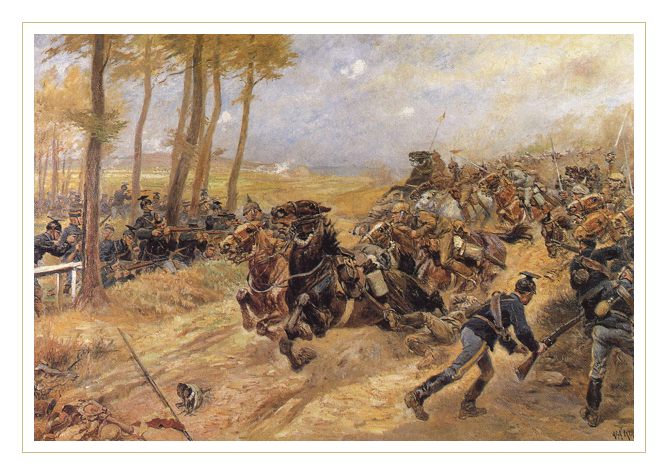
Units of the Belgian cavalry (the 4th and 5th Lansiers, plus a company of cyclists and another of pioneer engineers) under General de Witte ambushed the advanced squadrons of the German cavalry, in what was almost certainly the last fight between mounted cavalrymen, wearing the breastplates and helmets of a different era.
...
(at the bridge, the Germans) encountered a prepared Belgian cavalry, fighting under General de Witte. The two cavalry fought throughout the day. The significant difference between the two cavalry was that the Belgian cavalry dismounted and fought as infantrymen.

The Germans launched numerous and repeated attacks against the Belgian forces but their sabers and lances could not hold against the unexpected Belgian rifle fire. The Germans fought until 6pm that evening having begun the attack around 8am. Frustrated Marwitz and the German cavalry were forced to withdraw from the bridge at Haelen that evening.

In all the Germans suffered nearly 1000 casualties that August day in 1914; 200 – 300 were taken prisoner by the Belgians, 150 were killed and 600 Germans were wounded. Belgian forces suffered approximately half that number in casualties.
...
Von Marwitz withdrew, advancing days later with great caution. This battle grew in Belgian folklore as the 'Battle of the Silver Helmets'.
...
The Battle of Haelen was a tremendous victory for the Allied Forces. Although the Belgians held the bridge at Haelen, the remainder of the German army won the Battle of Liege on August 16 and the German army continued their advance through and takeover of neutral Belgium.
Fight with what you have. Fight for every hour - as those behind you need every one.

Unlike WWII - not all of Belgium was taken by the Germans, and the plucky actions of the Belgian King and his people kept a tiny corner of Belgium free through the war. Their holding action along with the British Expeditionary Force and the spotty help of the French was essential in stopping the Germans from taking Paris.

Without Generals like de Witte, we would live in a very different world. Important to remember - especially for Americans.

In WWI, the Belgians lost 14,000 men in a population of 7.5 million.

For the USA's population of ~307 million today (2010) - that equates to 573,066 dead.

First posted November 2010.

Friday, March 19, 2021

Fullbore Friday


Zeebrugge. If you have been there or to its inner city Brugges you know what a beautiful and peaceful place it is - as most all of Belgium is today. 

In 1918 though, Belgium was a nightmarish slaughterhouse where the bodies of millions were blended into the beaten earth - where like Okinawa and Iwo Jima over a quarter century later - the living earth would move with a blanketed mass of maggots.

In one of history's subtle hints she will give you early if you wish to listen, Britain found herself on the edge of starvation due to a threat few understood or even knew of at the beginning of the war - the submarine. Something new, unexpected and decisive needed to be done.
By 1918, the Great War had entered a decisive phase. While Russia had been knocked out of the war, its place had been taken by the United States, which now provided a fresh pool of manpower and industrial capacity to the Allied cause. The transfer of these resources however was threatened by the continuing war at sea and the U-Boat menace that also threatened Britain's link with the continent. The early advance by the German Army in 1914 had meant that the Belgian ports of Ostend and Zeebrugge had been overrun and with the expansion of the port facilities, the Germans were in a position to threaten the very lifeline that supplied the Allied armies in France. The two ports were connected by a canal network with the city of Brugges that also gave access to the open sea. Brugges in turn, was connected to Germany by the railway network and partially completed U-Boats were shipped from Germany, to be finished at Brugges and then make their way to the open sea by means of the canal system. The canals formed a triangle and inside this, the Germans had built a series of airfields from which they conducted air raids on Britain and fortified the entire length of the coast with light and heavy artillery batteries. The Royal Navy did not attempt to bombard these ports until 12 May 1917 when it bombarded Zeebrugge in order to put the lock system out of action and used a smoke screen to hinder German observation. While the bombard failed in its task, the Germans stepped up defensive measures and as the war progressed, the front line drew ever closer to Ostend, bringing it within range of the Royal Marine heavy howitzer battery in France, forcing the Germans to transfer many of its facilities to Zeebrugge.

One of the objectives for the Third Battle of Ypres (Passchendaele) was the expulsion of the Germans from Flanders and to capture the ports of Zeebrugge and Ostend. The battle however failed to achieve the intended breakthrough and so any attempt to expel the Germans from these ports or to deny them the use of these facilities meant that any future attempt would have to made from the sea. The mounting losses in the war at sea caused the Royal Navy to look at the problem. A suggestion by Admiral Keyes that the ports might be blocked by sinking a ship in the entrance was initially rejected but as the war dragged on, the Royal Navy returned to the idea and it was decided that it might be done with the use of several ships, although the exact position would have to be chosen with care so that it would not be possible to get around the ships or to dredge around them to create additional channels and their bottoms would have to be blown to sink them as quickly as possible and prevent drifting.
So, as it is often done in this line of work, the word went out. Volunteer for a mission you have no idea about - odds are you won't come back. You will be trained quickly, sloppily with a pick-up team. You execute.
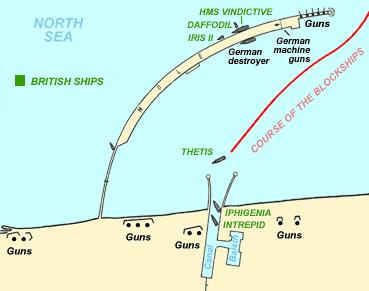
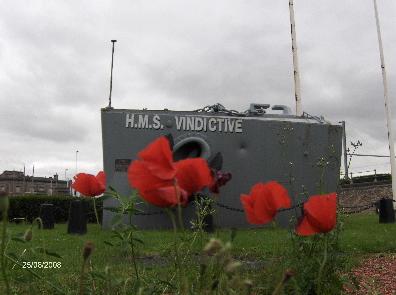
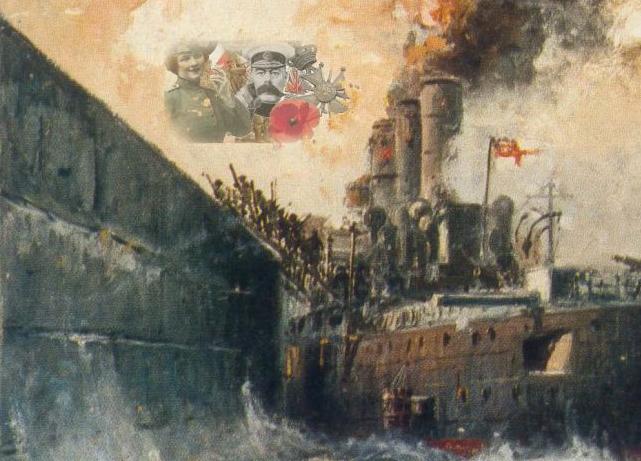
As the ships were approaching the entrance to the port, some protection would be afforded (in the case of Zeebrugge) by the Mole, which extended in an arc across the entrance to the channel. It was over a mile in length and some 100 yards wide, having extensive storage facilities and hangers for seaplanes. A railway connected the Mole to the shore and was used to transfer men, equipment and stores. As the planning for the operation got underway, a special Royal Marine battalion (mainly volunteer) was formed in February 1918 to eliminate the battery that was situated at the end of the Mole and would threaten the block ships as they approached the canal. Lt Col F E Chichester was appointed to command the battalion but was succeeded by Major B N Elliott. The battalion consisted of a headquarters, a machinegun section, a mortar section, three rifle companies and medical support staff. The troops were to be conveyed to Zeebrugge in HMS Vindictive, assisted by the Iris and the Daffodil, two Mersey ferry boats that had been provided for this operation. Once they had reached Zeebrugge, Daffodil was to push Vindictive against the Mole until she could be secured and disembark the troops. The ships were modified for this task. Special ramps were fitted to Vindictive so that the storming parties could reach the Mole, while Iris and Daffodil had been fitted with ladders to that their parties could climb up onto the Mole. Vindictive was strengthened and armoured against the storm of fire she would receive and additional armament fitted so she could support the troops as the moved onto the Mole.

By April 1918, the preparations for the raid had been completed, the men trained for their tasks and the shipping collected for the operation. Three block ships were to be sunk in the Zeebrugge canal entrance, HMS Thetis, HMS Intrepid and HMS Iphegenia. The first time the force sailed, 11 April 1918, the weather conditions changed as they neared Zeebrugge, which forced a postponement, but on the eve of St George's Day, 22 April 1918 the force sailed and during the passage, Admiral Keyes signalled "St George for England". Commander Carpenter on the Vindictive replied, "May we give the dragon's tail a damned good twist." By 23.20 on 22 April, the monitors had opened fire on Zeebrugge. Twenty minutes later, the motor launches that had accompanied the force began to make the smoke screen. One minute after midnight, St George's Day, Vindictive arrived alongside the Mole after which Daffodil arrived alongside her to push her against the Mole. By this point the smoke screen had begun to lift and the defensive fire was intense. In the approach to the Mole, many of the ramps fitted to Vindictive were damaged and only two could be used to allow the storming parties to disembark on the Mole. The ladders fitted to Iris were damaged as well and so the troops had to transfer to Vindictive to land. Once on top of the Mole, they had to endure intense German machinegun fire in order to get to the battery and while they failed to knock it out, they prevented it from firing on the blocking ships and so succeeded in their mission, something for which they suffered heavy casualties for.


The distraction caused by the motor launches and Royal Marines enabled the block ships to approach the canal entrance without too much difficulty. Thetis ran into problems when one of its propellers got caught in a net, forcing her to collide with the bank. She had to be sunk some distance from the entrance but performed admirable work in helping to direct the remaining two ships into the canal entrance itself. Both Intrepid and Iphigenia were able to be sunk in the correct positions, thus blocking the canal. Two submarines, C1 and C3 were packed with explosives and rammed into the viaduct, demolishing it, thus isolating the Mole from the shore. The crews from the submarines and the block ships were picked up by the motor launches despite heavy fire from the German batteries. By 00.50 on 23 April the recall had sounded and by 01.00 the survivors were all aboard. A quarter of an hour later, Vindictive had cleared the protection of the Mole and was undergoing intensive fire from the Germans but managed to come through it. The raid on Ostend at the same time proved to be a failure but another attempt was tried the next month and Vindictive was used as a block ship in that operation. The Royal Marines had been on the Mole for just an hour and the force had displayed such courage and devotion to duty that it gave great encouragement to the Allied forces at such a dark hour in the war. The 4th Royal Marine Battalion was awarded two Victoria Crosses with another six being awarded for the action at Zeebrugge and three being awarded for the actions at Ostend. At Deal, on 26 April 1918, a ballot was held as to who should receive the awards, with Captain Bamford and Sergeant Finch winning. In order that the gallantry of the battalion would be remembered, it was decided that no other marine battalion should be named the 4th.
In a day where entire nations ponder abandoning the battle against an existential threat to their very existence due to a number of casualties suffered at Zeebrugge in a matter of minutes, it can make you wonder if we can even try to understand what these men did and why. We can try. That is what the study of history is. That is why what we have done to the study of history from elementary school through college and as adults is a crime in itself and a shame on our culture.

And in the end;
Much was made of the raid. Keyes was knighted, and 11 Victoria Crosses were awarded. The Germans, however, made a new channel round the two ships, and within two days their submarines were able to transit Zeebrugge. Destroyers were able to do so by mid-May.
Did it make a difference? Of course it did. Did the pundits of the day nit-pic it to death? No, they understood that war from the Strategic to the Tactical is a dark room you step in to. No, it has only been nit-pic'd once the pundits were safely behind the wall of freedom that those who bled built.


First posted NOV08.

Monday, March 26, 2018

Oh, your Air Force Chief of Staff Caught Lying to your Defense Chief?

Relatively unreported here, I've been thinking over the weekend what the USA version of this would look like;
At least three Belgian generals, including the chief of the air force, and several senior officers were suspended yesterday by Belgian Chief of Defense Marc Compernol as the F-16 scandal continues to widen, to the point it is now referred to in the media as the “F-16-gate.”

The officers are suspected of having hidden from Compernol and Defense Minister Steven Vandeput studies carried out by Lockheed Martin and which concluded that the Belgian air force’s F-16s could remain in service for at least six years longer that their planned 2023 retirement date.
...
Compernol did not name the suspended officers, but media reports have identified them as Air Force Commander Gen. Frederik Vansina; Gen. Luc Roelants, head of the public procurement section of the defense ministry’s Material Resources agency; and Col Peter Letten, “manager” of the F-16 fleet. Col Harold van Pee, head of Air force procurement, and of the Air Combat Capability Program (ACCaP) which is managing the fighter competition, confirmed to Belga news agency that he had also been suspended.
I know a few Belgian officers that I've served with. They are a frustrated lot. Their politicians are thoroughly contemptible. Their military is small and starved, even for a nation of ~10 million people. As we covered last week, they are the premier "welfare queen" in the alliance.

You can see how, in a desperate attempt to try to get the best path forward, some would be tempted to nudge and fudge - but you can't do that. You can never do that. Those in uniform cannot adopt the habits of the politicians they work with. Sure, there are some of their techniques and habits you can adopt to survive at the highest levels when you are in the same tank as they are - but there are lines.

A lesson here for everyone. You can be in Brussels, but don't be of Brussels. You can be in DC, but don't be of DC.

Monday, March 28, 2016

The Wages of Decades of European Delusion

There is a nuance to the attack on Brussels last week that is already well understood by long-time readers of CDRSalamander. Yes, on the whole the most recent attack in Europe was a well-executed tactical operation by the enemy in the course of The Long War.

Brussels, as the HQ of the EU and NATO is the premier target in Europe along with Paris and London, closely followed by Rome and Berlin. The backstory to the attack in question; this was an inside job. That is the nuance.

The attackers were not part of wave of million+ military aged males from radicalized Islamic nations that crashed over the borders of Europe in the last two years. No, these were native born Belgians, the end result of decades of wrongheaded national policies that had no historical record of success. Just the opposite, all of written history showed where polities being supported in Belgium would lead, but history was ignored in the arrogance of the now.

Over at TheNewYorkPost, Amir Teheri does an outstanding job filling in the caps of why this latest attack was very much part of The Long War, with some distinct local characteristics;
What happened in Brussels was a co-production by adepts of two sick ideologies.

The first one is Islamism in its many versions, including Khomeinism in Iran, Talibanism in Afghanistan, Salafism in Arab countries, Boko Haram in Nigeria, and ISIS and its offshoots across the globe. It will remain firmly in place until it implodes under the weight of its savage contradictions, as did the old Soviet Union, or is defeated in a war as was the case with Nazi Germany and imperialist Japan.

The other co-producer, the mushy and politically correct “liberal” ideology that has seduced segments of opinion in Western democracies, can and must be combated by all those who wish to protect the democratic system in an increasingly dangerous world.

Since most factories were located in the Walloons’ area, the owners were careful to import workers from French-speaking lands which, at the time, made French-controlled North Africa an attractive source of labor. The Walloons also had a low birth rate, while the Flemish had large families. One source of concern for French speakers was the capital Brussels, with its 19 districts divided across linguistic lines. The Walloons feared that their depopulated districts would be repopulated by Dutch-speakers. They offered rent-free or subsidized housing to immigrants from Morocco, Algeria and Tunisia who knew no Flemish but could plod along in kitchen French.

By the 1990s, most of the factories had disappeared, but the immigrants remained. By then Islam was Belgium’s second-largest religion, now accounting for over 700,000 people or 6.2% of the population. Of these, almost half live in Brussels, counting for 28% of the total population of the city, and guarding the demographically declining districts from “falling” to the Flemish.
...
The Belgian multiculturalist elites, making a fetish of the concept of “otherness” corrected that lacuna by financing courses in Islam, encouraging the building of mosques and Koranic schools and even subsidizing pilgrimages to Mecca. The welfare industry also had an interest in protecting the “otherness” of the immigrant community where unemployment was rising, reaching over 40% by the end of the 1990s. In some cases, four generations of a family could be found on the welfare register in the context of their cherished “otherness.”

Radical Islamists of all ilks were welcomed to market their ideological wares.

In 1993 when France and most other Western nations banned the Algerian terrorist groups, Belgium welcomed them with open arms. For example, the so-called Islamic Armed Group (GIA), responsible for tens of thousands of killings in Algeria, maintained an office and published a magazine in Molenbeek, while the Islamic Liberation Party (Hizb al-Tahrir) which campaigns for the revival of the caliphate, transferred its leadership to Belgium.
...
The Belgian multiculturalist elite, helped by political allies in France and Germany, also secured European Union subsidies for Islamist propaganda in the shape of seminars and conferences and, ultimately, the creation of a European Fatwa Council headed by the Muslim Brotherhood televangelist Sheikh Yussef al-Qaradawi.
...
After the 9/11 al Qaeda attacks against the United States, Belgium, though member of the North Atlantic Treaty organization (NATO) and host to its headquarters, kept a low profile when the allies acted against the Taliban to dismantle terrorists bases in Afghanistan. In the US-led liberation of Iraq that followed in 2003, Belgium joined France’s President Jacques Chirac in denouncing “George W Bush’s illegal war.”

So open, so accommodating, not unlike the evil US or Britain. Belgium was sure it wasn’t a target for jihadists.
...
They even wrote to the king of Belgium inviting him and his family to convert to Islam as soon as possible.
Petty domestic identity based political concerns by a small but active political party, throw in some fluffy useful idiots from the multiculturalism cult, and there you go.
... the European Union’s foreign policy representative, the Italian Federica Mogherini, happened to be on an official visit to Amman, the Jordanian capital.

Fighting back tears, she cut short a news conference saying: “It’s a very sad day for Europe, as Europe and its capital are suffering the same pain that the Middle East has known and knows every single day, be it in Syria, be it elsewhere.”

She then mused about the role that Islam may have played in the tragedy, dismissing “the idea of a clash between Islam and the West.”

“Islam,” she said, “holds a place in our Western societies. Islam belongs to Europe…I am not afraid to say that political Islam should be part of the picture.”

Mogherini’s statement offers an insight into the mentality that has helped produce the situation in Western European societies, where fear is woven into the fabric of daily life. It is a world of illusions and false identities.
...
Brussels is the result of this thinking. It’s what happens when immigrants are allowed to construct their own state within a state, not pushed to become part of a nation.

In a sense, Mogherini is right. Islam in its most violent form is already part of Europe just as much as a cancer belongs to the body it attacks.

Mogherini’s crocodile tears remind one of the German Nazi anthropologists Sigrid Hunke, another grand lady of misguided European Islamophilia. In her book “Allah’s Sun Shines Over the West,” Hunke claims that Islam, not Judeo-Christianism, created modern Europe by shaping the Andalusian model and must at some point return to resume its work. Well, may be the prodigal son has returned, invited back by Europe’s multiculturalist elites.
Mogherini and the Belgian left, specifically the Walloon Parti Socialiste, are almost cartoonish weak-horse representations of may be a terminal illness of the EuroLeft - and even significant portions of the American Left; a personal self-loathing projected to a national cultural scale. Like a pretty girl who doesn't believe that she is pretty and deserving of being respected who makes herself unattractive, hurts herself, and then partners with lovers who abuse and debase her because she thinks she is somehow deserving of it.

Yes, it is a mental disorder.

The next question is; will the Belgian people hold their government accountable? Can they? As we outlined during the 2007 Belgian crisis, the entire nation can be held up by less than 25% of the nation's voters - specifically in this area by the Walloon Parti Socialiste. This sub-plot in the general European disaggregation in the face of waxing Islamism will only get worse.

Watch this space.

Friday, June 14, 2013

Fullbore Friday

It has been six years - time to remind everyone that it wasn't too long that even Belgium could rise to the occasion. Time for a nice FbF best of;


Today, ... we will remember plucky Belgium. OMC sent me this awhile ago, and it tells a story not well known. 

Forget the image you have of the castrated Belgium of today; the Belgium that spends much less than 2% of her GDP to defend herself and whose Capitol's most popular name for newborn boys is Mohammed - no think of what was - and give them credit. Why credit? They held so others could bring victory.
In 1936 Belgium started its policy of "Armed Independence", which is different than a policy of strict neutrality. The Policy of "Armed Independence" was highly supported by the Belgian people even if it meant that 25% of the national budget was spent on the military and that in times of economic recession. Nor Britain or France were able to outline such a policy. In both countries military expenditures were highly criticized by public opinion until it was too late.

The inability of the French and British government to react when Germany re-occupied the Rhine-land had brought the German army at the Belgian-German border. The international agreements were broken (Locarno pact). At that time Belgium was the only country prepared to help France in case of a war with Germany. But France didn’t react, as Britain didn’t want to support a war.

Before 1936 Belgium was obliged to help France or Germany when the other attacked the other one and vice versa. French generals and politicians saw Belgium not as an independent state but as the ideal battleground to fight another war with Germany. As tensions grew all over Europe Belgium needed a policy which was supported by the majority of the Belgian people, "Armed Independence".

The majority of the Belgians were against the Germans, but also against the French and this goes back to what happened after WOI, where Belgium was completely forgotten by the French in the Versailles Treaty. Also by not extending the Maginot Line at the Belgian-French border, the French practically invited the Germans to attack France through Belgium. The Belgian government asked the French government, on several occasions, to extent the fortifications, but as the French post-war commission wrote the French military preferred to fight the war with Germany in Belgium. This refusal resulted in a growing mistrust of the French by the Belgian population.

The British government supported in the 1930's the Belgian policy. The following is written in official documents of the Foreign office: The military built-up in Belgium, and the strengthening of their defenses, increases their chances to remain neutral, an attitude, which is beneficial for France and for ourselves.

In 1940 Belgium would have the best-prepared army in its history. Even Germany was impressed by the military built-up in Belgium and Hitler counted to need one million troops to defeat the Belgian army. While Belgium was doing an extraordinary effort to strengthen his army, Britain was following a policy of "no responsibility". Or in military terms, in the winter of 1939 the British Expeditionary Force was only 152.000 men strong. In May 1940 the BEF counted only 237.000 men. If it had spent the same proportional amount of its national budget on the military as Belgium, Britain would have had an army of 4.8 million men strong.
...
When on the 10th of January German military plans were captured when a German plane crashed, Belgian King Leopold III was prepared to accept allied troops in his country if the following conditions were agreed:

* Peace negotiations are not started without Belgian participation
* Belgium's integrity and of his colonies would be guaranteed after the war
* Financial support when Belgium needed to rebuilt his country after the war

For the British government (except Churchill) these conditions were unacceptable. The French decided that they didn't need to wait for an invitation and if Holland was attacked would march into Belgium with or without Belgian approval. The speech of Churchil on the 30th March stating that the neutral countries were scared to chose a side was an insult to the efforts which Belgium had done regarding its military efforts far more greater than Britain or France.
Short sighted politicians in the face of evil is not unique to our age.
The Belgian army counted 650 000 men (22 divisions). With another 150 000 men drafted in May 1940 to be sent to France to form reserve units. Totaling 800 000 men out of a population of 8 million In comparison it was three times a strong as the BEF (British Expeditionary Force). The majority were infantry divisions (all around 17 000 men strong), 2 divisions "Ardense Jagers" which were considered by the Germans as elite units, 2 divisions Cavalry (motorized infantry), a heavy artillery division, and several specialized regiments.
It started in a beautiful part of Europe on a beautiful day.
10/11 May 1940: Battle at the Albert-Canal.

On a sunny day WWII started for Belgium. The Germans obtained tactical surprise by attacking without any warning a large number of military targets and succeeded in destroying most of the already small Belgian airforce on the ground. It succeeded in taking two bridges over the Albert-canal and destroyed the strong fortress of Eben-Emael.
Read it all - read about the 17 days of an incredible fighting retreat.
Battles at the Lys River: At the Lys river the most fiercest battles of the Belgian campaign occurred.

While the battles at the Derivation canal took place 6th Army of Von Reichenau attacked the positions of the Belgian troops at the Lys river. The Belgian troops had extended their front to Menin to link up with the British front. Both fronts formed a 90° angle. The British front was diagonal with the German attacking direction. Which made the German left flank very vulnerable to British flank attacks and British artillery

The Belgian front was held here held by two divisions. The 1st (only 7000 men left) and 3rd (only 6000 men left) division and the 10th in reserve. The lack of material was even worse (no radios, few machine guns left). The divisions were supported by twenty artillery formations, something the Belgians still had plenty. These two divisions faced 6 German divisions and one division (7th) in flank protection against the British front.

Already on the 23rd of May the Germans made contact. The whole day and night the German artillery bombed the Belgian positions and the sky was full of German planes. The Germans lost on the 23rd 16 planes over this area, which is an accomplished as the Belgians didn’t have any plane in the sky. The Belgian artillery also participated and as usual dominated the German one. Several German units designated to attack the next day were replaced because the casualties they had taken by the Belgian artillery.

24th May: On the 24th of May 6 German divisions attacked the Belgian positions near the city of Kortrijk. The first attempt of the 30th division failed completely, as did the second, third and fourth one. But after two hours, 26inf managed to cross the river after sustaining very high losses in men and material. At two other places the German division managed to get over the Lys river, at Bavikhove (German 19th division) and Beveren. After a day of fighting the Belgian troops needed to retreat here, but some units remained fighting off the Germans until being eliminated. In the history of the German 30th division is written, "the resistance was much higher than expected"

Between Kortrijk and Menin the 31st German division attacked and managed to break through the Belgian front of the 1st division. The town of Bissegem was lost. The front was lost here as the Germans were now attacking two regiments in the flank. The Germans created a bridgehead of 3km long. The 1st division received units to perform a counterattack to retake Bissegem, but these units could only move slowly to their attacking positions because of the constant Stuka attacks. Still they managed to stop the German breakthrough and reduced the German Bridgehead(4km long and 3km depth)

The main German attack took place around Kortrijk. 4 German divisions, the 18th, 14th, 19th and 30th smashed in the front of the Belgian 3rd division. The 3rd division put up a tenacious fight, defended every meter, and inflected heavy casualties to the German troops. The division itself sustained heavy casualties and its defenses cracked everywhere. The German commander of the 18th division would later write that the attack against this elite Belgian division was very hard and costly.

It wasn’t an elite division, hell it wasn’t even on half it strength. The 3rd division was starting to give away when it supporting artillery fell out of ammo. The supply convoy had been destroyed by another air attack. At 21.00 P.M remnants of the division retreated behind the Roulers canal, leaving a temporary breach of 9 km in the front.

Between the Kortrijk area and the Derivation canal the Germans attempted also to cross the Lys river. The German 255th division failed completely. The German 216th division managed to get a foothold over the river by using two regiments (348 and 396 infantry) but they were quickly beaten back by the precise shooting of the Belgian artillery. The German commander wrote, "The enemy shoots with such a precision that we were only able to retreat back over the Lys river during the night"

25th May: On the 25th of May the Germans had created two bridgeheads, only separated by a small corridor in the Kortrijk area. This corridor included the city of Kortrijk itself. Still the city of Kortrijk was evacuated as it was endangered by encirclement. Belgian troops were moved from other places of the frontline to strengthen this sector, as there were no reserve units left.
A fight to the end.
On the 27th May Belgian command realized that the situation was hopeless and that the army was on its last legs. The army couldn’t dislodge anymore and casualties increased by the day. The supply situation was dramatic. While for many different weapon types there was simply no ammo left, the real problem was that the German Luftwaffe had gradually paralyzed the supply convoys.
The information coming from the corps commanders to the Belgian high command on the 27th was dramatic:
    • The I Corps reported that is was endangered to be encircled
    • IV corps was heavily attacked
    • V and VII corps reported enemy breakthroughs and that their front was broken
    • With other corps commanders contact was lost
It was cleat that the Belgian army was falling apart.
In the evening of the 27th of May negotiations started and unconditional surrender was accepted. The cease-fire started at 4.00 A.M the next day.
And what did that buy?
The battle at the Lys river had been very costly for the Belgian army as it had sustained 40.000 casualties (4000 KIA, 36.000 WIA), but it had managed to disturb the Germans plans and had aided, without their knowledge, in the escape of the BEF at Dunkirk.
Dunkirk. With not an hour to spare, the nucleus of the Army and the Allied forces that would liberate Europe 4 years later was saved. Saved by the Belgian Army.

Friday, March 29, 2013

Fullbore Friday


When ignored and left to wither on the vine, how long does it take a nation to build up a world class military?

A navy can take much longer, but in general - if there is the will - how long does it take? 

Let's go back to a FbF from half a decade ago to review an important data point just on the edge of living memory.


 OMC sent me this awhile ago, and it tells a story not well known. Forget the image you have of the castrated Belgium of today; the Belgium that spends much less than 2% of her GDP to defend herself and whose Capital's most popular name for newborn boys is Mohammed - no think of what was - and give them credit. Why credit? They held so others could bring victory.
In 1936 Belgium started its policy of "Armed Independence", which is different than a policy of strict neutrality. The Policy of "Armed Independence" was highly supported by the Belgian people even if it meant that 25% of the national budget was spent on the military and that in times of economic recession. Nor Britain or France were able to outline such a policy. In both countries military expenditures were highly criticized by public opinion until it was too late.

The inability of the French and British government to react when Germany re-occupied the Rhine-land had brought the German army at the Belgian-German border. The international agreements were broken (Locarno pact). At that time Belgium was the only country prepared to help France in case of a war with Germany. But France didn’t react, as Britain didn’t want to support a war.

Before 1936 Belgium was obliged to help France or Germany when the other attacked the other one and vice versa. French generals and politicians saw Belgium not as an independent state but as the ideal battleground to fight another war with Germany. As tensions grew all over Europe Belgium needed a policy which was supported by the majority of the Belgian people, "Armed Independence".

The majority of the Belgians were against the Germans, but also against the French and this goes back to what happened after WOI, where Belgium was completely forgotten by the French in the Versailles Treaty. Also by not extending the Maginot Line at the Belgian-French border, the French practically invited the Germans to attack France through Belgium. The Belgian government asked the French government, on several occasions, to extent the fortifications, but as the French post-war commission wrote the French military preferred to fight the war with Germany in Belgium. This refusal resulted in a growing mistrust of the French by the Belgian population.

The British government supported in the 1930's the Belgian policy. The following is written in official documents of the Foreign office: The military built-up in Belgium, and the strengthening of their defenses, increases their chances to remain neutral, an attitude, which is beneficial for France and for ourselves.

In 1940 Belgium would have the best-prepared army in its history. Even Germany was impressed by the military built-up in Belgium and Hitler counted to need one million troops to defeat the Belgian army. While Belgium was doing an extraordinary effort to strengthen his army, Britain was following a policy of "no responsibility". Or in military terms, in the winter of 1939 the British Expeditionary Force was only 152.000 men strong. In May 1940 the BEF counted only 237.000 men. If it had spent the same proportional amount of its national budget on the military as Belgium, Britain would have had an army of 4.8 million men strong.
...
When on the 10th of January German military plans were captured when a German plane crashed, Belgian King Leopold III was prepared to accept allied troops in his country if the following conditions were agreed:

* Peace negotiations are not started without Belgian participation
* Belgium's integrity and of his colonies would be guaranteed after the war
* Financial support when Belgium needed to rebuilt his country after the war

For the British government (except Churchill) these conditions were unacceptable. The French decided that they didn't need to wait for an invitation and if Holland was attacked would march into Belgium with or without Belgian approval. The speech of Churchil on the 30th March stating that the neutral countries were scared to chose a side was an insult to the efforts which Belgium had done regarding its military efforts far more greater than Britain or France.
Short sighted politicians in the face of evil is not unique to our age.
The Belgian army counted 650 000 men (22 divisions). With another 150 000 men drafted in May 1940 to be sent to France to form reserve units. Totaling 800 000 men out of a population of 8 million In comparison it was three times a strong as the BEF (British Expeditionary Force). The majority were infantry divisions (all around 17 000 men strong), 2 divisions "Ardense Jagers" which were considered by the Germans as elite units, 2 divisions Cavalry (motorized infantry), a heavy artillery division, and several specialized regiments.
It started in a beautiful part of Europe on a beautiful day.
10/11 May 1940: Battle at the Albert-Canal.

On a sunny day WWII started for Belgium. The Germans obtained tactical surprise by attacking without any warning a large number of military targets and succeeded in destroying most of the already small Belgian airforce on the ground. It succeeded in taking two bridges over the Albert-canal and destroyed the strong fortress of Eben-Emael.
Read it all - read about the 17 days of an incredible fighting retreat.
Battles at the Lys River: At the Lys river the most fiercest battles of the Belgian campaign occurred.

While the battles at the Derivation canal took place 6th Army of Von Reichenau attacked the positions of the Belgian troops at the Lys river. The Belgian troops had extended their front to Menin to link up with the British front. Both fronts formed a 90° angle. The British front was diagonal with the German attacking direction. Which made the German left flank very vulnerable to British flank attacks and British artillery

The Belgian front was held here held by two divisions. The 1st (only 7000 men left) and 3rd (only 6000 men left) division and the 10th in reserve. The lack of material was even worse (no radios, few machine guns left). The divisions were supported by twenty artillery formations, something the Belgians still had plenty. These two divisions faced 6 German divisions and one division (7th) in flank protection against the British front.

Already on the 23rd of May the Germans made contact. The whole day and night the German artillery bombed the Belgian positions and the sky was full of German planes. The Germans lost on the 23rd 16 planes over this area, which is an accomplished as the Belgians didn’t have any plane in the sky. The Belgian artillery also participated and as usual dominated the German one. Several German units designated to attack the next day were replaced because the casualties they had taken by the Belgian artillery.

24th May: On the 24th of May 6 German divisions attacked the Belgian positions near the city of Kortrijk. The first attempt of the 30th division failed completely, as did the second, third and fourth one. But after two hours, 26inf managed to cross the river after sustaining very high losses in men and material. At two other places the German division managed to get over the Lys river, at Bavikhove (German 19th division) and Beveren. After a day of fighting the Belgian troops needed to retreat here, but some units remained fighting off the Germans until being eliminated. In the history of the German 30th division is written, "the resistance was much higher than expected"

Between Kortrijk and Menin the 31st German division attacked and managed to break through the Belgian front of the 1st division. The town of Bissegem was lost. The front was lost here as the Germans were now attacking two regiments in the flank. The Germans created a bridgehead of 3km long. The 1st division received units to perform a counterattack to retake Bissegem, but these units could only move slowly to their attacking positions because of the constant Stuka attacks. Still they managed to stop the German breakthrough and reduced the German Bridgehead(4km long and 3km depth)

The main German attack took place around Kortrijk. 4 German divisions, the 18th, 14th, 19th and 30th smashed in the front of the Belgian 3rd division. The 3rd division put up a tenacious fight, defended every meter, and inflected heavy casualties to the German troops. The division itself sustained heavy casualties and its defenses cracked everywhere. The German commander of the 18th division would later write that the attack against this elite Belgian division was very hard and costly.

It wasn’t an elite division, hell it wasn’t even on half it strength. The 3rd division was starting to give away when it supporting artillery fell out of ammo. The supply convoy had been destroyed by another air attack. At 21.00 P.M remnants of the division retreated behind the Roulers canal, leaving a temporary breach of 9 km in the front.

Between the Kortrijk area and the Derivation canal the Germans attempted also to cross the Lys river. The German 255th division failed completely. The German 216th division managed to get a foothold over the river by using two regiments (348 and 396 infantry) but they were quickly beaten back by the precise shooting of the Belgian artillery. The German commander wrote, "The enemy shoots with such a precision that we were only able to retreat back over the Lys river during the night"

25th May: On the 25th of May the Germans had created two bridgeheads, only separated by a small corridor in the Kortrijk area. This corridor included the city of Kortrijk itself. Still the city of Kortrijk was evacuated as it was endangered by encirclement. Belgian troops were moved from other places of the frontline to strengthen this sector, as there were no reserve units left.
A fight to the end.
On the 27th May Belgian command realized that the situation was hopeless and that the army was on its last legs. The army couldn’t dislodge anymore and casualties increased by the day. The supply situation was dramatic. While for many different weapon types there was simply no ammo left, the real problem was that the German Luftwaffe had gradually paralyzed the supply convoys.
The information coming from the corps commanders to the Belgian high command on the 27th was dramatic:
    • The I Corps reported that is was endangered to be encircled
    • IV corps was heavily attacked
    • V and VII corps reported enemy breakthroughs and that their front was broken
    • With other corps commanders contact was lost
It was cleat that the Belgian army was falling apart.
In the evening of the 27th of May negotiations started and unconditional surrender was accepted. The cease-fire started at 4.00 A.M the next day.
And what did that buy?
The battle at the Lys river had been very costly for the Belgian army as it had sustained 40.000 casualties (4000 KIA, 36.000 WIA), but it had managed to disturb the Germans plans and had aided, without their knowledge, in the escape of the BEF at Dunkirk.
Dunkirk. With not an hour to spare, the nucleus of the Army and the Allied forces that would liberate Europe 4 years later was saved. Saved by the Belgian Army.

Thursday, July 21, 2011

Well, you we could be Belgium ...

It's always fun to watch a German fuss'n at grumpy Dutchmen and lazy Frenchmen ... oh I'm sorry - the Belgian King scolding his Flemish and Walloon "countrymen."
The Belgian head of state used his traditional eve of national day address to demand an end to disputes that have left Belgium without an elected government for 14 months.

"On this national day, I would have liked to enjoy with you the swearing in of a new government. Alas, we are not there yet, and I deplore this," he said.

Banging the table during Wednesday's broadcast from his castle just outside Brussels, the king castigated "ignorant" voters and painted a pessimistic picture of the divisions between Dutch and French speaking communities.

"Our current situation is a cause for concern among our partners and could damage our position in Europe, and even the momentum towards European integration which has already been undermined by populism and Euroscepticism," he said.
There you go King - those pesky peasants wanting to run their own affairs with their own community. How gauche.


Putting your trust in Waloon Socialists - the ones who are responsible for Flemish separatism.

Stuck on stupid.

Friday, November 26, 2010

Fullbore Friday


Lessons - yep there are lessons.

When you go to war - you step in to a dark room. You hopefully have prepared yourself with the best equipment, training, operational concepts possible. The wise commander steps in to that dark room knowing that he will not know what will happen when he enters. At first, he won't see what works and does not - but he looks for it.

He adjusts, he modifies - he tries to find advantage.

Remember the FbF the other day about the Australian Light Horse and the
assault on Beersheba? The Germans then did not think that mounted infantry would fight as cavalry - though the Commonwealth leadership saw the need to improvise, adapt, and overcome. Victory came to the less myopic leader.

Now the other side of the coin. You have cavalry. Always go back to one question: what is the mission.

General de Witte, Belgian Army knew what to do.
On the morning of August 12, the German cavalry arrived at Haelen and prepared to cross the bridge there.
...
Units of the Belgian cavalry (the 4th and 5th Lansiers, plus a company of cyclists and another of pioneer engineers) under General de Witte ambushed the advanced squadrons of the German cavalry, in what was almost certainly the last fight between mounted cavalrymen, wearing the breastplates and helmets of a different era.
...
(at the bridge, the Germans) encountered a prepared Belgian cavalry, fighting under General de Witte. The two cavalry fought throughout the day. The significant difference between the two cavalry was that the Belgian cavalry dismounted and fought as infantrymen.

The Germans launched numerous and repeated attacks against the Belgian forces but their sabers and lances could not hold against the unexpected Belgian rifle fire. The Germans fought until 6pm that evening having begun the attack around 8am. Frustrated Marwitz and the German cavalry were forced to withdraw from the bridge at Haelen that evening.

In all the Germans suffered nearly 1000 casualties that August day in 1914; 200 – 300 were taken prisoner by the Belgians, 150 were killed and 600 Germans were wounded. Belgian forces suffered approximately half that number in casualties.
...
Von Marwitz withdrew, advancing days later with great caution. This battle grew in Belgian folklore as the 'Battle of the Silver Helmets'.
...
The Battle of Haelen was a tremendous victory for the Allied Forces. Although the Belgians held the bridge at Haelen, the remainder of the German army won the Battle of Liege on August 16 and the German army continued their advance through and takeover of neutral Belgium.
Fight with what you have. Fight for every hour - as those behind you need every one.

Unlike WWII - not all of Belgium was taken by the Germans, and the plucky actions of the Belgian King and his people kept a tiny corner of Belgium free through the war. Their holding action along with the British Expeditionary Force and the spotty help of the French was essential in stopping the Germans from taking Paris.

Without Generals like de Witte, we would live in a very different world. Important to remember - especially for Americans.

In WWI, the Belgians lost 14,000 men in a population of 7.5 million.

For the USA's population of ~307 million today - that equates to 573,066 dead.

Wednesday, May 28, 2008

A job for Jawa


Dr. Rusty Shackleford and his band of merry pranksters have had a field day shutting down Jihadi websites. I think we have a prime target for them to do that do like they do so well,
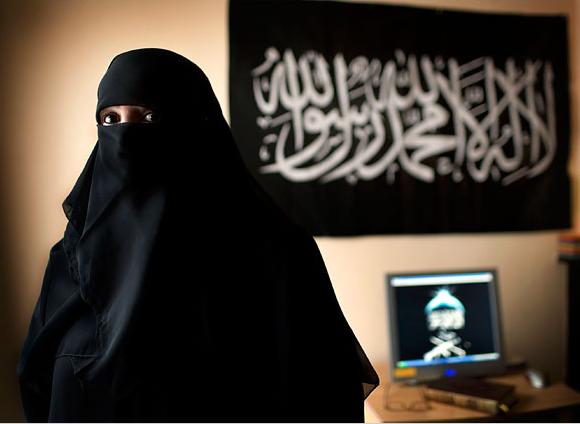
On the street, Malika El Aroud is anonymous in an Islamic black veil covering all but her eyes.

In her living room, Ms. El Aroud, a 48-year-old Belgian, wears the ordinary look of middle age: a plain black T-shirt and pants and curly brown hair. The only adornment is a pair of powder-blue slippers monogrammed in gold with the letters SEXY.

But it is on the Internet where Ms. El Aroud has distinguished herself. Writing in French under the name “Oum Obeyda,” she has transformed herself into one of the most prominent Internet jihadists in Europe.

She calls herself a female holy warrior for Al Qaeda. She insists that she does not disseminate instructions on bomb-making and has no intention of taking up arms herself. Rather, she bullies Muslim men to go and fight and rallies women to join the cause.

“It’s not my role to set off bombs — that’s ridiculous,” she said in a rare interview. “I have a weapon. It’s to write. It’s to speak out. That’s my jihad. You can do many things with words. Writing is also a bomb.”

Ms. El Aroud has not only made a name for herself among devotees of radical forums where she broadcasts her message of hatred toward the West. She also is well known to intelligence officials throughout Europe as simply “Malika” — an Islamist who is at the forefront of the movement by women to take a larger role in the male-dominated global jihad.
Don't you love how she sucks off the teat of the beast she damns? You will love her background even more.
Ms. El Aroud began her rise to prominence because of a man in her life. Two days before the attacks of Sept. 11, 2001, her husband carried out a bombing in Afghanistan that killed the anti-Taliban resistance leader Ahmed Shah Massoud at the behest of Osama bin Laden. Her husband was killed, and she took to the Internet as the widow of a martyr.

She remarried, and in 2007 she and her new husband were convicted in Switzerland for operating pro-Qaeda Web sites. Now, according to the Belgium authorities, she is a suspect in what the authorities say they believe is a plot to carry out attacks in Belgium.
... she knows the rules. “I write in a legal way,” she said. “I know what I’m doing. I’m Belgian. I know the system.”
...
Ms. El Aroud was tried with 22 others in Belgium for complicity in the Massoud killing. As a grieving widow in a black veil, she persuaded the court that she had been doing humanitarian work and knew nothing of her husband’s plans. She was acquitted for lack of evidence.

Her husband’s death, though, propelled her into a new life. “The widow of a martyr is very important for Muslims,” she said.

She used her enhanced status to meet her new “brothers and sisters” on the Web. One of them was Moez Garsalloui, a Tunisian several years her junior who had political refugee status in Switzerland. They married and moved to a small Swiss village. There, they ran several pro-Qaeda Web sites and Internet forums that were monitored by Swiss authorities as part of the country’ first Internet-related criminal case.

After the police raided their home and arrested them at dawn in April 2005, Ms. El Aroud extensively described what she called their abuse.

“See what this country that calls us neutral made us suffer,” she wrote, claiming that the Swiss police beat and blindfolded her husband and manhandled her while she was sleeping unveiled.

Convicted last June of promoting violence and supporting a criminal organization, she received a six-month suspended sentence; Mr. Garsalloui, who was convicted of more serious charges, was released after 23 days. Despite Ms. El Aroud’s prominence, it is once again her husband whom the authorities view as a bigger threat. They suspect he was recruiting to carry out attacks last December and that he has connections to terrorist groups operating in the tribal areas of Pakistan.

The authorities say that they lost track of him after he was released from jail last year in Switzerland. “He is on a trip,” Ms. El Aroud said cryptically when asked about her husband’s whereabouts. “On a trip.”
...
Although the identities of those detained were not released, the Belgian authorities and others familiar with the case said that among those detained were Mr. Trabelsi’s wife and Fatima Aberkan, 47, a friend of Ms. El Aroud and a mother of seven.

“Malika is a source of inspiration for women because she is telling women to stop sleeping and open their eyes,” Ms. Aberkan said.

Ms. El Aroud operates from her three-room apartment that sits above a clothing shop in a working-class Brussels neighborhood where she spends her time communicating with supporters, mainly on her own forum, Minbar-SOS.

Although Ms. El Aroud insists that she is not breaking the law, she knows that the police are watching. And if the authorities find way to put her in prison, she said: “That would be great. They would make me a living martyr.”
Nice. I would love to see how many Euros a month she gets from the Belgium gov'munt in benefits. Brussels, the capital of Europe. Mohamed the number one name for males born there. Nice future you have there OMC.

And people think electing Sen. Obama (D-IL) will bring this war to an end. I know what MTH would say.....

Wednesday, September 12, 2007

Belgium's rotten soul

The Dhimmi Socialist mayor does not want a peaceful demonstration on 911 against the Islamization of Europe. The "protesters" gather for a static gathering of ~200. The police move in, grabbing nut-sacks and violently going after middle-aged politicians in business suits and ties doing press interviews.

If I was Flemish and on the fence on if I was going to want to support succession of Flanders - this would be the last straw.


Please pay a visit to Michelle, The Brussels Journal, GatewayPundit, and Gates of Vienna for more. Also, via No Pasaran, we are reminded that freedom as Americans know it is rare...and easily lost to those who claim "authority:"
The head of the Council of Europe - a mainly human rights watchdog based in Strasbourg, France and not an EU institution - branded the protesters bigots and said they were a threat to Europe's values.

"It is very important to remember that the freedom of assembly and expression can be restricted to protect the rights and freedoms of others, including the freedom of thought, conscience and religion," secretary general Terry Davis said.

Saturday, August 25, 2007

A greater Netherlands?


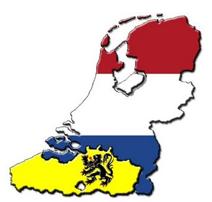
Hey, history never stops. There used to be a Yugoslavia. There used to be a Czechoslovakia. Why can't we say, "There used to be a Belgium."? There is a significant constitutional crisis in Belgium. It boils down to the Dutch speaking Free Market Flemish getting tired of underwriting the Socialists Walloons. As usual, the best summary can be found over at The Brussels Journal.
Belgium is rapidly unraveling. Following the June 10th Belgian general elections, won by Flemish-secessionist parties, the Belgian parties seem unable to form a government coalition.

Belgium is a multinational state, the model for the European Union’s efforts to turn Europe into a single multinational state. Belgium is made up of 60% Dutch-speaking, free-market oriented Flemings and 40% French-speaking, predominantly Socialist Walloons. The Belgian Constitution stipulates that the government should consist of 50% Flemings and 50% Walloons. Belgian governments always have to rely on a majority in both Flanders and Wallonia, since major decisions need the support of both parts of the country. In practice this means that 20% of the population (i.e. half of the Walloons) can veto every decision. This has made the Parti Socialiste (PS), the Walloon Socialist Party, the power broker in the country.

The refusal of the PS to reform the welfare state system has caused growing Flemish frustration, and turned what used to be a linguistic conflict into a dispute about economic and welfare policies. While Flanders pays most of Belgium’s taxes the bulk of the money flows to Wallonia. There a welfare-receiving electorate votes for parties which for over three decades have been blocking any attempts at reforming the collapsing welfare system.

...

Last week, Prof. Em. Robert Senelle, one of Belgium’s most prominent constitutionalists, a Flemish Socialist and formerly a teacher of the Belgian Crown Prince, advised the Flemings to annul the Belgian Constitution and solemnly declare Flemish sovereignty. Following this advice Filip Dewinter, the leader of the secessionist Vlaams Belang party, the largest party in the Flemish Regional Parliament, called upon the Flemish Parliament to convene and declare Flanders an independent country.

Yesterday another Flemish constitutionalist, Prof. Paul Van Orshoven said thatTennis Court Oath. The Tennis Court Oath refers to 20 June 1789, when the representatives of France’s third estate [the bourgeoisie] declared themselves to be the true representatives of the nation. “In the spirit of the Tennis Court Oath it is permitted that, even if it violates the Belgian constitutional rules, a simple majority of the Dutch-speakers in the Belgian Chamber of Representatives and the Senate declare to secede.” “intelligent people” should consider a Flemish secession from Belgium. “Because the situation cannot go on where a minority denies the majority its legitimate and democratic aspirations.” Prof. Van Orshoven said that if Flanders secedes this obviously violates the Belgian Constitution, which requires that the Walloons approve of such a decision. He referred, however, to the historical precedent of the

Apart from the media in Belgium and the neighbouring Netherlands, the international papers and broadcasters have hardly reported about the disintegration of the EU’s host country. On Tuesday a survey of the Dutch [Netherlandish] television network RTL4 showed that 77% of the inhabitants of the Netherlands are in favour of the Netherlands and Flanders merging into one country.

In Belgium, an internet poll of Flanders’ largest newspaper, Het Laatste Nieuws, showed 50.9% in favour of reuniting Flanders and the Netherlands. The Flemish provinces were part of the Netherlands until 1831, when the international powers established the Kingdom of Belgium.

Many parts, if not the balance, of their military is already split up, with what I understand both Dutch and French speaking fighter squadrons and other units. Obviously, Flanders would get the Navy. Being that Walloonia cannot support her welfare state on her own - perhaps she could beg France to take her back?

Tuesday, August 21, 2007

EuroWobbles

Want to know where a multi-culti, multi-lingual, Socialist stunted, type of nation will get you? Well, The Brussels Journal can give you a nice brief on Belgium in 2007.

Want to understand why the Left wants as many immigrants as possible? Mike will help you there as well.

Monday, July 30, 2007

That ain't the Georgia National Guard

While we are talking about the nations in Iraq that you will never hear about from the MSM - let us take a moment to say, "thanks, Shipmate" to the small, poor, but American loving friend that we have in the Republic of Georgia. They know how to cowboy up.
He is one of the 1,200 extra troops that Georgia is sending to Iraq to join the U.S.-led coalition. When the troops are fully deployed, Georgia will have the third-largest number of troops in Iraq, after the United States and the United Kingdom.
...
But it isn't just the number of troops that has been boosted, but also their role.

Around 800 Georgian troops have been serving in Iraq since 2004, but, for the most part, not in a frontline role.

But the new Georgian troops will take on a more high-profile responsibility: patrolling the border with Iran to stop the smuggling of weapons and other goods.

RFE/RL military analyst Koba Liklikadze says it will be a challenging operation.

"Before, Georgian units just participated in the control of checkpoints and organization, in Ba'qubah, and in the so-called Green Zone in Baghdad," Liklikadze says.

"Now the contribution is very significant from Georgian soldiers [and] it's a very new and significant challenge for Georgian soldiers. They will lead this operation in this very huge area. "

For the most part, only U.S. and British forces in the coalition have taken part in combat operations.

Troops from other countries tend to be deployed in support roles, providing security or logistics. Countries often send troops for specialized tasks like engineering, bomb disposal, or providing field hospitals.

To date, no Georgian soldiers have been killed in Iraq and only a few have been wounded. But Liklikadze says the new mission along the Iran-Iraq border carries a much higher risk.

Chris Parker, a retired British lieutenant colonel who served as the chief of staff for the British 7th Armored Division in Iraq, says the enhanced role of Georgian troops could be a sign of things to come.

"On the political level, I think [the United States and United Kingdom] will be delighted to see more aggressive posture -- in terms of determination to get into the more dangerous roles -- from other coalition members," Parker says.

"Of course that helps on the political level to allay any fears of their own populace, in America or Britain, who perceive that their own countries are taking all the hard work and other countries less so."
And for lesser nations who were born into freedom and therefor can spit on it with abandon (Hat tip Ayaan) - or those who will happily let others fight for their freedom, but won't lift a finger to help others get theirs - here are the stats for Georgia - compared to, say, Belgium:
Population: Georgia: 4,646,003 Belgium: 10,392,226
Economy:

--GDP Overall PPP:
Georgia: $17.88 billion Belgium: $342.8 billion
--
GDP Per Capita: Georgia: $3,800 Belgium: $33,000
In Iraq: Georgia: 1,200; no caveats Belgium: none
In Afghanistan:
Georgia: 50-100 in the recent past; present offer of SOF. Belgium: 300. Loaded with caveats, only guarding the airport.

Monday, June 18, 2007

Belgium joins rightward drift

If you haven't been to DownEastBlog anytime soon, head on over and show Mike some lov'n.

While the right in France didn't get the tidal wave hoped for (still they have the Presidency and 314 out of 577) - next door the Belgians have taken a less dramatic - but none-the-less significant - step to the right.

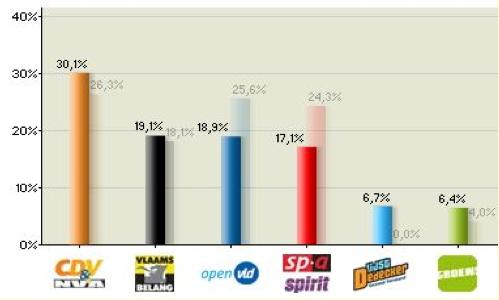
The results for Flanders: big wins for the opposition party CD & V (Christian Democrats, first pillar from the left), a slight win for the VB (second pillar from the left), heavy losses for the ruling liberals (third pillar) and socialists (fourh pillar), sudden emergence of breakaway rightwing party LDD (fifth pillar, light blue), Green nutters (last pillar) winning a bit. If not a shift to the right, definitely a shift away from the left.

Noteworthy too is the sudden rise of a small breakaway rightwing party from the liberal VLD. This LDD party, for Lijst De Decker, which secured in Flanders some 7% of the vote, seems to have attracted most of the malcontent "dark blue" liberals of the VLD, who could not stomach anymore how their once great party - I myself was a VLD member till 2004 - had become nearly indistinguishable from the socialists.

In light of the shift towards the centrist Christian Democrats and the sudden appearance of the rightwing LDD (rightwing only with regards to economics, ethically it has a "progressive" agenda, it is perhaps surprising that the VB still stood its own, and even gained 1.1% as compared to the previous parliamentary elections. Given the peculiarities of the Belgian voting system this will however not translate in another seat in Parliament, to the contrary, the VB loses one, from 18 seats to 17. By contrast, the Christian Democrats now have 30 seats in the 150-seat Kamer (Lower House).

To sum it all up, there IS a rightwing shift in Belgium, both in Flanders and Wallonia.
Good news for the West. They won even with statements like this.
Flemish Christian Democrat, Pieter De Crem, ..spoke(n) out in favor of "more risky operations" for the Belgian Army. This may very well be interpreted as a more active involvement in the WOT.
I had a Swedish Army (of all types) tell me once with much conviction that Europe will, in the end, come to its senses. It will take too long, will come late, and will be fixed in the messy way Europe does things - but it will happen.

Who knows, maybe Europe will go down fighting - and maybe pull a win out of it. I like the trend here, and will take the good news, because this war is still in its opening rounds - and with the most popular name for boys born in Brussels being Mohammed - time is not on Belgium's or Europe's side.

Friday, May 11, 2007

Fullbore Friday


Today, 67 years later, we will remember plucky Belgium. OMC sent me this awhile ago, and it tells a story not well known. Forget the image you have of the castrated Belgium of today; the Belgium that spends much less than 2% of her GDP to defend herself and whose Capitol's most popular name for newborn boys is Mohammed - no think of what was - and give them credit. Why credit? They held so others could bring victory.
In 1936 Belgium started its policy of "Armed Independence", which is different than a policy of strict neutrality. The Policy of "Armed Independence" was highly supported by the Belgian people even if it meant that 25% of the national budget was spent on the military and that in times of economic recession. Nor Britain or France were able to outline such a policy. In both countries military expenditures were highly criticized by public opinion until it was too late.

The inability of the French and British government to react when Germany re-occupied the Rhine-land had brought the German army at the Belgian-German border. The international agreements were broken (Locarno pact). At that time Belgium was the only country prepared to help France in case of a war with Germany. But France didn’t react, as Britain didn’t want to support a war.

Before 1936 Belgium was obliged to help France or Germany when the other attacked the other one and vice versa. French generals and politicians saw Belgium not as an independent state but as the ideal battleground to fight another war with Germany. As tensions grew all over Europe Belgium needed a policy which was supported by the majority of the Belgian people, "Armed Independence".

The majority of the Belgians were against the Germans, but also against the French and this goes back to what happened after WOI, where Belgium was completely forgotten by the French in the Versailles Treaty. Also by not extending the Maginot Line at the Belgian-French border, the French practically invited the Germans to attack France through Belgium. The Belgian government asked the French government, on several occasions, to extent the fortifications, but as the French post-war commission wrote the French military preferred to fight the war with Germany in Belgium. This refusal resulted in a growing mistrust of the French by the Belgian population.

The British government supported in the 1930's the Belgian policy. The following is written in official documents of the Foreign office: The military built-up in Belgium, and the strengthening of their defenses, increases their chances to remain neutral, an attitude, which is beneficial for France and for ourselves.

In 1940 Belgium would have the best-prepared army in its history. Even Germany was impressed by the military built-up in Belgium and Hitler counted to need one million troops to defeat the Belgian army. While Belgium was doing an extraordinary effort to strengthen his army, Britain was following a policy of "no responsibility". Or in military terms, in the winter of 1939 the British Expeditionary Force was only 152.000 men strong. In May 1940 the BEF counted only 237.000 men. If it had spent the same proportional amount of its national budget on the military as Belgium, Britain would have had an army of 4.8 million men strong.
...
When on the 10th of January German military plans were captured when a German plane crashed, Belgian King Leopold III was prepared to accept allied troops in his country if the following conditions were agreed:

* Peace negotiations are not started without Belgian participation
* Belgium's integrity and of his colonies would be guaranteed after the war
* Financial support when Belgium needed to rebuilt his country after the war

For the British government (except Churchill) these conditions were unacceptable. The French decided that they didn't need to wait for an invitation and if Holland was attacked would march into Belgium with or without Belgian approval. The speech of Churchil on the 30th March stating that the neutral countries were scared to chose a side was an insult to the efforts which Belgium had done regarding its military efforts far more greater than Britain or France.
Short sighted politicians in the face of evil is not unique to our age.
The Belgian army counted 650 000 men (22 divisions). With another 150 000 men drafted in May 1940 to be sent to France to form reserve units. Totaling 800 000 men out of a population of 8 million In comparison it was three times a strong as the BEF (British Expeditionary Force). The majority were infantry divisions (all around 17 000 men strong), 2 divisions "Ardense Jagers" which were considered by the Germans as elite units, 2 divisions Cavalry (motorized infantry), a heavy artillery division, and several specialized regiments.
It started in a beautiful part of Europe on a beautiful day.
10/11 May 1940: Battle at the Albert-Canal.

On a sunny day WWII started for Belgium. The Germans obtained tactical surprise by attacking without any warning a large number of military targets and succeeded in destroying most of the already small Belgian airforce on the ground. It succeeded in taking two bridges over the Albert-canal and destroyed the strong fortress of Eben-Emael.
Read it all - read about the 17 days of an incredible fighting retreat.
Battles at the Lys River: At the Lys river the most fiercest battles of the Belgian campaign occurred.

While the battles at the Derivation canal took place 6th Army of Von Reichenau attacked the positions of the Belgian troops at the Lys river. The Belgian troops had extended their front to Menin to link up with the British front. Both fronts formed a 90° angle. The British front was diagonal with the German attacking direction. Which made the German left flank very vulnerable to British flank attacks and British artillery

The Belgian front was held here held by two divisions. The 1st (only 7000 men left) and 3rd (only 6000 men left) division and the 10th in reserve. The lack of material was even worse (no radios, few machine guns left). The divisions were supported by twenty artillery formations, something the Belgians still had plenty. These two divisions faced 6 German divisions and one division (7th) in flank protection against the British front.

Already on the 23rd of May the Germans made contact. The whole day and night the German artillery bombed the Belgian positions and the sky was full of German planes. The Germans lost on the 23rd 16 planes over this area, which is an accomplished as the Belgians didn’t have any plane in the sky. The Belgian artillery also participated and as usual dominated the German one. Several German units designated to attack the next day were replaced because the casualties they had taken by the Belgian artillery.

24th May: On the 24th of May 6 German divisions attacked the Belgian positions near the city of Kortrijk. The first attempt of the 30th division failed completely, as did the second, third and fourth one. But after two hours, 26inf managed to cross the river after sustaining very high losses in men and material. At two other places the German division managed to get over the Lys river, at Bavikhove (German 19th division) and Beveren. After a day of fighting the Belgian troops needed to retreat here, but some units remained fighting off the Germans until being eliminated. In the history of the German 30th division is written, "the resistance was much higher than expected"

Between Kortrijk and Menin the 31st German division attacked and managed to break through the Belgian front of the 1st division. The town of Bissegem was lost. The front was lost here as the Germans were now attacking two regiments in the flank. The Germans created a bridgehead of 3km long. The 1st division received units to perform a counterattack to retake Bissegem, but these units could only move slowly to their attacking positions because of the constant Stuka attacks. Still they managed to stop the German breakthrough and reduced the German Bridgehead(4km long and 3km depth)

The main German attack took place around Kortrijk. 4 German divisions, the 18th, 14th, 19th and 30th smashed in the front of the Belgian 3rd division. The 3rd division put up a tenacious fight, defended every meter, and inflected heavy casualties to the German troops. The division itself sustained heavy casualties and its defenses cracked everywhere. The German commander of the 18th division would later write that the attack against this elite Belgian division was very hard and costly.

It wasn’t an elite division, hell it wasn’t even on half it strength. The 3rd division was starting to give away when it supporting artillery fell out of ammo. The supply convoy had been destroyed by another air attack. At 21.00 P.M remnants of the division retreated behind the Roulers canal, leaving a temporary breach of 9 km in the front.

Between the Kortrijk area and the Derivation canal the Germans attempted also to cross the Lys river. The German 255th division failed completely. The German 216th division managed to get a foothold over the river by using two regiments (348 and 396 infantry) but they were quickly beaten back by the precise shooting of the Belgian artillery. The German commander wrote, "The enemy shoots with such a precision that we were only able to retreat back over the Lys river during the night"

25th May: On the 25th of May the Germans had created two bridgeheads, only separated by a small corridor in the Kortrijk area. This corridor included the city of Kortrijk itself. Still the city of Kortrijk was evacuated as it was endangered by encirclement. Belgian troops were moved from other places of the frontline to strengthen this sector, as there were no reserve units left.
A fight to the end.

On the 27th May Belgian command realized that the situation was hopeless and that the army was on its last legs. The army couldn’t dislodge anymore and casualties increased by the day. The supply situation was dramatic. While for many different weapon types there was simply no ammo left, the real problem was that the German Luftwaffe had gradually paralyzed the supply convoys.

The information coming from the corps commanders to the Belgian high command on the 27th was dramatic:

    • The I Corps reported that is was endangered to be encircled
    • IV corps was heavily attacked
    • V and VII corps reported enemy breakthroughs and that their front was broken
    • With other corps commanders contact was lost

It was cleat that the Belgian army was falling apart.

In the evening of the 27th of May negotiations started and unconditional surrender was accepted. The cease-fire started at 4.00 A.M the next day.

And what did that buy?
The battle at the Lys river had been very costly for the Belgian army as it had sustained 40.000 casualties (4000 KIA, 36.000 WIA), but it had managed to disturb the Germans plans and had aided, without their knowledge, in the escape of the BEF at Dunkirk.
Dunkirk. With not an hour to spare, the nucleus of the Army and the Allied forces that would liberate Europe 4 years later was saved. Saved by the Belgian Army.