Showing posts with label Art. Show all posts

Monday, November 02, 2015

Jeb Coriolanus

I don't do this as much as I did when the blog was young - mostly because as I found out on active duty - most people in the Navy do not care all that much about the classics, theater, architecture or much of the classic "Renaissance Man" liberal arts canon (though I was quite pleased the interest the Front Porch showed in to my self-indulgent dive in to T.S. Eliot last year).

That and people look at you funny when your deployment movies include Pride & Prejudice, but I digress. 

Anyway, we're about to go all Shakespeare on 'ya but stick with me a bit - it is germane.

I managed to startle the spaniel last night when my internal dialog leaked out with a resounding, "Exactly!" when I read Ian Tuttle's bit over at NRO, Jeb’s Coriolanus Syndrome;
Coriolanus is, of course, the title character of a Shakespeare tragedy, the general outline of which is taken from Plutarch’s Lives. In Shakespeare’s telling, Caius Marcius Coriolanus — virtuous warrior and true aristocrat — runs for consul, the highest elected office in the Roman Republic, at the behest of an ambitious mother. He wins the support of the Roman Senate, but schemers turn the people against him. Not inclined to flatter, he responds by railing against the easily swayed masses, whom he “disdain[s] with cause” for failing to recognize true virtue among them.
...
By record and character, he is surely among the most creditable candidates in Republican politics. He would be a responsible executive, if not a flawless one. Then along come Donald Trump and Ben Carson and this foul mood among the voters. The crows peck at the eagles. But Jeb has misread the moment. Conservatives are bucking not because people are curs (though there’s some of that), but because many people feel abandoned by their representatives, if not betrayed, and not on questions of passing interest, but on questions of principle and identity. If that anxiety has alighted on Donald Trump as its spokesman, it is at least in part because more responsible leaders have refused to take it up.
I feel for Jeb, a man I voted for three times and who was an exceptional governor. His time has passed in the last decade and a half - and he knows it. He also has some flaws that did not matter at the State level, but in national office would manifest themselves in a way that would be destructive in the extreme.

That is our reality - one his family had no small part in creating starting with 1990 Bush 41's 1990 no-precondition summit in order to avoid an automatic Gramm-Rudman-Hollings cut of only $100 billion. He was completely outfoxed by the Democrats and begat the 1990 Budget Enforcement Act.

That fundamental betrayal of a promise by what many saw as one of the most ethical Presidents, injected suspicion and a lack of faith in good governance in to one of the last bastions in the electorate of the good government Boy Scouts. That is why Jeb cannot get traction. It does not really have to do with his brother, it has to do with his father.

Let's get back to admittedly one of The Bard's lessor works - but when seen correctly, one of the more uniquely insightful, Coriolanus.

You need to first understand the play's political context. This video of Robert Luongo, author of The Power Template: Shakespeare's Political Plays does this better than anyone.


For those who were not aware, a few years ago a slightly modified and modernized version of the play directed by Ralph Fiennes came out.  

Highly recommended. The "banish" scene in some ways will reflect Jeb's internal dialog when he has to end his campaign.


Like that? Well, here goes the productive part of your day. The entire 2.5 hr movie. Yes!

Wednesday, October 22, 2014

LCS Supporters as Art

Almost a decade ... almost, folks here and a few other places have been trying to tell as many people of possible the complete and epic failure of the Little Crappy Ship. As a concept, as a program, as an effective use of shipbuilding money.

Sure, we can have an build as many LCS as we want, but it will be about as useful as using BMWs to plow potato fields.

Every season, new people come in to the discussion anew. They either have not been interested in the topic until recently, have a job related to it, or are doing their best to be a team player for Big Navy.

Our message on LCS has remained fairly consistent over the last decade, and we are a bit over 86% correct. The true believers? Well, no. They keep failing.

We've used lots of words to argue with them - but how do you demonstrate to them how they look, all wet behind the ears and running right in with enthusiasm to the church of the hard truth?

Well, Dave Fothergill has provided us with a artistic representation of each new batch of LCS advocates as they approach the firm, strong, and unmoving truth of the god of the LCS copybook headings.

BEHOLD!

Saturday, September 21, 2013

Knowing Kong

Here is a follow-up to Thursday's post about the Orwellian sillyness at Annapolis over a poem, Kong Looks Back on His Tryout with the Bears, by William Trowbridge.

From, literally, "people pay good money for this stuff" file, Professor Bruce Fleming was kind enough to share with us how an English Professor teaches and explains a poem. Many thanks to him for agreeing to take the time to put it down and let me use it for a guest post.

The rest of the post is his. Professor Fleming; over to you.

First, a few words about poetry. It spooks a lot of people because they have bad memories of sitting passively while the high school teacher told them what its “deep meaning” was, but never explained how she got that (she was the expert so she didn’t have to). Anyway, they wanted to be playing ball or walking the mall. In fact, there isn’t “deep meaning” in most literature. Instead, if you pay attention you can figure out what it’s saying—and then ask yourself about the issues it helps you think about. That last part, the issues raised by what is on the page, isn’t deep meaning, it’s just reflection. But no, it’s not in the lines of the poem—it’s like ripples spreading out from it. Poetry has ripples a news story doesn’t. That’s the purpose of poetry, to get you to think about the big issues. It usually does that by telling a little story and then letting you realize that you have something in common with it.

I read this poem in a creative writing class, where the students write their own poems (and short stories, short plays etc). For us it’s like taking apart a complicated gizmo to see how it works so they can learn to construct gears and levers (words) in their own poems. I’ll put the poem itself in italics.

Kong Looks Back on His Tryout With the Bears

Titles are usually important. They’re the first thing you read and if they’re good titles they get your mind going in the right direction. This title tells you to stand by for a funny/odd poem, and a really American one. Plus it has a sort of “talking to your buds” tone. You have to get that Kong is “King Kong” of movie fame, but his name here is almost like a nickname, or the way a guy would shorten it. Kong. Short and sweet. And you have to get that Bears are football. That establishes the tone: guys, classic movies, and football.

If it had worked out, I'd be on a train to Green Bay, 
not crawling up this building with the air corps 
on my ass.  And if it weren't for love, I'd drop 
this shrieking little bimbo sixty stories 
and let them take me back to the exhibit, 
let them teach me to rumba and do imitations.

This gives us a lot of information. First, that “it” (his tryout) didn’t work out. And we know where he is, just as in the famous final scene of the movie: at the top of the Empire State Building. (Army) air corps is pre-Air Force lingo, of course, a nice reference to the original movie with biplanes. (It was remade with Jessica Lange. Nah.) He talks like a football player too, assuming we know where Green Bay is and why he’d be going there. He calls the tiny female he’s carrying (remember the movie) a “bimbo”—30s slang, and not complimentary; clearly her “shrieking” is getting on his nerves--and talks about his own “ass.” It’s bitter guy talk. What he’s most bitter about is that he’s totally controlled by his feelings for the “bimbo”! He wants to give up now, but he’s still driven by “love” so he can’t. That’s the silly aspect of the movie, and the poem: the notion that a creature could feel anything (love? Lust?) for something he can fit in the palm of his hand. But it’s also true to our lives, not just his: sometimes we’re controlled by a mixture of lust and love that defies all rationality. Kong knows he’s controlled, but he can’t do anything about it. At this point he’s so demoralized he would even accept the humiliation of being on display, doing a dance (football players don’t usually dance) or even worse, imitations. So we want the story of why it didn’t work out.

By the way, we can tell this poem lacks regular meter and rhyme—as most twentieth-century lyric poetry does. That means it has to pay attention to grouping the words on the line so that they sound good together or create a slight hitch as the line ends in white space—as in “air corps” before the growl of “on my ass” and “drop” at the end of a line so you sort of see the empty air he’d drop her in. (I spend more time on this in class.)

The story here is pretty straightforward.

They tried me on the offensive line, 
told me to take out the right cornerback for Nagurski. 
Eager to please, I wadded up the whole secondary, 
then stomped the line, then the bench and locker room, 
then the east end of town, to the river.

(Note that the lines end with each forceful assault here rather than breaking off like the lines above them, like waves on a beach.) If you don’t know who Bronco Nagurski was, no problem: in the poem it’s clearly a reference (remember the other period references) to a historical great. Everybody gets that, and that’s really all you have to get. Sometimes readers beat themselves up about references when they shouldn’t: you can usually get the gist from context and look up the footnotes later if you feel like it. So it’s real football with real people. That may help us think about it makes more sense to imagine King Kong being recruited to play football rather than, say, baseball. It’s pretty clear why the scouts would have been salivating over him: he’s huge. And strong. Real football material! Could punch through any opposition! So it seems to us, and clearly to Kong as well as the scouts, that his strength and his aggression are going to stand him in good stead. He’s getting strokes for being so, we have to say it: masculine. Athletes, especially males, compliment each other by saying they’re “animals” or “beasts.” For guys in the weight room, saying somebody is “huge” or “freaky huge” is the highest compliment. So we can see why Kong was recruited. He’s what a lot of men aspire to be. What we don’t know is what could have gone wrong. That’s why we have to keep reading.

But they were not pleased: they said I had to 
learn my position, become a team player.

He’s “eager to please”—he may be a brute but he’s a nice guy and he’s giving it his all. And he has no idea why “they were not pleased.” He did what was expected of him, right? He was a beast! The problem is, and this is what makes us think—he was too much of one. Huge is good, aggression is good—only wait! Not that huge! Not that aggressive! I’ve heard Marines talk this way: society trains them to kill and then gets upset if they break a rule. A lot of men, especially these days, feel something like Kong’s bafflement about society’s expectations for them. And it starts early: little boys get dinged in elementary school because they don’t want to sit still, and far too many teenaged boys drop out when they hit puberty. Girls make better students. And men are the ones getting laid off in the recession, with stereotypical male jobs in heavy industry manufacturing being the first to disappear. (An interesting book by Atlantic writer Hannah Rosin of a couple years ago was called “The End of Men” for that reason.) It’s a baffling time for many males, not just Kong.

But bless his heart, he tries. He tries to be a team player.

The great father Bear himself said that, 
so I tried hard to know the right numbers 
and how the arrows slanted toward the little o's.

He’s very male, and brimming with hormones. So of course by this point, things are getting somewhat sexual. Arrows, o’s…and it’s distracting him. Yes, they’re what’s on the play diagrams. But here they are also wink-wink sexual, like a teenager’s dirty joke. Then the joke gets more elaborate, with “wet grass” (reminds you of…) and grunts (reminds you of…):

But the o's and the wet grass and the grunts 
drowned out the count, and the tight little cheers 
drew my arrow straight into the stands, 
and the wives tasted like flowers and raw fish.

Ok, get it? Drew his arrow? Yeah, as in the play, but things are clearly somehow sexual and in any case are going seriously haywire here. Only remember, these are women about the size of a grasshopper to us. He can’t have sex with them, not in our way. So what does he do? He eats them! (Never mind that real great apes are vegetarians.) He eats them, as in chomps them up. But, um, that “raw fish”—yeah, it’s a common comparison for part of the female anatomy—it’s made a little nicer with the “flowers”. So it’s literal (imagined) eating with a sexual echo. Too complex? Nah. Of course he can’t have sex with creatures that are large enough to fit in his hand, but clearly the idea is that he’s having a lot of sexual feelings that just lead to mayhem.

So it hasn’t worked with guys, because he’s too brutal, and it hasn’t worked with females for the same reason—this is from a creature who the scouts thought would be perfect.

So I was put on waivers right after camp, 
and here I am, panty sniffer, about to die a clown, 
who once opened a hole you could drive Nebraska through.

He’s literally a panty sniffer (in the original movie he takes off Fay Wray’s clothes, a scene that was expurgated but that you can sometimes see on YouTube). And he’s disgusted with himself. He was once a muscular beast stomping down the opposition, part of the wholesome Midwest (he made a hole you could drive a large Midwestern state through—very big! And driving something big through a hole is, um, rather sexual too…) and all he can do with the female is sniff her panties and about to die a clown. He has all this power and he can’t do a damn thing with it.

How can he die such a shameful death (clown, panty-sniffer) because of being too much of a stud, as we say at Annapolis? (The female form of this word is “studette.”) That’s the part we’re supposed to think about. Because poems are read by people, not giant apes. So if his story doesn’t have any relevance for us, we don’t have to bother about it. So usually you can see the connection if you say, what do some people have in common with Kong?

Kong was praised for what? For being large and aggressive. Apparently he seemed fabulous to the scouts. And he’s puzzled by the demand that he play well with others. If boys are lucky they get the aggression channeled—sometimes literally into football. They learn to play with others. And how about this opposite sex business? A lot of guys just want to bro out—it’s far easier than learning the rituals of dating or the fact that women have different kinds of needs than the bros.

A lot of men have felt the frustration of Kong without of course being so exaggeratedly out of sync with the demands of society. But many men still dream of breaking the bonds. Miss Watson in Huckleberry Finn wanted to “civilize” him while Huck just wanted to live in the woods. Adventure stories for boys are all about living on your own. Fantasy movies for adults are all about killer studs that lay waste to the bad guys, blow up buildings, against all rules of how we’re supposed to behave, and don’t even have to be nice to the women, because the women find them irresistible and come after them. Most males accept being “civilized.” Some even like it. But we live our fantasy lives through football or movies, yearning to be the huge guy who never dies and who wipes out the opposition.

Reality, um, isn’t that way. It’s diapers and the dry cleaners, and remembering to take your lunch or grade your papers. Or write your FITREPS. This poem could be taken as a warning: an acknowledgment that many males would like to be Kong, huge and invincible. But the fact is, society is based on people getting along. Which means you can’t be too much of a stud. Freud thought that the repression of instinct that society demanded made us all frustrated. The Marine Corps gets its recruits from people, largely male, who want to escape those constraints if only for a time (what they don’t know is that there are new constraints). If the world were all Rambos, we’d all kill each other, Hobbes’s world of “all against all.”

The poem leaves us realizing that the dream of exercising unlimited dominion over the world, annihilating the men and consuming the women, is one many men, in particular, find attractive. But it’s only a dream.

So how can men preserve their masculinity in a world that wants to “civilize” them?

There is a fictional character who provides an answer. It’s not Rambo or Kong, but—Bond. James Bond. The stud in a tuxedo. Though of course Sean Connery is the only perfect Bond, I kind of like the recent films with Daniel Craig. He’s jacked but he’s not even good looking. And he’s beat up: he’s tired and he’s weary. He can still wear the tuxedo to perfection, and there are some girls. But not as many as before because frankly he doesn’t look up to it. The fact that we all wear down especially if we go all out all the time is something nobody has ever been able to change. Poems don’t change reality. But they can reconcile us to it by making us realize that’s just the way things are. If you’re as huge as Kong, you’ll die a clown. So maybe it’s ok being less huge, and staying alive.

Monday, October 22, 2012

The Poet in the Coal Mine

From Vietnam to London ... how do we get there?  

Well, first we have to bounce around my nogg'n a bit ... indulge me; I had a great weekend and am in zen for a small bit. We'll build of off URR's medium from over the weekend.

Why do we serve?

Maybe that is a bit too broad; why do you serve?

With our allies, we serve side by side. Some are from different governmental systems than ours. Some are based on what we understand as a democratic form of government based on the consent of the governed, but others are not.

That is easy to explain, as on the micro level we serve next to each other because that is what you do. At the unit level and the personal level, politics really do not mean much - nor does nationality. Just the fact that the person next to you has your back and you have hiss - that is all that matters.  

That is Warfare 101 that has been true since the Ooogaa and Boogaa clans defended a berry patch they were both used together against the Aanngaa and Baanngaa from the other valley who had no reason to be way over here near the berry patch between the Ooogaa and Boogaa clans.

No, let me project a bit. I'm an art queer (using the "q" word in the traditional sense, natch). Though 89.5% of the time my politics differ from theirs, I enjoy the company of artists.  Like I did this weekend, I will hang out in an artist's gallery with Mrs. Salamander and the wee Salamanders chatting up a storm because the artist happened to be there that afternoon. I go to museums ... my kids even enjoy it because they think it is a natural thing to do.

I love music ... and even with the stuff I don't like - I enjoy watching musicians make it. Momma Salamander was an artistic polymath from music to drawing to singing, so I get it natural; I guess. Sadly, I have it in the brain, but it never makes it out of there. I cannot play an instrument to save my life, and puberty took away what I am told was a nice voice. I cannot draw worth squat ... but I'm not that bad with a camera - that is my booby prize. I would like to blame my father, the jock, for keeping me away from that stuff, but I can't. A lot of that is genetic, and I just didn't get it from mom.  Sadly, my father was also a nationally ranked player in the sport that paid for his college - but in spite of all the opportunities I had there, I didn't quite get his gifts either.

Funny,  but in the strange calculus that makes up a person's world view - I think it is the artist in the brain, and the frustration in its inability to get to the fingertips and the eye, that led from my youthful flirtation with the Left to the right, and why though I am a man of the right, it is the libertarian right.

As discussed before, it was the 1980s Western Left's inability to talk on a factual basis on what was then a radical discussion of the Ukrainian famine of the 1930s just coming out in to the public that made me turn, there were other things that set the foundation for the turn; part of that was the treatment of artists on the other side of the Iron Curtain.

I could never understand how my artistic friends could excuse the nightmare of Communism, or for that matter even seemed to support them; especially in the music world (hypocrite of a Burton Bradstock, Dorset living Billy Bragg, call your office).

I mean, in the USA we may grump at, or even march in front of the "put a crucifix in urine" supporting museums and galleries .... but we never throw the owners or artists in jail.  However, the Communists filled their prisons and graves with artists; expecially those of the written word.

Yes, I know ... most of you who are still reading are thinking, "Sal, enough of the free therapy for you, you insufferable narcissist - get on with it!" I hear you, I'm getting there.

There is one place where I can almost understand the Communists ... next to Mimes (actually, I respect Mimes) ... I find poets bothersome. Spoken word? Child please. I just don't get most of it - but a lot of people do, so maybe it is just me.

They should really just be ignored - but no; Communists, like all totalitarians, cannot just walk away from those who do not submit.

I was reminded of that when I read in The Economist about Nguyen Chi Thien who passed recently. A poet who, it seems, was a much stronger warrior than most.
THE poems were under his shirt, 400 of them. The date was July 16th 1979, just two days—he noted it—after the anniversary of the fall of the Bastille. Freedom day. He ran through the gate of the British embassy in Hanoi, past the guard, demanding to see the ambassador. The guard couldn’t stop him. In the reception area, a few Vietnamese were sitting at a table. He fought them off, and crashed the table over.
In a cloakroom nearby, an English girl was doing her hair; she dropped her comb in terror. The noise brought three Englishmen out, and he thrust his sheaf of poems at one of them. Then, calm again, he let himself be arrested. Thus Nguyen Chi Thien sent his poems out of Communist Vietnam. They were published as “Flowers from Hell”, translated into half a dozen languages, and won the International Poetry Award in 1985. He heard of this, vaguely, in his various jails. In Hoa Lo, the “Hanoi Hilton”, one of his captors furiously waved a book in his face. To his delight, he saw it was his own.
... he had done several long spells in prison and labour camp. Hard rice and salt water had made him scrawny and thin-haired by his 40s. ...
The mind’s treasury was a safer place for them. It was also, for almost half his life, the only place he had. In prison he was allowed no pen, paper or books. He therefore memorised in the night quiet each one of his hundreds of poems, carefully revised it for several days, and mentally filed it away. ...
Walking out to till the fields with his fellow prisoners, many of them poets too, he would recite his poems to them and they would respond with theirs. Some of them counted the beats on their fingers to remember. He never did; memory alone served him. It saved him, too. After 1979 he spent the best part of eight years in solitary, in stocks or shackles in the dark. His poems became sobs, wheezes, bloody tubercular coughs. But in his mind he still set out fishing, and watched dawn overtake the stars. He sniffed the jasmine and hot noodle soup on a night street in Hanoi. He remembered his sister Hao teaching him French at six—what a paradise the French occupation seemed, in retrospect!—and went swashbuckling again with d’Artagnan and his crew. That way, he kept alive.
Read it all; and join me in cutting poets a little slack. After all, it is just a short jog from poetry to prose to a free press. So, the late-teen Salamander had an issue with those who throw artists in jail and that helped push him in to a uniform ... so what? ... and for what? 

Well, I thought that I was on the side of those who laughed and rolled their eyes at poets ... not throw them in jail. The great West ... those who believed in the freedom of the mind with wide lanes to let cultural creative friction work its magic. A culture secure and mature enough to take a tough word or two like an adult. 

Well ... yep. Here we are.
The Blackadder and Mr Bean star attacked the "creeping culture of censoriousness" which has resulted in the arrest of a Christian preacher, a critic of Scientology and even a student making a joke, it was reported. He criticised the "new intolerance" as he called for part of it the Public Order Act to be repealed, saying it was having a "chilling effect on free expression and free protest".
Mr Atkinson said: "The clear problem of the outlawing of insult is that too many things can be interpreted as such. Criticism, ridicule, sarcasm, merely stating an alternative point of view to the orthodoxy, can be interpreted as insult." Police and prosecutors are accused of being over-zealous in their interpretation of Section 5 of the Act, which outlaws threatening, abusive and insulting words or behaviour, the Daily Mail reported.
The logical path for those I rail against now - the PC police and their thought police ... they will take us to a point when the wrong world will put the police on the speaker's back; just like their serious friends of the Left, the Fascists and Communists. 

In the Mother Country. The land of George Orwell to Monty Python to Benny Hill - and here we find ourselves in the 21st Century; the insult comic or fool finds themselves with a record; when will we start putting poets in too? 

Job still isn't done, is it?

Saturday, April 09, 2011

Saturday Movie Stop

Don't tell anyone ... but I want to see this movie, a lot.


The line by the older man in French at the end of the trailer is spot on. It is true at 25, 45, or 85.

Hat tip Mike.

Saturday, November 20, 2010

Tuesday, June 30, 2009

I'll do it for half and for twice a long ..

Skippy, MTH, and LGB - I might need some EA's and field research assistants on this if I pick up the grant.
A CHEEKY artist has been given a £20,000 National Lottery grant - to look at girls' bums.

Sue Williams was given the cash to "explore cultural attitudes towards female buttocks".

She will create plaster cast moulds of women's behinds to try to understand their place in contemporary culture.


Sid, Byron and AW1, sorry - I don't think your tickers could handle all the, ahem, strain.

All artists, of course, have their biases .....


Thursday, April 16, 2009

Women in Uniform


From WWII to now ... and interesting view of women in the navy and how we view them.

My fav on the right .... and just because I am juvenile, feel free to have a caption contest in comments.

Hat tip Rusty Nail.

Saturday, January 24, 2009

Troops to Teachers Program ....

So, do you wonder what it would be like to have Phibian as your High School English teacher after he is bonged ashore one last time? Ahhhh, the mind boggles.....

Why might that never happen? Troops to Teachers is a great program that may one day lead to a Heinleinian School Experience, but - well - perhaps it is best for someone else with a different, ahem, skill set.

Why? BEHOLD! The Random Adolescent Poetry Generator!

To be honest, most are better than that junk from the Inauguration.

Hat tip Derb.

Friday, October 10, 2008

Salamander approved art show


For all you closet actors - get out the extra bedsheets, fake beards, and bad teeth. Get a digital video camera - or for my European friends take the next AirBerlin flight into Frankfurt and give it your best in person.
A Muhammad look-a-like competition is slated to take place during the Frankfurt Book Fair, and it has already offended and outraged people far beyond Germany. But Titanic, the monthly satirical magazine behind the inflamatory event, insists: "It will be a blast."

Titanic, the German satire magazine, is never far from polemics, but its latest action takes its reputation for controversy to new heights: It is staging a Muhammad look-a-like competition -- and has invited the Turkish President Abdullah Gül to take part.
...
According to its Web site, however, Titanic is going ahead with its look-alike contest: "Come along to the most dangerous event of the Frankfurt Book Fair ... It will be a blast," it wrote. The competition, to be held on Oct. 18, is set to take place on a specially built stage at the state-funded Caricatura Museum in Frankfurt. Achim Frenz, head of the museum, said it was designed to test of the boundaries of "jokes and fun." The museum's Web site comments: "Of course it is a sin to represent the prophet. For this reason, we are trying to do something exceptional."

Nine participants are expected to take part, including Osman Engin, a Turkish-German satirist, and Hans Zippert, a prominent columnist for the conservative daily Die Welt. During the competition there will be readings from the Koran and participants will be encouraged to mimic the Muslim prophet. "Of course you can never create a picture of the prophet," the magazine claims in a flyer advertising the event, "but you can try to emulate him.
"
Achim just became my favorite German first name. Sorry Franz.

Just because I like to tease the
hyper-sensitive. Send me your best entry preferably in .mov format for video, tiff or jpg for pics, and I will give you a front billing posting on a temp-activated mothballed drawmohammedweek. All entries must be rated-PG for Kristin - especially if you have a 9-yr old girl in a wedding dress as an extra.

More artistic cowbell. This is how you defeat the absurd - you be absurd.

Wednesday, August 20, 2008

Timeless advice

Mid-term counseling, "welcome aboard" office call, Change of Command or retirement speech. I think this about covers them all.

Tuesday, July 22, 2008

DDG-1000 gets underway!!!

Kind of sort of.

We are all by now quite familiar with this painting of what the USS ZUMWALT (DDG-1000 (sic) ) is supposed to look like,


Over at gCaptain you can get the scoop of what a little Russian Oligarch money and solid German shipbuilding can buy you.

BEHOLD!


The first thing that went through my mind was, "Where is the video of it during sea trials in heavy weather at high speed?" Can't find that, but there is this video of the yacht known as "A" and "Project Sigma;" sorry about the cheezy music.


The WSJ calls her ugly. Well, I don't think that is fair. You can call her a lot of things, but ugly isn't in the top 20. Not even close.

The designer, Philippe Starke isn't even a maritime designer - more a furniture dude. You can see his angle on the yacht at his website under "vehicles." A difficult site to navigate through, but you'll figure it out. In this interview I found it funny that nowhere does he mention "DDG-1000" anywhere. To deny that this yacht is derivative is just plain dishonest.

120m chick magnet...but I would love to be the fly on the wall when Blohm & Voss engineers talk about the tumblehome hull some, though most concerns have to do with damage control which in a yacht isn't a big deal....and yes I know the hull form below the waterline is very different between DDG-1000 and "A," but come'on and have some fun with me.


Hey, maybe we can use some anti-terrorism funds to buy a few for "4-Star and Senior Civilian Executive" transport....

Hat tip Tom commenting over at Galrahn's place.

Wednesday, July 16, 2008

Guess the year...

Real fast.


Look closer...


It's a little retro Shoe fun from the USS Whidbey Island (LSD 41) - this year. More from their CO's Flickr account here.

Monday, June 23, 2008

Job American's won't do?


That is what you get for hiring a Communist artist.
The United States Commission on Fine Arts, which must approve the statue before it can be built, stepped on a rhetorical landmine when it suggested that the design for the memorial made the slain civil rights leader look too “confrontational.’’
...
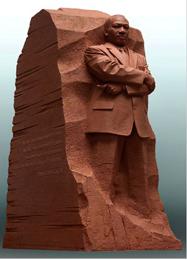
The commission may have chosen some of its words poorly. But it was on the mark when it likened the model for the memorial (top right) to the socialist realist art once found behind the old Iron Curtain. That’s fully understandable, given that the work is being crafted by the Chinese sculptor, Lei Yixin, who hails from the socialist realist tradition.

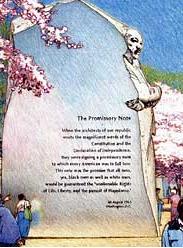
The 28-foot memorial was modeled on a photograph of Dr. King (middle right) and was supposed to remind viewers of his quiet, contemplative side. That aspect came through clearly in the concept drawing of the memorial (bottom right), which showed a likeness of Dr. King seeming to materialize out of slab known as “The Stone Of Hope.’’

The drawing is subtle, nuanced and vividly alive. By contrast, the model that raised hackles at the commission is static, off-putting and even dictatorial in style. That, the commission rightly notes, would be inappropriate as an expression of Dr. King’s legacy.
Bait and switch. I am also not a fan of the "modern" trend where the artist is more important than the subject - so you know what I think of "teh hunk."

The proposal on the left isn't all that best, I guess - but couldn't an American artist have been found that could produce something that, if nothing else, would have less sail area?

Shame; MLK deserves something a bit more dignified - and for a change, I think the powers that be agree.

Wednesday, April 30, 2008

Darken ship...

Once again, I am falling off the grid for awhile. I will be back on or about 05 MAY.

Until then, all orders remain in effect, and I will leave you with one of my favorite scenes from one of my favorite movies, Scene 58 - Hopeless, from Das Boot.

An assignment to kick off the Open Post; feel free to pick your favorite scene from the "Movies for Leaders" on the right side of the page and discuss at will.

For those who may have an interest, the poem at the end of the clip is partially quoted is "Schlacht - Das Maß" ("Battle - The Measure"), by German author Rudolf Georg Binding. In full, with an English translation for you non-FAO intellectual cripples out there....


SCHLACHT - DAS MASS

Die Erde drängt sich zitternd an uns heran.
Das Feld steht auf wie ein Mensch vom Lager.
Saaten bewaffneter Männer sprießen
aus unsichtbaren Samen
in den Furchen zutag.
Schauerlich groß blühn grünschwarze Kelche
Erdstaub und giftige Gase
allenthalben empor.
Aufgeschreckt rasend
springen Fontänen aus trockenem Grund.
Auf Feuer gekreuzigt
fahren Menschenleiber zum Himmel,
zerstieben mit einer Grimasse,
schwarze verkohlte Sterne:
Erde und Gebein.

Rauchterrassen wälzen sich über uns hin.
In schweren Wettern rauscht Eisen nieder.
Blitze tasten heran.
Donner erwürgt uns.
Heulender Abgrund bäumt sich herauf
allüberall, und die Sonne schleift
Dunkel verpestete Mähnen in unseren Atem.
Unentrinnbar hält uns der Himmel
unter sich hingebannt:
unheimliches Basiliskenauge
Über kleinem Getier.

Einsam liegen wir da in der Not der Schlacht;
wir wußten, daß jeder einsam war.
Aber wir wußten auch dies:
Einmal vor Unerbittlichem stehn,
wo Gebete entrechtet, Gewinsel zu Gott
lächerlich ist,
wo keines Mutter sich nach uns umsieht,
kein Weib unsern Weg kreuzt,
wo alles o h n e Liebe ist,
wo nur die Wirklichkeit herrscht,
grausig und groß,
solches macht sicher und stolz.
Unvergeßlich und tiefer
rührt es ans Herz des Menschen
als alle Liebe der Welt.

Und wir fühlen: dies war das Maß.

--

BATTLE - THE MEASURE

The soil trembling presses to us.
The field stands up like a man from the bed.
Crops of armed men grow
From invisible seeds
In the furrows.
Eerily big green-black goblets let
Soil dust and poisonous gases
Bloom everywhere.
Alarmdly raving
Fountains arise from dry grounds.
Crucified on fire
Human bodies go to heaven,
Burst with an antic,
Black charred stars:
Soil and bones.

Terraces of smoke roll over us.
In thunderstorms, iron rains down.
Levins feel their ways.
Thunder strangles us.
Wailing abyss rears up
Everywhere, and the Sun grinds
Dark mephitic manes in our breath.
Inescapably heaven holds us
Bound below:
Sinister basilisk's eye
Over small animals.

Sesolate we lie there in the misery of battle;
We knew that everyone was desolate.
But we also knew this:
Standing before the remorseless once,
Where prayer is futile, where canting to God
Is ridiculous,
Wher no mother looks for us,
Where no woman crosses our path,
Where everything is w i t h o u t love,
Where only reality reigns,
Gruesome and grand,
That makes firm and proud.
Unforgettable and much deeper
It touches the heart of man
Than all the love in the world.

And we felt: This was the measure.
Look forward to coming back.

Saturday, April 26, 2008

Saturday Movie Stop

Must add to the DVD collection.

For reasons best left at the foot of my chosen career, I was not able to see "The Lives of Others" when it came out - though from what I read about it made it look like something I would want to see. This review and discussion by Jay Nordlinger in National Review seals it - I will buy it for my library if for no other reason than for the man almost solely responsible for it, the writer and directory Florian Maria Georg Christian Graf Henckel von Donnersmarck.
What about Donnersmarck’s politics? He is clear and direct: “I want the government to stay as far out of my life as humanly possible.” . . .

He has a frustration shared by many: the success of socialists in portraying the Nazis as diametrically opposite them. He says that people ought to be reminded that socialism was part of the Nazis’ very name. He is against any system that forbids the individual to live his life to the full. And he is determined that Communism, in Europe and elsewhere, will not be perfumed.

“We must make sure to remember that it was a nightmare, because, as we know, ideologies do make cyclical reappearances. It’s incredibly important that we don’t allow people to romanticize Communism, and that we call it what it is: an anti-man religion, completely contrary to freedom.” . . .


He is brimming with opinions, and I ask him about the United States. Donnersmarck says, in the course of his remarks, “I really, really hope that America will not make the mistake that has so weakened Europe: looking toward the government for answers to all problems. I hope that America will continue to respect the principle of subsidiarity, which is to say: The state should do only what the individual truly cannot do on his own” — and even then, the government that acts should be the most local government possible.
His story on how he he made the move is almost important as the movie itself. Everyone said, no - and he did it anyway. A great tragedy for the acting profession - and us all - is the early death of the lead actor, Ulrich Mühe, a man who knew the evil of East Germany well.

Saturday, April 19, 2008

Costs more per pound than Skippy's ex-wife

Heck, it may be Skippy's ex-wife for all I know.

In deference to my "sensitive readers" You are warned.
1

-

2

-

3

-

4

-

5

-

6
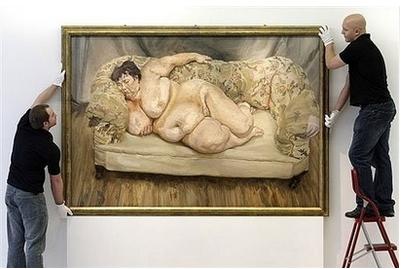
Lucian Freud's one-time muse was paid £20 a day to sit for a painting expected to fetch more than £17m.

But Londoner Sue Tilley said she did not do it for the money and had "lovely lunches" with the artist.

Freud's 1995 work, Benefits Supervisor Sleeping, looks set to become the most expensive painting by a living artist when it is sold in New York next month.
That is almost $35 million. Is that what you want covering your wall? And the model is all happy about it as well.

Like we talked about last week; art isn't anymore.

I'll take my c.
1930 80x100cm painting of St. Godarduskerk in Bekkerzeel (Beckerzeele), Belgium any day. Heck, getting that thing across the pond in one piece could be defined as art.....

Thursday, April 17, 2008

Art is everything: art is nothing

It is much harder, I think, for the "modern" art movement to reach a lower level of vacuity.
Art major Aliza Shvarts ’08 wants to make a statement.

Beginning next Tuesday, Shvarts will be displaying her senior art project, a documentation of a nine-month process during which she artificially inseminated herself “as often as possible” while periodically taking abortifacient drugs to induce miscarriages. Her exhibition will feature video recordings of these forced miscarriages as well as preserved collections of the blood from the process.

The goal in creating the art exhibition, Shvarts said, was to spark conversation and debate on the relationship between art and the human body.
When no one defends a standard, there is none. When everything is something; something does not exist.

We can talk about a few things here. First, she did not miscarry - to say so is to vomit in the face of those who have gone through a miscarriage. No, she aborted. What once was, will never be. Not by accident. Not by mistake. By deliberation. By intent.

The damage she has done to her physical and mental future is an abomination. Simple.

She will one day have to get a job. She will one day have to meet new people and friends. She will one day look for a partner in life. She will, perhaps, become a mother. She will, one day, as her mind matures and he perspective deepens - have to reflect about what others let her move forward with with a morally-neutral nod.

Though she has a curious little book out, and a background in nothing, and seem to have a thing with her body's natural cycle - you have to pause and, if it is your nature, perhaps say a prayer for her.

We can also talk about the fact that someone is paying Yale money for this; but that is a real minor issue in the end analysis.

Want a snap-shot of the cultural rot at the core of our society's "elite."

God & Man at Yale? God; indeed.
UPDATE: Allah thinks, with some sound medical perspectives, that it might be a stunt. If so, it is almost - almost as bad. Want to put a face to the damaged woman, Michelle and GatwayPundit have it. Check out Rusty as well. Awwww, what the heck. I'll let the woman speak for herself.


Not a McCain voter, I would guess. She really needs to get out and see the world a bit.

In the end, I feel more pity than anything else.
UPDATE II: Yep, hoak. Yale called her bluff, they must have found an adult. Sick chick.
Or maybe not a hoax - or a maybe hoax. Either way, sick chick.

Monday, April 14, 2008

Zut Alors!


Ahhhh; the French.

Now THAT is a first lady

Interesting background story if you are still reading,

Thursday, April 10, 2008

Kipling's return ...


Last week I saw more than a few links to Roger Kimball's article in The New Criterion, Rudyard Kipling Unburdened. He isn't talking to the demi-troll, once banned and back now and then that posts here - no, he is talking to an author that never left my top-shelf. You might have figured that out with all the Hopkirk I keep re-reading. The crux of Kimball's argument is that over the last century or so - Kipling's critics have become almost stuck as actors in a Kabuki dance. With the fading fog of Imperial Guilt - Kipling is, simply, a giant;
A good deal of intelligent commentary on Kipling operates like this. Irving Howe, for example, in his introduction to the Viking Portable Kipling, begins with the obligatory condemnation of Kipling the “tub-thumper” for imperialism, etc., but then proceeds to find numerous things to praise. His denouement is the conclusion that Kipling was “a brilliant if unacknowledged fellow traveller of literary modernism.”

This strikes me as completely wrong. Kipling was in a different game altogether. Yes, he was sui generis, but only in the way—or rather, to the extent—that Eliot himself or other “strong voice” poets (Wallace Stevens, for example) are sui generis. You can’t imagine Kipling beginning a long poem with the observation that “April is the cruellest month” (to say nothing of “Complacencies of the peignoir”). But then you can’t imagine Eliot or Stevens writing “Now this is the Law of the Jungle—as old and as true as the sky;/ And the Wolf that shall keep it may prosper, but the Wolf that shall break it must die.” Which is better, more important, more serious?

I am not sure those are answerable questions. But if Auden is correct in defining poetry as “memorable speech,” what Kipling wrote is surely poetry.
Read the whole thing. Kipling is a giant, always will be. Just because he wrote like he had a pair is no reason to smear him with post-modern gobbly-gook. BEHOLD!
IF you can keep your head when all about you
Are losing theirs and blaming it on you,
If you can trust yourself when all men doubt you,
But make allowance for their doubting too;
If you can wait and not be tired by waiting,
Or being lied about, don't deal in lies,
Or being hated, don't give way to hating,
And yet don't look too good, nor talk too wise:

If you can dream - and not make dreams your master;
If you can think - and not make thoughts your aim;
If you can meet with Triumph and Disaster
And treat those two impostors just the same;
If you can bear to hear the truth you've spoken
Twisted by knaves to make a trap for fools,
Or watch the things you gave your life to, broken,
And stoop and build 'em up with worn-out tools:

If you can make one heap of all your winnings
And risk it on one turn of pitch-and-toss,
And lose, and start again at your beginnings
And never breathe a word about your loss;
If you can force your heart and nerve and sinew
To serve your turn long after they are gone,
And so hold on when there is nothing in you
Except the Will which says to them: 'Hold on!'

If you can talk with crowds and keep your virtue,
' Or walk with Kings - nor lose the common touch,
if neither foes nor loving friends can hurt you,
If all men count with you, but none too much;
If you can fill the unforgiving minute
With sixty seconds' worth of distance run,
Yours is the Earth and everything that's in it,
And - which is more - you'll be a Man, my son!
Want to know who is the guy in the upper right hand corner? Click here. A Kipling Man if there ever was one.

No, the nay-sayers are wrong. Kipling is a giant, and deserves the credit lesser men never gave him.
If you are, like me, a Kipling fan - and you know the story of his son, you may be interested in this.