skip to main |
skip to sidebar
I typed out a rather grumpy screed about what is happening in IRQ, AFG, and generally - again - the mess the Democrats have done to the success and blood of others. From the Democrat starving of S. Vietnam in 1975 to the Carter nightmare.
So, we have it with IRQ. I'm not interested in plowing that field again ... so I'm going to go back to the year before we won the war in IRQ for a encore FbF. We can argue how Obama lost the peace later.
 How do you define sacrifice? How do you respond to loss? How do you focus pride, grief, love and honor? Do you try to take positive action in the face of a horror you never expected to face? Can you go beyond the emotional and tap into the intellectual? For today's FbF, I ask you to step back , absorb, and most of all - be humble.
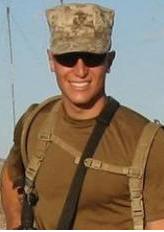
His son, Marine Lt. Nathan Krissoff, 25, had been killed in a December 2006 roadside bomb explosion in Iraq.
...
The younger Krissoff joined the Marines in 2004 with a background that might not have predicted a military career. He wrote poetry as a youngster and was an accomplished pianist.
Before graduating from Williams College in Williamstown, Mass., he was captain of the swim team, in addition to being a whitewater kayaker and alpine skier.
The outdoor activities were a joy shared by Nathan, his father, and his younger brother, Austin, 24, who joined the Marines shortly before Nathan died.
The family kept word of Nathan's death from Austin until after he graduated from the same Marine Corps officer school in Quantico, Va.
"Nate was an extraordinary man in a lot of ways," Bill Krissoff said.
Like many who have lost their loved ones in this war, they had an opportunity to meet with the Commander in Chief, President Bush.
Bill Krissoff never figured to be in a position to look President Bush in the eye and ask a favor.
But there he was, sitting in a room in Reno, Nev., with Bush and several other families who had lost soldiers in Iraq or Afghanistan.
...
"I said, 'Yeah, there is one thing. I want to join the Navy medical corps and I gotta get some help here,' " recalled Krissoff, 61, who lives in California, near Reno.
Three days after that meeting, the Navy called.
His waiver had been granted.
What waiver?
Months later, Krissoff came to a carefully considered decision: He would honor his son by leaving a flourishing orthopedic practice, a comfortable life, to join the Navy as a combat surgeon.
But his application for an age waiver was mired in paperwork.
So, on that August day in Reno, when Bush went around the room and asked if there was anything he could do, Krissoff spoke up.
That is how the CINC got involved. You get action that way.
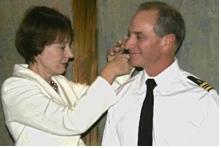
Krissoff was commissioned as a lieutenant commander Nov. 18, and he expects to attend officer development school in January. Attached to the 4th Medical Battalion, he plans to join a combat surgical team and hopes to serve in Iraq.
 It is a story of loss and sacrifice being told on national media outlets. But Krissoff considers himself anything but a hero. He reserves words like that for people such as his son.
"The loss of a son puts a certain perspective on things.
"It's my turn to serve. I'm honored and privileged that the Navy will have me in the medical corps," Krissoff said.
This was a family decision.
He and his wife, Christine, plan to sell their house and move to San Diego. They see it as another chapter in their life, perhaps a way to ease the grief they have shared for nearly a year.
"Really, I'm just inspired by the dedication to service of both my sons," Krissoff said.
Christine Krissoff, 56, has made peace with his choice as well. But it doesn't mean she won't miss her husband.
"I am not fine with the amount of time he's gone. But none of the wives of the military people who serve are going to be fine with it.
"That's just part of the deal."
His mother, Sylvia Krissoff, 88, said she was "shocked" when she learned what he planned to do. Then it started to make sense to her.
"I think, for him, it really is great. It's really an extension of his love for Nate and, in some ways, carrying on for what Nate would have done.
"Nate would have been so proud of him."
LCDR Krissoff and Christine - welcome aboard. Your response to your son's death and your other son's ongoing service is, simply, Fullbore. Thank you.
The U.S. Embassy in Baghdad is preparing contingency plans to evacuate its employees if necessary now that one of the deadliest Islamic militant groups in the region has taken control of large swaths of Iraq, a U.S. official told TheBlaze.
The State Department also warned U.S. citizens against traveling to Iraq, following several days of bloody clashes between insurgents with the Al Qaeda-inspired Islamic State of Iraq and the Levant and Iraqi military forces. ISIL has taken control of Mosul, Tikrit and Fallujah and aims to create an Islamic state across the Iraq-Syria border.
Drink America! You voted for it ... twice!
The huge upset we saw last night where House Majority Leader Eric Cantor (R-VA) was defeated in the Republican primary by an Economics Professor from Randolph-Macon College seems to have caught most people off guard - myself included. No sitting Majority Leader has been defeated in a primary since 1899.
Stay with me you members of the, "stick to naval matters" caucus - there is a lesson here for the military side of the house. First though, I want to put this out.
I like Cantor. Always have. His strange push towards amnesty concerned me, but I don't ask for perfection in anyone. However, for his constituency disconnect and his poorly run primary campaign combo, he now finds himself in the embarrassing position of being primaried by a neophyte and losing.
Why? Simple. He became "of DC" instead of serving "in DC." He lost touch with the people who sent him there; he broke sync with their needs, concerns, wants, and desire were. He used up his good will to the point that they looked past their selfish instincts - the Majority Leader has the power to take care of his district more than most - and decided to say, "No more. You're fired."
Only Cantor can say how he lost his way, but one can make an educated guess. The core of the problem is in DC itself.
I make my way to DC on a regular basis - mostly for business, but as I will for my next trip - sometimes for personal reasons. I do love the town, third only to Paris and Amsterdam - but I do love the town.
I live well out in the provinces now days, back to the family responsibilities the anonymity of naval service kept me away from for a couple of decades. I do my best to keep myself well grounded in my soil - in fits and starts I think I'm achieving that goal after playing Sailor for so long.
I am always a bit humored when I visit our Imperial City. I almost feel like some minor Freiherr from Lower Silesia coming to beseech the Holy Roman Emperor ensconced in Vienna on behalf of his burdened serfs. Don't get me wrong, again I love DC like an overly educated and slightly arrogant son of Medieval Liegnitz would love that glittering city on the Danube with its society and distractions.
Alas, like the Imperial City, our city on the Potomac is absurdly disconnected from the rest of its hither lands, and that humors and troubles me. The whole concept of what makes the economy grow, what good, hard working people have to do just to try to create a better start for their children is little more than a focus grouped sound-bite that those "of DC" think that it is.
DC is a city, not unlike Rome, where the citizens publican, plebeian, and patrician go about their days served by, cleaned up by, and pampered by a suffering underclass of mostly foreigners. Most of our nation's richest counties straddle the Beltway. The Imperial City produces nothing but patronage and power. For a nation that thinks of itself as a mercantile republic, that is not healthy.
Go out to dinner one night in DC and see how many of the servant class - outside a block or so from the various Universities - where the servants do not have English as their second language. This quasi-feudal stew is not the reality of the nation.
Like the old Imperial City, the concerns in DC are mostly power, position, and privilege. They are not, with the rare exception, service or trade. The leading families marry each other, protect each other, and do their best to keep the money coming in for their use - and their power/influence going out.
In our Imperial City, you see that dynamic happen in one area that led to Cantor's downfall. On the right, you see the Chamber of Commerce desire to keep wages low by the influx of low skilled workers who will work for wages Americans won't. From the national self-loathing Left, you see a sneering desire to replace the present voting public with their frustrating ideas of self-government and individualism, with one that is more pliant and culturally comfortable with a quasi-feudal top-down system, folded in with a tendency to stay as a group - easier to control and manipulate.
Yes, we are talking about the rolling train wreck that is immigration policy. Cantor was not just out of step with his constituency here and in other places, he was pushing back against them. Well, last night they pushed back.
Hard working middle-class Americans have seen the job market shrink and wages stagnate so much that millions have simply stopped looking for work at all. Meanwhile, their elected representatives want to expend their political capital on people who are not their constituents, not even citizens, yet will put downward pressures on the lower end of the wage scale while at the same time increasing demands on an already broke social welfare system.
No one was as shocked as he was that he lost. He has no one to blame but himself. He most likely was too influenced by the Republican Beltway consultancy class, the DC media, the "proper" social circles, the intellectually inbred conferences and think tanks - flooded with the right money - to the point that his reality, that of being "of DC," made the actual reality of those he was to represent seem to him, well, unreal and unrelateable. His constituency figured that out over the last few months - disconnected DC did not.
That gets us to our Navy. I jokingly call the huge mass of USN within a commute of DC the Potomac Flotilla. There are a lot of people who, to be blunt, spend too many tours there. Some can survive, some thrive - but most have their intellect warped by the priorities of DC, which if not properly adjusted, can soon get your priorities out of phase from the priorities of the Fleet.
From ships that no one really knows what to do with, to aircraft with no range, limited armament that in the end we cannot afford in the numbers we need, to personnel policies that act like it is still 1973 - we see it all reflected in people who have become "of DC" from spending too much time "in DC."
If you want to know where the disconnect is between policy, leadership, and the Fleet - start there. Look at the Potomac Flotilla and its annex in Millington, TN.
As the problem with a dirty, poorly run ship is not the Sailors but their leadership, the problems we are having aren't with the Fleet - the problem is with the civilian and uniformed nomenclatura of the Potomac Flotilla.
The Fleet cannot vote for its leaders, but as CDR Snodgrass has been banging the drum about - it can vote with its feet.
Make no mistake - the cohort of our leadership who has spent the balance of the last decade in DC are as out of touch with the Fleet as Cantor was with the 7th Congressional District of Virginia.
From the "you can't make this stuff up" department, let's take a little peek in to what happens when the reality meets the DC make believe.
I'm not sure what the Navy version of this will look like - but odds are the only thing that would impact our ossified leadership would be a sinking of a major combatant. So laugh at Cantor in a schadenfreudeistic manner if you wish ... just not too hard.
Cantor addressed his supporters for about four minutes at a suburban Richmond hotel ballroom, then boarded an SUV without taking questions from reporters scurrying after him.
Then it got really rambunctious. In the room of downcast Cantor allies, a new energy suddenly erupted — but not the kind they wanted on election night. A group of immigration activists stormed the ballroom, screaming and waving a flag. “What do we want? Immigration reform! When do we want it? Now!”
A few Cantor supporters tried to block the protesters’ entrance into the ballroom, and pushing and shoving ensued. And before they reached the microphone, one Cantor supporter threw his glass of wine at a female protester. She swore at him in return.
A hotel employee took the microphone Cantor had used and told the protesters in Spanish that the police were on their way.
...
Another Spanish-speaking man who was with the protesters told them that they had made their point and should follow the police direction to leave.
I dearly hope that the USMC will take care of Sergeant Major Archie - though it looks like he may have dropped his retirement paperwork.
He did what others should have done ... as a Sergeant Major should have.
I won't second guess what happened between him and his Chain of Command.
Marine Sgt. Maj. Paul Archie has tendered his resignation and voluntarily stepped down from his post as senior enlisted adviser at Parris Island recruit depot, Marine Corps Times has learned.
...
Marine Corps officials released this statement concerning Archie’s decision: “Understanding the Marine Corps has very high standards of personal and professional conduct for its most senior leaders, Sgt. Maj. Archie voluntarily stepped down as the depot sergeant major, and the commanding general regrettably accepted his retirement.”
On Thursday, Archie stopped his vehicle in front of a protest near the gates, got out and proceeded to get into a verbal altercation with a protester, Ethan Arguello, who is also a former Marine drill instructor.
The official police statement on the incident has more detail: “During argument, Archie’s head struck the campaign cover knocking it off the head of the protestor. Archie took the campaign cover and proceeded onto MCRD Parris Island.”
Police later recovered the campaign cover.
No. That does not do what happened justice. You need to watch the video.
Oh and Ethan - you have no honor you pussy.
Bravo Zulu Sergeant Major Archie. Bravo Zulu.
Words mean things. When you name things that will last decades, they mean even more. When names have the opportunity to inspire, teach, and otherwise give those who visit, work, or live - or go to war - in named things; the importance of the right name reaches a new level. That is why I get so twitchy when we do goofy things for iffy reasons when we name ships.
Not totally unrelated to ships; as unique of an opportunity it is to pick a name for a ship, it is even more rare to have an opportunity to name a building at a institution of higher learning.
Especially places that do not add buildings often, are space limited, and whose students can rise to important positions - not only are these opportunities rare, they also require careful thought.
All that bubbled to the surface when I read this from The Capital;
Legislation with $120 million for a planned Center for Cyber Security Studies at the Naval Academy could reach the U.S. Senate floor for a vote within the next month, U.S. Sen. Barbara Mikulski, D-Md., told the Naval Academy Board of Visitors on Monday.
Mikulski, who sits on the Board of Visitors and has been an avid supporter for the funding, said she expects the fiscal 2015 Military Construction, Veterans Affairs and Related Agencies Appropriations Bill, or HR 4486 to come to the Senate floor in three weeks.
...
Construction is scheduled to begin in late 2016 and be finished by late 2018. The building would be between Nimitz Library and Rickover Hall, overlooking the Severn River.
The academy also plans to break ground on a multilevel parking garage near the center in early 2015, to make up for parking spaces that will be lost when the new building goes up.
The Center for Cyber Security Studies would include labs, offices, classrooms, lecture halls, an observatory and a rooftop multipurpose space.
Nimitz on one side, Rickover on the other.
Well, there are some large shoes to fill.
OK alumni from the Severn School for Wayward Boys and Girls. A cyber security building ... whose name should be on the front, and why?
If in 1909, just five years before WWI, Norman Angell published his intellectually facepalming book, The Great Illusion .
.
In that book, he makes the argument that;
... advanced economies based on trade and contract law can only generate value in the absence of military upset. War destroys any wealth that conquerors may have wanted to obtain, making the whole enterprise pointless. A deep understanding of this would, then, end the need for war.
We all know how that turned out.
Let's see, 24 years after publication was what? There we go, 1934. What was happening in 1934? That's right, Hitler was effectively now dictator after the Night of the Long Knives, etc..etc.
So, it would seem rather silly for someone like Angell to state in the mid-30s that everyone should ignore the reality around him and still cling to his pre-Great War theories. Actually, by the mid-30s, Angell was aggressively warning all about returning German nationalism - so at least he learned from history, in a fashion.
That brings us to Francis Fukuyama. As we've covered here for years, I am not a fan of the work he has been living off of most of my adult life, his essay The End of History, and the book that followed three years later, The End of History and the Last Man .
.
Don't get me wrong, there is some solid academic work done in both, and some nice concepts ... but for the love of Pete - he is not a soothsayer or a Titan of history. You can drive trucks through all his work. He thinks he has built a brick wall of thought, but it is really just a tennis net.
Well, F2 is back, this time over at WSJ with an essay, At the 'End of History' Still Stands Democracy: Twenty-five years after Tiananmen Square and the Berlin Wall's fall, liberal democracy still has no real competitors.
Put on your goggles, and let's dive in to the whirlwind of myopia, shall we? I want to start with a "I told you so," F2 is showing some leg;
I argued that History (in the grand philosophical sense) was turning out very differently from what thinkers on the left had imagined. The process of economic and political modernization was leading not to communism, as the Marxists had asserted and the Soviet Union had avowed, but to some form of liberal democracy and a market economy. History, I wrote, appeared to culminate in liberty: elected governments, individual rights, an economic system in which capital and labor circulated with relatively modest state oversight.
Thank you for confirming what we all knew about the left during the Cold War - you weren't in it to win it - you were just standing by to join the Commissariat once they took power like the useful idiots you were/are.
It wasn't so much you didn't want to win, you just had no concept that the West could. The left still has that attitude, and I hold them still in contempt for it.
Looking back at that essay from the present moment, let's begin with an obvious point: The year 2014 feels very different from 1989.
Was the day F2 was born Year-Zero? This is the same mindset that thinks it is a crisis that the climate is changing. Good googly moogly, the climate has, is, and will always change - and jumps of 25-years will always show difference in the political state of the world.
Yes, this guy is paid for these observations. He is milking this dead goat for all it is worth.
As the foreign-policy analyst Walter Russell Mead recently wrote, old-fashioned geopolitics has returned big time, and global stability is being threatened at both ends of Eurasia.
It never left! When did it ever leave? F2 may have not been paying attention, but everyone from Poland to Bosnia has been.
So has my end-of-history hypothesis been proven wrong, or if not wrong, in need of serious revision? I believe that the underlying idea remains essentially correct, but I also now understand many things about the nature of political development that I saw less clearly during the heady days of 1989.
Yep, hindsight will do that to you - but again - the year F2 was born, 1952, was not Year-Zero.
He is like the military transformationalists. They don't see evolution and adoption - as they have never bothered to understand how both have been so successful in the past - no, they are fascinated by themselves and their own period where each new thing - new to them - is the item that will change everything in the blink of an eye. Like the teenager who think they discovered s3x.
History never ended, paused, or otherwise took a break at the end of the Cold War. It just took a turn, but those like F2 were too busy fussing with their hair in the mirror to look at where it was going. They still don't, but they seem to get a little glimpse of its shadow, but that is about it.
Huge changes have taken place in the political sphere as well. In 1974, according to the Stanford University democracy expert Larry Diamond, there were only about 35 electoral democracies, which represented something less than 30% of the world's countries. By 2013, that number had expanded to about 120, or more than 60% of the total. The year 1989 marked only a sudden acceleration of a broader trend that the late Harvard political scientist Samuel Huntington labeled the "third wave" of democratization, a wave that had begun with the transitions in southern Europe and Latin America some 15 years earlier and would later spread to sub-Saharan Africa and Asia.
The emergence of a market-based global economic order and the spread of democracy are clearly linked. Democracy has always rested on a broad middle class, and the ranks of prosperous, property-holding citizens have ballooned everywhere in the past generation.
This has been true since political and social trends were put down in the West as we crawled out of the Dark Ages ... and can be found in ancient Greek and Roman commentary as well.
Why has it "grown" as of late? Simple, the bayonet of the totalitarian leftist theory of Communism at the throat of the natural yearning for man to be free has been lifted. Where else was the needle going to go once that is lifted?
Many of the world's most stubborn bastions of authoritarianism are oil-rich states such as Russia, Venezuela or the regimes in the Persian Gulf, where the "resource curse," as it has been called, gives the government enormous revenues from a source other than the people themselves.
No. This shows F2's greatest weakness - his inability to address uncomfortable cultural truths.
The resource curse has not forced the Norwegians or Australians into authoritarianism. This has to do with the nature of the culture of the people who are blessed with resources.
Some radicals in the Middle East may dream of restoring an Islamist caliphate, but this isn't the choice of the vast majority of people living in Muslim countries. The only system out there that would appear to be at all competitive with liberal democracy is the so-called "China model," which mixes authoritarian government with a partially market-based economy and a high level of technocratic and technological competence.
When have those cultures ever enjoyed the freedom of the will of the people inside a democratic structure? At best, post-Colonialism they were given one man, one vote ... and then decided, "one time."
The "China Model" is quite attractive, but it is just a different flavor in the authoritarianism-totalitarianism spectrum of societies.
Wait ... do I find common ground?
Democracies survive and succeed only because people are willing to fight for the rule of law, human rights and political accountability. Such societies depend on leadership, organizational ability and sheer good luck.
Well, knock me down with a feather - I agree. Democracies also tend to commit suicide ... but that is a different topic for a different day, perhaps.
The biggest single problem in societies aspiring to be democratic has been their failure to provide the substance of what people want from government: personal security, shared economic growth and the basic public services (especially education, health care and infrastructure) that are needed to achieve individual opportunity. Proponents of democracy focus, for understandable reasons, on limiting the powers of tyrannical or predatory states. But they don't spend as much time thinking about how to govern effectively. They are, in Woodrow Wilson's phrase, more interested in "controlling than in energizing government."
Oh, so close. He dodges the cultural aspect of it. Government is best where it governs least as that mitigates the dark-couple side of human nature - corruption and power.
If you have a small to medium sized, relatively homogeneous people with a healthy civil society, you can have largish governments. Large heterogeneous nations? Never can make it work.
He also does not seem to want to accept that it takes a long time for a culture that has never lived under democratic systems to work on it long enough for it to grow roots. It rarely happens in the life of one man.
Had an effective democratic administration come to power, cleaning up corruption in Kiev and making the state's institutions more trustworthy, the government might have established its legitimacy across Ukraine, including the Russian-speaking east, long before Mr. Putin was strong enough to interfere. Instead, the democratic forces discredited themselves and paved the way for Mr. Yanukovych's return in 2010, thus setting the stage for the tense, bloody standoff of recent months.
India has been held back by a similar gap in performance when compared with authoritarian China. It is very impressive that India has held together as a democracy since its founding in 1947. But Indian democracy, like sausage-making, doesn't look very appealing on closer inspection. The system is rife with corruption and patronage; 34% of the winners of India's recent elections have criminal indictments pending against them, according to India's Association for Democratic Reforms, including serious charges like murder, kidnapping and sexual assault.
Perfect examples. They are working on it.
Our republic had its challenges as well - but we're getting there and we have a few centuries head start on these two ancient cultures, but young nations.
Here is where F2 really shows not just his ankles, but his leftist anti-American a55;
Americans, more than other people, often fail to understand the need for effective government, focusing instead on the constraint of authority. In 2003, the George W. Bush administration seemed to believe that democratic government and a market-oriented economy would spontaneously emerge in Iraq once the U.S. had eliminated Saddam Hussein's dictatorship. It didn't understand that these arise from the interaction of complex institutions—political parties, courts, property rights, shared national identity—that have evolved in developed democracies over many decades, even centuries.
The inability to govern effectively extends, unfortunately, to the U.S. itself. Our Madisonian Constitution, deliberately designed to prevent tyranny by multiplying checks and balances at all levels of government, has become a vetocracy. In the polarized—indeed poisonous—political atmosphere of today's Washington, the government has proved unable to move either forward or backward effectively.
He totally does not get that inefficiency is a feature, not a bug. Effective governments line obedient subjects along slit-trenches to get bullets in the head. Unconstrained authority imprison millions for thought crimes and commit genocide on personal whim.
There is a reason why we are a young nation, but a relatively old republic. It has to do with the constraints on power in the Constitution.
Though the U.S. economy remains a source of miraculous innovation, American government is hardly a source of inspiration around the world at the present moment.
That is because the international self-appointed elite are in love with their own pursuit of power and control, and the self-loathing of the balance of our own intelligentsia. Self-governing republics are an anathema to those who want the EU to just be an adjunct to the UN and SCOTUS to be a mid-point to the ICC. Talk to the young in Iran, and the US system doesn't seem too bad. Ask those in labor camps in the Chinese deserts.
A second problem that I did not address 25 years ago is that of political decay, which constitutes a down escalator. All institutions can decay over the long run. They are often rigid and conservative; rules responding to the needs of one historical period aren't necessarily the right ones when external conditions change.
Decay? Was the decay in post-WWII Britain caused by "rigid conservatives?" No, Socialism and labor unions (yes, I'm being redundant). Was the Weimar Republic crumbled by "rigid conservatives?" No, it was the Communists and National Socialists who did them in. As a matter of fact, the only effective opposition to the Nazi were the "rigid conservatives" of the old German nobility. The various French Republics fell by "rigid conservatives?" Do I really need to go on?
Again, back to F2's self-referential Year-Zero issue;
... the power of the democratic ideal remains immense. We see it in the mass protests that continue to erupt unexpectedly from Tunis to Kiev to Istanbul, where ordinary people demand governments that recognize their equal dignity as human beings. We also see it in the millions of poor people desperate to move each year from places like Guatemala City or Karachi to Los Angeles or London.
The first part has always been true throughout history. In the Anglosphere, just open your aperture a bit and you can see the same drive and trend from the English Civil War to the American Revolution.
As for the second part, again F2 dodges the cultural problem. He is an intelligent man, so I'll be courteous and say it must be for ideological blindness reasons that he won't address the problem.
Even though - is anything he uses as a benchmark date from before the year he was born?
Francis Fukuyama; still negative help to aspiring intellectuals everywhere; to good thought what these guys are to good music.


.png)


