Proactively “From the Sea”; an agent of change leveraging the littoral best practices for a paradigm breaking six-sigma best business case to synergize a consistent design in the global commons, rightsizing the core values supporting our mission statement via the 5-vector model through cultural diversity.
Remember, our NATO allies in Europe have a greater population than we do. They also have a GDP about the same as ours. And yet, they will not make a full effort to defend themselves. As if it was last century, they still think that the USA has to do the primary lifting. Heck, we keep having the same instinct.
The United States needs more forces in Europe, Supreme Allied Commander Europe Gen. Curis Scaparrotti said during a hearing at the US House of Representatives Armed Services Committee on Thursday.
"In terms of rotational versus permanent, I do believe we need more forces in Europe, I don’t think we are at the posture that I believe appropriate or required yet," Scaparrotti said. "And because of that, I think that there are some permanent forces that I would like to have."
No, that is not the answer. The rest of NATO has to continue to strive to get better. Especially when most economies are strong and the Russians are expanding capabilities, there is no excuse. There is a lot on this topic NATO's Secretary General report for 2017. First, to be fair - things are getting better on the margins - but faster please.
Allies have made significant progress in meeting these goals. After years of defence cuts, the trend over the last three years has been one of increased defence spending.
In 2017, the trend continued, with European Allies and Canada increasing their defence expenditure by almost 5%. Many Allies have put in place national plans to reach 2% by 2024 and are making progress towards that goal. In real terms, defence spending among European Allies and Canada increased by 4.87% from 2016 to 2017, with an additional cumulative spending increase of USD 46 billion for the period from 2015 to 2017, above the 2014 level.
In 2017, the United States accounted for 51.1% of the Allies’ combined GDP and 71.7% of combined defence expenditure. At the same time, European Allies and Canada increased their spending, helping to redress the balance.
In this report is another metric that brings you a level deeper. For old NATO hands, another of the problems is with how our allies spend their money. For some nations, their military is little more than a parade and garrison force. Sure, they have some numbers, but they have little to no functioning kit. We saw this in spades in AFG where planes of allied forces would arrive, but would go hat in hand for equipment. I like this chart a lot.
Look at it close, it tells a great tale. The further you get from the center, the more you fit the following assumptions; If you are in the top-right grid - you are doing your share or more, and have something to fight with. If you are in the upper-left - you have something to bring to the fight, but you are not spending your fair share. If you are in the lower-right, you are spending a lot, but it is mostly on bodies. If you are in the lower-left, not only are you a welfare queen, you are sitting in a hammock wearing nothing but shorts, a t-shirt, and flip flops while your neighbors are working to keep the wolf at bay. The American tax payer does not need to spend money borrowed from its grandchildren to subsidize Europe's defense more than it already is. Keep spending until you reach 2% or more, then you can afford your own maneuver forces. No need to send more American brigades over there. If you need us for a fight, we'll be there - but you need to do your fair share now - in peace. Do that, and we probably won't have to come over by the hundreds of thousands ... again.
...in student politics when the wolf is at your institutional throat? Hell yes, and take the Air Force with you for support. Story over at USNIBlog. There will be hippies, commies, and paleo-soyboys crying, so come for the fun.
While the Navy is grumping a lot over upgrading its force, something has happened over on the USCG side of the house. Digging around for change in the sofa, picking up a few items their neighbors left on the curb, dropping a few things off at the neighborhood mechanic & body shop, and a little good luck - the USCG has some nice new kit, especially in the air. It is a good time to be a USCG aviator; Craig Collins has a nice summary.
Much public attention has been paid to the Coast Guard’s new generation of surface assets – the Legend-class national security cutters (NSCs), the Sentinel-class fast response cutters (FRCs), and the Heritage-class offshore patrol cutters (OPCs) – but perhaps less so their counterparts in the air.
...
The new generation of the Coast Guard’s long-range surveillance and transport aircraft, for example, the HC-130J Super Hercules, is a nose-to-tail overhaul of the previous generation of HC-130Hs, with new Rolls-Royce turboprop engines, composite scimitar propellers, and digital avionics. These upgrades have increased the range of the aircraft by 40 percent and its top speed by 15 percent, while decreasing its takeoff distance by 15 percent. But the aircraft’s most important enhancement may be its suite of command, control, communications, computers, intelligence, surveillance, and reconnaissance (C4ISR) components, which combine radio and digital transmission of voice and data.
...
Over the past decade, the Coast Guard has been phasing out its older HU-25 Guardian, a high-speed medium-range aircraft that was finally retired from service in 2014. Its replacement, the HC-144 Ocean Sentry, was phased in at Coast Guard air stations beginning in 2009. The Ocean Sentry was a marked improvement, offering the Coast Guard the ability to remain on scene and track targets for longer periods of time – up to 10 hours – with improved sensor capability and room for more passengers. ...
The Coast Guard fleet of 102 Dolphin helicopters, meanwhile, is in the final segment of a similar incremental upgrade, a transformation into MH-65E short-range recovery helicopters. The -E series features new radar, EO/IR sensors, and a CAAS cockpit similar to the Jayhawk’s.By 2014, the service had acquired 18 Ocean Sentries, and the HC-144 was logging more flight hours annually than any other Coast Guard aircraft.
The Coast Guard’s original plan called for a fleet of 36 Ocean Sentries – but this plan was altered when Congress, in the National Defense Authorization Act of 2014, directed the service to cease its HC-144 program and instead acquire and missionize 14 C-27J Spartan aircraft, to be transferred from the U.S. Air Force. The Ocean Sentry and the Spartan are twin-engine turboprops, similar in configuration – according to Kimball, the Spartan is faster, with greater range, endurance, and lift capability – and will play similar roles in medium-range surveillance.
...
...beginning in 2007, the Coast Guard began an overhaul of its 42 Jayhawk helicopters, converting them from HH-60Js into multimission MH-60Ts. This upgrade, which was completed in 2014, ...
Uncertainty. In training, equipping and manning your Navy for the next war, the further you get from the last time you fought the kind of war you will fight next, the more uncertainty there is on how it will be fought. You can guess, you can surmise, you can do your best to wargame and benchmark similar wars – or vignettes of war – to help guide you on the path towards making sure the young men and women you will call on in the future to perform violence on your behalf will be given what they need to win. War is always a dark room. Regardless of how much you prepare, you will quickly find that you have things you don’t need, things you have some but not enough of, other things you need now that you had no idea would be that important, or the most infuriatingly those things you need but foolishly (in hindsight) left behind. For the entirety of human history, this has been true. The only thing that is certain at the outbreak of war is uncertainty. That is why in peace you need an open and aggressive exchange of ideas. You need brutal honesty. You need rigorous testing with an eye to victory at war. When you become focused on other things, you only amplify the error differential that grows each year between what you think you will need and what you will really need. As a natural part of this process, in peace you are always looking for that bit you don’t know you need – that “known unknown.” That search puts some people over their skis when it comes to technology. DDG-1000 and LCS along with other legacies of the Age of Transformationalism that peaked 15-yrs ago are perfect examples of this. Sadly, the recognition of this excessive dismissal of technology risk seems to have spawned a few unnecessary reactions, reactions that are encouraged by some who see such reaction as a benefit towards the defense of the empires they have built to protect their legacy ricebowls. This dynamic is best seen in the very clunky progress – or lack of it – in the Unmanned Aircraft Systems (UAS) area. UAS are not new; they date back well over half a century. Advances in materials, communications, computing, and the promise of AI in the last decade have been an accelerant enabling UAS to perform missions not previously realistic UAS mission sets. There is a broad spectrum of opinion of UAS, from the “must have a man in the loop at all times” school to the “let loose the AI gods of war” school. At least today, I am somewhere in the middle. Using the template of UAS in the strike role as a reusable TLAM, I think we should be aggressively moving towards strike options. UAS as a tanker? A good first step so we can work out the kinks of having these in the airwing. Over the last six months I’ve detected a drift. If anything, a bit of a retreat. If nothing, we seem to be intentionally backing away from experimentation – forward leaning but clear-eyed experimentation that can help us mitigate that error that comes from the “known unknowns.” Now that we’ve wandered in to Rumsfeldland with knowns and unknowns, I’d like to bring up a follow-on to that famous press conference from a decade and a half ago – the concept of “unknown knowns.” From Errol Morris’s 2014 documentary, “The Unknown Knowns”
Confused? It’s ok, - most people are. Here are Rumsfeld’s two definitions not quite in alignment with each other - but they work;
“Things that you possibly may know, that you don’t know you know.”
“Things that you think you know, that it turns out that you did not.”
-Donald Rumsfeld
Either way, the whole concept is illuminating. Here’s another take on it from Slovenian Psychoanalytic philosopher Slavoj Žižek;
…the things we don't know that we know-which is precisely, the Freudian unconscious, the "knowledge which doesn't know itself," as Lacan used to say.
There is a lot more than engineering, science, money, and politics in getting UAS right. No one has the right answer. There are some – usually on the extremes – who have the wrong answer, but the right answer is out there. The only way to get to the right answer is that creative friction that comes from open, direct, and aggressive discussion about needs, wants, strengths, and weaknesses. Priorities and prejudices. Motivations and desires. When it comes to UAS, Jerry Hendrix stepped up to the plate today in National Review to bring this discussion back above the natsec ambient noise. In a surprise visit towards the end of yesterday’s Midrats, Jerry gave us a heads up about the article coming out, and I’ve been pondering it through the day and decided to push out the post I was going to do today to the right and instead fold it in to some broader broodings I was having over the weekend outlined above. Jerry goes a bit further and faster than my preferences with UAS, but his points are solid and well deserve a full reading and considerations. Here’s a few pull quotes for you to ponder;
...to fight and win within the emerging great-power competition. This new environment, at last recognized in President Trump’s National Security Strategy and the Secretary of Defense’s National Defense Strategy, requires the Navy to strike enemy capitals and other vital centers of gravity from range, but the Navy’s decision to bypass a carrier-based strike asset, and now even to push off its acquisition of an unmanned mission tanker, suggest that it is not taking A2AD great-power competition seriously. Its decisions place the future relevance of the entire maritime service, at least as it is presently composed, at risk.
Green eye-shade decisions drift from complacency spiced up with a lot of arrogance and an environment where professional excellence was seen as victory over "competing" community platforms are the primary cause of our retreat from not just defense in depth, but attack from a distance. These were all deliberate decisions. Professionals who should know better gleefully danced on the grave of the VA community and then the F-14 community. There is a lot of Beltway squid ink to explain why, but the best explanations are best explained by marriage counselors, psychologists, and high school Vice Principals. The short picked-on kid wound up on top of a mountain made on the bodies of those who used to tease him - and others who were easy pickings. We went from the slightly insecure, "No slack in light attack," to "All we have is light attack because we killed and ate the rest." And so, on our Hornet and Super Hornet filled, monoculture airwings, we have this;
The average unrefueled range of the aircraft embarked on super carriers during the 1950s was over 1,200 miles, allowing those aircraft to conduct missions deep into the Soviet Union, but somehow in the post–Cold War generation the Navy forgot the lessons of World War II and, by retiring long-range aircraft such as the F-14 Tomcat, A-6 Intruder, and A-3 Skywarrior without analogous replacements, allowed the average strike range of the aircraft embarked on the super carriers to decline to less than 500 miles, pulling the super carriers back into the threat range of those who would make themselves enemies of the United States.
Like the decision to abandon the heavy fighter/strike "Super Tomcat" and organic tanking, we once again find ourselves willfully blinding ourselves to our weakness. We are setting ourselves up to repeat the fears during the Guadalcanal campaign of the safety of our only viable carrier in the area, USS Saratoga (CV-3). We will save her by making her combat ineffective, damaged, or exhausted for much of the early campaign - letting the battle be fought by the rest of the fleet at a freighting cost in men and ships.
For some reason, despite the obvious statement of importance assigned to great-power competition and balancing capabilities and capacity in the face of A2AD challenges in recent strategic documents, the Navy has assigned little priority to the development and production of the MQ-25 aircraft, which is placed at the far end of the current five-year budget and not expected to reach initi,al operational capability until 2026. Perhaps this is because the original impetus for the mission-tanker program, the need to relieve pressure on the Super Hornet inventory, has been relieved by congressional decisions to restart the FA-18E/F production line. In fact, the Navy seems so comfortable with its fighter-attack-aircraft inventory that it has made the decision to retire or “strike” 140 older aircraft ahead of schedule to avoid the higher costs associated with maintaining them. Perhaps the Navy is unsure of whether it needs an unmanned tanker at all, or perhaps it wishes to forestall its final commitment to the program until it has come to a better understanding of its future requirements.
Carriers are what they have always been - your most effective offensive platform and your hardest platform to defend. Time-distance can amplify what is good or bad depending on what you put on that carrier.
The real strategic challenge facing the Navy is a requirement for penetrating deep strike from the carrier deck. The Navy needs a new aircraft to perform this mission. Given the mission profile, a range of 1,000 to 1,500 miles out and then back, the density of A2AD surface-to-air defenses, and the ten-hour-plus flight duration, the aircraft should probably be unmanned. The Navy should not forget the lessons of World War II that Admirals Mitscher and McCain wrote down after they lost multiple carriers while operating well inside Japan’s then-advanced A2AD environment. At $12.9 billion apiece, our modern carriers are too dear to the force fiscally and strategically to risk against the current threat.
The Navy would be well served if it were directed to return and review the requirements associated with the UCAS-D program ten years ago and refocus its efforts on creating a new unmanned, all-aspect stealth aircraft that is capable of operating from the carrier deck and hitting targets deep inside enemy territory. If the Navy does not take these steps, it will risk allowing its carrier force and, in fact, its entire accompanying surface fleet, to lapse into strategic irrelevance.
"...ten years ago." To use a measurement of time I coined three years ago, what is that, something like 2.5 worldwars ago?
Now that we're near the end of 2QFY18, it's time for another Midrats Free-For-All! This Sunday from 5-6pm Eastern join us as we cover the latest developments on the maritime and national security front. If you have topics you would like us to address, send them to us on twitter at @cdrsalamder or @lawofsea, join the chatroom while the show is live ... or even call in.
Chris Cavas mentioned this to us last Midrats. I think it pretty much speaks for itself. This in not your father's China ... as we've been warning people here for years.
Remember: nothing is routine. No watch is standard. Combat will not wait for you to be ready.
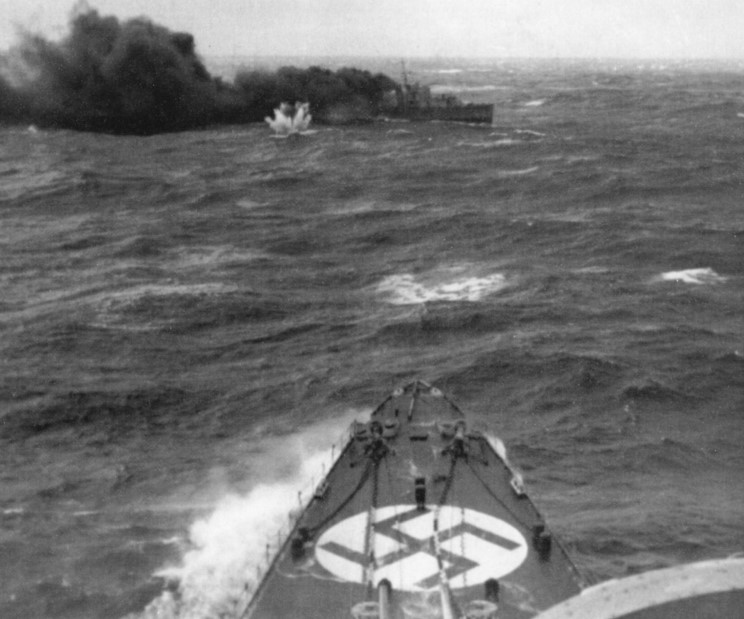
Place yourself on watch on the HMS Glowworm. You still are not happy going on liberty with "Glowworm" on your cover, but your nation is at war - and you suck it up. You have been detached from the main formation to look for a man overboard that in this water you know must be dead by now. After longer than you should, you give up the search and turn to return to your Task Force. You just received your second cup of tea for this watch....
...the Glowworm sighted a destroyer who when challenged, identified itself as Swedish. It was in fact the German von Röder class destroyer, Bernd Von Arnim, which very quickly opened fire, to which Glowworm responded. Unfortunately another German destroyer, the Paul Jakobi soon appeared. However, the Von Arnim was packed with invasion troops and soon both it and the Paul Jakobi turned and fled into a rainsquall. Lt Cdr Roope gave chase despite guessing that they were trying lead him onto their main force in an attempt to discover there whereabouts and inform the Admiralty.
Hiding in the showers, eh? Well, good Skipper, you head in as well - not to let Jerry get away from a proper battle. Then...
As the Glowworm emerged from the squall she came face-to-face with 14,000 ton the German Heavy Cruiser, Admiral Von Hipper armed with eight 8 inch and twelve 4 inch guns. The Glowworm laid smoke and conducted torpedo attacks from the cover of the smoke screen but failed to hit the Hipper. Glowworm had sustained substantial damage by this time and Lt Cdr Roope gave the order 'Stand by to ram'. The Hipper, realizing what was happening tried to turn and ram the Glowworm but was too slow. The Glowworm tore into the starboard side of the Hipper amidships and tore 100 feet of armour plating away, damaged her starboard torpedo tubes and punctured two fresh water tanks. After ramming the Hipper, Glowworm drew clear, but received another close range salvo from the Hipper to which the single gun, commanded by Petty Officer Walter Scott responded. Glowworm by this time had sustained massive damaged and started to sink and Lt Cdr Roope gave the order to abandon ship. He went down to open the sea cocks himself and the ship started to sink, forcing men into the freezing water or onto her bow.
In the very Navy way the Germans fought at sea in WWII for the most part,
The Captain of the Hipper, Helmuth Heye, gallantly stayed for over an hour picking up survivors. He positioned Hipper so that the tidal currents would carry the survivors too them. All the personnel on deck helped with hauling survivors aboard but many were too exhausted to make the final effort of climbing up the ropes and ladders and slipped away, including Lt Cdr Roope who helped many of his men to get life jackets on and to get to ladders. Out of a crew of 149, only 31 survived, the only officer being Lt Robert Ramsey. The prisoners were treated well by the Germans who congratulated them on a good fight, and Captain Heye told the men that their Captain was a brave man.
You want class? Need 'professionalism' defined? I present to you two men, LCDR Roope and CAPT Heye (later VADM).
Later, Heye sent a message through the International Red Cross recommending Lt Cdr Roope for the Victoria Cross, the only time in British history that a VC has been recommended by the enemy. The survivors spent the rest of the war as PoWs and afterwards, Lt Ramsey was able to return home and tell the whole story. The story was published on the 10th July 1945, in the Fourth Supplement to the London Gazette for Friday, 6th July 1945. As a result, Lt Cdr Roope was awarded the Victoria Cross, Lt Ramsey the Distinguished Service Order and three other ratings received the Conspicuous Gallantry Medal.
Fullbore
Encore edition from 29DEC06. UPDATE:This painting is better - and here and here are actual pictures taken from the HIPPER during the attack. First posted DEC10.