Tuesday, December 08, 2009

Three SEALS and MILJUS - A Primer

As the case of the OBJECTIVE AMBER SEALs' case moves forward, I asked the Salamander Staff JAG to put out a quick post to make sure everyone had a good foundation of where things stand from a JAG's perspective.

I know many of you already know how the process works, but there is a lot of bad gouge floating around out there - and I wanted my readers to have a clear view.

Without further embelishment .... JAG, over to you.

The three Navy SEALS accused of detainee abuse were first referred to nonjudicial punishment. Non-judicial punishment or "NJP" is a low level form of dicipline for minor offenses. Punishments at NJP vary by rank and include foreiture of pay, reduction in rate, restriction, confinement on bread and water, extra duties, and other similar punishments. In the military, service members not assigned to or emarked upon a vessel have a right to refuse non-judicial punishment and instead demand a trial by court-martial.

In the military system, there are three types of courts-martial: summary, special, and general. A summary court-martial is for minor offenses and has substantial limits on punishment. Additionally, while the rules of evidence apply, the rights of the accused are substantially less at a summary than in other forums. Like a non-judicial punishment, the accued has a right to
refuse trial by summary court-martial. A special court-martial is loosley equivalent to a midemeanor court. The rules of evidence apply, and the accused has a right to counsel. Punishment for enlisted sailors is capped at one year confinement, reduction to E-1, forefeiture of 2/3 pay and allowances and a bad conduct discharge. It also carries a federal criminal
conviction. A general court-martial is equivalent to a civilian felony court. Based on my reading of the news articles on this case, it appears their case has been referred to a special court-martial.

Two of the three SEALs have been arraigned, with a thrid arraignment to be scheduled at a later date. Arraignemnt is the first appearance of the accused before the military judge and it stops the "speedy trial clock". In essence, at arraignment the government is announcing it is ready to proceed to trial. At arraignment the accused will either enter a plea, or reserve
pleas and forum for a later date. At this time it appears the two who have been arraigned have plead not guilty, and will select forum at a later time. As to forum, as enlisted sailors, each has a right to be tried either by military judge alone, or by military jury members with no less than one third enlisted members.

Typically, in a case involving an NJP refusal, the fact the accused refused NJP is inadmissible. It will be difficult in this case to find local jurors who are not already aware of this fact, as the case has been so nationally publicized.

How is that Global Maritime Partnership working for you?

International naval forces will never be able to completely secure the vast area of ocean where Somali pirates are hijacking ships off East Africa, the commander of the EU Naval Force's counter-piracy efforts said Tuesday.
...
The naval commander said the Maran Centaurus was traveling east of an area that the EU Naval Force advises tankers to steer clear of, so that it wouldn't necessarily have expected to have been attacked. Pirates now hold 11 ships and 264 crew members off the coast of Somalia, said Rear Adm. Peter Hudson.

"The news of a few days ago of a 300,000-ton tanker being seized is illustrative of the problems in protecting and policing an area of the world's oceans that amounts to an area of about 1 million square miles," said Hudson, the commander of the EU Naval Force's counter-piracy operations.

Hudson also said the fact that pirates are now attacking ships as far as 1,000 miles (1,600 kilometers) off the Somali coast presents a large challenge and that the EU force will never fully secure such a large area. The EU Naval Force's strategy in the smaller Gulf of Aden is to lengthen the amount of time it takes pirates to get on board so that a warship or helicopter can be dispatched to the scene.

"The difficulties in an area as large as it is in the Indian Ocean with the short number of assets that we have is that ... the pirate can keep going and keep going and keep going until it's successful in getting on board, because there's nothing there to stop it," he said.
Poor excuse. What weak cheese.

That being said, what did you expect from the EU?

Clearing waters of pirates was done over 200 years ago using wooden sailing ships with limited ISR ... it can be done today. All it takes is will.

Having worked with the EU military structures in Strasbourg .... I can tell you that you won't find the will there.

Not that it means other less supine organizations can't try.

One of the good guys, SACEUR (nee Admiral Stavridis) is
passing the hat.
Adm. Jim Stavridis, new Supreme Allied Commander Europe (SACEUR), said here Dec. 7 that "more ships would be helpful" to counter piracy off Somalia but that "what I'm really after is maritime patrol aircraft, NATO AWACS [Airborne Warning and Control System] and satellite images."
Bingo.

A big, fat, slow Maritime Patrol and Reconnaissance aircraft is about as nonthreatening as you can get. Even the EU shouldn't have trouble getting the vapors from using them. We won't even make them carry weapons.

So, what is ADM Stavridis asking for? First of all, outside some "special" UAS out of The Seychelles - let's go ahead and acknowledge that all the UAS are off doing AFG business. Let's stick with manned aircraft - and cheat by using Wikipedia for our J2.

So, you want a NATO anti-piracy ISR "surge?" How would you do it?

Sticking to large, fixed-wing, long range Maritime Patrol and Reconnaissance aircraft for planning purposes, let's see what we can do. Well, the French have about 22 Atlantique II/III. The Italians I think retired their antique Atlantiques - I can't find an up to date reference - so I guess the Italians can go get a coffee then. The Germans bought the Dutch P-3s and have about 16. Portugal has five, and Spain a half dozen or so P-3s. The Brits have a dozen Nimrods that are still limping around, and even the Norwegians have a half dozen P-3s left.

Expand the scope, and you might even get an Aussie or Kiwi P-3 to help out. In a perfect world, the Japanese would bring theirs out ... but I doubt it.

Enough to choose from. Now, where do they go?

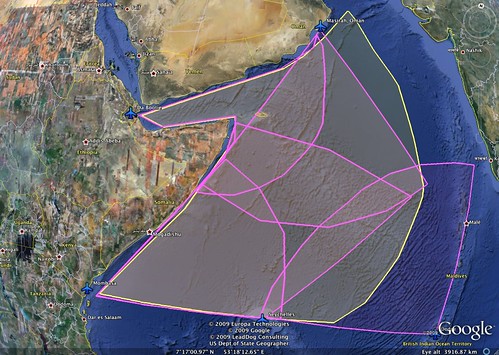
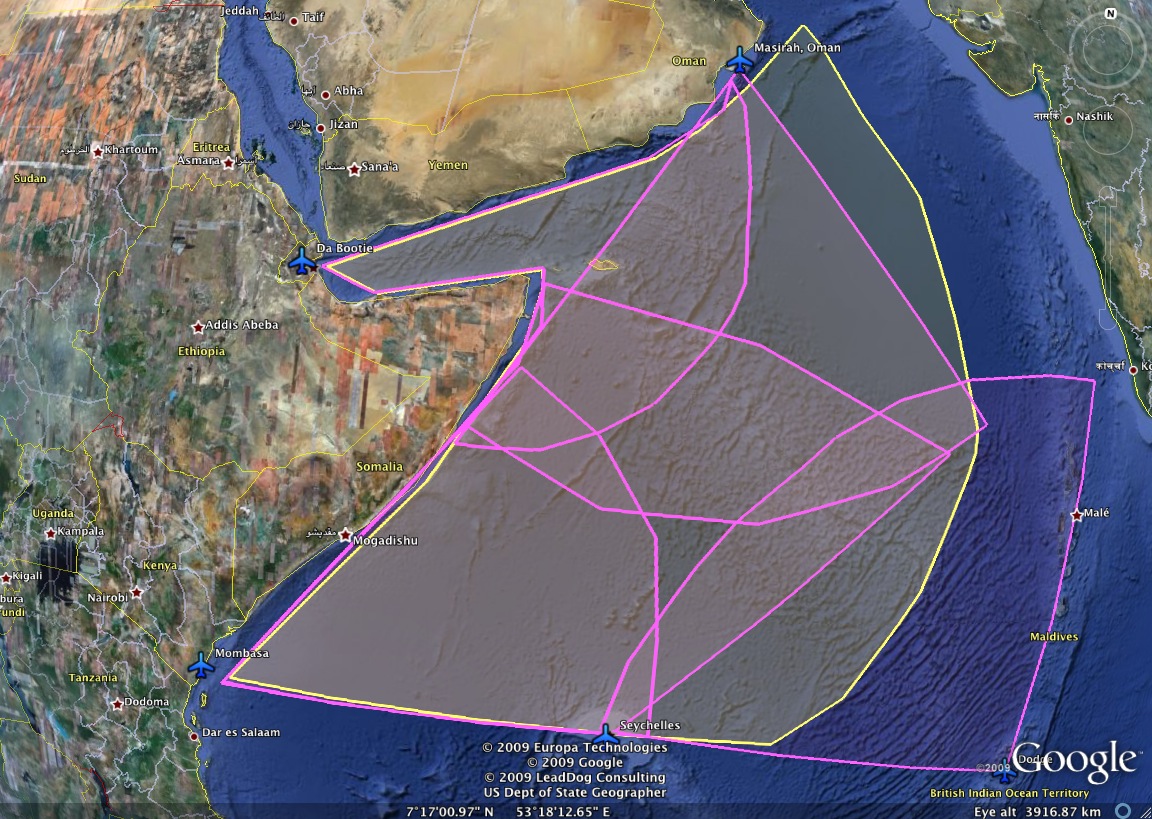
Between Mombasa, Masirah, Dodge, Seychelles, and "Da-bootie" there are plenty of places to park them if you can get the host nations to buy in .... from there all it takes is the Europeans finding the OPTAR. Good luck with that. Everyone is short of money, and one thing MPR aren't are cheap.

The French could take Da-bootie, the Germans have a good history flying out of Kenya - and of course we and the Brits know Masirah like the back of our hands. Ditto Dodge and The Seychelles.

AW1 & MTH, help me out here in case I am totally out of order. What do you need now days to make two missions a day? Three to make two?

OK, I'm digging deep in my brain here - so don't be too picky.

I've had a little fun with GoogleEarth. There are ADM Stavridis's basing options. Only Dodge belongs to a NATO nation - but Da Bootie should be a shoe in via the French and our history with them. From there, in decreasing likelihood of getting an OK; Kenya, Seychelles, and Oman.

From each base I have put a roughly 1,000 arch (in P-3 pink) as the plane flies (yes, you can cover more our of Masirah - don't be so picky I am a one man shop and was in a hurry). The yellow area is a roughly 1,000nm range from the coast of Somalia; pirate country. Here is the map (larger one here.)


Again, AW1 & MTH - help me out. Let's rough out an average of 9-hrs per mission. It would take what, 3 hrs to get to a 1,000 mile onstation point (let's work realistic worst case missions - though some will be much closer to base)? Assume that you don't enter and exit at max distance even for the long runs. Round trip 5 hours. That gives you 4 hours on-station time a mission, minimum (as some missions would be much closer - and with modern EO/radar you don't need to fly by everyone). You guys tell me how much area you could cover in the IO with 4-hrs in 2009. I'll keep moving.

If each base could cover two missions a day - that would be 8-hrs onsta per base. If "3 makes 2" and you have 5 bases operating, that would be 15 P-3s to make 10 missions a day giving the anti-piracy commander (if they could ever get unity of command, which they don't right now) 40 hours a day of MPR onstation time.

We are dealing with NATO here - so best case you get 7 non-USA MPR aircraft flying from two locations giving you 3 missions a day. To fill the gap, you would need a full USN P-3 squadron flying out of two other to do the rest - and even then - you won't get the balance of missions. You might get 4 to 5 from USA. That is 3+5=8 missions, 32 hours a day of MPR onstation time best case. That is one big body of water. When you add it all together - figure a 1,700nm x 1,200nm area for planning purposes. To compare - the Caribbean is about 800nm x 1,400nm

NATO gets Da Bootie and Kenya. USA gets Dodge and Masirah - we'll leave The Seychelles to the snake eaters. That would leave a triangle shaped gap in coverage about 400NM north of The Seychelles - but the surface ships and helos could over that.

So, what 'cha think for a few minutes of pondering? Did I earn a per diem check?

A Very Berube Christmas

This week's Christmas book recommendations come from Claude Berube, a teacher in the Political Science Department at the Naval Academy.

Obviously not medicated enough as a child or an adult, he has well exceeded his quota of "Top 5."

Being that I share his faults, I won't hold it against him - mostly because his recommendations, every one of them, demand your consideration.

Not only does he love books, he also writes them. His first book was A Call to the Sea: Captain Charles Stewart of the USS CONSTITUTION.

He’s co-authored another on Congress,
Congress: Games and Strategies. He’s been published in Naval History, Proceedings, Vietnam, Orbis, The Christian Science Monitor, Small Wars Journal, and others.

A Lieutenant Commander in the Navy Reserve, he deployed in 2004-05 with Expeditionary Strike Group Five participating in tsunami relief in Sumatra, maritime interception operations in the Arabian Sea, and anti-piracy operations off Somalia.

The rest of the post is his.

Two years ago, I interviewed via email CDR Salamander, Eagle1, Lex, Galrahn, and Steeljaw Scribe for an article that was published in Proceedings, “The Navy Can Handle the Truth: Creative Friction without Conflict.” Phib has called in that chit and asked me to post my top five Navy and/or leadership books that I recommend this Christmas. I’m hoping Eagle1, Lex, et all will give me a pass.

Normally, I’d suggest starting with Thucydides’ The History Of The Peloponnesian War, but it’s usually required reading in one course or another. Still, this is a book that never gets old – literally or figuratively. This should already be on any military officer’s bookshelf and regularly consulted. A natural companion to it might be Barry Straus’ The Battle of Salamis: The Naval Encounter that Saved Greece -- and Western Civilization.

For my top five, in no particular order other than chronological, I’ve opted for big picture books about major periods and conflicts rather than leadership-specific books, since lessons can be derived from any of these.

Empires of the Sea: The Final Battle for the Mediterranean, 1521-1580 by Roger Crowley.
I realize that an earlier reviewer from the Naval War College recommended Empires at Sea but this book is so good that I felt it worth repeating. I came across this book when I was travelling in the UK last year. How many naval campaigns have a central figure like Don Juan about whom Mozart wrote an opera, Lord Byron wrote a poem, or Moliere wrote a play? Or the Ottoman Barbarossa whose name struck fear into contemporary coastal towns along the Mediterranean or centuries later when used by Hitler in a major operation? Or admirals like Andrea Doria after whom ocean liners have been named? The characters are as rich as the organizations like the Knights of St. John or the empires who had this earlier clash of civilization. This was an era that created legends, yet is little studied today. The decades-long conflict between the Ottoman Empire and Christian Europe is a tale of changing alliances, strategies, and leaders, all culminating in the Mahanian Battle of Lepanto. In addition to the campaigns and understanding control of the Mediterranean, it helps students of the defeat of the Spanish Armada understand the conditions by which Spain ultimately decided to attack the English fleet in 1588.
A fantastic segue from the previous work. In his introduction, Padfield writes: “Of course maritime supremacy offers no clue to the profounder questions of the spirit, pure philosophy o ethics, or to the directions in which we may be carried by venal science. It cannot explain our terrifying hubris as a species. It is, however, the keyto simpler questions: our faith in democracy, personal freedoms and human ‘rights,’ and the other comforting prescriptions of the humanist liberal credo, stem from the supremacy of maritime over territorial power.” The author discusses the importance of both trade and a naval force to maintain maritime supremacy. What happens when the wealth of a nation disappears and with it it’s ability to trade? It is a gentle reminder when we become too complacent with our own country’s rich maritime heritage or the economy that drives it to grow or into the ground.

Six Frigates: The Epic History of the Founding of the U.S. Navy by Ian Toll.
Here’s what I wrote, in part, in my review for The Journal of the Early Republic a couple of years ago:
Toll’s work offers a new depth of understanding of the Navy and the country’s history. In addition to America’s early naval engagements, Toll pays equal attention to the vital but largely ignored congressional debates and political involvement, without which there would not have been a Navy. This book includes the stories of the six ships, whose launchings were sometimes less than spectacular or auspicious; the ship designers and builders (Humphreys, Penrose, and Fox), who were not immune to differences of opinion; and the members of Congress who opposed or funded these projects... His multi-disciplinary analysis of the foundations of the U.S. Navy deftly takes the reader from the Federalist Papers to the halls of Congress to the wharves of Philadelphia; he guides the reader from public opinion debates to woefully underestimated shipbuilding projects (the last being a perennial issue through U.S. history). Toll’s vivid accounts of everyday life, such as the 1793 yellow fever epidemic in Philadelphia, which had a ten percent death rate, reminds the reader of the late historian Barbara Tuchman’s prose. The story of the creation of the Navy and its early adventures is already riveting; Toll’s writing style makes it doubly so.
Lincoln and His Admirals by Craig L. Symonds.
Symonds brings a heck of a lot to the table: impeccable research, the ability to get to key points, a great narrative, and more. Plus, he more than most historians understands the mid- to senior naval officer corps since he taught them. Though he retired from the Naval Academy several years ago, Symonds taught midshipmen naval history for decades so he knows how to get his points across – and they’re now the audience for all of these books who are making or will be making major decisions. Another reason to read this work is that naval operations and leadership during the Civil War largely play second fiddle to primarily land-based operations and the generals, most of whom are more familiar to readers than the admirals, a rank that did not exist in the U.S. Navy until after the first year of the war. How admirals dealt with their Commander-in-Chief and vice versa during a war has many lessons for today’s and tomorrow’s leaders.

The Two-Ocean War: A Short History of the United States Navy in the Second World War by Rear Admiral Samuel Eliot Morison.
I’m not sure how many naval officers have time to read Morison’s fifteen-volume History of United States Naval Operations in World War II. Fortunately, they can read his condensed single volume. Morison was an accomplished sailor when he wasn’t teaching, but with the outbreak of war, he convinced President Roosevelt to give him a commission in the Navy Reserve so that he could write about naval operations from the front lines instead of an academic office.

If you’re still looking for a few others, here are some suggestions:

Christopher McKee’s A Gentlemanly and Honorable Profession: The Creation of the U.S. Naval Officer Corps, 1794-1815.

James Robbins’ Last in Their Class: Custer, Pickett and the Goats of West Point (although not a naval book, the author wrote an accompanying article about the anchormen of the Naval Academy; he has an interesting thesis and tells a great tale).

Arthur Herman’s To Rule the Waves: How the British Navy Shaped the Modern World (P.S.).

Small Boats, Weak States, Dirty Money: Piracy and Maritime Terrorism in the Modern World (Columbia/Hurst) by Martin Murphy should be required reading for all junior officers. I can’t think of a single more comprehensive volume about piracy and maritime terrorism. This is not light reading and Murphy’s research is impeccable. But this work spells out in detail the background of two asymmetric threats.

Geoffrey Till’s Seapower: A Guide for the Twenty-First Century (Cass Series, Naval Policy and History) (2009 edition).


Monday, December 07, 2009

Shipbuilding goes Salamander

Let's review a few of the Salamander fundementals, shall we?

- Evolutionary wins over revolutionary.
- Technology demonstration on proven platforms first - then on new hulls.
- Good beats perfect.
- Spread you eggs around many baskets.
- PPT lie, even if people don't.
- Costs estimates are low balled.
- Actual manning requirements will be greater.
- Do not assume budgets will increase to meet expanding per-unit costs - expect smaller budgets instead.
- Configuration control with block upgrades.

Well, that is a few of the fundamentals we have discussed over the years ..... and if you want to see what cold water feels like on the face;
behold!
The Navy will kill the CG(X) cruiser program and instead develop new warships based on the design of Arleigh Burke-class DDG-51 destroyers, according to a draft report the service is preparing for Congress.

The long-term shipbuilding report, due to Congress in February, says unaffordable cost estimates and immature technology doomed the CG(X) program, which was supposed to fill a critical role in integrated air and missile defense. Inside the Navy reviewed a copy of the draft, which is labeled "for official use only -- pre-decisional information -- not for release outside the Navy."
Yes, I know. Pre-decisional ... but let's keep going because I am enjoying the "I told you so" nature of it all; kind of.
The Navy's fiscal year 2009 budget plan called for buying the first CG(X) cruiser in FY-11, but eight months ago Defense Secretary Robert Gates announced officials would delay the program to revisit its requirements and acquisition strategy. This summer, Chief of Naval Operations Adm. Gary Roughead asserted the Navy might still buy CG(X) cruisers.

"I would say that CG(X) could be the next surface combatant," the admiral told reporters June 30 after a speech in Washington, DC.

But that is not going to happen, according to the new draft report.

Due to "the ship's projected high cost and [the] immaturity of its combat systems technology and design, the Navy has determined that it is not in the department's best interest to pursue CG(X) procurement," the report states.
...or they could have just read CDRSalamander for the same answer. And no, I am not really enjoying ... well, in a schadenfreude kind of way; maybe. I wish I were wrong, but here we are in a corner we painted ourselves in. We have to come to solutions - we have to turn to the realists.

Let's roll around in the awesomeness some more, shall we?
"However, it will be critical to pursue the technology development and combat system design for application on a smaller combatant such as a DDG-51 variant," the report continues.

The new move to kill CG(X) follows the Navy's dramatic decision last year to truncate the Zumwalt-class DDG-1000 destroyer program. The DDG-1000s were intended to support integrated air and missile defense but the service decided it was more affordable and efficient to restart the DDG-51 program.
Why? Because no one in leadership for the last decade had a command climate that allowed smart, sharp, and honest engineers - civilian or military - to stand up and say, "Just wait a g0d@!mn minute! That vignette is BS, your technology PPT thick, and your cost estimates are produced by vaporware!"

We have those guys in The Pentagon, we have them at NAVSEA. We have those EDOs and Program Managers. These guys get it - and know it a lot better than I do. But they are muffled by the dead hand of short-term leaders, dead weight SES, and the smothering layers of bureaucracy that blands all and promotes happy talk. Those guys have sure talked to me though over the years - but their concerns were crushed by a culture that promoted personal loyalty over institutional loyalty - their hearts are broken, but they soldier on.

Also, good leaders were fed bad information by consultants with financial conflicts and poorly led staff officers who were terrified of being the junior guy contradicting the senior guy who owned paper on them. They also know what would happen if they were blamed for putting the spike in the forehead of ADM XXXX's pet project.

We. Knowingly. Did. This. To. Ourselves.

Do not blame Congress; do not blame industry - if you have 4-Stars, blame yourself.

Then take action.

We need to change a culture from what we have right now that gives us this result - tough decisions are pushed to someone else's PCS cycle, the Fleet suffers, and the taxpayer is left holding the bag. No one believes anything we say.

We need to fix the process that produces bad shipbuilding programs or this will happen again. All programs have challenges, but the epic fail of LCS and DDG-1000 (the argument could also be made to include the Tiffany Amphib LPD-17 too) in this decade should get the attention of someone to make the changes needed. Vince Lombardi leadership - back to fundamentals. Maybe we are getting there.

Solutions in DEC of O9, eh? Hey, this sounds Salamanderesque,
The Navy is buying nine DDG-51s from FY-10 to FY-15 and anticipates adding an integrated air and missile defense capability to new DDG-51s as early as FY-16, the report states. These upgraded DDG-51s will be modifications of the current design, combining the "best emerging technologies" aimed at further increasing integrated air and missile defense capabilities and providing a "more effective bridge between today's capability and what had been planned for CG(X), the service writes.


While the Navy has "much work" to do to determine the final design, the service envisions the DDG-51 variant having "upgrades to radar and computing performance with the increased power-generation capacity and cooling required by these enhancements," the report states. The report also states procurement of a new class of DDG(X) destroyers will begin in FY-23 "and is anticipated to be a modification to legacy ship designs."
Sad thing is - the Arleigh Burke is an old design. We could have a new hull now to build our next generation of cruisers - but we pi55ed away a decade chasing transformational shadows and expended our institutional capital with Congress supporting systems, and changing our story every FY, that were faulted at birth by bad conceptual thinking.

As a result, we are having to make sub-optimal decisions. Strange, the lack of accountability of it all.

Norman from over a year ago,
The most likely, near-​​term alternative to the DDG 1000 is to resume construction of the Burkes. The Navy now has 62 in the fleet and under construction. The former CNO, and now Chairman of the Joint Chiefs of Staff, Admiral Mike Mullen, has declared repeatedly that the Navy does not need additional Burke–class ships. And, restarting that line and updating the ships would give them a price tag of about $2 bil­lion each. (The Burke original design dates from 1979.)
Sad, and not that elegant.

Currents

An economist on vulnerability

There is a tendency in our planning to confuse the unfamiliar with the improbably ... Furthermore, we made the terrible mistake ... of forgetting that a fine deterrent can make a superb target. ... We were so busy thinking through some 'obvious' Japanese moves that we neglected to hedge against the choice that they actually made...

-Dr. Thomas C. Schelling, Professor of Economics
Harvard University
1962. Introduction to Roberta Wohlstetter's, Pearl Harbor: Warning and Decision
Today, I would like you to internalize this lesson of 07 DEC and ponder how it applies today. There is more then one place - and most of them do not involve an enemy in a conventional form. Ponder.

Sunday, December 06, 2009

Cleaning up after the boss ...

The chaos that the CINC put out there at West Point is slowly being repaired by the SECDEF, SECSTATE, and in this case by COMCENTCOM, Gen. Petraeus.

The way he explains it here - though in a literal sense is in conflict with what the CINC said at West Point and what Gibbs said later - it all makes sense from a military planning perspective, and sounds correct.

I think later this week I will post, if I get some time, on what "Transition" means in military speak for the wider audience. It is a very well understood concept - and fully meshes with what Petraeus says. Once you understand that - and can see the details woven in the below clip - you will see that the plan in back on track.

Now, if we can only convince our allies to trust the word of the underlings over his boss.