Yea, this is a tad late - but oh, so sweet.
Hat tip Bryan.


3 hours ago
Have you been in an airport recently and maybe seen a gaggle of America's heroes returning from Iraq? And you've probably thought, "Ah, what a marvelous sight. Remind me to straighten up the old 'Support Our Troops' fridge magnet, which seems to have slipped down below the reminder to reschedule my acupuncturist. Maybe I should go over and thank them for their service."Read it all, my post on it last week, and the PowerLine posts, then click the Stolen Valor tag at the end of the post to see - this is all part of a standard, normal Course of Action of the Left. If we are all basket cases, then our opinions and ideas and deeds are just as unworthy of a sane world.
No, no, no, under no account approach them. Instead, try to avoid making eye contact and back away slowly toward the sign for the parking garage. You're in the presence of mentally damaged violent killers who could snap at any moment.
You hadn't heard that? Well, it's in the New York Times: "a series of articles" – that's right, a whole series – "about veterans of the wars in Iraq and Afghanistan who have committed killings, or been charged with them, after coming home." It's an epidemic, folks. As the Times put it:
"Town by town across the country, headlines have been telling similar stories. Lakewood, Wash.: 'Family Blames Iraq After Son Kills Wife.' Pierre, S.D.: 'Soldier Charged With Murder Testifies About Postwar Stress.' Colorado Springs: 'Iraq War Vets Suspected in Two Slayings, Crime Ring.'"
Obviously, as America's "newspaper of record," the Times would resent any suggestion that it's anti-military. I'm sure if you were one of these crazed military stalker whackjobs following the reporters home you'd find their cars sporting the patriotic bumper sticker "We Support Our Troops, Even After They've Been Convicted." As usual, the Times stories are written in the fey, more-in-sorrow-than-in-anger tone that's a shoo-in come Pulitzer time:
"Individually, these are stories of local crimes, gut-wrenching postscripts to the war for the military men, their victims and their communities. Taken together, they paint the patchwork picture of a quiet phenomenon, tracing a cross-country trail of death and heartbreak."
"Patchwork picture," "quiet phenomenon."… Yes, yes, but exactly how quiet is the phenomenon? How patchy is the picture? The New York Times found 121 cases in which veterans of Iraq and Afghanistan either "committed a killing in this country, or were charged with one." The "committed a killing" formulation includes car accidents.
Thus, with declining deaths in the war zones, the media narrative evolves. Old story: "America's soldiers are being cut down by violent irrational insurgents we can never hope to understand." New story: "Americans are being cut down by violent irrational soldiers we can never hope to understand." In the quagmire of these veterans' minds, every leafy Connecticut subdivision is Fallujah and every Dunkin' Donuts clerk an Abu Musab al-Zarqawi.
In 2008, the editors of the Times, our college professors and Hollywood celebrities, are horrified by a fiction. Faced with a historically low cost of war, they retreat into fantasy. Who's really suffering from mental trauma? Who needs the psychotherapy here?No, I won't give them the easy out. My vote, as is my nature, is when you find yourself under attack - you go on the attack. Fixed fortifications (family, good will, mythology of the people's support) are monuments to the stupidity of man. Attack, attack, attack, attack.


I was walking out of a grocery store recently when a homeless man approached me and said, "Excuse me sir, I'm trying to buy some food. Can you help me out?" After talking to him for a few minutes, I discovered that he was a Vietnam War veteran. I gave him a few dollars knowing that my humble contribution might help him eat today. But what about tomorrow?I only repeat those stats because Chaplain Key did - but I don't buy them?
...
Veterans make up one in four homeless people in the USA, though they are only 11% of the general population, according to The Alliance to End Homelessness.
There are myriad reasons for these dismal numbers: limited access to affordable housing, inadequate health care and employment instability. But many cases are fed by the fact that displaced and at-risk veterans often live with the lingering effects of post-traumatic stress disorder or substance abuse. These are the hidden costs of fighting a war.
Support for Defense Secretary Robert M. Gates' criticism of other NATO members' performance in Afghanistan appeared from an unexpected source yesterday — a European defense specialist who is closely linked to senior NATO officials.
"Mr. Gates is absolutely right," said Giles Merritt, director of the Security and Defense Agenda, an influential military think tank in Brussels which counts NATO Secretary-General Jaap de Hoop Scheffer among its patrons.
"It's quite clear that the Europeans as a whole have not lived up to their commitments [in Afghanistan]," Mr. Merritt said in an interview.
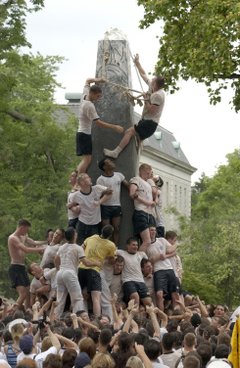
In the name of safety, the U.S. Naval Academy is considering an overhaul of one of its most bizarre traditions: the annual ritual in which a thousand first-year midshipmen struggle to conquer a 21-foot granite obelisk coated with 200 pounds of lard.That is a statement worthy of the United States Naval Academy about one of its iconic traditions? Pathetic; unless you hate an institution and want to remake it in your own image. Then this is brilliant. You can only change an institution if you destroy its connection to its past?
The Herndon Climb has occupied a hallowed place in Naval Academy tradition for decades. For members of the plebe class, the climb represents what a former midshipman called "our final exam of all finals." The starter gun fires, and the plebes, working together, race to replace a blue-rimmed sailor's cap, known as a "dixie cup," with a midshipman's cap.
The scene is unforgettable to those who watch, as the sweating, grunting, red-faced midshipmen at the bottom, their arms linked, support a human pyramid surging to the top of the monument. The pyramid often collapses, but the plebes invariably make it to the top whether it takes them minutes or hours.
But at the ever-changing academy, the climb may be going the way of the sailing ship and the smoothbore cannon.
"Similar to how our Navy looks at all traditions in the Fleet, we are evaluating the Herndon Monument Climb to ensure the event remains a valid part of our heritage but it is conducted with professionalism, respect, and most important, safety in mind," the academy's public affairs office said in a statement.
Alumni scoffed at the risk of someone's getting hurt, especially given the school's mission to prepare officers for combat.Once again, there are a lot of reasons I counsel NROTC and OCS This just makes my case stronger. Supe, time to fire someone.
"It's not dangerous. That's a lame excuse," said Dwight Crevelt, who made it to the top of the monument in 1976. Crevelt never graduated from the academy, because his eyesight went bad after two years at the school. But his memory of scaling the mud- and lard-spattered obelisk -- and the week of glory that followed as he was feted like an admiral -- remains strong.
"It's the wrong move to make," Crevelt said. "You're trying to build team spirit, camaraderie, and that's the ultimate in team effort. . . the team going after that."
Herbert McMillan, a 1980 graduate who became an airline pilot and Annapolis politician, also opposes a change.
"We're going to send these guys to war but they can't climb a monument because they might get hurt? Come on," he said. "It just seems like a solution in search of a problem."


