Showing posts sorted by relevance for query Keane. Sort by date Show all posts

Tuesday, September 09, 2008

THAT is top cover


First two things: you always have to be careful with Woodward's version of history, and no one can call Woodward a Bushie.

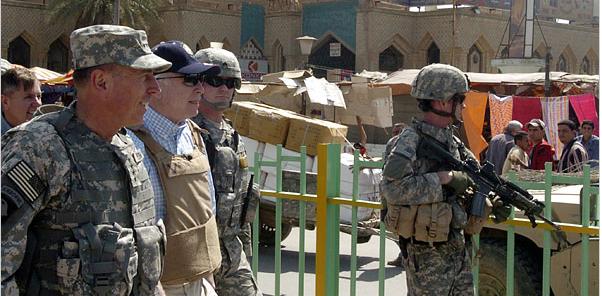
What you do have in the excerpt in the WaPo pushing his next book, The War Within: A Secret White House History 2006-2008 , is a demonstration of the exemplary kind of wartime leadership (yes, I give President Bush credit for that) of President Bush and retired US Army General Jack Keane.
As Keane was laying out his view, President Bush walked in.

"I know you're talking to Dave," Bush said to Keane. "I know that the Joint Chiefs and the Pentagon have some concerns." The JCS had not favored the surge of 30,000 troops that Bush had decided was essential to quell the escalating violence in Iraq; the chiefs were deeply worried that the surge left no strategic reserve for an unexpected crisis elsewhere.

Keane repeated what he had just told Cheney: The JCS and Adm. William J. Fallon, Petraeus's boss at Central Command, were insisting on studies and reports to justify even the smallest request for more resources for Iraq. Their persistent pressure, pushing Petraeus for a faster drawdown, was taking its toll.

"There is very little preparation," Keane said, "for somebody who grows up in a military culture to have an unsupportive chain of command above you and still be succeeding. You normally get fired." The result, he said, is that Petraeus "starts to look for ways to get rid of this pressure, which means some kind of accommodation."

Bush said he wanted Keane to deliver a personal message to Petraeus from his commander-in-chief. After Bush laid out his thoughts, Keane went to the large West Wing lobby, sat among the couches and chairs and wrote out the president's words.

Then he called Petraeus and said they had to meet.
...
* * *

On Saturday, Sept. 15, Keane went to Quarters 12-A at Fort Myer in Arlington, where Petraeus and his wife, Holly, maintained Army housing while he was stationed in Iraq. Ever since Petraeus had taken over as the Iraq commander, Keane had been making regular visits to Baghdad to see his protégé. Upon his return to Washington, Keane would come to the White House or the vice president's residence, establishing a line of communication -- Petraeus to Keane to Cheney and Bush -- around the official chain of command.
This says so much about Gen. Keane.
The two men sat alone. Keane took out the piece of paper and read the president's message, verbatim, aloud to Petraeus:

"I respect the chain of command. I know that the Joint Chiefs and the Pentagon have some concerns. One is about the Army and Marine Corps and the impact of the war on them. And the second is about other contingencies and the lack of strategic response to those contingencies.

"I want Dave to know that I want him to win. That's the mission. He will have as much force as he needs for as long as he needs it.

"When he feels he wants to make further reductions, he should only make those reductions based on the conditions in Iraq that he believes justify those reductions. These two concerns that we are discussing back here in Washington -- about contingency operations and the needs of the Army and the Marine Corps -- they are not your concerns. They are my concerns.

"I do not want to change the strategy until the strategy has succeeded. I waited over three years for a successful strategy. And I'm not giving up on it prematurely. I am not reducing further unless you are convinced that we should reduce further."

It was a message of total support. No ground commander could ask for more. That Bush had sent it through this back channel, or even at all, revealed the depth and intensity of disagreements between the president and the military establishment in Washington.

After hearing the president's message, Petraeus told Keane, "I wish he'd tell CentCom and the Pentagon that." These were the people he had to deal with every day, and they had a very different perspective.
The next bit gives you a look into some of the petty turf battles that plague GOFO DC - being a foot soldier in some of these battles, this one actually seem substantive in comparison, but petty in a time of war it is.
The senior military leadership in Washington, though unaware of the extent of Keane's role, was uncomfortable with his frequent visits to Iraq and his influence at the White House.

Gen. George W. Casey Jr. was one of them. After serving as Iraq commander for two years, he had handed over the job to Petraeus in early 2007. Casey was now Army chief of staff and a member of the Joint Chiefs. It was a promotion and a kind of soft landing, but he had left Iraq feeling he had lost Bush's confidence.

In the summer of 2007, Casey was at Walter Reed Army Medical Center in Northwest Washington, waiting for a routine physical, when he spotted Keane standing in line at the radiology desk.

The two generals locked eyes for a moment, then Keane turned away, as if he hadn't recognized Casey.

"Hi Jack, how are you?" Casey said, extending his hand. He had been waiting for a moment like this. "Has the chairman called you yet?"

"No, why?" Keane asked.

"Because we feel -- the chiefs feel -- that you are way too out in front advocating a policy for which you're not accountable. We're accountable. You're not accountable, Jack. And that's a problem."

Keane said he had taken action as a member of the secretary of defense's policy board, whose members were supposed to offer their independent advice. All he was trying to do was help Petraeus, he said. "I supported this strategy for three years when a lot of other guys didn't," Keane said, referring to Casey's strategy to build up the Iraqi security forces in hopes of a speedier withdrawal of U.S. troops. "And at some point, I no longer could support it. I'm not operating as some kind of Lone Ranger."

"It's not appropriate for a retired general to be so far forward advocating a policy that he is not responsible or accountable for," Casey said again.

"I'll take your counsel," said Keane, but he didn't suggest he would act any differently.
ADM Mullen, CJCS, does not come out very good here at all.
The following month, Keane heard through the Pentagon grapevine that Adm. Michael Mullen, who had replaced Gen. Peter Pace as JCS chairman, had told colleagues that one of his first plans was to "get Keane back in the box."

Keane arranged an appointment with Mullen.

"This is a difficult session for me," Mullen said, "but I don't want you going to Iraq anymore and helping Petraeus."

"What the hell? What are you talking about?" Keane asked.

"You've diminished the office of the chairman of the Joint Chiefs," Mullen said. It wasn't clear to the American people who was actually in charge of the military, he said.

"C'mon, stop it," Keane said. "The American people don't even know who the hell I am. This is Washington, D.C., stuff. You can't be serious."

"Yeah, I am," Mullen said.

Keane tried to tell Mullen how his contacts with the White House had begun, how he had gone to Pace and Defense Secretary Donald H. Rumsfeld in late 2006 with his complaints about the Iraq war strategy and had wound up meeting with the president because Pace and the vice president had recommended that Bush hear from Keane directly.

Mullen, formerly chief of naval operations, had not favored the surge; Keane had, publicly and vocally. Mullen told Keane he had become acutely aware of the strains on the Army and the Marine Corps. Military families were shouldering the strain, and the military was losing quality officers.

"Mike, all of that's true," Keane said. "But this is true every time we fight a war of any consequence." Wars break armies, and they have to be put back together, he said. That's the price of war. But the price was worth it. "You've not talked one time about winning here, Mike. Not one time have you mentioned 'I want to win in Iraq.' I mean, do you?"

It was an insulting question to put to a fellow military man.

"Of course I want to win," Mullen said.

"I assume you do," Keane replied, "but to the degree that you're putting pressure on Petraeus to reduce forces, you're taking far too much risk, and that risk is in losing and not winning."

"Well," Mullen said, "we're just going to disagree."

"You really don't want me to help Petraeus?" Keane asked. "Dave Petraeus, no matter who he wants to talk to over there, no matter what size he is, shape he is, what his views are, given Petraeus's responsibility -- he's got the toughest job anybody in uniform has -- why wouldn't you let him have that?"

"No," Mullen said, "I don't want to take the chance. I don't want you to do it."

End of meeting.

Afterward, when Keane found that he couldn't get clearance to go to Iraq, he called John Hannah, Cheney's national security adviser, to report what had happened. Shortly afterward, Keane received a call from Army Lt. Gen. Skip Sharp on Mullen's staff.

"We have an unusual request," Sharp said. "We have a request from the White House to provide assurances that General Keane will be able to visit Iraq and assist General Petraeus as he has been doing in the past." Sharp was apparently doing some staff work before passing the request to Mullen. "This is really bizarre. Do you have any idea why this would be happening?"

"Yeah, of course," Keane said. "I've been told I can't go."

"Who told you that?"

"The chairman." There was a long silence. Finally, Keane said, "Skip, are you there?"

"I'm trying to figure out what the hell is going on," Sharp said.

Keane later spoke with Lt. Gen. Peter Chiarelli, senior military assistant to Defense Secretary Gates.

"The secretary has received some notes," Chiarelli said, so now the secretary and his office were telling everyone, "General Keane, as in the past, as well as in the future, can go into Iraq to assist General Petraeus whenever they want it to happen. We have no problem with any of that."

Who sent the notes?

There were two, said Chiarelli -- one from the vice president and another from the president.
There is also a bit of depth to the story of ADM Fallon that puts Fox in a good light as a professional who knows when he has become a problem, not a solution. BZ to him.
In early March 2008, Esquire magazine published a long article by Thomas P.M. Barnett, a former professor at the Naval War College who had traveled with Fallon to the Middle East. Headlined, "The Man Between War and Peace," the 7,500-word article was mostly laudatory but portrayed Fallon as "brazenly challenging" Bush and Cheney on Iran policy.

Fallon, who was in Baghdad, realized instantly the uproar it would cause. He called Gates.

"I think I need to be gone," Fallon said.

"Okay," Gates said.

Later that afternoon, Gates went before the television cameras. "I have approved Admiral Fallon's request to retire with reluctance and regret," he said. "Admiral Fallon reached this difficult decision entirely on his own. I believe it was the right thing to do even though I do not believe there are, in fact, significant differences between his views and administration policy."
Much more here. Much more. I'm going to keep up with the series, though may not comment on it again. I am still suspicious of Woodward, but I will give him a chance here.

On a similar note, William McGurn in the WSJ finds some interesting nuggets.
The same might be said of the one truly original take offered by Mr. Woodward. This is his curious assertion that it's not the surge that has produced the great reduction in violence in Iraq. The reduced violence, he says, is the result of the increased lethality of covert operations against terrorist leaders and operatives.

Which brings up two interesting points. First, we are led to find fault with a president allegedly obsessed with a "kill the bastards" approach to Iraq. But then we are asked to accept that the reason we're now seeing success in Iraq because we're . . . killing the bastards.

Second, the surge was a shift in mission, not simply an addition of five brigades. Until the surge, we had pursued a political solution, hoping that the answer to Iraq was the rise of a democratic government that would persuade Iraqis to come together for their future. The surge, by contrast, finally recognized the obvious: Until Iraqis started feeling safe in their own homes and neighborhoods, there would be no compromise or rebuilding.

Sophisticates have never liked Mr. Bush for his preference for words like "win" and "victory" to describe what America is trying to do in Iraq. And if Mr. Woodward's latest contribution is any clue, they'll never forgive him for doing something even worse: proving it can be done.

Tuesday, January 29, 2008

Bush, McCain and the Surge


A very important piece out by Fred Barnes in the Weekly Standard. It is a very accurate bit, from my POV, of how the Surge was born. It is good that much of this is now coming out. There were small public hints we could share early, but so much more waits to be discussed that you just have to wait to become public record to comment on.

Though only mentioned in one paragraph, I put McCain in the title of this post because you have to give credit where credit is due. In the area of victory in Iraq, few if any have been more right than Sen. McCain (R-AZ). Full stop. End the discussion. Fact. Everything else is mindless politics.

I have no problem saying that as a lapsed Romney guy, Rudy voter, anti-Huckabee Evangelical, (l)ibertarian Dennis Miller Conservative (mostly I guess), but one that tries to keep a VDH sense about things. I am not a McCain guy, that is for sure ... but ..... this steadfastness alone would ensure that if in the end it is him against Obama or Clinton - he will get my money and vote in '08.

Anyway, let's get back to Fred's bit. I want you to read it all, but here are the meaty bits that got attention from my highlighter.
Inside his own administration, Bush had few allies on a surge in Iraq aside from the vice president and a coterie of National Security Council (NSC) staffers. The Joint Chiefs were disinclined to send more troops to Iraq or adopt a new strategy. So were General George Casey, the American commander in Iraq, and Centcom commander John Abizaid. Secretary of State Condoleezza Rice favored a troop pullback. A week earlier, the Iraq Study Group, better known as the Baker-Hamilton Commission, had recommended a graceful exit from Iraq.
He did have some support from the rank and file though.
"If you're going to be a bear, be a grizzly."
Almost the title of this post, but a good concept to use in this line of work - or any for that matter.
"One of the most important jobs of a commander in chief, and particularly in a time of war, is to be thoughtful and sensitive about the U.S. military," he said. Bush believes in persuading the military to embrace his policies rather than simply imposing them. In fact, a senior Pentagon official said Bush hoped the military would use the interagency review to push for a surge on its own. That didn't happen. The chiefs preferred the status quo, which meant sticking to a strategy of training the Iraqi army and leaving it with the job of defeating the insurgency.
Not a shocker. Very few bold ideas will come out of the JCS. Any idea goes through too many filters to get there, and except for the rare bird, no one in this still peacetime military make it that far by being anything but status quo cautious.

Want to know why LTC John Nagl (USA A) is punching out at 20? Simple. Unlike WWII where you could make Col. before your 35th birthday (no JPME req'd); the conveyor belt mentality of peacetime promotion still rules. Sad, but he can fight better in suit and tie in 2008.
Bush agreed that strain was a problem. Then he delivered a sharp rejoinder, touching on a theme he returned to in nearly every meeting on Iraq. "The biggest strain on the force would be a defeat in Iraq," he said. Winning trumped strain. To alleviate the strain, the president committed to enlarging the Army by two divisions and increasing the size of the Marine Corps. The chiefs had two more complaints. The military, practically alone, was carrying the load in Iraq. Where were the civilians from the State Department and other agencies? Again, Bush agreed with their point. He promised to assign more civilians to Iraq. (The number of provincial reconstruction teams was soon doubled.)
Same question many of us have been asking for years. Still a great untold story.
After the bombing, NSC officials were increasingly dubious. They weren't alone. General Keane kept in contact with retired and active Army officers, including Petraeus, who believed the war could be won with more troops and a population protection, or counterinsurgency, strategy--but not with a small footprint. At the American Enterprise Institute (AEI) in Washington, a former West Point professor (and a current WEEKLY STANDARD contributing editor), Frederick Kagan, was putting together a detailed plan to secure Baghdad. But the loudest voice for a change in Iraq was Senator John McCain of Arizona. He and his sidekick, Senator Lindsey Graham of South Carolina, traveled repeatedly to Iraq. McCain badgered Bush and Hadley with phone calls urging more troops and a different strategy. Together, McCain, Keane, Petraeus, the network of Army officers, and Kagan provided a supportive backdrop for adopting a new strategy.
This is the McCain paragraph. Read it again. He has been a lion here. Give him all the credit he deserves.
The four-man panel wasn't stacked. Kagan spoke in favor of additional troops and outlined his plan for pacifying Baghdad with a "clear, hold, and build" strategy. American soldiers, along with Iraqi troops, would do the holding, living in Baghdad and guarding its citizens, Sunni and Shia alike. Robert Kaplan, the foreign correspondent and military writer now teaching at the Naval Academy, talked about successful counterinsurgency campaigns in the past. (Kaplan's books are among Bush's favorites.) Kaplan neither advocated a troop buildup nor opposed it.

Countering Kagan, Michael Vickers, a former Green Beret and CIA operations officer, explained how Iraq could actually be won with fewer troops, not more. Vickers is now an assistant secretary of defense. The fourth panelist was Eliot Cohen, now a State Department adviser. Bush had read his book on wartime leadership, Supreme Command. Cohen reemphasized its theme: Leaders should hold their generals accountable if a war is being lost or won.
A good example of solid leadership. Listen with an open mind to both sides. Not quite the GWB you read about, is it?
In Washington, the president got little satisfaction from the interagency review of Iraq policy. Instead of a surge, the State Department favored a strategy of pulling troops out of Baghdad and allowing the Sunnis and Shia to finish their bloody struggle. When Bush heard about this idea, he rejected it out of hand. "I don't believe you can have political reconciliation if your capital city is burning," he said.
State. Again.
That afternoon, Keane and Frederick Kagan gave Cheney a full briefing, including a slide show, on their surge plan. It had been developed at AEI with help from Keane's network of officers. Cheney didn't need much encouraging. Bush told Cheney biographer (and WEEKLY STANDARD senior writer) Stephen F. Hayes last year that the vice president had always been a "more troops guy." The surge neatly fit Cheney's specifications. Keane and Kagan became a sought-after pair in Washington, a gravelly voiced general and a young professor with a plan to win in Iraq. They gave briefings to Hadley and Pentagon officials, among others.
A little something for those with Cheney Derangement Syndrome.

Thursday, May 14, 2009

The Commander is dead ....


... long live the Commander.

I don't think I will approach this subject again for a few months until the real story is fleshed out, but let me touch on a few things about the very public sacking of the exceptional American General, General McKiernan.

First things first. McChrystal is from all that I hear as fine of a General as McKiernan and we are honored to have such a leader at such a time.

Now for the rest. There has been so much unmitigated garbage out there about General McKiernan and what he is and is not - why he is going and why not. What is and is not going on in Afghanistan. Just complete garbage.

I don't know who WaPo, NYT, LATimes, etc have as their Pentagon sources, but to quote LBG; they blow. My sources are so much better than theirs it makes me laugh. NB for the MSM - next time drop me an email at cdrsalamander(-at-)hotmail.com and let me help you out.

Pathetic, but besides a few like Yon, to get some good reporting on this we have to go across the pond.

I still can't believe I am blogg'n this, but you need to go to The Guardian (UK) to get something even close.
The problem is, the charges against McKiernan don't stick. In a media briefing last autumn, shortly after taking command, McKiernan set out a clear, thought-through, and politically subtle strategy. More troops were needed, especially in the south, after years of neglect due to Iraq. But reinforcements alone were not the answer.

"We can win all the tactical battles but that doesn't mean we win. To win, we have to win the battle of ideas," he said. "We must define winning in Afghan terms: meaning improved security, reduced civilian casualties, trustworthy government, economic and social progress."

McKiernan spoke of the need to increase Afghan army forces, provide a better-respected police force, root out foreign jihadis and Taliban extremists, and seek regional solutions via a "bottom-up" approach. "Most Afghans don't want the re-emergence of the Taliban. But we need a greater commitment by the international community ... Afghanistan will not ultimately be a military outcome. Isaf will not run out of bad people to kill. It will be a political solution."

These approaches accurately reflect Obama's Afghan policy, except McKiernan was already pursuing it six months before Obama made it his own. So the question remains: why was he fired?

One answer seems to lie with General David Petraeus, the Centcom commander and hero of the Iraq surge. Petraeus was the baleful, missing figure in the room when Gates and Mullen wielded the knife. Subordinate to McKiernan in Iraq, he is now his superior. The two men are not said to be close. McKiernan had allegedly been slow to adopt Petraeus's favoured counter-insurgency tactics, such as co-opting local tribal groups (as in Iraq). McChrystal, in contrast, is a special operations expert with a reputation for hunting down "high value" enemy targets.

But personal and tactical disagreements are not the whole story. The preoccupation of both Gates and Mullen with the urgent need to turn Afghanistan around rapidly reflects the pressure they are under from a White House that inherited a war it does not really want to fight and is not convinced it can win. McKiernan warned last year that a satisfactory outcome would take a decade, perhaps 14 years. For his political bosses, that was way too long.

The changes in command underscore the impression that Obama, abandoning long-term nation-building goals, is looking for quick, minimalist results in Afghanistan, chiefly containing and deflating the insurgency. His aides don't want the war dragging on when he stands for re-election in 2012.
.... and yes, you read something like the below at cdrsalamander well over 18-months ago and regularly since then.
In this latter respect, this week's developments mark another stage in the "re-Americanisation" of the Afghan war.
... but that is OK, the rest of the world eventually catches up.

If I can add one possible minority report to this post - as I know that I can be wrong, have been in the past and will be in the future. I believe I have fairly good vision on this issue and General McKiernan, but I don't have pure vision. I could be missing something very important. Why do I second guess myself here at the end? Simple - there are other opinions that I value greatly, and when my thoughts are not in alignment with theirs, it gives me pause. It doesn't mean I change my mind, but it does mean that I leave my mind open to being wrong in the event down the road facts line up against my first opinion.

Who is giving me pause in this case? Simple, retired General Jack Keane in
The Financial Times (UK).
Jack Keane, an influential retired general who lobbied for the dismissal of Gen
McKiernan, said the senior Pentagon leadership had "made a tough call, but also the right call".

"The problem with Gen McKiernan was his lack of experience dealing with irregular warfare and counter-insurgency and his inability to really put in place a comprehensive counterinsurgency strategy," said Gen Keane.
I believe General Keane is wrong in this case ... but his opinion is important to note ... and I leave the option open to be wrong.

To leave on a fun note in a way. Note how the Scots-Irish have taken over the Army? The last two and future Commanders in Afghanistan have been; McNeill, McKienrnan, McChrystal? Snerk.

When do they get their "Appreciation Month?"

Wednesday, July 25, 2007

The Joint Chiefs of Choice

Another datapoint that Goldwater-Nichols and the Joint Chiefs of Staff/Combatant Commander system/relationship no longer serves the needs of the nation. It is broke, and has reached the point it is actually a road-block to victory.

In The Washington Examiner, Rowan Scarborough reviews how we came up with The Surge – a plan that was way overdue – but that the Military wing of the National Security Structure in-place could not come up with on its own. A view we only saw bits of earlier.

The JCS is not structured to serve such a role - and neither are any of the Combatant Commanders (CENTCOM is in the weeds on IRQ, AFG, HOA, PAK, IRN.... like they have time and continuity to get out of the weeds).


The whole story is a stinging indictment on our National Security Structure that was put in place and supported by both political parties and two generations of Military leaders.
A group of military experts at the American Enterprise Institute, concerned that the U.S. was on the verge of a calamitous failure in Iraq, almost single handedly

They banded together at AEI headquarters in downtown Washington early last December and hammered out the surge plan during a weekend session. It called for two major initiatives to defeat the insurgency: reinforcing the troops and restoring security to Iraqi neighborhoods. Then came trips to the White House by AEIKagan, retired Army Gen. John Keane and other surge proponents.

More and more officials began attending the sessions. Even Vice President Dick Cheney came. "We took the results of our planning session immediately to people in the administration," said AEI analyst Thomas Donnelly, a surge planner. "It became sort of a magnet for movers and shakers in the White House." DonnellyAEI approach won out over plans from the Pentagon and U.S. Central Command. The two Army generals then in charge of Iraq had opposed a troop increase.
...
Keane already had done some ground work. He won a private meeting with then-Defense Secretary Donald Rumsfeld in September. The retired four-star bluntly told him that he would lose the war unless he changed tactics.
...
With its plan in place, the AEI Iraq team is not sitting still. Keane is an adviser to Army Gen. David Petraeus, the top U.S. commander in Iraq. He has inspected war conditions on two visits. Kagan left for Iraq this week.

"It was kind of the 11th hour, 59th minute," Donnelly said of AEI's surge plan.
convinced the White House to change its strategy. military historian Frederick said the
Maybe 12th hour, 1st minute politically. That is The Surge's birth.

As for the National Security Structure's Military wing - way past time to fix it.

Saturday, January 06, 2007

Taking Baghdad: Kagan-Keane OPLAN for '07

Frederick W. Kagan and General Jack Keane (USA, ret.) have created a plan worth your Saturday morning reading. This runs right into the face of the Iraq Studies Group (remember, it was run by retired politicians, diplomats and party functionaries - with the expected results [BTW, I read it, have you?]) and Speaker Pelosi/Senator Reid Surrender Plan.

To keep Darth Skippy happy, it is also a kick in the a55 to the Bush Admin. It sounds like we are heading in the direction this Plan calls for, but we'll see. If I was running the J5 shop at K2's place, I would have called this COA "Double Down." This is unquestionably an Operational Plan (OPLAN). It even covers possible Branches and Sequels. At only 50 pages though, it is about as thorough a "bang for a buck" OPLAN I have seen. I like the compact nature, and feel a little bit of envy that (a little inside baseball here) we don't have the ability to produce something this readable.

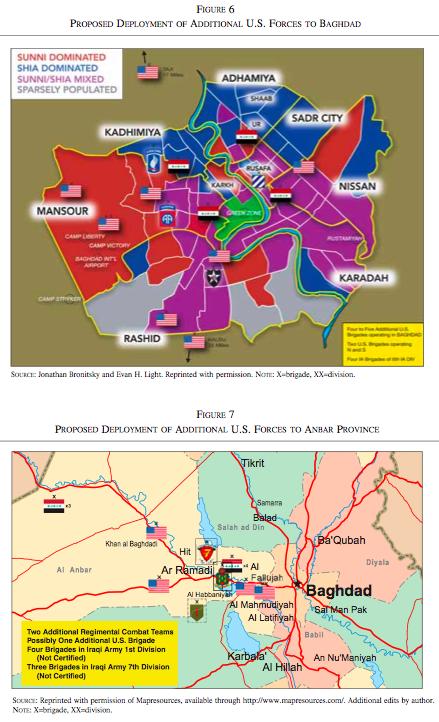
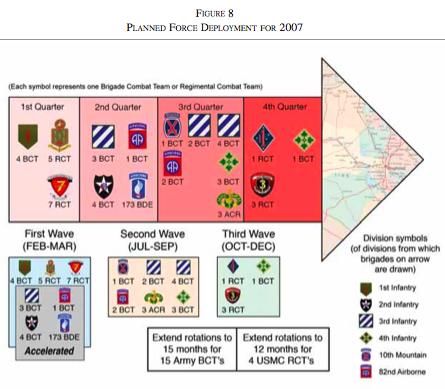
Their OPLAN Executive Summary can be read here and you will find there another link to the full report. It was presented at a Conference yesterday at the American Enterprise Institute. You can get the audio and video downloaded from here. Also speaking are Senators McCain and Lieberman. If you don't want to follow the link, the Executive Summary is below - it is worth the space. The maps in this post outline their recommended deployment plan.

Victory is still an option in Iraq. America, a country of 300 million people with a GDP of $12 trillion and more than 1 million soldiers and Marines, has the resources to stabilize Iraq, a state the size of California with a population of 25 million and a GDP under $100 billion. America must use its resources skillfully and decisively to help build a successful democratically elected, sovereign government in Iraq.

Victory in Iraq is vital to America’s security. Defeat will likely lead to regional conflict, humanitarian catastrophe, and increased global terrorism.

Iraq has reached a critical point. The strategy of relying on a political process to eliminate the insurgency has failed. Rising sectarian violence threatens to break America’s will to fight. This violence will destroy the Iraqi government, armed forces, and people if it is not rapidly controlled.

Victory in Iraq is still possible at an acceptable level of effort. We must adopt a new approach to the war and implement it quickly and decisively.

We must act now to restore security and stability to Baghdad. We and the enemy have identified it as the decisive point.

There is a way to do this.

  • We must balance our focus on training Iraqi soldiers with a determined effort to secure the Iraqi population and contain the rising violence. Securing the population has never been the primary mission of the U.S. military effort in Iraq, and now it must become the first priority.
  • We must send more American combat forces into Iraq and especially into Baghdad to support this operation. A surge of seven Army brigades and Marine regiments to support clear-and-hold operations that begin in the spring of 2007 is necessary, possible, and will be sufficient to improve security and set conditions for economic development, political development, reconciliation, and the development of Iraqi Security Forces (ISF) to provide permanent security.
  • American forces, partnered with Iraqi units, will clear high-violence Sunni and mixed Sunni-Shia neighborhoods, primarily on the west side of the city.
  • After those neighborhoods are cleared, U.S. soldiers and Marines, again partnered with Iraqis, will remain behind to maintain security, reconstitute police forces, and integrate police and Iraqi Army efforts to maintain the population’s security.
  • As security is established, reconstruction aid will help to reestablish normal life, bolster employment, and, working through Iraqi officials, strengthen Iraqi local government.
  • Securing the population strengthens the ability of Iraq’s central government to exercise its sovereign powers.

This approach requires a national commitment to victory in Iraq:

  • The ground forces must accept longer tours for several years. National Guard units will have to accept increased deployments during this period.
  • Equipment shortages must be overcome by transferring equipment from non-deploying active-duty, National Guard, and reserve units to those about to deploy. Military industry must be mobilized to provide replacement equipment sets urgently.
  • The president must request a dramatic increase in reconstruction aid for Iraq. Responsibility and accountability for reconstruction must be assigned to established agencies. The president must insist upon the completion of reconstruction projects. The president should also request a dramatic increase in Commander’s Emergency Response Program (CERP) funds.

  • The president must request a substantial increase in ground forces end strength. This increase is vital to sustaining the morale of the combat forces by ensuring that relief is on the way. The president must issue a personal call for young Americans to volunteer to fight in the decisive conflict of this generation.
  • The president and his representatives in Iraq must forge unity of effort with the Iraqi government.

Other courses of action have been proposed. All will fail.

  • Withdraw immediately. This approach will lead to immediate defeat. The Iraqi Security Forces (ISF) are entirely dependent upon American support to survive and function. If U.S. forces withdraw now, the Iraqi forces will collapse. Iraq will descend into total civil war that will rapidly spread throughout the Middle East.
  • Engage Iraq’s neighbors. This approach will fail. The basic causes of violence and sources of manpower and resources for the warring sides come from within Iraq. Iraq’s neighbors are encouraging the violence, but they cannot stop it.
  • Increase embedded trainers dramatically. This approach cannot succeed rapidly enough to prevent defeat. Removing U.S. forces from patrolling neighborhoods to embed them as trainers will lead to an immediate rise in violence. This rise in violence will destroy America’s remaining will to fight and escalate the cycle of sectarian violence in Iraq beyond anything an Iraqi army could bring under control.

Failure in Iraq today will require far greater sacrifices tomorrow in far more desperate circumstances.

Committing to victory now will demonstrate America’s strength to our friends and enemies around the world.

This is a Plan worthy of our nation. One I support. In their presentation (video and audio link) they also acknowledge the 800# gorilla in the room. Our Army (editor's note: and Marine Corps) is too small for present and future operations. To think or say other is folly.

Thursday, August 11, 2022

Diversity Thursday


The legal system works at the speed of smell, but we are getting closer to what may be one of the most important civil rights cases to come in front of the Supreme Court in the last half century.

There are new readers coming to CDRSalamander every day, so once again let me set the foundation. The cornerstones are rather simple but essential for our wondrously polyglot experimental republic to survive; persons deserve to be judged as individuals; individuals deserve equal opportunity; people deserve to be judged by the content of their character, not the color of their skin; no favor should be given to nor ill-favor placed on any person based on something they can do nothing about – their race, creed, color, or national origin, etc.

With that out of the way – it really should be self-evident, but the excessively emotive on this topic sometimes need a reminder – let us get back to the subject of todays DivThu.

The case in question is Students for Fair Admission v. President and Fellows of Harvard College & the University of North Carolina that is finally on the docket of SCOTUS. In summary, universities have shamefully been discriminating against different ethnic groups in favor of those they deem more desirable. Merit, objective criteria for success, academic excellence, and all those things one would expect to be determining factors are not what is driving the zero-sum game that is admissions. No, the diversity industry (those who derive financial, power, or psychological gain from promoting discrimination), have their metrics and they must be met. Turning their stated goals on it head, they are not about equal opportunity or the elimination of discrimination or sectarian division, instead they have decided that they want to use these evil methods to pursue their own goal; equity.

Stuck in a mid-20th Century mindset, they desire to legally be able to discriminate against people born in the 21st Century based on their race, creed, color, etc while at the same time, picking a desired group that they want to give preferential treatment to based on self-identified criteria.

Regulars of DivThu know the extended commentary. New people can click the “Diversity” tab to review if they wish.

This is where the military comes in.

It didn't have to weigh in on this political topic - but ideologs decided they needed a shield of political retired General and Flag Officers ... so be it.

Shots fired. Let the battle be joined. 

As we have documented through the last two decades – the military (especially at the service academies) have protested that they do not discriminate in admissions, but of course we know they do. Many of us have seen the data. As the data became known, then the excuses and smoke screens came out, but in the last half decade or more as the light of truth became brighter on their actions, they decide to turn in to the skid and claim, “Yes, we discriminate. Discrimination is a good thing. We will keep doing it. You will like it, and if you protest against our bigotry we will call you a bigot.” 

You know the drill.

In this case that involves college admissions, the natsec left decided that they would service-shame the civilian side of the house by gathering a bunch of retired senior officers to – and this is the amazing part – say, “Universities need to be allowed to discriminate, because if you don’t let them discriminate, then we won’t be able to discriminate. We love discrimination and we will lose all our wars if we can’t continue.”

Strange flex, and I’m taking a little artistic license with their verbiage, but there it is.

Well, some interesting things have come out that connect two cases, one from 2015, and the other the one that is the subject in today’s post.

I’d like you to look over two amici curiae. The first one from 2015’s Fisher vs. University of Texas at Austin.  You can read the details of the case here.

There was an amici curiae filed in 2015 that you can read here signed by 34 retired senior officers, a former Senator and Medal of Honor recipient, and one of Bill Clinton’s Army Secretary, Joe Reeder. Remember that name…he is one of the major players in the 2015 and 2022 efforts.

In their amici curiae they state;

In Grutter, Justice O’Connor, writing for the majority, stated:

It has been 25 years since Justice Powell first approved the use of race to further an interest in student body diversity in the context of public higher education. . . . We expect that 25 years from now, the use of racial preferences will no longer be necessary to further the interest approved today. 539 U.S. at 343. 

History may prove Justice O’Connor’s prediction prescient, but the day that racial preferences are no longer necessary to achieve student body diversity in the context of public higher education has not yet arrived. 

That was always a great gift to those who have been fighting this fight for so long. At last, a high profile “Ref. A” out in the open so that no one is silent due to a whole variety of reasons, that, yes, the military does discriminate.

People – though a shrinking pool of the ideological and ignorant – still claim that this does not take place, but even those who did not see it firsthand now at least had a Ref. A. to push

So, we now have Students for Fair Admission v. President and Fellows of Harvard College & the University of North Carolina. If you need the details of that case, click here.

We have a 2022 amici curiae for this case as well with Joe Reeder and his law firm again at the front.

We have this time 35 (33 retired GOFO plus Sen. Kerry and Reeder) signing on vice 36. Their Summary of the Argument seven years later from Fisher reads in part;

Prohibiting educational institutions from using modest, race-conscious admissions policies would impair the military’s ability to maintain diverse leadership, and thereby seriously undermine its institutional legitimacy and operational effectiveness. Amici respectfully request that, in considering whether to reverse decades of precedent affirming the constitutionality of such admissions policies, the Court will continue to consider how such policies enable the military to serve our Nation’s security interests.

What a gift to truth. Their policies can never survive the light of day. They can try to defend it – but especially as our nation becomes even more mixed-heritage – as the people are WAY ahead of the entrenched sectarians – fewer people are going to see any positive attribute to having government institutions line up with some outdated “one drop” rule, or look the other way to red in tooth and claw racial self-identification fraud for fun and profit.

Nope, however, there are some retire GOFO who are quite happy to. 

Let’s look at those 34 GOFO who signed on in 2015 and see which way the wind is blowing. Of those 34 GOFO, 15 returned to sign the 2022 document.

Huh.

What about the other 19? Well, three have passed away (Clemins, Griffith, and Neal) and one LTG Becton, USA (Ret.) is 96 years old. That leaves 15 who decided that 2022 is a different time and it was time to reassess.

Those who signed on in 2015 but did not return in 2022 were Abizaid, Brown, Casey, Dunwoody, Fogleman, Giambastiani, Keane, Maddox, Magnus, Powell, Prueder, Regni, Rondwau, Schwartz, and Tilelli. 

The highest profile the non-repeats are Abizaid, Casey, Fogleman, Keane, & Powell. That begs  the question, "What caused them not to join?" They will have to answer that on their own.

Who are the repeat defender who are doubling down on pro-discrimination? Blair, Christman, Clark, Hill, Inman, Jumper, Lennox, Lyles, Mullen (of course), Myers, and Oelstrom.

Look aback at who the high-profile non-repeats are. That is quite the group who did not return. Who replaced them? Abbot, Bolden, Bostick, Brooks, Carter, Caslen, Dunford, Haney, Johnson, McRaven (of course), Miller, Robinson, and Scaparotti. 

Who is high-profile in this group? Dunford, McRaven, and Scaparotti I think.

This is a great filtering mechanism to see who is who in the zoo, so to speak. A Salamander Pardon to 2015 alumni will be provided to those who did not show up in 2022, and BZ to a few high profile people whose name is not on either and will given a respectful nod to.

However, to come back in 2022 knowing the details of what this case is … that is just plain clear as day what these people support.

Noted. 

A final note, an organization called Veterans for Fairness and Merit also submitted an amici curiae for the latest case. You can read it in full here, but of note; remember the alumni from 2015? General Ronald R. Fogleman, USAF (Ret.) is on that amici curiae. He saw the light and didn’t just demur, put his name to it.

BZ.

Watch this case. It is time that we meet the promise of our nation’s founding and to address the reality of the 21st Century. The time for racial discrimination and preferences is over. No more sectarianism.

Monday, June 30, 2008

Let's talk about this this THU

“I said, ‘Jesus Christ, John, this is a recipe for disaster,’ ” General Keane told Army historians. “I was upset about it to say the least, but the decision had been made and it was a done deal.”
...
The story of the American occupation of Iraq has been the subject of numerous books, studies and memoirs. But now the Army has waded into the highly charged debate with its own nearly 700-page account: “On Point II: Transition to the New Campaign.”
I want to read some first. Download it at the link above, with the NYT article for background and highlights here.

Wednesday, November 19, 2008

Ben Franklin on Iraq

John covers well Gen (ret.) McCaffrey's memo that got a lot of play at work over coffee last week. Michael Yon adds some more meat to the argument. Greyhawk has been beating the drum as well.

The Salamander boil-down is thus: we have reached the point that few outside GWB, Keane, Petraeus, and those who had confidence in them thought we would have reached. The war is won - though the enemy always gets a vote and history throws sinking curve balls.

In essence, we can disengage while giving the Iraqis a chance few non-Western nations have been given. What has Uncle Sam and his allies given Iraq? One of my personal heroes, Ben Franklin said it best.
"A republic if you can keep it"
So, let's call it victory and go home; because that is what it is.

Thursday, July 03, 2008

OIF Lessons learned

Remember from earlier this week?
“I said, ‘Jesus Christ, John, this is a recipe for disaster,’ ” General Keane told Army historians. “I was upset about it to say the least, but the decision had been made and it was a done deal.”
...
The story of the American occupation of Iraq has been the subject of numerous books, studies and memoirs. But now the Army has waded into the highly charged debate with its own nearly 700-page account: “On Point II: Transition to the New Campaign.”
Looking over the OIF Lessons Learned, I think there are a few areas I am interested in your thoughts on, as recommended by one of my spies.
  • Ch. 2: Pages 65-80
  • Ch. 3: Pages 87-92
  • Ch. 4: Pages 161-170 (esp. 169-70)
  • Ch. 9: Pages 367-400
  • Ch. 14: Pages 567-584
My observations can be boiled down to just a few items:
  1. The problems with the post invasion challenges in Iraq were at least 51% the fault of the military, not our civilian masters or policy-mongers. We did not source our GOFO with the Staff they needed to plan properly. We did not push harder when it was needed. Especially when it comes to WMD, the fault is ours. I was there - I saw the briefs - I saw the intel. We fell in love with "Shock & Awe," we sold the sexy over the known. Generals like Shinseki were more focused on making points (and pushing bad ideas and unneeded pets like the Crusader) than providing doable options. We were focused so much on what was next as opposed to getting the now right.
  2. Good people can make honest mistakes - in this line of work that puts blood, treasure, and national honor on the line. When an armed forces fails at sea or ashore, more often than not the military should inspect itself before pointing fingers in other directions.
  3. To the great credit of the authors of this report, they do not point fingers. They find the fault, mostly and in a very tender well-worded way, where it belongs - with the U.S. Military.
The conclusion is spot on.
...
A more important reason for undertaking this project is to attempt to meet the charge posed by historians since the time of Herodotus and Thucydides some 3,000 years ago—to discern insights from the past that will cast a light, however bright or dim, that might guide today’s leaders into an uncertain future. The challenges in discerning those insights, with so little historical perspective about what are on-going events, are immense. Yet some insights have emerged from this study and the Army must capitalize on them.
...
The subtitle of On Point II—Transition to a New Campaign—was not idly chosen. Not only does the phrase “transition to a new campaign” accurately capture the Army’s experience in Iraq between May 2003 and January 2005, it embodies what the authors believe is the most significant insight provided by the historical record. That observation looks beyond the rather obvious lesson that military forces must be prepared for the operations that follow success in tactical-level combat missions. The superb Soldiers of the US Army improvised and adapted to unexpected circumstances in Iraq as they have in similar situations for more than 200 years. Far more critical is the planning and preparation that civilian leaders and military commanders must conduct for the transition to operations that follow the decisive combat phase of a campaign.

If the Army’s experience in Iraq in 2003 offers any single crucial insight, it is that this type of thoughtful, detailed, and deliberate planning must be done at the highest levels long before the campaign begins if military victory is to be transformed into strategic success.

The difficulty in Iraq in April and May 2003 for the Army, and the other Services, was that the transition to a new campaign was not well thought out, planned for, and prepared for before it began. Additionally, the assumptions about the nature of post-Saddam Iraq on which the transition was planned proved to be largely incorrect. Thus, as the US Armed Forces transitioned in April and May 2003 from Phase III, Decisive Operations, to what was essentially a new campaign that featured full spectrum operations, they did not have the benefit of policies and plans that fully envisioned the transition to guide their operations.

CENTCOM’s planned transition to Phase IV operations included only the final destruction of Saddam’s military and paramilitary forces, the search for weapons of mass destruction (WMD), the hunt for terrorists, and limited support to the humanitarian and reconstruction efforts of the Office of Reconstruction and Humanitarian Assistance (ORHA), all in the context of a rapid turnover of sovereignty to a new Iraqi Government.

As late as May 2003 the CENTCOM commander planned for the rapid withdrawal of US and Coalition military forces by September as responsibility for Iraq was turned over to the ORHA, to the new joint task force, to international organizations, and to a new Iraqi Government. In line with that thinking was the CENTCOM decision to unexpectedly turn over responsibility for Phase IV of OIF to the V Corps headquarters, designated as Combined Joint Task Force–7 (CJTF-7), and to withdraw its land forces component command, Third Army, from the theater. General Tommy Franks also decided to retire during this time, believing his military service to the nation had been accomplished, much as he believed CENTCOM’s mission to depose Saddam Hussein was at a close.

CENTCOM and Third Army did only the barest planning for Phase IV of OIF. The CFLCC plan for this phase was not formally issued until the start of the ground invasion of Iraq. Few if any commanders at all levels had any idea what their missions in Phase IV were to encompass. Lieutenant General (Retired) Jay Garner and the ORHA, created 20 January 2003, barely had time to build a staff and do a limited analysis of its tasks before it deployed to Kuwait in late March. US civilian and military planning and preparation, even for what was assumed to be a relatively easy and short Phase IV, was inadequate. Though essentially a joint planning process, the Army, as the Service primarily responsible for ground operations, should have insisted on better Phase IV planning and preparations through its voice on the Joint Chiefs of Staff.

It is an open question whether senior US civilian and military leaders should have known their optimistic assumptions about the nature of post-Saddam Iraq would prove to be flawed. Many have pointed to official and unofficial prewar studies and predictions of chaos and conflict in Iraq after Saddam was overthrown. Others have pointed to voices in the US Armed Forces and Department of Defense (DOD) who questioned the relatively small number of troops planned for the postconflict phase of OIF. Historians have even questioned the assumption that the Iraqi nation-state was viable, noting its history under Ottoman, British, and Baathist rule as obscuring the underlying sources of friction and disunity—a sort of Middle Eastern version of the former Yugoslavia. It appears that most senior civilian and military leaders failed to review the historical records of military occupations and of Middle Eastern or Iraqi history, and also failed to listen and evaluate outside views about potential weaknesses with their planning assumptions.

The intense desire to continue DOD’s transformation to smaller and lighter forces, to implement a perceived revolution in military affairs in the information age, and to savor the euphoria over seemingly easy successes in Afghanistan using those techniques seemed to outweigh searching through the past for insights into the future.


What lesson that last picture holds for me from OIF - I will keep to myself.

Friday, August 07, 2009

AFG: garbage in, garbage out


Remember growing up your parents always warned you about the kids you hung out with, to pick them well? Ditto with what you read, and what you listened too. Spend too much time with the wrong ideas in your head, and it starts to rub off on you.

Say what you want about GWB, but in Iraq he listened to the right people when it counted most. Keane and Petraeus. If he had listened to the ISG and then Sen. Biden (D-DE), then Iraq would have never had the chance it has now (that can still be lost BTW) and the consequences for this nation would be ... well ... don't even want to think about it.

Top U.S. officials have reached out to a leading Vietnam war scholar to discuss the similarities of that conflict 40 years ago with American involvement in Afghanistan, where the U.S. is seeking ways to isolate an elusive guerrilla force and win over a skeptical local population.
The overture to Pulitzer Prize-winning historian
Stanley Karnow, who opposes the Afghan war, comes as the U.S. is evaluating its strategy there.
When you bring in a person whose intellectual high points are beating a drum of defeat, loss, and his view of national military disgrace into a conflict that he does not support (BTW, what did he want us to do in 2001/02?) and does not believe you can win, what type of advice are you going to get?

If you are looking for a way to win, you don't go picking fruit from that orchard.

If you want to know the world view of Karnow, just watch
this PBS love fest of non-critical self-congratulation hosted by Charlie Rose with Stanley Schanberg, HDS Greenway and other like minded "experts" from Vietnam. Perfect example of the Vietnam those people want the nation to think about - because it excuses their complicity in the death of millions.

Funny, they never talk about what happened in Vietnam the way the military and unbiased history sees it. The facts are simple.

  • Tet was a victory by the USA and South Vietnam ... on the battlefield. The press, leading with the stab in the back mis-characterization by Cronkite, helped the North attack the allied Strategic Center of Gravity (support at home in the USA), by calling it something else.
  • Vietnamization worked so well that by the time the 1972 invasion of the South by the North took place, the North was defeated with South Vietnamese forces with a few USA advisors, financial and material support, and airpower.
  • Defeat in Vietnam only came in 1975 when the post-Watergate/post-74 election Democrat controlled Congress shut down all monetary and military support in time for the Soviet-Chinese supported North to invade again. That is how South Vietnam was lost.
So, back to Afghanistan. If Karnow is who the White House is listening to, then Admiral Mullen needs to get his A-game going and General Petraeus needs to work as best he can to make sure the military is clear and direct on what is needed to win.

Do not let defeatist Democrats and the leftist press once again hang a self-fulfilling prophecy of defeat they engineered around the military's neck.

That is another great lesson from Vietnam. The senior leadership under no circumstances should let themselves take the blame for political actions of others. We are not part of any political administration, we simply report to The President as Commander in Chief and report as required by law to the Legislative Branch. We do not have to spin for politicians, or hew to a political talking points memo. We should always speak the truth as we know it. That goes for Administrations of any Party - and any SECDEF. We support and defend the Constitution, not individuals.

Political administrations come and go - but the truth will always come out. In our professional lives we should never been seen as part of the political landscape.

Sims, Mitchell, Connolly. Study. Read. Reflect. Look in the mirror.