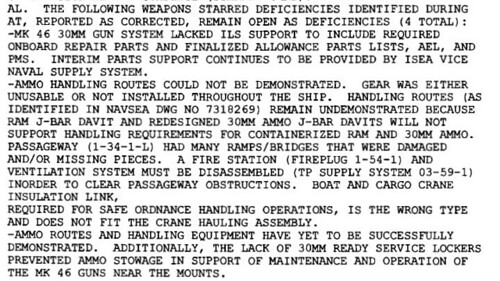
The president of the Board of Inspection and Survey (INSURV) rolled out major changes to the frequency and grading method of the INSURV program effective Jan. 1, 2013.Hat tip H2.
INSURV President Rear Adm. Robert Wray said changes to the frequency of the inspections and the grading system were implemented to improve the readiness of Navy ships and crews and to provide Navy and congressional leaders with an accurate reflection of that readiness.
Under the old program, INSURV teams conducted exhaustive inspections and surveys of ships every five years and reported their material readiness to Congress. Now ships will be inspected about every 30 months.
Under the new inspection timeline, INSURV inspectors will conduct a traditional "Material Inspection" during a unit's Fleet Readiness Plan cycle. In the alternating cycle, a similar inspection will be conducted by the unit's type commander with INSURV support.
"The major change for the average sailor will be twofold," Wray said. "First, each ship, prior to each deployment, will have a full-blown material inspection in which the ship will be expected to get under way, do full power, anchor, shoot guns, operate combat systems, etc., for a team of external inspectors. Second, ships will be expected to do this on their own, without months of external preparation and assistance."
While twice as many inspections may sound like a bad thing, Wray stressed that the new process will benefit the sailors who have to prepare the ship for INSURV.
"We want the pre-deployment material inspection to be a normal part of doing business, like the Composite Training Unit Exercise (COMPTUEX), something ships know how to do on their own," he said. "In a larger sense, we want to create a 'culture of material readiness' in which ships and their crews are always thinking about being ready for INSURV. The concept is to create a culture for material readiness, in which any ship, at any time in the appropriate part of the FRP, could successfully shoot their guns, do full-power runs, anchor, and demonstrate her combat systems."
Thursday, January 03, 2013
Your New INSURV ...
Monday, March 02, 2009
Navy sets a thicker smoke screen

I don't know about you - but this makes me professionally embarrassed.
The Navy has classified regular reports about the material condition of its fleet, an about-face from when the reports were accessible as public documents under the Freedom of Information Act.NB: look at the timeline. This has nothing to do with the new CINC - so keep that FOD out of the comments.
The reports, filed by the Board of Inspection and Survey, or InSurv, contain the findings of meticulous, days-long inspections that cover every detail of the workings of surface ships, aircraft carriers and submarines.
In December, InSurv president Rear Adm. Raymond Klein decided the reports were to be classified, said Linda Alvers, the FOIA coordinator for Fleet Forces Command. She said she did not know why. Also unclear was whether the classification order applied only to InSurvs performed after December, or whether it included reports from before then.
Neither Klein nor a representative for InSurv could be reached to comment for this story.
InSurvs are circulated widely among commanders and technical authorities within the Navy, but seldom seen by civilians unless they’ve been specifically requested under freedom of information laws. Even then, Navy officials can redact the names of people; information about classified equipment; or trade secrets of shipbuilders or other venders.
Over the past year, InSurvs obtained by Navy Times have revealed severe problems aboard the cruiser Chosin, the destroyer Stout and the amphibious transport dock New Orleans.
The reports have also revealed when the Navy has taken delivery of well-built ships, including the amphibious transport dock Green Bay and the first littoral combat ship, the Freedom.
However, combine this with the SECDEF's "shut up," and you have a more and more opaque system of review and accountability unprecedented in decades during both peace and war.
Read these INSURV posts, do you see anything classified?
How do you respond to someone with an objective mind trying to understand this decision but finds but one thing - a desire by the Navy to keep INSURV information from the taxpayer? The only other reason could be a desire to cover some systems in more depth - but we have been doing classified annexes on other subjects for years. Someone's PAO needs to come out and do some talking, because I don't know what to say to that person but - "Yep, that is what it looks like."
Galrahn made a good point Saturday,
I believe the current CG and DDG forces are the most important ships to the future Navy, particularly now that the Navy intends for them to serve 40 years. The material condition of those ships matters a great deal, and preventing the public from knowing the material condition of our ships with INSURV information insures that we do not get valid information that results from policy changes related to maintenance funding.That is a "Stump the Admiral" point.
The bigger problem is Congress doesn't get good information either. Lets face it, unless they ask for it specifically, they will be unfortunate victims of the 'failed to mention that' syndrome that always trumps full disclosure.
I am sorry, but if we in the Navy wanted to regain some of the credibility and integrity that we have lost over the last decade due to the trainwreck that has been acquisition and material condition - then this is no way to do it.
Hat tip SB @ USNIBlog.
Wednesday, June 15, 2011
I'd like my good name back ... and maybe a ship too?
INSURV results became so uncomfortable that Big Navy decided to classify them to stop the open questions. What can a bad INSURV do? As I believe this was INSURV related (presumption on my part). Let's go back to MAR 2009.
The commanding officer of the mine countermeasures ship Devastator was relieved of command Tuesday for not “maintaining ship readiness standards,” the Navy announced.If we had an unclassified copy of the INSURV, perhaps we could find out why, as reported by Tom Ricks,
Lt. Cmdr. Matt Tucker, who commanded the crew Persistent, was relieved by the commander of Mine Countermeasures Squadron 2, Capt. Robert Hospodar, just over three weeks after Naval Station Ingleside, Texas-based Devastator underwent a scheduled examination by the Board of Inspection and Survey.
Two years ago the Navy fired the skipper of the USS Devastator for not maintaining readiness standards. Now, I am hearing, his removal has been overturned.Galrahn is hearing the same thing.
Details anyone? As the Vice President says - this is a BFD.
LCDR Tucker - congrats and I hope our Navy does the right thing.
Monday, June 07, 2021
Three Card NGAD
I have spent a week waiting for someone to tell me the latest on NGAD isn’t exactly what I think it is, and no one even tries to explain it away. They know.
Via Mallory Shelbourne at USNINews;
The Navy is keeping classified the amount of Fiscal Year 2022 money it wants to develop the next-generation fighter aircraft set to replace the fleet of F/A-18E/F Super Hornets, according to service budget documents.
The Navy’s FY 2022 budget justification documents withhold the amount of dollars the service is putting toward the Next Generation Air Dominance (NGAD) program. This is the second consecutive budget cycle in which the Navy has classified information about its investment into the service’s sixth-generation fighter.
It was over a dozen years ago that we saw what I consider the most egregious cover-up of our Navy’s fundamental failure to properly understand its responsibility for stewardship of the professional capital the taxpayers bought for them - the classification of INSURV. The previous link has my comments at the time.
An entire generation of leaders now have grown up - and been promoted - in this climate of cover-up in our Navy. That is what it is, no reason to sugar coat it.
After eight years of classified INSURV and the problems they hid, Rep. Whitman (R-VA) clearly identified what it was;
…he (Whittman) noted that Board of Inspection and Survey (INSURV) reports used to be unclassified and but have been classified for almost a decade.
“During peacetime INSURVs should be declassified, and that makes sure there’s transparency there that we know what’s going on,” Wittman said.
“That creates, again, that direction, that focus to make sure that maintenance is being done, maintenance availabilities aren’t being missed, material readiness is being maintained. All those things are critical.”
“All of us have to look at this as an opportunity to really do some groundbreaking things in how the surface navy operates,” Wittman said.
“It doesn’t hurt for us to get to points where we feel a little uncomfortable – in fact, I would argue we have to get to a point where we feel uncomfortable to make sure we are exploring all the different avenues that we have to explore.”
Yes, we commented on INSURV back in the day, but that was part of the process. Fear and shame are great motivators, and there is nothing classified about poor maintenance practices…unless you are doing such a horrible job that your warships are almost helpless … but that just tells we need more transparency, not less.
I remain convinced that you can draw a straight line from the horrible events of the summer of 2017 to not just the direct second and third order effects of hiding INSURV, but to the cultural mindset it enabled.
Making uncomfortable facts classified is just a way to protect the powerful from being accountable - nothing more. We still have not addressed all the maintenance and material condition issues we “learned” from the summer of 2017's waste of 17 Sailors drowned in their racks, heck … we are still playing hide the ball on the manning issues.
We cannot afford to screw up NGAD, and I was hoping against experience that we would not. The fact we are on year two where we won’t even say what we’re spending on what is supposed to be a replacement for the Super Hornet only drags me in to further concern;
The Navy finished its analysis of alternatives (AOA) for NGAD in July 2019 and as of August 2020, it had already started convening industry days for the program, USNI News reported last year.
The Navy has been seeking a replacement for the Super Hornet fleet for nearly a decade. The service put out its first request for information for the F/A-XX program in 2012
Nine years ago.
As we’ve stated over and over - next to reforming Goldwater-Nichols and the COCOM structure, we have to rip up root and branch our hide-bound and accretions hobbled acquisition system.
It isn’t just inefficient and ineffective, it is a threat to national security. Just look at what it has done to our surface fleet the last quarter century.
The aviation side of the house doesn’t have all that much better of a record. We’ve forgotten and thrown away range right when it became even more important. The light attack mafia won their tribalistic battles, but have left a flight deck that can't refuel a strike package, find and kill a submarine, or reach far enough without endangering mother.
We’ve convinced ourselves that there was no way smaller aircraft carriers could park decks full of large footprint A-3, RA-5, F-14, EA-6B next to smaller aircraft - so we shrink our airwing in not just capability, but size, to the point of making its utility questionable. But hey ... the VFA guys got rid of all those VA & VF bubbas that teased them so much. They got rid of those goofy S-3s that kept taking up space ... so ... yea team.
Fewer aircraft with shorter legs is not how you win west of Wake.
With NGAD, it appears we have listened to industry oversell the promise of AI and unmanned systems, just assuming away very real issues such as bandwidth, reach back, ROE, engineering, and loss rates - all on the promise that technology risk is for losers and other people’s PCS cycle.
This is what is driving what looks like a NGAD cock-up; the LCS of CG(X)s.
If you read the below and don’t get the sickening feeling that the same mindset and system that begat the clown show that was CG(X) isn’t slowly enveloping NGAD, then you’re not paying attention;
“As we look at it right now, the Next-Gen Air Dominance is a family of systems, which has as its centerpiece the F/A-XX – which may or may not be manned – platform. It’s the fixed-wing portion of the Next-Gen Air Dominance family of systems,” Harris said during a Navy League breakfast event at the end of March.
“But we truly see NGAD as more than just a single aircraft. We believe that as manned-unmanned teaming comes online, we will integrate those aspects of manned and unmanned teaming into that,” he added. “Whether that – we euphemistically refer to it as our little buddy – is an adjunct air-to-air platform, an adjunct [electronic warfare] platform, discussion of could it be an adjunct advanced early warning platform. We’ll have to replace the E-2D [Advanced Hawkeye] at some point in the future, so as we look to what replaces that.”
Harris at the time said the Navy divided its work on the NGAD program into two increments – increment one will evaluate a successor for the Super Hornet fleet and increment two will determine a replacement for the EA-18G Growler. The Navy has used F/A-XX to refer to the F/A-18 E/F replacement, while NGAD refers to the whole family of systems.
Someone get hold of NGAD while there is still time.
Not much time, but there is still time.
Have we learned nothing from the F-35 program? Did we not learn anything at all about “one stop shopping?”
They are over thinking NGAD. What we need now is an aircraft with legs that can deliver a tactically significant number of strike missiles that can hold an enemy's fleet, ports, and economic infrastructure at risk from distance. Design for 2-seats. Think of a 21st Century version of the SU-34. Go heavy now, that is the requirement.
If we feel we need an "air dominance" fighter for the fleet, then design one that does that with a lesser included secondary strike capability. We can have more than one aircraft under design and production at at time. If we are still trying to make the cult of efficiency happy by designing Swiss Army knives, then we are fools.
Are we compromising the good now for the future perfect that will never come? If so, those in charge are steering us right in to a huge crisis at 2030 where the surface community finds itself today.
We don’t have time for that. Congress has no patience with the Navy for that.
Remember, this is the team that brought us the FORD Class CVN that cannot even launch and recover the F-35C. A ship whose elevators and electrical systems seem designed to aviation tolerances and office park sensitivities that may not make it through shock trials, and if not, be able to deploy by mid-decade.
I, and others it seems, were giving them the benefit of the doubt. We were wrong.
Congress needs to demand transparency. We cannot end up in 2030 with nothing to replace the Super Hornet. Its replacement should already be at IOC, but we playing three-card-monte with budget numbers.
If we screw this up - then why should the US Navy ever get more money in the budget? Any more responsibility? Any amount of respect and benefit of the doubt on Capitol Hill?
The Terrible 20s are fleshing out roughly as we saw a decade ago, and we appear to be compounding the problem through wholesale institutional incompetence.
Declassify now - not because it is in our self-interest (which it is) - but because we are a republic of a free people. The people and their representatives are not subjects.
Overclassification is a symptom of a larger problem. As outlined at CSIS’s Defense360 article from DEC09 by Patrick G. Eddington, Christopher A. Preble, and Seamus P. Daniels;
The overclassification of information poses a serious problem for national security. Restricting access to information prevents timely analysis and impedes decision-making by limiting debate on key policy issues to small groups of people within the government, and it inhibits public scrutiny of classified information and the decisions made from it. While it is critical to protect sensitive sources and methods, much of the information gleaned from these sources can still be made available in declassified formats. Still other information is already, and should properly be kept, in the public domain. Secrecy is inconsistent with the fundamental principles of transparency and democratic accountability, and the perception that government officials are using it to hide their own malfeasance contributes to widespread public disillusionment.
I am not sure what Congress is waiting for.
Take the bad news and discomfort for a few retirement eligible Flag Officers now than the trainwreck to our Navy and the national security it underwrites that will come at the end of the decade if NGAD just becomes CG(X) with flight pay.
Wednesday, May 09, 2012
LCS-1: a "no-go"
.... but, this is not a shock to the front porch.
2. SENIOR INSPECTOR COMMENTS: USS FREEDOM (LCS 1) IS EVALUATED AS A "NO-GO" AND IS NOT RECOMMENDED TO PROCEED WITH THE SCHEDULED SPECIAL TRIAL (ST). FREEDOM'S CREW AND CONTRACTORS WERE NOT PREPARED FOR THE INSPECTION. BOTH ENTITIES WERE UNFAMILIAR WITH THE CONDUCT OF INSURV MATERIAL CHECKS. EXECUTION OF THE SOE WAS VERY POOR. THERE WAS CONFUSION BETWEEN CONTRACTOR AND CREW RESPONSIBILITIES FOR THE PERFORMANCE OF EQUIPMENT CHECKS. THE INSPECTION EXPERIENCE LEVEL FOR THE MAJORITY OF THE CREW IS LOW ALTHOUGH THEY DID DEMONSTRATE A GOOD POSITIVE ATTITUDE. THE CREW AND CONTRACTORS NEED TO CONTINUE TO FAMILIARIZE THEMSELVES WITH THE SHIP'S EQUIPMENT, OPERATIONAL PROCEDURES, IMPROVE IN PRESENTATION/DEMONSTRATIONS AND AGGRESSIVELY MANAGE/COORDINATE SOE. THE SHIP WAS CLEAN. SEVERAL AREAS REQUIRE PRESERVATION. SAFETY PROGRAMS ABOARD THE SHIP ARE NON-EXISTENT. THE SHIP DID DEMONSTRATE THE ABILITY TO SELF-ASSESS. HOWEVER, THEY ARE NOT AGGRESSIVELY REPORTING AND PURSUING RESOLUTION OF THE DEFICIENCIES THEY HAVE IDENTIFIED.This isn't a "first in class" issue and I do not fault the CO, XO, CMDCM or the crew. These are excellent men and women - and good Sailors.
Here is why most of the problems above exist - there isn't time. There is only a 24-hr day. Even when properly manned, a ship has a challenge getting the basics done.
LCS is undermanned. As a result it will always have preservation problems, safety problems, poor procedures and execution, and not enough hours to resolve identified problems inside their lifelines - much less look for new ones.
It is baked in the cake. They have been set up to fail by bad theory and happy talk.
Oh, and 10-month deployments rotating crews? You'll wear that ship down even more.
While we are on the topic of INSURV - if you don't follow DODBUZZ on twitter, you need to.
You remember the hissy-fit I threw about the CYA classification of INSURV by the present CNO when he was doing ADM Roughead's bidding?
LOLZ!
INSURV classification trips up even Navy on LCS conference call -- speakers say they want reporters to see it, but PAO backs off that.
— dodbuzz (@DoDBuzz) May 9, 2012
Murdoch said he expects INSURV acceptance report on LCS 3 by Friday & urged reporters to read it to see high quality of ship. But no dice
— dodbuzz (@DoDBuzz) May 9, 2012
Tuesday, August 15, 2006
Fundamental Failures
If Iran had decided earlier this summer to close off the Persian Gulf by placing mines in the Strait of Hormuz, the Navy’s best mine warfare ships would have been unavailable to deal with the problem.Why are they there?
Instead, the Ardent and Dextrous were in port at Bahrain, all but unable to get underway. Even if they had managed to cast off, the extensive mine warfare suites in each ship were not functioning, hampered by cracks and leaks in equipment, damaged wire cables, faulty indicators and exposed electrical wiring.
The two MCMs have been stationed at Bahrain since 1996, when the U.S. decided to establish a permanent mine force in the region. The threat was real — Iranian-laid mines struck a Kuwaiti tanker in 1987 and nearly sank an American frigate in 1988. Iraqi mines damaged two U.S. warships during the 1991 buildup to Operation Desert Storm, helping dissuade the coalition from mounting an amphibious assault on Iraqi forces in Kuwait.Results?
Iraq laid an estimated 1,300 mines in the northern gulf before the 1991 allied invasion, and it took months of efforts by an international group of minesweepers to clear them.
“Cascading casualties occurred [during the inspection] because of poor maintenance and operating practices,” read the report on the Ardent, prepared by the Navy captain who led the inspection of the ship from June 27 to July 1.Is SeaSwap part of the problem (no shock here)?
“There was a demonstrated lack of knowledge and familiarity among watchstanders with shipboard engineering systems, equipment operation and maintenance requirements,” read the report on the Dextrous, prepared by the same officer after the ship’s June 21-24 inspection.
The multiday INSURV inspection is intended to detail the material condition of ships and not meant as a test, although crews are rated for their ability to assess their ship’s condition and detail its problems. The inspection includes an underway period during which ship systems are demonstrated and a pierside portion during which a detailed physical assessment is made.
The assessments are notoriously rigorous, and high scores are rare. MCMs generally receive “below par” assessments, one former senior mine warfare officer said.
“You probably have four or six minesweepers a year that get INSURVs,” the officer said. “Almost every INSURV, you’re a little embarrassed because they turn up something you didn’t anticipate.”
The Dextrous crew received a “satisfactory” rating for its overall self-assessment ability, although the engineering department was rated “unsatisfactory.” Ardent’s crew was evaluated as “marginal” in this area and received an “unsatisfactory” rating for auxiliaries and environmental protection. But the Ardent crew got a “satisfactory” for its “ability to resolve significant material issues during the inspection,” although the engineering department was evaluated as “unsatisfactory.”
“INSURVs are always ugly,” O’Donnell said. “But it’s like a perfect storm over there. You have crew swap, you’re dependent on the ability of port engineers, maintenance people are distracted doing other things. Then you get INSURVs like that.”Ooohhhh, lookie what makes a show...the Little Crappy Ship.
The former senior officer saw another aspect.
“Crews train on identical ships at Ingleside, fly to Bahrain, take over a ship and are supposed to be proficient from day one,” he said. “What bothered me most [about the reports] was the engineering department not being able to operate their own equipment.”
But the officer also saw issues with Sea Swap in the inspection reports.
“When I read the INSURV, the first thing I thought was that this is a failure of the Sea Swap program to pay enough attention to the ownership issues associated with rotating crews,” he said.
“There may be some longer-term implications for the new Littoral Combat Ship,” the former senior mine officer said.We need to put down the B-school Cliffs Notes, put down the PPT, walk away from the latest missive from the insecure bullies at the Diversity Commissariat, and put on the coveralls and remember what we are all about. Mission, Ship, Sailors. Rinse, repeat.
The Navy plans to deploy its LCS vessels in a manner similar to the Bahrain minesweepers. The ships will be based in forward areas and crews will swap out about every six months. The first ships will have Blue and Gold crews in the same manner as ballistic missile submarines, with the two crews rotating. But as the number of LCSs grows, crews will not be tied to a particular ship. Four or five crews might be responsible for three ships, for example.
The San Diego-based Naval Surface Force is developing the crewing and operating concepts for the LCS, and final details are being worked out.
But the implications of problems in the MCM INSURV reports could provide lessons for the LCS program.
“LCS is pretty much in the same category,” one former mine officer said. “I’m really concerned about the mission packages, the training.
“They’re going to have to be ready at a higher level than I think people are thinking about.”
Tuesday, May 01, 2018
HASC Has Some Ideas ...
To keep this focused, let's just look at DON related items;
The Readiness Subcommittee's proposal:
...This is, by and large, a Salamander endorsed list.
Directing the Navy to provide a clear chain of command for operations, for building readiness, and for shipyard maintenance;
Requiring the Navy’s Board of Inspection and Survey (INSURV) Inspections be conducted on a no-notice basis make details of those inspections unclassified and available to the public;
Requiring the Secretary of the Navy to provide a report on ways to optimize surface Navy vessel inspection and crew certifications to reduce redundancies and the burden on inspection visits that ships undergo;
Limiting the amount of time a Navy vessel is forward deployed overseas to no more than 10 years;
Ensuring the Navy retains sufficient ship repair capability and capacity in the Western Pacific by prohibiting the redevelopment of the Former Ship Repair Facility on Guam.
Ensure infrastructure supports military readiness by:
Recommending the Full Committee increase funds for facility sustainment above the fiscal year 2019 request;
Two items:
1. The return to unclassifed INSURV. It was a huge strategic error to classify INSURV last decade. From day-1, I have been adamant that it had nothing to do with keeping classified information from anyone - it had everything to do with providing cover as we starved our fleet of the readiness support it required. You can, and I will, draw a direct line from that decision and the attitude it encouraged to what happened in WESTPAC in 2017. Keeping INSURV out of the taxpayer's eyes only prevents accountability. It shields the Flag Officers from the results of their inability to make the case to our civilian leaders to give our Navy what it needs to sustain readiness. It is way too easy to just fire CDR/CAPT without having to answer questions why they were never properly resourced to begin with. BZ for this proposal.
2. No more lost bases. This acknowledges that once we lose a facility, we aren't getting it back. It isn't just Guam. Load a logistics professional up with a few beers and then ask them what BRAC threw away on the West Coast that we will never get back. Stand the line in Guam. Stand the line in CONUS.
Especially on our coasts, we are no longer a thinly populated nation with plenty of room to grow if needed. If you cave to developers and the myopic, you will have huge problems when the next global war comes.
Yes, its coming; we just don't know when.
Thursday, January 11, 2018
Rep. Whittman (R-VA) Goes Salamander
Time has shown that we were right about why we were classifying INSURV; it was because the Navy could not handle answering questions about why our Navy was being allowed to slowly degrade. As Chap said so well at that time;
...INSURV results have to be not only unclassified but public; only embarrassment will fix some problems. Classification, especially the insidious “unclassified but special” categories we invented after 9/11, can invite overcontrol of information, improper use and worse. Special places to go look at stuff invite special tweaking. Every boat I knew at one point took the exercise equipment out of the engine room for the inspection, then put it right back in afterward…and everyone knew it, and so did the inspectors. This example is silly, not dangerous; however, there are dangerous ones out there. What are they and how do we correct them?At last, we seem to have some top-cover on The Hill;
House Armed Services Committee members Reps. Rob Wittman (R-Va.) and Mike Gallagher (R-Wisc.) talked to a room of Surface Warfare officers on proposed changes in how the Navy organizes its surface force, handles maintenance and certifications of its ships and thinks and speaks about its capabilities, ... he (Whittman) noted that Board of Inspection and Survey (INSURV) reports used to be unclassified and but have been classified for almost a decade.
“During peacetime INSURVs should be declassified, and that makes sure there’s transparency there that we know what’s going on,” Wittman said.
“That creates, again, that direction, that focus to make sure that maintenance is being done, maintenance availabilities aren’t being missed, material readiness is being maintained. All those things are critical.”
“All of us have to look at this as an opportunity to really do some groundbreaking things in how the surface navy operates,” Wittman said.
“It doesn’t hurt for us to get to points where we feel a little uncomfortable – in fact, I would argue we have to get to a point where we feel uncomfortable to make sure we are exploring all the different avenues that we have to explore.”Excellent. Now, follow through on The Hill before the Democrats take power after the 2018 elections.
Tuesday, October 06, 2009
But I thought we "benchmarked best practices"?
“Bottom line: The maintenance community is not currently structured and the business practices do not currently support the large volume of work which inevitably must take place to prepare a ship for InSurv,” said the message, obtained by Navy Times. “The significant labor pool which rallied in support of SJA contributed greatly to preparations for the M.I. Without this additional manpower SJA would not have been ready for the M.I.”So sayeth Capt. John Cordle, Commanding Officer USS SAN JACINTO - so sayeth we all.
So Big Navy - how is that optimal manning working for 'ya? Being that all us retrograde troglodytes were wrong and all - I am sure that all is well.
...it took the ship’s company, plus as many as 87 extra people from 16 commands working as much as three months in advance, to set the ship up for its material inspection by the Board of Inspection and Survey.Oh, and goodness --- did you know that something shocking .... shocking ... has developed - something we have NEVER EVER seen in the Navy?
...
According to Cordle’s message, cruisers today have about 44 fewer sailors than before the onset of “optimal manning.” And because San Jacinto had recently come back from a deployment, its ship’s company was even smaller, Butler said.
The story of San Jacinto’s InSurv preparations demonstrates the Navy’s acceptance of ships bringing in external help to get in shape for inspections — not only because ships’ core crews have gotten smaller, but because crews shrink even more depending on a ship’s place in its deployment cycle, said Bob Butler, deputy fleet maintenance officer for Fleet Forces Command.I know, we can find a cute yet descriptive name for it. Let me help out some and offer a name: bathtub. We could have a readiness bathtub. A manning bathtub. See, you can have a little graph that looks like a bathtub to explain it to everyone!
Then we can get everyone together to try to mitigate the effects of the "bathtub." Wow, new solutions to new problems! War is new! Maintenance is new! Charmin is new! Teenagers have discovered this thing called s3x! [/sm@rt@ss]
Sigh.
“What this suggests is that optimal manning doesn’t create a situation in which a ship, using only its own assets, can succeed in InSurv,” he said.Don't even start with the inability to repair things underway - or deployed either.
...
San Jacinto didn’t just need extra people to get the ship squared away, according to the message. Ninety days beforehand, officials assessed that the ship needed about $1.5 million in repairs and at least six extra days underway, which later become 10.
...
The cruiser San Jacinto needed help from 16 commands throughout Naval Station Norfolk, Va., to get ready for its inspection. The commands that shared people and the number of sailors they gave, from 30 to 90 days before the inspection:
Enterprise Carrier Strike Group, 4; carrier Enterprise, 4; cruisers Leyte Gulf, 1; Monterey, 1; Vella Gulf, 2; destroyers Bulkeley, 1; Gravely, 10 people per day for 90 days; Jason Dunham, 10 people per day for two weeks; Ramage, 1; Roosevelt, 1; dock landing ship Carter Hall, 2; amphibious assault ship Nassau, 1; Cruiser Class Squadron, 3; Destroyer Class Squadron, 10 people per day for 90 days; Transient Personnel Unit Norfolk, 10 people per day for 90 days; Navy Reserve: 26 sailors for a total of 511 workdays.
The sad thing is that all this was known. Optimal manning isn't. Oh, and as Byron will tell you - Rust Never Sleeps
UPDATE: A little something I forgot to add that I think is worth pondering.
If we cannot effectively maintain our Fleet with the manning levels we have right now - then how on Earth do we think we can afford a larger Fleet - a properly manned larger Fleet? You are dillusional if you think you can in the present budgetary environment with the priorities and concepts we are working with now.
Of course, we could, ahem, prioritize. There are plenty of BA/NMP out there that is non-value added and do little to anything to contribute to Fleet readiness. How many E1-E5 can you buy for the price of one mid-level SES?
If the purpose of a Navy is to get underway - how many Sailors E1-O6 do we have that have not deployed or been stationed overseas in the last 5-10 years?
Have we really done the job we need to do when it comes to appraising our teeth vs. tail problem? Do we have an efficient Staff structure - or are we bloated with overlapping layers? Do we have a problem in our Navy where we have a huge stable of experienced officers in the ranks of CDR and CAPT who are really just filling non-value added "make work" billets because we don't have a place to put them to sea?
Speaking of shore duty, non-value added billets, non-warfare qualified, and never deploy money sponges; take a hard look at ... yes you know it is coming ... the Navy's Diversity Industry that seems to do little more than create justification for their own existance while feeding senior leadership a bunch of debunked racial theory from the 1960s and 1970s. Plenty of money there to do things like, I don't know, pay for some BM2s.
When it comes to priorities - I would much more prefer to hear the CNO say, "Give Commanding Officers the Sailors they need to properly maintain the taxpayer's capital base." than ... well ... you know.
Tuesday, August 26, 2008
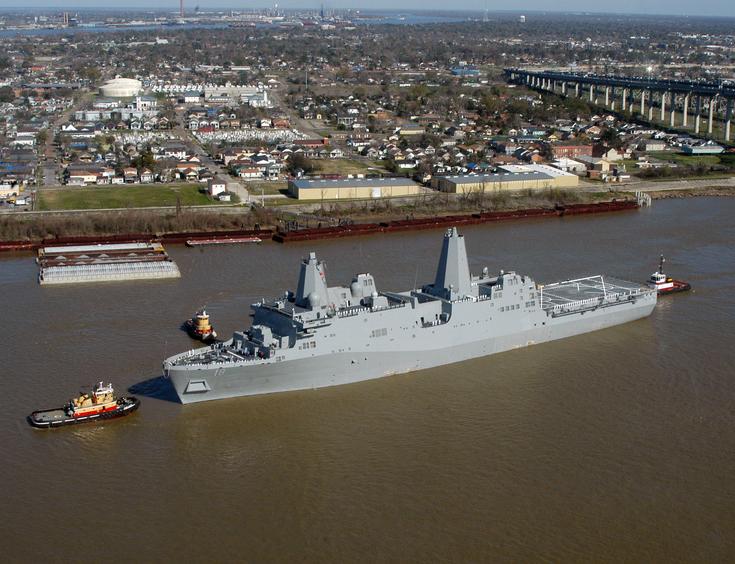
INSURV: now it is LPD-18

Woe is us. Two years --- good thing we aren't fighting a war or anything.
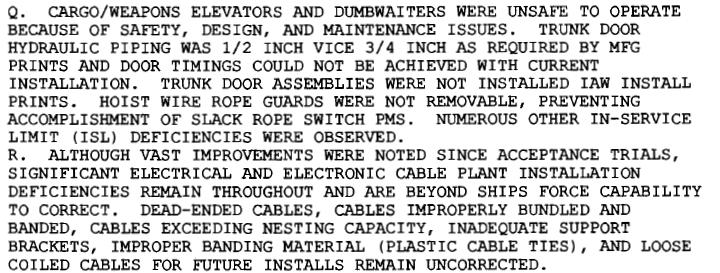
Just under two years after the amphibious transport dock New Orleans was delivered incomplete, the amphib still can’t perform the central mission for which it was designed: Carrying Marines, their gear and their vehicles into battle, according to a recent report by the Navy’s Board of Inspection and Survey, or InSurv.Heads on pikes? No, didn't think so.
The San Diego-based New Orleans was “degraded” in its “ability to conduct sustained combat operations,” and has a slew of other problems, according to the inspection, conducted Aug. 11-15. The report, obtained by Navy Times, paints the picture of a ship not only troubled by the same technical problems as its older sibling, the first-in-class gator San Antonio, but also with many of its own.
...
The New Orleans InSurv arrived just as the Norfolk, Va.-based San Antonio is preparing to make its maiden deployment this week. That ship was delivered three years ago, also incomplete. Like the San Antonio, the New Orleans’ electrical system had ship-wide problems, according to Navy inspectors: “Significant electrical and electronic cable plant installation deficiencies exist,” Navy inspectors wrote, including “dead-ended cables, cables improperly bundled and banded, cables exceeding nesting capacity, inadequate packing of cables at watertight penetrations.”
The findings make for a total of three ships with widespread electrical problems that were built at Northrop Grumman’s shipyards along the Gulf Coast: the first two San Antonios and the amphibious assault ship Makin Island. Northrop Grumman announced earlier this year that it had to delay the delivery of the Makin Island by six months to fix its wiring problems. The company agreed to bear the roughly $360 million cost.
Thursday, May 03, 2007
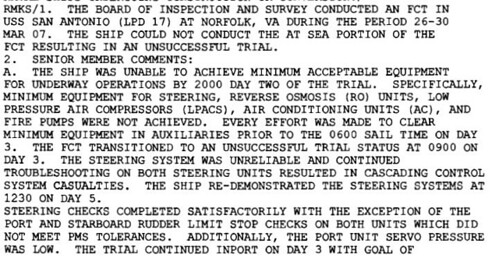
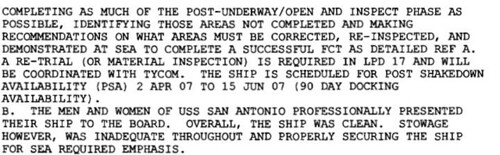
LPD-17 INSURV
First of all, we need to keep in mind that this is first in class, so expect a very tough INSURV. These types of ships are hard to get right, and usually a lot of Sailor sweat and national treasure is spent to get it right so follow-on units of the class have an easier time.
The CO and his Sailors were given an incomplete ship and a steep angle to climb. They have made great progress, but in spite of all their blood, sweat and toil - we owe it to the larger Navy to look at their ship with a cool, unblinking eye. Learn and process what you read.
That standard disclaimer aside, if you follow the LPD-17 tag below you will see that this is a very "special" ship. It still is special. Let's dig around and see what we can find.

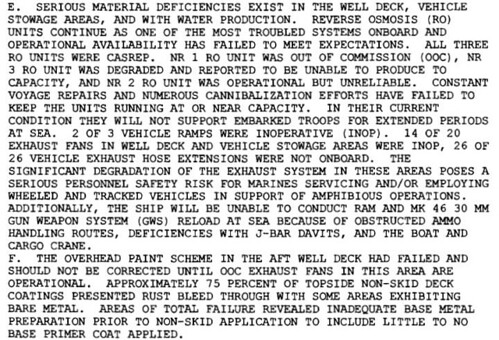
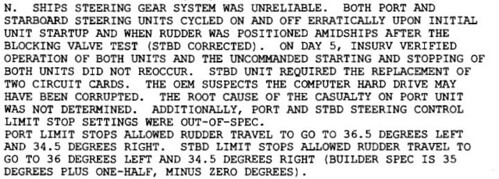
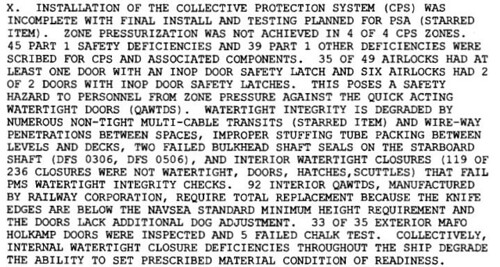
Ohhhhhh, the humanity! Just a firehose of pain. The next para starts, Delivered in JUL 05, USS SAN ANTONIO remains an unfinished ship. 138 of 943 spaces are unfinished and estimated completion dates o fthese spaces could not be determined.Like watching a train wreck, let's keep watching.
Like that warranty? The next bit is for Byron, especially the last part. Two words for you my friend; job security.
Correct me if I am wrong, but what does this tell you about proper PMS? Are they even doing it, or just not doing it right? Did they not get underway enough to find this stuff out ahead of time?
This and para 3.E will put you in the "sitting duck" spot real fast.
I know of one way to get Sailors more rack time.
We all know about the fancy new Damage Control software and systems. The thing is, how much good do they do you when the fundamentals are...
Well, if the thing just sinks you should be just fine.
Yep, that is 79% - not there.Is the ship ready to go in harm's way?
Hey, remember IT21 in the late '90s? Regret you were not part of the first IT21 Battle Group? No problem there Shipmate - we like the 1990's too! And it looks like some know how to find DRMO.
You know, I can almost smell the Suez canal from here.
The following is a great concern of mine - because if true, something very wrong has happened to "Not on my watch; not on my ship; not in my Navy!" Is this my Navy?
No autodog!?! No coffee in the Chief's Mess!?! Then again, that could explain a lot.Don't think anyone will be conducting flight ops any time soon.


So much for the wonders of the new CAD systems that was supposed to make everything come out the other end better. There is a lot more there, I just pulled those things that caught my eye. Note in the last extract above, Aviation was UNSAT at 0.59. Propulsion was UNSAT at 0.54 and Auxiliaries was UNSAT at 0.52. At this point, allAgain, don't beat up on the crew too much, they were give a tough job to do. Just try to learn. I know that the CO of the NEW ORLEANS and MESA VERDE are looking over this with a fine tooth comb. As for the Sailors of the SAN ANTONIO - you have more work to do - but you are going to make in the end a great ship.
Tuesday, March 29, 2011
OK, let's talk accountability
“Nobody trusts or has confidence in leaders who believe they cannot be held accountable for what they do,” Harvey wrote.OK. Notsomuch for ADM Harvey ... but up the chain a bit - where is the accountability for DDG-1000? LPD-17? How about "Optimal Manning" and refusing to give COs the personnel and resources they need to pass an INSURV or even get their ships underway? Not the sacrificial lamb O6/7 fired for the actions of others. No, those who made the decisions to begin with.
...
“We have good, fair processes to hold commanders accountable to established standards,” he wrote. “We need to use them, you need to use them, and I intend to use them.”
We have Flag Officers who not only encourage - but practice racial self-identification fraud for personal benefit. I know we won't question that - but when we accept such behavior in our most senior people --- do not expect everyone down the chain not to see that example and apply it elsewhere.
Instead of hiding (like classifying INSURV results) and happy-talk, why don't we hold our Flag Officers to the same level of professional expectation as we do our CDR and LCDR? That is a message that all will understand and will get you positive results down to the deckplates.
Programmatic failures are just as deadly as not carrying out procedures that don't exist ... I think.
Yes to accountability - but lead from the front.
Saturday, June 13, 2009
GM meets the classified INSURV
...INSURV results have to be not only unclassified but public; only embarrassment will fix some problems. Classification, especially the insidious “unclassified but special” categories we invented after 9/11, can invite overcontrol of information, improper use and worse. Special places to go look at stuff invite special tweaking. Every boat I knew at one point took the exercise equipment out of the engine room for the inspection, then put it right back in afterward…and everyone knew it, and so did the inspectors. This example is silly, not dangerous; however, there are dangerous ones out there. What are they and how do we correct them?Amen. Dude should do a spin off post at USNIBlog.
Monday, April 21, 2008
Sea Swap and the INSURV
UNCLASSIFIED//Do we set up our leaders and Sailors for failure sometimes? Is it always the CO and the Chief's Mess - or is there only so much a crew can do with the time, money, and ship they are given? How much deferred maintenance can you hold to those who were not responsible for it?
MSGID/GENADMIN,USMTF,2007/PRESINSURV NORFOLK VA//
SUBJ/INSURV REPORT FOR USS STOUT (DDG 55) MATERIAL INSPECTION (MI)// GENTEXT/REMARKS/1. THE BOARD OF INSPECTION AND SURVEY CONDUCTED AN MI OF USS STOUT (DDG 55) AT NORFOLK, VA DURING THE PERIOD 10-14 MAR 08 AT NORFOLK, VA.
2. SENIOR MEMBER COMMENTS:
A. USS STOUT WAS FOUND UNFIT FOR SUSTAINED COMBAT OPERATIONS.
B. ALTHOUGH THE SHIP CERTIFIED ITS READINESS FOR SEA, THE BOARD NOTED DISCREPANCIES THAT WOULD HAVE RESTRICTED UNDERWAY OPERATIONS OR DEMONSTRATIONS IN THE FOLLOWING AREAS DURING THE POST-UNDERWAY PORTION OF THE MI: 2B GTM/1B GTM, 1 GTG, STEERING, RESCUE BOAT/MAN OVERBOARD, ANCHOR, SPY-1D, FCS ILLUMINATORS, AFT VLS, CIWS MT 21, MK 32 SVTTS AND MK 45 LWG, HALON, AND UHF LOS COMMS.
C. AAW, USW, AND SUW MISSION AREAS WERE SIGNIFICANTLY LIMITED BECAUSE: AN/SPY-1D POWER OUT WAS REDUCED BY APPROX 75 PERCENT AND THE PROCESSING ABILITY WAS REDUCED BY APPROX 13 PERCENT, 2 OF 3 MK 99 ILLUMINATORS WERE INOP (LOSS OF 360 DEG COVERAGE AND NUMBER OF MISSILES INFLIGHT), AFT VLS MAGAZINE WAS UNAVAILABLE BECAUSE OF THE FUEL TANK LEAKAGE IN THE EDUCTOR SUMP (LOSS OF 68 PERCENT OF THE MISSILE INVENTORY), CIWS MT 21 WAS INOP, PORT AND STBD MK 32 SVTT TRAIN MECHANISMS WERE BINDING AND MOUNTS COULD NOT BE QUICKLY TRAINED TO FIRING POSITION, AND MK 45 5 INCH GUN COULD NOT SUPPORT GUNNERY DEMO BECAUSE OF CORROSION IN THE GUN CRADLE. SEE ANTI-SUBMARINE WARFARE, OPERATIONS, AND WEAPONS SECTIONS OF THIS REPORT FOR DETAILS.
D. THE ANCHORING DEMO WAS NOT COMPLETED BECAUSE THE ANCHOR WINDLASS WILDCAT/CAPSTAN SHAFT COUPLING UPPER AND LOWER SLEEVES HAD EXCESSIVE CONCENTRIC MOVEMENT (UP TO 1/4 INCH) AND THE MECHANICAL BRAKE WAS MISADJUSTED.
E. MOB RECOVERY METHOD WAS DEGRADED. CORROSION ON THE DAVIT FOUNDATION, PEDESTAL, FALLS TENSIONING DEVICE, DAVIT SHEAVE, AND THE HOOK SECURING PIN WAS SEVERE ENOUGH TO WARRANT A SAFETY INSPECTION (COULD NOT DEPLOY RHIBS). THE AS-FOUND SAR SWIMMER GEAR WOULD NOT PERMIT OPS IN WATER TEMP BELOW 60 DEG F.
F. THE SHIP INITIATED SELF-SUSPENSION OF FLIGHT OPS FOR DAMAGED FLIGHT DECK
NETS AND HARDWARE. AVIATION FACILITIES INSPECTION RESULTED IN 7 ADDITIONAL RECOMMENDATIONS FOR SELF-SUSPENSION OF FLIGHT OR AVIATION RELATED OPS. SEE AVIATION SECTION OF THIS REPORT FOR DETAILS.
G. ENGINEERING CONTROL SYSTEMS WERE DEGRADED. 8 OF 8 CONSOLES FOUND WITH RESISTANCE READINGS BETWEEN RETURN AND GROUND TO BE BELOW THE MINIMUM OF 250K OHMS IAW PMS 2521/051 A-18. 5 OF 62 DDG'S HAVE EXPERIENCED UNCOMMANDED MAIN PROPULSION/ELECTRICAL GENERATION EVENTS DUE TO GROUNDS.
H. 11 GTM RBOS AND 7 GTG RBOS WERE IDENTIFED DURING THE INPORT INSPECTION.
I. RUDDER INSPECTION OVER THE PAST 11 MONTHS INDICATED BARE METAL SURFACE AREA HAD INCREASED BY APPROX 700 PERCENT AND 270 PERCENT FOR STBD AND PORT RUDDERS RESPECTIVELY. ADDITIONALLY, PITTING OF UP TO 2 INCHES IN DIAMETER BY 0.25 INCHES DEEP HAD DEVELOPED ON THE RUDDER SURFACE AREA. THE SHIP'S IMPRESSED CURRENT CATHODIC PROTECTION (ICCP) SYSTEM WAS NOT OPERATING PROPERLY. ICCP IS DESIGNED TO PREVENT BARE METAL DAMAGE.
J. GROUNDS IN 60 HZ DISTRIBUTION AND IC SYSTEMS WERE A SIGNIFICANT ISSUE. 3 ICSM PANELS, 5 60 HZ POWER PANELS, 4 SOUND POWERED PHONE CIRCUITS, AND 1 SHORE POWER RECEPTACLE WERE FOUND GROUNDED DURING THE INSPECTION. 2 GROUNDS DISCOVERED BY SHIP'S FORCE IN JAN 08 HAD NOT BEEN CORRECTED. INVESTIGATION AND CORRECTION OF THE GROUNDS IAW NSTM 300 PARA 300-3.2.6 WAS REQUIRED.
K. KEEL REST AND BOAT CHOCKS DID NOT HAVE 90 PERCENT MINIMUM CONTACT WITH THE BOAT IN THE STOWED POSITION.
L. ACCOM LADDER WAS NOT OBSERVED. LADDER WAS OFF THE SHIP FOR REPAIR (CASREP 07094).
M. ANCHOR CHAIN'S 1ST AND 2ND SHOT DID NOT RIDE IN THE WELP OF THE WILDCAT IAW NSTM 581-5.1.4.1.
N. MK 39 GYRO DATA CONVERTER (GDC) DATA TO SPY-1D COMPUTER INTERMITTENTLY CHANGED STATUS FROM GOOD TO FAILED, CAUSING AFT GYRO INFORMATION TO BE UNRELIABLE BECAUSE OF FAULTY ADAPTATION DATA CIRCUIT CARDS. SYMPTOM WAS ORIGINALLY IDENTIFIED IN MAR OF 06 (CASREP 06049, USS STOUT MSG 311830Z MAR 06) WHICH ALSO IDENTIFIED UNRELIABLE DATA TO WCS, GUN FIRE CONTROL SYSTEM, AND N PLUS 1 COMPUTER.
O. AFT MK41 VLS HAD 10 DELUGE VALVES LEAKING AND FWD VLS HAD 3 VALVES LEAKING. SALINITY CHECK AFT HAD TWICE THE ALLOWABLE LIMIT (4 VICE 2 MICROMHO). SEDIMENT WAS ALSO PRESENT IN THE AFT DELUGE HOSES WHICH WILL LEAD TO VALVE FAILURES.
P. MT 51 CRADLE ROUND/POWDER POSITION SWITCHES WERE CORRODED, PREVENTING THE GUN FROM FIRING DURING THE GUNNERY DEMO. CORRECTIVE ACTION REQUIRED 4 HOURS (CORRECTED). ADDITIONALLY, SALT WATER CORROSION WAS ON THE CRADLE VALVE BLOCKS, LOADER DRUM PIPING/VALVE BLOCKS, FUZE SETTER ELECTRICAL SWITCH CONNECTORS, MAIN CABLE CONNECTOR TIE-POINT, LOWER HOIST ASSEMBLY, SHIELD ACCESS DOOR LINKAGES, AND UPPER HOIST CHAIN TRACK.
Q. SHIP'S UHF LOS COMMUNICATIONS WERE DEGRADED AND COULD NOT FULLY SUPPORT 80 PERCENT OF 5TH FLEET COMMUNICATIONS PLAN WITH AVAILABLE ASSETS. OVERALL COMMUNICATION ANTENNA MAINTENANCE AND CORROSION PREVENTIVE MEASURES, IF UNIMPROVED, WILL LEAD TO FURTHER COMMUNICATION SYSTEM DEGRADATIONS. SEE COMMUNICATIONS SECTION OF THIS REPORT FOR DETAILS.
R. AN/USQ-153 ISNS SIPRNET AND NIPRNET WERE DEGRADED WITH THE FOLLOWING DEFICIENCIES: SERVERS HAD UNAUTHORIZED USB 500GB HARD DRIVES CONNECTED, IAVA PATCHES WERE NOT CURRENT, SERVERS REQUIRED DEFRAGMENTATION, TAPE BACK-UP DEVICES WERE INOP OR MALFUNCTIONING, AND INTEGRATED NETWORK MANAGER (INM) WOULD NOT START.
S. AN/USQ-144 ADNS SYSTEM HAS BEEN INSTALLED FOR OVER 1 YEAR WITHOUT A COMPLETED SOVT.
T. FOOD SERVICE DIVISION'S ABILITY TO SAFELY OPERATE WAS DEGRADED BECAUSE OF THE GREASE INTERCEPTOR HOOD MATERIAL CONDITION. SEE SUPPLY SECTION OF THIS REPORT FOR DETAILS.
U. SHIP'S ABILITY TO STORE, PREPARE, AND SERVE FOOD WAS DEGRADED. SPECIFICALLY: WALK-IN FREEZER DID NOT MAINTAIN 0 DEG F OR BELOW (CORRECTED), 5 OF 13 REACH-IN REEFERS WERE INOP, 4 OF 13 REACH-IN REEFERS WERE DEGRADED, REACH-IN REEFER CONDENSER COIL FILTER CLEANING MAINTENANCE WAS NOT BEING COMPLETED (CORRECTED), 2 OF 2 SINGLE TANK DISHWASHERS WERE INOP, 3 OF 3 WASTE DISPOSAL UNITS WERE INOP, 3 OF 4 STEAM KETTLES WERE INOP, 1 OF 3 CONVECTION OVENS WAS INOP, AND 1 OF 2 SANITIZING SINKS WAS INOP.
V. SEALANT IN THE SHOWERS HAD FAILED, ENABLING 7 OF 12 SANITARY SPACE SHOWER DECKS TO BECOME SEPARATED FROM THE SURFACE AND ROT.
W. BERTHING 2 HAD NUMEROUS MATERIAL AND PRESERVATION ISSUES WITH THE BERTHING TIER FOUNDATIONS CORRODED TO THE POINT OF LOST METAL DUE TO A WATER FOUNTAIN THAT HAD BEEN LEAKING FOR A YEAR (SHIP REPORTED). BERTHING IS SCHEDULED FOR REHABILITATION IN 2011. FOUNDATIONS REQUIRE TESTING FOR QUALIFICATION TO SAFELY SUPPORT PERSONNEL FOR COMBAT STRESS/DESIGN STRESSES.
X. MAIN DRAINAGE WAS DEGRADED BECAUSE THE AUX 1 EDUCTOR OVBD DISCHARGE VALVE (MD-V 2-169-2) DID NOT SHUT REMOTELY, MER 1 EDUCTOR LOCAL AND REMOTE SUCTION GAUGES WERE INOP, THEREFORE PREVENTING SHIP'S FORCE FROM FOLLOWING EOP. AUX 1 BHD STOP VALVE (MD-V-31 4-173-6) MOV LOCAL OPEN INDICATOR LIGHT WAS OUT.
Y. HALON WAS DEGRADED BECAUSE THE PAINT LOCKER EXHAUST AND THE MER 2 SUPPLY VENTILATION DAMPENERS FAILED TO CLOSE.
Z. 22 OF 24 PORTABLE DAVIT SOCKETS HAD EXCESSIVE CORROSION AND REQUIRE LUBRICATION/CLEANING OF THE SOCKET COLLARS, DAVIT BEARINGS, DAVIT FEET, AND FOOT SOCKETS.
AA. 1 OF 2 CONREP STATIONS WAS INOP (SEE DECK SECTION OF THIS REPORT FOR
DETAILS).
AB. SHIP'S SELF-ASSESSMENT CAPABILITY WAS EVALUATED AS MARGINAL.
AC. 26 OF 77 WATERTIGHT CLOSURES INSPECTED WERE NOT WATERTIGHT.
AD. 2 OF 2 IPDS WERE OPERATIONAL.
AE. 14 OF 20 VENTILATION AIRFLOW ALARMS WERE EITHER INOP OR MISADJUSTED.
AF. 9 CRITICAL DEFICIENCIES PRECLUDED OILY WATER SEPARATORS CERTIFICATION.
AG. DOSSERT CONNECTORS WERE FOUND IN THE NR 1 AND NR 3 SWBDS. THERMAL INDICATIONS REVEALED NO SIGNS OF LOOSENING OR LOCAL HEATING. CONNECTORS NEED TO BE DOCUMENTED FOR FUTURE INSPECTION.
AH. 2 SYSTEMS DID NOT HAVE PREVENTIVE MAINTENANCE SYSTEM (PMS) INSTALLED. SEE ENVIRONMENTAL PROTECTION SECTION OF THIS REPORT FOR DETAILS.
3. THE FOLLOWING CASREPS WERE ACTIVE AT THE BEGINNING OF THE MI:
NUMBER NOMENCLATURE CATEGORY
06026 AUXILIARY SYSTEMS 2
06027 AUXILIARY SYSTEMS 2
06028 AUXILIARY SYSTEMS 2
07049 AFT MK41 VLS MODULE 3 2
07051 AFT MK41 VLS MODULE 2 2
07076 ACTS 2
07092 MSS CONSOLE 2
07094 ACCOMMODATION LADDER 2
07098 CONDITIONING SYSTEMS, AIR 2
08001 FLIGHT DECK NETS 2
08002 AIR SYSTEMS, HIGH PRESSURE 2
08005 SHF 2
08007 HULL STRUCTURE 2
08009 FCS NR 1 2
08011 STEERING GEAR W/CONTROL 2
08012 BFTT 2
08013 SPY HVPS 2
08016 STEERING GEAR W/CONTROL 2
08017 NR 1 HPAC WATER PUMP 2
08018 MT22 CIWS MAGAZINE 2
08019 PURIFIER NR 2 LUBE OIL 2
4. 23 DEPARTURES FROM SPECS (DFS) EXISTED AT THE BEGINNING OF THE MI.
A. THE FOLLOWING DFS WERE IN EXCESS OF 180 DAYS:
NUMBER NOMENCLATURE DATE ISSUED
DDG55-003-01 MILLING MACHINE 11/13/2003
DDG55-001-02 NR 1 CRP PUMP SEAL 1/23/2006
DDG55-002-02 NR 2 CRP PUMP SEAL 1/23/2006
DDG55-004-02 NR 1 CPP SHEAR PINS 9/26/2003
DDG55-005-02 NR 2 CPP SHEAR PINS 9/26/2003
DDG55-012-01 MRG MOST REMOTE BEAR 11/26/2002
DDG55-005-03 STBD BLKHD SEAL 220 3/13/2003
DDG55-006-03 STBD BLKHD SEAL 254 3/13/2003
DDG55-007-03 STBD BLKHD SEAL 300 3/13/2003
DDG55-008-03 PORT BLKHD SEAL 300 4/25/2003
DDG55-018-03 NR 1 MRG UNLOADER VLV 1/28/2006
DDG55-019-03 NR 2 MRG UNLOADER VLV 1/28/2006
DDG55-001-04 NR 1A GTM SHOCK MOUNT 4/9/2007
DDG55-002-04 NR 1B GTM SHOCK MOUNT 4/9/2007
DDG55-003-04 NR 2A GTM SHOCK MOUNT 4/9/2007
DDG55-004-04 NR 2B GTM SHOCK MOUNT 4/9/2007
DDG55-021-04 NR 2 MRG L/O COOLER 6/3/2005
B. NO DFS WERE ISSUED TO SUPPORT COMPLETION OF THE MI.
5. 15 ACTIVE TEMPORARY STANDING ORDERS (TSO) EXISTED AT THE BEGINNING OF THE MI.
A. NO TSO WERE IN EXCESS OF 45 DAYS.
B. NO TSO WERE ISSUED TO SUPPORT COMPLETION OF THE MI.
6. DEMO RESULTS: SAT (0.80-1.00)/DEGRADED (0.60-0.79)/UNSAT (0.00-0.59):
-AAW DTE DEMO WAS UNSAT (SCORE: 0.51) BECAUSE OF REDUCED AN/SPY-1 DETECTION RANGE AND FAILURE OF 2 OF 3 FCS ILLUMINATORS.
-SD DTE DEMO WAS DEGRADED (SCORE: 0.73) BECAUSE THE CIWS MT 21 WAS INOP AND DID NOT SUPPORT THE ENGAGEMENT.
-GUNNERY LIVE FIRE DEMO WAS UNSAT (SCORE: 0.30) BECAUSE MT 51 DID NOT FIRE UNTIL THE CORRODED BREECH SAFETY DEVICE WAS REPAIRED.
-USW DTE DEMO WAS SAT (SCORE: 0.91).
-FULL POWER DEMO COULD NOT BE CONDUCTED (SCORE: 0.00) BECAUSE REQUIRED EQUIPMENT COULD NOT BE ACHIEVED. SHIP WAS ABLE TO ACHIEVE 80 PERCENT FULL POWER ON A 3 GTM CONFIGURATION AND A 1 HOUR HIGH POWER DEMO WAS CONDUCTED AT THAT SPEED.
-QUICK REVERSAL ASTERN WAS SAT (SCORE: 0.95). QUICK REVERSAL WAS CONDUCTED FROM 80 PERCENT FULL POWER AHEAD TO 100 PERCENT FULL POWER ASTERN.
-QUICK REVERSAL AHEAD WAS SAT (SCORE: 1.00). QUICK REVERSAL WAS CONDUCTED FROM 100 PERCENT FULL POWER ASTERN TO 80 PERCENT FULL POWER AHEAD.
-STEERING DEMO WAS SAT (SCORE: 0.95). STEERING DEMO WAS CONDUCTED AT 80 PERCENT FULL POWER.
-ANCHORING DEMO WAS UNSAT (SCORE: 0.00) BECAUSE OF ANCHORING DEFICIENCIES.
7. SHIPBOARD PRESERVATION: DEGRADED (SCORE: 0.79):
-CCIPT IN-SERVICE CORROSION CONTROL SURVEYS WERE CONDUCTED IN JUN 06 AND SEP 05. INSURV CORROSION INSPECTION VALIDATED THAT 80 PERCENT OF THE DEFICIENCIES IDENTIFIED DURING THE SURVEYS WERE STILL OUTSTANDING. SURFACE PREPARATION AND COATING APPLICATION HAS NOT BEEN ACCOMPLISHED PROPERLY OVER THE LIFE OF THE SHIP AND HAS ADDED TO THE OVERALL INCREASED WEIGHT OF 3.5 TONS IAW CCIPT SURVEY REPORT FOR USS STOUT (DDG 55), WHICH HAS DECREASED FUEL SAVINGS, SPEED, AND STABILITY.
-FLIGHT DECK STATUS LIGHTING SYSTEM WAS INOP BECAUSE OF CORROSION.
-CORROSION CONTROLS FOR BULKHEAD TO DECK INTERFACE IN BERTHING 5 AND 7 SANITARY SPACES WERE INADEQUATE (GRADE 1G).
-APPROX 210 SQ FT OF THE 05 LEVEL DECK WAS CORRODED. 65 PERCENT OF THE NON-SKID HAD RUST BLEEDING THRU, ALL DECK DRAINS WERE CORRODED WITH FLAKING METAL AND WASTAGE, THE KNIFE EDGE HAD MULTIPLE SPOTS OF FLAKING METAL, AND THE JUNCTION OF THE DOG HOUSE BULKHEAD AND DECK WAS CORRODED OVER THE ENTIRE LENGTH. ADDITIONALLY, THE FWD STBD CORNER WAS CRACKED.
-AFT ICCP MAGNETIC CONTROLLER WAS INCORRECTLY SET. HULL POTENTIAL READING
WAS .900 VDC, REFERENCE AND AUX CELL CHECK READINGS WERE AT .900 VDC AND CONTROLLER OUTPUT READING WAS .150 VDC (CONTROLLER OUTPUT SHOULD BE 0 VDC WHEN HULL POTENTIAL IS ABOVE .850 VDC ).
-1 OF 2 BRUSHES ON THE STBD SHAFT GROUNDING ASSY HAD LESS THAN 50 PERCENT CONTACT WITH THE SHAFT SLIP RINGS.
-PORT AND STBD SHAFT GROUNDING WIRE INSULATION WAS DETERIORATED.
-PORT AND STBD RUDDER GROUNDING STRAPS WERE THE WRONG MATERIAL AND INCORRECTLY BOLTED ON BOTH ENDS.
-VAPOR CONDENSATION INHIBITORS (VCIS) WERE NOT INSTALLED IN APPROX 75 PERCENT OF THE ELECTRICAL ENCLOSURES IAW MRC 3001/002-18M-4.
-ALL FCS DIRECTORS HAD EXTENSIVE CORROSION ON THE FASTENERS AND HARDWARE BECAUSE THEY WERE NOT WEATHER-PROOFED. ADDITIONALLY, THE FCS 1 TRAIN SEAL FAILED AND ALLOWED WATER INTRUSION INTO THE TRAINING GEAR FLUID WHICH WAS MILKY WHITE IN COLOR. THIS IS A CLASSWIDE ISSUE.
-HARPOON LAUNCHERS AND FOUNDATIONS WERE CORRODED. CABLE STUFFING TUBES TO THE LAUNCHERS HAD ASTM 1G CORROSION AND SHOWED 90 PERCENT METAL WASTAGE.
-TV-DTS ANTENNA 10-1 (STBD/FWD) HAD RUST GRADE 1-G (OVER 50 PERCENT RUSTED) ON THE CONDUIT SECURING PLATE.
-OE-567/WSC-6 SHF ANTENNA 3-17 (STBD/FWD) HAD RUST GRADE 1-G (OVER 50 PERCENT RUSTED) ALONG ANTENNA BASE.
-AN/SRQ-4 HAWKLINK ANTENNA WAS SHOWING SIGNS OF WAVEGUIDE CORROSION.
8. SIGNIFICANT MATERIAL DEFICIENCIES AND EQUIPMENT OPERATIONAL CAPABILITY (EOC) INCLUDE:
A. PROPULSION: DEGRADED (SCORE: 0.69):
-1 OF 4 GTMS WAS INOP.
-4 OF 4 GTMS HAD LUBE OIL LEAKS.
-2 OF 4 GTM MODULE HALON ALARM BELLS WERE INOP.
-NR 1B GTM HAD FOD ON THE INTAKE PLENUM SCREEN.
-NR 1 MRG WAS MISSING PHYSICAL SECURITY DEVICES ON VARIOUS FLANGES.
-2 OF 2 MAIN THRUST BEARING REAR SEALS LEAKED LUBE OIL.
-3 OF 4 LUBE OIL SERVICE PUMPS LEAKED LUBE OIL.
-NR 2 MRG LUBE OIL STRAINER DIFFERENTIAL PRESSURE ALARM WAS MISADJUSTED (CORRECTED).
-2 OF 2 MER 1 FUEL OIL SERVICE TANK QUICK TRIP VALVES WERE INOP (CORRECTED).
-2 OF 2 MER 1 FUEL OIL PRE-FILTER DIFFERENTIAL PRESSURE ALARMS WERE MISADJUSTED (CORRECTED).
-2 OF 4 GTM BLEED AIR CHECK VALVES WERE INOP.
-8 BLEED/MASKER/PRAIRIE AIR SYSTEM LOW POINT DRAINS HAD NO FLOW.
-14 FLEXIBLE HOSE ASSEMBLIES THROUGHOUT THE BLEED/MASKER AND PRAIRIE AIR SYSTEMS HAD LAGGING PADS INSTALLED THAT APPEARED NOT TO HAVE BEEN REMOVED IOT CONDUCT THE ANNUAL PMS INSPECTION REQUIRED BY MIP 5000/009.
-3 OF 3 GTGS HAD LUBE OIL LEAKS.
-2 OF 3 GTG PMA LUBE OIL PUMPS LEAKED INTO THE GENERATOR.
-NR 1 GTG THERMOCOUPLE BLOCK WAS BROKEN.
-NR 1 GTG BLOW-IN DOOR CONTROLLER WAS IN MANUAL DURING OPERATION.
-NR 2 GTG HALON TIME DELAY WAS MISADJUSTED (CORRECTED).
-NR 3 GTG HAD A FUEL LEAK ON THE FUEL FILTER HOSE.
B. AUXILIARIES: UNSAT (SCORE: 0.56):
-RUDDER ACCURACY CHECKS FAILED FOR BOTH ALPHA AND BRAVO STEERING UNITS.
-ALL STEERING HYDRAULIC POWER UNITS WERE LEAKING HYDRAULIC OIL IN SEVERAL PLACES, REQUIRING CONSTANT WIPERS.
-VERTICAL PACKAGE CONVEYOR WAS INOP BECAUSE OF IN-SERVICE LIMITS. THE TORQUE COUPLING PERSONNEL SAFETY GUARD WAS NOT INSTALLED, MAIN, 2ND AND 3RD DECK LOADER/UNLOADER GRAVITY CONVEYOR CONNECTION POINTS WERE NOT INSTALLED (ECP 572-02A-C021), CONVEYOR DID NOT STOP WHEN THE JAM LIMIT SWITCHES WERE ACTUATED UP TO 1.5 INCHES IAW SAFETY ADVISORY 033-00, 01 LEVEL SECONDARY DRIVE CHAINS WERE LOOSE, AND ALL LEVEL PERSONNEL SAFETY SHIELDS WERE IMPROPERLY MADE WITH SHARP EDGES.
-NR 1 A/C WAS INOP BECAUSE OF A LEAKING MECHANICAL SEAL ON THE COMPRESSOR (CASREP 07098).
-NR 1 REFRIGERATION UNIT WAS OOC BECAUSE OF AN INOP CAPACITY CONTROL.
-NR 4 A/C CHILLER WAS LEAKING CHILLED WATER INTO THE BILGE.
-NR 1 FREEZE BOX COIL TEMP CONTROL SWITCH WAS INOP, MAINTAINING THE TEMP AT PLUS 3 DEG F.
-NR 1 AND NR 2 COILS FOR THE FREEZE BOX AND THE COILS FOR THE CHILL BOX LOUVERS WERE INOP.
-2 OF 2 REVERSE OSMOSIS UNIT DUMP VALVES FAILED TO TRIP ON HIGH SALINITY (CORRECTED).
-2 OF 2 HPAC AND 1 OF 3 LPAC TYPE 1 DEHYDRATORS FAILED THE DEWPOINT TEST.
-NR 1 HPAC HAD A LEAKING WATER PUMP (CASREP 08017).
-NR 4 FIREPUMP SUCTION VALVE WAS INOP REMOTELY FROM THE MAIN DECK CONTROL STATION.
-3 OF 6 FIREPUMP SUCTION VALVE LOCAL POSITION INDICATORS WERE MISSING.
-NR 1 SWS PUMP HAD A SIGNIFICANT LEAK IN PUMP CASING VENT LINE. LEAK WAS VENTING 1 FT BELOW A POWER PANEL.
-4 OF 5 SWS SUCTION VALVE LOCAL POSITION INDICATOR DIALS WERE MISSING.
-NR 2 AND NR 5 SWS PUMPS HAD LEAKING MECHANICAL SEALS.
-2 OF 3 WATER HEATER HIGH TEMP SAFETY SWITCHES WERE MISADJUSTED ON HIGH TEMP.
-3 OF 3 WATER HEATER HIGH TEMP SAFETY SWITCHES DID NOT HAVE MANUAL RESET.
-2 OF 3 WATER HEATER OPERATING SWITCHES WERE MISADJUSTED.
C. ELECTRICAL: DEGRADED (SCORE: 0.77):
-MAIN 60 HZ SWBD AND LOAD CENTER AQB-L AND AQB-LL SERIES CIRCUIT BREAKER ADJUSTABLE SHORT TIME PICK-UP AND SHORT TIME DELAY SETTINGS WERE NOT SET IAW TECHMAN (CORRECTED).
-CL Z VENT ZONE 3 PANEL NR 3 CIRCUIT BREAKER DID NOT TRIP DURING STAGE 1 LOAD SHED TESTING.
-ABTS 01-116-1 AND 02-305-2 DID NOT SHIFT IN AUTO WHEN TESTED.
-ABT 2-239-1 INTERMITTENTLY SHIFTED FROM NORMAL TO ALTERNATE POWER SOURCES WHEN IN THE AUTOMATIC MODE.
-ABT 1-127-1 EXTERIOR CABINET WAS SEVERELY CORRODED AND COULD NOT BE OPENED.
-POWER PANELS 2-50-2, 2-162-2 AND 03-173-1 HAD OVER-RATED CIRCUIT BREAKERS
INSTALLED.
D. DAMAGE CONTROL: DEGRADED (SCORE: 0.69):
-MER 1 BILGE SPRINKLER SOPV DID NOT OPEN FULLY WHEN ACTIVATED (CORRECTED).
-3 GEN RE-ENTRY HOSE NOZZLE WAS INOP (CORRECTED).
-2 OF 3 EBACS DID NOT FILL BOTTLES IAW THE PMS TIME FRAME (15-18 MINUTES).
BOTH WERE IN EXCESS OF 20 MIN.
-3 OF 3 HPFAS DID NOT FILL BOTTLES IAW THE PMS TIME FRAME (45 SEC).
-23 OF 63 SCBAS WERE UNSAT.
-3 BERTHING SALTWATER SPRINKLERS DID NOT ALARM DURING TESTING.
-1 OF 2 AN/KAS WAS INOP (PORTSIDE).
-1 OF 3 PP-4276C/PD WAS INOP.
-AUX 1, MER 1, AND 3 GEN HALON PRIMARY ACTIVATION CO2 BOTTLES LEAKED.
-FIREMAIN PRESSURE CONTROL VALVE WAS INOP.
E. DECK: UNSAT (SCORE: 0.50):
-3 OF 3 MEDICAL MK 1 LIFE VESTS WERE NOT MAINTAINED IAW MIP 5832/R-1.
-4 OF 7 RESCUE BOAT MK 1 LIFE VESTS FAILED TO PROPERLY INFLATE.
-1 OF 2 SAR LPU-28 LIFE VESTS FAILED TO PROPERLY INFLATE (CORRECTED).
-1 OF 2 SAR STROBE LIGHTS WITH THE BLUE LENS FAILED TO OPERATE IAW MIP 5832/U-1 (CORRECTED).
-1 OF 2 SETS OF SAR GLOVES WAS HOLED AND REQUIRED REPLACEMENT (CORRECTED).
-2 OF 2 SETS OF CPU-72P DRY SUIT LINERS WERE MISSING, PREVENTING SAR FROM ENTERING WATER IN TEMPS LOWER THAN 60 DEG F IAW NWP 3-50.1 FIGURE 5-59 WATER TEMPERATURE GUIDELINES.
-BOAT DECK SAR MEDIVAC LITTER WAS MISSING WEIGHT TEST DATA, 2 OF 2 ADJUSTABLE CARRYING HARNESSES AND A LUMBAR SUPPORT PAD (CORRECTED).
-4 OF 4 RETRACTABLE BITTS/CHOCKS REQUIRED MAINTENANCE IAW MIP 5821/Q-4. BITT BUSHINGS, UPPER AND LOWER GUIDES REQUIRED INSPECTION, CLEANING, AND LUBRICATION.
-3 OF 6 MOORING LINES HAD EXCESSIVE ABRASIONS, TWISTED STRANDS, IMPROPER SPLICES, SEVERE COCKLING, AND WERE NOT MAINTAINED IAW MIP 5821/Q-11R.
-2 OF 4 FANTAIL BITTS HAD EXCESSIVE ABRASIVE CUT CONDITIONS AND SIGNIFICANT CORROSION.
-RAS NR 5 MANUAL OPERATION CUT-OUT WAS BENT AND MISSING SECURING LANYARD.
-RAS NR 5 WAS MISSING THE ELECTRIC DISK BRAKE RELEASE LEVER. THE PADEYE COULD NOT BE DEMONSTRATED IN THE MANUAL MODE.
-1 OF 2 LOWER LIMIT SWITCHES WAS INOP ON RAS STA NR 5.
-SLIDING PADEYE EMERGENCY PNEUMATIC DRIVE WAS MISSING.
-1 OF 2 TILT STOWED BACKSTAY YOKES WAS SEIZED ON STA NR 5.
-RAS NR 5 AND NR 6 WERE NOT MAINTAINED IAW 5713/Q-3R-S-1. BOTH STAS HAS SEVERELY CORRODED CARRIAGES, WORM SCREWS, FOUNDATION MEMBERS, LOWER CONNECTION BOXES, AND ELECTRIC MOTORS.
-RAS NR 6 WAS ASSEMBLED INCORRECTLY AFTER OVERHAUL. THE KING POST REQUIRED RE-WORK TO PROPERLY INSTALL THE SLIDING BLOCK SO LUBRICATION MAINTENANCE OF THE BALL DRIVE CAN BE ACCOMPLISHED (SHIP REPORTED).
-4 OF 4 KINGPOST UNREP LIGHTS WERE DAMAGED AND INOP ON RAS STAS NR 5 AND NR 6.
-SEWING MACHINE WAS INOP BECAUSE OF MISSING POWER, SAFETY PLACARD, AND OPERATING ACCESSORIES.
-28 OF 28 TOPSIDE LIFEJACKET LOCKERS WERE NOT MAINTAINED IAW PMS MIP 6111/S-1.
-AFT LOOKOUT LIFE RING WAS DETERIORATED AND PUNCTURED. DISTRESS MARKER LIFE
RING SECURING BRACKETS WERE MISSING AND STENCIL WITH SHIP'S NAME AND HULL NUMBER WAS UN-READABLE.
-SHIP'S BROW WAS MISSING 5 OF 10 LIFELINE STAPLES.
-6 OF 6 FENDER SECURING STRAPS WERE MISSING.
-PILOT'S LADDER WAS NOT RIGGED IAW NAVSHIP DWG 804-5000900.
-PILOT'S LADDER WAS NOT PROPERLY ADJUSTED TO TERMINATE AT WATERS EDGE.
-72 OF 187 (31 PERCENT) OF MAIN DECK KEVLAR LIFELINES WERE NOT MAINTAINED IAW MIP 6121/S-5.
-60 PERCENT OF THE BAXTER BOLTS INSPECTED WERE NOT IAW PMS 6111/A-2R.
F. ANTI-SUBMARINE WARFARE: SAT (SCORE: 0.90):
-S/F COULD NOT POWER ON THE ALTERNATE MK 116 UYH-3 BECAUSE OF FAULTY WIRING TO THE BACK SHELL.
-1 OF 6 TORPEDO BREECH CONTROL VALVES WAS STUCK OPEN BECAUSE OF CORROSION.
-TORPEDO BANDING TOOLS WERE MISSING.
G. OPERATIONS: DEGRADED (SCORE: 0.62):
-AN/SPY-1D D/PD T20, FPA T26 MOD 3 (LOSS OF 4 OF 16 CHANNELS), AND FPA T27 MOD 3 (LOSS OF 4 OF 16 CHANNELS) WERE INOP BECAUSE OF FAULTY HVPS T138 (CASREP 08013).
-12 OF 16 CHANNELS IN FPA T26 WERE INOP (4 CORRECTED).
-12 OF 16 CHANNELS IN FPA T27 WERE INOP (3 CORRECTED).
-AN/SPY-1D SIGNAL PROCESSOR SIDE A DROPPED OFF-LINE BECAUSE OF DIGITAL FAULTY ISOLATION FAILURES AND THE INTERMITTENT FAULT WITH RADAR TARGET DATA PROCESSOR NR 2.
-AN/SPY-1D ARRAY T01 POWER SUPPLY WAS INOP (LOSS OF REDUNDANCY).
-AN/SPS-67 SHORT PULSE MODE WAS INOP.
-AN/SPS-67 MODULATOR CURRENT EXCEEDED 22 AMPS (CORRECTED).
-APX-118 IFF TRANSPONDER MODE 4 WAS INOP.
-ROTATING IFF ANTENNA (SPS-67) SUM AND DIFFERENCE VSWR WAS OUT-OF-SPEC.
-AN/URN-25 TACAN REFLECTED POWER WAS HIGH AND IPA TUBE CURRENT WAS OUT-OF-SPEC LOW.
-MK 137 MOD 4 SRBOC LAUNCHERS NR 1A AND NR 3A SAFE LAMPS WERE FAULTY (LAUNCHER NR 1A SHIP REPORTED). S/F COULD NOT DETERMINE SAFE/ARM STATUS AT AFFECTED LAUNCHERS.
-MK 137 LAUNCHER NIGHT LOADING LIGHTS WERE INOP (SHIP REPORTED).
-PCMS WAS DEGRADED (INSPECTION SCORE: 211).
-HD1140 SPY COOLING SYSTEM WAS NOT OPERATED IAW PMS 456/R08 W-1. COPPER NICKEL HEAT EXCHANGER WAS ON-LINE VICE TITANIUM HEAT EXCHANGER BECAUSE TITANIUM HEAT EXCHANGER WAS CLOGGED.
-BFTT DEMO WAS DEGRADED BECAUSE OF MULTIPLE FAULT INDICATIONS (CIU SETUP OR DMS FAULTY, 1553B STATUS ERROR-DUAL COMM FAILURE). FAULTS OCCURRED APPROX 3 TIMES PER MINUTE AND CAUSED OWN SHIP INFORMATION TO BE ERRATIC.
H. WEAPONS: SAT (SCORE: 0.88):
-MT 21 AMMO HANDLING SKIP BOX JUMPED DURING OPERATION AND WAS UNSAFE TO OPERATE.
-MT 21 WAS INOP BECAUSE OF A FAULTED ANTENNA VRU. PROBLEM COULD NOT BE REPLICATED WHEN RUNNING SOTS IN PORT.
-HARPOON LAUNCHERS AND FOUNDATIONS WERE EXTREMELY CORRODED. CABLE STUFFING TUBES TO THE LAUNCHERS HAD ASTM 1G CORROSION AND SHOWED 90 PERCENT METAL WASTAGE. PCMS HAD MULTIPLE LAYERS OF PAINT FLAKING OFF.
-26 OF 90 VLS LAUNCHER DELUGE GROUNDING STRAPS WERE CORRODED.
-AFT VLS LAUNCHER, MODULE 2, CELL 6 HATCH WAS BINDING AND REQUIRED REPLACEMENT.
-AFT VLS LAUNCHER, MODULE 3 FAILED SYSTEM BITE.
-AFT VLS LAUNCHER, MODULE 7 FAILED SYSTEM, LSEQ AND MCP BITE. CELLS 1-4 HAD MULTIPLE FAULT CODES.
-MT 51 AMMO ELEVATOR HOIST WAS NOT TESTED BECAUSE THE HATCH TRIPOD HOSES WERE DAMAGED AND FASTENERS WERE MISSING.
-FCS 1 TRAIN SEAL FAILED AND ALLOWED WATER INTRUSION INTO THE TRAIN FLUID WHICH WAS MILKY WHITE IN COLOR.
-FCS 1 MAN ALOFT SWITCH WAS INCORRECTLY LABELED. SAFE WAS UNSAFE AND VICE
VERSA (CORRECTED).
-FCS 3 TWT PARAMETERS WERE OUT OF ALIGNMENT, PREVENTING RADIATION.
I. NAVIGATION: SAT (SCORE: 0.90):
-GYRO REPEATER IN IC GYRO ROOM NR 2 WAS FAULTY.
-EM LOG NR 2 R1 POTENTIOMETER WAS FAULTY.
J. COMMUNICATIONS: DEGRADED (SCORE: 0.77):
-12 OF 14 AN/WSC-3 UHF LOS TRANSCEIVERS WERE INOP OR DEGRADED: NR 1, NR 3, AND NR 12 HAD NO RF POWER OUT, AND NR 4, NR 5, NR 6, NR 7, NR 8, NR 9, NR 10, NR 11, AND NR 14 WERE NOT IAW PMS AND WERE OUT OF ALIGNMENT.
-2 OF 2 AN/WSC-3 UHF HAVE-QUICK LOS TRANSCEIVERS WERE DEGRADED.
-AN/SSQ-88 QUALITY MONITORING TEST SET WAS INOP BECAUSE TEST EQUIPMENT WAS AT CAL.
-AS-3771, AS-3772, AS-3773 HF RECEIVE ANTENNAS REQUIRED PRESERVATION AND HAD LOW INSULATION RESISTANCE.
-2 OF 2 AS-3226 VRC-46 VHF ANTENNAS HAD MISSING HARDWARE AND NR 2 FAILED VSWR TEST.
-AS-390 UHF ANTENNA NR 3-15 HAD HIGH VSWR AND THE AS-390 QMCS UHF ANTENNA PAINT WAS DETERIORATED.
-4 OF 4 AS-2815 SSR-1 UHF SATCOM ANTENNA HARDWARE PRESERVATION WAS DETERIORATED AND 1 OF 4 HAD A LOOSE BOND STRAP.
-1 OF 2 AN/VRC-46 VHF TRANSCEIVERS WAS INOP BECAUSE OF FAULTY AS-3226 ANTENNA.
-OA-9243 (HF ANTENNA TILTING GROUP) ANTENNA HANDCRANK TURNED VIOLENTLY WHEN USING THE ELECTRIC SWITCH TO RAISE OR LOWER THE ANTENNA, CREATING A SAFETY HAZARD.
-HF IMI FAILED.
-S/F COULD NOT DEMONSTRATE AN/USC-38 NECC BECAUSE OF NO CKT AVAILABILITY.
-AN/WSC-6 SHF WAS INOP BECAUSE OF A POOR SIGNAL TO NOISE RATIO (CASREP 08005).
-OE-567/WSC-6 SHF ANTENNA 3-18 (PORT/AFT) BASE GASKET WAS WORN AND SPLITTING.
-21 OF 27 TA-970/980/990 RED PHONES WERE DEGRADED OR INOP.
-LINK 4A WAS INOP BECAUSE OF AN INABILITY TO PASS TRACK DATA.
-3 OF 3 NAVY ORDER WIRE TERMINALS WERE INOP OR DEGRADED.
K. INFORMATION SYSTEMS: DEGRADED (SCORE: 0.78):
-AN/USQ-185 CENTRIXS DOMAINS COULD NOT BE ACCESSED OR EVALUATED BECAUSE PASSWORDS WERE NOT AVAILABLE.
-AN/USQ-185 CENTRIXS FOUR EYES ENCLAVE COULD NOT BE TESTED BECAUSE PASSWORDS WERE NOT AVAILABLE.
-AN/UYK-163 NIAPS SERVER HAD SKED DATA TEMP FILES 500 GIG IN SIZE (CORRECTED).
-AN/UYK-163 NIAPS SERVER DID NOT BACK-UP SKED DATA NOR LIVE STATE IMAGES ONTO TAPES.
-NOMEX DECKING IN RADIO WAS SEVERELY DEGRADED BECAUSE NUMEROUS DECK PLATES HAD NO SECURING HARDWARE. THIS CREATED A TRIP AND MISSILE HAZARD. OF NOTE WAS THE FACT THAT THE DECKPLATES IN LOW OR NO TRAFFIC AREAS ALSO HAD NO SECURING HARDWARE BUT NO SIGNS OF DAMAGE.
L. SUPPLY: DEGRADED (SCORE: 0.67):
-GIH WASHDOWN SYSTEM NOZZLE CLEANING AND ALIGNMENT MAINTENANCE WAS NOT BEING COMPLETED (CORRECTED).
-GIH 5 OF 6 FAIL-SAFE (DETROIT) SWITCHES WERE NOT WITHIN ANNUAL CALIBRATION PERIODICITY AND THE ONE THAT WAS WITHIN PERIODICITY DID NOT FUNCTION AS DESIGNED.
-GIH MAIN GALLEY DIVERTER DAMPER WAS INOP.
-MEAT SLICER WAS INOP.
-1 OF 3 SELF-SERVICE ICE MACHINES WAS INOP.
-ICE CREAM MACHINE WAS INOP.
-1 OF 3 COFFEE MACHINES WAS INOP.
-BUFFALO MACHINE WAS INOP.
-1 OF 2 60 LB WASHERS WAS INOP BECAUSE OF A SAFETY INTERLOCK SWITCH ON THE DOOR.
-CORROSION CONTROLS FOR CPO SEABAG LOCKER DECK WERE INADEQUATE (GRADE 4G).
-CORROSION CONTROLS FOR STOREROOM NR 4 BILGES WERE INADEQUATE (GRADE 3 G).
M. HABITABILITY: DEGRADED (SCORE: 0.75):
-3 OF 7 CREW BERTHING WATER COOLERS WERE INOP AND 2 OF THE REMAINING 4 WERE
DEGRADED (S/F REPORTED REPAIRING 4 PRIOR TO OUR INSPECTION).
N. NAVOSH: SAT (SCORE: 0.85):
-3 OF 3 4-GAS ANALYZERS WERE INOP (1 CORRECTED).
-36 BOTTLES OF CALCIUM HYPOCHLORITE WERE STORED IN THE FLAMMABLE LIQUIDS STOREROOM (CORRECTED).
-5 OF 16 EYEWASH STAS HAD MATERIAL DEFICIENCIES.
-SAFETY NET BETWEEN GTMS 2A AND 2B WAS NOT INSTALLED.
-SAFETY GUARD CHAINS WERE MISSING ON 4 OF 6 ACCESS TRUNKS (1 CORRECTED).
-12 OF 17 TRUNK SAFETY NETS WERE NOT IAW NAVSEA GUIDANCE (NAVSEA DRAWING 804-5184163 REV A).
-BIOLOGICAL REFRIGERATOR ALARM (HIGH/LOW TEMP AND LOSS OF POWER) WAS INOP.
-STERILIZER WAS INOP.
-EMERGENCY POTABLE WATER WAS NOT AVAILABLE IN MAIN MEDICAL.
O. VENTILATION: DEGRADED (SCORE: 0.77):
-5 OF 13 OCCUPATIONAL HEALTH SPACES HAD EXHAUST AIRFLOW BELOW DESIGN SPEC.
-4 OF 20 SANITARY SPACES HAD EXHAUST AIRFLOW BELOW DESIGN SPEC.
P. ENVIRONMENTAL PROTECTION: DEGRADED (SCORE: 0.66):
-OIL CONTENT MONITOR LEAKED BY WHEN NOT ENERGIZED PREVENTING ACCURATE READINGS AND THE INLET PIPING DID NOT HAVE A RELIEF VALVE INSTALLED.
-WASTE OIL HOLDING TANK 5-220-1-F OIL/WATER TLI WAS INOP.
-1 OF 2 COMPRESS MELT UNITS WAS INOP (CORRECTED).
-LARGE PULPER WAS MISSING THE JUNK BOX CAUSING PULPED MATERIAL TO FLOW INTO THE PIPING SYSTEM AND CLOG THE DRAIN LINES.
-PMS WAS NOT INSTALLED FOR THE LARGE PULPER OR THE TOP-LOADING PARTS WASHER.
-FWD VCHT PUMP ROOM VENTILATION AND SUMP FLOODING ALARMS WERE INOP.
-S/F COULD NOT OPERATE NR 1 VCHT EJECTOR PUMP BECAUSE OF VACUUM LEAKS IN THE NON RETURN VALVE.
Q. AVIATION: UNSAT (SCORE: 0.59):
-RECOMMEND SELF-SUSPENSION OF FLIGHT OPS UNTIL THE FLIGHT DECK NETS AND ASSOCIATED HARDWARE ARE REPAIRED, DAMAGED PROXIMITY SUITS ARE REPLACED, AND THE DECK STATUS LIGHT IS REPAIRED.
-RECOMMEND SELF-SUSPENSION OF NIGHT FLIGHT OPS UNTIL THE DROP-LINE LIGHTS ARE REPAIRED.
-RECOMMEND SELF-SUSPENSION OF INSTRUMENT METEOROLOGICAL CONDITIONS (IMC) FLIGHT OPS UNTIL THE TACAN IS REPAIRED.
-RECOMMEND SELF-SUSPENSION OF VERTREP OPS UNTIL THE STATIC WANDS ARE REPAIRED.
-RECOMMEND SELF-SUSPENSION OF AIRCRAFT FUELING OPS UNTIL THE JP5 HOSES ARE HYDROSTATICALLY TESTED AND THE AIRCRAFT FUELING STA PRESSURE GAGE IS REPAIRED.
-RECOMMEND SELF-SUSPENSION OF HIFR OPS UNTIL THE HIFR REFUELING NOZZLE IS REPAIRED.
-2 OF 3 PROXIMITY SUITS WERE DAMAGED AND UNSERVICEABLE.
-DECK STATUS LIGHT WAS INOP.
-2 OF 2 STATIC WANDS FAILED CONTINUITY CHECK.
-LINE UP LIGHTS WERE INOP (CORRECTED).
-DROP LINE LIGHTS WERE INOP.
-JP5 STORAGE TANK 4-402-0-J HAD SEDIMENT IN TANK.
-JP5 SERVICE TANK 4-390-0-J HAD SEDIMENT IN TANK.
-HIFR NOZZLE GROUNDING CLAMP WAS BROKEN.
-ALL JP5 HOSES WERE OUT OF HYDROSTATIC PERIODICITY.
-AIRCRAFT FUELING STATION PRESSURE GAGE READING WAS INACCURATE.
-HIFR REFUELING NOZZLE AND 2 OF 2 D1R REFUELING NOZZLES FAILED CONTINUITY CHECK (1 OF 2 DIRS CORRECTED).
-1 OF 2 WIND SPEED TRANSMITTERS WAS INOP.
-1 OF 2 ELECTRICAL GLOVE SETS WAS DAMAGED (CORRECTED).
9. COMMODORE R. TINDAL III, COMDESRON 2, WAS PRESENT FOR THE INSPECTION AND OUT-BRIEF. CAPT R. BONNER WAS THE SENIOR INSPECTOR.
10. PRESIDENT, BOARD OF INSPECTION AND SURVEY, CONCURS WITH THE FINDINGS.//
Looking past the amost-unique aspects of Sea Swap, as we look to extend some of our ships to a 40+ service life - what do we need to do for the long-term? Are there harder questions out there? Below is one pro's opinion, what are yours?
STOUT has had a rough go of it lately. This was sort of anticipated.BTW, for a variety of reasons, I have a soft spot for STOUT, so be gentle.
Obviously with a poor INSURV, many of the items identified will be loaded into the SRA package or, more likely than not, scheduled for CMAVs after the SRA (the beauty of MSMO contracts). One big discussion point here that people seem to forget...STOUT was one of three East Coast participants in the SeaSwap experiment (along with LABOON and GONZALEZ). She was not the ship on station but she was literally "de-crewed" for extensive lengths of time during crew swaps. The ISIC (RSO) was left as a care-taker but that can't be the same. Add in the "lack of ownership" issues that get discussed when you talk SeaSwap, I'm sure that contributed to the less than stellar material condition of the ship but to what degree, I couldn't say. But we are seriously short-changing these ships of needed maintenance for budgetary reasons... We defer lots of work. Just my two-cents...
Hat tip NAVSEA Spy.
UPDATE: Wait, there's more! Galrahn is all over the CHOSIN. Christopher Cavas is on the hunt as well in Defense News. He includes a bit on the equally ugly CHOSIN INSURV.
First, we have an interesting quote; considering that it comes from Buzz Lightyear,
"I don't think I have ever seen anything so bad," said retired Capt. Rick Hoffman, who commanded the cruiser Hue City, a sister ship of the Chosin.Here is the Chang of Command Block-41 verbiage from h311,
"InSurv is by its nature an inspection that will always reveal a fairly large number of deficiencies, hopefully most of them minor," said retired Capt. Jan van Tol, who commanded a destroyer and an amphibious assault ship. "However, the scale and scope of the deficiencies, spread across all of the ship's departments and including the [executive officer] and command master chief, suggests that there is a severe and long-standing problem with low standards; low initiative in finding/fixing/managing problems and following up on documented problems; poorly managed programs; and an apparent inability to train junior people in material management."I think we see where the red-dot is pointing,
High-ranking officers now are searching for what led to the problems revealed by the two inspections.Byron, talk to me Brother!
"There's a discussion active inside the community about self-assessment issues and processes," said Capt. David Lewis, the assistant chief of staff for maintenance and engineering with Naval Surface Forces in San Diego.
Lewis pointed out that a great number of the problems on the two ships were known even before the inspections. But the InSurvs turned up more problems than were expected.
"The thing that popped at me was the volume of the discrepancies. Normally, we don't get that much on a given ship," he said.
"DDGs have a corrosion trend, we are seeing that more and more," Lewis said. "We are starting to address that in our work batches for depot-level repair. It's in areas that are generally hard for ship's force to get into, places they don't go routinely. Uptakes and that kind of stuff."Ohhhh, boy. CDR FITREP fodder on the way....under the bus he goes...
The ships' material condition was not due to lack of funds, Lewis said.
"We are 100 percent funded to our requirement for maintenance," he said.Remember what I said pre-update?
Based on calculations in the most recent 30-year fleet plan, Chosin is meant to remain in service for 35 years, or until about 2026. The Stout and its sister ships are to last for 40 years - until 2034, in the Stout's case.The best questions,
"Where was the chain of command? Why did the parent squadron not know of the terrible material condition?" van Tol asked. The ship's command, he said, "has a lot to answer for, either in terms of not finding and fixing the problems, or at least advising his seniors of the problems."Bring out a very uncomfortable truth,
The ship's enlisted leaders also are partly responsible, van Tol said.
"One could also ask where the chief's mess was in all this, since they are the technical experts as well as the senior enlisted leaders onboard."
...
"Many of the problems noted should have been picked up in previous inspections of various kinds," he said. "What were the results of those inspections? Who should have followed up on deficiencies? Why did the chain of command - both within the ship and above the ship level - not monitor progress in fixing said deficiencies?"
Each of the ships has a crew of about 350 sailors. The Navy has been working for some years to reduce maintenance requirements on sailors in order to shrink crew sizes, and the smaller crews planned for future ships such as littoral combat ships and the Zumwalt-class DDG 1000 advanced destroyers mean maintenance issues could become more acute. Navy planners have said a key to maintaining readiness is to transfer more responsibility to land-based organizations.Tough statements,
"... there doesn't appear to be a lot of attention to detail going on." ... "I see in both of these ships a basic contempt for good Navy practices," the retired flag officer said. "Too much rust. Too many [preventive maintenance systems] checks that weren't done properly. Too much equipment InSurv had to tell them wasn't working."That being said, we should be carfull looking to burn witches and say that is the end of the story and we can move back to "optimal manning" and "hybrid sailors."
...
"There's a serious lack of command involvement in what's going on on the ship," the flag officer said. "That's basic."
There are plenty of people out there who should be thinking hard about their decisions and how it may have had a play in this goat rope.
However .... MCPON gets in his shot as well. Ouch.
"The success or failure of any commandwide inspection can be placed directly at the entrance to the CPO mess," Campa said. "There are all kinds of challenges, and reasons for failure. But it's been proven that the experience that resides in the mess can tilt the results of any inspection toward success if the chiefs are engaged on the deck plates."Hard to argue with that.