Showing posts sorted by relevance for query Emden. Sort by date Show all posts

Friday, April 27, 2007

Fullbore Friday


There was a fox loose in your hen house - and no one can kill it.

It is the beginning of WWI. When one thinks of WWI, one thinks of Flanders and Jutland - few think of the Indian Ocean. In 1914 though, there was a fox loose in the British Empire's hen house of the Indian Ocean - and she was a terror.
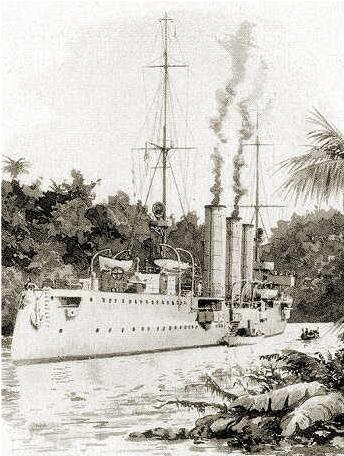
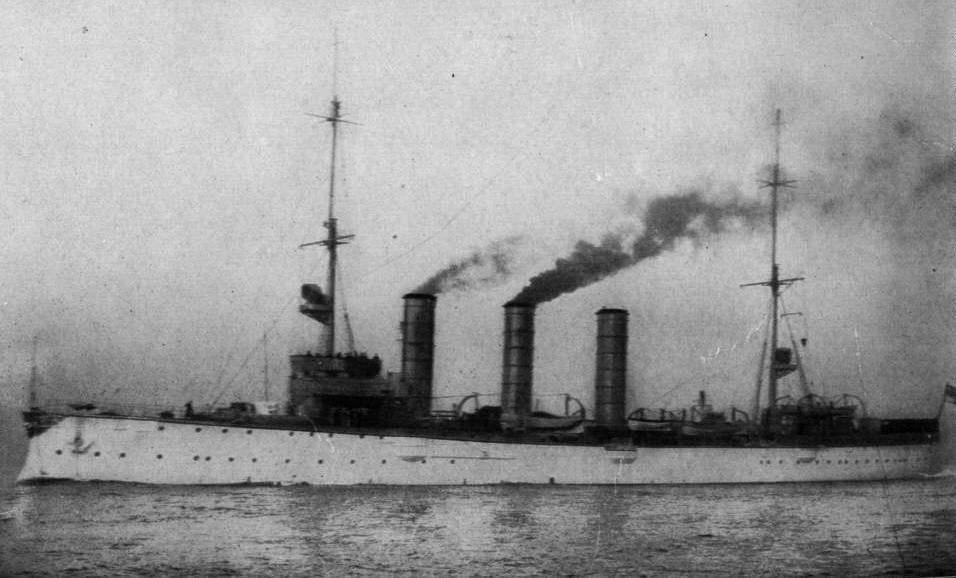
SMS Emden was launched in 1908, and became the Kaiserliche Marine'sTsingtao, in China, and was part of the German East Asia Squadron. On the same day as the Australian Government received notification that the Empire was at war, Von Spee's squadron was ordered to avoid the superior Allied naval forces in the Pacific, and it headed for Germany, by way of Cape Horn. The sole exception was the Emden, under Korvettenkapitänvon (Lt Commander) Karl Müller, which headed towards the Indian Ocean, with the objective of raiding Allied shipping. Müller frequently made use of a fake fourth smokestack, which — when the ship flew the Royal Navy ensign — made it resemble the British cruiser HMS Yarmouth and similar vessels.

The SMS EMDEN was detached from the East Asiatic Squadron for independent operations in the Indian Ocean. By early November Emden, under von Müller, Emden had sunk 30 Allied merchant vessels and warships. It had also shelled and damaged British oil tanks at Madras, in India. A collier named Buresk, was captured with its cargo intact, and was re-crewed with German seamen to accompany the Emden as a supply vessel. Other victims of the Emden included an obsolescent Russian cruiser and a French destroyer off Malaya, at the Battle of Penang, on October 28. By the end of October, no less than 60 Allied warships were looking for the Emden (the little outdated ship that was) .... forcing up insurance premiums, and drawing warships away from other theatres.
Yes, my baby - The Swan of the East - the SMS Emden.

And so began the Battle of the Cocos.
On 9 November 1914 Emden landed a shore party at Direction Island to destroy the cable station. The operators managed to get off a warning signal before the station was closed down.
One last act before surrender. One last act by civilians who knew their place - but were gentlemen at the right time.
We quickly found the telegraph building and the wireless station, took possession of both of them, and so prevented any attempt to send signals. Then I got hold of one of the Englishmen who were swarming about us, and ordered him to summon the director of the station, who soon made his appearance, - a very agreeable and portly gentleman.

"I have orders to destroy the wireless and telegraph station, and I advise you to make no resistance. It will be to your own interest, moreover, to hand over the keys of the several houses at once, as that will relieve me of the necessity of forcing the doors. All firearms in your possession are to be delivered immediately. All Europeans on the island are to assemble in the square in front of the telegraph building."

The director seemed to accept the situation very calmly. He assured me that he had not the least intention of resisting, and then produced a huge bunch of keys from out his pocket, pointed out the houses in which there was electric apparatus of which we had as yet not taken possession, and finished with the remark: "And now, please accept my congratulations."

"Congratulations! Well, what for?" I asked with some surprise.

"The Iron Cross has been conferred on you. We learned of it from the Reuter

We now set to work to tear down the wireless tower.
telegram that has just been sent on."
But that one signal - that one signal.
At about 0620 on 9 November, wireless telegraphy operators in several transports and in the warships heard signals in an unknown code followed by a query from the Cocos Island Wireless Telegraphy Station, 'What is that code'. It was in fact the German cruiser EMDEN ordering her collier BURESK to join her at Point Refuge. Shortly afterwards Cocos signalled 'Strange warship approaching.'

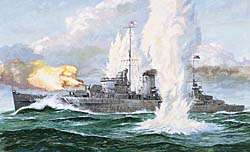
SYDNEY, the nearest warship to the Cocos group, was ordered to proceed at full speed. By 0700 she was 'away doing twenty knots' and at 0915 simultaneously sighted the island and the EMDEN some seven or eight miles distant.
Though SYDNEY didn't know what was going on, EMDEN's crew knew they were outgunned.
The RAN ship was a state-of-the-art Town class light cruiser, commissioned in 1913 and commanded by Captain John Glossop, an RN officer.
..
Sydney was larger, faster and better armed — (8) 6 inch (152mm) guns — than Emden, which had (10) 104mm (4.1 inch) guns.
She had to act fast.
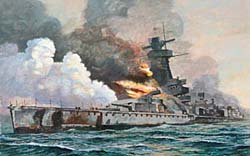
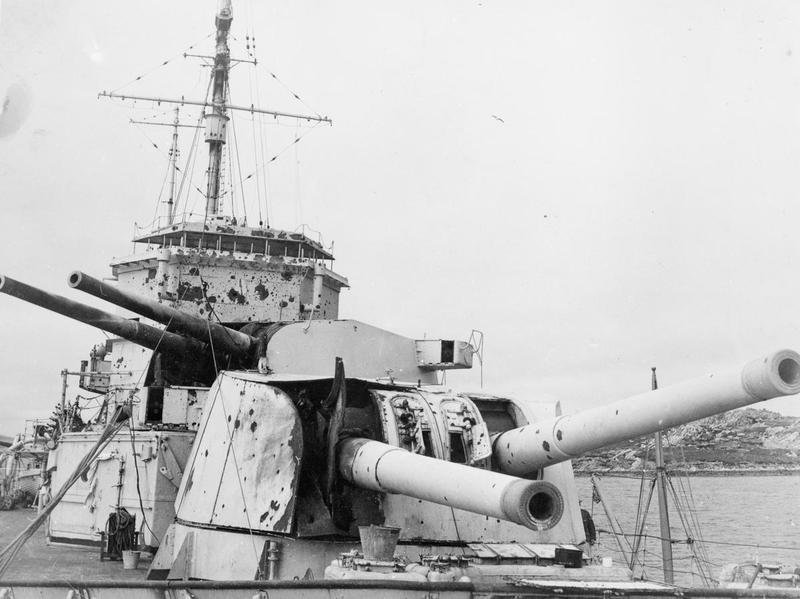
EMDEN opened fire at a range of some 10,500 yards using the then very high elevation of thirty degrees. Her first salvo was 'ranged along an extended line but every shot fell within two hundred yards of SYDNEY.' The next salvo was on target and for the next ten minutes the Australian cruiser came under heavy fire. Fifteen hits were recorded but fortunately 'only five burst.' Four ratings were killed and several wounded.

SYDNEY's first salvo went 'far over the EMDEN'. The second fell short and the third scored two hits. Meanwhile, EMDEN's captain (Captain Von Muller), aware that his only chance lay in putting SYDNEY out of action quickly, maintained a high rate of fire said to be a salvo every six seconds. It was to no avail. SYDNEY took advantage of her superior speed and fire power and raked the German cruiser. Her shells wrecked the enemy's steering gear, shot away both range finders and smashed the voice pipes providing communications between the conning tower and the guns. Shortly afterwards the forward funnel toppled overboard and then the foremast carrying away the primary fire control station and wrecking the fire-bridge. Despite the damage and the inevitable end, Muller continued the engagement. Half his crew were disabled until 'only the artillery officer and a few unskilled chaps were still firing.' Finally, with his engine room on fire and the third funnel gone, he gave the order 'to the island with every ounce you can get out of the engines.' Shortly after 1100, EMDEN was seen to be fast on the North Keeling Island Reef. She lost 134 men killed in action or died of wounds.
Look at that timeline for both ships. Also know, the SMS Emden had its CO ashore with a landing party of 50 out of a crew of 360. The XO took her into battle with a short crew - with no hesitation or delay - and aggressive.

There is one thing I would like you to do if you have time. Go get a refill of coffee for and read the below - including the full report at the link.

As we read the history of our Navy and others, there can be a tendency to think about ships and aircraft without, really, thinking about what a battle at sea can do to the men in them.


Dr Leonard Darby was the Senior Medical Officer of HMAS Sydney during her engagement with SMS Emden, and we have his notes. I will pull out some of the bits, but you need to read it all - and for you leaders out there - think about your Medical team. Your Corpsman. Your First Aid training for your crew. Are you ready for this?
By this time we had returned to the Emden, which was flying distress signals, and arrangements had now to be made for the transhipping and receipt of about 80 German wounded.
...
One German surgeon, Dr. Luther, was intact, but he had been unable to do much, and for a short time was a nervous wreck, having, had 24 hours with so many wounded on a battered ship with none of his staff left and very few dressings, lotions and appliances. The state of things on. board the Emden, according to Dr. Ollerhead was truly awful.

Men were lying killed and mutilated in heaps, with large blackened flesh wounds. One man had a horizontal section of the head taken off, exposing mangled brain tissue. The ship was riddled with gaping holes, and it was with difficulty one could walk about the decks, and she was gutted with fire. Some of the men who were brought off to the Sydney presented horrible sights, and by this time the wounds were practically all foul and stinking, and maggots 1/4 inch long, were crawling over them, i.e., only 24 to 30 hours after injury.

Practically nothing had been done to the wounded sailors, ... Some had legs shattered and just hanging; others had shattered forearms ; othes were burnt from head to foot; others had large pieces of flesh torn out of limbs and body. One man was deaf and dumb, several were stone deaf, in addition to other injuries. The worst sight was a poor fellow who had his face literally blown away. His right eye, nose, and most of both cheeks were missing. His mouth and lips were unrecognisable. The tongue, pharynx, and nasal cavity were exposed, part of his lower jaw was left and the soft tissues were severed from the neck under his chin, so that the face really consisted of two curtains of soft tissue hanging loosely front the forehead, with a gap in the centre, like an advanced case of rodent ulcer. In addition, the, wound was stinking and foul with copious discharge. The case was so bad that 1 had no hesitation in giving a large dose of morphia immediately, and after cleaning the wound as well as possible, a large dressing was applied, and he was removed to the fresh air on deck. The odour was appalling and it was some time before the sick bay was clear of it. The patient lingered from four to six hours afterwards in spite of repeated liberal closes of morphia.

Another face injury was almost as bad. Practically the whole right side of the face was completely blown away. His temporal, pterygoid, and maxillary regions were deeply exposed, and temporo-mandibular articulation was entirely removed. One had not time to examine these cases for minute details, but they were very instructive, and showed how hard it is to kill a man with face injury. In addition, the wound was septic and most offensive. I had no hopes for his life when he arrived, but he seemed to struggle on and five days later, on arrival at hospital at Colombo, it seemed likely that he would live. Later news tells us that the patient is doing well and they hope to fit him out with an artificial right half to his face.
...
Another face injury was rather severe. He had his right cheek turned down as a flap from the level of the upper lip, in addition the mandible was fractured and a piece of skin, fascia, and muscle the size of a large plate was blown out of the middle of the inferior surface of the left thigh. Later, when we were attending this case, it was suggested to me that the limb be removed. but though there was much destruction of tissue and the wound was very foul, I refused to allow this to be done and after events proved the wisdom of this, as the wound cleaned up and the limb was saved.

There were many cases of severe burns, two of which had head injuries in addition, and died on board. One of these was an engineer, who had suffered from pneumonia for six weeks on board the Emden. Altogether four deaths occurred on board us from among the German wounded. Most of the remaining cases had multiple lacerated shell wounds, with smaller or larger pieces of flesh blown away or penetrating tortuous holes, with metal buried in the tissue. Quite often this metal, was found just under the skin on the opposite side of the limb. Most of the wounds were charred. In one case a large amount of gluteal tissue was taken out in the region of the right anterior superior iliac spine, with fracture of the ileum. This man, in addition had a compound fracture of the right arm and numerous other wounds. A man was very lucky if he had less than three separate shell wounds. He was in a very low condition when we landed him, and it is doubtful if he will live.

In cases where large vessels of the leg or arm had been opened, we found tourniquets of pieces of spun yarn, or a handkerchief, or a piece of cloth bound round the limb above the injury. In some cases, I believe the majority, they had been put on by the patients themselves. One man told me he had put one on his arm himself. They were all in severe pain from the constriction, and in all cases where amputation was required, the presence of these tourniquets made it necessary to amputate much higher than one would otherwise have done, but no doubt their lives had been saved by the tourniquets. There was very little evidence of any skilled treatment before they arrived on board.

Naturally the German surgeon had been very much shaken and handicapped. His station in action was the stokehold, which was uninjured. His assistant surgeon was less fortunate, his station being the tiller flat aft, and when they were badly struck, fire broke out above him, whereupon he went up and was blown overboard, slightly wounded. The steering party remained in the tiller flat and were unhurt. After being blown overboard the surgeon managed to get ashore, and during the night he lay helpless and exhausted, dying of thirst, along with a few others who had also got ashore. After much persuasion he got a sailor to bring him some salt water, of which he drank a large quantity, and straightway became raving mad and died.
That, my friend, is war at sea. Most have forgotten. Hybrid-Sailors, "Optimal" manning, software run damage control and all that. And one last note, before they even got to the EMDEN, they had to treat their initial casualties. Why can't we have this in our Navy?
Cease fire sounded at 11.15 a.m. after we had been working two solid hours In confined atmosphere, and a temperature of 105 degrees F. The strain had been tremendous, and S.B.S. Mullins who had done wonderfully well with me, started off to faint but a drink of brandy caved him, and likewise myself.

Friday, November 28, 2014

Fullbore Friday

Still finding some items worth bring back from the WWI FbF archives.

It is time to sing the praises of the pinnacle of what it means to be Fullbore. Time to remember, again, an exploit of the SMS Emden in the Battle of Penang.
On the morning of October 28, Emden, with her false smokestack raised to impersonate HMS Yarmouth and, in a rare lapse of Müller's sense of chivalry, flying British colors, slipped into Penang Harbor and picked out among the many vessels there the 3,050-ton Russian light cruiser Zhemchug. Built in 1903, Zhemchug had participated in the Battle at Tsushima in May 1905 but had escaped that debacle to be interned in neutral Manila. Now she joined her former Japanese enemies in the hunt for Emden, having arrived at Penang on October 26 to clean her boilers. Against the advice of Admiral Jerram, commander in chief of Allied fleets in Indochinese waters, who encouraged him to take extra precautions, Captain Second Grade Baron Cherkassov had gone ashore that night to visit a lady friend, leaving his ship with torpedoes disarmed, all shells stowed save 12 and no extra men posted on watch.

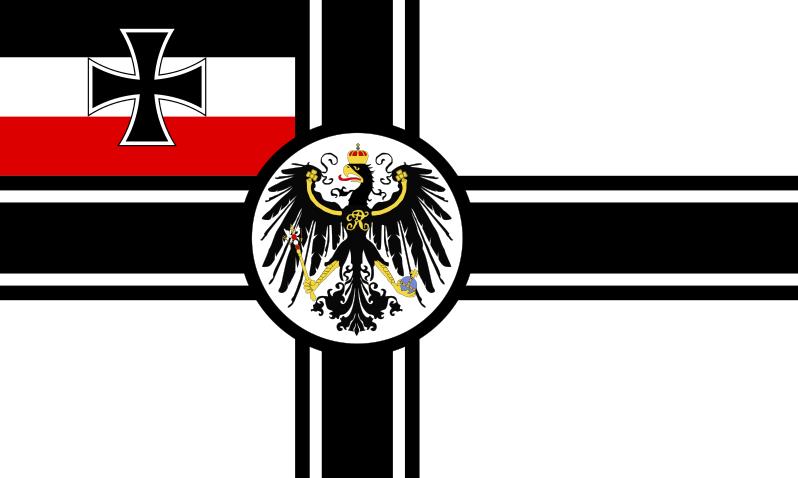
At about 5:13 a.m., Emden struck her British flag, raised the imperial German naval ensign, opened fire, and at 5:18 loosed her starboard torpedo. Half of Zhemchug's shells had been left by the after gun, which was put out of action when a blown-away ship's boat fell on it, and the other six shells were by the No. 2 starboard gun, which was pointing in the wrong direction. Her surprised crew dragged the ammunition to the forward gun and returned fire but scored no hits, one shell passing over the German cruiser and hitting a merchant ship in the harbor. After reversing course, Emden launched her port torpedo, which struck below Zhemchug's bridge and conning tower and blew her up, killing 89 of her crewmen and wounding 143. Deciding not to press his luck, Müller then headed out of the dangerous confines of the harbor. In August, a naval court at Vladivostok sentenced Zhemchug's captain and his first officer, Senior Lieutenant Kulibin, to a "house of correction" (3 1/2 years for Cherkassov, 1 1/2 years for Kulibin). Both officers were also stripped of their rank, their decorations and their status as members of the Russian nobility.

Of the French warships defending Penang, the third-class cruiser D'Iberville and the destroyer Fronde were laid up with boiler trouble. Although she herself suffered from bearing trouble, the destroyer Pistolet raised enough steam to take off in pursuit of the Germans at 20 knots. Meanwhile, Emden, mistaking an oncoming unarmed patrol vessel for an armed ship, fired on it and left it in a sinking condition, fortunately without inflicting casualties among its crew. Müller next encountered the steamer Glenturret and stopped her only long enough to ask her captain to convey his apologies for shooting at the unarmed vessel and for not being able to rescue Zhemchug's crew. Emden then encountered the remaining French destroyer, the 310-ton Mousquet, which fired one torpedo and engaged the Germans with one of her guns before being demolished in an uneven 10-minute fight. Emden's crew rescued one officer--whose leg would later have to be amputated--and 35 men and cared for them as best they could while raising full speed to outdistance the game little Pistolet, which they finally lost in a rain squall. Two days later, the Germans stopped the British Newburn and transferred the French aboard the steamer to be conveyed to Sabang, Sumatra, minus three who had died of wounds and were buried at sea with full naval honors.

While Emden lost herself in the open sea and lay low, the newspapers spread the word of her latest outrage against the Allies. In Germany, the Kaiser conferred on Müller the Iron Cross First and Second Classes and the Iron Cross Second Class to 50 men to be picked from among his crew.
The Swan of the East. Sigh - what a ship, a crew, and a Captain.

Learn her lessons - and watch out for those who also have.

Friday, October 31, 2008

Fullbore Friday

It is time to sing the praises of the pinnacle of what it means to be Fullbore. Time to remember, again, an exploit of the SMS Emden in the Battle of Penang.
On the morning of October 28, Emden, with her false smokestack raised to impersonate HMS Yarmouth and, in a rare lapse of Müller's sense of chivalry, flying British colors, slipped into Penang Harbor and picked out among the many vessels there the 3,050-ton Russian light cruiser Zhemchug. Built in 1903, Zhemchug had participated in the Battle at Tsushima in May 1905 but had escaped that debacle to be interned in neutral Manila. Now she joined her former Japanese enemies in the hunt for Emden, having arrived at Penang on October 26 to clean her boilers. Against the advice of Admiral Jerram, commander in chief of Allied fleets in Indochinese waters, who encouraged him to take extra precautions, Captain Second Grade Baron Cherkassov had gone ashore that night to visit a lady friend, leaving his ship with torpedoes disarmed, all shells stowed save 12 and no extra men posted on watch.

At about 5:13 a.m., Emden struck her British flag, raised the imperial German naval ensign, opened fire, and at 5:18 loosed her starboard torpedo. Half of Zhemchug's shells had been left by the after gun, which was put out of action when a blown-away ship's boat fell on it, and the other six shells were by the No. 2 starboard gun, which was pointing in the wrong direction. Her surprised crew dragged the ammunition to the forward gun and returned fire

but scored no hits, one shell passing over the German cruiser and hitting a merchant ship in the harbor. After reversing course, Emden launched her port torpedo, which struck below Zhemchug's bridge and conning tower and blew her up, killing 89 of her crewmen and wounding 143. Deciding not to press his luck, Müller then headed out of the dangerous confines of the harbor. In August, a naval court at Vladivostok sentenced Zhemchug's captain and his first officer, Senior Lieutenant Kulibin, to a "house of correction" (3 1/2 years for Cherkassov, 1 1/2 years for Kulibin). Both officers were also stripped of their rank, their decorations and their status as members of the Russian nobility.

Of the French warships defending Penang, the third-class cruiser D'Iberville and the destroyer Fronde were laid up with boiler trouble. Although she herself suffered from bearing trouble, the destroyer Pistolet raised enough steam to take off in pursuit of the Germans at 20 knots. Meanwhile, Emden, mistaking an oncoming unarmed patrol vessel for an armed ship, fired on it and left it in a sinking condition, fortunately without inflicting casualties among its crew. Müller next encountered the steamer Glenturret and stopped her only long enough to ask her captain to convey his apologies for shooting at the unarmed vessel and for not being able to rescue Zhemchug's crew. Emden then encountered the remaining French destroyer, the 310-ton Mousquet, which fired one torpedo and engaged the Germans with one of her guns before being demolished in an uneven 10-minute fight. Emden's crew rescued one officer--whose leg would later have to be amputated--and 35 men and cared for them as best they could while raising full speed to outdistance the game little Pistolet, which they finally lost in a rain squall. Two days later, the Germans stopped the British Newburn and transferred the French aboard the steamer to be conveyed to Sabang, Sumatra, minus three who had died of wounds and were buried at sea with full naval honors.

While Emden lost herself in the open sea and lay low, the newspapers spread the word of her latest outrage against the Allies. In Germany, the Kaiser conferred on Müller the Iron Cross First and Second Classes and the Iron Cross Second Class to 50 men to be picked from among his crew.

The Swan of the East. Sigh - what a ship, a crew, and a Captain.

Learn her lessons - and watch out for those who also have.

Friday, December 31, 2010

The Books of 2010

This has been a tough year for me and books. I have mostly cuckholded my library as my time has been very limited. A start-up year is a time sponge. That and two wonderful daughters, a demanding Mrs. Salamander, an wide estuary for my boat, two new dogs, and a newly purchased deep-country acreage for my dacha and hunting retreat have kept me away from books. That and my magazines and decades long news addiction made worse by the internet.

Oh, that and I blog.

Pathetic excuses, but I did manage a few books. Looking back - some I still need to finish the last 50-or-so pages
(a bad habit I share with Mrs. Salamander who reads about 4x as much as I do), the there is a mixed story in the collection.

There are the comfort food of books I have re-read for the umpteenth time; USNIPress's superb
The Emden-Ayesha Adventure: German Raiders in the South Seas and Beyond, 1914 is a perfect example of this. If you have never read this, you have not lived a full and informed life.

The classic
The Long March: Xenophon and the Ten Thousand was another return. It is all there. Over 2,000 years old and most all you need to know about leadership in adversity and the characteristics of good and bad leaders is there.

As I could not have made the civilian transition the way I did if I were not a little lucky and a little smart with money over the years, I re-read
Monster Stocks: How They Set Up, Run Up, Top and Make You Money. It paid off again after the September follow-through day. This week I locked in some very nice gains on a quad of stocks. Not luck - informed decisions and hard work. It is there for you to if you take the time to read.

Next year, I will re-read O'Neil's How to Make Money in Stocks: A Winning System in Good Times and Bad, Fourth Edition, this time in its new addition that came out in '09. I really should have read it this year - but didn't.

If you have never read a book on how to understand the stock market - read that book. 'Nuff said.

On a more personal note, it was neat to read about something about my corner of the war - something I was involved with on the side in "parallel play" during the first months of the Long War,
Horse Soldiers: The Extraordinary Story of a Band of US Soldiers Who Rode to Victory in Afghanistan. What a great story that will make a great movie one day.

There were also books I read by acquaintances & friends I have met over the years as my alter-ego "Sal," and have had as guests on
Midrats; James S. Robbins's This Time We Win: Revisiting the Tet Offensive and Bruce Fleming's Bridging the Military-Civilian Divide: What Each Side Must Know About the Other - And About Itself fit that niche.

Other Midrats guests books include Such Men as These: The Story of the Navy Pilots Who Flew the Deadly Skies over Korea, an important book covering a subject we touched on a few times this year, The Korean War.

Finally, there was a book that was simply horrible; James Bradley's
The Imperial Cruise: A Secret History of Empire and War. It read like some graduate history student trying to get laid with his far-left faculty advisor. What a horrible misuse of an important story. Post-modernism flavored with white guilt and national self-loathing. Pathetic.
So, that was the year in books.

On a side-note, the end of the year has me feeling a bit off to be candid. This is my first full year as a civilian since the early/mid-80s. I miss it in some ways - but am enjoying being a father while I can. Children don't wait for you. It is good to have a place to grow roots, have a nice boat, a home, extended family a short drive, some acreage, and all that I take for granted so many gave so much so I could have just a bit.

I am very happy in what I do now, but ... still. I miss the sea. I know I am not a warrior monk, but still. The military is a calling, not a job - at least it was to me. You can't have it all, but I tried as long as I could and then something had to give.

I come from a line that does not make the military a living, and Mrs. Salamander definately does not. I've returned to the place and position I was supposed to be at a decade and a half ago - but I am glad I waited.

No, wouldn't change a thing. Not one. 2010 was a different year.

2011 - with hope I will see 2012.

So much to do, so little time.


Friday, July 27, 2007

Fullbore Friday


A battle that wasn't, and a warship that did not find her way to war - but a lesson none-the-less. I present to you HMCS Rainbow, the one of the first two ships of the Canadian Navy.

Her story reminds me of those who think that because their ship is not manned, armed, trained, or designed for a mission - that for some reason in war they will be given a pass. "They won't deploy a CVN that close to shore....we won't go without air superiority...there is no threat there...other units can do that...the 1,000 ship Navy concept addresses that..." and so on.

No, when the call comes - you get underway - as the crew of the RAINBOW did.
At 8:55 p.m. on the 4th of August, 1914, a telegram was received from Westminster announcing that war had been declared against Germany. ... HMCS RAINBOW was already at sea, and was therefore the first ship of the RCN to be at sea as a belligerent.

Rainbow’s fearless captain, Commander Walter Hose, understood the crucial importance of setting the right tone early on. Much, therefore, hung in the balance when Rainbow headed south in search of von Spee’s cruisers on Aug. 4, 1914. The German Asiatic Squadron represented a formidable challenge: Two modern armoured cruisers, Gneisenau and Scharnhorst, and four modern light cruisers, Dresden, Emden, Leipzig and Nurnberg. The two big ships carried 8.2-inch and 6-inch guns, and their gunnery was renowned as the best in the German fleet. Their armour was impenetrable to Rainbow’s guns at anything beyond point-blank range. Scharnhorst and Gneisenau were also faster, by nearly four knots (23 versus 19.75): They could eat Rainbow for breakfast. The light cruisers were more of a match, but the German ships were newer and four knots faster, too, while their modern 4.1-inch guns had a longer range than Rainbow’s aging 6-inch. In fair weather, any one of them could stand off and beat Rainbow into submission without being hit. By late July 1914, this powerful German force was largely dispersed, with Leipzig and Nurnberg exchanging places off Mexico as part of an international force protecting foreign interests during the Mexican civil war. The British had few ships in the Pacific, and these were scattered across a quarter of the earth’s surface. The great uncertainty facing von Spee was the intent of Britain’s Pacific ally Japan. Her powerful fleet made the western Pacific untenable, while the heavy cruiser Idzumo was with the international fleet off Mexico and had to be watched carefully. Also off Mexico were two aging British sloops, Algerine and Shearwater, each of about 1,000 tons and utterly defenceless. The only British warship in the whole eastern basin of the Pacific Ocean was little Rainbow. Rainbow was ordered to prepare herself for war, while a group of British Columbia businessmen opened negotiations with a Seattle shipyard for the purchase of two submarines being built for Chile. Hose soon had Rainbow ready for sea, but high explosive shells for her guns were not expected to arrive from Halifax until Aug. 6 because the railway refused to handle the explosives. So Hose drew antiquated shells filled with black powder (modern shells used cordite) from old stores in Esquimalt, filled out his crew from local volunteer “reservists” (an amateur group of naval enthusiasts who had no official standing) and declared his ship ready. On the afternoon of Aug. 2, the British requested that “Rainbow should proceed south at once in order to get in touch with (Leipzig) and generally guard the trade routes north of the equator.” This was an ambitious order for a partially manned training cruiser equipped with little more than solid shot. At 1 a.m. on Aug. 4, Rainbow cleared Esquimalt harbour. Few thought they would see her again.
Great story. Admiral Graf von Spee's squadron's saga ... well .... that is for a few FbF for later on.

Friday, July 11, 2008

Fullbore Friday

What is duty? What can leadership accomplish? What is the ultimate price one pays for the two? What is your measure? How do you measure? Is your crew ready when the call comes? Are you ready?

While we are at it - tell me what is really "new" and "revolutionary" and "unknown" about asymmetrical warfare at sea?

Back to the old school - a story almost beyond belief, the
SMS Konigsberg.
With Captain Max Looff in command, SMS Konigsberg sailed out of Kiel on the 25th. of April in 1914, she passed through the Mediterranean, passaged the Suez canal, stopping at Aden, where her Captain even dined there with the British Governor, all very civil in time of peace, but even the , war clouds were looming on the horizon.

The cruiser made it to Matzetumbe, outside the port of Dar-es-Salaam by the 6th. of June 1914.
...
The Austrian Archduke Ferdinand was assassinated in Serbia on the 29th. of June...Captain Looff received the code word EGIMA, meaning his country was at war with England, now Konigsberg became the hunter.

First Blood.
On the 6th. of August 1914, the British SS City of Winchester was in the Gulf of Aden, making her way to London, She was crammed full of general cargo, including the 1st. of India's seasonal tea crop. Her Captain, George Boyak, now found his ship in company with a cruiser, which he thought was British, searchlights lit up his command, and he was asked by signal lamp " What ship and nationality?" He dutifully responded with the ship's name and port of registry, but was then ordered to stop.

The arrival on board of a German Naval Officer with his boarding party made the Captain suddenly realise his ship was now part of history, the first British ship to be captured by Germany in WW1, and the first victim of the Raider Konigsberg.
...
The afternoon tide of the 19th. of September carried Konigsberg out to sea, and she set a course for Zanzibar. The following morning she destroyed the Channel Pilot Boat off the harbour entrance, and Pegasus came within range at 9,000 yards, and the German ship opened fire. Within 20 minutes the British cruiser was down by her bows and giving off heavy smoke. Looff made good his escape heading back out to sea, and a broken piston rod crosshead in one of the ship's main engines forced her Captain to return to the Rufiji Delta...Two days after Konigsberg had sunk Pegasus, the German cruiser Emden ( a sister ship to Konigsberg ) had boldly steamed into the harbour of British Madras and bombarded it. The British had now had enough, and the 5,400 ton Royal Navy cruisers Chatham, Weymouth, and Dartmouth, were all sent out on a find and destroy mission seeking out Konigsberg.

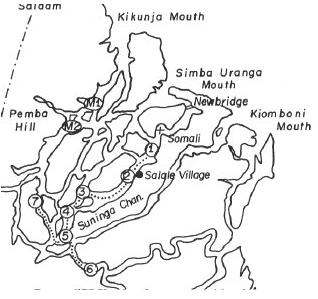
When Chatham stopped and searched the German ship Prasident, she found orders to ship coal out to the Rufiji Delta, then on the afternoon of the 20th. of October a landing party from the British cruiser was combing this Delta area. A sailor shinned up a tree, and was able to detect the disguised masts of both Konigsberg and Somali poking up through the forest canopy. Chatham promptly called up her sister ships, and the blockade began.

The attack begins.
On the 2nd. of November the three British ships commenced their bombardment, but Looff promptly moved his two ships 2 miles further upstream. A few days later, Somali was hit by Chatham's gunfire, set alight, to soon become a total loss, one down and one to go! On the 9th. a British freighter Newbridge was sunk as a block ship in the mouth of the Ssuninga channel, but really to no effect, as Konigsberg never was able to obtain enough coal for her to make a dash for the open sea.
...
The British went about very systematrically charting all of the cruiser's defences, and two shallow draft River Monitors, Severn and Mersey were sent off on their way to the Delta where they finally arrived in June of 1915.
...
At 0645 ( 6.45 AM ) the Monitors opened fire at a range of 10,000 yards, and soon after the German cruiser responded with return fire, and by 0740 ( 7.40 AM ) she had gained two hits on Mersey who was forced to retire, leaving Severn to continue the assault, she opened the range another 1,000 yards. Although the rather incredible number of British rounds fired added up to 635 from their 6 inch guns, only 3 of them actually struck Konigsberg.
...
Now four days of quietness descended on the scene, but early on Sunday morning of the 11th. of July, British aircraft circled Konigsberg, to announce a renewal of the action.

By 1115 ( 11.15 AM ) the Monitors had entered the River, and within 30 minutes the German ship opened fire with four guns of her main armament, but she could not match the rate of fire from the Monitors who began to score hits along her entire length. In addition, the German was short of ammunition, her middle funnel was brought down, smoke poured from her hollow mast, a fire started close to the forward magazine, by 1300 ( 1. PM ) Konigsberg was lost.

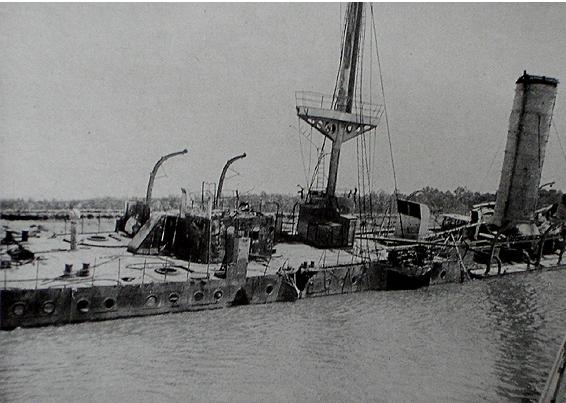
Abandon Ship was ordered, and the crew scrambled down the ship's side, taking their wounded with them. Shells from the Monitors continued to pour into the stricken German cruiser. First Officer Koch placed torpedo heads in position to blow out the ship's keel, and at 1400 ( 2 PM ) on the 11th. of July 1915, these heads detonated, SMS Konigsberg heaved slightly, then with a roar, the hull blasted apart, she heeled over to port, and sank into the ooze of the Rifiji River.

...
Konigsberg armament salvaged.
The Germans quickly salvaged the ten main armament guns from their stricken cruiser, to use them in the East African land campaign. In Dar-es-Salaam workshops, gun carriages were fashioned to carry these Naval guns, now formed into land artillery.

Fate of the crew from Konigsberg.
From the original crew of 350 Officers and Sailors, only Captain Max Loof and 14 others survived WW1, to eventually return home to Germany.

Conclusion.
This rather bizarre chapter in the early part of WW1, stage in the more remote region of German East Africa, proved that a resourceful Captain Looff, and his crew could tie up more formidable enemy forces for many months before sheer numbers overcame his resistance. An intriguing story from a now distant past.

By a strange twist of fate, two 4 inch guns from Konigsberg have survived today, one is in Mombasa, and the second in Pretoria. The Mombasa gun sits close to one salvaged from the British Cruiser Pegasus, in WW1 each ship fought against each other at Zanzibar, now the two guns peacefully coexist side by side.
You SUPPOs and CHENGs should read the whole thing - and it is a good example of how the British took one bit of carelessly kept information to their advantage, for you N2 types. What a story.

Thursday, February 08, 2007

Fullbore Friday

Speed. Superior technology. Superior Sailors. Long-range, accurate weapons. Superior training.

From LCS to DDG-1000, we are all told that these are the key to victory at sea. They make up for inferior numbers. They are Transformational. War has changed. We own them.

All that came to mind when I thought of three ships, HMS Exeter, HMS Ajax, and HMNZS Achilles.

The Graf Spee was, well, the Graf Spee. With memories of the SMS Emden in mind, she was the terror of the seas.

To go after her you had three old, under armed, and relatively unarmored cruisers. On paper, there should be no contest. But the combined British and New Zealand Force had a plan. They had what you cannot put on paper or PowePoint - but that which wins almost all battles at sea; audacity.

13th. of December 1939.
At 0520 ( 5.20 AM ) the squadron was in position 34 degrees 34 minutes South, 49 degrees 17 minutes West, on a course of 060 degrees, at a speed of 14 knots, cruising in line ahead Ajax, Achilles and Exeter. Smoke bearing 320 degrees, ie to the South West from the force, was sighted at 0610 ( 6.10 AM ) and Exeter was ordered to investigate, she soon replied:

"I think it is a pocket Battleship!"

It did not take long for Graf Spee to act, in only two minutes she opened fire with her 11 inch turrets, one firing at Exeter, and one at Ajax.

The first division altered course to 340 degrees to close the range to the enemy, whilst Captain Bell hauled out of the line, altering course to the west, so he might attack Graf Spee from a widely different angle. All ships increased speed, now it should be noted that the enemy armament had almost twice the power of the British
cruisers, both Ajax and Achilles were light cruisers mounting 6 inch guns in their turrets, whilst Exeter was the lone ship of her class, mounting 6 by 8 inch guns in three twin turrets, A and B turrets forward, and a single Y turret mounted aft.

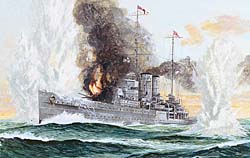
By 0623 ( 6.23 AM ) all ships had opened fire, and an enemy report was broadcast.Graf Spee straddled Exeter ( that means shells in a salvo fall both sides of the target ), one shell burst short, and killed the starboard torpedo tube crews, riddled the searchlights and the aircraft on the catapult, which was manhandled over the side, leaving the ship without any spotting capability from that source. The enemy ship seemed undecided about her gunnery policy, as she shifted targets several times before concentrating both turrets upon Exeter. The third salvo from

By 0624 ( 6.24 AM ) Exeter sent off 8 salvoes against the enemy, but on the incoming path, she received a direct hit from an 11 shell in the fore part of the B turret, putting it out of action, as splinters from this shell burst swept the bridge it killed or wounded all personnel there except for the Captain and two others. It also demolished the wheel house communications, leaving Captain Bell without any means of giving wheel orders to enable course changes, or orders to the engine room regarding speed changes. He decided to fight his ship from the after conning position, but the communication system here was also damaged from the shell burst earlier that effected the torpedo tube crews etc. A chain of messengers was set up to pass orders to the after steering position.

Now two further 11 inch shell hits registerd in the fore part of the cruiser, and Graf Spee shifted one 11 inch turret onto Ajax, who was straddled three times. The secondary armament of the German ship now took on Ajax and Achilles alternately, but to little effect.

During all of this intensive engagement, Ajax achieved a minor miracle by being able to catapult her aircraft for spotting purposes.

Exeter had fired off her torpedoes at 0632 ( 6.32 AM, ) but did not achieve any result, now at 0637 ( 6.37 AM ) Graf Spee altered course some 150 degrees, steering to the North West under cover of smoke.

0638 to 0650 ( 6.38 to 6.50 AM )
At about 0638 ( 6.38 AM ) Exeter altered course to Straboard to allow the firing of her starboard torpedoes, then took off to the North East to close the First Division, at 0645 ( 6.45 AM ) she turned westerly to keep within range.

Two more 11 inch hits fell upon Exeter, one put A turret out of action, and another started a fierce fire in the Chief Petty Officer's flat amidships, the 4 inch magazine was flooded through a burst water main. All the compass repeaters were out of action, the Captain had to rely on a simple boat's compass to allow him to keep the ship pointed so that Y turret might keep up her firing at the enemy, locally controlled, with the Gunnery Officer taking control from the searchlight platform.

At 0640 ( 6.40. AM ) an 11 inch shell fell just short of Achilles in line with her bridge, it burst at the waterline, with splinters killing four sailors, stunning the Gunnery Officer, ( many unkind Officers might comment, But that is but the normal condition for most Gunnery Officers. ) and slightly wounding the Captain and his Chief Yeoman of Signals.

0650 to 0708. ( 6.50 to 7.08 AM )
Achilles with her guns firing in local control could not find the right line with her gun fire, her salvoes falling short. The aircraft from Ajax, reporting that the salvoes were all falling short, but in Achilles, their gun control officer was unaware that Ajax was not still in concentrated firing, he therefore wrongly concluded it was his fall of shot being reported as short, and corrected accordingly, this had the effect of all his gunfire falling way over the enemy pocket battleship. A real mix up at a time when to achieve hits on the enemy was crucial. With all the smoke added to the general confusion, direct spotting was quite hard.

Graf Spee made frequent course alterations trying to throw off the British ship's gunfire, she also made skilful use of the smoke she generated.

Exeter valiently kept up firing her Y turret in local control, but she now had developed a 7 degree list to starboard, adding to the difficulties of keeping Y turret firing. She was still a target for fire from Graf Spee, but shots fell consistantly over.

0708 to 0728. ( 7.08 to 7.28 AM )
Graf Spee was still 16,000 yards from theFirst Division, and they were ordered to close the enemy at speed, accepting they would lose the benefit of having their guns bear on the enemy whilst they steamed closer to the German ship.

At 0708 ( 7. 08 AM ) Graf Spee made a dramatic alteration of course to port under cover of her smoke, and at 0720 ( 7. 20 AM ) she turned back to the North West to bring her guns to bear, and Ajax was very quickly straddled three times from a range of 11,000 yards.

At the same time, the First Division turned to starboard to bring all their main armament bearing on Graf Spee, their fire appeared to most effective with Graf Spee on fire amidships. But at 0725 ( 7. 25 AM ) Ajax was hit by an 11 inch delayed action shell on the after superstructure, its passed through some cabins, wrecking them, then it went through X turret trunk, wrecking all the turret machinery below the gun house, a part of this shell base then struck Y turret barbette, close to the turret training rack, and jammed the turret. Thus one shell was responsible for putting both X and Y turrets out of action, for killing four, and wounding another six of X turret's crew.

It appeared that Graf Spee was neglecting Exeter, as she steered North West to close on the First Division, with Ajax assuming that the German ship would hold this course, she decided to fire off a broadside of her torpedoes. At 0724 ( 7. 24 A M ) she turned to starboard, and let go four torpedoes at a range of 9,000 yards, but without result.

Graf Spee must have seen them coming, and quickly took avoiding action by turning 130 degrees to port, and then returned to the North West after about three minutes.

Exeter was slowly dropping astern of the action, the forward damage taking it's toll. At 0740 ( 7. 40 A M ) Y turret still in local control stopped firing, this was due to a power failure caused by flooding. At 0740 ( 7. 40 A M ) Exeter was steering South East at a very slow speed, she needed to both make repairs and herself seaworthy again.

Now Ajax and Achilles altered course to 260 degrees so that the range to the enemy was reduced even more, then at 0721 ( 7.21 A M ) the spotting aircraft reported "Torpedoes approaching, they will pass ahead of you." The two cruisers decided to make sure they missed, and altered course to 180 degrees.

At 0732 ( 7.32 AM ) Graf Spee turned away to the West and started to zig zag, and Ajax seemed to be making good use of her three available guns, one of the hoists had failed in B turret, and both X and Y turrets were out of action.

Suddenly at 0736, ( 7.36 AM ) Graf Spee altered course to the South West to again bring all her armament to bear on the First Division, the range now down to 8,000 yards.

Ajax reported she had only 20% of her ammunition left.

The shooting by Graf Spee was accurate, and Commodore Harwood did not think she had suffered much damage from the salvoes from the British ships, so he decided to break off the action, at least till after dark. One of the last salvoes from the enemy had demolished Ajax's top mast, and with it all of her aerials, so jury aerials were rigged as quickly as possible. As the British ships turned away, Graf Spee did not follow them, but then altered course to 270 degrees, her speed 22 knots, this course would take her directly to the River Plate. The First Division, now turned to place themselves in shadowing positions on both quarters of the German ship, at a distance of about 15 miles.

British shipping in the area was alerted to Graf Spee's position, course and speed, this information was also sent off to the British Admiralty.

At 0912 ( 9.12 AM ) Ajax recovered her aircraft, then at 0916 ( 9.16 AM ) Harwood ordered Cumberland from the Falkland Islands to close the River Plate at full speed, he was in dire need of reinforcements to his force.

At 1104 ( 11.04 AM ) a merchant ship close to Graf Spee was stopped and blowing off clouds of steam, a signal from the pocket battleship read: "Please pick up lifeboats of English steamer." When coming up to the British ship, SS Shakespeare, all her boats were hoisted, and she reported that she was not in need of any assistance.

At 1105 ( 11.05 AM ) Exeter signalled that all her turrets were out of action, she was flooded up to No. 14 bulkhead, but could proceed at 18 knots, she was ordered to sail to the Falkland Islands at her best speed without placing strain on her bulkheads.

At 1342 ( 1.42 PM ) the British Naval Attache at Buenos Airies was informed that Graf Spee was making for the Plate. The shadowing of Graf Spee continued, and at 1915 ( 7.15 PM ) she suddenly fired off two salvoes at Ajax who turned away under smoke, the first salvo fell in line, the second in her wake as she turned, the range 26,000 yards.

It now seemed that Graf Spee intended to enter the Plate, and Achilles was told to follow her if she went West of Lobos, now Ajax was to proceed South of the English Bank, just in case the German doubled back that way.

Just after sunset, Graf Spee fired off three salvoes at Achilles, the third lobbed very close, in return, AchillesGraf Spee now proceeded North of the English Bank, and anchored in Montevideo roads at 0050. ( 00.50 AM ) fired 5 salvoes that seemed to straddle the enemy ship.

Harwood now reports that his main concern was how long Graf Spee intended to stay here.

At 2350 ( 11.50 PM ) Ajax and Achilles were ordered to withdraw from the Plate, Harwood did not want to risk them having to face Graf Spee silhouetted by the rising sun behind them. Achilles was to patrol the area from the Urugayan coast to a line 120 degrees from English Bank, whilst Ajax was to look after the Southern area. Both cruisers were to move back to the mouth of the Plate after the threat posed by the dawn had passed.

Fullbore.
UPDATE: Reader Oyster sends along the radio report. Cool.

Friday, January 06, 2012

Fullbore Friday


I can't help myself; it is time again to revisit the crew of The Swan of the East; the SMS EMDEN.

Everyone should know the story of The Ayesha by Kapitänleutnant Hellmuth von Mücke;
Taking no one with me, I got into the steam launch and went out to the schooner to learn whether she was at all seaworthy. The captain and a single sailor were aboard her. Of the former I inquired casually whether he had any ammunition aboard, for I did not wish him to suspect the real purpose of my coming. He said there was none, and a brief inspection of the ship led me to believe that she was still seaworthy. Consequently I sent my officers and men aboard the "Ayesha" to get her into trim for sailing.

There was plenty to do on the little ship. All the sails and rigging had been taken down and stowed away, and had now to be put in place again.

When the Englishmen on the island realized that it was my intention to sail off in the schooner, they warned me with great earnestness against trusting ourselves to her, saying that the "Ayesha" was old and rotten, and could not stand a sea voyage. Furthermore, they informed me that an English man-of-war, the "Minotaur," and a Japanese cruiser were in the vicinity of the island, and that we would surely fall a prey to one of them. As my predecessor in command of the "Ayesha" was leaving her, he wished us Godspeed, and concluded with the comforting remark, "But the ship's bottom is worn through."
When, in spite of all these warnings, we remained firm in our purpose, and continued the work of getting the "Ayesha" ready for sea, the sporting side of the situation began to appeal to the Englishmen, and they almost ran their legs off in their eagerness to help us. Could it have been gratitude that impelled them to lend us their aid? It is a question I have never been able to answer to my satisfaction, although, to be sure, several of them did express a feeling of relief at the thought that now the fatiguing telegraph service with its many hours of overwork, and its lack of diversion, was a thing of the past. They showed us where the provisions and water were kept, and urgently advised us to take provisions from the one side, where they were new and fresh, rather than from the other, where they were stale. They fetched out cooking utensils, water, barrels of petroleum, old clothes, blankets, and the like, and themselves loaded them on trucks and brought them to us. From every side invitations to dinner poured down upon us; my men were supplied with pipes and tobacco; in short, the Englishmen did all they could to help us out.
Read it all; for free online - or buy the book.

Friday, April 02, 2010

Fullbore Friday

Speed. Superior technology. Superior Sailors. Long-range, accurate weapons. Superior training.

From LCS to DDG-1000, we are all told that these are the key to victory at sea. They make up for inferior numbers. They are Transformational. War has changed. We own them.

All that came to mind when I thought of three ships, HMS Exeter, HMS Ajax, and HMNZS Achilles.

The Graf Spee was, well, the Graf Spee. With memories of the SMS Emden in mind, she was the terror of the seas.

To go after her you had three old, under armed, and relatively unarmored cruisers. On paper, there should be no contest. But the combined British and New Zealand Force had a plan. They had what you cannot put on paper or PowePoint - but that which wins almost all battles at sea; audacity.

13th. of December 1939.
At 0520 ( 5.20 AM ) the squadron was in position 34 degrees 34 minutes South, 49 degrees 17 minutes West, on a course of 060 degrees, at a speed of 14 knots, cruising in line ahead Ajax, Achilles and Exeter. Smoke bearing 320 degrees, ie to the South West from the force, was sighted at 0610 ( 6.10 AM ) and Exeter was ordered to investigate, she soon replied:

"I think it is a pocket Battleship!"

It did not take long for Graf Spee to act, in only two minutes she opened fire with her 11 inch turrets, one firing at Exeter, and one at Ajax.

The first division altered course to 340 degrees to close the range to the enemy, whilst Captain Bell hauled out of the line, altering course to the west, so he might attack Graf Spee from a widely different angle. All ships increased speed, now it should be noted that the enemy armament had almost twice the power of the British
cruisers, both Ajax and Achilles were light cruisers mounting 6 inch guns in their turrets, whilst Exeterwas the lone ship of her class, mounting 6 by 8 inch guns in three twin turrets, A and B turrets forward, and a single Y turret mounted aft.

By 0623 ( 6.23 AM ) all ships had opened fire, and an enemy report was broadcast.Graf Spee straddledExeter ( that means shells in a salvo fall both sides of the target ), one shell burst short, and killed the starboard torpedo tube crews, riddled the searchlights and the aircraft on the catapult, which was manhandled over the side, leaving the ship without any spotting capability from that source. The enemy ship seemed undecided about her gunnery policy, as she shifted targets several times before concentrating both turrets upon Exeter. The third salvo from

By 0624 ( 6.24 AM ) Exeter sent off 8 salvoes against the enemy, but on the incoming path, she received a direct hit from an 11 shell in the fore part of the B turret, putting it out of action, as splinters from this shell burst swept the bridge it killed or wounded all personnel there except for the Captain and two others. It also demolished the wheel house communications, leaving Captain Bell without any means of giving wheel orders to enable course changes, or orders to the engine room regarding speed changes. He decided to fight his ship from the after conning position, but the communication system here was also damaged from the shell burst earlier that effected the torpedo tube crews etc. A chain of messengers was set up to pass orders to the after steering position.

Now two further 11 inch shell hits registerd in the fore part of the cruiser, and Graf Spee shifted one 11 inch turret onto Ajax, who was straddled three times. The secondary armament of the German ship now took on Ajax and Achilles alternately, but to little effect.

During all of this intensive engagement, Ajax achieved a minor miracle by being able to catapult her aircraft for spotting purposes.

Exeter had fired off her torpedoes at 0632 ( 6.32 AM, ) but did not achieve any result, now at 0637 ( 6.37 AM ) Graf Spee altered course some 150 degrees, steering to the North West under cover of smoke.

0638 to 0650 ( 6.38 to 6.50 AM )
At about 0638 ( 6.38 AM ) Exeter altered course to Straboard to allow the firing of her starboard torpedoes, then took off to the North East to close the First Division, at 0645 ( 6.45 AM ) she turned westerly to keep within range.

Two more 11 inch hits fell upon Exeter, one put A turret out of action, and another started a fierce fire in the Chief Petty Officer's flat amidships, the 4 inch magazine was flooded through a burst water main. All the compass repeaters were out of action, the Captain had to rely on a simple boat's compass to allow him to keep the ship pointed so that Y turret might keep up her firing at the enemy, locally controlled, with the Gunnery Officer taking control from the searchlight platform.

At 0640 ( 6.40. AM ) an 11 inch shell fell just short of Achilles in line with her bridge, it burst at the waterline, with splinters killing four sailors, stunning the Gunnery Officer, ( many unkind Officers might comment, But that is but the normal condition for most Gunnery Officers. ) and slightly wounding the Captain and his Chief Yeoman of Signals.

0650 to 0708. ( 6.50 to 7.08 AM )
Achilles with her guns firing in local control could not find the right line with her gun fire, her salvoes falling short. The aircraft from Ajax, reporting that the salvoes were all falling short, but in Achilles, their gun control officer was unaware that Ajax was not still in concentrated firing, he therefore wrongly concluded it was his fall of shot being reported as short, and corrected accordingly, this had the effect of all his gunfire falling way over the enemy pocket battleship. A real mix up at a time when to achieve hits on the enemy was crucial. With all the smoke added to the general confusion, direct spotting was quite hard.

Graf Spee made frequent course alterations trying to throw off the British ship's gunfire, she also made skilful use of the smoke she generated.

Exeter valiently kept up firing her Y turret in local control, but she now had developed a 7 degree list to starboard, adding to the difficulties of keeping Y turret firing. She was still a target for fire from Graf Spee, but shots fell consistantly over.

0708 to 0728. ( 7.08 to 7.28 AM )
Graf Spee was still 16,000 yards from theFirst Division, and they were ordered to close the enemy at speed, accepting they would lose the benefit of having their guns bear on the enemy whilst they steamed closer to the German ship.

At 0708 ( 7. 08 AM ) Graf Spee made a dramatic alteration of course to port under cover of her smoke, and at 0720 ( 7. 20 AM ) she turned back to the North West to bring her guns to bear, and Ajax was very quickly straddled three times from a range of 11,000 yards.

At the same time, the First Division turned to starboard to bring all their main armament bearing on Graf Spee, their fire appeared to most effective with Graf Spee on fire amidships. But at 0725 ( 7. 25 AM ) Ajaxwas hit by an 11 inch delayed action shell on the after superstructure, its passed through some cabins, wrecking them, then it went through X turret trunk, wrecking all the turret machinery below the gun house, a part of this shell base then struck Y turret barbette, close to the turret training rack, and jammed the turret. Thus one shell was responsible for putting both X and Y turrets out of action, for killing four, and wounding another six of X turret's crew.

It appeared that Graf Spee was neglecting Exeter, as she steered North West to close on the First Division, with Ajax assuming that the German ship would hold this course, she decided to fire off a broadside of her torpedoes. At 0724 ( 7. 24 A M ) she turned to starboard, and let go four torpedoes at a range of 9,000 yards, but without result.

Graf Spee must have seen them coming, and quickly took avoiding action by turning 130 degrees to port, and then returned to the North West after about three minutes.

Exeter was slowly dropping astern of the action, the forward damage taking it's toll. At 0740 ( 7. 40 A M ) Y turret still in local control stopped firing, this was due to a power failure caused by flooding. At 0740 ( 7. 40 A M ) Exeter was steering South East at a very slow speed, she needed to both make repairs and herself seaworthy again.

Now Ajax and Achilles altered course to 260 degrees so that the range to the enemy was reduced even more, then at 0721 ( 7.21 A M ) the spotting aircraft reported "Torpedoes approaching, they will pass ahead of you." The two cruisers decided to make sure they missed, and altered course to 180 degrees.

At 0732 ( 7.32 AM ) Graf Spee turned away to the West and started to zig zag, and Ajax seemed to be making good use of her three available guns, one of the hoists had failed in B turret, and both X and Y turrets were out of action.

Suddenly at 0736, ( 7.36 AM ) Graf Spee altered course to the South West to again bring all her armament to bear on the First Division, the range now down to 8,000 yards.

Ajax reported she had only 20% of her ammunition left.

The shooting by Graf Spee was accurate, and Commodore Harwood did not think she had suffered much damage from the salvoes from the British ships, so he decided to break off the action, at least till after dark. One of the last salvoes from the enemy had demolished Ajax's top mast, and with it all of her aerials, so jury aerials were rigged as quickly as possible. As the British ships turned away, Graf Spee did not follow them, but then altered course to 270 degrees, her speed 22 knots, this course would take her directly to the River Plate. The First Division, now turned to place themselves in shadowing positions on both quarters of the German ship, at a distance of about 15 miles.

British shipping in the area was alerted to Graf Spee's position, course and speed, this information was also sent off to the British Admiralty.

At 0912 ( 9.12 AM ) Ajax recovered her aircraft, then at 0916 ( 9.16 AM ) Harwood ordered Cumberlandfrom the Falkland Islands to close the River Plate at full speed, he was in dire need of reinforcements to his force.

At 1104 ( 11.04 AM ) a merchant ship close to Graf Spee was stopped and blowing off clouds of steam, a signal from the pocket battleship read: "Please pick up lifeboats of English steamer." When coming up to the British ship, SS Shakespeare, all her boats were hoisted, and she reported that she was not in need of any assistance.

At 1105 ( 11.05 AM ) Exeter signalled that all her turrets were out of action, she was flooded up to No. 14 bulkhead, but could proceed at 18 knots, she was ordered to sail to the Falkland Islands at her best speed without placing strain on her bulkheads.

At 1342 ( 1.42 PM ) the British Naval Attache at Buenos Airies was informed that Graf Spee was making for the Plate. The shadowing of Graf Spee continued, and at 1915 ( 7.15 PM ) she suddenly fired off two salvoes at Ajax who turned away under smoke, the first salvo fell in line, the second in her wake as she turned, the range 26,000 yards.

It now seemed that Graf Spee intended to enter the Plate, and Achilles was told to follow her if she went West of Lobos, now Ajax was to proceed South of the English Bank, just in case the German doubled back that way.

Just after sunset, Graf Spee fired off three salvoes at Achilles, the third lobbed very close, in return, AchillesGraf Spee now proceeded North of the English Bank, and anchored in Montevideo roads at 0050. ( 00.50 AM ) fired 5 salvoes that seemed to straddle the enemy ship.

Harwood now reports that his main concern was how long Graf Spee intended to stay here.

At 2350 ( 11.50 PM ) Ajax and Achilles were ordered to withdraw from the Plate, Harwood did not want to risk them having to face Graf Spee silhouetted by the rising sun behind them. Achilles was to patrol the area from the Urugayan coast to a line 120 degrees from English Bank, whilst Ajax was to look after the Southern area. Both cruisers were to move back to the mouth of the Plate after the threat posed by the dawn had passed.

Fullbore.
UPDATE: Reader Oyster sends along the radio report. Cool.
Encore FbF. Originally posted 2/8/07.

Friday, March 11, 2016

Fullbore Friday


A battle that wasn't, and a warship that did not find her way to war - but a lesson none-the-less. I present to you HMCS Rainbow, the one of the first two ships of the Canadian Navy.

Her story reminds me of those who think that because their ship is not manned, armed, trained, or designed for a mission - that for some reason in war they will be given a pass. "They won't deploy a CVN that close to shore....we won't go without air superiority...there is no threat there...other units can do that...the 1,000 ship Navy concept addresses that..." and so on.

No, when the call comes - you get underway - as the crew of the RAINBOW did.
At 8:55 p.m. on the 4th of August, 1914, a telegram was received from Westminster announcing that war had been declared against Germany. ... HMCS RAINBOW was already at sea, and was therefore the first ship of the RCN to be at sea as a belligerent.

Rainbow’s fearless captain, Commander Walter Hose, understood the crucial importance of setting the right tone early on. Much, therefore, hung in the balance when Rainbow headed south in search of von Spee’s cruisers on Aug. 4, 1914. The German Asiatic Squadron represented a formidable challenge: Two modern armoured cruisers, Gneisenau and Scharnhorst, and four modern light cruisers, Dresden, Emden, Leipzig and Nurnberg. The two big ships carried 8.2-inch and 6-inch guns, and their gunnery was renowned as the best in the German fleet. Their armour was impenetrable to Rainbow’s guns at anything beyond point-blank range. Scharnhorst and Gneisenau were also faster, by nearly four knots (23 versus 19.75): They could eat Rainbow for breakfast. The light cruisers were more of a match, but the German ships were newer and four knots faster, too, while their modern 4.1-inch guns had a longer range than Rainbow’s aging 6-inch. In fair weather, any one of them could stand off and beat Rainbow into submission without being hit. By late July 1914, this powerful German force was largely dispersed, with Leipzig and Nurnberg exchanging places off Mexico as part of an international force protecting foreign interests during the Mexican civil war. The British had few ships in the Pacific, and these were scattered across a quarter of the earth’s surface. The great uncertainty facing von Spee was the intent of Britain’s Pacific ally Japan. Her powerful fleet made the western Pacific untenable, while the heavy cruiser Idzumo was with the international fleet off Mexico and had to be watched carefully. Also off Mexico were two aging British sloops, Algerine and Shearwater, each of about 1,000 tons and utterly defenceless. The only British warship in the whole eastern basin of the Pacific Ocean was little Rainbow. Rainbow was ordered to prepare herself for war, while a group of British Columbia businessmen opened negotiations with a Seattle shipyard for the purchase of two submarines being built for Chile. Hose soon had Rainbow ready for sea, but high explosive shells for her guns were not expected to arrive from Halifax until Aug. 6 because the railway refused to handle the explosives. So Hose drew antiquated shells filled with black powder (modern shells used cordite) from old stores in Esquimalt, filled out his crew from local volunteer “reservists” (an amateur group of naval enthusiasts who had no official standing) and declared his ship ready. On the afternoon of Aug. 2, the British requested that “Rainbow should proceed south at once in order to get in touch with (Leipzig) and generally guard the trade routes north of the equator.” This was an ambitious order for a partially manned training cruiser equipped with little more than solid shot. At 1 a.m. on Aug. 4, Rainbow cleared Esquimalt harbour. Few thought they would see her again.
Great story. Admiral Graf von Spee's squadron's saga ... well .... that is for a few FbF for later on.

This FbF first published in July 2007.

Friday, November 21, 2014

Fullbore Friday

I'm still on a nautical WWI kick. An encore FbF.

What is duty? What can leadership accomplish? What is the ultimate price one pays for the two? What is your measure? How do you measure? Is your crew ready when the call comes? Are you ready?

While we are at it - tell me what is really "new" and "revolutionary" and "unknown" about asymmetrical warfare at sea?

Back to the old school - a story almost beyond belief, the
SMS Konigsberg.
With Captain Max Looff in command, SMS Konigsberg sailed out of Kiel on the 25th. of April in 1914, she passed through the Mediterranean, passaged the Suez canal, stopping at Aden, where her Captain even dined there with the British Governor, all very civil in time of peace, but even the , war clouds were looming on the horizon.

The cruiser made it to Matzetumbe, outside the port of Dar-es-Salaam by the 6th. of June 1914.
...
The Austrian Archduke Ferdinand was assassinated in Serbia on the 29th. of June...Captain Looff received the code word EGIMA, meaning his country was at war with England, now Konigsberg became the hunter.

First Blood.
On the 6th. of August 1914, the British SS City of Winchester was in the Gulf of Aden, making her way to London, She was crammed full of general cargo, including the 1st. of India's seasonal tea crop. Her Captain, George Boyak, now found his ship in company with a cruiser, which he thought was British, searchlights lit up his command, and he was asked by signal lamp " What ship and nationality?" He dutifully responded with the ship's name and port of registry, but was then ordered to stop.

The arrival on board of a German Naval Officer with his boarding party made the Captain suddenly realise his ship was now part of history, the first British ship to be captured by Germany in WW1, and the first victim of the Raider Konigsberg.
...
The afternoon tide of the 19th. of September carried Konigsberg out to sea, and she set a course for Zanzibar. The following morning she destroyed the Channel Pilot Boat off the harbour entrance, and Pegasus came within range at 9,000 yards, and the German ship opened fire. Within 20 minutes the British cruiser was down by her bows and giving off heavy smoke. Looff made good his escape heading back out to sea, and a broken piston rod crosshead in one of the ship's main engines forced her Captain to return to the Rufiji Delta...Two days after Konigsberg had sunk Pegasus, the German cruiser Emden ( a sister ship to Konigsberg ) had boldly steamed into the harbour of British Madras and bombarded it. The British had now had enough, and the 5,400 ton Royal Navy cruisers Chatham, Weymouth, and Dartmouth, were all sent out on a find and destroy mission seeking out Konigsberg.
When Chatham stopped and searched the German ship Prasident, she found orders to ship coal out to the Rufiji Delta, then on the afternoon of the 20th. of October a landing party from the British cruiser was combing this Delta area. A sailor shinned up a tree, and was able to detect the disguised masts of both Konigsberg and Somali poking up through the forest canopy. Chatham promptly called up her sister ships, and the blockade began.

The attack begins.
On the 2nd. of November the three British ships commenced their bombardment, but Looff promptly moved his two ships 2 miles further upstream. A few days later, Somali was hit by Chatham's gunfire, set alight, to soon become a total loss, one down and one to go! On the 9th. a British freighter Newbridge was sunk as a block ship in the mouth of the Ssuninga channel, but really to no effect, as Konigsberg never was able to obtain enough coal for her to make a dash for the open sea.
...
The British went about very systematrically charting all of the cruiser's defences, and two shallow draft River Monitors, Severn and Mersey were sent off on their way to the Delta where they finally arrived in June of 1915.
...
At 0645 ( 6.45 AM ) the Monitors opened fire at a range of 10,000 yards, and soon after the German cruiser responded with return fire, and by 0740 ( 7.40 AM ) she had gained two hits on Mersey who was forced to retire, leaving Severn to continue the assault, she opened the range another 1,000 yards. Although the rather incredible number of British rounds fired added up to 635 from their 6 inch guns, only 3 of them actually struck Konigsberg.
...
Now four days of quietness descended on the scene, but early on Sunday morning of the 11th. of July, British aircraft circled Konigsberg, to announce a renewal of the action.

By 1115 ( 11.15 AM ) the Monitors had entered the River, and within 30 minutes the German ship opened fire with four guns of her main armament, but she could not match the rate of fire from the Monitors who began to score hits along her entire length. In addition, the German was short of ammunition, her middle funnel was brought down, smoke poured from her hollow mast, a fire started close to the forward magazine, by 1300 ( 1. PM ) Konigsberg was lost.

Abandon Ship was ordered, and the crew scrambled down the ship's side, taking their wounded with them. Shells from the Monitors continued to pour into the stricken German cruiser. First Officer Koch placed torpedo heads in position to blow out the ship's keel, and at 1400 ( 2 PM ) on the 11th. of July 1915, these heads detonated, SMS Konigsberg heaved slightly, then with a roar, the hull blasted apart, she heeled over to port, and sank into the ooze of the Rifiji River.
...
Konigsberg armament salvaged.
The Germans quickly salvaged the ten main armament guns from their stricken cruiser, to use them in the East African land campaign. In Dar-es-Salaam workshops, gun carriages were fashioned to carry these Naval guns, now formed into land artillery.

Fate of the crew from Konigsberg.
From the original crew of 350 Officers and Sailors, only Captain Max Loof and 14 others survived WW1, to eventually return home to Germany.

Conclusion.
This rather bizarre chapter in the early part of WW1, stage in the more remote region of German East Africa, proved that a resourceful Captain Looff, and his crew could tie up more formidable enemy forces for many months before sheer numbers overcame his resistance. An intriguing story from a now distant past.

By a strange twist of fate, two 4 inch guns from Konigsberg have survived today, one is in Mombasa, and the second in Pretoria. The Mombasa gun sits close to one salvaged from the British Cruiser Pegasus, in WW1 each ship fought against each other at Zanzibar, now the two guns peacefully coexist side by side.
You SUPPOs and CHENGs should read the whole thing - and it is a good example of how the British took one bit of carelessly kept information to their advantage, for you N2 types. What a story.