Showing posts sorted by relevance for query "take back the keys". Sort by date Show all posts

Wednesday, December 26, 2007

AFG: when to take back the keys?

As always, history is a big help. When do you think this quote was made?
The Afghan president says his country is improving -- schools and hospitals are being built and the economy is stronger, but problems remain with insurgents.

"The construction of new schools and hospitals ... are the characteristics of our social policy," he says. "Our brave armed forces have significantly developed ... carry out combat operations, smash extremist bands."
Well, things didn't quite turn out like President Najibullah wanted.
But the time is is not 2007, it is 1987, and the president is Soviet-backed Najibullah, not the Western-backed Hamid Karzai. Yet 20 years later, Karzai is delivering a similar message.

Just two years after Najibullah made that speech his Soviet backers, worn down by constant casualties, withdrew their troops and abandoned the Afghan government to its fate.
Why bring this up? Well, more and more 2010 is looking about the time that the great NATO experiment may be up. Remember my comment about culmination back in SEP 06?

About the time I made my "culmination" statement om '06, I told Papa Salamander that, even at that low point in Iraq, that I was more worried about AFG than Iraq. I stand by that statement, and it is becoming clear with each passing month that the Strategic Risk in AFG grows larger. I would feel better if the trend lines were going the other way, but they aren't.
Now diplomats and the military fear unless something is done to revitalise strategy against the Taliban, Western governments will also lose their will and pull out their troops. Without Western backing, Karzai's government may not last very long.

"If we cannot show progress in the next year or two, or at least show we are moving in the right direction, we will have serious difficulty in keeping some of our partners engaged in Afghanistan," said one senior Western diplomat.

Six years after the Taliban were ousted following the Sept. 11 attacks, support for the war is waning and Canada, Germany and the Netherlands could withdraw troops by 2010, leaving a big hole that other NATO nations may be unwilling or unable to fill.

The 38-nation NATO-led International Security Assistance Force (ISAF) in Afghanistan is already hobbled by restrictions that mean most European nations only allow their troops to fire in self-defence and bar them from the more violent south.

U.S. appeals for 3,500 more military trainers, more helicopters and ground troops have largely fallen on deaf ears.

The shortage of troops means NATO, in the words of one analyst, "is left chasing the pieces round the chess board".

Some now question the validity of an alliance that won the Cold War, but is struggling against a rag-tag lightly armed militia. Failure in Afghanistan might damage NATO beyond repair.
It was good to give NATO the chance, but we need to start talking about "Plan-B;" re-Americanize AFG. The hard work will be how to do this diplomatically and politically without totally killing NATO and AFG in the process. The Dutch will leave in 2010. The Canadians may follow. Who will take their place? The Little Red Hen has more volunteers now than NATO does - but then again, can you keep something alive that does not want to make the effort to live? Shouldn't we open our eyes that the window will not stay open forever?
..the Bush administration has deflected Kabul's request for a bilateral relationship into a much more nebulous and less effective relationship with the North Atlantic Treaty Organization. A relationship with NATO is not what the Afghans want or need.

The transition of the Afghan security and reconstruction missions from U.S. to NATO control was undertaken more with an eye on what is good for NATO than for what is good for Afghanistan, and the Afghans have not benefited from it. They still want an American commitment. Given their centrality in the fight against al Qaeda and their determination in the face of our common enemies, they deserve it.
AFG knows the USA is reliable, the Brits almost as much. They know that to win they need to get their troops up to speed, but until then we need the same ability to operate in the North and West that we now do in the South and East. We need to accept that NATO will not supply the number and types of equipment needed to win. Just as one small example is the helicopter challenge. Watch that as we move towards FEB - that may be the next canary in the coalmine.
In addition to fears that Canada night waver in its commitment, the Bush administration is concerned that other members of NATO are not stepping up to do their fair military share in Afghanistan.

Defense Secretary Robert Gates has been pressing for months — without success so far — to get 16 more helicopters into southern Afghanistan to relieve a U.S. helicopter unit that will be leaving soon. He is also looking to fill other needs, including 3,500 NATO trainers for the Afghan police as well as a minimum of three battalions of ground troops.
Can the West win, albeit slower, in AFG with NATO in the lead? Just like the kid who couldn't help but keep denting the fender on the BMW, we may just have to take back the keys.

Tuesday, February 16, 2010

Marjah in the long view


Now that things have settled down a bit, I thought it was time to visit the operation in Marjah. I am going to stay away from the Tactical side and try to work the Operational side. First, a quick
overview.

First thing is to understand the context of the operation in light of how we got here, why now, and its place in the larger Operational Design.

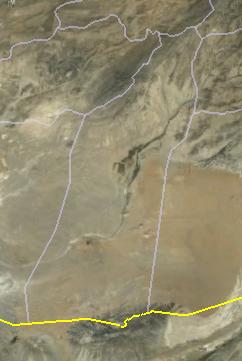
Geographically, the reason to move into this part of Afghanistan and Helmand is obvious from orbit. See that rare swath of green in the satellite photo on the upper right? That is the area around Marjah. Where you find green, you find people. Where you find people, you find your Center of Gravity.

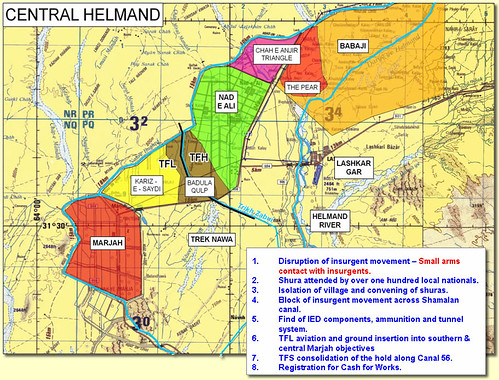
Now look at the close-up picture on the left. For those who have followed the AFG campaign for the last couple of years, I have put a couple of names up there to jog your memory and put Marjan in context of the campaign for the Helmand River Valley from the "Fishhook" in the south moving up to Marjan, Lashkar Gah, Sangin, on to the Kajaki Dam to the NE, and then the heart of Uruzgan Province where the Dutch and Aussie play.

If you remember back in '08 with the 24th MEU first stuck its toe in the waters in Helmand, this is a logical progression in Helmand. The British and other allies in "Helmandshire," the Danes and Estonians mostly, never had the forces they needed to properly secure the population in Helmand. As the USMC arrived in late '08 and through '09 as part of the US forces uplift, there were finally the right density of forces to do what was long been understood needed to be done.

This area is "Indian Country," a large internal safe-haven for the Taliban. Though everyone knew that COIN 101 did not allow large internal safe-havens, without the forces needed to clear them out - you just had to deal with it. There are other safe-havens in AFG - but you can't get them all --- all in due time.

You also need to keep in mind that this goes well back into '07 and was refined and established in '08 by Gen. McKiernan in the framework of "Shape, Clear, Hold, Build" (SCHB).

When it became clear that NATO had culminiated in late '06 through '07 and the US needed to move in as soon as forces became available, the critical failure to address the internal safe-havens became too obvious to ignore. The lack of Afghan National Army and Afghan National Police, in number and quality, was also seen as a critical failure. Just to get NATO to admit that fact was a challenge - and in the end the USA just did what needed to be done and NATO played catch-up as we changed the facts on the ground and took back the keys from an Operational Planning POV in late '08 early '09.

Let's go back to SCHB (you can also see it defined as Shape, Clear, Hold, Build, and Transfer). What you are seeing in Marjan is the end of Shaping and the main body of Clearing. Those are the easy parts. What comes next is the Holding and Building.

Holding will require ANA and ANP at the front - but with a lot of NATO backup to start. If that is done right, then the Hold process can begin ..... and Hold can go on for years and years - as will the Build. Build will begin when you have a safe and secure environment that will allow International Organizations, Governmental Organizations, and Non-Governmental Organizations to do what they do best. Sure, military Civil Affairs are great - but it is the IOs, GOs, and NGOs that will make it happen in the long run. IO, GO, and NGO cannot lead - the military has to create the conditions for them to operate, hence Marjan.

That is where number of forces come into play. This is where we as military professionals tried & failed. At the in-theater Operational side of the house; McChrystal's predecessor McKiernan, and McKiernan's predecessor McNeill - and on the Strategic side of the house Stavridis' predecessor Craddock; all failed to push the political side of the NATO house to admit that there was not enough and produce. They all tried - and in a fashion McKiernan succeeded in getting additional forces. But it took too long as IRQ needed to be fixed first and we put too much faith in NATO keeping its word.

As a result, years were lost. They all knew that more was needed - but we failed in that we let hope - hope that NATO could do what it promised - blind us to what good military practice told us what was proper.

As a result, things got away from us a bit. When we realized that it was time to take back the keys - something covered here through '08 and '09 - we knew that it would take 18 months to get enough additional forces to start to repair the damage. The Taliban grew - their safe-havens got stronger. The job got harder.

Did we pivot in time? I think so, if, and I repeat, if we have the strategic patience to do what needs to be done. This is at least a decade long process. We cannot go home starting in JUL 11 at the same rate we started going home from Iraq in late '08. AFG is not IRQ. No more than Long Island is Mississippi. Actually, Long Island and Mississippi are twin brothers compared to AFG and IRQ.

Watch Marjan and then watch the next move from there. Don't get caught up in the tactical part of the story too much - that leads to short-term thinking. The Marjan operation will take years to go through the SCHB process. There will be more Marjans.

Our Marines in the South, Army in the East, and the scattering of allies about the country can and will do their job if our Center of Gravity will hold. Where the Operational Center of Gravity for the Taliban and NATO is the people of Afghanistan - remember where our Strategic Center of Gravity is - Washington DC for the USA and Brussels for NATO (throw in Islamabad for AfPak if you must).

That is where you need to keep your eyes focused. The political JUL 11 is a significant weakening of the foundation for victory - yes I used the "V" word - watch how that developes. As some are retreating from the JUL 11 date - others are doubling down.

We will win Marjan at the Tactical and Operational - but it will be for nothing if the Political-Strategic collapses.

Tuesday, June 26, 2012

Rajiv & Exum on AFG: Partial Credit


I was not a big fan of Rajiv Chandrasekaran's book on Iraq, as I think he was a bit blinkered and his view lacked nuance, and I think he may make the same mistake in his upcoming book on AFG, Little America: The War Within the War for Afghanistan.

He is getting only part of the story - and letting a bit of an agenda float in what could otherwise be a solid job - just like his previous book.

In an exert in WaPo, he starts on something I actually have first hand knowledge of;
The problem was partly rooted in a 2005 decision by President George W. Bush to reduce American forces in Afghanistan and deploy them in Iraq. As the Taliban was gathering strength and violence was flaring across southern Afghanistan, his administration asked NATO to take up the task of stabilizing that region. The Canadians got Kandahar, and Helmand fell to the British.

By 2009, the British had 9,000 troops in Helmand because London kept adding more to confront expanding Taliban ranks. Although Kandahar was home to far more people, Canada had deployed only 2,830 soldiers to the province. Most of them were assigned to headquarters and support roles; fewer than 600 went on patrol.

When Exum returned to Kabul, he asked U.S. Maj. Gen. Michael Tucker, the soon-to-depart director of operations for all NATO troops, why more Canadians had not been sent into the city. Tucker said he did not want to dictate to the Canadians where to place their forces. “It is wrong,” he said, “to tell a commander, from this level, to put troops in Kandahar city.”

Exum was sitting next to Tucker. When he did not want others to see what he was recording in the Moleskine notebook he took everywhere, he scribbled in Greek. “This guy is a jackass,” he wrote. “Kandahar — not Helmand — is the single point of failure in Afghanistan.”

The decision to send the Marines to Helmand instead of Kandahar had been made by McKiernan, but he had been urged to do so by his subordinates in Kandahar, including a then-one-star U.S. Army general, John “Mick” Nicholson. When Nicholson met with Exum and his teammates to explain his reasoning, he emphasized that the Kandahar mission was Canada’s largest overseas deployment since the Korean War. Military leaders in Ottawa were reluctant to ask for more help — some were convinced that security in Kandahar was improving, others didn’t want to risk the embarrassment — and McKiernan didn’t want to upset the Canadians by forcing them to cede additional territory. To Exum and others on the team, however, it seemed that U.S. commanders thought that managing the NATO alliance was more important than winning the war.
Not everything is Bush's fault and that Beltway tic is getting very old. Only someone looking for a cheap and easy mark would make that statement about where we are in AFG right now. Let me take you back to the middle part of the last decade.

NATO's ISAF expanded their control out of Regional Command Capital from 2003-2006, after getting the nod from the United Nations to take Operational Control. In a strange fashion that only makes sense from Brussels, a German 4-star in The Netherlands technically runs the Operational Level Headquarters between the "In theater Operational Commander" COMISAF in Kabul, under a US General, and another American 4-Star as Strategic Level commander in Mons, Belgium in the person of SACEUR.

If you want to understand what happened between the middle of the decade and the surge where the US started to take the keys back in 2008 - that is where you start.

Back in late last decade, we went through it in detail (see Afghanistan and/or NATO tag if needed) - but let me remind everyone with an executive summary.

As any survivor of the 2004 election will remind you, "our allies" "international partners" and all that jazz was the big push. As AFG was relatively benign and we had such confidence in our soft-power and soft-covers ideas, the fevered concepts of the Bonn Conference have yet to implode, and people still believed that the Germans/EU could train ANP, Italy could fix the judiciary, Japan could disarm illegally armed groups, etc, etc. - of we went thinking war and COIN was new.

The whole operational plan by NATO was to go soft as possible, and they couldn't even do that. After a couple of cycles, it was evident that they couldn't even fill the very small Combined Joint Statement of Requirements. NATO wouldn't involve itself in Counter Terrorist activities, saddled its forces with caveats, and as usual over-promised and under-delivered based on best-case scenarios and .... hope.

There were really two wars being run - the American war in the East with Counter Terrorist forces here and there throughout the country - and NATO's war everywhere else. German traing teams wouldn't leave the North with the AFG Kandaks they trained, and Italian and Spanish forces would rarely leave their cantonments - much less the road. That only changed in late '08 and through '09 as the surge started to change the ground with more American caveat-free forces - even as CAN, NLD, and other forces ran for the door.

The final card in NATO's hand came out when NATO failed in the summer of 2007 to fill the aviation bridging force, and again in early 2008 requiring the usual response; Uncle Sam would do it. It became clear even to the last hold-outs that the USA needed to take back the keys and that NATO's plan would not work.

At that time, the USA had almost all its forces in the East. The Brits, Canadians, Dutch, Australians and a few others were in the South. The Germans and Nordic countries in the North. The Italians and Spaniards in the West. NATO was as tribal as the AFG.

We could not, would not, and should not have bully-boy'd our way in to the South any faster than we did.

AFG was not, especially in 2007-2009, and American fight in the South. Even if we wanted to - it would have been madness to have played the role of ugly American and have hip-checked our allies out of Command in the South in a rash manner. That is not how an alliance at war works.

The Canadians are not impressed either;
Canada's military effort in Kandahar has been heavily criticized and seriously misrepresented in a new book by a reporter and associate editor from the Washington Post ... Chandrasekaran reveals a misunderstanding of the history of the Canadian and American deployments in Kandahar and is apparently unaware of the many attempts that the overmatched Canadian task force there and political leaders in Ottawa made to get the U.S. and other NATO allies to join them in the fight.
The story of NATO's internal tribalism, our excessive hope in internationalism, and the international pettiness of IO/GO/NGO is really the subject for a book yet written, and it doesn't look like Rajiv's book will be it.

From what I am reading so far - this is all focused on the Obama Drama part of the AFG war, and perhaps that is my frustration. I find the years before the Obama more interesting - the grand illusion of NATO's AFG - much more fertile - but that probably wouldn't sell that many books in an election year.

The staff squabbles in the Obama Administration about what was the best way to lose the war after they were given a path to non-defeat just doesn't interest me all that much. The argument that we lost a chance to win (or not lose) in AFG because we did not negotiate with the Taliban is a non starter. Holbrookeism and Bidenism was never a path to anything but failure. The Taliban do not negotiate in the Western sense. They negotiate in the Muslim sense, and if I have to explain this to you then I can't help you. Read up on what Mohammed had to say about negotiating with your enemies and then come back.

The simple fact is that AFG was lost - or at least prevented from having a good chance for a "non-loss" - when President Obama made his announcement of his calendar based retreat/withdraw in the West Point speech in 2009. Full stop. That is the story of the Obama war effort.

Rajiv is looking at AFG from a too American centric point of view and it shows. That will be the critical failing of his book.

It is also worth noting that the author mentioned in the book, Sarah Chayes, whose book I recommended back in 2008, was not magically discovered by Andrew Exum and General McChrystal's group. She had been known to US & NATOs planners since the middle of the '00s.

I wonder if they will make a totally disconnected movie out of this too.

Tuesday, May 09, 2017

Desperately Seeking Phase 4: AFG Quandary Again

I guess it is time, again, as I have done every few years for the last decade+, to review how we got to where we are in AFG.

To understand why we are here, you have to know how we got here. 

It isn’t an easy story, but it should not be a surprise. Click the AFG tab if you want to see what I’ve written in the past on the topic, but I’ll summarize a bit here.

It can be best described in seven acts.

Act 1: Original Sin – Take the institutional arrogance of United Nations bureaucrats, business-class flying NGO leadership, Davos world view, and imbue it with a slight whiff of residual colonial parochialism, and you have the immediate post-911 Bonn Agreement. 

It was finalized when many of our Special Forces still had not washed the horse sweat from their DCUs. It set up a structure for the future Afghanistan before the power centers there could weigh in. Afghan solutions to Afghan problems and all that was simply not transformational enough. 

There were good people there who meant well, but it was asking too much, too soon, with too little appreciation for the realities of Afghanistan. This isn’t 20/20 hindsight either. We argued it at the time along the lines of, “Are they really committed to this for the long haul?”

This ran for roughly the first 2-3 years. Two recommendations for the later portions of this period that don’t get the attention they deserve: First, Sarah Chayes’s book, The Punishment of Virtue, and the documentary by Sedika Mojadidi, Motherland Afghanistan.

Act 2: Allied Hope – NATO decided to prove that it was more than just an exercise club and more than Euro-centric. As with a rather small footprint the USA seemed to have AFG under control, NATO believed it could take charge. From 2005-2006 it was decided while the USA remained in control of Regional Command East (RC-E), the Brits, Canadians, and Dutch would take RC-S, the Spanish and Italians would take RC-W, the Germans RC-N, and the Turks would take RC-C in Kabul.

It looked OK for a while, but the security situation started to spiral out of control. The exercise club also took some of its bad habits with it to war, and it stumbled. 

First, the Combined Joint Statement of Requirements out of Mons just never got filled. Some of the contributing nations who did throw their hat in the ring only did so with so many national caveats and ROE restrictions that they could never leave base, or if they did, couldn’t do much. They didn’t bring the right kit, or for some newer NATO nations, had no idea how to deploy. The assumption was Uncle Sam would, as always, pick up the slack.

Act 3: Buyer’s Remorse – By late 2006, the NATO-sceptics critique started to break above the happy-talk. AFG was more serious than NATO and the USA were saying, and most of the alliance member were not up to the challenge, and if they were – their staying power was brittle at best. 

If you had to draw the line somewhere, it would have been the summer of 2007 when NATO failed to fill the rotary-wing aviation bridging force. At the last minute, a combination of US military and civilian contractors filled the gap. After that goat rope, it was clear that NATO culminated. It was clear to the Americans in NATO and at the USA Joint Staff. 

Planning began to, in unkind terms, take back the keys … as long as the surge in Iraq worked. Some of the larger minimal-caveat maneuver forces, the Dutch and the Canadians, had already signaled they had enough and were going home. We needed to not only replace them over time, but increase the national presence overall.

Bit by bit, RC by RC, we took the keys back.

Act 4: Classic COIN’s Stillbirth – There is a little overlap between Act 3 and 4, as they transitioned slowly in parallel. A new Scots-Irish General came to lead the US forces in AFG and ISAF, General McKiernan, USA. He brought with him “Shape, Clear, Hold, Build” – a plan to combine civilian, governmental, and military efforts district by district to enable government of Afghanistan control. 

Shape and Clear required additional forces. Through late 2007 and 2008 the planning for the uplift of forces (surge) was made. The Iraqi surge’s success happened just in time, and forces were able to begin coming in by the summer of 2008.

Then we had an election. The new administration came in to Kabul to look over the surge plans, and with minimal changes, allowed it to continue. It was clear that there were new ideas with Holbrook and his fellow travelers, but that it would take a year for them to get those ideas ready for President Obama to issue derived D&G.

With SCHB and the uplift, we thought at the time this was a decade long effort if we stuck with it. In Destile Gardens we would darky speak that if we ditched this conditioned based plan and went to a calendar based plan, we might as well just retreat to the nearest airhead and go home.

It took less than a year.

Act 5: Retreat – President Obama’s December 2009 West Point speech where he announced a calendar based plan that signaled retreat, it seemed everything else was just commentary on the inevitable drive to The Friendship Bridge … if we were lucky.

In a story yet to be told well by anyone … over the course of the next year, someone competent and knowledgeable about military matters got the ear of President Obama and we never fully left in the summer of 2011 as he outlined. We hedged, and we got lucky.

Act 6: The Great Dithering – Obama moved the decision point to the right, to the next President. We treaded water in quiet, drone filled dreams of hoping that Afghanistan would just go away. From the end of his first administration through his second, we dithered. We mowed the grass and relied on hope. He hoped a disaster didn’t happen on his watch, we hoped for something we could call a win.

Act 7: Acceptance and Salvage – Here we are in Act 7. As with the change from Bush to Obama, the first year of Trump will mostly be the conditions created by the prior administration. As with McMaster and Mattis having better first hand knowledge of the area, it appears that we may see changes faster.

This week, we have heard that President Trump has a plan to look at;
The Washington Post this week reported that senior administration officials are pushing President Donald Trump to effectively return to the combat mission against the Taliban, adding thousands of troops to the fight.

Sources told the paper the new plan would also authorize the Pentagon to set its own troop numbers for Afghanistan, instead of following White House recommendations. Pentagon officials would also review the rules of engagement for troops operating there, following a Trump campaign trail promise to give military leaders more autonomy.
...
White House spokesman Sean Spicer said no decisions on troop levels in Afghanistan have been finalized yet, but he reiterated Trump’s promises to keep America safe and root out terrorist threats across the globe.

“One of the things he has asked our national security team to think through is to think through the strategy,” he said. “How do we win? How do we eliminate the threat?”
We should wait and see – and serious national security people need to give Mattis and his team the benefit of the doubt and a chance.

We can’t rewind back to 2009. The window long ago closed for SCHB and helping district by district drag Afghanistan to where we would like them to be.

Perhaps in Act 7 we can salvage something from Act 6. We keep enough forces in place to help build capacity of the ANSF (#evergreen) and to have the ability to kill AQ and ISIS where they pop their head up, as it pleases us. We accept that Afghanistan will have to come to peace on Afghan terms as best it can with its always restive Pashtun plurality. As long as trans-national terrorists can’t use it as a base, then that should be OK.

That should be good enough, and perhaps where we should have kept it before Act 1 set everyone off this long, sordid task almost a generation ago.

Tuesday, April 13, 2010

Germany; cuckolded in AFG


Let me quote myself from 17 JAN 2008 about our NATO allies in AFG:
The hints are getting stronger - Daddy is thinking about taking back the keys.
An older country - the German translation for this is,
'The US Is Taking the Reins out of Our Hands"
Well Der Spiegle - if you're just now figuring it out, then you need to read more CDR Salamander.
On Sunday, Afghan President Karzai and US chief commander McChyrstal met with tribal leaders in Kunduz. The spontaneous visit came as a surprise to the Germans forces in command of the northern area. Diplomats now believe it will become the site of a major new offensive.
...
The visit also indicated to Germany that larger joint missions between the US Army and Afghan units against the Taliban in Kunduz are imminent. Diplomats even expect major offensives to take place around the area where Germany's armed forces, the Bundeswehr, are stationed this summer that are similar in scale to the one launched a few weeks ago in Marja in southern Afghanistan. Karzai didn't officially announce any such plans in Kunduz this time, but he organized similar meetings in Helmand, the province where Marja is located, prior to the operation there in a bid to garner support from tribal leaders.
...General McChrystal has identified Kunduz as a second crisis zone -- following the Taliban stronghold of Kandahar -- and wants to fight far more aggressively in the region.
...
Meanwhile, US troops have found a fervent supporter in the governor of Kunduz Province. At the meeting with Karzai, Mohammad Omar called again for a tougher NATO crackdown. "Not only is the situation going to get worse here, but other provinces in the region will also be destabilized," Omar said. He spoke concretely about Germany's strict rules of engagement, which prevent its troops from carrying out an offensive strike against the Taliban. In the past, Omar consistently praised the US Army's rigid actions. Now he's calling on all NATO countries to relocate combat troops to the north.

It's still largely unclear what role Germany's Bundeswehr would play in an offensive against the Taliban. German troops have observed US special units accessing areas located very close to their base almost every night in recent weeks. German forces were generally kept informed about recent deployments of these tough, elite troops, but the Germans don't learn who the troops arrest or kill, or what the US's overall strategy in Kunduz may be. "The US is taking the reins out of our hands," one high-ranking officer says.
My readers have been hearing this for years - but I'll review again.

The minority report at Christmas '06 was: the USA made a mistake giving control of AFG to NATO. We should ignore the
promises and overly optiminstic plans coming out of Mons.

By the summer of '07 when NATO couldn't even scrap together some cargo helicopters and would not find the needed caveat free maneuver battalions - the understanding took root that NATO had culminated and Uncle Sam needed to find a way take back the keys without losing AFG and/or break NATO.

Through '08 the plan was made and execution began. We watched it adjust and fill out through '09. We will see through this year the tipping point when we split Regional Command South into
Southeast and Southwest as the British are moved north and east, CAN and NLD start packing their bags, and the USMC reinforces their stamp in the hardest part of AFG.

Europe has to face the fact that they have been measured and found wanting. We would not have the problems we are having now if DEU, FRA, TUR, GRC, BEL, ESP, ITA and others in NATO had from '05/'06 had the same attitude as USA, GBR, CAN, NLD, EST, DNK and the Baltic nations.

Don't complain when others have to clean up your mess. Sad. The German military could have done great things.

Tuesday, June 01, 2010

Know your AFG C2

You can put this in the "boring but important" category - but you need to know and process this. It is much more than bureaucratic moving of chairs.
The North Atlantic Council, in consultation with non-NATO ISAF Troop Contributing Nations, has given final authorisation for the reorganisation of ISAF’s Regional Command South and the establishment of an additional Regional Command South-West.
A new Regional Command (South West), based in Helmand, will oversee Helmand and Nimruz provinces; while the existing Regional Command (South), headquartered in Kandahar, will continue to control ISAF forces in Kandahar, Daykundi, Uruzgan and Zabul Provinces.
Note the bold. Nimruz and Daykundi are two provinces that were left without forces when NATO was running the show (it still is, but as we covered here often, Uncle Sam has taken back the keys in all but name). They were left empty because NATO could not generate the forces it needed to and tried to pretend that it could do more with less ... you know the rest. If this is new to you, click the Afghanistan tab below and read older posts. I am not sure we are expanding there yet - but I would bet at least Nimruz will.
The recent changes on the ground include a large increase in the number of ISAF troops in southern Afghanistan - up from 35,000 in October 2009 to over 50,000 by this summer - and a greater complexity in the conduct of operations, with major ongoing security efforts in Kandahar and central Helmand.

The new command structure will also enable a better alignment with Afghan National Army units, with 205 Corps continuing to work with Regional Command (South) [RC(S)] and 215 Corps partnered with the new Regional Command (South West).

The decision to divide responsibility between the two headquarters will help provide the best focus of command support for ISAF forces across the region.
The initial iteration had the USA just taking RC(S) ... but this plan is better. It also gives the USMC what they like - their own field of play.
Regional Command (South West) will operate under a rotational command, agreed in principle to be shared between US and UK forces. The first commander will be Major General Richard Mills of the US Marine Corps (USMC).

As part of the new arrangements, command and control boundaries will change within Helmand Province.

Following the split, Task Force Helmand (TFH) will come under the command of the US Marine Corps' 1st Marine Expeditionary Force (1 MEF), under Major General Mills. TFH will retain responsibility for central Helmand.

Major General Richard Mills, Commanding General of 1st Marine Expeditionary Force (Forward), said:

"Regional Command (South West) will ensure that ISAF and Afghan forces in Helmand and Nimruz provinces achieve the objectives of Operation MOSHTARAK, which are intended to assert the Government of the Islamic Republic of Afghanistan's presence in the region.

"Since taking command six weeks ago I have been hugely impressed by the momentum and achievements of RC(S) under General Carter.

"My predecessors in the 2nd Marine Expeditionary Brigade and the British troops of Task Force Helmand have distinguished themselves in the service of the Afghan people. Real progress is being made. "This will be the first time that the USMC has led an ISAF Regional Command. The British officers in my coalition headquarters and Task Force Helmand bring invaluable experience and knowledge. We are partnered with ANSF [Afghan National Security Forces] at all levels and conducting joint operations throughout Helmand Province.
Bingo. See that? Nimruz. Not sure what level we are there at; but the fact it is even being mentioned says all you need to know. Right focus; right time. Look at the map. Look at GoogleEarth with roads on, you'll see it. Ponder.

Remember - especially since the decision was made in '07 to have USA take back the keys, we can win this. All we need is a bit of luck and a lot of Strategic Patience.

Thursday, December 15, 2005

NATO's pre-emptive wobble in Afghanistan

OK, we called NATO's bluff on the nasty bits of Afghanistan. Over the next year, they are to take over combat operations throughout the country. Outside the Anglosphere nations (UK, CA, US, and non-NATO AUS), there are some problems.
The size and mission of the British military force due to be sent to southern Afghanistan next year as part of Nato plans to expand its peacekeeping operations are being scaled back, the BBC has learned.

The move comes amid continuing uncertainty over the commitment of other European alliance members to the plan for Nato to take over responsibility from the US for the more dangerous south and east, the heartland of the four-year-old Taleban-led insurgency.

Last week, the Dutch government again postponed a decision on sending 1,100 troops to the volatile southern province of Uruzgan, amid domestic concerns about casualties.
This is war. People die. This isn't feelgoodism. Welcome to varsity football. The time of sun and roses up north is coming to a close. The U.S., British and Canadians cannot do all the dying.

Sigh. My dear Dutch. What happened to the men who defeated the best German Paratoopers in
The Battle for The Hague in 1940? Will it take more battles in The Hague - this time fighting your home grown Jihadi?
...the UK government is now considering sending only about 1,000 combat troops to the equally challenging province of Helmand, ... That is about half the number originally discussed.

The government may also shelve plans to deploy Apache attack helicopters to support them. ... On paper though, Nato nations remain committed to the expansion of the peacekeeping force.

Foreign ministers agreed to provide 6,000 troops for the move south at a meeting last week in Brussels, with most coming from Britain - which will lead the alliance's forces - and Canada. ... In Afghan government circles, there is some frustration at the confusion, directed especially at the Dutch.

British soldiers in Afghanistan
UK has still not resolved details of its commitment

"They agreed to go to Uruzgan a long time ago," said one official. "Didn't they realise it was dangerous?"

However, jocular remarks reportedly made by a senior Afghan official to a visiting Dutch delegation about the number of "body bags" they might need for the Uruzgan deployment didn't help, several western diplomats have told the BBC.

Politicians in The Hague have also been worried about the treatment of any detainees their troops capture and the possibility of the death penalty being used.
They are already running for the exits and the show hasn't started. The Dutch military is better than their politicians. They have done great work already in Afghanistan and are being smeared as cowards by their government.
But the expansion south - due to be completed by June next year - is not the end of the story.

NATO is then supposed to take over responsibility for eastern Afghanistan, along the border with Pakistan, an area many regard as even more dangerous.
The U.S. needs to check six as we walk out the door and hand the keys to our NATO "allies." We could loose AF again if this isn't done right. Good people are at work on this, so lets give it a month.

Wednesday, November 20, 2013

CINC vs. Generals is not the Story

Rosa Brooks's article at Politico got a lot of play over the weekend, but most commentary focused on the title and the gossipy nature of the "who loves who, and how is saying naughty things about who" discussion of the civilian military divide that has been around since well before the Punic Wars.

No, that is not what concerns me, what concerns me are the nuggets of insight into the colossal ignorance we have from people with their hands on the levers of power. Not stupidity. No these are smart, patriotic Americans who are doing the best they can in a job their President has asked them to do. Ignorance; people put in jobs they are ill-trained for and never have the time to learn the fundamentals, or have the people around them which will properly brief things.
There was the White House staffer who called me up and asked me to have CENTCOM move a U.S. drone to Kyrgyzstan, for instance, in an effort to track an alarming outbreak of ethnic violence. When I told him why I couldn’t—the chain of command just doesn’t work that way, and in any case no formal planning or risk assessments had taken place—he quickly grew exasperated. 
“You guys”—the Pentagon—“are always stonewalling us on everything. I’m calling you from the White House. The president wants to prevent genocide in Kyrgyzstan. Whatever happened to civilian control of the military? 
“You,” I had to tell him, “are the wrong civilian.” 
As if to emphasize the culture clash, after episodes like this one, the response from some of my Obama administration colleagues in the White House was bitter: Had I “gone over to the other side?” one asked.
Interesting confrontation in the faculty lounge, but really? That is the conversation of some of the President's most powerful policy and decisions makers have.  Let that soak in while I grab my lance and look askance at that windmill again.

Some things must be confronted. Some things need to be repeated over and over, simply because they are the truth.

The next part of this post will be nothing new to longtime residents of the Front Porch, I walked you through this over and over in the last half-decade. Stick with me though, as we need to review it. We need to speak it. It needs to be brought up every time the false premise is brought up. The truth must always be represented, otherwise the past is lost.

Here we go.
Was there a single moment when Obama’s relationship with the military began to sour? Most observers point to the bruising 2009 debates about troop numbers in Afghanistan.

Immediately after his 2009 Inauguration, Obama set out to make good on his promise to “finish the job” in Afghanistan. He commissioned a sweeping review of U.S. policy and announced that he had authorized the interim deployment of an additional 17,000 U.S. troops in response to theater commander Gen. David McKiernan’s request.

By the end of February 2009, the president had adopted the new strategic objectives recommended by his interagency review team: From now on, the United States would emphasize the fight against al Qaeda—and build up the Afghan military’s security forces. But by mid-May, McKiernan, the first of several Afghanistan theater commanders under Obama to discover just how elusive “finishing the job” would be, had been fired. “War is a tough auditor,” retired Marine Corps Gen. James Mattis told me. Not every commander passes muster.

McKiernan was succeeded by Gen. Stanley McChrystal, who was in turn assigned to undertake his own 60-day assessment. But when word spread that McChrystal intended to propose a substantial new increase in forces, which Pentagon gossip initially put as high as 80,000 additional troops, waves of dismay spread through the White House. In late September 2009, a copy of McChrystal’s assessment was leaked to the Washington Post. Its bottom line was clear: If the United States did not pour significant additional resources into Afghanistan, and fast, the likely result would be “mission failure.”

I don’t think Obama really realized we were losing the war in Afghanistan until late in 2009,” a retired Army general with substantial Afghanistan experience told me. Furious at the leak—which they blamed on the Pentagon—and reluctant to accept McChrystal’s grim conclusions, senior White House aides engaged in strategic counter-leaks. In their version, McChrystal and the Pentagon were trying to box in the president by pushing to deploy tens of thousands more troops and refusing to consider other approaches.

After months of increasingly tense meetings, Obama came to a decision: Another 30,000 U.S. troops would be sent to Afghanistan, but after 18 months those troops would begin to withdraw.
No. That is not how it happened. Here is the rough outline.

The USA handed over the operation in AFG to NATO in late '05 and early '06 as ISAF moved out from Regional Command Capital. After that, NATO had Tactical and the bastardized "In Theater Operational" control of AFG through COMISAF (post '05 always an American), technical Operational Control through a German 4-Star in the NATO Joint Forces Command in The Netherlands, and the Strategic Control through SACEUR in Mons, BEL - always an American 4-Star.

The USA had a parallel Command and Control Structure which was to a large measure limited to scattered USA forces and Regional Command East. COMISAF had both a NATO and a USA hat. Big difference, we would do Counter Terrorism (CT) while few others would.

The Germans and Scandinavians were mostly in Regional Command North in Masar-e-Sharif, the Italians and Spaniards in Regional Command West in Herat, and the British, Canadians, Dutch, Australians, with very effective Danes and Estonians in Regional Command South. Other NATO and non-NATO nations contributed as well, scattered here and there.

There was also the humorous fact on the civilian side that the AFG judicial system was to be mentored by the Italians (!), the police by the Germans (then EUPOL), disbandment of illegally armed groups by Japan (!), and so on.

As we tired to figure out the AFG tribal situation, we soon fell in to our own tribal problems. NATO's version of USA Embedded Training Teams (ETT), Operational Mentor and Liaison Team (OMLT) never were sourced to the level promised, so training of AFG forces never got up on step in line with the OPLAN. Those OMLT who were working would not follow their Kandak from one RC to another making continuity impossible.

With few exceptions (Anglosphere nations plus Dutch, Estonians, Danes, and some other nation's SOF), NATO and non-NATO forces were so laden with restrictive Rules of Engagement and caveats that they were worse than useless for any type of direct action. Each Regional Command became a national fiefdom, and drift began.

NATO would not deliver the forces they promised to even inside their humble, risk adverse, low-balled Statement of Requirements. By mid-2007, inside the USA lifelines of CENTCOM and the Joint Staff - especially after NATO's failure mid-year to even send enough cargo helicopters or logistics forcing the USA to jump through hoops to make it work -  it became obvious the the USA had to take the keys back; NATO could not drive the car.

We had to be careful; NATO liked its new job. Other nations got their General Officers forward deployed time, and made sure they were there just long enough to get the check in the block and then move on. The Flags-to-Posts exercise was very nice for our allies.

We also were in the middle of the successful surge in IRQ - we had to balance what forces we could quickly move to AFG without side-tracking the good we were doing in IRQ - and not hurting our friends' feelings by jerking back too much from NATO too fast, and then doing significant long term damage to our alliance. 

By 2007, the Canadians and Dutch had already signaled that their maneuver forces were leaving. Careful balancing was needed ... but we needed to stabilize AFG beyond Kabul, the north, the west, and our FOBs.

When General McKiernan came in and brought to the front Shape, Clear, Hold, Build - the structure to make the change took place. Throughout late 2007 and 2008, the USA Joint Staff, CENTCOM and others looked at what was needed to execute Shape, Clear, Hold, Build, and more importantly - to take back the most difficult parts of AFG (mostly Pashtun areas) that our NATO allies either couldn't or wouldn't do what needed to be done. First forces of this "surge" started moving in by late '08 - before Obama was elected.

As all plans are, it was multi-phase; nothing happens at once.

After the 2008 election, Obama had his team do their little dog and pony show in theater (different story for a different day). As we chronicled here, he did a few things to put his stink on it - but nothing of any significance. The great Obama AFG surge was all, and I mean all, planned and put in to motion well before he even got the Democrat nomination. He didn't create it - he just approved it with slight to no modifications; initially.

There was a point that AFG did become all his; everything changed in DEC 09 with President Obama's West Point speech where he signaled retreat via a shift from a Conditions Based Plan to a Calendar Based Plan.

That was the moment that AFG was thrown to its fate. Everything since has been window dressing, vanity, and commentary.

Full stop.

Back to Rosa Brooks's article; 
... most of the military leaders I interviewed said they believed that military recommendations often go unheeded by senior White House staff, who now assume that a risk-averse Pentagon exaggerates every difficulty and inflates every request for troops or money.

This assumption turns discussions into antagonistic negotiating sessions. As one retired general puts it, “If you said, ‘We need 40,000 troops,’ they’d immediately say, ‘20,000.’ Not because they thought that was the right number, but they just took it for granted that any number coming from the military was inflated.”

“Sometimes you want to tell them, ‘This isn’t a political bargaining process,’” another retired senior military official says ruefully. “Where the military comes in high, they counter low, and we settle on an option that splits the difference. Needless to say, the right answer is not always in the middle.”

A former White House official with Pentagon experience says White House staff often remain willfully uninformed about the logic behind military recommendations: They “don’t want to take the time to go through the slide deck or get the full briefing. Basically, they don’t want to know.”

Over time, of course, a White House tendency to split the difference is bound to create perverse incentives for military planners, making mutual mistrust self-reinforcing. “If you believe the mission truly requires 50,000 troops and $50 billion, but you know that the White House is going to automatically cut every number in half, you’ll come in asking for 100,000 troops and $100 billion,” says the aforementioned former White House official. “The military eventually starts playing the very game the White House has always suspected them of playing.”
Amazing. Simply amazing. Ask General Shinseki over at the VA if he was inflating his numbers.

I really want to know who she was talking to. Names would be nice. I can't speak for them, but I can speak for others as one of the guys in the cheap seats who stayed quite but saw it all play out. What she speaks of may have happened somewhere she is aware of - but not where I sat actual and via VTC in AFG, Europe, Qatar, Kuwait, and in CONUS from DC to Tamps.

Let me tell you about the teams and commands I worked for/with on AFG; we never inflated numbers. As a matter of fact, we were bounded by Restraints and Constraints that kept our numbers low, but as accurate as possible. We were never ordered to inflate for the sake of inflation. We may argue of one number or another - but it was all about Troops-to-Task and forces needed to create Desired Effects - not negotiating. Not once General Officer, USA or NATO, ever directed numbers to be bumped up for political negotiating purposed. Just the opposite, more often it was about the ceiling on numbers coming from political D&G - as it should be.

Deliberately lie on an OPLAN or be ordered to do so for political negotiation purposes? No; the Bull Colonels and Captains would have had head on pikes or resigned first.

I never saw that at the Operational, COCOM or Joint Staff levels. If it did happen, let's see some names. Our beefy Union Thugs from Operational Planners and Targeteers Local 302 would like to pay them a visit.

Even today, it looks like the national security intellectual capital in the Obama Administration has not changed. The intellectual shallowness and malunderstanding of military history is the only logical reason the President's spokesman would say something like this;
Alternative explanation: they are knowingly misleading the American people. That is a different topic for a different day.

A war does not end just because one side leaves the field and is being pursued by the other. That is a fighting retreat or a route.

End of a war? No, the end of one phase.

So, there you go. Intelligence such as Rosa's and her colleagues do not translate in to the best in military or foreign policy affairs. "The Best and Brightest" who are out of their area of expertise rarely do.

No, the Gossip Girl story of the civilian military divide should not concern you - the fact that in the very serious business of fighting a war, political talking points and spin has in the minds of important people been made flesh - that is the story.

You can only learn from history if that history is based on fact. Without honest history, you only set up the future for failure.

Wednesday, May 07, 2008

SECDEF: we'll take back the keys ...

More evidence that the "Re-Americanization" camp in the Joint Staff is winning the battle inside the Joint Staff and the rest of the Army of Northern Virginia. The AP's Lolita C. Baldor lays it out in the Chicago Tribune,
The idea of giving the U.S. military more authority in areas of Afghanistan now under NATO command is "worth taking a look at," Defense Secretary Robert Gates said Friday.
...
"I think that this is a matter that is going to get looked at over probably some period of time," he said. "It will require consultation with our allies, particularly our partners in regional command south," referring to an area of southern Afghanistan that is currently under the command of a Canadian general and is due to switch to a Dutch commander before the end of this year.
Something else is cooking that will keep CENTCOM and EUCOM Staff's dusting off Operation RICE BOWL. Remember back in JUN of last year and this FEB when I brought up the subject about the need to review/change the AFG COCOM arrangement?
"We need to take a look also at some of our own command and control arrangements," he said. "For example, does it make sense to have two combatant commands involved in one country?" Gates was referring to the fact that Afghanistan itself is in the command area of U.S. Central Command, although the U.S. European Command is also involved because of the presence of NATO forces.
See, it pays to read CDR Salamander.

Finally, I have to do a little self-preening - because no one but Mrs. Salamander would notice. Note the bold.
Changing the command structure to give a U.S. general more control in the south would, in effect, mark a partial "re-Americanization" of the combat mission. That could be politically controversial, given U.S. interests in maintaining close ties with NATO in fighting terrorism.
A little self-indulgence if you don't mind; I normally wouldn't take credit for calling fire hot; but doing a quick googlesearch - I cannot find anyone who used the term "re-Americanization" in the Afghanistan context prior to my 05 APR 08 post, at least in the news section (that I am not in, ahem). Even in the wider "web section" my post is #2 in relevance, and none of the other posts on the first page are earlier - I beat them all by almost a month.

So, MSNBC, NYT, Lolita, WaPo, YahooNews, Reuters; where is the love for 'ole Phib? Maybe a Hat Tip? Do I have to, Drudge-like, put up a "must credit Phibian!!!"?

Sniffle. I'll just add that little star next to my RIVRON, LT Black, LCS and other lesser plaques on the CDR Salamander Love-Me-Wall and sulk in my unloved lonliness ....or would that be presumptuous and narcissistic? Hey, I am a blogger.....

Wednesday, October 28, 2009

Rahm Emanuel: ignorance or malice

You need to remember that this man is the Chief of Staff to the Commander in Chief.

OCT 18th on the Sunday shows, he demonstrated one of two things: ignorance on a colosal scale that should call for his resignation - or a deliberate malice towards the American and allied military and civilians who have been working hard on the Afghanistan conflict for most all this decade ---- and his willingness to use anything to avoid taking responsibility for national security. If that, then he should receive nothing but our contempt. Personally - I will go for ignorance - as maliciousness on that level is something I just don't want to believe is there. So, here is President Obama's Chief of Staff;
The president is asking the questions that have never been asked on the civilian side, the political side, the military side, and the strategic side. What is the impact on the region? What can the Afghan government do or not do? Where are we on the police training? Who would be better doing the police training? Could that be something the Europeans do? Should we take the military side? Those are the questions that have not been asked. And before you commit troops  .  .  .  before you make that decision, there's a set of questions that have to have answers that have never been asked. And it's clear after eight years of war, that's basically starting from the beginning, and those questions never got asked.
Looking at his questions; let me review for you.

1. Impact on region. We have done nothing but this as a rolling assessment since 2001. There are teams at (for starters) DOS, DOD civilian and the Pentagon Joint Staff and of course USCENTCOM that have been doing this full time for over eight years. That doesn't even cover the US military's work on AFG starting with SHAPE (Rahm, talk to your National Security Advisor there, natch) - the lead NATO guy is a US 4-star. In gory detail at the Strategic, Operational and in-theater Operational level since NATO took over responsibility for AFG in late 2005 through 2006 - countless hours on the USA and NATO side that has been constantly going on.

2. Afghan Capability Assessment. See #1. Wallow in the volumes of date created by CSTC-A and its NATO sister. That is all they do. On the larger side that covers Development and Governance - start with the 2001 Bonn Agreement, nibble a bit on the Afghan National Development Strategy and then sit down for a few minutes with Gen. McNeill, McKiernan, McChrystal and/or any other General Officer whose name starts with "Mc" and they will fill up your nogg'n in no time flat.

3. Police training & Europe. Good googly moogly; just read the first 10 pages from my buddy Matilka Krow. Germany had it - EUPOL took it over - neither did squat; and starting back well over a 18 months ago we increased our long running
Police Mentor Teams et al to fill in the gap left by the European belly-button picking. Classic epic fail by the Europeans that started the smart people in the Joint Staff to look at taking back the keys in '07. Have patience - we know police are the key, great success has been made - more is to come. Oh, and Italy is supposed to be the lead nation WRT Judicial Reform, and the UK counter-narcotics. How is that working for you so far?

4. Should we take military side. I you mean "we" so mean USA, then sure, if you want to destroy NATO. Once again, NATO has the security part of a three part plan/campaign design - governance and development being the others. The lead Strategic and in-theater Operational Commanders for the AFG operation in NATO are American - and starting in late '08 we started beefing up the US staff presence in Kabul to what you see now with
LTG Rodriguez, the 2-Star under GEN McChrystal. Again - this decision has been made and is the result of evolved thought through this entire decade.

I am still gobsmacked by Emanuel's statement. Ignorant? if so we should be rightfully concerned about this Administrations understanding of the conflict we are in. Malicious? Well, that just confirms what many of us thought -- and that is sad. There are some good people in this administration. To serve under a Chief of Staff that is that ignorant or malicious is a waste of their talent and efforts in service to their nation.

Funny thing for me to say, but pray for ignorance.

Tuesday, December 01, 2009

Driving to the Friendship bridge

As I thought about the CINC's speech at West Point today, in hindsight I have to admit I was being an optimist. In my head, I decided that I had a rough idea what was coming, and as a result was going to title this post, "Give the CINC some room to work." I wanted to support my President. Take 3/4 of the package and push on.

I have a buy-in in AFG - I want us to succeed, victory if you will. As you have read here, I have been confident that with with the USA taking back the keys from NATO, strategic patience, and going with what we know works - this is doable - doable with the right military and political leadership.

Our military leadership at the in-theater operational and strategic level is good and sound. Our COIN built around Shape-Clear-Hold-Build is sound. As in all war though, you need the political to be at the same level. That is the CINC. That is why this speech was so important. We are at an inflection point - we needed a home run.

He lost me at 20:18. I'll explain.

There are three parts to his strategy (it is unquestionably his now); a military surge - a civilian surge - and a "Pakistan" surge. The civilian surge cannot produce desired effects in AFG without the safe and secure environment created by military forces. A stable Pakistan, in terms and in line with our security needs, cannot exist without a safe and secure AFG. For the civilian and Pakistan part of his plan - the military must be given the resources and time to make it happen.

Here is how the President put it.

We will meet these objectives in three ways. First, we will pursue a military strategy that will break the Taliban's momentum and increase Afghanistan's capacity over the next 18 months.
That is when I looked over to Mrs. Salamander and said, "I hope I just didn't hear a timeline."
The 30,000 additional troops that I'm announcing tonight will deploy in the first part of 2010, the fastest possible pace, so that they can target the insurgency and secure key population centers. They'll increase our ability to train competent Afghan security forces and to partner with them so that more Afghans can get into the fight. And they will help create the conditions for the United States to transfer responsibility to the Afghans.
What you have here is the continuation of the plan that has been in the works since mid-08 and extended by a few more brigades - the McChrystal expansion of the McKiernan uplift. Good - but that previous paragraph was still echoing in my head.

Start sucking your teeth now.

Because this is an international effort, I've asked that our commitment be joined by contributions from our allies. Some have already provided additional troops, and we're confident that there will be further contributions in the days and weeks ahead.
Where are they coming from? Jones-Craddock tried and failed. McNeill-McKiernan tried and failed. Will Stavridis-McChrystal succeed now that we are telling everyone that we intend to leave come h311 or high water?

Here is what we do know. In a year from now, the Canadians and the Dutch (together ~3,500 relatively caveat-free forces) are leaving AFG. This has been known for awhile. The French stated earlier that they will send no more. The Brits can throw a few hundred in the south - but they are already looking at the door. You could double the Spanish, Italian, or German numbers if you want - but due to their ROE/Caveats, they will have little effect.

Former Warsaw Pact NATO economies are under so much stress and their militaries so small - they aren't going to give you thousands. Turks? Please.

I hope that the CINC has some surprises in his back pocket - really he as to. If we do not see allied contributions in the high four to low five-figures in the next, "
days and weeks" - then do I really need to tell you what that means tactically, operationally, or strategically?

From an INFO OPS & STRATCOM POV, I just cannot see the CINC saying the above without firm commitments that will be made public in that timeframe. If not; trainwreck. This is varsity football, you can't say things like that unless they happen. This is not domestic politics. This is significant national strategic risk.

Our friends have fought and bled and died alongside us in Afghanistan. And now we must come together to end this war successfully. For what's at stake is not simply a test of NATO's credibility; what's at stake is the security of our allies and the common security of the world.

Now, taken together, these additional American and international troops will allow us to accelerate handing over responsibility to Afghan forces and allow us to begin the transfer of our forces out of Afghanistan in July of 2011. Just as we have done in Iraq, we will execute this transition responsibly, taking into account conditions on the ground.
This was at approx 20:18 according to the clock in my car. I am glad Mrs. Salamander was driving. My head fell into my hands, literally. I didn't yell or pound the dashboard. I just said, "Oh, sh1t."

Now, everyone put on your red hat ... or red turban, if you will.

18 months is a fortnight at best for the Taliban, a weekend really. They will wait us out. The AFG government, just like the AFG government after the Soviet withdrawal, will hold on for awhile after we leave - but it is all baked in the cake.

Right now every smart AFG that can is transferring money and making plans to get out. Calls and emails are going to family in the USA, Canada, Germany, The Netherlands, The UK - wherever they have a connection - making a Plan B if they haven't already because they were foolish enough to believe in the USA.

The Afghans have seen this movie before; they know how it ends.

By moving from a conditions based (
or effects based depending on planning school you come from) plan to a time based plan, we just solved the Taliban's and Al Qaeda's problem.

We just validated all
that has been said about the West. The weak horse is at a canter for all to see.
We'll continue to advise and assist Afghanistan's security forces to ensure that they can succeed over the long haul. But it will be clear to the Afghan government -- and, more importantly, to the Afghan people -- that they will ultimately be responsible for their own country.
They can't do it in 18 months if they know we are leaving them. They know their history better than we do. They know what happened when the Soviets left. They know.

Everyone on the military side of the house knows the AFG will not be ready in 18 months. If anyone does - they sure have been keeping it to themselves. I would like to hear them say it to. Not, "I will carry out the orders .... " mantra - but a not kidding, "Yes, this is outstanding!" true believer stuff.

If the Afghans knew we were there for the long haul, would they be on the readiness curve to be ready once conditions were set? Sure. We just threw that away. You can't force this and expect it to work. This isn't politics - this is the building of a military and civil infrastructure that did not exist before.

By putting an 18-month stamp on things, we just stated that we don't care about the conditions on the ground or if we have desirable or undesirable effects - we are just looking at the countdown.

Success, victory - whatever you want to call it - is never achieved on a chronological basis. You retreat on a timetable - you succeed by reaching decisive conditions, objectives, effects, and end states as defined by your mission. Military 101. This can't be the best military advice he is getting.

Second, we will work with our partners, the United Nations, and the Afghan people to pursue a more effective civilian strategy so that the government can take advantage of improved security. This effort must be based on performance. The days of providing a blank check are over.

President Karzai's inauguration speech sent the right message about moving in a new direction. And going forward, we will be clear about what we expect from those who receive our assistance.

We'll support Afghan ministries, governors, and local leaders that combat corruption and deliver for the people. We expect those who are ineffective or corrupt to be held accountable. And we will also focus our assistance in areas such as agriculture that can make an immediate impact in the lives of the Afghan people.
None of that can be done in a nation larger than Germany in 18-months. Just talk to our Agricultural Development Teams in the east of AFG. They just started two years ago, and are only now impacting a few districts. It takes time to do this right.
Now, the people of Afghanistan have endured violence for decades. They've been confronted with occupation by the Soviet Union, and then by foreign al-Qaeda fighters who used Afghan land for their own purposes.

So tonight, I want the Afghan people to understand: America seeks an end to this era of war and suffering. We have no interest in occupying your country. We will support efforts by the Afghan government to open the door to those Taliban who abandon violence and respect the human rights of their fellow citizens. And we will seek a partnership with Afghanistan grounded in mutual respect, to isolate those who destroy, to strengthen those who build, to hasten the day when our troops will leave, and to forge a lasting friendship in which America is your partner and never your patron.
The AFG didn't hear a word of that. All they heard was,
"...transfer of our forces out of Afghanistan in July of 2011."
Everything else is background noise.
Third, we will act with the full recognition that our success in Afghanistan is inextricably linked to our partnership with Pakistan. We're in Afghanistan to prevent a cancer from once again spreading through that country. But this same cancer has also taken root in the border region of Pakistan. And that's why we need a strategy that works on both sides of the border.
That is/was what we have been doing as a nation. It will all be for nothing if we abandon AFG.

I am not going to fisk the entire speech,
read it yourself if you missed it, but there is one more thing I want to cover before I hit the rack.

He had three explanations in his speech. The first two were aimed at the political Left who either wants to retreat now - or do nothing. The third was aimed at, I believe, those who are seeped in a few thousand years of military best practices. Here it is.

Finally, there are those who oppose identifying a timeframe for our transition to Afghan responsibility. Indeed, some call for a more dramatic and open-ended escalation of our war effort, one that would commit us to a nation-building project of up to a decade. I reject this course because it sets goals that are beyond what can be achieved at a reasonable cost and what we need to achieve to secure our interests.

Furthermore, the absence of a timeframe for transition would deny us any sense of urgency in working with the Afghan government. It must be clear that Afghans will have to take responsibility for their security and that America has no interest in fighting an endless war in Afghanistan.
No one in a uniform has counseled an "open-ended escalation." No one. No, there are just those who are trying to achieve the mission in AFG. The only way to do that is through the proven methods of defining your mission, your end state, your objectives, your decisive points (or conditions or effects - depending on your flavor), your tasks and then the troops you need to achieve them.

There is no "time." If you are given a time limit - then you plan for that and work backwards. Usually though, the planning goes like this - "
When the following conditions are met, we can transition to the next phase .... " With time-based plans, all that matters is the time. You know that - the enemy knows that.

If your enemy does not have a chronological restraint, then to achieve their decisive points, objectives, end states and mission - then all they need to do is hit the mattresses and wait you out.

If your enemy sees your Strategic Center of Gravity as the political will to continue - then when you set a conditions-free chronological end to your campaign; then you just advertised that your Center of Gravity has been compromised and is falling apart.

The President in the end wanders into a discussion of costs. OK, we can do that. There is another thing that has stood true for thousands of years - war is always less expensive than defeat. Ask the Khwarezm Shahs, the Confederates, the Soviets, the Baathists, well ... you get the idea.

Here is a question I have for our 4-Stars:

Where in the history of warfare has a time-based strategy worked? When has it ever been determined to be a superior plan for success/victory/mission than a conditions based or effects based plan? Conventional warfare or COIN, when?


So, for the pro-victory coalition - what is there in this speech?

Well, hope isn't a plan - but there is hope.

This was a political speech, not a military speech. In politics there is nuance and the truth can change. We must hope for the truth to change. We can hope that "transition" if fudged enough to allow the Commander on the ground to have enough troops for a long enough time to build and expand the Afghan security forces.

Maybe the decision will be made to not start the withdraw in 18-months until conditions are better. Hope, maybe - but it is what it is.

As leaders, there is nothing illegal in the CINC's orders, so you pursue them as best as you can. You can push hard for 18-months with the hope that the largely Afghan National Army, Afghan National Police, and the other parts of the Afghan National Security Forces can significantly up their game to the point that when the American resources start to draw down - that the Afghans can keep it going. Hope that the drawdown will be manageable and that the financial and material support continues so the Afghan government isn't abandoned like we abandoned the South Vietnamese in '75.

That is, of course, if you think that the hope has a chance to succeed. What do you do if you are faced with the situation that you can no longer plan to win - instead you have to plan an orderly withdraw?

From a moral position - if your mission is strictly chronologically based - what is the risk level you take with the lives of your men and women? For what purpose are you expending lives? What are you "buying" with them?

Ahhh, that pesky thing called the operational art. A Decision Point. How do you define the conditions where further expenditure of resources will not bring about a sustainable desired effect inside an artificial timeline - and as a result when do you decide to pull back to the
cantonment?

Tough nut. It would be great to be able to talk to
John C. Pemberton about it.

History. How will she read this speech? How will history judge the uniformed leadership?

It doesn't have to end this way - but if you surrender to a time-based plan - history says it does.

If it does - it will be the fault of the elected leaders we have - though they will, like they did in Vietnam, falsely blame the military - but we know that.