Wednesday, February 08, 2023

The Democratic Party's Strange Internal Struggles on the Russo-Ukraine War

In the middle of Walter Russell Mead's article over at WJS, "The World Rejects the Wilsonian Order" there was an interesting insight for what the Russo-Ukrainian War revealed about the internal natsec divisions within the Democrat Party.

While one could quibble around the edges, this seems sound;

Within the Biden administration, the struggle is among three groups: liberal internationalists, who want America and the West to do what it takes to ensure that Russia loses the war; pragmatists who want to check Russia but fear Russian escalation and believe that the war will inevitably end in a compromise peace that falls short of Wilsonian hopes; and Asia-firsters who worry that U.S. support for Ukraine reduces America’s ability to face the more consequential and long-term threat from China. President Biden has tried to stay in the middle, giving Ukraine more support than the pragmatists and Asia hands prefer, but dribbling it out more slowly than the Wilsonians would like.

Liberal internationalists, pragmatists, and Asia-firsters.  That seems roughly correct, but for those who have a memory more than a few years old, there is one glaring omission; the anti-war left.

Of course, that part of the democrat coalition usually fades in to shadow whenever the party is in power. I've come to think a portion of them experienced a rather strange morphology during the now discredited Russia-Trump collusion hoax that had them all of a sudden become Russia hawks. They had yet to regress to the mean when the Russo-Ukrainian War started and it kind of stuck.

Sure, there are still some musty left-over leftists who still apologize for Russia like they used to apologize for the Soviet Union - but most have turned in to something else - perhaps just shifting down the bench to the "liberal internationalists" side. 

Of course, the (R) have their own tribes as well, but WRM does not cover them here. Funny thing about that, the teams are roughly the same, except some former Russia/Soviet hawks on the right now almost seem like their Cold War mirror images when it comes to giving the Russians way too many benefits of the doubt.

So, a new "bi-partisan national consensus" in the making? No, don't think so. Just bi-partisan national chaos as the Russo-Ukrainian War moves in to its second year - and like we did on Sunday - the rest of us try to find ways to describe what we see.

Tuesday, February 07, 2023

Our Navy at its Best: "Yeah, we can do that."

Over at DVIDS, a nice series of pictures that represents one part of our Navy that doesn't get to see the light of day often enough. Those who have served know it, probably been part of it, and nothing is more memorable than being right in the crunch of it all.

When you are well trained and well led with the right climate - things, in this case it really did, can come out of the blue that you haven't EXACTLY trained for, but ... you've done some things kind of like it.

You look at your Sailors, and you say, "Yes sir, we can do that."

One of the best communities for such responses are the Navy's EOD pros. Nice to see a little love heading their way, as much of what they do never breaks out in the open ... which is a good thing.

Check out the pics and track the story where you find it.

BZ.


Sailors assigned to Explosive Ordnance Disposal Group 2 recover a high-altitude surveillance balloon off the coast of Myrtle Beach, South Carolina, Feb. 5, 2023. EODGRU 2 is a critical part of the Navy Expeditionary Combat Force that clears explosive hazards to provide access to denied areas; secures the undersea domain for freedom of movement; builds and fosters relationships with trusted partners, and protects the homeland. At the direction of the President of the United States and with the full support of the Government of Canada, U.S. fighter aircraft under U.S. Northern Command authority engaged and brought down a high altitude surveillance balloon within sovereign U.S. airspace and over U.S. territorial waters Feb. 4, 2023. Active duty, Reserve, National Guard, and civilian personnel planned and executed the operation, and partners from the U.S. Coast Guard, Federal Aviation Administration, and Federal Bureau of Investigation ensured public safety throughout the operation and recovery efforts. (U.S. Navy Photo by Mass Communication Specialist 1st Class Tyler Thompson)

Monday, February 06, 2023

The Old Ways are the Same as the "New Ways" - Except for One


I find it fun, and helpful, to read refreshed think pieces on carrier vulnerability like our friend and always pleasant read Robert Farley put out last week at 19fortyfive, The U.S. Navy’s Nightmare: 5 Ways To Kill An Aircraft Carrier.

From their very birth, carriers have been vulnerable. They are delicate but deadly creatures. Expensive to own and operate, but valuable beyond measure at war. Recall that one of the reason the Guadalcanal Campaign had so many surface actions was because there were just not that many carriers available to sustain casualties because ... well, they're vulnerable. 

Everyone wants to kill them not just because they are so vulnerable, but because they are so useful. As Farley puts at the end of his article,
Aircraft carriers are instruments of geopolitical influence. As long as they serve usefully in that role, nations will seek means to neutralize them. The aircraft-carrier form has proven remarkably flexibly, serving in one way or another for nearly a hundred years. From the USS Forrestal on, the U.S. Navy supercarrier has existed in basically the same form since the 1950s, and is expected to continue operating into the latter half of the twenty-first century. At some point, the game will be up; carriers will no longer pack the offensive punch necessary to justify their vulnerability. It’s not obvious when that day will come, however; we may only find out after the destruction of one of the Navy’s prize possessions.
As almost all threats to carriers are evolutionary in nature - and I tend to be a bit immune to transformationalist hype - I see many of the "new" threats a few excitable people talk about accompanied with the requisite heavy breathing, as simply advances on known threats that will require an appropriate response in defense. No crisis, really ... however, there is one exception.

Farley is sound in this regard, and I encourage you to read it all, but here are 4 of the 5 ways to kill a carrier, and what I consider their evolutionally development from.

1. Undersea Unmanned Vehicles : SSK and sea mines.

2. Cyberattacks : Electronic Warfare and sabotage

3. Unmanned Aerial Vehicles : Old school Kamikaze mass attacks as in the Battle of Leyte Gulf

4. Hypersonic Weapons : Late Cold War ASCM delivered by SSGN & heavy bombers

For every threat - serious as they are - there is a countermeasure. I do wish more people will join the discussion that we need to plan to take losses and continue the fight - which is why we need more than 11 CVN, but one bit of the apple at a time, I guess.

That is 1-4, #5 is something, in a fashion, quite different.
5. Orbital bombardment systems (nicknamed “Rods from God”) can solve that problem. Satellites equipped with tungsten rods, or really any other kind of kinetic weapon, can simultaneously identify aircraft carriers and attack them, without messy problems associated with networked communications. The Rods from God, using kinetic energy alone, could deliver a tremendous blow to a surface target, either sinking a carrier or rendering it useless.
Many moons ago I has a 100# head type explain the math to me, and as Farley outlines, there are not many countermeasures one can have to this once someone launches those puppies downrange. They do have one vulnerability - they are in space and as such fragile (weight is a tax to get in orbit), and should be considered a first strike weapon. You have to get them before they go.

Unlike big-ass-balloons launched from Central China - you can't hide the rockets that will be needed to launch such weapons in to orbit and I have better than average confidence that Space Force will keep a close eye on those should they ever appear. 

That weaponization of space would be a significant escalation globally. If done, that could be countered by "simple" anti-satellite weapons ... again, an escalation - but often you don't seek escalation; escalation seeks you.

Should #5 take place, the steps it would take to get us there informs me that we would have a lot more than just carrier security we would need to be focused on in the global security scene. No one is playing games when you weaponize near-Earth orbit.

The future would be interesting. 

NB: I know many here save yourself the nightmare of twitter, so I just wanted to give everyone a heads up that there is a reason my posting here has been a bit light the last week - and perhaps a bit scattered - I am working my way through COVID. The worse it behind me, but I dodged it for three years, and it finally got me. I managed to recover well at home with minimum side effects besides a lack of appetite and an almost irresistible fatigue and desire to sleep. I will say this about COVID, except for the bone pain, it is worse than my previous worse malady, Dengue Fever. So, enough attention seeking for me. I do appreciate your patience as I attempt to get back up on step.

Sunday, February 05, 2023

American Realism in the Russo-Ukrainian War with Rebeccah Heinrichs - on Midrats


What path best enhances American security and prosperity, along with her allies, when it comes to the Russo-Ukrainian War?

Are American's interests best promoted by more support of Ukraine's ongoing fight for her independence, or by backing away to let things take their natural course?

Isolationists, realists, and idealists are all trying to make their case as to where to go next as the war moves in to its second year.

What are their arguments, and for those who say they promote a "Realist" policy - how do they define Realism?

Our guest for the full hour this Sunday from 5 to 6pm Eastern to discuss this and related issues she raised in her latest article in National Review, "Who are the Real 'Realists' on Ukraine?" will be Rebeccah Heinrichs, senior fellow at the Hudson Institute.

Join us live if you can
, but it not, you can get the show later by subscribing to the podcast. If you use iTunes, you can add Midrats to your podcast list simply by clicking the iTunes button at the main showpage - or you can just click here. You can find us on almost all your most popular podcast aggregators as well.

Thursday, February 02, 2023

Diversity Thursday

We should savor the victories when they come our way. Elections matter, and the average American does not want to have sectarianism, division, and hate injected in to their children using their money.

As we've said here for 18-years, those promoting division based on race, creed, color, and other immutable characteristics have no place in a diverse 21st Century Republic.

Elections mean things because for some reason, it can be hard to find leaders with the moral courage to do the right thing

Governor DeSantis on Tuesday announced a legislative proposal to eliminate programs, courses, and bureaucracies dedicated to diversity, equity, and inclusion (DEI) and critical race theory (CRT) at public Florida universities on the grounds that taxpayers shouldn’t be forced to subsidize harmful, divisive ideologies.

“We are going to eliminate all DEI and CRT bureaucracies in the state of Florida. No funding, and that will wither on the vine,” he said at a press conference. The removal of such departments, he suggested, will serve as an “ideological filter” and “political filter” for the schools. 

The proposed legislation would prohibit DEI spending in state university budgets, which would effectively starve DEI departments of resources, giving them no choice but to discontinue classes and fire administrators.

If you are a regular here, you know we've documented the bloat, growth, and expansion of the Navy's branch of the diversity industry - especially at our educational institutions in detail. 

One day, hopefully soon, someone like Governor DeSantis - perhaps DeSantis - will be elected as President and will do at the federal level what we are not doing in Florida.

The amount of wasted time, wasted resources, and empty hours listening to tenured radicals tell service members - most born in the 21st Century, that they should first and foremost see each other by the most artificial characteristics and then use that difference to position for advantage, conflict, and disorder firmly stuck in aspic from the perspective of the early 1970s..

Take a moment to listen. Good stuff. 

Take the "W."


Remember, there is nothing stopping every (R) governor from doing this in their state but moral courage.

There is also nothing from stopping a (R) President - the Commander in Chief - from ordering his military to do the same, as it should.


Wednesday, February 01, 2023

Eastern Europe's Second Chance


Geography doesn't change. To a slightly lesser extent, neither do historic patterns.

Even if Ukraine wins the Russo-Ukrainian War, Russia will still be to the east from Central Europe. 

She will be back in one form or another.

After the fall of the Soviet Union, liberation, and joining NATO - helped with a lot of ahistorical thinking on both sides of the Atlantic - there was a bit of hedging that there was time to rebuild Central European economies and civil society before a threat from the east came back. For almost three decades the former Warsaw Pact members of NATO let their military capabilities and investments fall closer to 1% of GDP as opposed to the 2% minimum.

The events of the last decade have sobered up everyone from Estonia to Bulgaria, but for most of those nations, by free-riding on their richer nations to the west for national defense, they lost or allowed to almost die what domestic arms manufacturing they had remaining from communism.

Everyone - well those who are paying attention - now realize the existential requirement to have at least the most basic domestic production capabilities to defend yourself, regardless what accountants may say.

The last year is seeing once strong medium powers in Central Europe bring capacity back online. 

Good for them, good for all alliance members;

Still wary of Russia, their Soviet-era master, some former Warsaw Pact countries see helping Ukraine as a matter of regional security.

...

“Taking into account the realities of the ongoing war in Ukraine and the visible attitude of many countries aimed at increased spending in the field of defence budgets, there is a real chance to enter new markets and increase export revenues in the coming years,” said Sebastian Chwalek, CEO of Poland’s PGZ.

State-owned PGZ controls more than 50 companies making weapons and ammunition – from armoured transporters to unmanned air systems – and holds stakes in dozens more.

It now plans to invest up to 8 billion zlotys ($1.8 billion) over the next decade, more than double its pre-war target, Chwalek told Reuters. That includes new facilities located further from the border with Russia’s ally Belarus for security reasons, he said.

Other manufacturers too are increasing production capacity and racing to hire workers, companies and government officials from Poland, Slovakia and the Czech Republic said.

...

Chwalek said PGZ would now produce 1,000 portable Piorun manpad air-defence systems in 2023 – not all for Ukraine -compared to 600 in 2022 and 300 to 350 in previous years.

The company, which he said has also delivered artillery and mortar systems, howitzers, bulletproof vests, small arms and ammunition to Ukraine, is likely to surpass a pre-war 2022 revenue target of 6.74 billion zlotys.

...

Czech arms exports this year will be the highest since 1989, he said, with many companies in the sector adding jobs and capacity.

“For the Czech defence industry, the conflict in Ukraine, and the assistance it provides is clearly a boost that we have not seen in the last 30 years,” Kopecny said.

David Hac, chief executive of Czech STV Group, outlined to Reuters plans to add new production lines for small-calibre ammunition and said it is considering expanding its large-calibre capability. In a tight labour market, the company is trying to poach workers from a slowing car industry, he said.

Defence sales helped the Czechoslovak Group, which owns companies including Excalibur Army, Tatra Trucks and Tatra Defence, nearly double its first-half revenues from a year earlier, to 13.8 billion crowns.

The company is increasing production of both 155mm NATO and 152mm Eastern calibre rounds and refurbishing infantry fighting vehicles and Soviet-era T-72 tanks, spokesman Andrej Cirtek told Reuters.

He said supplying Ukraine was more than just good business.

“After the Russian aggression started, our deliveries for Ukrainian army multiplied,” Cirtek said.

“The majority of the Czech population still remember times of a Russian occupation of our country before 1990 and we don´t want to have Russian troops closer to our borders.”

The Poles and the Czechs, in addition to having the industry, have a martial tradition going back over 1,000 years. 

There is no downside to having them strong. They'll bring their neighbors along with them. 

Tuesday, January 31, 2023

Keeping an Eye on the Long Game: Part XCVI

Since August of last year, this picture keeps cropping up, and for good reason.

Images posted on the Chinese social media platform Weibo show five hulls of the Luyang III-class Type 052 destroyer under construction at the state-owned Dalian Shipyard in Liaoning province, northeast China

China is building at a wartime pace - more than just these five - for a reason. They have plans ... or at least want to be ready to execute a plan ... one long in the making.

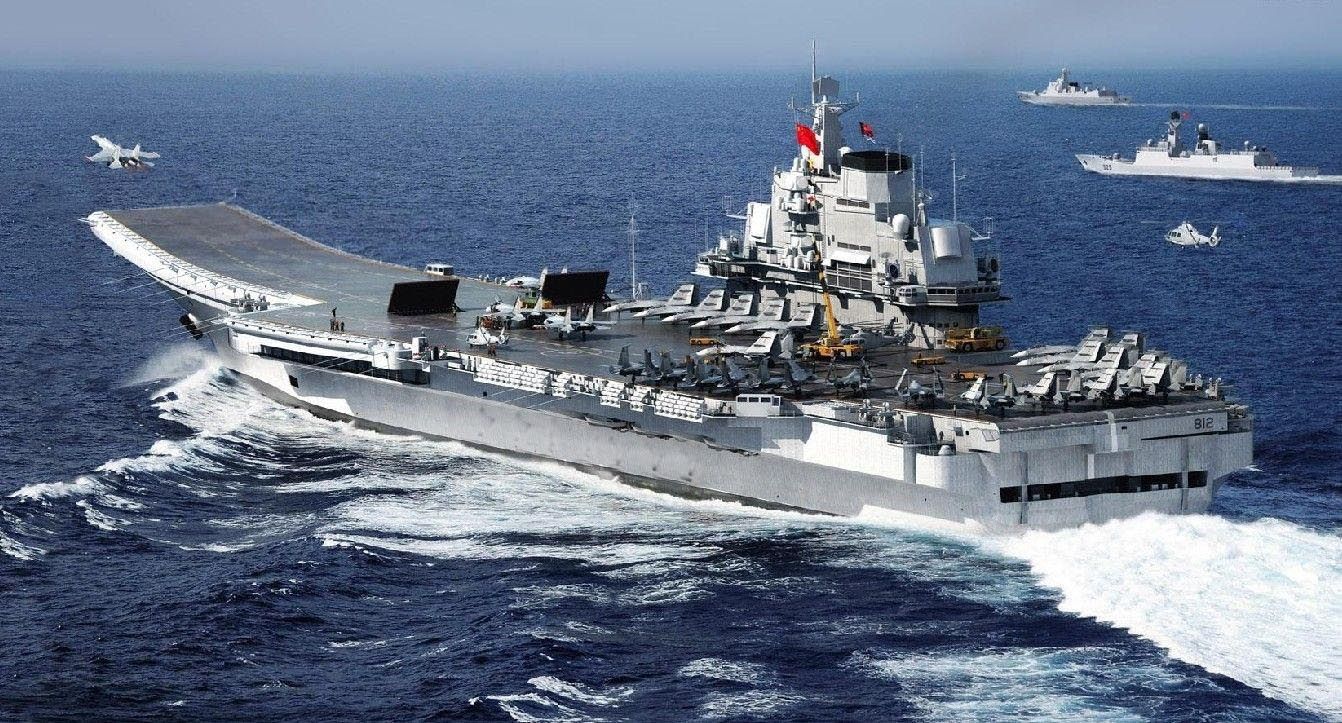
While we're at it, let's bring up a picture of the People's Liberation Army Navy's first aircraft carrier Liaoning - without which they would be at least one if not two decades behind in building their carrier fleet.


While it is encouraging that in the last few years "official Washington" has reached the pivot point in seeing the PRC's plans - it is almost criminal the lack imagination and vision on our part seeing it, especially in the 1990s when was the point everyone should have seen the game was afoot.

Just two datapoints, both related to these two pics.

"The Long Game" was an old story by the time we started it in 2004. It has its roots a lot further back. I think the first tickle of the idea came to Ensign Salamander back in 1990 when he caught a bit of info in the local paper about something that dominated the skyline for anyone coming in or out of Mayport.

Go to the pic at the top and look at those cranes and then return here. 

Know what the pic below is?


That's right - it was the original plan for "Goat Island" in the St. Johns River in northeast Florida. Today is is known as Blount Island.

There were big plans there in the 1960s and 70s;

...Offshore Power Systems (OPS) was formed on July 6, 1972 as a 50/50 joint venture between Tenneco Power Systems (who owned the Newport News shipyard) and Westinghouse Electric Corporation. It proposed to design, manufacture, and market complete nuclear power plants of a standardized design and integrated with specially designed floating platforms 5.

Each floating nuclear power station (FNPS) would contain two or more FNPPs within a protective breakwater. The individual plants were to be 1150 MWe Westinghouse four-loop PWRs with ice-condenser containments. They had once-through steam condenser cooling with no cooling towers. Electricity was to be transmitted at high-voltage (345 kV) through submerged cables beneath the sea bottom. A shore support facility would provide a staging area, a docking facility, office buildings, and parking.

At the time, the largest crane of its type in the world, just one, was at Blount Island - but the anti-nuclear movement in the 1970s killed OPS before any construction could be started.

That crane though...what was to be done with that? In 1990, in the heart of the Bush41 Presidency;

A REMNANT of a futuristic project that would have supplied cities with electricity from floating nuclear power plants is about to leave Florida. The world's largest crane, designed to build the nuclear systems, is being dismantled along the St. Johns River for shipment to China. The crane is being taken down by workers from the China State Shipbuilding Corp. at Blount Island. The Chinese reportedly paid $3 million for the 38-story crane, which cost $15 million when built for Offshore Power Systems.

Ensign Salamander - always suspecting the worse of all communist nations and enraged that we would do any business with them, was unpleased, but had a lot of PQS to do and was keeping a weather eye to that Iraq thing and hoped his betters knew what they were doing.

So began a bi-partisan decade of stupid acts.

Quick, go up to look at the PLAN carrier pic above again then come back.

Where did that start?


It was a mission like no other. In the aftermath of the Soviet Union's collapse, one businessman armed with cash and a casino cover story scooped the world to buy the unfinished hulk of a Ukrainian aircraft carrier that would become the centrepiece of the PLA Navy.

Speaking to the media for the first time, the Hong Kong-based businessman at the heart of the undertaking reveals in a two-part series the details of the little-known, behind-the-scenes odyssey to realise China's long-held dream of owning such a warship.

Xu Zengping disclosed that the militarily sensitive original engines of the carrier were intact when Ukraine sold the vessel in 1998. This is contrary to what Beijing told the world at the time.

Soon to be LCDR Salamander didn't like this either, but he was focused on that guy in Iraq who needed a good spanking for trying to kill Bush41, so he hoped  his betters knew what they were doing. He had his suspicions because we were also selling MIRV technology to the PRC, but what did I know?

His betters didn't.
Karginov told the media: “The unfinished aircraft carrier Varyag was handed over to Ukraine and then sold to China to convert it into a casino. After China received the ship, it completed its construction and renamed it the Liaoning ship. The ship was originally supposed to become one of the main ships of the USSR.”

I'm not really mad at the PRC. I'm actually quite impressed with their leadership's long term vision, drive, and follow through. 

Are we thinking as long-term? Is our defense nomenklatura focused on the Long Game ... or any game at all outside the Beltway?

Have we learned?