 If you have not kept up with the tragedy that is the story of General Cartwright, USMC (Ret.), head on over to USNIBlog and give my thoughts a ponder.

4 hours ago
If you have not kept up with the tragedy that is the story of General Cartwright, USMC (Ret.), head on over to USNIBlog and give my thoughts a ponder.


The best navy in Asia has a total of 114 warships and 45,800 volunteer personnel. It has a large fleet of fast, powerful destroyers, thoroughly modern diesel-electric attack submarines, and amphibious ships that can haul tanks and other ground forces. It can hunt submarines, square off against invasion fleets, and shoot down enemy ballistic missiles.Recognize that name? Of course you do;
...
The main component of the MSDF are its fleet of forty-six destroyers and frigates—more than that those fielded by the United Kingdom and France combined.
...
The most powerful of Japan’s surface combatants are the Kongo class of guided-missile destroyers. The four ships—Kongo, Kirishima, Myoko and Chokai—are all named after battleships and cruisers of the Imperial Japanese Navy, a practice once generally avoided but becoming more popular as the memory of World War II fades.
...
It also provides a national ballistic-missile defense system for all of Japan—just two Kongos can protect most of the country.
...
Another formidable Japanese ship is the JS Izumo. At twenty-seven thousand tons fully loaded and more than eight hundred feet long, Izumo has a full-length flight deck, an island for controlling flight operations, aircraft elevators and a hangar that spans the length of the ship.
While that sounds like a traditional aircraft carrier, Japan insists the ship is actually a “helicopter destroyer.” Izumo can’t carry fixed-wing fighter jets but it can carry up to fourteen helicopters. These helicopters and their missions can vary, from antisubmarine warfare to minesweeping to helicopter airmobile assault. This makes the Izumo a flexible platform capable of taking on a variety of tasks. A second ship of the class, Kaga, is currently under construction.
Kaga (加賀?) was an aircraft carrier built for the Imperial Japanese Navy (IJN) and was named after the former Kaga Province in present-day Ishikawa Prefecture.Spin and PR is one thing, but operational performance is another. Anyone who has worked with the Japanese military or been stationed in Japan know they are a serious naval power. For those that don't have first hand experience, I like this datapoint;
...After bombarding American forces on Midway Atoll, Kaga and three other IJN carriers were attacked by American aircraft from Midway and the carriers Enterprise, Hornet, and Yorktown. Dive bombers from Enterprise severely damaged Kaga; when it became obvious she could not be saved, she was scuttled by Japanese destroyers to prevent her from falling into enemy hands.
One final reason why Japan’s navy is the best in Asia? On March 11, 2011, a magnitude 9.0 earthquake struck off the coast of northern Japan. Vice Admiral Hiromi Takashima, commandant of the Yokosuka Naval District, immediately assumed temporary command of the entire MSDF and ordered all available ships north to the earthquake zone. The first ship left just forty-five minutes after the earthquake. Another seventeen ships packed with relief supplies departed within eighteen hours, some with only partially recalled crews. This ability to rapidly sortie the fleet with virtually no notice was perhaps the true test of the MSDF’s professionalism and efficiency.

Mr. Duterte’s gambit is strategically risky, Western diplomats in Manila and analysts said, as he puts his country’s alliance with the U.S. on the line to pursue an untested relationship with a government that Manila saw until very recently as its chief security threat.There is a school of foreign aid thought that promises that if nothing else, our money buys us good will. As the chart shows, notsomuch in The Philippines.
“It’s a strange negotiating tactic,” said Gregory Poling of the Center for Strategic and International Studies, a U.S. think tank. Mr. Duterte is “unilaterally abandoning the only leverage he has over Beijing—the U.S. security umbrella.”
An official at the U.S. Embassy in Manila said: “We will continue to honor our alliance commitments and treaty obligations and expect the Philippines to do the same.”
Zhang Baohui, a professor at Lingnan University in Hong Kong, said that for Beijing, “the strategic payoffs will be huge” if Manila pulls away from Washington, noting that Mr. Duterte is being honored with a full state visit.
The economic rationale behind Mr. Duterte’s Chinese strategy is understandable: He wants Chinese funding and technical expertise to build desperately needed infrastructure. Mr. Duterte has said he wants Beijing to build new railways on Luzon and Mindanao islands. He also said Beijing has offered him a 25-year loan on easy terms to fund arms purchases, although he gave no details and China hasn’t commented.Is he trying to play both sides? Perhaps.
China has largely spurned the Philippines over the past few years, even as it pledged investments of tens of billions of dollars for other Asian countries as part of its “Belt and Road” regional infrastructure program.
Mr. Duterte was elected on an anticrime platform, promising to extend nationwide the bloody campaign he waged against drug gangs as mayor of Davao City. For weeks he has lashed out with profanities at U.S. and other Western critics of his bloody campaign against suspected drug dealers, while also berating Washington for its supposed failures as an ally.
In Manila, diplomats privately expressed dismay and outrage at Mr. Duterte’s claim that billions in American and European aid amounted to mere “crumbs” that insulted the Filipino people, even as he heaped praise on China for its generosity in helping to build a single drug-rehabilitation center north of the capital.
While in Beijing, Mr. Duterte plans to visit “activities related to anti-drugs,” amid talks on bilateral cooperation in drug-control efforts, according to the Chinese Foreign Ministry.
Western officials noted that unlike Washington, Beijing won’t criticize Mr. Duterte’s human-rights record.

On 25 October she cleared Norfolk to rendezvous with TP 34 bound for the invasion landings on North Africa. Dallas was to carry a U.S. Army Raider battalion, and land them up the narrow, shallow, obstructed river to take a strategic airport near Port Lyautey, French Morocco. On 10 November she began her run up the Oued Sebou under the masterful guidance of Rene Malavergne, a civilian pilot who was to be the first foreign civilian to receive the Navy Cross. Under fire by cannon and small arms during the entire run, she plowed her way through mud and shallow water, narrowly missing the many sunken ships and other obstructions, and sliced through a cable crossing the river, to land her troops safely just off the airport. Her brilliant success in completing this mission with its many unexpected complications won her the Presidential Unit Citation.That is the airfield on the right. Oh, and they fought the French the whole way.
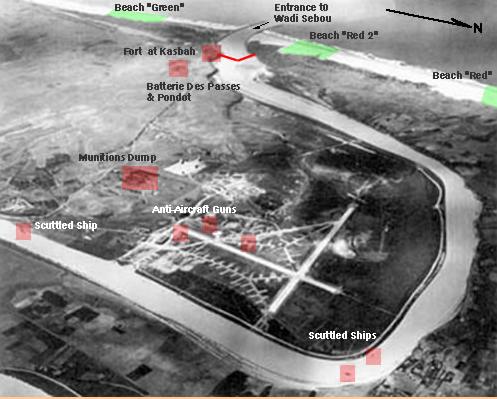
On the night of 9-10 November a tactical innovation involving the Navy raised American spirits. On the Sebou River the destroyer-transport Dallas pushed aside a barricade and sneaked upstream with a raider detachment to spearhead the assault on the airfield. As the night wore on, some colonial units gave up the fight, but Foreign Legion units continued to resist. Several companies of the 1st and 3d Battalion Landing Teams made progress, though slow, toward the airfield.Yes Virginia, we had to fight against the French before we would fight with them in WWII. One other thing, when looking up the Dallas, I noticed one of her then Junior Officers on that day who is buried at Arlington, Randall T. Boyd, Jr., CDR USN. Just for reference - what a career and life he had.
In bypassing a French machine-gun position, three companies of the 1st Team became disoriented and unintentionally provided some comic relief to a difficult night. At 0430 the companies reached a building they thought housed the airfield garrison. Intent on maintaining surprise, the troops crept up to doors and windows, weapons at the ready. Bursting in, the embarrassed Americans discovered they had captured a French cafe. Some 75 patrons put down wine glasses and surrendered. Patrols rounded up about 100 more prisoners in the area.
At daylight on 10 November the 1st Team mounted a new drive, this time with tanks, and by 1045 reached the west side of the airfield. On the river the Dallas passed a gauntlet of artillery fire and debarked the raiders on the east side of the airfield. American troops now occupied three sides of their objective.
Serious opposition still came from the Mehdia fortress. Although naval gunfire had silenced the larger batteries earlier, machine-gun and rifle fire continued. Navy dive bombers were called in, and after only one bombing run the garrison quit. After claiming the fort and gathering prisoners, the 2d Battalion Landing Team moved on to close the ring around the airport. By nightfall the American victory was assured' and the local French commander requested a parlay with General Truscott. At 0400 on 11 November a cease-fire went into effect, the terms of which brought all GOALPOST objectives under American control.
Commander Boyd saw combat as a naval artillery officer during World War II and as a pilot during the Korean War. He was awarded a Silver Star for his exploits during World War II and the Distinguished Flying Cross for his activities during the Korean War.Ship and man. Benchmark both.
Born in Hingham, Massachusetts, and raised in Weymouth, he graduated from the U.S. Naval Academy at Annapolis in 1941. He also earned a master's degree in aeronautical engineering at Massachusetts Institute of Technology.
On November 10, 1942, he was artillery officer aboard the destroyer Dallas when it made a treacherous 10-mile run up the Sebou River to land an Army Ranger detachment to capture Port Lyautey Airport during the assault and occupation of French Morocco.
According to the citation for the Silver Star he was awarded for the engagement, he displayed "remarkable courage under heavy hostile fire during the perilous journey" and "played a large part in providing protective gunfire for our Army Ranger troops and controlled and directed the fire of the ship so efficiently that hostile shore batteries were silenced before they were able to inflict any damage on the Dallas."
After World War II, he trained as a pilot in Pensacola, Florida, then served in the Korean War.
The first citation for his Flying Cross described him as "a skilled airman and cool leader in the face of hostile opposition."
According to the citation, he was flying a mission over Korea on October 12, 1950, "when enemy shore batteries attacked US mine sweepers with intense fire.
"Commander Boyd spotted hostile targets, took them under fire and held them down while the vessels escaped from the area. Braving heavy fire sent up from the ground, he controlled naval gunfire and vectored carrier-based aircraft to the enemy positions."
After the Korean War, he was commanding officer of Naval Patrol Squadron 34, and later was second in command at the Naval Base in Rota, Spain.
After retiring from the Navy, he was an engineer at MIT's Draper Laboratory, where he worked on the Gemini and Apollo space programs, and a senior engineer at Brown and Root Inc. in Houston, where he oversaw shipbuilding projects.


The Air Force’s growing shortage of fighter pilots is a “quiet crisis that will almost certainly get worse before it gets better,” the service’s new chief and its top civilian leader said in an opinion piece published Thursday. But how bad is it? According to data obtained by The Washington Post, the number of fighter pilots in the service has fallen five years straight, and plummeted in the last two despite increasing need.Well, yes - a serious organization focused on mission and having an ear towards accountability to the taxpayer and the very serious mandate to promote national security would be focused on this - but this is the American military's Air Force, so...
Earlier this year, Secretary of the Air Force Deborah Lee James introduced a series of new personnel initiatives geared toward enhancing diversity, inclusiveness, and equality across the force.What is the uniformed head of the USAF saying?
At the time, I offered criticism that her ideas appeared more politically expedient than substantive, and that some of what she wanted to do would require contending with various legal obstacles and regulatory challenges. I also worried aloud at the time that implementation of her initiatives, if done clumsily, could prove divisive, and that this might trigger new backlash and disharmony across a force already exhausted from a solid decade of human resource malpractice.
Others came right out and predicted that these policies would lead inevitably to race and gender quotas, creating unintended consequences that should be carefully considered before implementation.
“It’s quotas,” said retired Col. Terry Stevens at the time. Stevens spent 35 years in the Air Force and held a high-level post at the personnel center for 8 of those years. Stevens added:
“They won’t say that, but … [it’s] quotas. If you’re going to do that instead of picking the best qualified of any applicant, then you’re actually downgrading the quality of the force. A lot of people are not going to agree with that, but it’s true.”
The officials said they are working on a plan for an increased retention bonus to get pilots to stay longer. Currently, they offer $25,000 a year to stay up to nine years.Well, that was November. In less then 10 months, then this happened.
"We've got to make sure that we remain competitive," Goldfein said.
In addition to a pay boost, Goldfein, a former fighter pilot, added that it was necessary to improve the "quality of service," which he said involved making sure pilots can remain engaged when not flying combat operations.
"The reality is, pilots who don't fly, maintainers who don't maintain, controllers who don't control are not going to stay with the company because we're not allowing them to be the very best they can be," he said.
The first new initiative mandates that at least one diverse candidate will have to be in the running for important developmental positions like aide-de camp, senior enlisted advisor and executive officer, among other roles.Let's take a moment to clearly define this for you. "Goals" are quotas. If you don't meet them, you will be reported to the Star Chamber. It really is that simple.
A second proposal, however, declares that Development Teams (DTs) and Command Selection Boards (CSBs), both intimately involved in the selection process, must have a certain number of diverse candidates sitting on them.
More dramatically, the CSB or DT president must “assess the diversity of both the selectees and those not selected for command following the board’s decision.” In other words, the heads of these boards will have to provide clear justification if they decide to make decisions that run-up against diversity goals.
To head-off immediate criticisms of the far-reaching proposals, Air Force Chief of Staff Gen. David Goldfein recently insisted to Air Force Times in an interview: “This is not about social engineering. This is about maintaining a competitive advantage.”Sorry General Goldfein, no one believes you, and I would bet a tank of gas that you don't believe that either. It simply is not supported by the evidence.
Secretary of the Air Force Deborah Lee James put down her foot and said she wants to make the demographics of the service match more closely with the changing demographics of America.
But even as diversity increases, there are still numerous key positions that don’t seem to attract diverse candidates, namely pilots, cyber operations, intelligence operations and space and missile operations, which is very upsetting to Air Force officials.So, the USAF is going to start asking Airmen about their sexual proclivities? That is a metric now as well? What if you are gender-fluid and your desires change one FY to another? How do you update that? What if one area has too many homosexuals, do we ... what - give preference to heterosexuals?
So in careers where there isn’t a lot of diversity, commanders will have to come up with plans explaining why airmen in those positions are mostly white, male heterosexuals and how commanders can work towards changing that representation.
Although the Air Force already has unconscious bias training, the service wants to change the dates of the training to take place just before officials make key career decisions.I warned you years ago that "unconscious bias" was going to get mainstreamed. You see, regardless of what you do, you are a bigot.
“To the fullest extent possible, unconscious bias training will be given immediately prior to promotion boards, prior to DT meetings on school assignments, prior to civilian hiring panels, and prior to annual performance evaluations,” the fact sheet notes.
“Diversity and inclusion are national security imperatives,” Air Force Director of Diversity and Inclusion Chevalier Cleaves said in 2015. “So we must succeed. There is no second place for us. In order to do that, we need to make sure that we leverage the talent of all Americans, not just some.”No its not. What is a national security imperative is national unity and fair treatment to all. You can't have that when you promote sectarianism, race based preferences, and a science-free and merit blind system of promotion.
Black immigrants, on average, earn more money and use less welfare than blacks born in the United States, raising doubts about the reach and impact of systemic racism.I was hoping they would get to the Caribbean immigrants of African extraction. That is what I grew up seeing first hand.
The income data, which comes from the Census Bureau, is not new.
...
The median household income for black immigrants, $48,232, is more than $14,000 higher than the median income for blacks born in the United States. Whites, Hispanics, and Asians born in the United States all out-earn their racial or ethnic counterparts who have immigrated to the United States. American-born blacks also are more likely than black immigrants to be enrolled at least one government-assistance program and more likely to be living in poverty. Those two categories also are the reverse of other racial and ethnic groups.
“There are some things about black immigrants that would make them do better,” said Steven Camarota, director of research at the Center for Immigration Studies.
...
Black immigration, like immigration generally, is quickly rising. Since 1980, the number of foreign-born blacks in the United States more than quadrupled. Blacks currently make up nearly 10 percent of all immigrants, up from 3.1 percent in 1980.
“Many black migrants perceive things are better overall in the U.S. than where they are coming from,” said Carl Lipscombe, who is on the senior leadership team at the left-leaning Black Alliance for Just Immigration. “I think many of them don’t realize or don’t expect to face discrimination based on race.”
But some black immigrants said dark-skinned immigrants from Africa and Caribbean perceive better opportunities in America because there are better opportunities.
Rick Nugent, president of the National Association of Jamaican and Supportive Organizations, said he originally came on a student visa in 1967 because there were few opportunities in his homeland. At the time, Jamaica had a single university, he said.
“Once you get adjusted to the lifestyle and the opportunities, you don’t go back,” he said. “There are jobs for people who want to work. Same with education.”
Buried in the annual Coast Guard authorization act passed this week by Congress is wording that would strike from the U.S. Code the statement that all appointments to the Coast Guard Academy "shall be made without regard to the sex, race, color or religious beliefs of an applicant."Yep. Until 2010, the USCG was one of the last places where they were prevented from discriminating on the basis of sex, race, color, or religious belief. In order to open the door to the Diversity Bullies - which they have done with great vigor - they had to be allowed to do that.


NATO is slouching towards crisis. Beneath a facade of solidarity in the face of Russian revanchism, the Atlantic alliance is facing potentially its stiffest existential test since the end of the Cold War as questions emerge over the kind of organization it claims to be—versus what it does in practice.Has the alliance that stood down the Soviet Union morphed and twisted itself to the point its internal contradictions prevent it from standing up to a rump Russia?
...
no amount of reform can overcome the reality that NATO membership depends on a unanimous political consensus between its twenty-eight members. Corralling twenty-eight variations in national interest, risk perception, and vision for the alliance is difficult during the best of times. Today, it appears virtually impossible with Russian armies bearing down on Europe’s doorstep.
With expansion on indefinite hold and NATO’s increased focus on territorial defense and retrenchment, the practical outcome is a Europe rent between the “haves,” blessed by geography, the NATO umbrella, or both, and the “have-nots”—who have neither. In effect, Ukraine, Moldova and Georgia, despite European aspirations and some impressive reforms (particularly in Georgia), have been stranded on the wrong side of fortress NATO, condemned to subsist in Russia’s shadow because of the scars Russia itself inflicted: Crimea, Donbas, Abkhazia, South Ossetia, and Transnistria.
...
NATO’s current posture of retrenchment, at least in the way that it undermined expansion, is arguably a kind of withdrawal from the Alliance’s founding raison d’etre. And as a result, NATO’s expansion impasse has contributed to a widely perceived suspension, if not outright slow death, of Euro-Atlantic conditionality, a largely successful policy linking liberal reforms with integration.
...
Russian power, not to mention the wider spectrum of threats, menaces well beyond the Suwalki Gap; among plausible (if unlikely), potentially catastrophic scenarios, the threat to the Baltics is only one of many. More practically, NATO has neither the manpower nor resources to exhaustively fortify every region under potential threat, and any Alliance response to a large-scale contingency should be organized and launched not from the chaos of the front lines, but from regions benefiting from stable supply lines and strategic depth. This is the only (conventional, large-scale) means by which NATO would ever be successfully defended, and also the only way any future NATO members should expect the NATO cavalry to arrive. Alliance membership is not a substitute for national security, and any aspiring member should have no expectation that it can count on Western (read: U.S.) military bases in the event of accession.
...
NATO’s relevance in the twenty-first century won’t be found by erecting walls against Putin’s Russia, but in continuing to protect and extend the borders of a liberal European space. And while hard power is a pillar of that mission, it was always only intended as an instrument, and not as an end in itself.
Outside the wire, the likes of Ukraine, Moldova, and Georgia should not sit by and wait for the Alliance to fix itself—or collapse. Fairly or not, hard power is now the coin of the realm, and “defensibility” is a key prism through which their Euro-Atlantic aspirations will ultimately be judged.
...
As NATO approaches three years since Russian forces occupied and annexed Crimea, it is becoming increasingly clear that Moscow’s belligerent posture is a long-term issue. However, Moscow’s saber rattling should not trap the Euro-Atlantic West into an indefinite era of insecurity, and compel its members to abandon the values that have long underwritten Europe’s unprecedented period of peace and prosperity. NATO is in the midst of a crisis of purpose and identity at odds with its founding spirit, and only by reversing that trend can the Alliance and the broader Euro-Atlantic project be successful.
“I want to be clear to those that wish to do us harm.Then, a few days later, they play their card;
"I want be clear to those around the world who want to destroy our way of life and those of our friends and allies.
"The US military, despite all our challenges, will stop you, and we will beat you harder than you have ever been beaten before.
“We will destroy any enemy, anywhere, any time.”
Russia has moved nuclear-capable Iskander-M missiles into the Kaliningrad enclave bordering Poland and Lithuania, the Defence Ministry said on Saturday, adding it was part of routine drills.What is history doing here?
"These missile units have been deployed more than once (in the Kaliningrad region) ... and will be deployed as part of military training of the Russian armed forces," ministry spokesman Igor Konashenkov said in a statement.
A U.S. intelligence official said on Friday that Russia had started moving the Iskander-Ms into the enclave on the Baltic in what he said could be a gesture to express displeasure with NATO.
Konashenkov said one of the missiles had been deliberately exposed to a U.S. spy satellite. "We did not have to wait for too long - our American partners confirmed it themselves in their revelatory endeavor," he said.
Lithuania, neighboring Kaliningrad and a member of NATO, said it would protest to Moscow.
"The deployment not only increases tensions in the region, but also possibly violates international treaties which limit deployment of ballistic missiles of range of over 500 kilometers," Foreign Minister Linas Linkevicius told a news briefing in Vilnius.
"There will be a NATO-Russia Council meeting, and this is shaping up as one of issues on the agenda," he added.
"We will use all channels available to not only raise this question, but to demand that international agreements are adhered to."
Some modifications of the Iskander can hit targets 700 km (450 miles) away, putting the German capital Berlin in range of Kaliningrad, Linkevicius said.
"This is a usual Russian tactic: escalate tensions, create a discord and then expect concessions elsewhere. I would like to hope that this will not work this time," he added.
Russian President Vladimir Putin on Monday suspended a treaty with Washington on cleaning up weapons-grade plutonium, saying it was a response to unfriendly acts by Washington.


