Showing posts sorted by date for query SSBN. Sort by relevance Show all posts

Monday, March 27, 2023

Transcript from the Defense Breakfast Seminar


Remarks by Commander Salamander before the Congressional Research Service, Defense Breakfast Seminar, Wednesday, 22 March 2023

I appreciate the opportunity to discuss some of my views on current topics affecting our defense posture and the future of our country. The views I will express are my own from my perspective after 35 years as a naval officer, defense journalist, and student of history.

I will not dwell on the specifics of the broad breadth of topics I’ve written on because they are available for anyone with access to a computer. I would like to share with you thoughts on the importance on one topic I’ve been writing about since 2004; the People’s Republic of China’s (PRC) naval threat as compared to our naval strength.

The PRC’s Naval Threat

Recent PRC aggression in the western Pacific has brought renewed realization of PRC intentions for world power and concern for the adequacy of our own defense. What many may not realize is that the PRC’s threat in naval power, as in other areas, has been growing more ominous. Past warnings by many in the military have been greeted with some indifference. However, today we are faced with a naval threat more serious than any since the end of the Cold War.

Forty-One years ago, Admiral Liu Huaqing, Commander-in-Chief of the People’s Liberation Army Navy (PLAN), headed a navy which was little more than a defense oriented extension of the People’s Liberation Army. Under him and the three-step plan he developed, the PLAN was transformed. Since 1982, the PRC built hundreds of new ships and combatant craft, a program of naval expansion that in recent decades surpasses the efforts of any other naval power. From a defensive fleet in the Cold War, it has evolved into a major blue-water navy that challenges the U.S. for control almost everywhere in the world. 

The PRC’s momentum for superiority in naval warfare continues while U.S. naval plans fluctuate every year. Never this century has there been anything comparable to the growth of the Chinese naval power. This certainly raises concern over the PRC’s desire to maintain the peace.

Here are some comparative examples to illustrate these concerns.

• In the past 10 years the PRC has built over 151 major surface combatants, mine warfare, and amphibious ships, while the U.S. has built 42, or just over 25 percent as many.

• The PRC has more major surface combatants than we, and are introducing new ships at a greater rate. These include a new class of cruisers, though they call it a destroyer, while we have none.

• Their program has strong support and stable funding. They are striving for qualitative equality. They already have numerical superiority. Our shipbuilding program is uncertain and does not get strong support from the Defense Department.

Any comparison of the Chinese and the U.S. Navy must be viewed from the context that we are a maritime power dependent upon being able to maintain sea lanes of communication necessary to conduct military operations overseas and to support our allies. The mission of our navy is a far more difficult one than that of the PRC’s of denying us free use of the seas as they are already doing in the South China Sea.

We have given up any chance of matching the PLAN in numbers of ships. Therefore, the quality of our ships must continue to be superior. It is axiomatic that a nation dependent on the quality of its weapons must design its forces around an offensive strategy if it is to prevail over a numerically superior foe. It cannot afford to fight a defensive war of attrition.

Need for Flexible and Capable Ships

A few years ago, few people gave much though to deploying naval forces through hostile waters to the Indian Ocean or the once-American lake known as the Pacific Ocean to protect our interests. Today that has become a reality. Few appreciate how difficult it is to maintain a significant naval force half way around the world. The supply line, particularly for conventionally powered ships, is tenuous. There may be a new realization that war of attrition as sea is a real possibility. In these circumstances, our naval forces must be able to defend the sea lanes and carry the battle to the enemy as well. In a global wartime situation we will not have the time to build the complex ships we need the way we did in the last world war. The ships we build in peacetime are those we will have to rely upon in the event of hostilities.

If we miscalculate or succumb to the easy economic choice of putting off decisions, and do not build ships adequate to face the threat, our choice will be to either give in to our enemies or resort to nuclear war. The cost of adequate strength to ensure peace is small compared to the cost of war.

Current Issues

1. The Attack Submarine Issue

2. New SSBN

3. Need for a New Cruiser

4. Retention of Experienced Naval Personnel


Closing Comments

Without congressional actions and help throughout the years, we simply would not, today, have what fleet we have. You have the constitutional responsibility to maintain this nation’s ability to defend itself. Indeed no other national issue is more critical than national defense. If we are not able to prevail against our enemies, all other issues, however significant, become irrelevant. It is to the Congress that we all must look for a defense posture strong enough to assure our survival as a nation. 


BT BT BT BT

OK, I'm having a little fun with you here ... these aren't my remarks ... and at least yet, no one has invited me to speak at a breakfast meeting ... but these are, with minor changes, the words of a much more intelligent and influential person than just your humble blogg'r - these are the words of Admiral H.G. Rickover, USN before the Congressional Research Service, Defense Breakfast Seminar, Wednesday, 4 June 1980.

Friend to the blog known well by regular readers here, Claude Berube, is in the process completing a new book about Admiral Hyman Rickover that I can't wait to read, as I do with all his books.

For those new here, Claude has written non-fiction before, as with his last naval history book “On Wide Seas: The US Navy in the Jacksonian Era,” and his third fiction novel in the Connor Stark series, “The Philippine Pact,” will be released this spring.

Claude saw this in his research and was kind enough to share the text of Richover's speech, as he knew I'd find it interesting. That share prompted a little exchange between the two of us - as we like to do. 

Claude, rightfully so, observed that with a few words changed, the 1980 view of the USSR aligns pretty well with the 2023 view of the PRC.

Considering that more of a challenge than an observation, I did just that.

Below is the original text from 1980. Give it a read - you'll see exactly what Claude saw.

It begs the question: what lessons could we learn from that critical last decade of the Cold War that began with such worry, but ended with the coming collapse of a system that could not compete with the West - economically, militarily, or morally?


Remarks by Admiral H.G. Rickover before the Congressional Research Service, Defense Breakfast Seminar, Wednesday, 4 June 1980

I appreciate the opportunity to discuss some of my views on current topics affecting our defense posture and the future of our country. The views I will express are my own from my perspective after 50 years as a naval officer, engineer, and student of history.

I will not dwell on the specifics of the naval nuclear propulsion program I am responsible for because I have testified on that subject before several congressional committees. I would like to share with you thoughts on the importance of the Soviet naval threat as compared to our naval strength.

The Soviet Naval Threat

Recent Soviet aggression in Afghanistan has brought renewed realization of Soviet intentions for world power and concern for the adequacy of our own defense. What many may not realize is that the Soviet threat in naval power, as in other areas, has been growing more ominous. Past warnings by many in the military have been greeted with some indifference. However, today we are faced with a naval threat more serious than any since World War II.

Twenty-four years ago, Admiral Gorshkov, Commander-in-Chief of the Soviet Navy, headed a navy which was little more than a defense oriented extension of the Soviet Army. Under him, the Soviet navy has been transformed. Since 1958, the Soviets have built over 1800 new ships and combatant craft, a program of naval expansion that surpasses the efforts of any other naval power. From a defensive fleet in World War II, it has evolved into a major blue-water that challenges the U.S. for control almost everywhere in the world. The Soviet momentum for superiority in naval warfare continues while U.S. naval plans fluctuate every year. Never in peacetime has there been anything comparable to the growth of the Russian naval power. This certainly raises concern over the Soviet desire to maintain the peace.

Here are some comparative examples to illustrate these concerns.

• In the past 10 years the Soviets have built over 900 major and minor surface combatants, mine warfare, and amphibious ships, while the U.S. has built 100, or just over 10 percent as many.
• The Soviets have more major surface combatants than we, and are introducing new ships at a greater rate. These include 4 new classes of cruisers, one of which will likely be nuclear powered. AT about 22,000 tons, it would be the world’s largest nuclear powered cruiser and will carry a formidable array of weapons.
• The Soviets have almost 3 times as many submarines and one-third more nuclear submarines.
• They have 5 submarine construction yards; we have two. All U.S. submarine construction capacity could fit into one Soviet submarine yard.
• Since 1970, they have introduced 10 new submarine designs; the U.S. two. During this period, the Soviets have put to sea more new design submarines than any other country during a comparable period in all of naval history.
• Their program has strong support and virtually unlimited funding. They are striving for qualitative superiority. They already have numerical superiority. Our program is uncertain and does not get strong support from the Defense Department.

Any comparison of the Soviet and the U.S. Navy must be viewed from the context that we are a maritime power dependent upon being able to maintain sea lanes of communication necessary to conduct military operations overseas and to support our allies. The mission of our navy is a far more difficult one than that of the Soviets of denying us free use of the seas.

We have given up any chance of matching the Soviet Navy in numbers of ships. Therefore, the quality of our ships must be superior. It is axiomatic that a nation dependent on the quality of its weapons must design its forces around an offensive strategy if it is to prevail over a numerically superior foe. It cannot afford to fight a defensive war of attrition.

Need for Flexible and Capable Ships

A few years ago, few people gave much though tot deploying naval forces to the Indian Ocean to protect our interests. Today that has become a reality. Few appreciate how difficult it is to maintain a significant naval force half way around the world. The supply line, particularly for oil fired ships, is tenuous. There may be a new realization that war of attrition as sea is a real possibility. In these circumstances, our naval forces must be able to defend the sea lanes and carry the battle to the enemy as well. In a global wartime situation we will not have the time to build the complex ships we need the way we did in the last world war. The ships we build in peacetime are those we will have to rely upon in the event of hostilities.

If we miscalculate or succumb to the easy economic choice of putting off decisions, and do not build ships adequate to face the threat, our choice will be to either give in to our enemies or resort to nuclear war. The cost of adequate strength to ensure peace is small compared to the cost of war.

Current Issues

1. The Attack Submarine Issue
2. Trident
3. Need for Nuclear-Powered Aegis Cruisers
4. Retention of Experienced Naval Personnel

Closing Comments

I have shared with you my thoughts from my vantage point of being involved in our nation’s defense for a long time and in charge of the nuclear propulsion program since its inception over 25 years ago. From that perspective, I am particularly sensitive to the role that the Congress has played. Without congressional actions and help throughout the years, we simply would not, today, have the strong nuclear fleet we have, now representing over 40% of the Navy’s major combatants. You have the constitutional responsibility to maintain this nation’s ability to defend itself. Indeed no other national issue is more critical than national defense. If we are not able to prevail against our enemies, all other issues, however significant, become irrelevant. It is to the Congress that we all must look for a defense posture strong enough to assure our survival as a nation.

Monday, March 13, 2023

Money Talks: the UK Edition


The long post-Cold War period of low defense spending - for serious nations - is coming to an end ... at least those are the words and the vibe ... but what are the actions?

It is one thing to say you want to do more, the United Kingdom is actually talking about putting its money where their theory is;

The UK will spend an extra £5bn on its military and aim to lift defence spending to 2.5% of GDP as part of an updated strategy to counter intensifying threats from China and Russia.

Aspirations are good ... and so are statements of reality. Did you note the "C" word?

The revised defence, security and foreign policy review will describe the Chinese Communist Party as an "epoch-defining challenge" in a toughening of language.

The top priority will be to tackle the "fundamental risk" to European security posed by Moscow and to deny President Vladimir Putin from benefitting from his invasion of Ukraine. 

It is easy at this point to, like I did, get a little too must towards singing "Rule Britannia," as we will have to watch for a followthrough. That is always the hard part. Applied optimism leavened with the cynicism of experience;

Prime Minister Rishi Sunak, speaking before his updated review is published on Monday, said the new money for defence over the next two years would replenish and grow ammunition stockpiles and top-up funding for the nuclear deterrent.

This is a wise first move. No one can deny that the last 30-yrs of wargaming, theory, and funding of magazine depth and industrial capacity was an exercise in self-delusion. This would be my recommendation.

Of course, like we are doing with the new SSBN, an expensive bit of kit, the British have to recapitalize that as well. If you want to have a credible strategic deterrence, you have to make it happen. Not the best timing, but such is the flow of history.

Investing in her nuclear deterrent will have a nice knock-on effect of beefing up their submarine construction capabilities in preparation for AUKUS builds in the 2030s,

To synch back to one of my favorite phrases as it relates to the Mother Country, like her children she is a maritime and aerospace power. That is where her comparative advantage is. Yes, a strong army is needed, but if funding is not exactly as great as you would like - if you have to place risk somewhere - for a maritime and aerospace power, the land component is where that risk must be;

But the amount - while welcomed by the Ministry of Defence - is much less than what military chiefs are thought to require. Sources have told Sky News that the British Army alone needs an extra £3bn a year to avoid further cuts.

Then they need to find more money ... and this is when Lucy walks up to Charlie Brown with a football;

Mr Sunak, on a trip to the United States, also failed to commit to a timeframe on when his ambition for defence expenditure to reach 2.5% of national income, up from just over 2%, would be achieved other than in the "longer term".

That is ... unfortunate. The ever famous "out years," but I'll take it. 

At least the British are stretching to reach 2.5% - many of the rest of our allies aspire to get near 2%.

Monday, August 15, 2022

The Case for American Shipbuilding

To build the Navy we need, the one thing we have to get right is - and this seems obvious - to successfully build ships. A lot of them.

Easy to type, hard to do.  While we have had many well-documented troubles this century, we also have some notable successes that give hope we can do it right when we want to.

Returning today with another top-shelf guest post, Bryan McGrath picks up the conversation with a reminder of what we did get right, and what we need to do with that institutional capital.

Bryan, over to you.


When a “Murderers Row” of Navalists (Hendrix, Salamander, Work) all take to the interwebs within the same week to opine on the recent pathologies of American naval shipbuilding, one is forced to take note. As I toil and scribble in the same lanes as these fellows, I feel called to add my thoughts to the mix, some of which track well with theirs, some of which are not well-aligned, and some of which touch on issues their essays chose not to address. Their flurry of essays provides occasion to reflect upon the state of naval shipbuilding in the United States. With China’s naval expansion proceeding at an alarming pace and multiple studies converging on the finding that the U.S. Navy is too small, America must build more warships. This need is complicated by recent, well-documented descriptions of delays, cost overruns, and technical failures, raising questions about whether the United States is up to the task. This essay asserts that it is, but only if tough lessons are implemented, sufficient resources are applied, common sense is embraced, and political will is demonstrated. Some of this my esteemed colleagues touch on, some they do not. 


The Acquisition Kluge

The first thing to consider before we bend any steel or take to the computer-aided design software is that the acquisition of Navy warships exists within a complicated cauldron of interlocking systems and stakeholders to include executive branch policy making, legislative branch resourcing, Department of Defense/Navy budgetary prioritization and strategy-making, and industrial base concerns, to name only a few. There are no silver bullets, there are no magic beans. The act of acquiring warships is hard, and countless trade-offs among and within these systems are a feature, not a bug. 

This complex kluge creates numerous perverse incentives among the stakeholders. At the national level, we are unable to make coherent grand strategy, and so what kind of and how big a Navy we need devolves to slight deviations from the Navy we have, even when that Navy is patently insufficient. When the Navy does seek to develop a new class of ship, it consistently understates both the cost of the first in class and the life-cycle costs that it will incur. Why? Because everyone involved has an interest in keeping “sticker shock” from derailing the acquisition, including Congress. Better to get the program up and operating and ask for more money later than to drive away interest in a program due to its expense. 

Compounding this kabuki is the problem of immature designs, and much of the blame here belongs in the Pentagon. Whether one points to Secretary of Defense Rumsfeld’s “transformational” edicts to both the FORD Class CVN program and the DDX program (now the DDG 1000) resulting in the parallel integration of numerous immature technologies, or the similarly “transformational” decision to provide potential LCS vendors with “performance specifications” rather than “design specifications” (resulting in brittle supply chains and the introduction of one-of-a-kind and unproven technology in main propulsion 


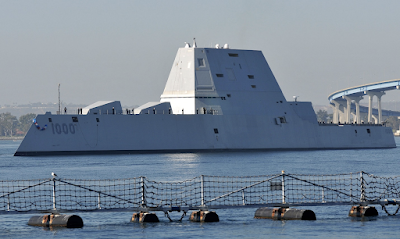
USS ZUMWALT (DDG 1000)

and combat systems), the pathologies of all three programs (CVN, DDG 1000, and LCS) are in part the result of immature designs incorporating unready, untested, and unsupported technology. Additionally, as part of the post-Cold War move to favor “efficiency” (over effectiveness), the Navy’s own technical community was dramatically down-sized, resulting in a situation in which it attempted—under pressure from OSD and from its own questionable decision-making—to oversee the development of increasingly complex warships with unfamiliar technology utilizing a workforce that was not up to the task. This was a recipe for failure, and three ship classes suffered as a result. 


Is All the News Bad?

Reading the thoughts of my friends Jerry Hendrix, Bob Work, and Commander Salamander on the turmoil in naval shipbuilding of the past two decades provides a depressing but incomplete picture of the status of American warship building. The United States is at this moment, building several classes of ships that are the envy of the world-- effectively and efficiently--to include the VIRGINIA Class attack submarine, the ARLEIGH BURKE Class destroyer, and two classes of large amphibious ships (LPD and LHA). The Navy and the Congress possess such confidence in these ships that they are routinely acquired in batches, rather than with individual contracts for each hull. What is the difference in these ships and the three (CVN, DDG 1000, LCS) discussed earlier?

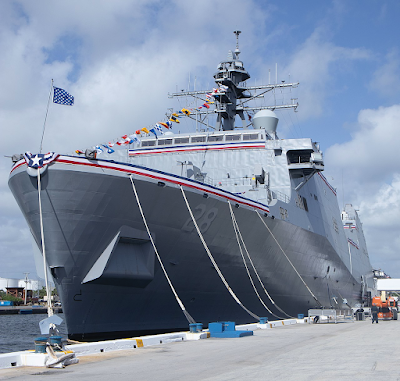
The simple answer is that they are mature programs with generally stable designs. The ship pictured below at its recent commissioning ceremony--USS FORT LAUDERDALE (LPD 28)—is the beneficiary of years of construction experience and what the industry calls “learning”. More efficient processes are created, early design problems are overcome, and real costs decline the longer a production line remains open. The VIRGINIA Class SSN, DDG 51 class, and the LPD 17 class all had early problems to overcome, but the Navy and the shipyards—with considerable oversight from Congress—worked those problems out and put the programs on a steady course. As of this writing, it appears that similar conditions are prevailing in the construction of follow-on FORD Class CVN’s. 

The point here is that America CAN build ships; it builds GREAT ships. But given the pace of China’s Navy buildup and the considerable number of new and newly modernized ships in the pipeline, how can the Navy and other stakeholders in the acquisition process behave differently to achieve positive results earlier rather than later?


What Is to Be Done?

In his recent guidance to the Navy’s Surface Forces called “The Competitive Edge”, VADM Roy Kitchener USN (Commander U.S. Naval Forces) identified ten “new or modernized platforms” that will join the fleet or be in construction over the next ten years. Those platforms are: 

  • ZUMWALT-Class Destroyers (DDG 1000) with Conventional Prompt Strike (CPS)
  • ARLEIGH BURKE Class Guided Missile Destroyers (Flight III)
  • ARLEIGH BURKE Class Guided Missile Destroyers (Flight IIA Modernization)
  • LCS Lethality and Survivability Upgrade
  • CONSTELLATION-Class Guided Missile Frigate (FFG 62)
  • Light Amphibious Warship (LAW)
  • Medium Unmanned Surface Vessels (MUSV)
  • Large Unmanned Surface Vessels (LUSV)
  • SAN ANTONIO Class Amphibious Transport Dock (LPD 17 Flight II)
  • Next Generation Guided Missile Destroyers (DDG (X))

This is a considerable amount of complexity entering the fleet in the next decade, and unless lessons from the past twenty years of frustration are implemented among all the various stakeholders, that frustration will continue. Here are several suggested focus areas:

Design Maturity. Civilian and uniformed leadership of the Navy should be required by Congress to certify design maturity and maturity of new technologies prior to proceeding to construction. Concurrency must be avoided at all costs, and new capabilities should be developed and proven in land-based test facilities PRIOR to introduction. Exceptions would include corrections of obvious mistakes, and changes to ships that are built at wider intervals (like aircraft carriers and amphibious assault ships). Of note, well into the Biden Administration’s second year, the Navy does not have a Senate confirmed Assistant Secretary for Research, Development, and Acquisition (ASN RDA), nor has one been nominated. 

Additionally, Congress must play a constructive role here by providing funding for design and testing to support Navy acquisition timelines and for additional land-based test capacity (an unsung Congressional achievement of late). These funds are often harvested and re-applied elsewhere, which causes acquisition delays (at best) and at worst—contributes to design immaturity as the Navy rushes to meet production schedules. The best of all cases from a Congressional oversight standpoint is to provide the design and testing resources when they are requested but to relentlessly hold the line on construction until satisfied of design and technology maturity. Long lead-time material must be closely managed to ensure availability.  

Requirements Discipline. When and if this country becomes serious enough about force structure to seat a Senate-confirmed official at ASN RDA, that individual must be utterly ruthless in shooting down the good idea fairy, even if that fairy appears in khaki with several stars on the collar. Multiple iterations of mature designs should be constructed to reap pricing benefits, with (as stated above) changes and capabilities proved and binned awaiting a new “tranche” of ships into which they will be integrated. 

A Virtuous Cycle of Stability and Investment. There is, within the latest Navy 30 Year Shipbuilding Plan, discussion of industrial base concerns in both the surface and submarine shipbuilding narratives, with no less an authority than the CNO casting doubt. Building multiple VIRGINIA Class SSN’s and the COLUMBIA Class SSBN simultaneously will surely flex the submarine industrial base, but the suggestion that there is not additional capacity in the surface industrial base is misplaced (although skilled workforce issues impact shipbuilding as much as most other industrial concerns). Where there are serious problems is within the supply chain, as tier 2 and 3 suppliers exit their businesses in response to inconsistent demand signals from the Navy. This inconsistency is important to the entire industry, as publicly held businesses must answer to shareholders who would (rightly) question capital investments driven by the behavior of their monopsonic partner. 

Leverage Hot Production Lines. Both tier 1 shipyards (HII and Bath Iron Works) are transitioning to the Flight III DDG line of ARLEIGH BURKE Destroyers—HII from building Flight II’s, and BIW from building DDG 1000’s.  The first hull at HII is nearing completion, and the first at BIW is under construction. Hot production lines also exist in the LPD 17 program and the LHA program. The Navy should plan to and budget for AT LEAST 2 SSN’s a year (in addition to the required SSBN program), 2 large surface combatants a year, 1 LPD 17 every other year, 1 LHA every four years and 1 CVN every five years. 

USS FORT LAUDERDALE (LPD 28)

For those hearkening back to paragraph three where I stated “…what kind of and how big a Navy we need devolves to slight deviations from the Navy we have…”, be advised that what I suggest above is just a part—a large part, but just a part—of the building program we need. We (the kluge cited earlier) have dithered long enough on unmanned platforms on and under the ocean, and the dearth of new Medium USV acquisitions in the President’s FY23 budget is concerning. A third of the 2045 fleet is to be unmanned, and if we hope to get there, we need to start bending metal, much of which will be done at more modestly sized yards. And then there is the new frigate. 

Compete the CONSTELLATION Class As Soon As Possible. It is difficult to see in the Navy’s plans a desire to bring on a second yard to build the CONSTELLATION Class frigate any time soon. Whether this is an architecture decision, a resource decision, or a risk decision is not known to me, but it is logical to assume that if the Navy is to grow larger in the coming years, more of these ships must be built. The design chosen by the Navy—while based upon a successful European hull—is considerably different from the parent design, in no small measure due to requirements for survivability driven by NAVSEA. Those requirements are often seen as onerous, but one important fact distinguishes STARK, SAMUEL B ROBERTS, PRINCETON, TRIPOLI, MCCAIN, and FITZGERALD from MOSKVA, and that is that only one of these ships went to the bottom. That the yard chosen to build CONSTELLATION has never built a ship of this size and complexity before is even more reason to expeditiously compete the design among the other building yards, both to get to at least four hulls per year and a means of backstopping production risk. Some would caution against this path, citing the need for the Navy and its shipbuilding partner to “learn” from the first hull. While there is indeed learning to be done, there is precedent worth considering in the transition from building CG 47’s to DDG 51’s. Bath Iron Works won the contract for the ARLEIGH BURKE, and Ingalls began construction on BARRY two years after ARLEIGH BURKE construction began, with the yards competing on hulls and multi-year procurements ever since. 

Like I said earlier, shipbuilding is hard. But it is harder when costs are consistently and predictably under-estimated (I’m no math major, but there seems to be a fudge factor suggested here), when the key policy and oversight positions are not filled, when construction begins before plans are ready, when considerable changes are made from hull to hull without discipline and testing, and when there are dramatic swings in shipbuilding plans that frustrate coherent capital investing. 

The nation needs a larger Navy; it needs more of the same and it needs more of different. It needs capacity and capability. It needs more, and more predictable resources. More than anything else though, it needs this country’s national security decision making elite to walk away from any notion that the Navy the nation needs can be had on the cheap, that other instruments of government can make up for what the Navy does every day around the world, and that we can “technology” our way out of the seapower deficit we are in. Winter is coming.


Bryan McGrath is the Managing Director of The FerryBridge Group LLC. He has clients in government and industry. His public writing and speaking represents his own opinions. 

Thursday, July 28, 2022

The CNO Has a Plan...


The Chief of Naval Operation's 2022 Navigation Plan is out ... and besides a couple of expected errata points I'll cover at the end ... I like it. It answers the bell.

I'm not going to go paragraph by paragraph as I want you to read the whole thing. The document is important because the CNO is the boss, and this is the Ref. A everyone needs to align with. It will drive discussions, efforts, focus, and defines the four corners for any argument the Navy will make. As such, read it if you want to understand what everything for the next year or more is going to be built around.

It is just a couple of dozen and change pages. Lots of pictures and side-bars, so it is a quick read. Congrats to the chop chain as there is an economic use of jargon and acronyms with just a few exceptions - but as a whole digestible from E1-O10.

Full disclosure up front - because long-term readers and certified members of the Front Porch may think I had a role in at least the Introduction ... because it is - I will humbly submit - Salamanderesque ... sadly I did not ... but someone here did;

First, the 2022 National Defense Strategy (NDS) clarified America’s national security objectives, emphasizing the need to address long-term competition with China and sustain military advantage against Russia. 

Did you catch that? "...competition with China..." and "sustain military advantage against Russia."  That is a clever way of saying the primary effort must be to counter to the People's Republic of China, and the USN's efforts and posture towards Russia will be an economy of force effort. 

Exactly correct. 

Anything we develop to address China will translate well if needed against what remains of the Russian Navy. As long as we keep and advance our ASW edge against the best the Russians can put to sea, the Army and Air Force can handle the rest of the worry with our NATO allies in primary position. That's the subtext.

Third, through a rigorous campaign of learning, we recognized that the Navy needs a more continuous, iterative Force Design process to focus our modernization efforts and accelerate the capabilities we need to maintain our edge in this critical decade and beyond.

The victory of the Anti-Transformationalists is complete. "Transformation" is mentioned nowhere, and "transforming" written only once in a different context. "Third" above is a return to the cornerstone of the great Rear Admiral Wayne Eugene Meyer, USN's "Build a Little, Test a Little, Learn a Lot." For 18-years we've wanted to see the turn towards this correct mindset be complete, and I think we are here. BZ Front Porch. 

Take the "W."

Our Navy team is the most capable in the world. However, we have identified unacceptable variability in our performance—the gap between our best and worst performers is too great. History shows that the navy which adapts, learns, and improves the fastest gains an enduring warfighting advantage. The essential element is fostering a healthy ecosystem—a culture—that assesses, corrects, and innovates better than the opposition. This is the essence of our Get Real, Get Better call to action, 

That is simply so damn good I don't really think I have much more to say than, yes. As for the "Get Real, Get Better," I first scrunched up my nose at it as it has a little of this vibe...

...but it has grown on me. I like it. It underlines a mindset of honesty, humility, and ... a call to action to improve from a sub-optimal position. 

Like I said, the Introduction is superb...but we are not even there yet ... as so far we've only go to the warm-up to the intro and we are already well in to Salamander-101.

The Introduction starts like this;

America has always been a maritime nation. The seas are the lifeblood of our economy, our national security, and our way of life. 

...

This progress and prosperity did not happen by accident. American sea power, combined with the dedication of our allies and partners, guaranteed freedom of navigation, maintained peace, and fostered a rules-based order grounded in fairness for all.

I'm not even going to be grumpy that I wasn't given a footnote.  

Today, for the first time in a generation, we face strategic competitors with the demonstrated intent to unravel the free and open order. 

...

This is a critical decade. As global challengers rise to threaten U.S. interests, America must maintain maritime dominance.

That is the "Long Game" series running 18-yrs in a nutshell.

The CNO could have stopped with the Introduction. That is the core, everything else is commentary ... but as Hillel might suggest, let's continue to read. 

The three trends in Security Environment are spot on;

Today, our Navy operates in a battlespace that is quickly growing in lethality and complexity. We face many challenges across the globe, but they largely stem from three significant trends:

• The erosion of credible military deterrence, particularly due to China’s rapidly increasing military capabilities.

• Increasingly aggressive Chinese and Russian behavior that undermines the international rules-based order.

• The accelerating pace of technological change and the expanding impact of the information environment.

It nicely boils down China's goal;

China designs its force for one purpose: to reshape the security environment to its advantage by denying the United States military access to the western Pacific and beyond. 

I wish this thread was pulled a little more, as the Russo-Ukraine War is giving a strong affirmation of this;

Artificial intelligence, ubiquitous sensors, unmanned systems, and long-range precision weapons are proliferating globally, making contested spaces more transparent and more lethal, and transforming how navies will fight in the future. 

The CNO ends the argument about if presence is a mission. Solid.

America cannot cede the competition for influence. This is a uniquely naval mission. A combat-credible U.S. Navy—forward-deployed and integrated with all elements of national power—remains our Nation’s most potent, flexible, and versatile instrument of military influence.

While not worthy of being included in the errata sheet, what looks like a last minute bone thrown to the SSBNs mafia is an awkward construct around the problematic and questionable concept of "Integrated Deterrence" ... but I think it looks forced because it was forced...maybe.

The ultimate backstop of integrated deterrence is a secure and reliable strategic nuclear deterrent. 

A little high and right methinks. We need to find a better way to hook in the strategic deterrence imperative as the SSBN force is the most effective of the triad.

Leaving that stumble behind, this is much better;

Every day, the Navy operates forward alongside allies and partners through combined operations, theater security cooperation, and capacity building initiatives. These activities strengthen our strategic partnerships, increasing interoperability, information sharing, and capacity for resilient, integrated logistics. Working together, we strengthen our ability to prevail in conflict and further bolster integrated deterrence by demonstrating a united front against potential adversaries. 

All allies and friends are one of our primary comparative advantages. That paragraph was solid...but the following one a little, "meh."

The Navy is also uniquely equipped to contest gray-zone incrementalism and malign influence by our adversaries. Many gray-zone activities occur in the global commons—particularly in the maritime domain and cyberspace. Gray-zone aggression thrives on non-attribution. The best way to oppose these activities is to deny our adversaries anonymity with persistent domain awareness, the effective leveraging of intelligence, and the agile application of sea power. Together with whole-of-government partners, the Navy denies the obscurity that our rivals exploit. Contesting, exposing, and attributing malign behavior imposes reputational costs, diminishes the effectiveness of propaganda, and galvanizes international resistance.

That would not have survived my chop.

I like lists as they are easy to remember and frame arguments around. The six "Force Design Imperatives" get a Salamander endorsement letter in the affirmative;

  • Expand Distance
  • Leverage Deception
  • Harden Defense
  • Increase Distribution
  • Ensure Delivery
  • Generate Decision Advantage
I'm not a big fan of the "Force Design 2045" section, not so much from the substance but from the concept. 2045 is 23-yrs from now. The "out years" are an unknown country and too many people put too much credit to it. 

Imagine in 1927 what "Force Design 1950" would look like. Lots of dirigibles I think.  What about 1892's "Force Design 1915?" How about 1972's "Force Design 1995

Wait a minute. 1892's would have probably have a lot of big gun ships, and I believe Aegis started in 1969 and TLAM in 1972 ... so they might have been pretty close to being right. 

See, a useful process, just be careful expecting too much clear-eyed futurism. Some of it will be shockingly right, but a lot notsomuch.

Like the "Force Design Imperatives," I liked the "Navigation Plan Priorities." 
  • Prioritize readiness
  • Modernize capabilities
  • Generate cost-effective capacity
  • Invest in .... Sailors
Yes, yes, yes...these are fundamentals, but you have to repeat the fundamentals on a regular basis or things get sloppy.

Let's back up a bit to Force Design 2045 for a second. There is this nugget;

Retiring legacy platforms that cannot stay relevant in contested seas—and investing in the capabilities we need for the future—is essential for our national security.

Its companion is found in Priorities and together is a bit of a war warning for the Potomac Flotilla. Both are bolded in the original for a reason and you need to read them carefully. 

To simultaneously modernize and grow the capacity of our fleet, the Navy will require 3-5% sustained budget growth above actual inflation. Short of that, we will prioritize modernization over preserving force structure.
The prophecy of The Terrible 20s made flesh.

Look at the economy and inflation. Do you think the Navy is going to get 3-5% above inflation with how we do budgets now? Without finding some way to get Army money? I don't see a path there, so what does that lead to?

We've seen this movie before. Be careful.

Like I said earlier, the "Get Real, Get Better" section is good. It gives the impression that we officially and openly are self-aware that we need to do better than we have in the past - regardless of the happy talk of the past.

We can work with this.
Get Real requires Navy leaders to ruthlessly self-assess; be honest, humble, and transparent about their capabilities and limitations; challenge their beliefs using data, facts, and diverse input; and “embrace the red”—acknowledge shortcomings—by being curious and taking pride in finding and fixing problems.

Get Better requires Navy leaders to deliberately self-correct; find and fix small problems before they become larger, systemic issues; fix the root causes, not just symptoms; apply critical problem-solving tools and best practices to shift from more activity to better outcomes; set clear accountability; work collaboratively; and quickly identify and remove barriers to progress, elevating problems to higher leadership, if necessary.

The substance from there has a good workmanlike feel to it for its genre. 

Parts of the "Where we are Going" section hit some high points regulars here and over at Midrats will like. Here are my top-6 from the list;

- Ship/Submarine/Aviation Maintenance: Continue to drive maintenance delays down to zero. Work with naval shipyards and industry partners to improve performance. Accelerate gains made in aviation readiness to reinvest in other areas of the Naval Aviation Enterprise.

Terminal Defense: Pursue a fully-integrated combat capability that employs lethal and sustainable effects to defend naval forces against complex raid scenarios.

Contested Logistics: Recapitalize our logistics fleet through used sealift buys in 2022, achieving T-AO 205 Initial Operational Capability by 2023, delivering Next-Generation Logistics Ship by 2030, and recapitalizing C-130s by 2030. Continue war-gaming and experimentation to inform how a survivable Navy logistics construct supports the sustainment of military operations in a contested environment. 

- Long Range Fires: Develop and integrate joint, all domain capabilities to project power at increasing ranges through contested maritime environments. Pursue a mix of weapons with required enablers, including CPS development and all-up-round testing. 

Unmanned Systems: Accelerate innovation efforts by aligning the acquisition, requirements, financial management, and operational communities supporting unmanned technology. Strengthen a culture of accountability and measurable progress. Focus on adopting enabling technologies that both provide near-term capability and help lay the foundation for the future hybrid fleet.

- Affordable Force Structure: Improve budget, requirements, and acquisition processes with a cost estimating dashboard to better project risk in cost, schedule, and performance.

I was going to do a top-5, but that last bit was a nice nod to, "Yeah...we screwed the pooch on CG(X)" and as such needed to be folded in.

We are running out of time and have not yet won the battle for money, so this is where I would prioritize what push we have. Faster.

I think the most fair critique of the document is the section on "Sailors" that in part I will cover in the errata section. If Sailors are our greatest asset, then why are they tagged on as an afterthought at the end and only get less than 10% of the effort in the document? It signals again the very DC nature of our Navy where much of our leadership has spent too much time - and our naval nomenklatura never leave. 

In DC, it is all about money and the programs that move it around ... and that can focus the mind for leaders that soak too long in it. Sailors can become an abstract. If this is an external messaging document - which it is - with a secondary internal role, if you consider Sailors an "internal" challenge, then I can understand its placement at the end and underemphasized. 

The substance seems a bit copy and paste, which is OK, some of the rest of the document is to a lesser effect - as you would expect - is. That is OK. I'm a firm believer that you have to repeat the essentials until you are sick of doing it. Only then will you finally be heard.

However, the "Sailors" section just isn't written as well as the rest of the document. It even starts with this vein on the forehead throbbing line;

The Navy’s enduring asymmetric advantage is our workforce—both uniformed and civilian—across our active and reserve components. 

No. Just, no. There is nothing more symmetric than Sailors. Sailor performance is not "asymmetric" to anything at sea. It is the center of everything. What they are trying to say - and this would be in my chop - is; 
The Navy’s enduring comparative advantage is our workforce—both uniformed and civilian—across our active and reserve components. 
No, that is not a minor difference. Yes, words matter. 

Finally, what in the name of Poseidon's trident is this?
We holistically evaluated Navy efforts focused on building a stronger, tougher, and more resilient Navy. We found that we risk creating gaps in supporting the physical, psychological, spiritual, and social needs of our force without an integrated framework focusing on optimizing the performance of our Sailors. We will better align this constellation of programs so that Sailors, with the support of their commands, can reach their optimal potential.
Well. OK.

Now to my "Errata Section."

Review my comments above WRT DC and our leadership who spends too much time there. I get to DC a few times a year. As I've advertised a lot, I love the city. I wish it would return to pre-COVID levels of enjoyment, but perhaps soon. I still love the city and have a nearly perfect circle of acquaintances and friends there - but - it is a cultural terrarium. 

The people and their priorities of DC are not aligned with the rest of the nation, much less the fleet. If you are soaked in DC life, its media, its culture, and you live in base housing surrounded by the long dwell natsec nomenklatura who have spent 80%+ of their professional life inside a commute distance of DC for decades - if you don't make a sustained effort to remained grounded with the larger nation you serve, you will do and think some strange things as viewed from the provinces.

Like a fish that is not aware that it lives in water - what you assume is normal, isn't - at least to the land dwelling animals that surround you.

Of course, I am talking about something we've long gotten used to; the DC-centric domestic political posturing that leaks in to US Navy. Not just the Biden Administration either. This is a Potomac Flotilla problem, not a partisan problem ... though it gets worse in (D) administrations, but to be clear, Bush-43 was not much better, and until the last 6-months of his administration, Trump did nothing to counter any of it. 

Mike Mullen's back to back tenure from CNO to CJCS allowed him to shape a generation of domestic political agenda nomenklatura pushing senior leadership to carry their banner - and it shows. It has become normalized, I just don't think they know it sticks out in bold relief.

Errata A: Fealty to an Official Religion: This seems obviously spot-welded in to the "Security Environment" section;
Climate change threatens coastal nations with rising sea levels and more extreme weather. Melting sea ice opens the Arctic to growing maritime activity and increasing competition. COVID-19 demonstrates how rapidly some threats can become global in scope, generating worldwide political and economic instability. Competition over offshore resources, including protein, energy, and minerals, fuels international tensions. All these trends create vulnerabilities for adversaries to exploit and volatility that can erupt quickly into crisis.

Praise Buddha that this reads so clunky and out of place that most readers will see it was clearly included as a, "We have to address this..." to check the block.

I'm less irritated then humored. 

Errata B: The Least Important Aspects of our Sailors are What we Worry About the Most: Next to Gaia worship, the other secular religion of the senior leadership of the US Navy is to first judge Sailors by the color of their skin, to hell with the content of their character or performance. 

I did a quick wholesale word count of the document. It is 7,469 words. The "Sailor" section is just 694 words, 9.3%. Of those 694 words, 142 are dedicated to "Diversity, Inclusion, and Equity" discussion. 20.5%.

We only dedicate less than 10% of our "Navigation Plan" to our greatest comparative advantage, and of that we dedicate almost a fifth of that time on something that does not bring Sailors together, but drives them apart. Something that does not reward performance, but gives special treatment based on something so incredibly meaningless to winning our nation's wars - the self-identified race, creed, color or national origin of our Sailors (something they cannot do anything about).

Heck, I'll go ahead and quote that section - but first as a reminder - let's go back to basics; words mean things. "Equity" does not mean "equality."

Let's use Ellen Gutoskey's efficient definition from 2020;

Equality has to do with giving everyone the exact same resources.

Equity involves distributing resources based on the needs of the recipients.

Remember, the US Navy does not have a "needs" metric it tracks. No, it uses the brain-stem simplistic metrics of tribalism; race, creed, color, and just to divide us more, sex and probably soon sexual orientation. All, including sex, self-identified and subject to self-identification. When the Navy says "equity" it is talking about special treatment based on tribalistic markers. Don't forget that great shame.

So, now that you understand what "equity" means in your Navy;

Launched 48 Task Force One Navy initiatives, which remain on track for full implementation, with further Navy Diversity, Equity, and Inclusion efforts underway.

What We Have Learned

• Progress toward a more diverse, inclusive, equitable, and stronger Navy is difficult and requires sustained commitment. Given how diverse each community is within the Navy, tailored approaches are more successful than one-size-fits-all, prescriptive measures. We are developing a Navy methodology to measure diversity of representation and equity of opportunity to make progress toward essential Diversity, Equity, and Inclusion goals across the Total Force.

...

Inclusive and Diverse Force: Through the Navy Leader Development Framework, continue to measure the results of initiatives to ensure the Navy is becoming a more diverse, inclusive, and equitable force, making stronger teams and stronger warfighters.

Supported Commander: Deputy CNO for Manpower, Personnel, Training, and Education/Chief of Naval Personnel (OPNAV N1)

History will no look back kindly on this posturing ... and change is coming.

Again, on balance this is a good publication and especially the opening five pages - exactly what we need.

Don't rely on my pull-quotes above, read the whole thing and let me know your thoughts in comment.


Tuesday, March 29, 2022

We Chose Decline

The People's Republic of China does not have to aggressively take our status as the premier world power. It appears that we are willingly giving it to them, sooner more than later.

As a maritime and aerospace power, especially when it comes to the challenge west of Wake, if you want to understand how serious our nation's national security nomenklatura is toward the clear threat to the place previous generations died by the hundreds of thousands to place us in the last century - just look at what we are spending our money on.

Megan Eckstein over at DefenseNews has the summary for everyone. It isn't pleasant reading, especially for those who have their eyes on the world around us. You don't have to like it, but you do have to accept the simple fact that the leadership the American people have put in charge of their security simply are not interested in funding it.

Until elections move new people in to power - and even that may not produce the needed result - we will simply have to accept that The Terrible 20s that we started talking about a dozen years ago are our future.

The title of Megan's latest is as good of a start as any;

US Navy budget would pay for 9 ships, decommission 24 amid readiness drive

Yes, that is a net loss of 15 ships. Meanwhile the PLAN grows and grows.

Like the intellectually dishonest "Integrated Defense" we covered yesterday, all this is being justified with spin and bad theory.

A couple of examples;

Meredith Berger, who is currently performing the duties of Navy undersecretary, told reporters the plan is strategy-driven and follows the chief of naval operation’s priorities of funding the Columbia-class ballistic missile submarine in full and then prioritizing readiness for today, lethality for tomorrow and capacity for down the road.

The budget proposal, she said, “enables the Department of Defense’s investment in the three pillars of the National Defense Strategy: integrated deterrence, campaigning forward and building upon our enduring advantages to fulfill the strategic priorities that are identified [in] the National Defense Strategy.”

I'm sorry Acting Under, but bullsh1t. No serious person who sees what is happening on the other side of the Pacific believes that. I really am interested in what exactly you will be "campaigning forward" with ... and the rest is, as my European friends like to say, "fried air."

The U.S. Navy is requesting more money in its fiscal 2023 budget proposal compared to the previous fiscal year, but it’s still on a trajectory toward a smaller fleet.

...

The Navy’s request represents a 5% growth in spending compared to the FY22 budget Congress passed, and the Marine Corps’ request would be a 1.8% increase in spending compared to the enacted FY22 budget.

In an inflationary environment - especially accelerating inflation - these % changes and raw number increases are meaningless.

Only units matter. How many of what you can buy. Focus on that first, then the money.

Along those lines, here is where the numbers fall;

Included in the request are two Virginia-class attack submarines, two Arleigh Burke-class destroyers, one Constellation-class frigate, one America-class amphibious assault ship, one San Antonio-class amphibious transport dock, one John Lewis-class fleet oiler, and one Navajo-class towing, salvage and rescue ship.

...

The Navy currently has 298 ships. That would dip to 280 by FY27 under the plan pitched by the Navy.

The service proposes decommissioning 24 ships in FY23: nine Freedom-variant LCSs, five Ticonderoga-class cruisers, four Whidbey Island-class amphibious dock landing ships, two attack submarines, two oilers and two Montford Point-class expeditionary transfer docks.

The loss of LCS is a net gain for the Navy, but building two while decom'n two SSN doesn't grow that needed west of Wake capability ... and we are gutting what is needed to get personnel and gear ashore from the sea - a strange position to take when that is one of the critical requirements to conduct and sustain operations in the Pacific.

Of those 24 vessels, 16 have not yet reached the end of their service lives and would require the Navy secretary to sign a waiver to Congress, including all nine LCSs, one of the five cruisers and the two expeditionary transfer docks.

16/24=8/12=2/3

Two thirds of our ships are being decommissioned before they were even used to their designed longevity. That is damning of both our maintenance and fleet design errors of the last 30-yrs.

Speaking of submarines, let's go back to something we were discussing on the Front Porch a dozen years ago;

Let's look at 2020 again. What else is happening in the 20s? Well, for one, we will have to find money to re-capitalized the SSBN fleet. I offer to you that the 20 JAN HASC SEF Subcommittee meeting has an outstanding money discussion about that challenge. Deputy SECNAV Work has also discussed this challenge in other venues, and I think he has a very firm grasp of the problem, as do most in positions to know.

You have to look at it in the broader context of the budget as well. The hangover in the 20s from this decade's drunken frenzy of spending will couple with another cohort of Baby Boomers retiring and putting stress on the budget in ways we still do not have a firm grasp on.

In 2020 - that ship built in 1990 will be at 30 years. That LCS built in 2009 will only have 9 years or so of service life (LCS is expected to only last 20-25 years) - so by the end of the 2020s, LCS will be dropping like flies.

When you consider that we will be limited this decade to LCS and DDG-51 for our non-amphib surface ship program (don't throw JHSV at me, that is just a truck - full stop - all else is spin and hope) - you have about a perfect story for the 20s of limited shipbuilding funds and a stunted fleet.

No one - at least here - should find this from Megan's article even a little bit surprising;

He also noted that 21% of the shipbuilding budget supports the Columbia program — which doesn’t affect the ship count for FY23 since the Navy is not buying a new ship this year but rather is incrementally paying for the lead ship bought in FY21 and buying parts for the upcoming FY24 ship.

...

The Columbia program will grow to consume 30% of the shipbuilding budget once it moves into one-per-year procurement later this decade. As a result of this pressure, surface ship programs may be scaled down.

A month before the above post from FEB2010, we also had this CDRSalamander post - again from over a dozen years ago;

 We did this to ourselves - and in the budget environment everyone who wanted to has seen for the last half decade, the simple math that the Tiffany Navy forces us to use tells us that there was no way we would reach 313, 300, or even hold fast at 283.

Further evidence continued to mount last spring, when the administration submitted a shipbuilding budget that would only support the construction of eight ships.

In just a few short years, this level of funding will produce a 240-ship fleet, given that a typical Navy warship has an expected life of 30 years.

We will be lucky if we can hold 240 - as we have been discussing here for the last few years.

What is happening on the aviation side of the house?

... it plans to retire 24. It is asking for 96 aircraft, but no F/A-18 Super Hornets and fewer carrier-variant F-35C Joint Strike Fighters than last year. It’s also proposing a decrease of about 10,000 sailors to crew the fleet in the next five years.

...

Of note, the five Advanced Hawkeyes and the 26 TH-73A helicopter trainers in the budget request would be the last in the program before the production lines end.

The three V-22 Ospreys the Navy is buying this fiscal year and the nine the Marines are buying would be the last for that production line as well, with the services listing zero in their request for FY23 and in the four following years.

10,000? Do you know anyone in a sea-going command who thinks they are overmanned?

I repeat my standard once again; if you believe war in coming west of Wake, time is short. Under no circumstances should any production line of aircraft or ships be allowed to go idle until there is an immediate production of that platform's replacement. 

We cannot afford to allow us to lose in the mid-20s the ability to produce E-2 or MV-22 or F/A-18...anything until their replacements are in production. 

We need serious people for this serious time.

We will have to wait.