Showing posts with label Energy. Show all posts

Tuesday, December 21, 2021

Germany's Coming Cold, Expensive, and Dangerous Experiment


Desire and will are powerful things. With luck, hard work, and good timing ... really wanting something enough can be the key to making things you desire come to pass.

Little warning though ... wanting something by itself is not enough. It has to match with reality.

Few things are more real than being cold, being able to produce products at market prices, and to be in control of the energy you need to be a modern nation.

Germany is about to see if desire - to be a "green superpower" fully dedicated to the carbon-neutral pagan god - is enough.

Germany is set to close almost half of its nuclear power capacity before the end of the year, putting further strain on European grids already coping with one of the worst energy crunches in the region’s history.

The shutdowns of Grohnde, Gundremmingen C and Brokdorf -- part of the country’s nuclear phaseout -- will leave just three atomic plants, which will be taken offline by the end of 2022. Beyond the squeeze on supply, the closures remove a key source of low-carbon power in a nation where emissions are on the rise.

Don't laugh, this is a serious matter. This is our largest NATO partner in Continental Europe. What happens to her economy ... and her strategic vulnerabilities ... impacts the USA directly.

Energy vulnerability for ourselves and our cornerstone allies is a national security problem.

“From a pure emissions perspective, it was always a questionable idea to shut down German nuclear before the plants have reached the end of their lifetime,” said Hanns Koenig, head of commissioned projects at Aurora Energy Research. “It was always clear that the nuclear phaseout would need coal and gas plants to run more and therefore cause substantial extra emissions.”

They let their least critical thinkers make their policy ... and everyone in the West is in greater danger because of it. Transnational green-leftism is a pox on us all.

...and that gas will be coming from where? Russia? 

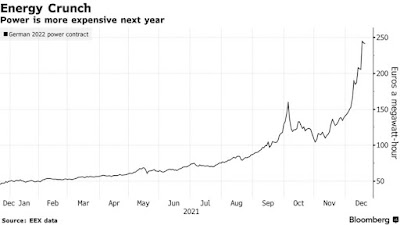
Atomic plants are designed to generate power around the clock, providing valuable backup when the wind doesn’t blow or the sun doesn’t shine. While the shutdowns have been known about for years and are unlikely to cause a spike in prices, the removal of 4 gigawatts of baseload output highlights a dwindling reserve of buffer capacity in Germany. It’s one reason why prices are higher next year: electricity for delivery in 2022 has jumped more than fivefold this year.

This is one hell of a graph.

It is helpful to note that the whole project to get Germany hooked on Russian gas - in its final form as Nord Stream 2 - was led by the previous SPD Chancellor of Germany and this friend the former East German Stasi spy. If you don't know that, look it up.

Germany intends to take all coal-fired generation offline by 2038, with the lignite power-plant fleet reduced almost 16% by 2024. By that year, high carbon prices and an expansion of renewable power will have cut Germany’s coal production “strongly,” according to the International Energy Agency.

"Renewables." Anyone who has been to Germany knows they will never be a solar powerhouse and wind is iffy. Without nuclear & coal to fill in on quiet, cloudy days - absent a technological breakthrough unknown today - the only option is natural gas.

Russian gas.

Almost by design? Anyone familiar with the Cold War history of the Greens and large segments of the SDP can connect the dots from there. 

Feel good fools ... but the gods of the copybook headings will work their magic when Germany can no longer get by on the excess capital accrued by prior, more responsible German leadership.

There is still time for the German people to do something else, but elections have consequences - and they just voted for this.

They are going to get it good and hard. 

Bundle up my German friends ... and save your Euros.

Tuesday, October 03, 2017

The Great Green Vanity Project

When does a personal vanity project become policy? Simple, when you have the power to do so and the top-cover to let you have your way.

That is all you really need to know about how SECNAV Mabus got his farcical “Great Green Fleet” – a topic we’ve covered here over the years.

In the September issue of USNI’s Proceedings, Marc Cancian brings the whole sordid mess back in to view, stake and hammer in hand,
In 2011, then-Secretary of the Navy Ray Mabus announced an initiative called the Great Green Fleet. Although wrapped in the mantle of warfighting, it was never really about the Navy. Instead, it was about pursuing a national energy agenda and using military money to create a biofuel industry. The Great Green Fleet became part of a broader set of initiatives designed to put the Navy on the front lines of the fight against climate change.
...and why not. It is only money;
The Great Green Fleet was the most egregious element of the former secretary’s energy initiatives. Biofuels—making fuel from biological matter rather than pumping it from the ground—were thought to be more environmentally friendly and a way to reduce dependence on foreign oil. The administration committed to a half-billion-dollar initiative to jump-start the industry, of which the Navy was responsible for $150 million.
How much depot level maintenance in WESTPAC would that have supported? Well, not as much press time and infinitely less virtue to signal - but priorities, Shipmate;
Although wrapped in the mantle of warfighting, it was never really about the Navy. Instead, it was about pursuing a national energy agenda and using military money to create a biofuel industry. The Great Green Fleet became part of a broader set of initiatives designed to put the Navy on the front lines of the fight against climate change. Although superficially plausible at the time when fuel prices were high, the Green Fleet is inappropriate, even counterproductive, at a time of booming U.S. energy production and Navy budget shortfalls. It is time to take a critical look at these energy initiatives, terminate those that do not directly help the Navy, subject others to cost-benefit analysis, but also look broadly at places where additional energy investments might help the Navy.
...
Creating new fuel sources was never necessary, but it is ludicrous now. Fracking and other technologies have skyrocketed U.S. production of oil and natural gas. The U.S. Energy Information Agency expects the United States to produce more crude oil in 2018 (9.9 million barrels per day) than it ever has in its history. The United States is now the largest hydrocarbon producer in the world, surpassing Russia and Saudi Arabia, having increased its production by 50 percent in the last decade. Global oil prices have plummeted, from $140 per barrel to about $50 per barrel.
Make sure to read it all, and I like his recommendations at the end; Terminate, Review, Continue, Examine, & Drop.

Monday, July 18, 2016

SECNAV, When You've Lost ViceNews ....

This sad little vanity project is well known to the folks here on the Front Porch, but it appears that the smell could not be contained.

As reported by Justin Rohrlich at Vice;
In an October 2009 speech at the Naval Energy Forum, Secretary of the Navy Ray Mabus, who had taken over the post six months before, unveiled five energy targets he wanted the Navy to hit over the course of the following decade.

"Energy reform is a strategic imperative," he said.

One of the targets involved the deployment, by 2016, of what he called the Great Green Fleet, a carrier strike group "composed of nuclear ships, surface combatants equipped with hybrid electric alternative power systems running biofuel, and aircraft flying only [on] biofuels."

Three years later, following a vicious battle with Republican legislators over the initiative, a 50/50 blend of chicken fat and conventional petroleum successfully powered two destroyers and a cruiser for two days during a month-long warfare exercise in Hawaii. The feat required 450,000 gallons of biofuel at a cost of $12 million;
We should all give credit to Rep. Duncan Hunter The Younger (R-CA) for his clarity on this topic;
For 2016, the Navy has purchased just under 80 million gallons of the 10/90 biofuel blend, about 6 percent of the 1.3 billion gallons of fuel the Navy uses annually. The Navy paid $2.05 per gallon, which is roughly in line with the cost of regular marine diesel thanks to robust biofuel subsidies from the US government, though that hasn't satisfied the program's detractors.

"There's more important shit to spend money on in the military, period," says US Representative Duncan Hunter, a Marine Corps veteran and Republican congressman from San Diego, principal homeport of the Navy's Pacific Fleet.

He describes the decision-makers behind the Great Green Fleet as "all the smartest guys that went to the John F. Kennedy School of Smart People," and calls their interest in biofuels "just stupid."
This adds no value to our Navy and actually is counter-productive;
A recent analysis by Transport & Environment, a European conservation group, found that biodiesel made from palm oil leads to three times the overall CO2 emissions of regular petroleum-based diesel. Therefore the biofuel the Navy took on in the Mediterranean earlier this year arguably enlarged its carbon footprint.

"The Department of Energy is investing a lot of money into algae-based fuels, which are promising, but often the greenest fuels are also the most expensive ones," says Emily Cassidy, a research analyst at the Washington, DC-based Environmental Working Group.

The Navy has paid as much as $424 a gallon for algae-based biofuel in the past…

Biofuels need to be created from something, and according to a report released last year by the nonpartisan World Resources Institute, a Washington, DC-based research group, meeting 20 percent of global energy demand using plant-based biofuels by 2050 "would require humanity to at least double the world's annual harvest of plant material in all its forms.... Therefore, the quest for bioenergy at a meaningful scale is both unrealistic and unsustainable."
In the end, this isn’t just a wasteful vanity project by the SECNAV, but embarrassing for all the good people whose professional lives are impacted by supporting it.
Somerville says that "the Navy is essentially doing, well, I don't really know what they're doing. I suppose they're making a statement that they want renewables."

Hunter's take is that a "green [Navy] sounds great to a large part of the population that votes a specific way."

And Heinberg says it's due to nothing short of an existential crisis.

"[Navy officials] see the future of oil as bleak, and without oil, how do they stay in business? There is no real answer," he says. "They've got to grasp at some straw or another, and this is the one that's nearest.... But just because people need something doesn't mean it exists."
What a boondoggle.

Wednesday, October 15, 2014

OK Naval Futurists, Wargame This

Yes, yes, yes ... this technology has been touted as "just around the corner" since Disney's Tomorrowland was considered a plausible view of the future, but ... from weapons that require a lot of electrical power, to power itself, to a further diversification of the world's energy options ... ponder.
Lockheed Martin Corp. said on Wednesday it had made a technological breakthrough in developing a power source based on nuclear fusion, and the first reactors, small enough to fit on the back of a truck, could be ready in a decade.

Tom McGuire, who heads the project, said he and a small team had been working on fusion energy at Lockheed's secretive Skunk Works for about four years but were now going public to find potential partners in industry and government for their work.

Initial work demonstrated the feasibility of building a 100-megawatt reactor measuring 7 feet by 10 feet, which could fit on the back of a large truck and is about 10 times smaller than current reactors, McGuire said.
You read that size correctly. Scalability? Safety? We'll see.
Compact nuclear fusion would also produce far less waste than coal-powered plants, and future reactors could eliminate radioactive waste completely, the company said.

McGuire said the company had several patents pending for the work and was looking for partners in academia, industry, and among government laboratories to advance the work.

Lockheed said it had shown it could complete a design and build and test it in as little as a year, which should produce an operational reactor in 10 years, McGuire said. A small reactor could power a US Navy warship and eliminate the need for other fuel sources that pose logistical challenges.

US submarines and aircraft carriers run on nuclear power, but they have large fission reactors on board that have to be replaced on a regular cycle.

"What makes our project really interesting and feasible is that timeline as a potential solution," McGuire said.

Monday, October 06, 2014

General Winter Waits at his Line of Departure

For those who had so much hope in the progress made over the summer in Ukraine, as fall shows up, the situation has not continued to move in our direction.

When the pro-Russian amateurs were getting their a55 handed to them, the Russians stepped up their game as this was no time for defeat. You have to give them credit; this slow roll hybrid war is working for them.

Notsomuch a blitzkrieg, but a kreepkrieg.

Just look at the map on the right; the professionals are taking over and getting results.

The pro-Russian forces have solidified their lines to a more defensible and logistically efficient arrangement. They have expanded their areas of control and access to a variety of supply lines. For the Ukrainians, mostly alone in this struggle, they are facing a very rough next nine months.

Why nine months? Simple; winter is coming. Winter does not play games in Ukraine and Russia.

Normally, one thinks of the impact of the cold on armies. The last to feel its fury was the Germans - a good account can be found here and here

That would be a good topic for discussion if this were a conventional conflict, but this isn't. No, this is something else.

Once Winter comes and the cold hits - we will see how accurate the Russian Center of Gravity analysis has been. The Ukrainian Strategic Center of Gravity (COG) is the support of the Ukrainian people for their government. A government's primary role is to support the people. Hunger and cold are very real and personal. If those in areas under pro-Russian control are warm and fed, while free-Ukraine is cold and hungry - spring could have a very different look.

One would think that the West - especially NATO nations - would see this and would do all they can to not weaken the Ukrainian COG. One would think;
Hungary has "indefinitely" cut off its supply of natural gas to Ukraine, a move that Kiev's state gas firm has described as "unexpected and unexplained."

Russia's ITAR-TASS news agency cites Hungary's gas operator, FGSZ Ltd., saying that the pipeline cutoff "was made to meet the growing domestic demand."

However, The Financial Times notes that the gas was shut off "days after the head of Russia's Gazprom monopoly visited Budapest." FGSZ's move comes three days after Gazprom CEO Alexey Miller met Hungarian Prime Minister Viktor Orban in Budapest.
...
Natural gas from Hungary, Poland and Slovakia has become crucial to Kiev since Gazprom suspended gas supplies to Ukraine in June, months after Moscow's annexation of the Crimea, due to a payment dispute, officials said. The supply disruption is of particular concern because of Ukraine's cold winters and its heavy reliance on natural gas for central heating in homes and buildings.

The FT says: "Poland and Slovakia have reported reductions in their supplies from Russia in recent weeks, apparently aimed at limiting their ability to re-export to Ukraine."
Why? Follow the money.
Far-right parties are set to do well in next month’s elections to the European Parliament, a fact that has thrown a spotlight on their links with the Kremlin.

A recent study by the Budapest-based Political Capital Institute documents the support that far-right parties in the EU have given to Russian President Vladimir Putin, particularly throughout the Ukraine crisis.

These parties repeated the Kremlin’s line that it is the EU and the West, rather than Russia, which are provoking tension and fuelling violence in the Eastern European country.
...
Hungary’s Jobbik earlier this month (6 April) won over 20 percent in national elections making it the far-right party with the highest rate of popular support in Europe.

While some right-wing parties in Western Europe – such as France's National Front – refuse to build alliances with Jobbik, they are welcome guests in Moscow.

There have been rumours about Jobbik's financial ties with Russia in Hungary for years, but nothing has been proven. However, Jobbik politicians openly support the Kremlin, and believe that opening to the east and Russia is essential.

In an interview with The Voice of Russia in 2013, Jobbik leader Gabor Vona said: "I consider Russia as a country of key importance. Besides Turkey, I believe Russia is the other Eurasian power that could spearhead a real political, economic and cultural resistance against the Euro-Atlantic bloc.”
Which NATO nations are most susceptible to Russian money? Just look at the Corruption Perception Index. You invest money to get returns. Dividends are coming due.

This is not news to Ukrainians who are trying to diversify their supplies of natural gas, but decades of Russian work is hard to fix quickly as General Winter starts to come in to view.
The Kremlin does not supply gas. It uses it as an opportunity to apply pressure on the recipient countries, to influence their foreign policy, and to determine their possible response to certain events. Given that gas, unlike oil, represents a small part of Russia’s budget revenues, Putin can experiment with the supply of gas as much as he wants — until he achieves the desired result. And we know all this very well from the Ukrainian experience.

Russian gas means corruption, underdevelopment, poverty, war, and death. The sooner we get rid of its supply, the fewer opportunities there will be for the bony, aged hand of the Kremlin ruler to squeeze Ukraine’s throat.
As fall comes, watch the weather. Watch the reports of access to and price of natural gas to free-Ukraine. Watch who in NATO helps, and who demurs.

Oh, and watch the money. Always watch the money.

Saturday, May 10, 2014

Maybe SECNAV Speaks German?

A couple of things:
1. This is the German version of TheDailyShow.
2. Germans still don't get humor that well, but they're trying.


Hat tip HotAir.

Thursday, March 27, 2014

Lithuania Wakes Up & Realizes She is Sleeping Next to a Bear, Takes Prudent Action

Estonia is already there; the President of Lithuania has decided it was time to wake up from the post-Soviet haze.

Read all of President H.E. Dalia Grybauskaitė;
First, we have to stand in unity and to work together in order to respond to new challenges.

It is necessary to renew without any delay the national agreement between all political parties on foreign and security policies, and also on adequate finances for defence. We have advanced to reach the two percent defence spending target in the next five years without hurting other economic areas and social groups 
....the symbol of our energy independence - a special vessel for the LNG terminal - will arrive to Lithuania this coming autumn after overcoming hostile storms and turbulences created by commissions and instigated by others.

This geopolitical project of cooperation between Lithuania, Norway and South Korea, the first in the Baltic region, is the result of historic changes in our energy system.

It is a crowning achievement by the efforts of the whole of Lithuania, making Russian gas - which poses an existential threat - simply needless for Lithuania.

In the course of only several years, Lithuania has managed to develop alternatives to both gas and electricity supplies. Next year, in 2015, a power bridge to Sweden will be built, linking Lithuania to Western Europe through electricity networks.
...
She gets it. Well done Madam President. Latvia, your play.

Tuesday, May 07, 2013

Gaggley Green Gobbledegook

The blessings of technology and geography have us heading in the direction of more oil production than Saudi Arabia inside of 7 years.

Our defense budget groans under the stress of recapitalizing after a decade of war, cuts & sequestration ... and yet - there is always time for vanity projects, it seems.

Solar instead of batteries, good idea ... but ....
The Pentagon increasingly sees this energy dependence as a military weakness and is trying to reduce it. The Navy is attempting to transition to biofuels for its ships and planes, and the Army and Marine Corps are exploring a host of initiatives, including using solar energy to power radio batteries.

"Every time some yahoo says 'I'm going to close the Strait of Hormuz' (the price of) oil spikes," Navy Secretary Ray Mabus told USA TODAY in an interview.

In the past, Iran has threatened to close the Strait of Hormuz, through which 20% of the world's oil supply travels.

"Right now, we buy our oil from foreign sources, and some of those sources don't have our best interest at heart," Mabus said.
OK, let's check a few facts, shall we?
The United States relied on net imports (imports minus exports) for about 45% of the petroleum (crude oil and petroleum products) that we consumed in 2011. Just over half of these imports came from the Western Hemisphere. Our dependence on foreign petroleum has declined since peaking in 2005.
Join us in 2013 people! The economy blows, but otherwise the water is warm ... or changing ... whatever.
The United States isn’t quite as reliant on foreign oil as it used to be.

Imports of crude oil and other petroleum products are on pace to drop to 6 million barrels per day by 2014, according to new forecasts by the Energy Information Administration. That’s the lowest level since 1987. It’s also just half as much liquid fuel as the country was importing back in 2005, at 12.5 million barrels per day.

So what’s responsible for the drop? For starters, the United States is producing more of its own crude. New drilling techniques such as hydraulic fracturing for shale have helped companies access “tight oil” in places like North Dakota and Texas.

And the less-noticed flip side is that Americans are using less oil. Consumption of liquid fuels plummeted during the recession, and it isn’t expected to rebound anytime soon. The EIA projects that Americans will be driving slightly more over the next few years as the economy recovers, but that will be offset by more-efficient vehicles and the retirement of older cars and trucks:
...
Combine those two trends together, and U.S. imports are falling rapidly. By 2014, the EIA expects the country to import just 32 percent of its oil, down from 60 percent in 2005.
So, let's review.

We buy SOME of our oil from other nations, and the percentage is dropping. As of right now, half of that oil comes from countries in the Western Hemisphere. As far as I know, Canada and Mexico generally have our interests at heart, and Venezuela is a basket case.

Look to the right shipmates - which nations is the SECNAV referring to that don't have our best interests at heart?

Let's assume that the Western Hemisphere generally is "feh" to "meh" about the USA at the worst (post-Hugo Venezuela I'm talking to you).

Ditto for African sources of oil. They actually mostly like us.

That leaves the Persian Gulf. 12.9%. Who in the SECNAV's office wants to call the Saudi embassy and tell them that the SECNAV does not think that The Kingdom does not have the best interest at heart? 
Hey, I think honest people can debate that point ... but let's play Mr. Mumble Grumpypants and say they don't. That is 8.1%.  Kuwait? Bahrain? Qatar? UAE? I'm stretching here ... but no, they're mostly fine.

What if we just got rid of Persian Gulf oil at 12.9%.  And the economist in me says;
"Anybody who follows the oil industry will tell you that it doesn't make any difference where the oil comes from," says Keith Crane, an energy expert at RAND Corp.

Global oil markets are so intertwined, Crane says, that changes in any one part of the system can trigger effects elsewhere.

He points out that the U.S. has imposed sanctions on Iran and therefore does not import its oil. But "if Iranian oil goes off the [world] market, it still affects the price in the United States," Crane says.

Meanwhile, Iran has had no real problem selling its oil to Asian countries, though tougher sanctions are set to go into place this summer.

Now that the U.S. involvement in Iraq has wound down, Crane says, oil seems to be less of an American security concern.

"Do you need military might to preserve access to oil? I don't think there's a lot of evidence to say that's really important," he says.
OK. Another opinion, perhaps?
People have tended to exaggerate how much oil we imported from the Middle East. In the long term, it may look like a historical anomaly that the U.S. became so involved in the Persian Gulf.
- John Duffield, energy expert at Georgia State University
OK; get your political Vince Lombardi playing cards out.  Ace of Spades; "Who benefits?"

Let's review the project;
A centerpiece of Mabus' initiative was the Great Green Fleet, a demonstration last year of the Navy's ability to operate its ships and aircraft on biofuels.

During the demonstration, the Navy powered a carrier strike group, which consists of escort ships and aircraft, with 50% biofuels over a two-day exercise. The biofuels were made from a number of sources, including used cooking oil and algae.

The Green Fleet name is a reference to President Theodore Roosevelt's Great White Fleet, a battle group that circled the globe in a demonstration of American seapower in the early part of last century.

Critics saw the Great Green Fleet as a demonstration of wasted taxpayer money. Sen. James Inhofe, R-Okla., has pointed out that the Navy spent $12 million for biofuels at $27 a gallon for the demonstration.

The Navy acknowledges it has paid a premium for biofuels, but insists it is for experimental and test purposes only until the price becomes competitive with conventional fuel.

The Navy's use of the Defense Production Act, designed to allow the military to support industries considered critical to national security, to invest in biofuel refineries has drawn criticism.

"The Navy wants to spend hundreds of millions of dollars in companies to create the market," Forbes says.

Mabus sees the investment in biofuels as a hedge against the vagaries of the world oil markets.

U.S. military aircraft and ships patrolling the Persian Gulf or in the far reaches of the Pacific are forced to purchase much of their fuel from foreign suppliers, where they are hostage to price fluctuations and vulnerable to supply disruptions by rogue states.

Mabus said the Navy has faced skeptics before.

"The Navy has always been on the forefront of changing energy use," Mabus says. He said there were skeptics when the Navy moved from wind to steam.

"Every single time, those naysayers were absolutely wrong," Mabus says. "If price had been the only consideration, we'd still be using sails."
I am all about experimentation, but this vanity project should stop there. The Navy should not be in the industrial energy policy business. The economics is wrong, the geo-political basis is wrong, the justifications are wrong ... and the spin simply cannot stand up to the follow-on question.

The last part of the pull quote is just insulting. The Navy went from sail to steam just as industry did. Ditto from coal to oil. When you look at the driver of sail to coal to oil, what was the big driver? Simple; energy density and economics of moving something further cheaper.

Biofuels - as the MPG on my FlexFuel truck tells me - is not as energy efficient as traditional oil. So, actually, the SECNAVs argument works against him. Not only are biofuels less efficient than normal fuels - they cost more. Pay more - get less.  That is 180deg policy lock-off if I have ever seen it.

I'm sorry - of all the things to expend political capital on - this is not it. 

Meanwhile ... 8-month deployments are being called the norm SECNAV. Please pivot.

UPDATE: The folks at CIMSEC are engaged in a little parallel play. Worth a read.

Wednesday, April 10, 2013

The Slow Defeat of the Green Fleet?

Remember the heady days when Salamander and SECNAV Mabus skipped hand in hand through the verdant fields? From when I first found out his present job, to his speech ... and the fact that there are good odds we're related ... it was nice while it lasted.

Alas, then things went pear-shaped. Ship naming was one issue - but I think he really didn't like when I turned on him first with the swap at the whole "Green Fleet" boondoggle. Sad, I saw and still do see a generally nice and effective man - though one who IMAO is misallocating his intellectual and political capital.

He can't like some of the latest news. Are people intentionally blowing off the SECNAV's signature issue - a brave thing to do - or do the smart people see something going on in the background? Has SECNAV sent out messages ... or does the message speak for itself?

Germany is coming to terms with the fact that you can go broke wearing too much green - and we may have a little of that acknowledgement in the background - the Navy might be reaching an understanding as well.
The U.S. Navy’s high-profile program to draw half of its energy from alternative fuels by 2020 didn’t receive much attention during the opening day of the annual Sea-Air-Space conference.

The effort, dubbed the Great Green Fleet and championed by Navy Secretary Ray Mabus, didn’t headline any of the panels. The topic of energy instead came up during an afternoon session that mostly centered on the Marine Corps’ small-scale use of portable solar panels in Afghanistan and during training exercises at stateside posts.
Solar=good. Gold plated fuel by the metric ton? Notsomuch.

If you are interested in digging a little deeper and are still feeling Kermit like - our friend Captain Ike Kiefer, USN has a nice primer.
Some prominent arguments appear almost daily in the media that biofuels will increase our domestic supply of transportation fuel, end our dependence on foreign oil, reduce military vulnerabilities on the battlefield, and generally improve national security. Biofuels are further touted to reduce fuel price volatility, polluting emissions, and green - house gases (GHG) and even stimulate the economy. These arguments all fall apart under scrutiny. The promise and curse of biofuels is that they are limited by the energy that living organisms harvest from the sun and suffer a fatal “catch-22”: uncultivated biofuel yields are far too small, diffuse, and infrequent to displace any meaningful fraction of US primary energy needs, and boosting yields through cultivation consumes more energy than it adds to the biomass. Furthermore, the harvested biomass requires large amounts of additional energy to convert it into the compact, energy-rich, liquid hydrocarbon form required for compatibility with the nation’s fuel infrastructure, transportation sector, and especially the military. The energy content of the final-product biofuel compared to the energy required to produce it proves to be a very poor investment, especially compared to other alternatives. In many cases, there is net loss of energy. When energy balance (energy output minus energy input) across the full fuel creation and combustion lifecycle is considered, cultivated liquid biofuels are revealed to be a modern-day attempt at perpetual motion that is doomed by the laws of thermodynamics and a fatal dependence on fossil fuel energy.
That got a rather lame response from DOD by Adam L. Rosenberg, Ph.D., Deputy Director for Technology Strategy - who has left to become a staffer on the Energy Subcommittee of the House Science, Space, Technology Committee. Follow the money ....

Well ... it makes sense. When the taxpayers are having their Blue Angels held back as DON has a major pout-fest because the peasants are not giving up their seed corn - paying exorbitant amounts per gallon for a quasi-socialist industrial policy on the back of the military budget just does not pass muster.

I think the tide must be turning. I really feel sorry for anyone who missed the turn, and sold a lot of personal capital by writing an obsequious suck-up "Mister, mister, look at me" article.  All that ... and you're left in the wake after corpen. Yea ... that would be sad to see.

Saturday, August 06, 2011

Energy security on Midrats

There is a common thread that helps explain why we went to war 2.5 times in Iraq, but zero in Burma. Why NATO is off Libya, but not Syria.

Where American Indians tribes fought over the best hunting grounds and nations slaughtered each other for access to the sea - so today our forces and policy revolve around access to affordable sources of energy.

The more a nation relies on foreign sources, the more it will find itself in foreign entanglements - not to mention the economic problems of sending your dollars abroad in such huge numbers/

New technology is giving our nation another path towards more energy independence in a way that may lead to a reassessment of our national security requirements.

Join us this Sunday, July 7th from 5-6pm EST as EagleOne and I discuss the topic for the full hour with Amy Myers Jaffe, the Wallace S. Wilson Fellow in Energy Studies, director of the Energy Forum at the Baker Institute, author, and associate director of the Rice Energy Program at Rice University.

Ms. Jaffe is one of the authors of the paper, sponsored by the U.S. Department of Energy, from the James A. Baker III Institute for Public Policy at Rice University, “SHALE GAS AND U.S. NATIONAL SECURITY” and has studied this area extensively.

Join us live if you can and join in with the usual suspects in the chat room where you can contribute your thoughts and observation - and suggest to us questions for our guests.

If you miss the show you can always listen to the archive at blogtalkradio - but the best way to get the show and download the archive to your audio player is to get a free account and subscribe to the podcast on iTunes.

Saturday, May 09, 2009

Drill CINC Drill

Give credit where credit is due. BZ to the CINC, via IBD.
President Obama is quietly keeping his options open on offshore oil projects. He told Democratic lawmakers last week that his administration may consider more drilling in the Outer Continental Shelf.

The May 5 meeting with members of the House Energy and Commerce Committee had been called to discuss climate change legislation.

But Rep. Frank Pallone, D-N.J., asked if the White House was going to reinstate the moratorium on drilling that lapsed last year, according to lawmakers there. Obama replied that he would not, because the country might need to develop those resources. “The president was fairly pointed in saying we need to have domestic production,” said Rep. Gene Green, D-Texas,who backs such drilling.

According to Green, Obama said: “We are not going to drill everywhere off the shore of every state, but, if there is reason to get there, we think we can produce it (in an) environmentally safe (manner) in our own country.”
Watch for follow through, but a good report.

Monday, March 23, 2009

Good, can we build some now?

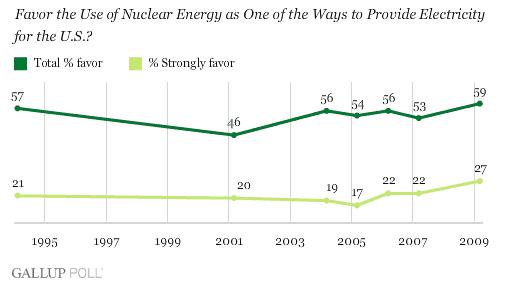
A majority of Americans have been supportive of the use of nuclear energy in the United States in recent years, but this year's Gallup Environment Poll finds new high levels of support, with 59% favoring its use, including 27% who strongly favor it.


Wednesday, January 07, 2009

Скорпион и лягушка

The bear can't help himself - it is his nature.
Ukrainian officials said Wednesday that Russia had cut off all gas supplies through pipelines crossing Ukrainian territory, the latest move in a devastating pricing dispute between the two neighbors that has already left a number of countries without gas.

Valentyn Zemlyansky, spokesman for state gas company Naftogaz, said Russia's gas giant Gazprom completely stopped sending gas to European consumers at 7:44 a.m. (0544 GMT). Eighty percent of Russian gas is shipped via Ukraine.

"Words fail us," Zemlyansky said of Gazprom's move.

Russia confirmed the cutoff but said it was Ukraine's fault because it had shut down the last pipeline carrying gas from Russia.

The Russia-Ukraine natural gas dispute has hit Europe with the force of a winter storm. It has affected at least a dozen nations. Tens of thousands of people were left without heat and governments scrambled to find alternative energy sources.

Before Wednesday, Bulgaria, Greece, Macedonia, Romania, Croatia, Serbia and Turkey had all reported a halt in gas shipments, while France, Germany, Austria, Poland and Hungary had reported substantial drops in supplies from Russia.
Why energy independence and diversity in energy sources are strategic imperatives.

Tuesday, December 30, 2008

The Krauthammer option; now more than ever‏

Time to make you fine, loyal, and wise readers mad at me again.

I never ask that you need to agree with me; just ponder some of what I am pondering.
Americans have a deep and understandable aversion to gasoline taxes. In a culture more single-mindedly devoted to individual freedom than any other, tampering with access to the open road is met with visceral opposition. That's why earnest efforts to alter American driving habits take the form of regulation of the auto companies--the better to hide the hand of government and protect politicians from the inevitable popular backlash.

But it's not just love of the car. America is a nation of continental expanses. Distances between population centers can be vast. The mass-transit mini-car culture of Europe just doesn't work in big sky country.

This combination of geography and romance is the principal reason gas taxes are so astonishingly low in America. The federal tax is 18.4 cents per gallon. In Britain, as in much of Europe, the tax approaches $4 per gallon--more than 20 times the federal levy here.

...the virtues of a gas tax remain what they have always been. A tax that suppresses U.S. gas consumption can have a major effect on reducing world oil prices. And the benefits of low world oil prices are obvious: They put tremendous pressure on OPEC, as evidenced by its disarray during the current collapse; they deal serious economic damage to energy-exporting geopolitical adversaries such as Russia, Venezuela, and Iran; and they reduce the enormous U.S. imbalance of oil trade which last year alone diverted a quarter of $1 trillion abroad. Furthermore, a reduction in U.S. demand alters the balance of power between producer and consumer, making us less dependent on oil exporters. It begins weaning us off foreign oil, and, if combined with nuclear power and renewed U.S. oil and gas drilling, puts us on the road to energy independence.
...
Today we are experiencing a unique moment. Oil prices are in a historic free fall from a peak of $147 a barrel to $39 today. In July, U.S. gasoline was selling for $4.11 a gallon. It now sells for $1.65. With $4 gas still fresh in our memories, the psychological impact of a tax that boosts the pump price to near $3 would be far less than at any point in decades. Indeed, an immediate $1 tax would still leave the price more than one-third below its July peak.

What to do? Something radically new. A net-zero gas tax. Not a freestanding gas tax but a swap that couples the tax with an equal payroll tax reduction. A two-part solution that yields the government no net increase in revenue and, more importantly--that is why this proposal is different from others--immediately renders the average gasoline consumer financially whole.

Here is how it works. The simultaneous enactment of two measures: A $1 increase in the federal gasoline tax--together with an immediate $14 a week reduction of the FICA tax. Indeed, that reduction in payroll tax should go into effect the preceding week, so that the upside of the swap (the cash from the payroll tax rebate) is in hand even before the downside (the tax) kicks in.

The math is simple. The average American buys roughly 14 gallons of gasoline a week. The $1 gas tax takes $14 out of his pocket. The reduction in payroll tax puts it right back. The average driver comes out even, and the government makes nothing on the transaction. (There are, of course, more drivers than workers--203 million vs. 163 million. The 10 million unemployed would receive the extra $14 in their unemployment insurance checks. And the elderly who drive--there are 30 million licensed drivers over 65--would receive it with their Social Security payments.)

Revenue neutrality is essential. No money is taken out of the economy. Washington doesn't get fatter. Nor does it get leaner. It is simply a transfer agent moving money from one activity (gasoline purchasing) to another (employment) with zero net revenue for the government.
.... and we need to cut diesel tax by a half to help bring our auto diesel usage in line with Europe's ~30-50%. Diesel gets ~25-30% better mileage and is easily mixed with biodiesel where it makes sense, etc. We aren't talking about a 1978 GM diesel either. Modern diesels are outstanding engines. Next time you are in Europe, rent a VW turbo diesel and you will know what I am talking about.

Less money in the pockets of the Saudis and Hugo - and will take a huge chunk out of our crippling trade deficit etc, etc, etc.

Win, win, and win.

Tuesday, September 23, 2008

PA tip to McPalin?

The top 4 coal producing states are WY, WV, KY, and PA.

RealClearPolitics has those states ~ KY McPalin +15, WV, McPalin +8, WY McPalin +19.

Here is the kicker - PA Obama +2.5.


2.5 is within the margin of error - how does this help team Obama?


GaffTastic!

On a serious note two things:
  1. His body language would have him in the CMEO office toot-sweet.
  2. Why do we want to cripple our energy sector because China is the global Pig-Pen? Isn't Pig-Pen's hair kind of like Biden's?

Hat tip HotAir.

Wednesday, September 10, 2008

Want a 65mpg Ford?


Simple --- get the politicians to kill our bassakwards tax policy. That is most of it -- stupid tax laws -- and archaic emissions laws.
If ever there was a car made for the times, this would seem to be it: a sporty subcompact that seats five, offers a navigation system, and gets a whopping 65 miles to the gallon. Oh yes, and the car is made by Ford Motor (F), known widely for lumbering gas hogs.

Ford's 2009 Fiesta ECOnetic goes on sale in November. But here's the catch: Despite the car's potential to transform Ford's image and help it compete with Toyota Motor (TM) and Honda Motor (HMC) in its home market, the company will sell the little fuel sipper only in Europe. "We know it's an awesome vehicle," says Ford America President Mark Fields. "But there are business reasons why we can't sell it in the U.S." The main one: The Fiesta ECOnetic runs on diesel.

Automakers such as Volkswagen (VLKAY) and Mercedes-Benz (DAI) have predicted for years that a technology called "clean diesel" would overcome many Americans' antipathy to a fuel still often thought of as the smelly stuff that powers tractor trailers. Diesel vehicles now hitting the market with pollution-fighting technology are as clean or cleaner than gasoline and at least 30% more fuel-efficient.

Yet while half of all cars sold in Europe last year ran on diesel, the U.S. market remains relatively unfriendly to the fuel. Taxes aimed at commercial trucks mean diesel costs anywhere from 40 cents to $1 more per gallon than gasoline.
Advice to Team McCain: you can get votes with this. Attack the do nothing Democrat Congress .... attack them hard.

Imagine if we were on par with Europe with 50% of our cars getting 30% more MPG. Less money to Hugo, the Saudis, Iran, etc. More money to an American car company. Think.

Tuesday, September 02, 2008

Palin on ANWR's Caribou

I think this picture about says it. Bring'n a little sanity to the discussion. Perfect.

Tuesday, July 15, 2008

Angry at the price of gas?


Upset that so much of that money you are throwing down the road is being picked up by Saudi Arabia, Venezuela, and other like nations? Understand the impact oil importation has on our balance of trade deficit?

Wonder why no one is doing anything about this?
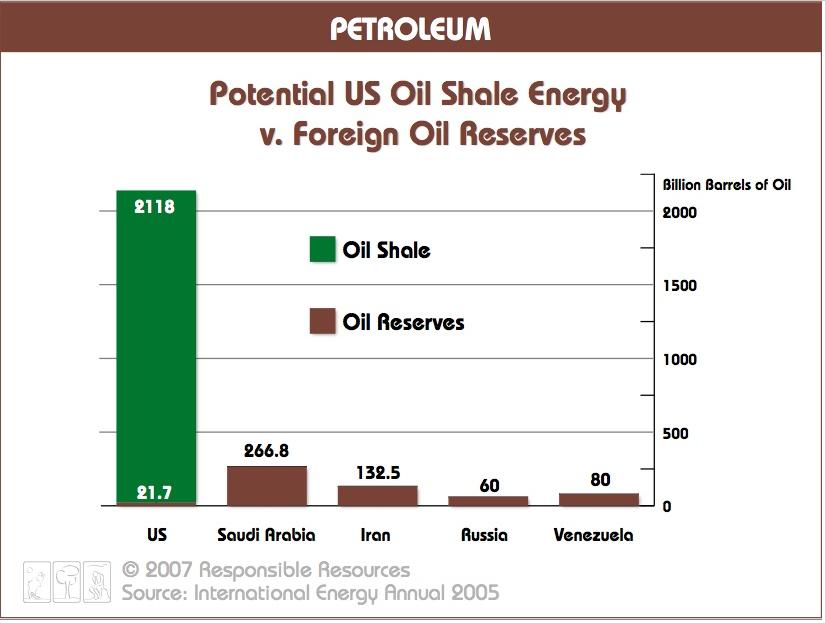
One massive potential American energy resources is known as oil shale. In fact, no other nation in the world is as rich in oil shale as the U.S. The largest deposits of American oil shale are located in Colorado, Utah, New Mexico and Wyoming. And though extraction poses some technical challenges, US oil shale reserves contain the energy equivalent of 2 trillion barrels of oil.

To put this figure in perspective, the world has used 1 trillion barrels of oil since the first oil well was successfully drilled in Pennsylvania in 1859. As such, the United States’ 2 trillion barrels of oil shale is a potentially huge new source of oil, and must be central to any discussion of our continental energy security. Shale and other new sources of oil, like oil sands currently being developed in Canada, offer important new North American energy supply options.
Shale oil is generally considered economically viable at $40 a bbl oil. We are, ahem, at over $140.

You ask, "What, pray tell, is stopping us?"
Repeal the Congressional prohibition precluding the production of oil shale leases on taxpayer-owned federal lands.As part of the Energy Policy Act of 2005, Congress directed the U.S. Secretary of Interior to develop a program to enable the production of America’s oil shale resources - the largest oil supply in the world – for American consumers.The United States has 2 trillion barrels of oil shale. This is more than 7 the amount of crude oil reserves found in Saudi Arabia, and is enough to meet current U.S. demand for over 250 years. According to the U.S Department of Energy (DOE):

“Once developed, U.S. oil shale resources will be similar in extent and energy potential to Alberta’s tar sand reserves. When oil shale and tar sands are considered together, the United States and Canada will be able to claim the largest oil reserves in the world.”However, in 2007, Congress adopted a rider that prohibited the Department of Interior from completing the task it was assigned in 2005. Consequently, the United States is still without a program to bring this massive resource to market for American consumers.
Who ran Congress in 2005 and who ran it is 2007? Corrupt and rudderless Republican leadership gave Congress to a band of irresponsible Leftists. Well done.

What can be done? Here are some good starting points.

Hat tip PowerLine.