Proactively “From the Sea”; an agent of change leveraging the littoral best practices for a paradigm breaking six-sigma best business case to synergize a consistent design in the global commons, rightsizing the core values supporting our mission statement via the 5-vector model through cultural diversity.

Events in the Second Russo-Ukrainian War (or whatever it is being called, this is what I call it with the 1st being in 2014), are moving fast. It seems anything you write will be OBE in a few hours, but write one must.
Case in point; going in to the weekend Germany was stuck in, "We are pausing NS2..." and we find our way to Monday where she is giving the nod for artillery, fighter jets, anti-aircraft, and anti-armor weapons to Ukraine as fast as they can get there and announcing an unprecedented increase in defense spending.
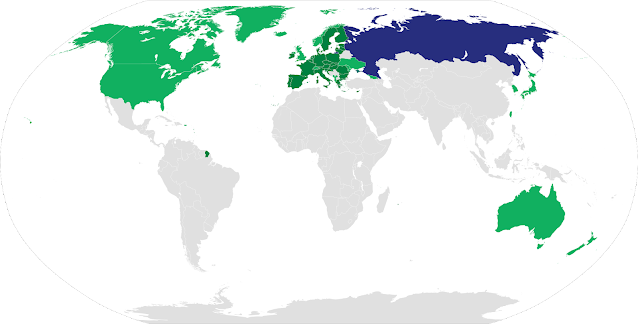
So, today let's focus on something that isn't quite as sexy as air superiority or logistics convoys, but may be the most important news of the day; financial sanctions.
Let's go back to Chris Morris at the BBC five days ago;
Notably only about 16% of Russia's foreign exchange is now actually held in dollars, down from 40% five years ago. About 13% is now held in Chinese renminbi.
All of this is designed to protect Russia as much as possible from American-led sanctions.
Over time it has reduced its reliance on foreign loans and investments, and has been actively seeking new trade opportunities away from Western markets.
China is a big part of that strategy.
The government in Moscow has also taken initial steps to create its own system of international payments, in case it gets cut off from Swift - a global financial messaging service which is overseen by the major Western central banks.
And it has been cutting the size of its budget - prioritising stability over growth.
That has meant the Russian economy has grown at an average of less than 1% a year over the past decade. But it may have become more self-reliant in the process.
...
There's no question that sanctions can have an impact, but a package as broad as this has never been imposed on an economy as large as Russia.
And to make it effective, the West would have to be in it for the long haul.
This was all theory last week, now we come to a very different reality this last day of February...and Russia gets a vote. We can't assume she won't react.
Also from the BBC, as of this AM US Eastern time;
Western nations are imposing increasingly severe sanctions on Russia following its invasion of Ukraine.
The measures are designed to cripple Russia's economy and punish its government for taking military action.
As you read the above and what is to follow, there is a word as old as war that should come to mind; blockade.
There are benchmarks about how nations can interpret blockades, and this is but one example in living memory;
A casus belli played a prominent role during the Six-Day War of 1967. The Israeli government had a short list of casūs bellorum, acts that it would consider provocations justifying armed retaliation. The most important was a blockade of the Straits of Tiran leading into Eilat, Israel's only port to the Red Sea, through which Israel received much of its oil. After several border incidents between Israel and Egypt's allies Syria and Jordan, Egypt expelled UNEF peacekeepers from the Sinai Peninsula, established a military presence at Sharm el-Sheikh, and announced a blockade of the straits, prompting Israel to cite its casus belli in opening hostilities against Egypt.
We can't forget this from the edge of living memory either;
In 1939 the United States terminated the 1911 commercial treaty with Japan. “On July 2, 1940, Roosevelt signed the Export Control Act, authorizing the President to license or prohibit the export of essential defense materials.” Under this authority, “[o]n July 31, exports of aviation motor fuels and lubricants and No. 1 heavy melting iron and steel scrap were restricted.” Next, in a move aimed at Japan, Roosevelt slapped an embargo, effective October 16, “on all exports of scrap iron and steel to destinations other than Britain and the nations of the Western Hemisphere.” Finally, on July 26, 1941, Roosevelt “froze Japanese assets in the United States, thus bringing commercial relations between the nations to an effective end. One week later Roosevelt embargoed the export of such grades of oil as still were in commercial flow to Japan.” The British and the Dutch followed suit, embargoing exports to Japan from their colonies in southeast Asia.
In today's global financial system that unlike the last world war where nations held physical assets like gold that could be loaded on cruisers as payment, much of nations' "wealth" is stuck in the cyber-world's 1s and 0s.
They are among the toughest measures nations can use, short of going to war.
As we go down this route - even with the Swiss of all people - we need to be clear-headed about how this can be seen by the Russians.
The action is aimed at cutting Russia off from the international financial system and to "harm their ability to operate globally".
A ban from Swift will delay the payments Russia gets for exports of oil and gas.
Cutting off a nation from its access to funds not just to fight but to feed, house, and employ its people - if we now consider "cyber" to be a domain like land, sea, and air - is keeping a nation from accessing resources in the cyber domain - AKA a blockade - any different than a ground, sea, or air blockade with the same goal?
Western leaders have agreed to freeze the assets of Russia's central bank, to limit its ability to access its $630bn international dollar reserves.
...
Targeting a central bank of a G20 nation is unprecedented and designed to "push the whole of Russia in to as deep a recession as possible, with the added chaos of bank runs", says BBC economics editor Faisal Islam.
...
The UK, EU, US and other countries have announced curbs on products that can be sent to Russia. These include dual-use goods, which are items that could have both a civilian and military use, like high-tech items, chemicals or lasers.
Are Russian "elite" motivated by the same things Western "elites" are? That seems to be the bet;
The EU, UK, US and Canada have launched a transatlantic task force to identify and freeze the assets of sanctioned individuals and companies, targeting more "officials and elites close to the Russian government, as well as their families".
Maybe...but maybe not. Either way, we have to expect some blowback - directly or indirectly;
Russia supplies 26% of the EU's crude oil and 38% of its gas. Even a brief cut in gas supply would raise energy prices.
...
Russia's foreign ministry has threatened sanctions of its own against the West. This may include reducing or shutting off gas supplies to Europe.
...
Hitting the Russian banking sector is likely to damage firms which do business in Russia, or have assets in its banks, and the export ban on high-tech goods will hit many Western manufacturers.
There is an important thread from Georgetown political scientist Professor Abraham Newman that you need to read in full on the topic. Here are a few consolidated pull quotes from his thread;
In a world of interdependent fiat currencies central banks have to live in a world where they depend on foreign buys and holders of their money. What does this mean and how does it relate to the sanctions regime? As the @FT explains, much of the reserves are held in securities i.e. assets that need to be sold to be used. To do that, Russian central bank needs intermediaries to conduct the transactions. Most international banks are now a no go so hard to sell. But the other problem is that the Russian Central Bank doesnt actually sit on the money it has. The money is in accounts in other central banks/international bodies. Russia has to access these ledgers to use its funds. Western sanctions black this. Aside from their gold reserves, the Russian self-insurance strategy is comprised of made up stuff which lives in a financial imaginary. Their ability to use and access is interdependent on the West. Russia, then, is confronting the reality of what @henryfarrell and I have termed Weaponized Interdependence. And the consequences for the Russian economy are going to be quite severe.
As I've stated before, I cannot think like a Russian - much less Putin - so I won't even try, but I can look at their capabilities, history, and what they could do.
Let me put on my red hat.
If I were RUS COMCYBERCOM, I would have three Courses of Action of increasing severity ready to present President Putin today to take down the entire Western financial system. It would be along the historically established, "If I can't use this, then I am damn sure going to guarantee that no one else can either." You want a cyber world war? That is how you get one. Shut down the global online financial system. What do the Russians have to lose?
I hoped some smart people have wargamed this out. Again, if we are blockading, with the EU & Switzerland, Russian access to her money that they need to not just fight, but to feed and employ the people of Russia, is it beyond reason to consider that a belligerent act - especially when we are arming and giving aid to the Ukrainians? We have invaded other nations for less.
Things are moving fast - and Putin has no off ramp outside complete victory.
Good luck everyone.

The news of the last 48-hrs about DarkSide and the pipeline held hostage is just another chapter in a long story;
The ransomware group linked to the extortion attempt that has snared fuel deliveries across the U.S. East Coast may be new, but that doesn’t mean its hackers are amateurs.
Who precisely is behind the disruptive intrusion into Colonial Pipeline hasn’t been made officially known and digital attribution can be tricky, especially early on in an investigation. A former U.S. official and two industry sources have told Reuters that the group DarkSide is among the suspects.
You should recognize this for exactly what it is; piracy. The cyber domain, a global common in a fashion, is not that different from another global common, the high seas. Human society has a template thousands of years old of this kind of crime. We also know how to solve it.
Piracy is like any other business, if there is a profit to be made, more people will try to make it.
Piracy usually starts with small victims with small costs. Governments and corporations, both often dangerously short sighted, accept it as the cost of doing business and not worth the trouble. They ignore it as it grows, but eventually it gets too big and too powerful, and hopefully that trigger point is small enough to be quickly managed. If you wait too long, the threat to commerce becomes a national security threat.
For decades, criminals, nee pirates, in the cyber domain have been holding small companies, local governments, and even individuals hostage, blackmailed, or even vandalized. The government, in the responsible law enforcement entity of FBI and DOJ, have not been engaged to the level they need to be going after this international criminal conspiracy. They have been doing other things while this threat has grown. It is so effective that the non-state and quasi-non-state actors have been joined by governments in this enterprise for fun and profit.
Enough.
Nation states cannot let piracy stand. It is best to crush them when a small threat, but when large, the need is even greater.
As I asked over on twitter;
If someone threatened to sink a container ship to block the port at Long Beach that was at anchor blocking the port right now unless a ransom was paid, would we say that was a "private sector decision" to pay the ransom or not?
— cdrsalamander (@cdrsalamander) May 11, 2021
Critical infrastructure is critical infrastructure https://t.co/hiHCeOquGT
We need to raise the Blood Flag.
Of course, in our overly civilized times, we cannot gibbet cyber criminals from the lampposts in front of DOJ or 10th Fleet HQ (however …) but there are other things we can do.
In conjunction with the CIA – as many of these threats are overseas – we need to make this business no longer profitable.
Destroy their systems. Take their property or render it useless. Seize their assets. Find the embarrassing information about their principals and make it public. Seize the individuals when possible and give them to SDNY's most dyspeptic attorneys.
What we cannot do is have our government state that this is a “private sector problem” anymore than we would tell shipping companies that piracy on the high seas is a private sector problem.
Raise the Blood Flag and get our geeks to work.
We have all seen this brief every decade or so for decades. You can almost use the same sales pitch as before, just move the clauses around.
We know what is wanted - but it is hard. Instead of saying that, we try to trick everyone in to thinking there is a new idea out there.
There isn't ... and every time "we" pretend there is, we lose more credibility.
The latest example from the, “This is Why DOD Can’t Have Nice Things” is the superbly mockable “Joint All-Domain Command and Control" (JADC2) concept. It is almost insulting in that is seems to be written by people who either themselves don’t know what has been going on in this area for the last few decades, or they assume no one else has institutional memory either. Just bask in the opening;Joint All-Domain Command and Control (JADC2) is the Department of Defense’s (DOD’s) concept to connect sensors from all of the military services—Air Force, Army, Marine Corps, Navy, and Space Force—into a single network.For those with an Electronic Warfare background and an onion-paper thin understanding of what the Chinese and Russians are capable of today – or even what they did as far ago as the Vietnam War - just behold Figure 1. If you transmit, you will be tracked, identified, and attacked. Transmit all day long, even easier. You then have the intellectual hangover from a couple decades of colonial policing;
JADC2 intends to enable commanders to make better decisions by collecting data from numerous sensors, processing the data using artificial intelligence algorithms to identify targets, then recommending the optimal weapon—both kinetic and nonkinetic (e.g., cyber or electronic weapons)—to engage the target.
Some analysts take a more skeptical approach to JADC2. They raise questions about its technical maturity and affordability, and whether it is even possible to field a network that can securely and reliably connect sensors to shooters and support command and control in a lethal, electronic warfare-rich environment. Analysts also ask who would have decision making authority across domains, given that, traditionally, command authorities are delegated in each domain rather than from an overall campaign perspective. Some also question how much a human will be needed for JADC2 to make decisions in real time, and whether it is appropriate to reduce the amount of human involvement in military-related decisions.
The Joint All-Domain Operations concept, thus, provides commanders access to information to allow for simultaneous and sequential operations using surprise and the rapid and continuous integration of capabilities across all domains—to try to gain physical and psychological advantages and influence and control over the operational environment.
DOD is leading a Joint Cross-Functional Team to explore JADC2 as the concept evolves.
The Army and Air Force have announced programs to implement JADC2; what are the Navy’s plans to implement this new command and control concept?
What role would AI have in JADC2 development?
How much human-in-the-loop is necessary if sensors are linked to shooters in real-time?
Denmark wants to be able to exclude 5G technology suppliers from providing critical infrastructure in Denmark if they are not from countries considered security allies, online technology news outlet ITWatch reported on Monday.Good.
“In order to protect Denmark and the Danes, we want to collaborate with someone with whom we already have alliances,” Minister of Defence Trine Bramsen told ITWatch.

The Army is upgrading and more widely deploying a cutting-edge battlefield force-tracking technology for dismounted Soldiers, enabling them to know the locations of their fellow Soldiers and more quickly find, identify, target and destroy enemy fighters.Think about all those electrons bleeding out in to the environment? Think about how advanced the offensive EW and EW surveillance capabilities are of our peer and near-peer competitors.
Called Nett Warrior, the technology is a cell-phone-like device showing graphics on a small, digital moving map identifying fast-moving combat information.
“It provides unprecedented situational awareness at the dismounted level through the map display. The icons show where all the other users are on the battlefield and the device allows for battlefield messaging. Everyone sees the same picture,” Marsh explained. “The battle changes in real time and information can transmit across the force in real time.”Do we not know our own history? Units get captured. Items get lost and dropped. This is an order of magnitude worse than broken codes and maps wrapped around cigars. Gobsmacking.
The technology uses a moving digital map display to mark friendly forces, surrounding terrain, enemy forces, targets and other high risk items such as IED locations, Marsh explained.
“As they sweep up into a house, they don’t have to worry about fratricide, because they can see where the other maneuvering forces are. You can track the location of friendly units as you are moving up on a target,” said Jason Regnier, deputy product manager for Nett Warrior.
Nett Warrior can even connect with nearby vehicle units who might need to know the location of mobile, ground or infantry units or wish to pass along combat-relevant information, Marsh said.
“Every Nett Warrior display is visible to every other Nett Warrior system. That is the key part. That is the game-changing revolution,” he explained.
While the Nett Warrior device looks like a cell phone or smartphone, it uses what’s called software programmable radio – a technology which sends IP packets of information, such as voice, video and data, across the force using high bandwidth radio frequencies.
The high bandwidth frequencies, such as Soldier Radio Waveform, use computer technology and function quite similar to wireless internet. The cell phone function of the system is turned off. The radio, called the Rifleman Radio or PRC-154, uses NSA encryption to safeguard combat information transmitting across the force.
The technology also uses a technique called a “chem light,” wherein a Soldier can highlight or “light up” a location to pass along key information such as the location of a cleared building or other data relevant to an ongoing fight.
The platform is now being built with what the Army calls “open architecture,” meaning its software and hardware are engineered to quickly embrace and integrate new technologies or applications as they emerge, Marsh said.At least our peer and near-peer adversaries don’t have dedicated forces that do nothing but learn to break in to open architecture devices. Good googly moogly.

It is critical to understand that cyberderived data does not sit in isolation from other developing technologies.As he touches on in his article - there is one place this give me the most pause, and it has nothing to do with state-to-state conflict.
One technology that achieved significant prominence in recent years is the use of remotely-piloted aircraft commonly known as “drones” to engage in long-term surveillance of battlefields in Iraq, Afghanistan, and elsewhere, and to attack enemy fighters wherever found.
...
the U.S. military is developing a generation of small drones capable of operating in networked groups, or “swarms.”
Other reports suggest efforts to develop lethal micro-drones that “resemble winged, multi-legged bugs” which “swarm through alleys, crawl across windowsills, and perch on power lines” as they seek their target.
Parallel to the rapid development of drone technology is the swift advance of facial recognition software.
The linkage of the two in the context of “Big Data” was virtually inevitable. In 2013 the Associated Press, in a story provocatively entitled, “Drones With Facial Recognition Technology Will End Anonymity, Everywhere,”
...
What does this “cocktail” of cyber technologies mean for warfighting? Quite simply, it appears that in the not-too-distant future, the U.S. military - and likely other militaries - will be able to launch swarms of drones equipped with facial recognition software to roam battlefields looking for very specific members of an enemy’s force. These could be officers, but also selected technicians and battle-hardened leaders who possess vital and difficult-to-replace skills.
... the biggest shortcoming ... was the inability of any of the panel members to actually define the term “Information Dominance” in any meaningful way. ... We heard what information dominance is similar to, and what the supposed goals of information dominance were, but neither was in any way a real definition. (This is not a surprise. Two years ago, the Navy had an “Information Dominance” booth on the “gizmo floor”, staffed alternately by a Captain and two Commanders. I asked each, separately, over a couple days, to give me their definition of “information dominance”. None of theirs were remotely similar, nor any more adequate than what we heard today.)You can catch the full panel at the below video.
The problem, of course, is the term itself. Information cannot be “dominated”, despite assertions to the contrary. An enemy with a very specific information requirement that he can fulfill reliably and in a timely manner can be said to have information “dominance” over our massive sensor and communications networks that commanders and staffs pore over in attempts to see through the fog of war. The dust cloud from the dirt bike as the teenager rides from Baghdadi to Hit to tell the insurgents of the Coalition convoy headed their way trumps our networked, data-driven ISR platform links that cannot help prevent the ambush that awaits us.
We have much work ahead of us to make most effective use of our incredibly robust data collection systems and information networks. The solution to the problems of analytical capacity resident in C2 nodes with which to turn raw data into useful information and intelligence will be far more human than digital. Commanders have to insist on a philosophy of “Don’t tell me everything, tell me what I need to know”. And then go about ensuring that those who collect, compile, and analyze data have a very good idea of what they need to know.
And we can start by retiring the troublesome and ill-suited term “Information Dominance”. As General van Riper is fond of saying, “Words MEAN things!”. They’re supposed to, anyway.
Speaking at last week's Defense One conference, retired Capt. Mark Hagerott cited recent reports about sonic computer viruses as one way that hackers could "jump the air gap" and target systems that are not connected to the Internet.OK.
"If you take a cybernetic view of what's happening [in the Navy], right now our approach is unplug it or don't use a thumb drive," Hagerott said. But if hackers "are able to jump the air gap, we are talking about fleets coming to a stop."
The Pentagon is so starved for bandwidth that it’s paying a Chinese satellite firm to help it communicate and share data.... and in wartime you will get all that additional bandwidth (in addition to what you are already using), from whom exactly?
U.S. troops operating on the African continent are now using the recently-launched Apstar-7 satellite to keep in touch and share information. And the $10 million, one-year deal lease — publicly unveiled late last week during an ordinarily-sleepy Capitol Hill subcommittee hearing — has put American politicians and policy-makers in bit of a bind.
...
“That bandwidth was available only on a Chinese satellite,” Deputy Assistant Secretary of Defense for Space Policy Doug Loverro told a House Armed Services Committee panel, in remarks first reported by InsideDefense.com. “We recognize that there is concerns across the community on the usage of Chinese satellites to support our warfighter. And yet, we also recognize that our warfighters need support, and sometimes we must go to the only place that we can get it from.”

F. Michael Maloof, ... cites Huawei Technologies Co. Ltd and ZTE Corporation as the companies the Chinese government and People Liberation Army can use to gain access to this information via commercial networks installed by each Chinese electronic manufacturer.
“The two companies give the Chinese remote electronic “backdoor” access through the equipment they have installed in telecommunications networks in 140 countries. The Chinese companies service 45 of the world’s 50 largest telecom operators,” Maloof writes.
With a primary source of funding for commercial satellite capacity drying up, the U.S. Department of Defense must find an alternative means to feed the tremendous appetite for bandwidth generated by unmanned aircraft, according to a U.S. Air Force official.
For the past decade or so, the Pentagon has relied heavily on Overseas Contingency Operations (OCO) accounts funded by wartime supplemental appropriations bills to pay for commercial satellite services. But the Pentagon likely will not be able meet the demand for commercial satellite bandwidth with OCO funding in the months and years ahead, said Air Force Col. Michael Lakos, the service’s military satellite communications lead.
Speaking at the Satellite 2012 conference here organized by Access Intelligence LLC, Lakos pleaded with satellite industry executives to come up with cheaper ways of providing bandwidth that is critical to a growing number of unmanned aerial vehicle (UAV) applications. “There is not a lot of money to put those into the service budgets because those are being shrunk,” he said.
...
Industry officials have maintained that the military’s demand for commercial bandwidth will not decline as its forces withdraw from Iraq and Afghanistan because the draw-downs will increase its reliance on bandwidth-hungry UAVs.
...
Today, most UAVs are equipped to transmit in the heavily used Ku-band. But commercial satellite operators are increasingly expanding into the Ka-band, and the Air Force is deploying a new fleet of Wideband Global Satcom communications satellites that operate in both Ka- and X-band frequencies.
Andy Beegan, chief technology officer for Inmarsat Government Services here, agreed that future UAVs should be designed with an ability to utilize multiple frequency bands. Inmarsat operates a fleet of L-band satellites and is planning in the coming years to deploy a Ka-band system.

Department of Navy forays into cloud computing appear to be gathering steam with the July 12 release of two requests for information, one for thin- or zero- client devices, the other for browser-based office and collaboration software.This summer, we're still moving in that direction.
The thin- or zero- client RFI specifically states that Navy Next Generation Enterprise Network, or NGEN, will transition "to a cloud-based computing delivery model," adding that "the vast majority of the DON systems and computing capabilities fielded in the future must be able to operate in a cloud computing/shipboard virtualization environment."
The thin- or zero- client RFI classifies as a zero-client device an end user computer that the installer need not configure beyond the actions of connecting a keyboard, mouse and monitor, that would require no driver updates to support peripherals, that, should updates be required, would be capable of installing them without impacting end-user operations and without the intervention of personnel.
-----------------------
The Navy has sketched out data center and cloud computing plans for a multibillion dollar, next-generation network it's building for both naval forces and the Marine Corps.
The Navy aims to reduce its non-tactical IT budget by 25% through the deployment of the Next Generation Enterprise Network (NGEN), and to do that will consolidate the more than 80 data centers it currently has and move on-premises software to the cloud, according to two separate requests for information (RFIs) posted on FedBizOpps.gov.
....
To leverage cloud computing, the Navy plans to assess all of its applications and, for its NGEN plans, will continue only to maintain, use, and procure those that can be hosted in in the cloud, according to the RFI.
The current raft of in-house applications for command and control, legal, administrative, and other functions that the Navy uses have a very high total ownership costs (TOCs), and do not fit into the reduced costs the military expects to achieve with NGEN, the Navy said.
The Naval Air Warfare Center - Aircraft Division (NAWCAD) has awarded Smartronix Telecommunication and Related Communications-Electronic (C-E) Systems (TARCES) task order, under the SeaPort-e contract, in support of the Special Communications Requirements Division (SCRD) at Webster Field in St. Inigoes, Maryland. The task order has a three-year period of performance and is valued at more than $114 million, with all options exercised.One man's asset is another man's target.
Under this task order, Smartronix, and a strong subcontractor team, will provide support services for the implementation (from concept through deployment) of telecommunication and related C-E systems to enable efficient information exchange of voice, video, and data. SCRD, as the Lead Systems Integrator for all TARCES deliverables, will call on Smartronix for a variety of services, to include research, design, engineering, development, analysis, prototyping, fabrication, integration, installation, test and evaluation, training, and logistics support of telecommunication and related C-E systems, subsystems, and components.
...
Smartronix is a global professional solutions provider specializing in Mission-Focused Engineering, NetOps, Cyber Security, Cloud Computing, Enterprise Software Solutions, and Health IT.
Storm-related outages at an Amazon data center in Ashburn prompted some congressional officials on Monday to question whether the federal government is moving too swiftly to put important data on private-sector cloud computing servers."Cloud" sounds fancy - but it is actually buildings. Where are those buildings? How secure are those building from both cyber and physical attack? Where are their backups located?
The outages affected companies such as Netflix and Pinterest, not the government. But several federal agencies have moved e-mail and other services to cloud servers, which are housed at remote data centers and typically managed by technology companies such as Amazon or Google.
...
Federal officials predict that the most sensitive information — from the White House or CIA, for example — may be moved eventually to cloud servers maintained by the government itself, allowing for maximum control and security.
...
“Cloud computing has an enormous upside when it comes to storing and accessing information,” she said. “But have we really thought through the downside posed by cyber- terrorists, hackers and even naturally occurring threats such as thunderstorms? I’m not so sure.”
Admiral Stirvis (sic) - who was in charge of operations in Libya to bring about the end of Colonel Muammar Gaddafi's regime - now has an official Facebook site while the bogus one has been permanently deleted from the internet.Oh, for the record .... THIS is my FB page.
But it opened up a treasure trove of personal information to the people behind the fake.
As well as their names, people routinely put personal email addresses, dates of birth, clues about their home address and personal and family pictures online. Some even state their current location, and messages on a page's "wall" can reveal huge amounts about their beliefs and state of mind.
Although it is not known how much information was harvested, foreign intelligence agencies would be delighted to have such huge amounts of information which can be used to produce detailed profiles of potential targets for espionage or even blackmail.
Senior Nato staff were warned about the fake account late last year and made representations to Facebook.
It is understood that Facebook uses very sophisticated techniques to identify bogus accounts which, it says, have very different footprints to genuine Facebook users.
A spokesman said: "After the profile was reported to us, it was taken down as soon as we were notified and investigated the issue."
Last night officials at SHAPE, the Supreme Headquarters Allied Powers Europe, reluctantly confirmed that its commander had been targeted.

On Saturday, hackers who say they are members of the collective known as Anonymous claimed responsibility for crashing the Web site of the group, Stratfor Global Intelligence Service, and pilfering its client list, e-mails and credit card information in an operation they say is intended to steal $1 million for donations to charity. The hackers posted a list online that they say contains Stratfor’s confidential client list as well as credit card details, passwords and home addresses for some 4,000 Stratfor clients. The hackers also said they had details for more than 90,000 credit card accounts. Among the organizations listed as Stratfor clients: Bank of America, the Defense Department, Doctors Without Borders, Lockheed Martin, Los Alamos National Laboratory and the United Nations.Hey, I like those guys. Why didn't they pick on Greenpeace or sump'n? Now, I'm not a Ron Paul supporter, but my first instincts were to ponder - there must be some deeper conspiracy going on here ... what was REALLY on STRATFOR's servers .... and was this REALLY Anon ..... but then ....
The group also posted five receipts online that it said were of donations made with pilfered credit card details. One receipt showed a $180 donation from a United States Homeland Security employee, Edmund H. Tupay, to the American Red Cross. Another showed a $200 donation to the Red Cross from Allen Barr, a recently retired employee from the Texas Department of Banking.
Stratfor didn't just expose a website to the public. It also, apparently, put all this other stuff online, in the clear, for the taking.Oh come on. Talk about an easy target. Ummmmm .... let me guess - no one will be contracting STRATFOR for cyber security work in the near future.
It's true that websites are like storefronts, and that it's more or less impossible to stop determined people from blocking or defacing them now and again.
Here, however, it looks like Stratfor left private files in the window display, waiting to be grabbed by the first guy to put a brick through the glass.
Now, I'm not America's premier intelligence and security research group, and I'm not a member of its national IT security planning task force. But I'm pretty sure that putting unencrypted lists of credit card numbers and client details on public-exposed servers isn't quite explained by "no matter what you do, every system has some level of vulnerability."

The flood of counterfeit military microelectronics results largely from the Pentagon's need for parts for aging equipment and its long efforts to save money. In the mid-1990s, after the collapse of the Soviet Union, the Clinton Administration launched an initiative, continued during the Bush years, of buying all sorts of components off the shelf. In addition to the traditional pattern of purchasing equipment from original manufacturers and their large, authorized distributors, the Pentagon began doing business with smaller U.S. parts brokers that sprang up to offer low-cost items, including microchips. Federal affirmative-action goals have further encouraged the military to favor suppliers that qualify as "disadvantaged." The chips wholesale for as little as 10 cents and as much as $2,000 each, depending on their complexity and quality. The Pentagon spends about $3.5 billion a year on spare chips, many of them for planes and ships that are 10 or 20 years old.Harmless?
It's very difficult to determine whether tiny fake parts have contributed to particular plane crashes or missile mishaps, says Robert P. Ernst, who heads research into counterfeit parts for the Naval Air Systems Command's Aging Aircraft Program in Patuxent River, Md. Ernst estimates that as many as 15% of all the spare and replacement microchips the Pentagon buys are counterfeit. As a result, he says, "we are having field failures regularly within our weapon systems—and in almost every weapon system." He declines to provide details but says that, in his opinion, fake parts almost certainly have contributed to serious accidents. When a helicopter goes down in Iraq or Afghanistan, he explains, "we don't always do the root-cause investigation of every component failure."
The CIA has launched a taskforce to assess the impact of 250,000 leaked US diplomatic cables. Its name? WikiLeaks Task Force, or WTF for short.That isn't TheOnion - but TheGuardian. Hard to tell the difference sometimes ... but looks ligit.