Saturday, January 06, 2007

Officer Promotion Freeze - for 5 years

Don't panic, for now. This is for the Royal Navy.
Promotion for Royal Navy officers is to be frozen for five years in a cost-cutting measure that has caused fury in the Fleet, The Daily Telegraph can reveal.

If the warship cuts go ahead, 1,500 sailors will probably lose their jobs

Morale is plummeting as officers stand to lose more than £10,000 a year in pay.

An official Navy document passed to this newspaper states that all promotions to the rank of Lieutenant Commander or above will be halted until 2012. The internal memo, labelled Galaxy 36/06, said that a temporary halt will be required to "rebalance in favour of the front line". ... The fleet will lose almost half its warships with 19 out of 44 laid up in port.

If the warship cuts go ahead, 1,500 sailors will probably lose their jobs in a service that has already been reduced to 36,000 personnel in recent years.
Good discussions by Bubblehead, Greyhawk and Chap over at MilBlogs. Looks like a way to clear away mid-grade officers without paying anyone to leave. Like this quote from a man who likes the same movies I do.
"People who have worked extremely hard and given their careers to the Navy, have bled for the Navy are now being rewarded like this, he said. "It is also a real kick in the teeth for those commanders who will now probably never have the chance to captain a ship."

Another officer based in Portsmouth, with 27 years service, including action in the Falklands war, was told by his commander that he should start looking for another job.

"I'm in the position of five years until retirement and after having given 27 years service it's now 'so long and thanks for all the fish'," he said.
I too find it hard to believe - but it looks ligit, though it may be just a proposal at this time. Let's see. It does have the ring of truth though; the Labour Party of Blair has been chipping away at the UK's military for over a decade. Also, I wouldn't laugh to hard. The bill for the Long War and the need for a larger Army and USMC will in many ways come from the USN and USAF's piece of the pie.

LTG Petraeus: what will he do?

Besides the ongoing problem his name gives spell checking software, what LTG Petraeus plans to do when he heads over to MNF-I has yet to be seen. The best path to take, for those who what to look inside his mind, is to read the last major publication that has his name on it.

Last month the Army in conjunction with the Marine Corps published the new FM3-24/MCWP 3-33.5 Counterinsurgency. If you have not, you should read it now. Just got my hard copy.

More thoughts can be found via BLACKFIVE and Skippy has his, well unique, take on it all.

Taking Baghdad: Kagan-Keane OPLAN for '07

Frederick W. Kagan and General Jack Keane (USA, ret.) have created a plan worth your Saturday morning reading. This runs right into the face of the Iraq Studies Group (remember, it was run by retired politicians, diplomats and party functionaries - with the expected results [BTW, I read it, have you?]) and Speaker Pelosi/Senator Reid Surrender Plan.

To keep Darth Skippy happy, it is also a kick in the a55 to the Bush Admin. It sounds like we are heading in the direction this Plan calls for, but we'll see. If I was running the J5 shop at K2's place, I would have called this COA "Double Down." This is unquestionably an Operational Plan (OPLAN). It even covers possible Branches and Sequels. At only 50 pages though, it is about as thorough a "bang for a buck" OPLAN I have seen. I like the compact nature, and feel a little bit of envy that (a little inside baseball here) we don't have the ability to produce something this readable.

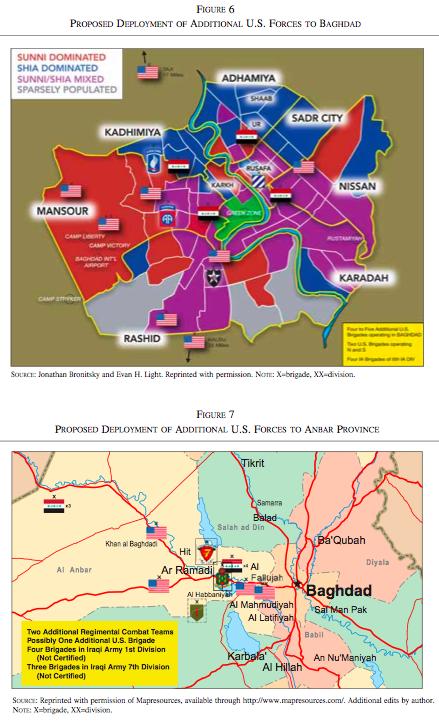
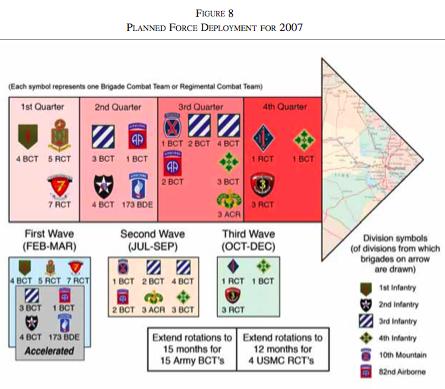
Their OPLAN Executive Summary can be read here and you will find there another link to the full report. It was presented at a Conference yesterday at the American Enterprise Institute. You can get the audio and video downloaded from here. Also speaking are Senators McCain and Lieberman. If you don't want to follow the link, the Executive Summary is below - it is worth the space. The maps in this post outline their recommended deployment plan.

Victory is still an option in Iraq. America, a country of 300 million people with a GDP of $12 trillion and more than 1 million soldiers and Marines, has the resources to stabilize Iraq, a state the size of California with a population of 25 million and a GDP under $100 billion. America must use its resources skillfully and decisively to help build a successful democratically elected, sovereign government in Iraq.

Victory in Iraq is vital to America’s security. Defeat will likely lead to regional conflict, humanitarian catastrophe, and increased global terrorism.

Iraq has reached a critical point. The strategy of relying on a political process to eliminate the insurgency has failed. Rising sectarian violence threatens to break America’s will to fight. This violence will destroy the Iraqi government, armed forces, and people if it is not rapidly controlled.

Victory in Iraq is still possible at an acceptable level of effort. We must adopt a new approach to the war and implement it quickly and decisively.

We must act now to restore security and stability to Baghdad. We and the enemy have identified it as the decisive point.

There is a way to do this.

  • We must balance our focus on training Iraqi soldiers with a determined effort to secure the Iraqi population and contain the rising violence. Securing the population has never been the primary mission of the U.S. military effort in Iraq, and now it must become the first priority.
  • We must send more American combat forces into Iraq and especially into Baghdad to support this operation. A surge of seven Army brigades and Marine regiments to support clear-and-hold operations that begin in the spring of 2007 is necessary, possible, and will be sufficient to improve security and set conditions for economic development, political development, reconciliation, and the development of Iraqi Security Forces (ISF) to provide permanent security.
  • American forces, partnered with Iraqi units, will clear high-violence Sunni and mixed Sunni-Shia neighborhoods, primarily on the west side of the city.
  • After those neighborhoods are cleared, U.S. soldiers and Marines, again partnered with Iraqis, will remain behind to maintain security, reconstitute police forces, and integrate police and Iraqi Army efforts to maintain the population’s security.
  • As security is established, reconstruction aid will help to reestablish normal life, bolster employment, and, working through Iraqi officials, strengthen Iraqi local government.
  • Securing the population strengthens the ability of Iraq’s central government to exercise its sovereign powers.

This approach requires a national commitment to victory in Iraq:

  • The ground forces must accept longer tours for several years. National Guard units will have to accept increased deployments during this period.
  • Equipment shortages must be overcome by transferring equipment from non-deploying active-duty, National Guard, and reserve units to those about to deploy. Military industry must be mobilized to provide replacement equipment sets urgently.
  • The president must request a dramatic increase in reconstruction aid for Iraq. Responsibility and accountability for reconstruction must be assigned to established agencies. The president must insist upon the completion of reconstruction projects. The president should also request a dramatic increase in Commander’s Emergency Response Program (CERP) funds.

  • The president must request a substantial increase in ground forces end strength. This increase is vital to sustaining the morale of the combat forces by ensuring that relief is on the way. The president must issue a personal call for young Americans to volunteer to fight in the decisive conflict of this generation.
  • The president and his representatives in Iraq must forge unity of effort with the Iraqi government.

Other courses of action have been proposed. All will fail.

  • Withdraw immediately. This approach will lead to immediate defeat. The Iraqi Security Forces (ISF) are entirely dependent upon American support to survive and function. If U.S. forces withdraw now, the Iraqi forces will collapse. Iraq will descend into total civil war that will rapidly spread throughout the Middle East.
  • Engage Iraq’s neighbors. This approach will fail. The basic causes of violence and sources of manpower and resources for the warring sides come from within Iraq. Iraq’s neighbors are encouraging the violence, but they cannot stop it.
  • Increase embedded trainers dramatically. This approach cannot succeed rapidly enough to prevent defeat. Removing U.S. forces from patrolling neighborhoods to embed them as trainers will lead to an immediate rise in violence. This rise in violence will destroy America’s remaining will to fight and escalate the cycle of sectarian violence in Iraq beyond anything an Iraqi army could bring under control.

Failure in Iraq today will require far greater sacrifices tomorrow in far more desperate circumstances.

Committing to victory now will demonstrate America’s strength to our friends and enemies around the world.

This is a Plan worthy of our nation. One I support. In their presentation (video and audio link) they also acknowledge the 800# gorilla in the room. Our Army (editor's note: and Marine Corps) is too small for present and future operations. To think or say other is folly.

Friday, January 05, 2007

Fullbore Friday

There was one US ship that sunk a German warship in WWII. One.

What was her main armament? One 4" deck gun. One.

The SS Stephen Hopkins. Not USS; SS. A liberty ship.
The raider Stier, formerly the merchant ship Cairo, was built by Krupp in 1936, at 434 feet long, 56.5 feet broad, with a top speed of 14 knots. The Allied code name for her was "Raider J." She began operation as a raider in May 1942 under the command of Horst Gerlach, with a crew of 324 well-trained Navy men.

Her first three victims were: Gemstone (British), Stanvac Calcutta (Panama-flag U.S.-owned), and Dalhousie (British).

On the morning of September 27, 1942, the Stier was taking on supplies from the blockade runner Tannenfels off the coast of South Africa when she spotted a ship coming out of the mist not far away. It was the Liberty ship SS Stephen Hopkins, operated by the Luckenbach Steamship Co. out of San Francisco. Built by Kaiser Richmond No. 2, she was on her maiden voyage - San Francisco - Bora Bora - Auckland, New Zealand - Melbourne - Port Lincoln, Australia, Durban - Capetown - and bound in ballast for Paramaribo, Dutch Guiana.
First voyage, in the middle of nowhere away from the war, or so she thought.

As is usually the case; the battle started without warning.
At 9:30 AM that Sunday morning Captain Paul Buck, Chief Mate Richard Moczkowski, and George Papas, A.B., were on the bridge. Kenneth Vaughn, 3rd Assistant Engineer, Michael Fitzpatrick, fireman, and Andrew Tsignonis, wiper, were on watch in the engine room. Ford Stilson, the 32-year-old Chief Steward, heard a shot pierce the superstructure, then the general alarm. He grabbed his lifejacket and went to his battle station. He would set up a makeshift hospital in the officers’ mess.

The Armed Guard gunners and mariners assigned as loaders raced to their guns. Off the starboard bow, they saw a ship about the same size as the Hopkins firing at them. A larger ship was behind her. Explosions rocked the ship and machine gun fire was raking the decks. One of the first shells killed two mariners as they stepped on deck.

Moczkowski gave orders to steer so the stern of the ship - with its 4 inch gun - would continue to point at the enemy ship and at the same time present the smallest target.

Kenneth Willett, commander of the Armed Guard, was severely wounded in the abdomen by shrapnel, but he continued directing the men. Seaman Barker, in charge of the 4 inch gun, trained it directly at the waterline of the German raider, getting a shot off about every 45 seconds. They made every shot count, hitting the raider’s rudder and then damaging the raider’s forward guns.

In the forward tub, Wallace Breck, two other Armed Guard men, and Second Mate Joseph E. Layman, fired round after round at the smaller ship. All the guns aboard the Hopkins were firing as fast as they could be loaded and discharged. Hit after hit was scored on both enemy ships.

An enemy shell pierced the Hopkins' half inch steel hull, hitting directly in the engine room. Those above heard the explosion, then the roar of steam, as the black gang died at their posts.

A large caliber shell hit the forward gun tub just about the time the abandon ship signal was blown. Seaman Second Class Breck was the only survivor. He jumped overboard and climbed into a lifeboat, just as a shell hit the lifeboat, blowing it out of the water. Breck was the only survivor again.

The Stier was still putting shell after shell into the upper works of the Stephen Hopkins.The Tannenfels kept machine gunning the Hopkins. The Armed Guard fired their machine guns right back.

Cadet O’Hara saw the 4-inch gun deserted and dead men on the deck around it. O’Hara loaded and fired all 5 shells left in the ready box, scoring hits with all five. A few moments later he was killed by a shell which exploded nearby.
After the battle - that wasn't the end of it for the crew.
The battle lasted about half an hour. A total of 35 shells hit the Stier and she was in as much of a shambles as the Hopkins. Both ships were on fire and sinking.

Commander Horst Gerlach ordered his crew to set detonating charges to scuttle the Stier, and then to abandon ship. Saedie Ben Hassan, a severely wounded crewman from the Stanvac Calcutta, was among those transferred to the Tannenfels.

After an hour or so, the Stephen Hopkins also sank. The 19 survivors gathered in one lifeboat, which had little food and water, and began a 2,200-mile 31-day journey to Brazil. Fifteen men survived.
The Skipper of the SMS Stier paid her a great compliment.
In his battle report, which he turned in upon the Tannenfels' arrival in Nazi territory, Captain Gerlach reported he fought a "heavily armed cruiser."
She sure fought like one. This really could be a great movie.

Here are a couple of thoughts to leave you with; how is your cross training doing? How many people can crew your weapons if the primary and secondary go down or cannot get to their station? Are you ready to sail a distance equal to a drive from Jacksonville, FL to Bremerton, WA in an open boat? With 5 minutes warning? When was the last time you were trained to survive at sea with little or no water and food? Have you actually "gone over the side?"

If I took you by the arm and walked you over to the stern, could you load and fire just a simple M2 .50 cal? If I walked into the CIC and told everyone "you are all dead," and then I walked up to the bridge and told you that everyone on the bridge was dead but the helmsman and that the last thing he heard was the Skipper saying before he bled out something non standard like, "CIWS to auto and open flank speed to the south." - what would your ship do?

Ponder.

Hat tip Cap'n George.

Thursday, January 04, 2007

Seen Speaker Pelosi today?

This helped me.

Clinton Crony Corruption Cont.

So, what would happen to you if you did the following?
* She failed the ‘Touch the Tip of the Pen’ Test: “Failed to touch the tip of the pen with index finger as instructed. Repeatedly reached out to touch the tip of the pen before being told to do so.”

* She failed the ‘Horizontal Gaze’ Test: “Failed to keep head still numerous times as instructed.”

* She failed the ‘Nine Step Walk and Turn’ Test: “Failed to touch heel to toe on all 9 steps out and 4 of 9 steps back”; “Stopped while walking”; “Stepped off the line”; “Used arms for balance”

* She failed the ‘One Leg Stand’ Test: “Put foot down on count of 3 on first attempt” and second attempt; “Failed to complete the test”

They didn't release her for her model cooperation, either. McKenna says that she repeatedly asked to be let go, and then refused to enter the cell when she was brought to the station for booking. ... then, ironically, lectured McKenna about abuse of power.

Well, serf - you are of a different class. The proper people have this happen to them.
...the case was tossed out of Attleboro District Court on Friday at the request of a prosecutor from Bristol District Attorney Paul F. Walsh Jr.’s Office. The prosecutor, Roger Ferris, told the Sun Chronicle the case was dismissed at the request of his superiors.
Hwy? Simple.
A politically wired campaign fund-raiser with ties to Gov.-elect Deval Patrick and former President Clinton has been cleared of drunken driving charges, despite allegedly failing sobriety tests and blowing over the legal limit on a Breathalyzer.

Suzanne Magaziner, a Patrick campaign organizer married to ex-Clinton adviser Ira Magaziner, was busted April 4 in Mansfield after a trucker spotted her swerving on Interstate 95, the Sun Chronicle of Attleboro reported.

State police who pulled over Magaziner, 54, said she had bloodshot eyes, alcohol on her breath and failed sobriety tests. She also reportedly blew a .12 on a breath-alcohol test, which is above the state’s legal limit of .08.
Republicans are such amateurs.

Hat tip CAPT Ed.

March of the Dhimmi - North American Version

I think the Canadians have us beat. Our Dhimmis are just drunk on PC. The Canadians are selling their culture to the highest bidder.

College of William and Mary:
The president of the College of William and Mary College has begun backtracking over his decision to remove a donated bronze cross from the school's historic Wren Chapel, but students and alumni say his proposal for a "permanent plaque" just isn't enough.


Melissa Engimann circulated an e-mail announcing the removal of the cross

WND broke the story on Oct. 27 when university administrator Melissa Engimann circulated an e-mail noting that the cross was going to be stored in order to make the chapel "less of a faith-specific space."
Chapel "less faith specific?" Water less wet?

Simon Fraser University:
Another university is dropping a cross from its historic imagery, saying it creates confusion and sends the wrong message.

The announcement from Simon Fraser University near Vancouver, B.C., about the school's Coat if Arms. (about the Coat of Arms) A spokesman for Simon Fraser said the two crosses on the 40-year-old emblem are a problem. Warren Gill, the school's vice-president of university relations, said the school doesn't want people to think the wrong thing.

...
Another university is dropping a cross from its historic imagery, saying it creates confusion and sends the wrong message.

The announcement from Simon Fraser University near Vancouver, B.C., about the school's Coat of Arms brings it in alignment with a precedent set earlier by the College of William and Mary, which said in a story WND broke that a historic cross in a structure built as a Christian chapel hundreds of years ago would have to go because it offended some people.

A spokesman for Simon Fraser said the two crosses on the 40-year-old emblem are a problem. Warren Gill, the school's vice-president of university relations, said the school doesn't want people to think the wrong thing.

"For some people, particularly internationally, the crosses were seen to identify us as a private religious institution as opposed to a secular public one, and a lot of our international folks were getting that back," he said.
Think there is more to this? Give your self a Gold-Star-Happy-Face.
At virtually the same time, the school announced that was creating a center for the study of Muslim issues.

It is being funded by $1 million from the Amin Lalji family and $250,000 from school Board of Governors chair Saida Rasul and her husband Firoz.

"We have already a very strong program in Middle Eastern and Islamic history, an endowed lectureship in Iranian and Persian studies, courses in Persian, and soon, Arabic and other languages," said SFU President Michael Stevenson. "These activities are a strong base for building an internationally recognized center for scholarship that embraces the full diversity of Muslim societies and cultures."
It looks like the Canadians are going to surrender without a fight - the Americans are still fighting a holding action though.

President Gene Nichol last week sent an e-mail to the "college community" admitting that he "acted too quickly and should have consulted more broadly" in deciding to remove the cross. So to make up for that, he said a plaque would be put up in the chapel and the cross would be put on the altar for extended hours on Sunday.

Students and alums who have assembled in a group called SaveTheWrenCross.org, however, said that wasn't good enough.

"Nichol acknowledged that his unilateral action upset many current students and alumni, who believed that his decision was a dilution of the history and traditions of the College and an example of an animus toward religion in general and Christianity in particular," the group said.

"After apologizing for his failure to involve others in this historic decision, Nichol went on in his letter – apparently unaware of the irony – to dictate what he obviously thinks is a compromise solution to the problem he created," said the organization, which had collected almost 7,500 signatures on a petition seeking the return of the cross.


Alum says it's the historic Wren Chapel, not the Wren Spare Room

"It is the Wren Chapel, not the Wren Spare Room," wrote Karla Bruno, a 1981 graduate. "Nichol does not address the idea that the Chapel with the cross on permanent display was indeed welcoming as witnessed by the plethora of non-Christian and secular events that have been held there over the years. No one has been turned away because they were not Christian."

Another graduate, Karen Hall, of the Class of 1978, said Nichols' argument doesn't make sense.

"He explains … the cross has made a number of people feel uncomfortable in the chapel. I would venture to guess that a far greater number of people have been made uncomfortable by the removal of the cross. Why is it that one group's discomfort is enough to merit drastic action, but the other group's discomfort is virtually worthless?"

The old policy was that the cross was on permanent display on the altar of the chapel, and was removed only when someone using the room asked that it be removed. Nichol's new policy is that the cross is permanently in storage, and will be brought out only on special request.

The group said its top priority will be for the school's Board of Visitors to talk about the issues at the next meeting, in February.

Join the fight if you wish.

Hat tip Dhimmi Watch.