Tuesday, July 19, 2022

SDP Becomes the Salamander Democratic Party?


Well before Trump was even a Republican, here and other places in the natsec arena warned Germany ... hell ... begged Germany to step up.

She needed to take her place on the stage as a responsible partner in the security of Europe - a full partner in the West. We tried to tell her she needed to spend her fair share, to make the alliance stronger ... but she always seemed to want to do just the bare minimum ... and then less.

We were concerned about her weakness, but more we were concerned that she was allowing herself to get too close to Russia, too dependent on Russia ... but her Smartest People in the Room™ convinced their people they knew what was best.

They sneered at the unsophisticated Americans and their complaints. 

Then Trump came along and then they laughed at the very idea that they had anything to worry about. Say what you want about him and his exceptional national security team, but they were right.


That critique was long standing, but other previous  administrations of both parties refused to call Germany on their shortfalls.

Here we are 4-yrs after the laughing German UN delegation ... and with the Russian invasion of Ukraine, now Chancellor Olaf Scholz seems to be going Salamander;
...the condition of our Bundeswehr and civilian defense structures, but also our excessive dependence on Russian energy suggest that we felt a false sense of security after the end of the Cold War. Politics, business and large parts of our society were only too happy to draw far-reaching consequences from the dictum of a former German defense minister, according to which Germany was only surrounded by friends. That was a mistake.

Good. A nice step ... now follow it up.

More help to Ukraine, Poland, the frontline states of NATO who - though smaller and poorer than Germany - are punching way above their weight compared to Germany.

If you really want to keep the Russians at bay, then they have to be defeated in Ukraine. Germany and the West did not pick this moment, but the moment is here.

Good step by Germany. While I have understandable concerns about Germany and France's desire to co-opt the EU towards something it should not be, that is a struggle for another day. In any event, I think especially the Central Europeans and Baltic republics will thwart any effort there down the road. 

Anyway. More.

Monday, July 18, 2022

On D+0 on the Opening of the Next Pacific War - we Will Regret not Having This

With the expected losses due to enemy action and mechanical failure, how do we plan to rescue aviators out of the water in the western Pacific?

What few subs we have will be fully employed elsewhere and really shouldn’t show themselves in a lot of those waters. We don’t have a lot of surface ships with helos either to spare.

As the USMC desires to make every island possible a fighting position, how do you supply them when their airfields – such that the are – are cratered by the PLARF conventional S//M/IRBM at D+1?

If your major airfields are unusable due to enemy military action or host nation political uncertainty ... how do you conduct long range ASW and reconnaissance as the Chinese fleet goes to sea and our satellites are blinded? What about tankers who use the same fields that our CVW are reliant on now that the same green-eyeshade pod-people got rid of organic tanking too (again, no - buddy tanking does not count).  

How limited is your ability to fully use your special forces if you cannot deliver and extract them in a theater dominated by shallow seas and countless islands, bays, coves, and rivers?

Why is your tool box limited to a flathead screwdriver and a hammer?

My entire adult life I have lamented the lack of seaplanes/flying boats in the toolkit of the US military. 

We had that capability in the past, but politics, green eye shade efficiency-cultists, and leaders of limited imagination but unlimited ambition stripped it away decades ago for the worst reasons possible. Some of our friends, like Japan, never did. Some opponents, like China, are rediscovering the logic of having such a versatile asset.

It is time again to discuss a huge gap in the US Navy’s toolbox; the seaplane.

Peter Ong at Naval News has a good update at a good – though not optimal – hope;

 “In terms of amphibious MC-130 demonstration, USSOCOM is actually going through some market research, currently, to see if we can identify any potential amphibious capacities to meet some of the SOF Requirements that are existing.  And currently AFSOC is also doing an experimental demonstration where they are planning on putting some float assemblies on a C-130 platform.  They use digital engineering as a major factor of reducing some of that risk and making some of those changes, and they have gone through some hydrotesting and some aero testing on a subscale factor.”

Good.

Better.


Best.


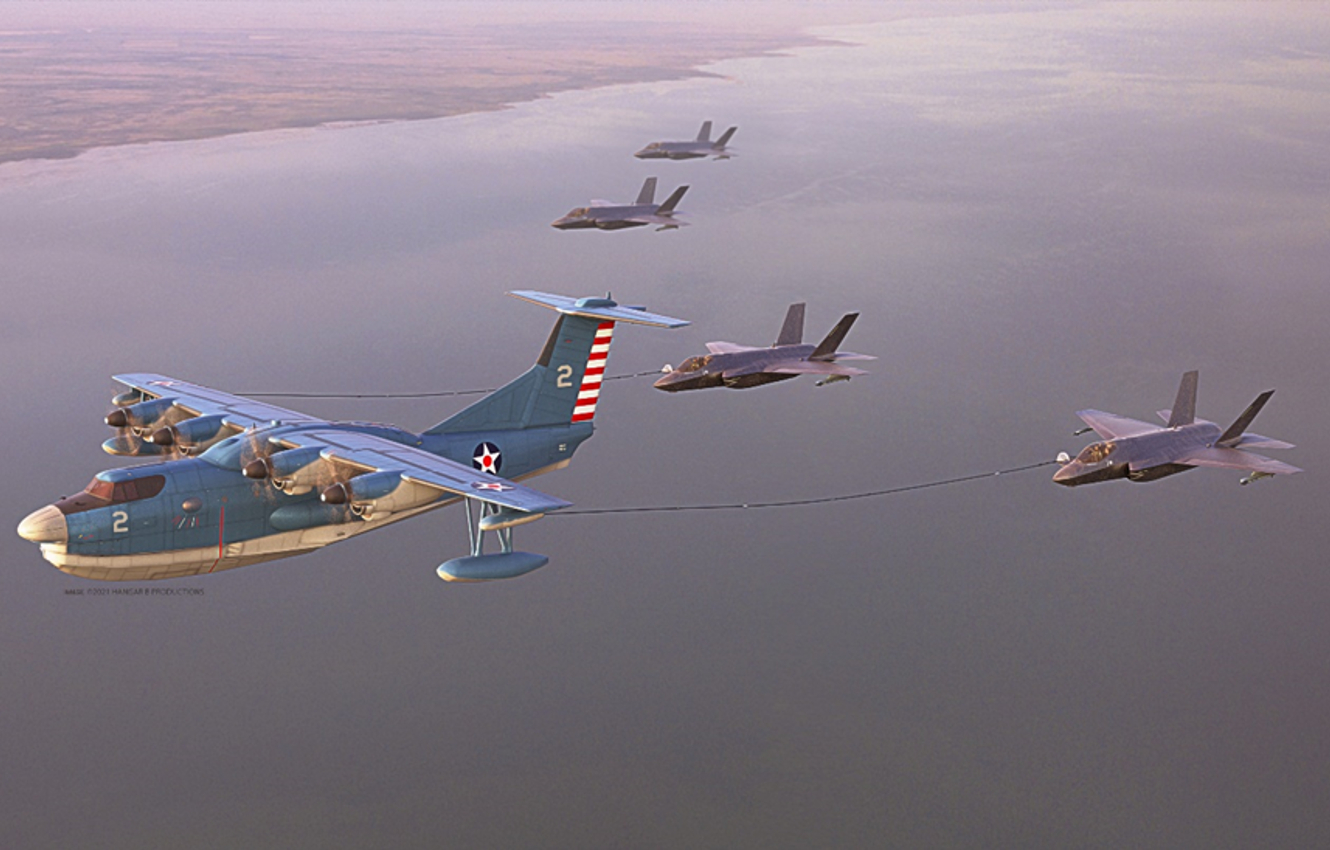
Yes, we should give a nod to the C-130 option, but should just buy what works NOW and works exceptionally well, the Japanese ShinMaywa US-2

If Japan can buy US built F-35s whole and in part, we can buy a few dozen US-2.

…and give them a great livery while we are at it.


Sunday, July 17, 2022

It's a Mid-Summer Midrats Melee!!


This week's Midrats is going to be the ever-popular everything goes melee format.

You never know where in the natsec world the conversation will take us, but from Snake Island to the San Diego waterfront, from DC to the Baltic Sea - if there's a maritime issue worth considering, we'll try to pack it in for the hour this Sunday from 5-6pm Eastern.

As with the normal melee format, we have open topic, open chat, and open phones - so if there is an issue you'd like covered, now's your time.

Join us live if you can
, but it not, you can get the show later by subscribing to the podcast. If you use iTunes, you can add Midrats to your podcast list simply by clicking the iTunes button at the main showpage - or you can just click 
here. You can find us on almost all your most popular podcast aggregators as well.

Friday, July 15, 2022

Fullbore Friday


So, how was your war?

A little more than 15-years ago after 93-years on our little planet, one of the greatest US Navy tactical leaders passed away.

He and his crew had an incredible record during WWII that I would encourage you to review in full here ... but after the Navy decided that they were running out of Navy Crosses to reward the man then all of 31-yrs old, he earned the Medal of Honor for events in his 11th Patrol.

Attention to citation:

“For conspicuous gallantry and intrepidity at the risk of his life above and beyond the call of duty as commanding officer of USS BARB during her Eleventh War Patrol” along the east coast of China from 19 December 1945, to 15 February 1945. After sinking a large ammunition ship and damaging additional tonnage during a 2-hour night battle on 8 January, Commander Fluckey, in an exceptional feat of brilliant deduction and bold tracking on 23 January, located a concentration of more than 30 enemy ships in the lower reaches of Nankuan Chiang (Mamkwan Harbor ). Fully aware that a safe retirement would necessitate an hours’ run at full speed through the uncharted, mined and rock-obstructed waters, he bravely ordered, ‘Battle Station—Torpedoes!” In a daring penetration of the heavy enemy screen, and riding in 5 fathoms of water, he launched the BARB’s last forward torpedoes at 3,000 yards range. Quickly bringing the ship’s stern tubes to bear, he turned loose four more torpedoes into the enemy, obtaining eight direct hits on six of the main targets to explode a large ammunition ship and causing inestimable damage by the result of flying shells and other pyrotechnics. Clearing the treacherous area at high speed, he brought the BARB through to safety and 4 days later sank a large Japanese freighter to complete a record of heroic combat achievement, reflecting the highest credit upon Commander Fluckey, his gallant officers and men, and the United States Naval Service.”

After receiving his Medal of Honor, Fluckey gave a signed card to each member of the crew that read as follows:

As Captain it has been an outstanding honor to be your representative in accepting the Congressional Medal of Honor for the extraordinary heroism above and beyond the call of duty which you and every officer and man in the BARB displayed. How fortunate I am, how proud I am, that the President of the United States should permit me to be the caretaker of this most distinguished honor which the Nation has seen fit to bestow upon a gallant crew and a fighting ship…the “BARB.”

Sincerely,

Eugene Fluckey


He was 32 at war's end and served until 1972 as a Rear Admiral.

What a life.


Thursday, July 14, 2022

Kanton, Now More Than Ever

In an age of long range sensors and precision guided weapons, do we have the option to, with the exception of the most important, "bypass and haulass" through the Pacific's constellation of small islands between Hawaii and the Western Pacific and Australia like our ancestors did? 

Generations of American planners have just assumed that the Pacific WWII granted the USA was a birthright. We fought wars and guaranteed peace with certain assumptions that, in real time, are fading away in the presence of a rising power who is serious, focused, and knows what it wants.

It wants the Pacific and it seems we are helping them take it without a shot being fired;

Kiribati President Taneti Maamau's "surprise" announcement to abandon its membership from the region's premier policy and political body at the 51st Forum Leaders' meeting this week has heightened concerns the Micronesian nation is moving closer to China.

"I know they are cooking something with China," Tong, who led the atoll islands from 2003 to 2016, said.

"I think it would have started with the reopening of the Phoenix Island Protected Area."

The Phoenix Islands Protected Area is the largest designated marine protected area in the world, spanning almost 400,000 sq km in the South Pacific Ocean, midway between Australia and Hawaii.

Sources have told RNZ Pacific that a possible deal may include exclusive access to Chinese vessels to the Protected Area.

Tong believed the move by the Maamau government suggested that it hoped to "gain from being isolated from the region" by striking a deal directly with China.

"It's totally unexpected. I did not think it was in our nature, in our character, to do something quite so radical like that," he said.

The Kiribati Government is under financial pressure due to the economic impacts of Covid-19 and the current drought.

They will take in peace with greed and corruption what in war they will use for obstruction and denial. They know that we cannot respond quickly at the far reaches of the western Pacific if we have to "clean up" the central Pacific first.

Remember what we discussed 14-months ago?

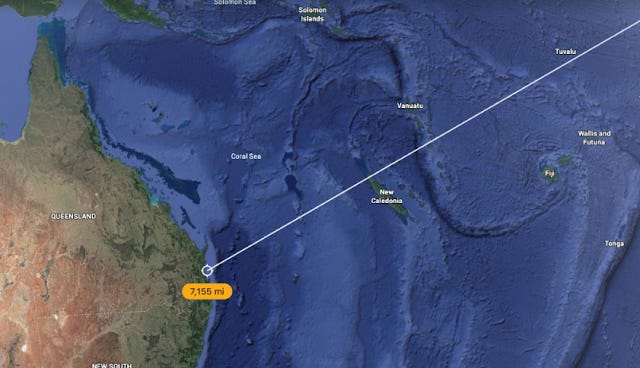
Here's the terminal end of the great circle route from San Diego to Australia.

Where does that great circle routs go by Kanton?

Yep. 28 nautical miles. 28.

You cannot classify geography or math. That is why the Chinese are interested in it. I can't blame them. If I were Chinese, I'd do the same exact thing. 

They know the USA can't rush to the aid of anyone from Taiwan to the South China Sea if they have to clean up what used to be their backyard first.

Time and distraction. Defense in depth. None of this can be classified. They are open to all.

The fun follow on question: what would they do with it?

We warned you.

h/t Zach.

Diversity Thursday


Funny, but I don't quite remember this twist from the shower scene in Starship Troopers;

Via the irreplaceable Kristina Wong;

The training slide offers a “vignette” instructing soldiers on what to do if they encounter a female soldier who identifies as male according to the Department of Defense’s personnel tracking system known as Defense Enrollment Eligibility Reporting System (DEERS), but has not surgically transitioned and still has “female genitalia.”

The slide, titled “Soldier/Unit Training Barracks, Bathrooms, and Showers,” reads:

Vignette: Following his transition from female to male (which did not include sex reassignment surgery) and gender marker change in DEERS, a transgender Soldier begins using male barracks, bathroom, and shower facilities. Because he did not undergo a surgical change, the Soldier still has female genitalia.

The slide instructs soldiers: “Soldiers must accept living and working conditions that are often austere, primitive, and characterized by little or no privacy. … Understand anyone may encounter individuals in barracks, bathrooms, or shower facilities with physical characteristics of the opposite sex despite having the same gender marker in DEERS.”


We live in a strange place where politics trumps biology and cowards lead the brave ... but this is what we voted for - so lie back and think of England. 


Tuesday, July 12, 2022

Ukrainian Lessons as Old as Time: Logistics-Auxiliaries-Prizes


We opened
Midrats last Sunday with a question to our guest Jimmy Drennan about what lessons he's taken so from from a maritime perspective during the Russo-Ukrainian War. This is a question I would like all of our navalists to think hard about. One constant we see throughout history is that small to medium wars will signal to you what you need to be ready for when the big war comes - and come it will. They always do.

Well, yesterday another Midrats alumnus, Dr. James Kraska has a tightly written overview of some takeaways for him, and as always with Kraska's work ... his observations deserve close consideration.

The setback for Russia was apparently tied to the oldest of military challenges—force sustainment during combat. The capture of Snake Island may help Ukraine to position anti-ship cruise missiles south of Odessa to weaken the Russian stranglehold on the port city.

The Attack

The resupply ship that never reached Russian forces on the island is believed to be the Russian naval tugboat Spasatel Vasily Bekh. The ship had a loaded displacement of 1670 tons. Part of the Black Sea Fleet, the Vasily Bekh was launched in 2016 and commissioned in 2017. The tugboat is designed to provide towing services for ships in distress, firefighting at sea and ashore, freshwater and electrical supply to other vessels, and to evacuate injured personnel. It carried a complement of 20 crewmembers with capacity for 36 more people and could carry tons of supplies.

Coming after the sinking of the Black Sea flagship Moskva on April 14, the strike on the Vasily Bekh underscores the Russian Navy’s inability to establish sea control in the western area of the Black Sea. The Moskva was the largest Russian warship damaged by enemy fire since 1941, when the Luftwaffe damaged a Soviet battleship in Kronshtadt. The Russian withdrawal from Snake Island also demonstrates the importance of combat logistics. While Russia maintains internal lines of communication that can feed the Russian war machine inside Ukraine, the Russian element that occupied Snake Island had to be supplied from the sea, raising questions about the rules for targeting ships supporting the armed forces in war.

If you want to know the sobering reality of war at sea - especially how we have done it in our entitled mindset of decades of dominance at sea, read close his legal outline of  "Targeting Combat Logistics" next.

I don't know about you, but it immediately makes me want to ask some very hard questions to people who I don't think are ready for them.

Then I want you to play that out for the USA vs. China west of Wake. Heck, make it globe-wide.

Later in his article, a few conversations I've had with Claude Berube and my co-host from Midrats came to mind - about Letters of Marque. 

Where does Ukraine's government stand on Letters of Marque ... because as this war drags on ... there are some interesting options for them ... and depending on how that plays out, for any - ahem - nation that may find itself at war at some time in the future with the People's Republic of China;

Russia’s plans to leverage greater support from merchant ships also implicates the law of naval warfare. Russian-flagged merchant ships are liable to capture by Ukrainian naval forces, and they may be converted to use after adjudication of prize in a court of admiralty jurisdiction.

The Russian merchant fleet has 1,155 ships and 7.7 million deadweight tons and could serve as an effective force multiplier for the Russian military services. China’s merchant fleet is among the top ten largest in the world, with 87 million deadweight tons and 4,881 ships. Decimated by uncompetitive costs of operation resulting from the Jones Act, the U.S. fleet is shockingly small and shrinking. The number of U.S. oceangoing commercial ships in the U.S. merchant fleet fell from 282 vessels to 182 ships since 2000. This means that while Russia and China can supplement their auxiliary naval forces with national-flagged merchant ships, the United States would find that option more challenging.

This situation is ironic because unlike Russia and China, which enjoy internal lines of communication, U.S. requirements for force replenishment depend on a massive logistical flow to Asia and Europe. American forces operate forward, along the first island chain running from Japan to the Philippines, and on NATO’s eastern border in Europe. Sustainment of these forces likely would require merchant shipping. Like Russia, the United States may also resort to contracts with merchant carriers to provide force sustainment. These merchant ships would also be liable to capture by the enemy during armed conflict, and they may be attacked and destroyed if they resist capture.

Yes, there are a lot of maritime lessons in this mostly land-centric war. The longer this goes - if you are willing to open your mind a bit - the more interesting the implications that may evolve for the US national strategy - or at least in the classified annexes.