Monday, October 10, 2016

So, you want to play varsity football?

Last week, the varsity team took the field;
Three U.S. warships are operating off the coast Yemen following a guided missile attack against a UAE operated ship by Houthi rebels, two U.S. defense officials confirmed to USNI News on Tuesday.

The ships – guided-missile destroyers USS Nitze (DDG-94), USS Mason (DDG-87) and the afloat forward staging base USS Ponce (AFSB(I)-15) – are on station off Yemen near the Bab Al Mandeb strait that links the Red Sea to the Gulf of Aden.
Reports as of late Sunday tell us the locals decided to scrimmage.
"USS Mason detected two inbound missiles over a 60-minute period while in the Red Sea off the coast of Yemen. Both missiles impacted the water before reaching the ship," Pentagon spokesman Captain Jeff Davis said.

"There were no injuries to our sailors and no damage to the ship," he said.
So far, well done all.

Friday, October 07, 2016

Fullbore Friday

Let's talk about "small ship" survivability, ability and what they bring to the fight.

FREEDOM Class LCS:
- Length: 378 ft
- Displacement: 3,800 short tons

INDEPENDENCE Class LCS:
- Length: 418 ft

- Displacement: 3,422 short tons

FLETCHER Class DD:
- Length: 376.5 ft
- Displacement: 2,500 short tons

No commentary or tug jokes required. I'll let you look up what weapons they carry yourself

Let's catch up with the Battle Off Samar. This time with the FLETCHER Class DD the USS HEERMANN (DD-532).
HEERMANN screened transports and landing ships safely to the beaches of Leyte and then joined Rear Admiral Thomas L. Sprague's Escort Carrier Task Group 77.4 which was made up of three escort carrier task units, known as the three "Taffies" because of their radio call signs: "Taffy 1", "Taffy 2", and "Taffy 3". Destroyers HOEL and JOHNSTON joined her in screening Rear Admiral Clifton A. F. Sprague's unit, "Taffy 3" which also included his flagship FANSHAW BAY (CVE-70) and three other escort carriers.

Dawn of October 25, 1944 found Taffy 3 east of Samar steaming north as the Northern Air Support Group. Taffy 2 was in the central position patrolling off the entrance to Leyte Gulf, and Taffy 1 covered the Southern approaches to the Gulf some 130 miles to the southeast of HEERMANN. At 0645 Taffy 3's lookouts observed antiaircraft fire to the northward and with 13 minutes later were under heavy fire from Vice Admiral Takeo Kurita's powerful Centre Force of four battleships, 6 heavy cruisers, 2 light cruisers, and 11 destroyers. The battle off Samar was thus joined.

The only chance for survival of the little group of light American ships lay in slowing the advance of the enemy warships while withdrawing toward Leyte Gulf and hoped-for assistance. The carriers promptly launched their planes to attack the Japanese vessels, and the escorts promptly set to work generating smoke to hide the American ships.

HEERMANN, in a position of comparative safety on the disengaged side of the carriers at the start of the fight, steamed into the action at flank speed through the formation of "baby flattops" who, after launching their last planes, formed a rough circle as they turned toward Leyte Gulf. Since smoke and intermittent rain squalls had reduced visibility to less than 100 yards, it took alert and skillful seamanship to avoid colliding with friendly ships during the dash to battle. She backed emergency full to avoid destroyer escort SAMUEL B. ROBERTS and repeated the maneuver to miss destroyer HOEL as HEERMANN formed column on the screen flagship in preparation for a torpedo attack.

As she began the run, dye from enemy shells daubed the water nearby with circles of brilliant red, yellow, and green. HEERMANN replied to this challenge by pumping her 5-inch shells at one heavy cruiser, CHIKUMA, as she directed seven torpedoes at another, HAGURO. When these "fish" had left their tubes, HEERMANN changed course to engage a column of four battleships whose shells began churning the water nearby. She trained her guns on the battleship KONGO, the column's leader. Then she quickly closed HARUNA, the target of her of her last three torpedoes, which were launched from only 4,400 yards. Believing that one of the "fish" had hit the battleship, she nimbly dodged the salvoes which splashed in her wake as she retired. Japanese records claim that the battleship successfully evaded all of HEERMANN's torpedoes, but they were slowed down in their pursuit of the American carriers. The giant, YAMATO, with her monstrous 18.1-inch guns, was even force out of the action altogether when, caught between two spreads, she reversed course for almost 10 minutes to escape being hit.

HEERMANN sped to the starboard quarter of the carrier formation to lay more concealing smoke and then charged back into the fight a few minutes later, placing herself boldly between the escort carriers and the column of four enemy heavy cruisers. Here she engaged Japanese cruiser CHIKUMA in a duel which seriously damaged both ships. A series of 8-inch hits flooded the forward part of the plucky destroyer, pulling her bow down so far that her anchors were dragging in the water. One of her guns was knocked out but the others continued to pour a deadly stream of 5-inch shells at the cruiser, which also came under heavy air attack during the engagement. The combined effect of HEERMANN's guns and the bombs, torpedoes, and strafing from carrier-based planes was too much for CHIKUMA who tried to withdraw but sank during her fight.

As CHIKUMA turned away, heavy cruiser TONE turned her guns on HEERMANN who replied shell for shell until she reached a position suitable to resume laying smoke for the carriers. At this point planes from Admiral Stump's "Taffy 2" swooped in to sting TONE so severely that she too broke off action and fled. The courageous attacks of the destroyers and aircraft thus saved the outgunned Taffy 3.

Temporary battle-damage repairs were applied at Kossol Passage. From there, she was sent to Mare Island, California for a much-needed overhaul. She would not return to the Western Pacific until January 1945.
It's not the size of the ship in the fight .....
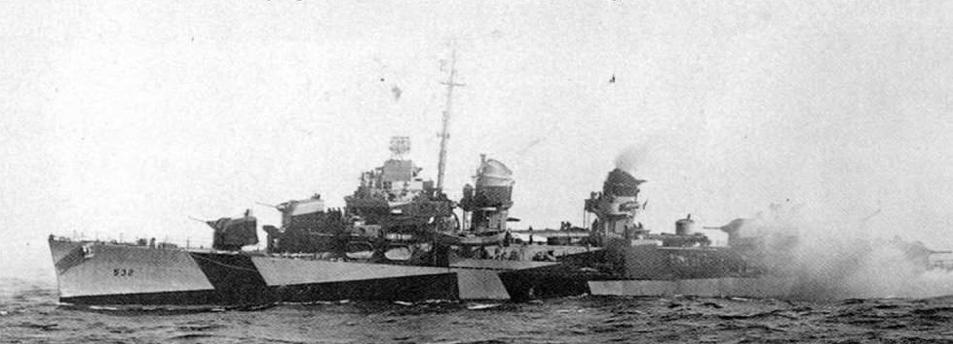


This FbF first posted NOV08.

Thursday, October 06, 2016

Diversity Thursday

After a break, your humble host needed one, my loins are fully girded and I’m ready to wade back in to the fetid swamp of intellectual dishonesty, moral cowardice, political bullying, divisive sectarianism, grievance pimping, rent seeking, and outright red-in-tooth-and-claw racism that is today’s Diversity Industry.

Now that we’re through stretching enough to break the adhesions after such a long DivThu break, let’s focus on the issue at hand.

Not just for the USA, but throughout human history – think about the importance of diplomacy. The incredibly important part making peace and looking out for the national interests of a nation a Ministry of Foreign Affairs or a State Department have. All the national security area civilian and uniformed.

There is no substitute for excellence. Critical thinking, levelheadedness, and a broad and deep understanding of the world. Those are just a few of the most important attributes needed for such important positions. None of that attributes have a thing to do with race, creed, color, or national origin – much less who you want to cuddle up with in the middle of a hurricane.

It doesn’t seem that the Obama Administration really gives a damn about any of that. Oh, no…there are axes to grind;
"In broad comparison with the wider federal government, the federal workforce dedicated to our national security and foreign policy is — on average — less diverse, including at the highest levels," according to a White House fact sheet.
...
The memo requires the assistant to the president for national security affairs, "in consultation with" the directors of both the Office of Management and Budget and the Office of Personnel Management, to report to the president on the progress in implementing the "requirements of this memorandum" in 120 days.

Obama pinpointed three ways national security agencies, including the Pentagon, State Department and intelligence agencies, could promote diversity, including collecting, analyzing and disseminating workforce data to the public and agency personnel in order to "increase transparency and accountability."

The president said more professional development opportunities and tools, such as academic programs, private-public exchanges and detail assignments in relevant private or international organizations would help attract and retain a diverse workforce.
...
"In addition, agencies in the national security workforce shall offer, or sponsor employees to participate in a [Senior Executive Service] Candidate Development Program or other programs that train employees to gain the skills required for senior-level agency appointments," Obama wrote.

Obama also directed senior leaders and supervisors to "play an important role in fostering diversity and inclusion in the workforce they lead" by rewarding and recognizing efforts to promote diversity and inclusion.
As we have covered before, this has nothing to do with diversity in education, philosophy, geographic origin, life experience, or foreign language abilities. This has everything to do with race and to a lesser extent, sex.

As we have also covered in previous DivThu, due to the clear racial differences in objective criteria mostly involving education with black, and to a smaller extent "Hispanics" compared to the general population averages - the only way you will get strict alignment with the general population is through discrimination on the basis of race and ethnicity - at the detriment of citizens from Asian extraction and those of non-Iberian European heritage.

All the incentives are in the above pull quote, but as we've warned here for years, they will find other ways to force you to make their metrics work.

You see, they are going to make you understand that a search for non-biased decisions and to evaluate people in a color blind manner is in itself nothing but bigotry.

You see, you are by nature a racist. Just make the metrics work, and Big Brother will smile on you.
One of those efforts, Obama said, should include an expansion of training on "unconscious bias, inclusion and flexible work policies."

"Agencies shall ... make implicit or unconscious bias training mandatory for senior leadership and management positions, as well as those responsible for outreach, recruitment, hiring, career development, promotion and security clearance adjudication," the memo stated.
As a side note, when you are forced to sit through these implicit bias training sessions and you just sit there without challenging their slander against you, you are accepting their world view. You are admitting that you are a bigot.

Is “diversity” a problem for the Russian MFA? How about the Chinese? Of course not, they are serious nations run by serious people who have a firm understanding of how the world works.

Having lived overseas for years, you know how the rest of the world sees someone with a passport that says “United States of America?” As Americans. That. Is. It. We should exhibit the same level of maturity.

Remember, when dealing with the Commissariat; ignore what you can, slow roll if you can, challenge if you have no choice. Calmly but deliberately challenge them with confidence. Always stare them right in the eyes when you do; deep down they have nothing but shame for the hate and sectarianism they spread - and it will show.

Silence is approval. Be silent and you will get what you deserve.


Wednesday, October 05, 2016

If you like your AI, I don't know if you can keep your AI

So, think unmanned systems coupled with AI will be the future of full spectrum combat?

Even if it could be - do we really want to build AI that can operate at that level.

I'm asking that question with Sam Harris over at USNIBlog.

Come visit and see what we're flopsweating about.

Tuesday, October 04, 2016

The Beginning of De-Buzzwordification of Pentagonese?

He is only one Service Chief, and we are only talking words, but words mean things. It’s a start. 

To work effectively, you need to communicate clearly, with confidence, and in a manner that is well understood by both the target audience and more importantly – to those who underwrite your project.

Words can also be misused. They can be used to obscure, confuse, inflate importance or de-emphasize importance. When you throw in the overuse of acronyms, the problem just compounds.

You can reach a point that some presentations, articles, and comments include so many of the buzzwords and acronyms popular at that moment – usually floating in a soup of obsequious signaling – that the impression isn’t so much that the speaker or author knows what he is talking about, but simply that he wants you to know he knows what the latest fad is. 

Everything is about the fad, all is impacted by the fad, and we love the fad so much – that we fail to realize that instead of providing insight and clarity, we are just selling Pet Rocks.

In light of that, I welcome CNO Richardson’s ditching of A2/AD;
On Monday, Chief of Naval Operations Adm. John Richardson said he and other Navy brass are going to stop using the acronym "A2/AD" -- short for anti-access area denial, to describe maritime threats and challenges.

The term has become too broad and too ambiguous, he said, an insider shorthand that describes a range of nuanced and very different problems. In place of A2/AD, Navy leaders will not get a different catch-all term to use, but rather will focus on describing the specifics of the challenge at hand.

"We have to resist the temptation to oversimplify this conversation," Richardson said. "I'm afraid I'm just not going to propose replacing one acronym with another. [Although] no matter what I say, we will eventually get to an acronym."
A few more remarks on the topic;
“To ensure clarity in our thinking and precision… We’ll no longer use the term A2/AD as a stand-alone acronym that can mean all things to all people or anything to anyone – we have to be better than that,” he said.
“Since different theaters present unique challenges, ‘one size fits all’ term to describe the mission and the challenge creates confusion, not clarity. Instead, we will talk in specifics about our strategies and capabilities relative to those of our potential adversaries, within the specific context of geography, concepts, and technologies.”
I understand where a lot of this starts. On the good side, people are looking for a simple shorthand to explain a challenge without going in to details. I don’t think it works out that way at the end of the day most of the time. 

For those who know the business, it just builds cynicism by those on the receiving end that those in power are historically ignorant at best, most likely just being patronizing, or at worst shilling for and repeating the spin coming from the defense industry’s latest marketing program.

It can at times turn in to a wonk version of a rap battle. Classic case, General Neller, USMC states,
…marines must wage a “four-block war (in) six domains…”
Those in the fraternity know what he means, mostly, but why iterate a previous buzzword “three-block war” and add more stuff to it? How did C2 become C3I become C4I become C4ISR? How many Marines are now going to force "four-block war in six domains" in their work?

Buzzwords and acronyms often become an end to themselves. Instead of talking about missions, roles and responsibilities, we feel the need to create an esoteric vocabulary that is often a barrier to discussing the unchanging fundamentals of this business; what are your critical vulnerabilities, critical capabilities, etc etc.

I’d like to hear more from the CNO on this topic. By his example, he could greatly elevate how we talk about our challenges and as a result bring about better solutions.

At the end of his article, the always subtly cheeky Sam put in a nice reminder of this rather systemic problem;
Early last year, the Office of the Secretary of Defense changed the name of the controversial Air Sea Battle Office – the group tasked with countering the A2/AD threat on a larger Pentagon level – to the Joint Concept for Access and Maneuver in the Global Commons (JAM-GC pronounced: Jam, Gee-Cee) and folded it into the Pentagon’s joint staff.
Clear?


Monday, October 03, 2016

The Near Death Nature of Near Shore Operations

History, on large scale and small, will give you hints what should concern you when the next war comes.

On operating near shore, the history can be mixed in the messages it sends if you don't look at the details. In the last real big war, you had successful defenses such as the approaches to Oslo and even the sporty use of field artillery against ships by the few Marines defending Wake in the early days of WWII.  Shore based defenses - immobile and a frustration at most - are seen as ineffective as those we faced in our last gunfight outside of Haiphong during the Vietnam War.

It is this history that can be misleading in the second decade of the 21st Century. The edges of living memory is good to understand, but you need to look closer.

Don't look too far. Are we worried so much about the sexy but rare and unproven Anti-Ship Ballistic Missile (ASBM) right now, as well as other exotic items you only see in a PPT, to the point we are ignoring a larger, legacy threat of a proven and effective threat scattered around the world by the hundreds to thousands? They may be old to oldish - but so are our ways to defend against them.

They are the cost effective answer to those who do not have the luxury of having a navy to throw up against an overpowering USN at sea - but want to have the ability to bloody the nose of those who would assume they own the sea. Of course, we are talking about what we believe took out the SWIFT, the shore based anti-ship cruise missile. Harpoon, Exocet, Styx/Silkworm, C801, C802, etc ... they are out there and waiting. They aren't fixed. They can be in any garage or "lorry" seen on the road. They would even fit in the parking bay of a MSF hospital.


The first practical big hint about the dangers of going close ashore in the modern era was the HMS Glamorgan attack in the closing days of the 1982 Falklands War. The 2012's strike on the INS HANIT is the most germane to what we saw over the weekend to the former (JHSV 2) SWIFT;
AN Incat catamaran has been sunk in the Red Sea by the Yemeni Army, say Arab news agencies.

Al-Masirah Television and Tasnim News Agency report that the 98m wave-piercing HSV-2 Swift, built at the Prince of Wales Bay Incat shipyard in 2003, was destroyed in a rocket attack off the shores of the Red Sea port city of Mokha early on Saturday.

Al-Masirah reports that the Swift was carrying aid and equipment for the United Arab Emirates Army when it was targeted by an anti-ship missile. There have been no reports of casualties but Yemini Houthi fighters claim to have sunk the ship.
...
The aluminium-hulled catamaran had a helicopter flight deck, vehicle deck, small boat and unmanned vehicle launch and recovery capability, and a communications suite.

It was capable of carrying 350 personnel and military vehicles and had a 2600 sq m mission deck.

Swift returned to Incat at Hobart in July 2013 for a refit and in July 2015 was reported to be operated by the UAE’s National Marine Dredging Company.

Most who served in the last few decades know the Bab-el-Mandeb area at the southern end of the Red Sea well. It is a classic choke point and "near shore" operating environment. How do you define "near short?" In the modern era, I wouldn't judge near shore by distance, but by time. Here's why.

Almost any poorly resourced military or non-state actor have the ability to do over the horizon targeting using over-the-counter communications equipment, using fishing boats as intel collection nodes, commercial radars for targeting, or even recreational drones (you should see some of the scouting by drone some of my duck hunting acquaintances are doing. For the record, I hinted how great an idea that is, but Mrs. Salamander shot that down pronto. Not a drone, just the idea of me buying one to, "Save time scouting." I failed on the sale).

Let's put the latest generation of supersonic ASCM to the side and go with the affordable previous generation of sub-sonic cruise missiles. They go +/-9 NM a minute. From launch to impact, a 2-minute flight time from the parking lot of KFC to your ship 18-NM out at sea. How long does it take for your watch to go from detect to engage (that assumes you have a good radar designed for such, have ES gear, have an awake & well trained crew, are expecting an attack, and nothing is CASREP'd)? Depending on the missile, these can be shot in "line of sight" mode where the targeting radar comes on right after launch (easiest to counter), they can have the radar come on at the last minute, or some can even be IR guided.

Ponder that threat a bit and ask yourself - how close to you want to get? Yes, you are a bit frustrated at all those glossy advertisements for DDG-1000 that showed them happily firing away a thousand yards or so from a nice white beach and green shore with nary a village in sight ... but that was marketing, this is war where you have hundreds of thousands of possible hiding places for shore based, mobile ASCM. How close are you comfortable with the risk vs. how close you have to do to accomplish your mission? That overlap is the rub.

Once you get your head around that legacy threat, then ponder the latest ASCM that in the next decade will probably be sold like Hilux trucks, the BrahMos and their fellow travelers. 

How do you defeat that threat? Dowe have the right defensive measures to fight through the envelope? Are we properly taking in to account this threat in how we design our fleet? How we man, train, and equip it?

As for this instance, I would expect a lot more to come out in the next 48-hrs, but here's the video we have of the attack.

Sunday, October 02, 2016

Building National Resilience with J. Michael Barrett, on Midrats


At the height of hurricane season, people think of the impact such storms can have on the security, economy, and even the political direction of places if hit by such huge events such as Katrina.

As we saw in the attacks in New York City in 2001, terrorists are trying to create those same effects, along with a few more. With a global economy, local events can have international impact.

How do you best to prevent, prepare for, and recover from natural events - but on the high end, terrorist attacks that go beyond explosions, but reach the next level with chemical, biological, or even nuclear weapons?

Our guest to discuss this and related concerns for the full hour, Sunday from 5-6pm Eastern, will be J. Michael Barrett, Director of the Center for Homeland Security & Resilience (CHSR), and Diligent Innovations.

Mike's previous experience includes serving as the Director of Strategy for the White House Homeland Security Council, Intelligence Officer for the Office of the Secretary of Defense, and Senior Analyst for the Chairman of the Joint Chiefs of Staff.

A former Fulbright Scholar to Turkey, Mike has served as a Homeland Security Fellow at the Manhattan Institute, an Olin Foundation Fellow at Johns Hopkins University, and a research analyst at the Center for Strategic and International Studies.

Mike received an M.A. in Strategic Studies and International Economics from the Johns Hopkins University School of Advanced International Studies (SAIS) in Washington, D.C., and an M.B.A. from the Australian School of Business in Sydney, Australia. He also was graduated cum laude with a B.A. in International Relations from the University of Pennsylvania and is an Occasional Guest Lecturer at National Defense University, Georgetown University, and Joint Special Operations University.

Join us live if you can, but if you miss the show you can always listen to the archive at blogtalkradio or Stitcher

If you use iTunes, you can add Midrats to your podcast list simply by clicking the iTunes button at the main showpage - or you can just click here.