Friday, October 18, 2013

Fullbore Friday

Let's cleanse the palate and go back a couple of years and a century for one of my favorite FbF. Every bit of this applies to naval warfare today. Every. Single. Bit.

Naval History Magazine has an article (membership required) out in the latest edition about the WWI Battlecruiser HMS Invincible.  It reminded me of a FbF I did back in 2007 on the WWI Battle of the Falkland Islands. Let's revisit.
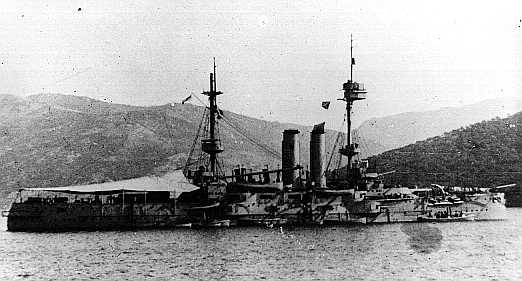
Time for Part 2 ... of 3 of the story of Admiral Graf Maximilian von Spee' glorious and beautiful, but doomed fleet. It is time for a classic story of revenge at sea: The Battle of the Falkland Islands, 8 December 1914. I like to pay a lot of attention to HMS Canopus. If you review Part 1, you will see how you could dismiss this old ship full of Reservists; but it that what a leader does? No, a leader finds a way to make every bit of kit count.
On November 11 1914 the battlecruisers Invincible and Inflexible under Admiral Sturdee left for the Falkland Islands. HMS Princess Royal was dispatched to the Caribbean to guard the Panama Canal. The shock of the defeat at Coronel had made the Royal Navy take decisive action to destroy Spee and the battlecruisers were the chosen means for retribution.

After his victory Spee coaled and then loitered in the Pacific whilst he decided what to do next, little did he realise that this indecision would prove fatal. Eventually he decided to enter the Atlantic and try to make it home. The squadron had passed Cape Horn by December 1 and on the following day they captured the Drummuir carrying coal. They then rested for three days at Pictou Island. Spee wanted to raid the Falkland Islands but his captains were opposed to the idea, however in the end Spee decided to go ahead anyway, another decision he was to regret.
HMS Canopus was now beached at Port Stanley, the capital of the Falklands, as guard ship. On December 7 Sturdee arrived, bringing the British warships at Port Stanley to the pre-dreadnought Canopus, the battlecruisers Invincible and Inflexible, the armoured cruisers Kent, Carnarvon and Cornwall, the light cruisers Bristol and Glasgow and the armed merchant cruiser Macedonia.

On the morning of December 8 1914 Gneisenau and Nürnberg were detached from the main squadron, which followed about fifteen miles behind, to attack the wireless station and port facilities at Port Stanley. At 0830 they sighted the wireless mast and smoke from Macedonia returning from patrol.

They didn't know that at 0750 they had been sighted by a hill top spotter which signalled Canopus which then signalled Invincible, flagship, via Glasgow. The British ships were still coaling and most ships, including the battlecruisers, would take a couple of hours to get up steam. If the Germans attacked the British ships would be stationary targets and any ship which tried to leave harbour would face the concentrated fire of the full German squadron, if they were sunk whilst leaving harbour the rest of the squadron would be trapped in port. Sturdee kept calm, ordered steam to be raised and then went and had breakfast!

0900 the Germans made out the tripod masts of capital ships. They were unsure of what theses ships were but they knew Canopus was in the area and they hoped that these were pre-dreadnoughts, which they could easily outrun.

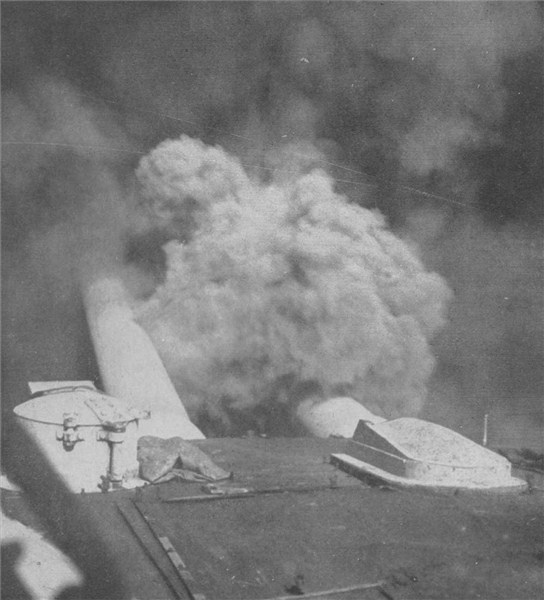
Canopus was beached out of site of the German ships, behind hills but had set up a system for targeting using land based spotters. At 13,000 yards her forward turret fired but was well short, the massive shell splashes astonished the German ships who could see no enemy warships. The rear turret then fired using practice rounds which were already loaded for an expected practice shoot later. The blank shells ricocheted off the sea, one of them hitting the rearmost funnel of Gneisenau. The two German ships turned away. Canopus didn't fire again but she saved the British from a perilous situation.
Also a lesson on not pressing the attack and getting spooked. Probably remembering what happened when the British pushed the attack against his Squadron and were sunk for it - Admiral Graf Spee was too cautious by half, perhaps with a bit of "get-home-itis," a disease that will get you killed.
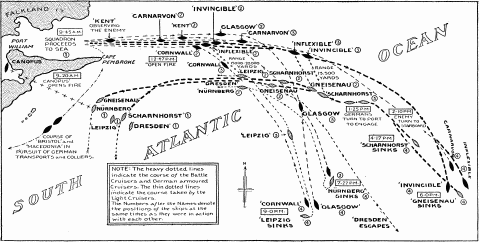
By 0945 Bristol had left harbour, followed 15 minutes later by Invincible, Inflexible, Kent, Carnarvon and Cornwall, Bristol and Macedonia stayed behind. The German squadron had a 15-20 mile lead but with over eight hours of daylight left and fine weather the battlecruisers would be in action in a couple of hours.

The German lookouts could now tell that the tripod masts belonged to battlecruisers which at c25 knots were considerably faster than the 20 knots the in need of refit German ships could manage. Spee set course to the South East in the hope of finding bad weather.

At first the British squadron stayed together but the battlecruisers were being slowed down by the other ships and so pulled ahead on their own.

At 1247 at 16,500 yards the battlecruisers opened fire, with little accuracy, taking half an hour to straddle the rear ship, Leipzig. Spee realised he was caught and turned his armoured cruisers to slow the British whilst ordering his light cruisers to try and escape. Sturdee had made contingency plans for this and Invincible, Inflexible and the trailing Carnarvon engaged the armoured cruisers whilst the rest of the force set off after the light cruisers.

The battlecruisers turned onto a parallel course to Scharnhorst and Gneisenau at 14,000 yards. The Germans had the advantage of being in the lee position of the wind, the British gunnery was badly affected by their own smoke. The German shooting was excellent but at this long range their shells did little damage to the battlecruisers. The British also scored a few hits which did more damage but they were unaware of this as the visibility prevented them from seeing these.

In an attempt to gain the lee (smoke free) position Sturdee made a sharp turn to starboard towards Spee's stern. Whilst performing this turn the British were shrouded in their own smoke and Spee took this opportunity to turn south, pulling out of firing range. It took the British another 45 minute stern chase before they could resume firing.

At 1450 the battlecruisers turned to port to bring their broadsides to bear. Spee decided that his only chance was to close the range and use his superior secondary armament but his change of course made the smoke much less of a problem for the British. Their firing became much more accurate and both German ships, but especially Scharnhorst suffered severe damage and casualties. By had received over fifty hits, three funnels were down, she was on fire and listing. The range kept falling and at 1604 Scharnhorst listed suddenly to port and by 1617 she had disappeared. As Gneisenau was still firing no rescue attempts were possible and her entire crew including Spee were lost. Invincible had received 22 hits, over half 8.2 inch, but these caused no serious damage and only one crew member was injured.

Gneisenau kept on alone, zigzagging to the south west. At 1715 she scored her last hit on Invincible before her ammunition ran out. The British stopped firing soon afterwards and the burning German ship ground to a halt, her crew opening the sea-cocks and abandoning ship, 190 crew from a total of 765 were rescued but many of these died from their wounds. Inflexible was only hit 3 times and had 1 killed and 3 injured.
The brutal facts of war at sea. There is little room for caution or pause.
Whilst the big ships were fighting the smaller cruisers were having their own battles. The German light cruisers were in the order Dresden leading followed by Nürnberg and Leipzig whilst the British were led by Glasgow with Cornwall and Kent trying to keep up with her.

At 1445 Glasgow opened fire on Leipzig, Leipzig turning to port to reply, scoring two early ships whilst Glasgow's fell short. Glasgow had to turn away, allowing Leipzig to resume her earlier course. The other German ships had not turned to help Leipzig but had carried on their escape attempt.

Glasgow fired on Leipzig again, but this time the other German cruisers changed course, Dresden to the South West and Nürnberg to the South East. Glasgow's ploy of forcing Leipzig to turn and fire succeeded in slowing her so that at 1617 Cornwall had her in range, Kent setting off after Nürnberg.

Leipzig's firing was good but she didn't hit Glasgow and her shells didn't do much damage to Cornwall. By 1900 Leipzig's mainmast and two funnels were down and she was on fire. When her ammunition was exhausted she made an unsuccessful torpedo attack on Cornwall and then her crew prepared to abandon ship.

Glasgow closed the range to finish her off as her flag was still flying, stopping when two green flares were fired by the crippled German cruiser. At 2120 she rolled over and sank leaving eighteen survivors.

Cornwall had received eighteen hits but no casualties. Glasgow had received no damage after the two early hits which killed one and four wounded. Her boilers were damaged which reduced her speed enough for there to be no chance of catching Dresden which escaped.

Nürnberg had a 10 mile led on Kent and was, on paper, faster, but Nürnberg needed an engine overhaul and Kent's crew worked so hard that the old cruiser exceeded her designed horsepower, reaching 25 knots, being forced to burn all available wood on board and causing the whole ship to vibrate violently.

By 1700 the range was down to 12,000 yards and Nürnberg opened fire with the by now expected superb accuracy. When Kent returned fire ten minutes later her shells fell short. Once the range had fallen to 7,000 yards both sides started to score regular hits and Nürnberg gave up her escape attempt and turned to bring her broadside to action.

By 1730 the range was down to 3,000 yards and Kent's heavier shells and thicker armour gave her the upper hand. An hour later, just as bad weather arrived which may have saved her, two of Nürnberg's boilers exploded, reducing her speed. Kent was now able to easily outmanoeuvre her opponent and within half an hour Nürnberg was dead in the water, at 1926 she rolled over to starboard and sank with only twelve survivors.
Kent had received thirty eight hits but only sixteen casualties.

Whilst these battles had gone on Bristol and Macedonia had sunk Spee's colliers Baden and Santa Isabel, the other collier, Seydlitz escaped, eventually being interned in Argentina.
Even in victory, you will be second guessed by those who don't know; they just don't know but their petty concerns.
Sturdee searched for the Dresden before returning to the UK with the battlecruisers. There was some criticism (mainly from the 1st Sea Lord Fisher) of him for letting Dresden escape and for the heavy ammunition expenditure of his battlecruisers (Invincible 513 12 inch rounds, Inflexible 661 12 inch rounds fired) but generally his clear victory was welcomed. He had destroyed Spee's squadron without any serious damage to any of his ships and their shooting (c.6.5%) was considerably better than was managed by British (and German) battlecruisers at Dogger Bank and Jutland.
Ah, the SMS Dresden. That will be Part 3, with a twist. See you there in March.
Thursday, October 17, 2013

Diversity Thursday

OK, as sequester and other budgetary nightmares swirl around our Navy. As N00 and N00A have to approve all travel outside area codes. As we have huge issues that we need our Engineering Duty Officers to concentrate on to maximize what we have coming in and stretching out what we have already ... what are they using as a priority?

Just add up the manhours, personhours, workhours - whatever Newspeak says it is this week. Just bask in the entire thread. I'll get rid of a few non-value added layers ... but you may want to read bottom up for the full glory of a Navy at war and short of money.

Rust never sleeps.

---------- Forwarded message ----------
From: [redacted], Miguel G CAPT PEO[redacted], 
Date: Wed, Aug 28, 2013 at 10:35 PM
Subject: FW: EDO DWG: establishing a GC - The Steps
To: [redacted],


Fellow [redacted], EDOs,
The community's Diversity Working Group (DWG) is evolving from the current structure of Pillar Groups to a Guiding Coalition (GC) focused on EDO community health, diversity, and professional development. The process of effecting this change is described below.

This is a great opportunity for anyone energized to shape the community's future. As CAPT [redacted], states, "RDML Whitney is looking for a larger audience than just the DWG." If you are interested and would like to hear more during the September DWG phonecon (currently scheduled for 17 Sep, 1300-1400), the dial-in is 1-866-758-[redacted], Pass Code: [redacted],#. Alternatively, RDML Whitney will send an ALL HANDS e-mail asking for volunteers.

~~~~~~~~~~~~~~~~~~~~~~~~~~~
Topic: Re-organization of EDO DWG into a Guiding Coalition to address EDO community health, diversity, and professional development.

Guiding Coalition Start-up Actions:

1. Gain primary champion support and validate community interest. COMPLETE.

2. Set the size of the Guiding Coalition. I recommend 16-20 people. This allows for three to five GC members per GC initiative team. I'm assuming you'll start with four initiatives. If you'd like to start with more, you'll want a larger GC. You could make the GC as small as 12, but then you'd want to limit yourselves to three initiatives.

3. Recruit Guiding Coalition members.

Action 3.1: Decide who you want to invite to become GC members. I recommend you send the invitation to apply for GC membership to the entire EDO community. You'd think, based on what you mentioned from Dr. Kotter's work below, that you should predetermine how many of what groups you'd like represented prior to the sending the invitation. I recommend against that. Since you'll be doing a selection on the group of volunteers, you'll be able to sift and sort based on varying the demographics and positions without having to pre-judge the field. Plus, if you send out the invitation without any bias toward three of one type or four of another you'll learn who in the community rises freely to an opportunity like this. Now, that doesn't mean that the people who don't volunteer are disinterested in the topic. Rather, it just tells you the positive data of who is interested enough to volunteer for more work (that's good information to have).

Action 3.2: Assign who will manage the selection process. I'm assuming this will be CAPT [redacted],  but it could be someone on staff.

Action 3.3: Set the selection panel. For the first round, you can keep the selection process very simple. CAPT [redacted], can select with RDML Whitney concurrence, or you could put together a team of three or four people from various levels to rate the volunteers and choose a GC. We've done it both ways. When we first started one of the department heads and the Shipyard Commander chose the GC. Later, we added a six person panel selection.

Action 3.4: Invite people to volunteer. I can provide you with a rough application and other information to help set the stage for the application. We try to keep it simple. While applications flow in, you are watching for what groups aren't represented in the applications. From that information (generically) you can target some asks or reminders. This is a two edged sword. You want to be sure that people you expected to see in the applicant pool are aware of the GC, but you don't want them to feel forced to apply. We've had a few folks over the years that only applied because their boss or mentor told them they should and they were the worst GC members.

Action 3.5: Select and notify. Those who volunteer but aren't selected for the Guiding Coalition are invited to join the initiative teams once the GC has chosen the initiatives.

4. Set the direction of the GC. Our typical method was to hold an in-person one-day off-site. You don't have to do that to be successful. We can start to plan this step once you get the applications started. Tentatively we can assume that you will be forming the GC without the benefit of an in-person meeting. It'll be easier to start assuming that than to assume an in-person and downgrade to via telecon.
---------------------------------------------------------------
Separately, let me address the issues of trust and credibility.

Trust: I've found that groups of volunteers who come together around a cause they believe in (e.g., taking action to improve EDO community health, diversity, and professional development) start with an assumption of trust. This entering position allows the groups to form much faster than groups assigned to work together. Now, knowing that people in a community know each other, you sometimes have two people with a history who would rather not work together. To those people I offer them the choice to either resolve/ignore their issue with each other so they can both work on the topic or select different topics within the GC to work on. That free choice/own-your-choice method has worked well. You're right to include the rule of "checking rank" so everyone is free to speak. That'll help too.

Credibility: One of the great benefits of a Guiding Coalition is that the entering assumption is that a person is credible or they wouldn't have been selected for the GC. From there, each person is free to earn greater credibility through their actions within the group and their accomplishments on behalf of the group. So too, people are free to lose credibility through their behaviors or lack of outcomes. A larger danger is the false assumption that volunteer groups are less credible than appointed groups. I haven't figured out where this assumption stems from, but it is dangerous if it takes hold of leaders and how they talk about the Guiding Coalition. With RDML Whitney involved, you'll have a strong champion opposed to that assumption, but I offer it as something to watch for as the CAPT in charge of the GC.
~~~~~~~~~~~~~~~~~~~~~~~~~~~

Please pass to anyone I may have missed on this email. Thanks!

v/r Miguel

CAPT Miguel [redacted], USN
Program Manager, [redacted], (PEO [redacted],)
4301 Pacific Highway
Bldg OT-1, Room [redacted],
San Diego, CA 92110-3127
[redacted],


-----Original Message-----
From: [redacted], Thomas J CAPT EDO School, CO
Sent: Wednesday, August 28, 2013 9:11 AM
To: [redacted],
Subject: EDO DWG: establishing a GC - The Steps
Importance: High

To all,

What follows are the steps RDML Whitney asked me to get from April [redacted], about how to start the process of setting up the GC. As we talked about on the August DWG phone call, I am forwarding the steps to everyone so they can talk about it with in pillars and if you have specific questions, you can talk or e-mail April directly.

We will discuss every ones concerns at the September DWG call and decide on the steps. At that point, RDML Whitney will put out his ALL HANDS e-mail calling for volunteers.

For the Mentor Leads ... Please share this with your members as well since RDML Whitney is looking for a larger audience than just the DWG

v/r ... tjb
Captain Tom [redacted], USN
Commanding Officer
Engineering Duty Officer School
805-982-[redacted],

-----Original Message-----
From: [redacted],, April K CIV PSNS/IMF, Code 1101.AM
Sent: Tuesday, August 27, 2013 8:13 AM
To: [redacted],, Thomas J CAPT EDO School, CO
Cc: [redacted],
Subject: RE: EDO DWG: establishing a GC

CAPT - Sorry for the delay. I've copied my boss, Brenda [redacted],  on this e-mail for her information on our progress with this task.

Topic: Re-organization of EDO DWG into a Guiding Coalition to address EDO community health, diversity, and professional development.

Guiding Coalition Start-up Actions:

1. Gain primary champion support and validate community interest. COMPLETE.

2. Set the size of the Guiding Coalition. I recommend 16-20 people. This allows for three to five GC members per GC initiative team. I'm assuming you'll start with four initiatives. If you'd like to start with more, you'll want a larger GC. You could make the GC as small as 12, but then you'd want to limit yourselves to three initiatives.

3. Recruit Guiding Coalition members.

Action 3.1: Decide who you want to invite to become GC members. I recommend you send the invitation to apply for GC membership to the entire EDO community. You'd think, based on what you mentioned from Dr. Kotter's work below, that you should predetermine how many of what groups you'd like represented prior to the sending the invitation. I recommend against that. Since you'll be doing a selection on the group of volunteers, you'll be able to sift and sort based on varying the demographics and positions without having to pre-judge the field. Plus, if you send out the invitation without any bias toward three of one type or four of another you'll learn who in the community rises freely to an opportunity like this. Now, that doesn't mean that the people who don't volunteer are disinterested in the topic. Rather, it just tells you the positive data of who is interested enough to volunteer for more work (that's good information to have).

Action 3.2: Assign who will manage the selection process. I'm assuming this will be CAPT [redacted]  but it could be someone on staff.

Action 3.3: Set the selection panel. For the first round, you can keep the selection process very simple. CAPT [redacted] can select with RDML Whitney concurrence, or you could put together a team of three or four people from various levels to rate the volunteers and choose a GC. We've done it both ways. When we first started one of the department heads and the Shipyard Commander chose the GC. Later, we added a six person panel selection.

Action 3.4: Invite people to volunteer. I can provide you with a rough application and other information to help set the stage for the application. We try to keep it simple. While applications flow in, you are watching for what groups aren't represented in the applications. From that information (generically) you can target some asks or reminders. This is a two edged sword. You want to be sure that people you expected to see in the applicant pool are aware of the GC, but you don't want them to feel forced to apply. We've had a few folks over the years that only applied because their boss or mentor told them they should and they were the worst GC members.

Action 3.5: Select and notify. Those who volunteer but aren't selected for the Guiding Coalition are invited to join the initiative teams once the GC has chosen the initiatives.

4. Set the direction of the GC. Our typical method was to hold an in-person one-day off-site. You don't have to do that to be successful. We can start to plan this step once you get the applications started. Tentatively we can assume that you will be forming the GC without the benefit of an in-person meeting. It'll be easier to start assuming that than to assume an in-person and downgrade to via telecon.
---------------------------------------------------------------
Separately, let me address the issues of trust and credibility.

Trust: I've found that groups of volunteers who come together around a cause they believe in (e.g., taking action to improve EDO community health, diversity, and professional development) start with an assumption of trust. This entering position allows the groups to form much faster than groups assigned to work together. Now, knowing that people in a community know each other, you sometimes have two people with a history who would rather not work together. To those people I offer them the choice to either resolve/ignore their issue with each other so they can both work on the topic or select different topics within the GC to work on. That free choice/own-your-choice method has worked well. You're right to include the rule of "checking rank" so everyone is free to speak. That'll help too.

Credibility: One of the great benefits of a Guiding Coalition is that the entering assumption is that a person is credible or they wouldn't have been selected for the GC. From there, each person is free to earn greater credibility through their actions within the group and their accomplishments on behalf of the group. So too, people are free to lose credibility through their behaviors or lack of outcomes. A larger danger is the false assumption that volunteer groups are less credible than appointed groups. I haven't figured out where this assumption stems from, but it is dangerous if it takes hold of leaders and how they talk about the Guiding Coalition. With RDML Whitney involved, you'll have a strong champion opposed to that assumption, but I offer it as something to watch for as the CAPT in charge of the GC.
--------------------------------------
Is this enough to get us started? Feel free to send me more questions. I need the ping back from you to ensure that I'm giving you all of the necessary details. I've been doing this so long that I'm prone to miss a step or two in the instructions because I just do it by instinct now. I'm excited for this opportunity to work with you so I can make the details of the start-up process more evident and repeatable for others.

You're going to achieve more than you expected with the GC. This is going to be fun too. Let's get started.

All my best - April

-----Original Message-----
From: [redacted], Thomas J CAPT EDO School, CO
Sent: Wednesday, August 21, 2013 3:18 PM
To: [redacted], April K CIV PSNS/IMF, Code 1101.AM
Cc: [redacted]
Subject: EDO DWG: establishing a GC

April,

Hope things have settled out at home.

As stated in the minutes from the August DWG conference call, the group will evolve into a guiding coalition structure. RDML Whitney was very quick to say and not to use the term "re-organize".

The group still had some questions about how to get started. RDML Whitney tasked me to get with you and come up with a few POA&M-like steps to form the GC. He was also very careful not to call it a full POA&M, just a few high level steps for the DWG to hold a dialog on, so we can discuss and decide on them at the September DWG conference call.

According to J.P. Kotter... there are three steps to setting up a GC;

Right Composition
Obtaining a level of trust
Shared Objectives

Right Composition:
a. Enough Power Positions so those who are 'left out' can't block progress (could be the existing pillar leads, something to dialog on)
b. Expertise, which in our case also means diversity (all ranks, all mentor groups, all minority and gender groups)
c. credibility (not sure how to handle this one)
d. Leadership; I think we have that in RDML Whitney


Obtaining a level of trust:

The only thing that comes to mind here is an old rule from the CNO Strategy Studies Group; everyone is equal, no hierarchy (in the GC)
Off-site, which will be tough in this era of reduced TAD. This group will be scattered

Shared Objectives:

We got a very clear vision from RDML Whitney; To evolve from a DWG to a GC that takes on all aspects of community health and professional development not just improving our demographics.

If you can add onto this and transform it into a few actionable steps, I'll get it out to the group so we can have e-mail dialog before the September conference call (17 September)

I have copied CAPT Chris [redacted] on this note; Chris will be relieving me on 19 September and we assumes the same collateral duty in the DWG or whatever its new title will be.

v/r ... tjb
Captain Tom [redacted], USN
Commanding Officer
Engineering Duty Officer School
[redacted]

Wednesday, October 16, 2013

Friedman Goes Salamander on the ..... Boomers?

Skippy, you may want to go get your smelling salts. 

Yes, the NYT's Thomas L. Friedman has, for all intents and purposes, echoed our inditement of the most selfish generation this nation has ever begat; given the most by their parents - taking the most from their children.

Pure generational theft.
After we baby boomers get done retiring — at a rate of 7,000 to 11,000 a day — if current taxes and entitlement promises are not reformed, the cupboard will be largely bare for today’s Facebook generation. But what are the chances of them getting out of Facebook and into their parents’ faces — and demanding not only that the wealthy do their part but that the next generation as a whole leaves something for this one?
...
Whenever Druckenmiller (a friend) is challenged by seniors, who also come to his talks, that he is trying to start an intergenerational war, he has a standard reply: “No, that war already happened, and the kids lost. We’re just trying to recover some scraps for them.”

With graph after graph, they show how government spending, investments, entitlements and poverty alleviation have overwhelmingly benefited the elderly since the 1960s and how the situation will only get worse as our over-65 population soars 100 percent between now and 2050, while the working population that will have to support them — ages 18 to 64 — will grow by 17 percent. This imbalance will lead to a huge burden on the young and, without greater growth, necessitate cutting the very government investments in infrastructure, Head Start, and medical and technology research that help the poorest and also create the jobs of the future.
...
At the Harlem Children’s Zone, explains Canada, “we have made a promise to all of our children: you play by the rules, do well in school, avoid drugs, gangs, crime and teenage pregnancy, and we will get you into college and on your way down the path of the middle class” and toward a future of financial security. But, he adds, “the current spending on my generation — I’m 61 — if it continues unabated, will erase any chance my children will have the safety net of social, education and health services they will need. It seems deeply offensive to me that we will be asking these poor children from Harlem to subsidize a generation that is, by and large, more well-off than they are, and then leave them deeply indebted in an America that had eaten the seed corn of the next generation.”
Read it all ... and then watch the following video.

The Most Important Pentagon Story You're Not Reading About

C-27J, China's Apache, drones, sequester  budget woes, - whatever you're worrying about - none is of more importance than this.
The Pentagon is considering reorganizing its internal think tank, an organization credited with helping the US win the Cold War, according to defense sources.

The office has been around since 1973, and is the ultimate rarity in Washington, where senior officials come and go like the seasons. Andrew Marshall, who is over 90 years old, was its boss on Day 1 and continues to be its boss.

But now as the Pentagon looks to build itself for the decade ahead, a period with fewer spending cash, the revered office could be reorganized or, as some have suggested, eliminated.
Marshall is a national treasure who cannot be replaced - but his legacy has a lot of good people who can keep it going.

I am going to keep this short; Office of Net Assessment (ONA) is one of the few places where I am in full alignment with Senator Levin (D-MI),
Asked if he thinks closing the Net Assessment shop is a good idea, Senate Armed Services Committee Chairman Carl Levin’s eyes grew large as he replied: “No!”

“It doesn’t strike me as a good idea,” the Michigan Democrat said. “But I would at least consider their argument. I’m sure before they do it, they’ll talk to me about it.”
We need to talk, and think, very carefully.

If you only knew what they saw years before anyone else. There are people who want to kill the office - some for all the wrong reasons. It would be an insane loss if we let this well hidden - as it should be - national asset leave.

Here's an UNCLAS freebee from 2002.

Tuesday, October 15, 2013

Well, they're there if we need them

You cannot have everything in the military of a quasi-broke country not presently under direct attack. More hard decision are coming - and this one is defendable.
New cargo planes on order for the U.S. Air Force are being delivered straight into storage in the Arizona desert because the military has no use for them, a Dayton Daily News investigation found. A dozen nearly new C-27J Spartans have already been taken out of the US Air National Guard service and shipped to the so-called ‘boneyard’ at Davis-Monthan Air Force Base in Tucson. Five more are expected to be built by April 2014, all of which are headed to the boneyard unless another use for them is found.

The Air Force has spent $567 million on 21 C-27J aircraft since 2007, according to purchasing officials at Wright-Patterson Air Force Base. Sixteen had been delivered by the end of September. The Air Force almost had to buy more of the planes against its will, the newspaper found. A solicitation issued from Wright-Patterson in May sought vendors to build more C-27Js, citing Congressional language requiring the military to spend money budgeted for the planes, despite Pentagon protests.
I actually like(d) the program and the aircraft does fit a niche ... but .... what a waste of new-aircraft-smell.

Maybe we will never need them - maybe we will at some point; the future is an imperfect unknown.

What we do know is that at least at DOD, serious and real cuts are here and more are on the way. Hunker down, take the risk, and pray the truth does not change again against you.

Monday, October 14, 2013

Chinese Apache? Begins with an "E" and ends with a "T"

Our friends at WiB and ChinaDefense have had their puzzl'r puzzl'n over the pictures of what looks to be an AH-64 Apache on a flat-bed in the Middle Kingdom.


A few theories are out there. Let's play some with them.

1. "This was a plant for some reason. They wanted it seen, otherwise it would be covered."
--- Never assign to complicated conspiracies what is best assigned to simple human incompetence. Call it the "Snowden must be a CIA operative" school of crazy. Odds; 10%

2. "This was from a crash in AFG or IRQ that was smuggled out."
--- No. Look at it. It is in too good shape ... and I've seen what we do with helos we have to leave on the field. Odds; 1%

3. "The Chinese have stolen the plans are have copied the entire helo."
--- They have a perfectly fine attack helo on their own. Down to the paint job copy then put it on a flat bed? Odds; 2%

4. "A movie prop." No. What movie ... and not. Odds; 1%

No - I am more likely to ascribe the Chinese getting an Apache to one of the Seven Deadly Sins or combo of a few. Lust, wrath, greed, pride ... those liberty risk factors.

Let's look who actually has Apaches making shadows on the ramp; USA, GBR, UAE, ROC, SGP, SAU, NLD, KWT, JPN, ISR, IDN, GRC, and .... wait for it ... EGY.

So, on that list, which country and/or military has the ingrained corruption, present dislike to the USA, need of new friends, and could use the money and influence that China can bring that the USA can't/won't?

OK, GRC ... but seriously. Who on that list also have the chaos to let something like this slip through? OK, GRC again ... but work with me.

Yep, Egypt. That is where my money is. Pay the right people the right amount of money. Put it in the right container or on the right ship ... and there you go.

I remember being escorted by an Egyptian Apache through the Suez and talking to some folks on the Flag Bridge the wisdom of selling Egypt all our best equipment. Well, there you go.

You have the pic above, below is one taken recently in Egypt of one of their Apaches.


China got an Apache from Egypt by some corrupt military type for money, influence, and just to spite the Americans who supported the Muslim Brotherhood? Odds; 51%

Sunday, October 13, 2013

Exorcising Sukhomlinov’s Ghost

As someone who enjoys an obscure reference ensconced in just the right place - noting gets my interest than when another writer finds a way, unrelated and on their own, to place that intellectual Easter egg in just the right place.

Remember last month my passing mention of Sukhomlinov?

You can never get enough Sukhomlinov, and to keep the double theme going - did you get a chance to listen to yesterday's Midrats? If so, then you are in for a treat. Yesterday's guest LT Matt Hipple, USN has also taken the time to grab something off the cutting room floor and to send out way for a guest post.

If anyone could appreciate Sukhomlinov, he knew the Front Porch would.

Matt, the rest of the post is yours!

The Sukhomlinov Effect, a progenitor to Colonel Boyd’s “to be or to do,” points towards the central truth of leadership. The Sukhomlinov Effect was coined during the final days of combat pompadours for Imperial Russia’s failed but bespoke Chief of the General Staff, Vladimir Sukhomlinov; roughly stated, the side with the fanciest uniforms, especially those of leadership, loses. We all have the cravings of Sukhomlinov’s ghost in us, the desire to BE a leader. However, we must exorcise Sukhomlinov and pursue our objectives without airs. Leadership is not something gained while trying to embody a leader, but stumbled upon when pursuing objectives the best way we can in a team; the key aspects of which are salesmanship, cultivation, and prioritization.

Making the Sale
We have often heard, as in the Honorable John McCain’s article “Leadership over Management,” that leadership is something separate from management. However, what they call leadership is merely salesmanship: the ability to conceptualize, communicate, and inspire men to the cause. What they call management is merely bad management. Leaders must be able to do both.

Salesmanship is the tip of the leadership spear, and what separates the “dragger” and “pusher” from a “leader.” It creates the independent initiative that engenders independent pursuit of the team’s goals.

Making the sale has three components; knowing the product, honesty, and knowing the customer. The dangers of a silver tongued officer who doesn’t understand his mission or purpose is self-evident. As stated by General Kurt von Hammerstein-Equord:
“I divide my officers into four groups. There are clever, diligent, stupid, and lazy officers. Usually two characteristics are combined... One must beware of anyone who is stupid and diligent -- he must not be entrusted with any responsibility because he will always cause only mischief.”
The ability to make the sale without knowledge or direction leads to disastrous excursions like the Czar’s Russo-Japanese war. Not only does uninformed salesmanship create poor results, but it soon wears thin as subordinates gain a Pavlovian fear of following their leadership.

Trust goes further than mere competence; even if you are familiar with the mission, you must always pursue the sale with good faith. Honesty is a keystone to continued leadership. If you argue for a mission with a senior leader, then announces to the division that you “fought against it,” they will find out; trust is broken for the snake-oil salesman whose motivations and information are suspect. If you think something is important, say so. Lying also puts your men in the position of spreading disinformation and potentially embarrassing situations. It is important to remember that your men are adults and know they don’t have to like everything they hear. Of course, lying is largely initiated by the fear of those who don’t understand how to engender true motivation from their men; if a leader knows his audience, he need not dread this problem.

Knowing the audience allows us to communicate our product information in a focused and useful way. Sailors join the navy for different reasons: patriotism, family history, education, money, etc… The ability to communicate to the importance of a mission or policy is useless if it cannot be communicated in the motivations of those who must execute it. While, “because I said so,” is an acceptable positional-authority fall-back, it’s unnecessary if we can communicate how it can build a career, support a national mission, or help a shipmate. Tacit obedience comes later, when your men have learned that your orders are in good faith with both them and the cause.

Unfortunately, not every leader is Winston Churchill, or even the Sham-Wow guy; competence and honesty don’t create good communicating skills. The gift of gab is not your only tool; setting the example is the most reliable fall-back position. It doesn’t matter from where; you can be a young LTJG Zumwalt firmly standing OOD in a storm despite endless vomiting or a Nimitz deftly orchestrating efforts from behind a desk. Practically, for your subordinates, the good faith example set by his leader is the reliable and thoughtful management that inspire a holistic trust and confidence.

The Martial Gardener
The best way to build and manage an effective team is cultivation, not curation. If you visit the gardens of Versailles and Buckingham Palace, you’ll notice the stark contrast between the French meticulously cut lawns and militarily precise potted shrubberies and the British style of flowing vines and natural water-side willows. The French form is unnatural, a curative style requiring constant trimming, support, and micromanagement as the natural world attempts to break the mold; the frays are immediately noticeable. The British style is superior, as a garden becomes more beautiful as it is cultivated and grows into its natural environment, trimmed only minimally as the gardener allows the innate advantages of the flaura to take root. A good leader is a British gardener, able to provide the opportunities for growth and cultivating organic success rather than micromanaging his team and limiting himself to what is familiar and comfortable. One of the greatest American gardener-admirals was ADM Elmo Zumwalt. As COMNAVFORV, he delegated incredible levels of tactical and operational leeway to his intelligence and brown-water officers. He often would take his own ideas or those inspired actions observed in the field and churn out ZWI’s (Zumwalt’s Wild Ideas), allowing his staff JO’s to knock them down if they came at him with enough evidence.

As CNO, ADM Zumwalt turned DESRON 26 into the “Mod Squad”, a test platform in which command positions were offered to officers one rank below the billet’s typical holder. He created opportunity, trusted his subordinates, and let the garden grow. As a JO’s, it is as simple as trusting in the word of your technicians, probing them for ideas, and giving accolades and opportunity based on ability rather than rank. This creates an atmosphere in which the leader’s motivations are trusted, subordinates independently work toward team goals, and learning is an encouraged and organic part of the team’s development. It is all about creating a working, growing organization: "In this age, I don’t care how tactically or operationally brilliant you are, if you cannot create harmony—even vicious harmony… you need to go home, because your leadership is obsolete." -General Mattis

A free cultivation mindset does create opportunities for failure or deviation, which is why so many modern military leaders fear it. However, the Japanese have a type of pottery called Kintsukori which explains the error of this idea. Kintsukori means “to repair with gold,” an art in which broken pottery is repaired with gold or silver and observers acknowledge that the piece is more beautiful for having been broken. This concept applies to both teams and individuals as an organization grows.

An individual may fail, greatly fail, but the lessons they learn are important and sometimes expensive. ADM Nimitz drove a ship aground as an ENS. RADM Mahan ran his ship into an anchored barge as an LT and as a CO collided with some more ships and got a ship stuck in a drydock. General Charles Gordon, when a cadet at Woolwich Royal Military Academy, punched a fellow cadet through a staircase window. One managed our war in the Pacific, one transformed a generation’s understanding of naval strategy, and the other ended the Taiping revolution and conquered the Sudan one of two times. Zero-tolerance is a plague upon the navy, as we expel redeemable sailors who may not be in the right field or who have learned expensive life lessons that can be kept and taught within the organization. One of the best officers I’ve met was a CMC-gone-warrant who, in his heydays, dismantled a Naples bar in a drunken haze for re-assembly in the street. Yes, a rabble rouser and perhaps not acceptable in scale with today’s social media, but these are the people who learn their lessons, mature from experience, and teach the next generation not to be psychotic from a pulpit of experience. While as in a garden, not every plant is worth keeping, some are weeds, we are all still humans and flawed. The people who learn, move on, and are grateful for the opportunity are the kinds that are, even if everything is horrible, a reminder to JO’s like me that there’s a reason we joined the navy.

An organization may find its parameters broken, such as the incident of LTJG Michael Bernique’s breech of NAVFORV protocols during a raid Rach Giang Thanh, a river close to the Cambodian border. When called to Saigon

to face a potential court-martial, his deft defense of his actions as inspired by his overall mission led ADM Zumwalt to award him the Silver Star instead, the actions at “Bernique’s Creek” inspiring Operation Foul Deck. Curation is about holding an organization and its methods in a glass case as it gathers dust and the world passes it by; cultivation is letting that organization grow, risking the bad to find the good. As junior sailors bring their ideas or outside experiences, if not acted upon, they should at least be acknowledged as good active thinking necessary for or If you invest in your people, take risks for them and give them independence, they will take risks for you. It’s scary, but the job of a leader is to take those risks, not hide from them:
"Take the mavericks in your service, the ones that wear rumpled uniforms and look like a bag of mud but whose ideas are so offsetting that they actually upset the people in the bureaucracy. One of your primary jobs is to take the risk and protect these people, because if they are not nurtured in your service, the enemy will bring their contrary ideas to you." - General James Mattis
From everything so simple as a method to plan divisional qualifications to greater concerns like watchbills, the O-6 isn’t going to fix the navy for you. It’s only you and your division. Start prioritizing your concerns between what is safe and what is leading.

Sweating the Big Stuff

If everything is a priority, nothing is a priority. A leader’s job is not to enforce all standards, but to enforce the ones that he can see are important, clearing the path of those that are not. Some, such as Senior Chief Jim Murphy USN (Retired) may disagree in his proceedings article, Sweat the Small Stuff, “Even requirements that appear petty and inconsequential are important.” I would counter that importance is only based on context. It is the job of a leader to take responsibility for the risks, bend the rules when necessary, and protect those trying to get the mission done. These sentiments are best illustrated by the conclusion to the letter of dubious attribution from General Wellington to Whitehall during the Iberian Campaign:
“This brings me to my present purpose, which is to request elucidation of my instructions from His Majesty's Government so that I may better understand why I am dragging an army over these barren plains. I construe that perforce it must be one of two alternative duties, as given below. I shall pursue either one with the best of my ability, but I cannot do both:
1. To train an army of uniformed British clerks in Spain for the benefit of the accountants and copy-boys in London or perchance,
2. To see to it that the forces of Napoleon are driven out of Spain.”
To a JO, this is as simple as giving your sailors the cover necessary to do critical maintenance while higher-ups are gathering everyone for the vitally important “don’t set yourself on fire” safety stand-down, or giving justification to your department head or CO to bypass safeties or circumvent the regular supply system. As ADM Burke said, “A commander who does not exceed his authority is useless to his subordinates.” In the end, leaders exist apart from standards. If standards were all that were necessary, we would hire hall monitors, not uniformed officers.

Part of prioritization also rounds back to honesty in making the sale. There is a misguided notion out there that every JO’s job is to be a PAO for every policy the navy comes out with and that any pitch must acknowledge the inherent value of those policies. In being honest, and knowing how to prioritize, sometimes the answer is, “do this, so we can get back to work. Otherwise, people will come bother us from our real mission.” To those who consider their ideas or policies brilliant, it may be offensive, but it’s a reality check. Every policy is not equally important to everyone. As said before, we cannot allow the ego of Sukhomlinov’s Ghost to guide us.

The return of Sukhomlinov’s Ghost leads us to the final and arguably most important part of prioritization is learning how to de-prioritize yourself. We talked before about knowing our subordinates, their motivations, their capabilities, and their personalities. As JOs, we are not the technical experts, we don’t have the experience, and even if we stay until we’re CNO, we will be learning things every day. Know who and when to push your subordinates to the forefront, or seek their forceful backup or insight into your decisions. You may have a rank on your collar, but a PO2 can have built as much authority on a subject as an officer of any rank. It is your job to find those individuals and bring them into the circle.

When we let that ego blind us, we lose opportunities. On my first ship, we had an SN who painted capstans. While more than regular for the navy, this leads into our previous point on knowing your team. Standing JOOD on our Atlantic crossing to AFRICOM, I learned the man was from the Gambia and spoke not only English, but French, Swahili, and a smattering of other local languages fluently. When I suggested to someone that we move him to more appropriate tasking, I was told he “had to do his time.” Being new, and stupid, I accepted this answer inspired by a superior’s organizational ego. We are not a frat conducting initiation, we’re here to conduct missions with the capabilities we have. I could have taken it to my chain of command, pushed the issue, but I didn’t. I didn’t put faith in my instinct and I let the smallest amount of organizational inertia best my better judgment.

Consider the Source

It feels silly to write about leadership from the perspective of what still feels like so little time in a vast organization; and I hope humility serves me well. I am by no means an amazing officer, but I hope that this realization at least indicates I am a good one. Sukhomlinov’s ghost whispers every rare often, but I drown him in the work of serving both shipmate and taxpayer. There are many senior and junior officers, warrants officers, and a whole slew of enlisted that I admire as far better leaders than I. Perhaps I’ll be like them and perhaps I won’t; but whether we get the job done is far more important than how I feel about my leadership. It may well be that as the pieces fall, it is not the best part for me to play. The best I can do, that we all can do, is do our jobs to the best of our ability; every watch, every task, every sailor in trouble we treat with the greatest consideration, discipline, and care. Find the cause and passion for what you believe in, do well by your people, stay faithful to your country, and never betray your own honor; you will find that as the likeliest path as any to stumbling upon leadership. When you find it, you’ll likely realize it wasn’t what mattered.

Matthew Hipple is a surface warfare officer who graduated from Georgetown’s School of Foreign Service. He is Director of the NEXTWAR blog and hosts of the Sea Control podcast. While his opinions may not reflect those of the United States Navy, Department of Defense, or US Government, he wishes they did.