Showing posts sorted by date for query "Obama's West Point Speech". Sort by relevance Show all posts

Monday, September 13, 2021

Preliminary Commander's POSTEX on Afghanistan

CNN’s summary of Sunday’s 2-hr documentary on Afghanistan has some interesting quotes from the commanders – and a few errors – I thought we should start the week out with.

What is most interesting here are three individuals speaking out who have mostly stayed in the background: Barno, McNeill, and McKiernan. You’ll come away wanting to hear more from them.

No longer in uniform, Gens. Stanley McChrystal, David Petraeus, Joseph Dunford, John Allen, David McKiernan, Dan McNeill, and Lt. Gens. Eikenberry and David Barno, speak frankly.

First, as always – let’s pull out the appropriate graphic. Time and context matters. In the article, they don’t do like they should and go chronologically, so I will here.


Let’s get to the pull quotes:

"I personally resented the war in Iraq," Barno, the senior US commander in Afghanistan for 19 months over 2003 to 2005, says.

Fair, but this is all in hindsight. That feeling is just 20-yrs of running the play over and over. If you read what was being done from Bonn, Brussels, and DC on AFG, what AFG was to become was not seen by most of the decision makers – heck almost all the decision makers. It was more than IRQ, and the contemporary historical record is helpful to review here. In hindsight, he is not wrong – but time travel is not possible.

"The 20-year war in Afghanistan was -- for the results that we have achieved -- not worth the cost," Karl Eikenberry, both a commander in Afghanistan from 2005 to 2007 and ambassador to the country from 2009 to 2011, tells CNN's Jake Tapper in a two-hour documentary that airs Sunday.

...

Eikenberry observes, "There really was no clear political end state. That leads to deep questions. Was it worth it? What was it all about?"

...

"We could provide advice," Eikenberry says. "We could provide training support. But we couldn't give that Afghan army a soul. Only the political leadership and people of Afghanistan could do that. And that was a failure. The Afghan government remained extraordinarily corrupt."

Eikenberry was part of the early, smaller efforts and then came in again later as a civilian with the Obama administration when there was a hard pivot away from a long-term plan to try to get a win. He was there when the march towards defeat began when we culminated at Obama’s DEC 09 West Point speech. He has two perspectives that he seems to be trying to work through internally.

Eikenberry is an almost tragic character. He knows he owns a lot of the blame – as every officer who served in AFG does – and appears to try to explain things as best as he can. His latest comments on Biden’s withdraw are another example.

"My first impulse is to say, yes, it was worth it, but I no longer am certain of that," retired four-star general McNeill, who led coalition forces in Afghanistan from 2002 to 2003 and then US troops from 2007 to 2008, says. "Before I go to my grave, I hope to have that question answered."

...

McNeill, the commander Bush didn't know in 2002, recalls meeting the President at the White House in 2007, during his second tour as a commander in Afghanistan. "'Tell me exactly what you need'," McNeill remembers Bush saying, before adding a caveat: " 'You're not going to get it, because I got to take care of this Iraq thing'."

...

McNeill is introspective. "I am doing soul searching to determine -- is it fair to say I did my share of the task?" he asks. "Did I come up short in some way? What's the duty owed to those who came home, not carrying their shields, but on their shields?"

When asked what he would say to Gold Star families or veterans who wonder if the sacrifices of Afghanistan were worth it, McNeill speaks about his pride in everyone who stepped up to fight there or in Iraq before continuing.

"I would just simply say that for what I have failed to do, I'm sorry," McNeill says. "I did the best I could."

Tapper asks why he blames himself.

"The commander is responsible for what his unit does or fails to do," McNeill answers. "If this is a failure, then I carry my share of it."

McNeill, along with McKiernan, is one of the commanders I have the most direct knowledge of. Our time and place in the AFG conflict mostly overlap, so our perspectives – one a General Officer one a Field Grade staff weenie – are similar from our relative positions. His comments are the best of all here and the ones that resonate best with me. 

I need to make a few comments on this McKiernan paragraph that I think contains some commentary from the authors and are not in line with McKiernan. I briefed this issue for months.

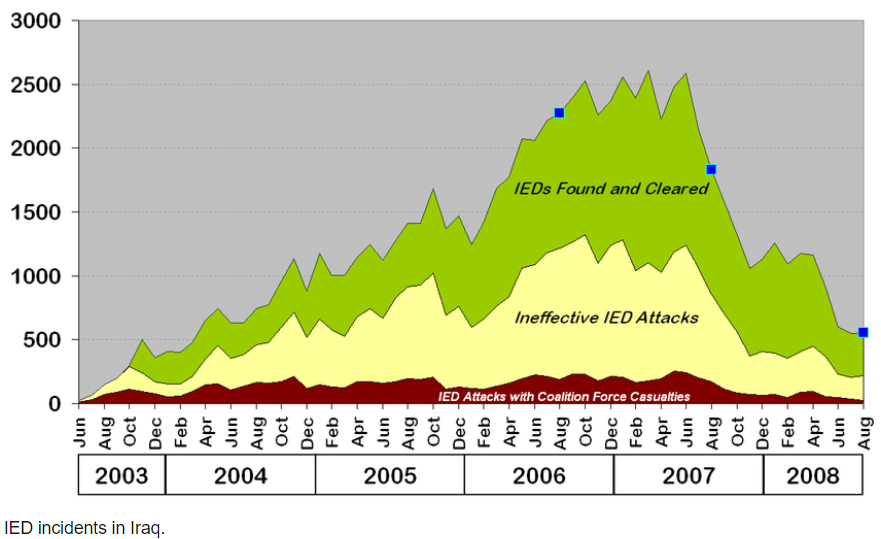
McKiernan recalls that in the summer of 2009, troops in Afghanistan were facing a terrible problem with improvised explosive devices. They had three "route clearance companies" to clear roads. Iraq, which faced far fewer issues with IEDs and mines at the time, had some 90 route clearance companies. That didn't change for eight years, until President Barack Obama ordered a surge in troops.

IED came in to AFG from the lessons learned by our enemy in IRQ. The problem manifested itself in IRQ first and then started to decline in 2007. Even at the peak fighting season in 2007 AFG, the IED attacks in IRQ were 10-times higher in IRQ than they were in AFG. The IRQ commander was very jealous of his assets – as he was with his ISR assets, through 2008 in case he needed them. 

See these two graphs. They help.


"What happens in that eight years?" McKiernan asks. "You have a Taliban, which has generally a safe haven in the frontier provinces and the Federally Administered Tribal Areas in Pakistan. They become resurgent. And eight years, we don't grow fast enough and well enough [the] capabilities of the government in Afghanistan and the army. And there you are."

...

McKiernan wonders aloud whether there were better ways to retaliate for September 11. He concludes that, there are "probably lots of things we could have done differently."

Remember at the start of the AFG conflict when everyone said that to avoid a problem like Vietnam we had to deny a safe haven? Well, we let Pakistan give them a safe haven. There is a direct line from there to 2021. Department of State, call your office.

The next two players are, in my opinion, the worst of the bunch; McChrystal and Petraeus;

"We didn't understand the problem," says McChrystal, who led international forces from 2009 to 2010. "The complexities of the environment, I think, weren't appreciated. We went for what we thought would work quickly over what would have likely worked over the longer term."

McChrystal argues that in hindsight, right after the September 11, 2001, attacks that triggered the invasion of Afghanistan, the US should have held its fire -- "no bombing, no strikes" -- though he acknowledges that would have been almost impossible. Instead, he would have spent a year building a coalition to counter al Qaeda and training Americans in Arabic, Pashto, Urdu and Dari languages "to get ourselves ready to do something that we knew would be very, very difficult."

McChrystal points out that no one was thinking in the long term, either. "I don't think we sat around a table, ever, and talked about where's this going to be in 20 years."

That is one of the most disingenuous comments about the AFG conflict by any General or Flag Officer. It is, in a word, bullshit. All we did – at least on the planning level – was talk about the long-term project this was. In 2008-09 in Kabul, that was the entire foundation of the Operational Plan.

As for his, “take a year” COA – I’m sorry, I was in theater at the start in 2001. In none of an infinity of parallel universes would that ever been thought of, briefed, or accepted. What a bullshit comment. I don’t need to say more, it mocks itself by its own existence.

Petraeus argues that counterinsurgency -- a strategy he co-wrote a book about -- worked. "It actually did work during the period that we had the resources to do that," he says. McKiernan disagrees. "I think in rural Afghanistan, which is most of Afghanistan, it has not worked," he says.

In general, it is best to ignore Petraeus and listen to McKiernan. ‘Nuff said.

"Much of our strategic attention and much of our strategic capacity was diverted into Iraq, to the detriment of the war," Allen says.

This is true in a variety of ways. Not fully appreciated at the time, but unquestionably true.

Dunford says he believes the US accomplished its mission "to prevent al Qaeda from attacking the United States, to prevent Afghanistan from being a sanctuary and also mitigate the risk of mass migration."

He adds, however, "We shouldn't confuse the outcome with saying that we did that at an appropriate level of investment." He would have liked to see "fewer young men and women having lost their lives, families suffering, casualties, there's no question about it. But at the end of the day, I'm not willing to say it wasn't worth it."

In the short term, yes. I am of the school that things are much more dangerous now than they were 20-yrs ago. That is what we should plan around today. If not, we’ll be luck. If so, we’ll be ready.

Go back and read McNeill’s comments. They resonate best of all, I think.

I’d also offer that you look back at the short video I posted last month with quotes from the commanders of the AFG war. This was, for most of its effort, a NATO effort until they culminated in 2007 and it shifted over to mostly a USA effort from there. 

That is one of the problems with this documentary that was also a problem during the AFG conflict. Too many Americans, from Main Street to the Joint Staff, never understood the international effort that was AFG for the first decade of the conflict.

Another error is the mistelling of the “Obama surge.” Review my contemporary writings from 2008-09 on the topic. What we called at the time the “uplift of forces” (to avoid confusion with the IRQ surge that took place earlier), began in 2008 with its first phase done before Obama became CINC. He just approved the next phase. The “Obama surge” was really a Bush-Obama surge. They both were involved. Seems like a small point, but it is an important historical fact that cannot be allowed to become forgotten. 


Tuesday, July 06, 2021

Are You Ready to Listen to me Now?

Over the July 4th weekend, we slipped out of the American fortress in Bagram. The way we left tells you all you need to know about Afghanistan – the conflict we lost in December 2009 when the Taliban were given the last indication they needed that we were not going to press the issue on our time and change Afghanistan our way, but we would let them win on their time and return Afghanistan their way.

It is all as clear now as it was when I wrote about our culmination at Obama’s West Point speech linked above. Regulars here know the story; the rest can follow the link above.

Good ideas are timeless, so I want to return to a topic that predates CDRSalamander and this is a decision point where we can decide to return our nation to its natural state.

My view of our place in the world started to gel in the mid-90s and by the late 90s had solidified into what in the 2020s has cured into a firm mass of resolve; we will destroy our republic by playing empire.

Generations of civilian and military leaders – and generations of citizens – had their view of America’s place in the world warped by WWII and the Cold War. In both cases, the world was faced with expansionist totalitarian secular confessions that required America to be the world power that it was. 

That world, thankfully, is gone. There are major threats in this world – Islamic fundamentalism is one, a renewed China is another – but neither of them have the combination of desire and ability that fascism and communism had. Neither are trying to expand their power by military means. 

Islamism has a bleeding edge, but its center of gravity is religious, and it has natural boundaries (unless stupid migrant policies succeed in letting it expand). 

China’s military growth is based on primarily ensuring access to resources to keep its population’s standard of living improving and as such, protect the domestic power of the Chinese Communist Party. 

We do not have a land border with either.

How do we mitigate risk against these two primary and lesser constellations of threats? Generally speaking, it doesn’t take a large standing army … which in a time of limited resources, that is a good thing.  Specifically: 

- Islamic fundamentalism: simple; contain and modernize. Contain Islamic fundamentalism to where is it now, and on the bleeding edge of the territory where it has reached critical mass, support local forces and governments to modernize along moderate lines. We cannot want a modern existence more than the people of those nations. We cannot force it on them. In nations where there is not a critical mass, aggressively eliminate small cells as you find them. The Cold War campaigns against the Red Army Faction, Weather Underground etc are a good template here. A deadly nuisance, but in time will fade through impotence and attrition.

- China: not so simple. China is primarily an economic and diplomatic challenge. She wants to use her economic power to back her diplomatic efforts to ensure that nations do not get in the way of her economic growth and future prosperity. From those two items, she will take was she sees as her natural place for a nation of 1.3 billion souls: the global leader by mid-century. 

China is not advancing primarily through military means. No, she is advancing by a clear national vision, economics, diplomacy, and an evolutionary, iterative advancement of her priorities for her people supporting her national greatness. Her military strength is to underline to others her larger national will; it is supporting, not supported.

While there are some nations such as India, Taiwan, Japan, and the nations around the South China Sea that have some territorial issues, unless you are a very paranoid Russian or Mongolian, China is not otherwise a military threat around her present borders. Where she is – specifically India – they have the land forces they need to counter China if so needed. Though accidents happen, China has no need for a land war on the Asian landmass. Her other conflicts are either at sea or are connected to her access and ability to secure her sea lines of communication to resources. 

That is the key; we do not need a large standing army to mitigate the most likely Chinese threats to us or our friends. We can best address the Chinese challenge through our economic strength and smart diplomacy. We have the advantage there if we choose to use it. Militarily, we also have the comparative advantage at sea, in the air, and space … if we choose to accept that.

How does this tie into what I started the post with? Easy.

We were enabled to think we could change Afghanistan, Iraq, Libya, etc etc because we thought we could do it on the cheap. Sure, a few National Guard forces would have to be activated, but mostly we had a large standing army to pull the effort from. Like former SECSTATE Albright said, “what is the use of a large army if you aren’t going to use it.”

That was the theory. In practice, especially in 2005-7, it turned out different especially in the reliance on National Guard forces, but we just managed to get through it only because we were one standard deviation away in 2003 from General Shinseki’s center point.

No big national discussion was needed. No large sacrifice. No great national mobilization. We went in half-ass, and our results were half-ass. In Iraq, it was a near run thing it was not a worse disaster than it turned out.

Wars of choice need to demand an understanding that wars are a dark room. You don’t know what is in it when you step in, but you will have to deal with it.

If wars are hard to get in to, you do not fall easily in to tar pits of whimsy.

Take that temptation away. Make it hard. Make it a national effort. 

We are a large nation with large responsibilities, but we are also a republic, not an empire.

Give our friends more warning than we did the Afghans last weekend but let them know we have a new strategy. They need to up their land game. We will be there to help, especially in the air and from the sea, but we will not do their work for them.

We plan to move 2/3 of our active ground forces to our National Guard. Except for a few combined logistics, maintenance, and training facilities, all our forward deployed land forces, and most of our air and sea forward deployed forces, need to come home.

WWII and the Cold War are over. Again, we are a republic, not an empire.


We will mitigate risk by ensuring that while we reset our ground forces, we maintain and improve our posture as the world’s premier maritime and aerospace power – including space. 

We will maintain a large and robust ground combat capability, but any large conflict will require mobilization of our National Guard and reserve forces. We will have a standing army, but our friends will need to plan to defend their territory with their ground forces primarily – at least at the start.

That is external … but the real benefit here is internal. Remember, the military did not get us in these long running small land wars in Asia this century nor initiate them.

Politicians and the civilians they appointed did. They provided the Direction and Guidance that drove Initial Planning Guidance. They pointed the military in a certain direction. 

A large standing army makes things too easy for people who have a short-term focus, especially politicians. Wars should never be easy for those who don’t have to fight them. 

Politicians do understand hard work as well as risk/reward. When silky smooth, feel good ideas ooze out of think tanks and faculty lounges into politician’s ears, when those politicians bring those ideas to their military staff, there needs to be a higher bar for yes-men … and more opportunities to deliver the hard truth that the politicians will need to ask more from the American people. No so much money, but the blood of their constituents living in their towns, working in their businesses, friends with their patrons and supporters.

The American people have a good, if imperfect, track record of supporting the expenditure of significant amounts of blood and treasure when needed. American politicians have a rather imperfect, rarely good, track record of convincing themselves they can fight wars of choice on the cheap.

The greatest threat to our nation’s future security and place in the world is not an unrestrained China, it is a US political elite’s inclination to empire.

Put up the guardrails. 

Come home. 


Tuesday, December 10, 2019

Shaping the Blame in Afghanistan

It is one of my favorite photos of my last deployment before becoming a civilian less than a year later. It was taken almost exactly 11 yrs ago.

It was a beautiful mid-day afternoon to sit outside on a table at Destile Gardens right outside HQ ISAF in Kabul. It was one of our regular smoke breaks for our organized gossip group where the message went out to meet, and we wandered over from our various desks in the 3-Shop, 5-Shop, security, and the front office to enjoy a pipe or cigar ... but more importantly - catch up on the latest developments.

It was the usual Star Wars bar gathering like you'd see at HQ ISAF, but this one was slightly different - it was all Anglosphere. Only half of us were USA, from O3-O6, including a guy at the back of the table, the oldest US Army Major you have ever seen. Always quiet, but he knew everything. Retired since the late 1980s, he was brought back on active duty a few years ago because of his specialty; he did civil affairs as a JO in Vietnam.

It was 2008, and we knew we were running out of time.

Most of us at the table had been working for most of the year, and in my and another's case even longer, on the uplift of forces that started to come late that summer. There are things you can do with Five-Eyes nations that just make planning easier, thus the Anglosphere nature of our gathering.

We had no idea what exactly the election a month before would mean for what we were trying to do, but we knew what the plan was meant to do. We had one last meeting in Qatar run by the Joint Staff to suffer through, and then the last part of the surge would be fairly well understood.

We were at the point then only trying to find enough airfield matting and rhino snot for the Red Horse and Seabees to expand airfields in RC(S), so the hard stuff was done.

We were happy about our timing, all things considered. 2007 made it clear that the short experiment of NATO running AFG was a mistake. The failure of filling the Aviation Bridging Forces of RW aircraft in RC(S) combined with the earlier announcement that the maneuver forces of Canada in Kandahar and the Dutch in Uruzgan were going home for good told us all we needed to know.

US Army to the East, USMC to the South; Uncle Sam was taking the keys back from a spent NATO force as the drawdown of forces in Iraq made it easier to find ready to deploy units.

We knew none of the trends were going our way and that there was no easy fix. This was going to take a long time. The general consensus at the table: 10-years if we stuck with Shape-Clear-Hold-Build.

We all knew the district map - and district by district we would have to create the conditions so AFG could be stable on AFG terms and we could all go home.

The key to us going home, we told each other, were those 8-yr old kids in schools who would have a different mindset when they became 18 ... if we could help the adults build a better AFG for them while they grew up.

If we didn't have the patience to see it through. Well, it got quite. None of us saw a high probability of anything but a lot of killing with any other plan - and more importantly, any path to something resembling peace on AFG terms. My take at the moment was, darkly, if we can't stick it out - retreat to the airfields, get everyone home, take what we can, leave what the ANSF can use, blow the rest in place. Let them work it out.

Well, the rest is history, and 11 years later all we have is hope and killing. As what little is left of our national patience runs out, we seem to be moving on to the recrimination phase where the responsible try to place their portion of the blame on the innocent. 

Honest mistakes are twisted in to conspiracies, PAO optimism is seen as propaganda, and the truth gets lost in a miasma of incomplete stories, ignorance, and the inefficiencies of agendas and templates.

All that is to be done at this point is for those who were there and still give a damn to step up and tell their story - and critique the stories of others.

So, after about 4 different drafts and a good night's sleep, I'm going to wade in to it. Before that though, I know a lot of the regular readers here, the "Front Porch," have honored me by being here reading my prattle for a decade or more. They have heard most of this before, some as it was happening. For those new or newish here, go to the bottom of the post where the Afghanistan tag is. It's all there. Almost a decade and a half on Afghanistan as a USA tactical operator, staff weenie, and finally a NATO fonctionnaire.

I should just walk away, but I won't.

...and so it starts.

With Craig Whitlocks article out, many are selectively focused on what little they paid attention small attention to for so long - and I'm about to crawl out of my skin.

This will not stand. I will not let what happened to those who served in Vietnam be saddled to those of us who served in Afghanistan.

I will not let "the military lied and lost the war" smear start before we've even drafted the MOVEORD to the Friendship Bridge.

Did we cover ourselves with glory? No ... but what GOFO said or did not say was closely scoped by what D&G their civilian masters gave them ... and it is they - the folks in suits - who need to answer first before anyone else comes under the spotlight.

There are partial stories, wrong stories, selectively edited stories ... and a whole lot of ass-covering stories in the impressive Special Inspector General for Afghanistan Reconstruction (SIGAR) interviews behind the paywall.

There are some good things here, but as a body, it is incredibly incomplete. It is as if he is writing a restaurant review about a bad slice of apple pie he was served, but only discusses the type of apple in the pie and the fork it was served with. No discussion of the crust, filling, temperature … just little bits here and there.

Whitlock can only write about what he got from his FOIA, but the gaps here are mind boggling. Yes, it has been a long war - but some periods and institutions are more important than others. Some you simply cannot do without. At least my friendly acquaintance Sarah Chayes (read her 2007 book) got some mention and a chance to respond.

Like the old saw goes; victory has many fathers, but defeat is an orphan – but not when it comes to the blame game. People, institutions, and agendas will point fingers all over the place to avoid any blame being put on them. Oldest game in the book … and like we saw in Vietnam, the cheap and easy thing to do is blame “the generals” – specifically those at the Operational and Tactical levels.

Nope. Not here. Not today Satan; not today.

First some comments I made on twitter Monday that I will consolidate here.

I’ll start with what was most missing; General  McKiernan's tenure at the end of Bush43 and start of the Obama administration and what we saw as the only way to do what DC and Brussels was asking to be done; Shape-Clear-Hold-Build a better Afghanistan. The plan I helped write at CENTCOM in NATO? He knew, we knew - we had a plan.

No one was hiding anything from anyone when I worked with/for him.

From an article in The Guardian, of all places, in 2009, here is a summary that should show you why the absence of any discussion of McKiernan’s experience is such a hole in Whitlock’s article;
"We can win all the tactical battles but that doesn't mean we win. To win, we have to win the battle of ideas," he said. "We must define winning in Afghan terms: meaning improved security, reduced civilian casualties, trustworthy government, economic and social progress."
McKiernan spoke of the need to increase Afghan army forces, provide a better-respected police force, root out foreign jihadis and Taliban extremists, and seek regional solutions via a "bottom-up" approach. "Most Afghans don't want the re-emergence of the Taliban. But we need a greater commitment by the international community ... Afghanistan will not ultimately be a military outcome. Isaf will not run out of bad people to kill. It will be a political solution."
These approaches accurately reflect Obama's Afghan policy, except McKiernan was already pursuing it six months before Obama made it his own. So the question remains: why was he fired?
One answer seems to lie with General David Petraeus, the Centcom commander and hero of the Iraq surge. Petraeus was the baleful, missing figure in the room when Gates and Mullen wielded the knife. Subordinate to McKiernan in Iraq, he is now his superior. The two men are not said to be close.  
McKiernan had allegedly been slow to adopt Petraeus's favoured counter-insurgency tactics, such as co-opting local tribal groups (as in Iraq). McChrystal, in contrast, is a special operations expert with a reputation for hunting down "high value" enemy targets.
Petraeus, McChrystal, Mullen … yeah, those guys.

That leads to the second largest gap in the article – and something missing from the majority of reporting from American media; the role of NATO.


Again, you can find more detail over the years at the Afghanistan tab below, but let me summarize.

The first stage of the war was invasion and set up, mostly ‘01-03. From ’03 to ’05 the initial inertia started to slow, but we did not fully see that the Western experience in Afghanistan in the 21st Century was going to be like it was in the 19th and 20th Centuries. Our NATO allies were joining – in a fashion – and by ‘05 things were set up to by early ’06 to hand things over to NATO.

Yes, the General in charge of NATO at HQ ISAF in Kabul was an American, but the Americans only had significant forces in Regional Command-East (RC-(E)). The Anglo-Canadian-Dutch-Australians had RC-(S). Spain-Italy RC-(W). The Germans and Scandinavians RC-(N). RC-(C) was, nominally, the dominion of the Turks (that is a long story in to itself).

That construct held until the Summer of 2007 when another attempt to fill the never filled Combined Joint Statement of Requirements (CJSOR) failed. When the promised Aviation Bridging Force NATO nations promised did not appear, as we do, the USA cobbled together a fix at the last minute. That is when the USA realized that NATO would never be able to do what it promised. When NATO couldn’t even scrape enough cargo and support rotary wing – not to mention the never filled maneuver forces in the CJSOR – the USA knew NATO cumulated.

Canada and The Netherlands announcing they were withdrawing their maneuver forces that year was just icing on the cake.

Farcical national caveats that limited utility of most partner nations gave a false view of actual usable forces. (Best example, German Operational Mentoring and Liaison Teams (OMLT) trains and mentors an ANA Kandak that has to move to another province to reinforce another Kandak … and the Germans refuse to cross a provincial boundary, leaving the Kandak to go forward with either no mentors, or as was the case, American mentors from an American Embedded Training Team (ETT) working with another Kandak have to come in and make it happen. 

Second best was the Belgian security at the airport. If my convoy was 200 meters from the gate and was under attack, they could not support us. They couldn’t leave the airport.

As I’ll quote from Whitlock’s article later, another thing that grabbed me was the hand wringing from those clueless staffers at USAID.

They were exceptionally difficult to work with in AFG regardless of how hard we tried to integrate efforts with them. They are in no position to throw shade on anyone.

The ones who told me they were building 1,800km of gravel road regardless of which areas were controlled by the enemy or not ...and had no clue about what kind of culverts were needed for IED mitigation? Never came to the follow-on meetings as asked?

Those guys? Sit. Down (at least those who were their before 2010).

Also in the article, the dates are not quite in line with what actually happened. The surge was dead in 2009 after the strategic sea-change on the ground after Obama's DEC09 West Point speech. Again, read what I said at the time.

So, are we going to play the blame game are we? 

We are going to selectively focus on certain time periods and turn a blind eye to the more complicated experience that was/is Afghanistan?

Well, bollocks to that. We all knew this was losable from junior staffers to the 4-star level in '05 on. 

Why do you think McKiernan came in with SCHB a few years later? 

We briefed the Obama advance team before the inauguration about the surge and SCHB that was already underway and the importance of momentum ... and they pissed it all ways in DEC09. 

The article has some great information, but I am left screaming in to the void with the complete lack of emphasis on the Bonn Accords, McKiernan, lead nation construct early on, and more.  There is a lot of self-serving people quoted making excuses for their own self interest - accuracy for history be damned as far as they're concerned.

You do have to give WaPo credit allowing people mentioned to respond behind the paywall - and there are a lot of valid critiques to be found that, sure, I will admit are not wildly known ... but we are 19 years in to this conflict.

The happy talk? That part of the critique is ligit. A lot of that has to do with the PAOisms that people feel the need to form up behind. The constant "just around the corner" stuff does, after awhile, grind down credibility. 

Part of the problem is the sound bite world we live in. It is hard to explain to people in 5-seconds nuance and branches - must less effects and military planning. We've all been there when the primary goes in front of the press and makes his hostage tape, only to come back looking deflated. 

That is a tough row to hoe, but that is part of the job. A hard job with many masters. Your #1 master? The civilian leadership at the POLMIL level.

What are in-theater operational commanders supposed to do when on high orders state that, "Under no circumstances are you to discuss the impact of partner nation national caveats or issues with IO/NGO/GO."

The press has a lot to blame on itself.

Again,  "we" knew this had the potential to go south 15 yrs ago, but that odds were it would go south on AFG time. The press knew too. They were all in our HQ and in the field. They ate, drank, smoked, traveled and deployed with us. 

People love yelling at "the generals" but the suits in DC and Brussels and those in Bonn in the first year are the ones who need to be held to account first.

The shortcomings I have with the summary article sitting on top of the big FOIA dump should not be seen as shade thrown at the author. Whitlock has done a great job here with what he had on hand and should be commended for it. 

That being said, there are significant problems with what is there – or not there – and that is where the danger is for those that are just now starting to think about Afghanistan. The problem is the source material. There are huge gaps in both time and personality.

I was both a US and a NATO guy at different times in AFG, all during the first decade of the conflict, and have watched from the sidelines for the second decade. That is where I noticed the first glaring gap, as I’ve seen it before; the data is too USA centric.

I’ll put my biases right out there, my sympathies are more on the NATO view of the conflict vice the USA view of the conflict. Even for USA officers in the first decade of the war who were working the NATO side, what the USA was doing in RC-(E) was another war. 

RC-(E) never communicated well with the rest of the International Security Assistance Force (ISAF), even to the USA components working under the NATO umbrella. It was dysfunctional, but not isolated to RC-(E) alone. 

None of the RC’s mid/late decade worked well together. People like to talk about Afghans’ tribal issues, but ISAF had its own tribal problem; the stubborn German tribe to the north; the haughty Anglo-Dutch tribe to the South, the sedate Mediterranean tribe out West, and the reclusive yet violent American tribe in the East. There was also the strange case of the Turkish tribe in Kabul with their secret agreements with the shadows no one would speak of.

All my sympathies aside about the NATO vice USA view of AFG, NATO was a mess and mostly hapless. When I stepped back in for my last tour, the Canadians and Dutch were already heading out the door and the Brits were maxed out. We had lots of other nations, but they were slathered with an amazingly complex matrix of national caveats that made them mostly useless for much of the spectrum of tasks. 

The Anglosphere nations, Dutch, Danes, Estonians and a couple others were of mostly full use, but the others only a fraction once you took their national caveats in to account. As a result, what I considered the superior view of the conflict coming from the NATO side of the house simply never had enough useful force to garner much credibility. At the end of the day, everyone knew the USA would have to do the heavy lifting.

He who does the heavy lifting wins the argument.

Oh, the USA. Beyond that strange and violent tribe in RC-(E), there was the strangely distant and blinkered view coming from CENTCOM in Tampa and the Joint Staff in DC. 

I’d spent some time in Tampa, and knew their angle, but the Joint Staff seemed to be running their own war. We’d come out of a VTC with the JS and wonder, “Where are they getting this stuff?” We’d show up in Qatar for a big confab, and often it seemed that the JS never read anything that came out of Kabul - and they sure weren't sharing their stuff ahead of time. 

The only thing more disconnected were the Department of State delegations and the Obama advance team.

Everything seemed like a blank slate with them. Not that they were too lazy to do their homework – they just didn’t think years of work, observations, and lessons from others were of any value. They were talking to someone and reading something, but not from the staff in-country. That was the impression at least. They were good, passionate people (especially Holbrooke who was right about a lot and stood out), but there wasn’t a curious attitude from most of those at the staff level – more imperious. 

Well, that’s my rambling intro … so here we go.

Craig Whitlock's, The Afghanistan Papers: A Secret History of the War.

I want you to read it all and I free-formed enough in the intro, so let me just pull a couple of things;

First, know the context of what you are reading;
With a bluntness rarely expressed in public, the interviews lay bare pent-up complaints, frustrations and confessions, along with second-guessing and backbiting.
People are people;
Several of those interviewed described explicit and sustained efforts by the U.S. government to deliberately mislead the public. They said it was common at military headquarters in Kabul — and at the White House — to distort statistics to make it appear the United States was winning the war when that was not the case.
Not while I was involved from 05-09, and unquestionably when I was in Kabul in '08-09. Nope. Not once while I was there, in the CUB, publishing reports, briefing various people, did anyone at any time distort statistics. Never, not once. I didn't see it in Tampa while I was there either. I can't speak to what happened at the Joint Staff; but in Brussels, Kabul and Tampa - no one screwed with numbers.

Name names.
“Every data point was altered to present the best picture possible,” Bob Crowley, an Army colonel who served as a senior counterinsurgency adviser to U.S. military commanders in 2013 and 2014, told government interviewers. “Surveys, for instance, were totally unreliable but reinforced that everything we were doing was right and we became a self-licking ice cream cone.”
'13-14? That was General Dunford, USMC's tenure has COMISAF. He ended up as CJCS, retiring at the end of September this year.

Huh.
... SIGAR has published seven Lessons Learned reports since 2016 that highlight problems in Afghanistan and recommend changes to stabilize the country.
But the reports, written in dense bureaucratic prose and focused on an alphabet soup of government initiatives, left out the harshest and most frank criticisms from the interviews.
“We found the stabilization strategy and the programs used to achieve it were not properly tailored to the Afghan context, and successes in stabilizing Afghan districts rarely lasted longer than the physical presence of coalition troops and civilians,” read the introduction to one report released in May 2018.
Of course. It is because we abandoned SCHB in DEC09 and only played not to lose since.
Sopko, the inspector general, told The Post that he did not suppress the blistering criticisms and doubts about the war that officials raised in the Lessons Learned interviews. He said it took his office three years to release the records because he has a small staff and because other federal agencies had to review the documents to prevent government secrets from being disclosed.
3 years? We fought and won WWII in under 4 years.
“We didn’t sit on it,” he said. “We’re firm believers in openness and transparency, but we’ve got to follow the law. . . . I think of any inspector general, I’ve probably been the most forthcoming on information.”
No, you slow rolled it or are an inefficient blob. Remember what I have been saying for years about how broke our governmental IG systems are? There's another data point.
“We don’t invade poor countries to make them rich,” James Dobbins, a former senior U.S. diplomat who served as a special envoy to Afghanistan under Bush and Obama, told government interviewers. “We don’t invade authoritarian countries to make them democratic. We invade violent countries to make them peaceful and we clearly failed in Afghanistan.”
I wish that were true, but I don't think James has read much about what was said in the first 24-months of the war. I don't think he has read the Bonn Agreement. I think I have heard enough from James.
“I may be impatient. In fact I know I’m a bit impatient,” Rumsfeld wrote in one memo to several generals and senior aides. “We are never going to get the U.S. military out of Afghanistan unless we take care to see that there is something going on that will provide the stability that will be necessary for us to leave.”
“Help!” he wrote.
The memo was dated April 17, 2002 — six months after the war started.
It took 6-years to get SCHB off the ground. We dithered and trusted NATO's untested optimism too much. 
Some of the interviews are inexplicably short. The interview record with John Allen, the Marine general who commanded U.S. and NATO forces in Afghanistan from 2011 to 2013, consists of five paragraphs.
LOL! Of course. Allen has gone uber-political. What did you expect?
In contrast, other influential figures, including former U.S. ambassador Ryan Crocker, sat for two interviews that yielded 95 transcribed pages.
I always found Crocker a good man trying to do his best. 95 pages is what I would expect from him.
Yet the interviews show that as the war dragged on, the goals and mission kept changing and a lack of faith in the U.S. strategy took root inside the Pentagon, the White House and the State Department.
To be fair, as we say this at the time, even though for most of the first decade of the war the US only "ran" one of the four RC's, DC always acted as if AFG were a US only operation. Also, there was little continuity in the Staffs and Commanders - and there was constant churn and little sustained knowledge. That had a lot to do with the inertia; once people understood their job, they were rotated out and their expertise lost in a personnel system CONUS that did not realize we were at war.
Dec. 1, 2009
“The days of providing a blank check are over. . . . It must be clear that Afghans will have to take responsibility for their security and that America has no interest in fighting an endless war in Afghanistan.”
— President Barack Obama, in a speech at the U.S. Military Academy at West Point, N.Y.
Read what I said at the time. This was the pivot point. On this day, the Taliban knew they just needed to wait us out, that we lacked the will to win. They did, we didn't.
U.S. officials tried to create — from scratch — a democratic government in Kabul modeled after their own in Washington. It was a foreign concept to the Afghans, who were accustomed to tribalism, monarchism, communism and Islamic law.
The below ... I'm sorry ... but that was the mindset from the beginning!
During the peak of the fighting, from 2009 to 2012, U.S. lawmakers and military commanders believed the more they spent on schools, bridges, canals and other civil-works projects, the faster security would improve. Aid workers told government interviewers it was a colossal misjudgment, akin to pumping kerosene on a dying campfire just to keep the flame alive.
Amazing amnesia. 
One unnamed executive with the U.S. Agency for International Development (USAID), guessed that 90 percent of what they spent was overkill: “We lost objectivity. We were given money, told to spend it and we did, without reason.”
That is your fault USAID. Like I mentioned earlier, at least when I was there, you were impossible to work with. Heal thyself.
Christopher Kolenda, an Army colonel who deployed to Afghanistan several times and advised three U.S. generals in charge of the war, said that the Afghan government led by President Hamid Karzai had “self-organized into a kleptocracy” by 2006 — and that U.S. officials failed to recognize the lethal threat it posed to their strategy.
True. It was his entire family. Huge impact on things great and small. For a significant time period if you needed gravel there was only one person you could get it from - Karzai's brother. He had the corner on rock crushers, it seems.

This too was not the fault of "the generals."
In the Lessons Learned interviews, however, U.S. military trainers described the Afghan security forces as incompetent, unmotivated and rife with deserters. They also accused Afghan commanders of pocketing salaries — paid by U.S. taxpayers — for tens of thousands of “ghost soldiers.”
Another long running problem that was nothing but graft driven. Leaders stole their people's paychecks. That simple ... and we let them.
One unidentified U.S. soldier said Special Forces teams “hated” the Afghan police whom they trained and worked with, calling them “awful — the bottom of the barrel in the country that is already at the bottom of the barrel.”
You get what you pay for - and we paid a lot. What do we have for it?

Well ... it isn't worse than it was on 10 SEP 01.

That is enough from the article, I'll let you pick through the rest. 

Is there anything "new" here? Perhaps ... but only for those who were content to let others fight for the better part of two decades, but were too distracted to make the effort to find out what was going on.


Tuesday, May 21, 2019

The Story of the Afghanistan Graphs

Armed Conflict Location & Event Data Project (ACLED) continues to be one of my go-to spots for good data, specifically on Afghanistan.

A little over a decade ago when I was finishing up my last tour supporting operations in AFG, in our talks in HQ ISAF and around the country, we didn't expect this is where we would be half-way through 2019 - but we knew we could be here.

I have to give the Taliban credit where credit is due. As I have outlined here for the last ~9.5 years, since we sent a clear signal at Obama's West Point speech in DEC 2009 that we did not have the will for what needed to be done, the Taliban knew they could do this on AFG time with AFG methods; husband your forces to get ready for the post USA/ISAF presence civil war to come. Keep the attacks going, and just enough to make sure you can say you kicked them out the door. Time is on our side, Allah is on our side, the West is weak and corrupt. Like the infidel Soviets before them, they will leave frustrated and defeated. We will take back what was always ours.

Just look at the graph and the notes to the side. The story is all there for you to see.

It didn't have to be this way, but perhaps it was destined to be.

Read it all.

Tuesday, June 13, 2017

So, we get Stav and Mattis in a room ....

So, SECDEF Mattis (no, I don't get tired of saying this) put it right out there;
"We are not winning in Afghanistan right now. And we will correct this as soon as possible," Mattis said in testimony to the Senate Armed Services Committee. Mattis acknowledged that he believed the Taliban were "surging" at the moment, something he said he intended to address.

From last month, Jim Stavridis outlined 5 reasons we need more forces in AFG

First, it is a tactical necessity. Over the past two years, the Taliban have been steadily encroaching on Afghan government control of territory, and by some estimates they are now in a position to influence the population in 40% of the country. While Afghan Security forces number over 300,000 and have shown real mettle in many places, they are taking significant casualties and still require effective mentoring down to at least the Battalion level. That means an increase in our overall troop strength is necessary.

Second, the emergence of an Islamic State element in Afghanistan is very concerning. While they have largely been unable to galvanize either the population or create cooperation with the Taliban, they have conducted a series of disruptive terror attacks and add further chaos to an unstable system. A larger NATO force can blunt their impact.

A third key reason is to create political capital that can be very helpful when some portion of the Taliban (who are not a holistic organization to say the least) eventually come to the negotiating table. We will never “win” militarily in Afghanistan, nor can we kill our way to success. Sooner or later we will need to bargain, and a stronger NATO force on the ground will give us better leverage.

Fourth, the additional forces send a signal to the Pakistanis, who are still somewhat playing a “double game” of overtly cooperating with NATO, but in reality supporting some elements of the insurgency. This commitment will tell Pakistan we intend to continue to work for a successful outcome in Afghanistan, and will hopefully encourage them to force the Taliban into negotiations.

Which brings us to another key point: what does success look like? Afghanistan is not going to resemble Singapore anytime soon; but it can have a functioning democratic government, general control over much of its borders, the ability to minimize impact from the insurgency, armed forces with high public approval, and a reduction in both corruption and narcotics — the latter two issues posing a longer term threat to the nation than even the Taliban. Getting to that point of success will require security and thus the additional forces.
I've been writing about AFG from the start of the blog, click the AFG tag below if you're new here and want to catch up.

Both Mattis and Stavridis are spot on. Since Obama's DEC09 West Point speech, we turned over all momentum to the enemies of modernity. 

We had a good, long range plan by 2008, but that was all thrown away. There is a lot to do.

Though we are as a nation tired, and on some days I think we should just all just look for the airhead version of the Friendship Bridge and cover what we leave behind in thermite ... but that isn't how this works.

Mattis was the first General Officer to set foot in AFG as a 1-Star, and Stavridis had to do what he could with the Political Level D&G he received from Obama as SACEUR.

A smart person would defer to their recommendations, or at least give them a fair hearing.

If those two gentlemen are standing up and pointing in a certain direction, I'm lacing up my boots and forming up behind them.

$.02.

Tuesday, May 09, 2017

Desperately Seeking Phase 4: AFG Quandary Again

I guess it is time, again, as I have done every few years for the last decade+, to review how we got to where we are in AFG.

To understand why we are here, you have to know how we got here. 

It isn’t an easy story, but it should not be a surprise. Click the AFG tab if you want to see what I’ve written in the past on the topic, but I’ll summarize a bit here.

It can be best described in seven acts.

Act 1: Original Sin – Take the institutional arrogance of United Nations bureaucrats, business-class flying NGO leadership, Davos world view, and imbue it with a slight whiff of residual colonial parochialism, and you have the immediate post-911 Bonn Agreement. 

It was finalized when many of our Special Forces still had not washed the horse sweat from their DCUs. It set up a structure for the future Afghanistan before the power centers there could weigh in. Afghan solutions to Afghan problems and all that was simply not transformational enough. 

There were good people there who meant well, but it was asking too much, too soon, with too little appreciation for the realities of Afghanistan. This isn’t 20/20 hindsight either. We argued it at the time along the lines of, “Are they really committed to this for the long haul?”

This ran for roughly the first 2-3 years. Two recommendations for the later portions of this period that don’t get the attention they deserve: First, Sarah Chayes’s book, The Punishment of Virtue, and the documentary by Sedika Mojadidi, Motherland Afghanistan.

Act 2: Allied Hope – NATO decided to prove that it was more than just an exercise club and more than Euro-centric. As with a rather small footprint the USA seemed to have AFG under control, NATO believed it could take charge. From 2005-2006 it was decided while the USA remained in control of Regional Command East (RC-E), the Brits, Canadians, and Dutch would take RC-S, the Spanish and Italians would take RC-W, the Germans RC-N, and the Turks would take RC-C in Kabul.

It looked OK for a while, but the security situation started to spiral out of control. The exercise club also took some of its bad habits with it to war, and it stumbled. 

First, the Combined Joint Statement of Requirements out of Mons just never got filled. Some of the contributing nations who did throw their hat in the ring only did so with so many national caveats and ROE restrictions that they could never leave base, or if they did, couldn’t do much. They didn’t bring the right kit, or for some newer NATO nations, had no idea how to deploy. The assumption was Uncle Sam would, as always, pick up the slack.

Act 3: Buyer’s Remorse – By late 2006, the NATO-sceptics critique started to break above the happy-talk. AFG was more serious than NATO and the USA were saying, and most of the alliance member were not up to the challenge, and if they were – their staying power was brittle at best. 

If you had to draw the line somewhere, it would have been the summer of 2007 when NATO failed to fill the rotary-wing aviation bridging force. At the last minute, a combination of US military and civilian contractors filled the gap. After that goat rope, it was clear that NATO culminated. It was clear to the Americans in NATO and at the USA Joint Staff. 

Planning began to, in unkind terms, take back the keys … as long as the surge in Iraq worked. Some of the larger minimal-caveat maneuver forces, the Dutch and the Canadians, had already signaled they had enough and were going home. We needed to not only replace them over time, but increase the national presence overall.

Bit by bit, RC by RC, we took the keys back.

Act 4: Classic COIN’s Stillbirth – There is a little overlap between Act 3 and 4, as they transitioned slowly in parallel. A new Scots-Irish General came to lead the US forces in AFG and ISAF, General McKiernan, USA. He brought with him “Shape, Clear, Hold, Build” – a plan to combine civilian, governmental, and military efforts district by district to enable government of Afghanistan control. 

Shape and Clear required additional forces. Through late 2007 and 2008 the planning for the uplift of forces (surge) was made. The Iraqi surge’s success happened just in time, and forces were able to begin coming in by the summer of 2008.

Then we had an election. The new administration came in to Kabul to look over the surge plans, and with minimal changes, allowed it to continue. It was clear that there were new ideas with Holbrook and his fellow travelers, but that it would take a year for them to get those ideas ready for President Obama to issue derived D&G.

With SCHB and the uplift, we thought at the time this was a decade long effort if we stuck with it. In Destile Gardens we would darky speak that if we ditched this conditioned based plan and went to a calendar based plan, we might as well just retreat to the nearest airhead and go home.

It took less than a year.

Act 5: Retreat – President Obama’s December 2009 West Point speech where he announced a calendar based plan that signaled retreat, it seemed everything else was just commentary on the inevitable drive to The Friendship Bridge … if we were lucky.

In a story yet to be told well by anyone … over the course of the next year, someone competent and knowledgeable about military matters got the ear of President Obama and we never fully left in the summer of 2011 as he outlined. We hedged, and we got lucky.

Act 6: The Great Dithering – Obama moved the decision point to the right, to the next President. We treaded water in quiet, drone filled dreams of hoping that Afghanistan would just go away. From the end of his first administration through his second, we dithered. We mowed the grass and relied on hope. He hoped a disaster didn’t happen on his watch, we hoped for something we could call a win.

Act 7: Acceptance and Salvage – Here we are in Act 7. As with the change from Bush to Obama, the first year of Trump will mostly be the conditions created by the prior administration. As with McMaster and Mattis having better first hand knowledge of the area, it appears that we may see changes faster.

This week, we have heard that President Trump has a plan to look at;
The Washington Post this week reported that senior administration officials are pushing President Donald Trump to effectively return to the combat mission against the Taliban, adding thousands of troops to the fight.

Sources told the paper the new plan would also authorize the Pentagon to set its own troop numbers for Afghanistan, instead of following White House recommendations. Pentagon officials would also review the rules of engagement for troops operating there, following a Trump campaign trail promise to give military leaders more autonomy.
...
White House spokesman Sean Spicer said no decisions on troop levels in Afghanistan have been finalized yet, but he reiterated Trump’s promises to keep America safe and root out terrorist threats across the globe.

“One of the things he has asked our national security team to think through is to think through the strategy,” he said. “How do we win? How do we eliminate the threat?”
We should wait and see – and serious national security people need to give Mattis and his team the benefit of the doubt and a chance.

We can’t rewind back to 2009. The window long ago closed for SCHB and helping district by district drag Afghanistan to where we would like them to be.

Perhaps in Act 7 we can salvage something from Act 6. We keep enough forces in place to help build capacity of the ANSF (#evergreen) and to have the ability to kill AQ and ISIS where they pop their head up, as it pleases us. We accept that Afghanistan will have to come to peace on Afghan terms as best it can with its always restive Pashtun plurality. As long as trans-national terrorists can’t use it as a base, then that should be OK.

That should be good enough, and perhaps where we should have kept it before Act 1 set everyone off this long, sordid task almost a generation ago.

Tuesday, July 28, 2015

Behold, the wages of a speech

It is like watching a yard you once cared for slowly fade to weeds, dead spots, and brambles.

As we have discussed for over 5 1/2 years, this was all foreseen. When you retreat under fire, this is what happens.

Sudarsan Raghavan at WaPo has a heartbreaking story about the fruit of this administration's shift in December 2009, now that it is starting to ripen.
Across Afghanistan, tens of thousands of people are once again on the move. It’s a grim deja vu of the years of civil war and Taliban rule, when masses of Afghans flocked to refugee camps. What’s different now is that much of this desperate migration from rural areas to cities is unfolding in Afghanistan’s northeast, reflecting the conflict’s shift from conventional fighting zones in the south and east.
The new refugees are also a bleak symbol of how the shape of the fight has changed since the U.S.-led NATO mission formally ended combat operations last year. Afghan security forces, now backed by less American air support, are engaged in more fierce ground battles with insurgents, trapping civilians in the paths of mortars, rockets and bullets. With the Taliban fragmented and new militant groups surfacing, including the Islamic State, the number of front lines has surged around the country. Civilian casualties are at record levels.
...
The exodus has now reached levels unprecedented since the Taliban regime’s demise in late 2001. Nearly a million Afghans — about 3 percent of the population — have been driven by conflict to other parts of the nation.
...
And after nearly 14 years of conflict — and with crises in Syria, Iraq and South Sudan competing for the world’s attention and dollars — “donor fatigue” has set in, aid workers say. Halfway into the year, the United Nations has received less than one-third of the $405 million it has requested from the international community to respond to Afghanistan’s various humanitarian problems.
...
In the first five months of this year, doctors treated three times as many patients for conflict-related injuries as in the same period last year. On this day, every bed was full. Last month, over a four-day period, doctors treated 77 patients injured by clashes, one-third of whom were women and children.
This is the future our leaders chose. This is what we warned would happen if we did not have the strategic patience to play the long game.

This next pull quote is a nice vignette of what Shape-Clear-Hold-Build, district by district, was designed to avoid - and what became inevitable following President Obama's speech at West Point in December 2009.
“I am worried about getting shot again,” said Ghafoor, his eyes downcast as he lay on a bed in the hospital ward. “I don’t care if the Taliban or the government rules. All I want is security.”
...
“My whole life was a few hens and a cow,” said Jamillah. “I have lost all of them, as well as my son and my home. How can I go back?”
This too is Obama's legacy.

If you thought the Islamic State found fertile ground in Syria and Sunni Iraq - wait until they build partnerships with the Taliban. Wait until the Iranians move in to Herat and the Shi-ite Hazara heartland of the country to fight against the Islamic State aligned Sunni tribes.

Yes, a legacy of a feckless, shortsighted, and self-referential foreign and defense policy.