Showing posts with label Unmanned systems. Show all posts

Monday, October 31, 2022

The Aspects of the Sevastopol Attack You Need to Focus on

The big navalist news over the weekend was unquestionably what appears to be a successful attack on the Russian Navy at Sevastopol by remotely piloted surface craft by the Ukrainians.

Some reports call them "drones" or other such descriptors, but really they appear to be an upscaled militarized remotely piloted surface vessel on a one way trip. There is a lot of expected hyperbole about the attack, and that is what I wanted to address today. I am concerned that the overhype by the ignorant, click hunting, or agenda driven people in the public space will cause us to miss the most important lesson here.

This attack was not historically significant in a larger sense, no more than the attack on the Moskva was. This is not a glimpse into the future of naval warfare. This was simply a continuation of sound naval tactics with a pedigree directly tracible thousands of years in to the past. Not to understand this is to dangerously not understand what happened.

First of all, let's take a moment to state the obvious: the Russians should have been ready. They had about as clear of a warning as possible in September.

A MYSTERIOUS vessel widely believed to be a Ukrainian suicide drone has washed up near to a Russian naval base.

The vessel was found in Omega Bay, by the port of Sevastopol, which is home to Vladimir Putin's Black Sea fleet.

We can safely assume - as the videos below seem to demonstrate - that the ones used in the attack are of the same design.

We will loop back to this point later, but just behold the simplicity of it via the article from The Sun linked above;
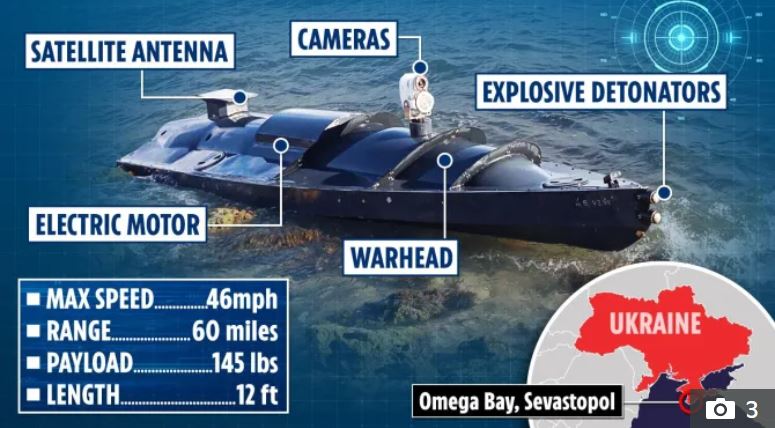
This is all COTS technology riding on either a canoe or ocean going kayak. If you have someone with an understanding of explosives and communications (the only part requiring military expertise +/-) and then any garden variety electrician, small engine pro, and fiberglass guy ... you can run a production line of these on a shoestring budget at scale.

They look fragile, but ... well ... I'm getting ahead of myself. Let's finish setting the table.

In a classic, "We live in magical times.." moment, take some time if you have not already to look at the released video we have of the attack as published by The Guardian;

Now that we're through with the fun stuff, let's get to the serious lessons.

First - and this is the most important - this is no transformational breakthrough in warfare at sea. From the start of the written record of naval warfare, attacking another nation's navy - especially a stronger navy - in port with remotely piloted or unmanned surface vehicles has been "a thing."

Before the advent of explosives, they were simple "fire ships" like these Song Dynasty examples;


Even a thumbnail review of the next thousand years through the Crusades and untold numbers of European wars to WWI and WWII - this tactical action is used.  

Even non-state actors like the ever-inventive Houthis of Yemen have a recent record of similar use just five years ago.

The details of the Ukrainian attack on Sevastopol will come out in time but the bold-faced lessons are clear - as are the warnings.

This is another demonstration that the military culture of Russia is broken. The human element in the Sevastopol was manifested in the complete lack of preparation for the attack in spite of the warnings so clearly provided in September.

As old as "fire ships" are to naval warfare are the defenses to them. They are as simple as the weapons needed to defend against them. Barriers at the water level and crew served weapons - preferable optically sighted - as a backup.

Part of the video above you can see both surface ship and helo gunfire taking out the threat from one boat, but other boats were able to approach surface ships underway and penetrate deep in to port. 

Why? 

What is one of the things we have repeatedly discussed here for the last 18-years? When war comes you never have enough of what? That's right, anti-aircraft defenses and medium caliber guns including crew served weapons. 

We build our ships around the most high-technology threats and equally exquisite defenses against them, but completely overlook the low-tech weapons that are just as deadly. We ignore mine warfare, and we also ignore threats as simple as a converted kayak. It isn't sexy and the contracts awarded are small ... but the threats are real.

There isn't a sexy or expensive defense against them - though you can try to sell one - and the best defense you have are Sailors on watch - with good surveillance equipment to support them - and weapons they can use at scale and volume.

Yes, there is a cost to have increased manning levels, additional weapons in the armory and drills/training to maintain readiness ... but if that is the cost to be ready for war ... then do it.

Look at the early lessons from WWII to the Falkland Islands War etc; at peace we get lazy. When war arrives, we find ourselves lining the rails with anything that can throw lead.

The Russians do not appear to have taken the most obvious and immediate steps to address this cheap, low-tech threat. They did not have significant barriers in place at the entrance to their harbors or around their ships' berths. They did not have Sailors on watch with weapons at the ready.

They were complacent. They were arrogant. They assumed too much.

Now is the time to loop back to a few points made at he top. This is where everyone needs to focus their attention.

1. For thousands of years, weaker naval forces have significantly damaged superior naval forces by using their disadvantage to advantage. When large and heavily armed warships are designed, trained, and manned for war against their peers on the high seas, how do you best attack them? Inshore with simple; small, lightly armed civilian derived boats roughly designed, simply trained, and unmanned. 

Be it a raft filled with burning straw and tar, or a butched-up sea-kayak filled with RC boat tech, commercial satellite data, Sea-Doo propulsion, duct taped explosives and contact detonators. If the larger naval force in a mix of arrogance and bureaucratic sloth, or just professional malpractice, refuses to see the full-spectrum vulnerability - even when I&W tells you it is there - then the motivated, flexible, and capable smaller power will reach in to history's toolbag to pick out the best bang for the buck.

2. You do not have to be a state power to create the modern "fire ship." You do not have to access controlled technology. You don't need even a lot of money. You just need imagination and the bare minimum of technical capability.

3. Most readers here are familiar with San Diego, Norfolk, Mayport and our other major naval bases. Can you wargame the rest? Yes, we have some nice barriers you can even see from GoogleEarth, but what about getting from the pier to the open sea in 2022? Where could the enemy hide? How much warning do you have? How many crew served weapons do you have ready ... and what is your ROE in such crowded ports? I don't know about you, but I like Mayport even more now.


Good on the Ukrainians for using this time proven tactic. It was clear the Russians were not ready for it - a common characteristic of the Russian military - so the Ukrainians took advantage of the Russians' sloth.

As for the US military, I'm really not interested in the question of how we could use such tactics, but as we are the big Navy, I want to know more what we do to protect ourselves from this tactic.

We can start with what is the most obvious: more crew served weapons. 

More smaller boats to escort our ships to sea (USCG or USN, don't care).

If I were a state or non-state actor watching this scene - I'd already have plans in place and just wait for the moment to be ripe. 

I hope we are ready for same.

Saturday, August 28, 2021

The US Navy's Unmanned Programs, with CAPT Captain Pete Small, USN - on Midrats

While a lot of the attention in unmanned systems the last two decades has been in the air, significant developments on and under the surface of the oceans were happening in parallel.

From small mine hunting unmanned surface vessels and the development of the Large Unmanned Surface Vessel above the seas, to unmanned systems the size of lightweight torpedoes to midget submarines below the surface, unmanned maritime systems capabilities are growing each year.

With each incremental advance in engineering automation to autonomous operations, their utility from maritime security to war fighting increases as well.

For the full hour this Sunday from 5-6pm Eastern our guest to discuss the potential of unmanned platforms will be Captain Pete Small, USN, Program Manager for Unmanned Maritime Systems (PMS 406) in PEO Unmanned and Small Combatants.

A submariner by trade, CAPT Small has led PMS 406 since 2018 after multiple tours on submarines at sea, and ashore as an instructor, and leading program management and development.

He earned a Bachelor of Science Degree in Mechanical Engineering from the University of Virginia as well as earning a Master of Science Degree in Operations Research in 2002 from Columbia University and a Master of Science Degree in Mechanical Engineering and a Naval Engineer Degree in 2005 from the Massachusetts Institute of Technology.

If you use iTunes, you can add Midrats to your podcast list simply by clicking the iTunes button at the main showpage - or you can just click here. You can find us on almost all your most popular podcast aggregators as well.

Wednesday, August 11, 2021

What if the Future Can't be Unmanned?


Do you get a little worried when people seem to be a bit overexcited at the prospects of such a large percentage of our fleet being unmanned in the near future?

Are you worried that too few hard questions are being asked and answered?

Me too.

Head on over to USNIBlog and help ask more hard questions.

Sunday, October 04, 2020

Missile Barges and the Modern Auxillary Cruiser with Chris Rawley

 Turning merchant ships in to warships is a story as old as mankind. From war canoe to privateers to auxiliary cruisers fo the modern era - they always fit a certain niche in the drive to control the seas. What of today? 

What options are there if we need the ability to get as much "national will" downrange and over the horizon as soon as possible? Combine that question with a new one, "Where are all the VLS cells we need?" - and you have a great episode of Midrats. 

Returning to Midrats this Sunday from 5-6pm Eastern to discuss these and related issues will be Chris Rawley. 

Captain Chris Rawley is Reserve Chief of Staff for Commander, Naval Surface Forces, helping to oversee 3,800 reserve sailors supporting fleet units around the world. During his 28 year military career, Rawley has filled a variety of leadership positions in naval, expeditionary, and joint special operations units afloat and ashore. He has deployed to Afghanistan, Iraq, throughout Africa, the Persian Gulf, and Western Pacific. Rawley has a degree from Texas A&M University, earned an MBA at George Washington University, and is a graduate of the U.S. Naval War College and Joint Forces Staff College. In his civilian role, Chris is the CEO of Harvest Returns, a platform for investing in agriculture.

If you use iTunes, you can add Midrats to your podcast list simply by clicking the iTunes button at the main showpage - or you can just click here.

Tuesday, August 18, 2020

LUSV is Looking Like a Mating of Jeffboats and Auxillary Cruisers

Our friend David Larter may have to report this straight, but I am under no such requirement. 

Get the waffle-paddle out - time to take the Large Unmanned Surface Vessel (LUSV) to task.

Unchallenged dreams, accountants, and yes men - these are what get us, to be blunt, shitty programs. Throw in a bit of careerism and greed with a few other human weaknesses ... and you get a fleet - just not one worth a damn in war.
As the U.S. Navy pushes forward with developing its large unmanned surface vessel, envisioned as a kind of external missile magazine that will tag along with larger manned surface combatants, a growing consensus is forming that the service needs to get its requirements and systems right before making a big investment.
In other words, sober minds have reached the point they can't dismiss the neo-transformationalist money pit otherwise smart people are pushing. Good.
“The approach has to be deliberate,” Gilday said. “We have to make sure that the systems that are on those unmanned systems with respect to the [hull, mechanical and electrical system], that they are designed to requirement, and perform to requirement. And most importantly, are those requirements sound?
That is the polite way for the CNO to say, "You know that fiasco that was LCS and DDG-1000? We need to at least pretend that we learned something from that living nightmare."
“What I’ve found is that we didn’t necessarily have the rigor that’s required across a number of programs that would bring those together in a way that’s driven toward objectives with milestones,” Gilday told Defense News.
AKA, people were believing the PPT and industry/consultant spin and fever dreams.
“The Navy wants LUSVs to be low-cost, high-endurance, reconfigurable ships based on commercial ship designs, with ample capacity for carrying various modular payloads — particularly anti-surface warfare (ASuW) and strike payloads, meaning principally anti-ship and land-attack missiles,” the report read.
The Navy also wants a pony for its birthday.
“One of the biggest challenges people are realizing now is the machinery systems and keeping the systems operational for six months [over a deployment],” Collette said. “If you think about a ship today, there are daily machinery rounds and constant preventative maintenance. The Navy has its casualty reporting system, and the commercial world has something very similar. And over six months, that’s a lot of work that’s not getting done on the autonomous ship.
This challenge, the merchant one, is actually the easiest to overcome. For the military, you have legal, piracy, connectivity, damage control and AI maturity that are the harder nuts to crack.
“But the other approach is to try and monitor it and put in a lot of redundancy and figure out how we get this system reimagined so it can do a six-month deployment. And I can’t really assess where we are with that at this point, I just don’t have enough insight to know if that’s six months away. Is it six years? Is it never reachable?”
Another polite way of saying, "Calm down people. This is about as ready for prime time as a 1950s Popular Mechanics article on the future military."
...jumping toward something like large unmanned surface vessel, is a big, big step with a lot of risk.”
This last quote gives me hope. I think we have in some quarters at least, hoisted aboard the hard lessons of the Age of Transformationalism. We need to maintain a humble view of what we can accomplish, re-embrace the "build a little, test a little, learn a lot" approach to weapons development and to keep a weather eye out for squishy salesmen pushing snake oil dripping PPT programs.

Saturday, May 30, 2020

AI, Autonomous Systems, Emerging Tech & the Future of War with Chris Brose - on Midrats


The relentless advance of knowledge and technology has always been with us. The speed and impact of the advance can vary, but the key - especially when it comes to those advances related to warfare - is to at least pace the advance, and if possible, be at the front.

There can be box canyons, false trails, mirages and other dead ends you may follow, but mixed in with the wrong is "what's next."

Are the USA and its allies ready for the changes in artificial intelligence, autonomous systems, and other emerging technologies that are already here or right over the horizon?

This Sunday from 5-6pm Eastern to discuss this and related issues in his book, The Kill Chain: Defending America in the Future of High-Tech Warfare will be Christian Brose.

Brose is currently Chief Strategy Officer of Anduril Industries, a technology start-up that develops national defense capabilities, and Senior Fellow at the Carnegie Endowment for International Peace. He served as Staff Director of the Senate Armed Services Committee (2015-2018), where he was the youngest person to hold the position in the committee’s history. Before that, he served as Senator John McCain’s senior policy advisor (2009-2015). Brose was previously a speechwriter to two secretaries of state, Colin Powell and Condoleezza Rice, and a member of the State Department Policy Planning Staff.

You can listen to the show at this link or below, but remember, if you don't already, subscribe to the podcast at Spreaker or any of the other podcast aggregators.

If you use iTunes, you can add Midrats to your podcast list simply by clicking the iTunes button at the main showpage - or you can just click here.

Monday, March 16, 2020

A Terrible Decision by the Commandant of the Marine Corps

What are the primary drivers when it comes to the unmanned systems we will deploy forward, ready for wartime use? 

Size, range, use, mission, flexibility, technology risk, commonality, basing, cost? What weight do you give each variable - and why?

With only a few systems that will end up getting a funding line, you need to make sure you thought it through correctly, and have the right set of priorities.

This week, let's take a look at the USMC's recent decisions on unmanned air systems from the point of view of friend-to-the-blog Bryan McGrath.

Bryan, over to you.

Since assuming the duties of Commandant of the Marine Corps last summer, General David Berger has enjoyed a fairly smooth go of it, releasing a Commandant’s Planning Guidance to near-universal acclaim and putting forward a vision of naval integration around which the Department of the Navy has wisely moved to coalesce. And so, it was surprising earlier this week to see the Commandant make a decision that so starkly works against the principles of integration for which he has so forcefully advocated.

The decision, as the Naval Institute’s Megan Eckstein first reported, was to restructure the Marine Air-Ground Task Force (MAGTF) Unmanned Aerial System (UAS) Expeditionary program -- known as “MUX”--from one centered around a large, medium altitude long endurance (MALE) unmanned vehicle organic to the ships of the amphibious force to a “family of systems” approach that would rely heavily on a “very large land-based aerial vehicle and a medium sized one for shipboard operations”. There are three main reasons that this decision is wrong, and Acting Secretary of the Navy Thomas Modly should intervene quickly to reverse the Commandant’s error.

Reason 1: Kiss the “Lightning Carrier” concept goodbye


Commandant Berger expressed support for the “Lightning Carrier” concept in his planning guidance. As described in detail in the Center for Strategic and Budgetary Assessment’s 2017 Fleet Architecture Study, the Lightning Carrier would evolve the current LHD/LHA from its current singular devotion to the support of troops ashore, to a multipurpose, multi-mission conventional deterrence platform built around the considerable capabilities of the F-35B. The LHD/LHA would become more of a small aircraft carrier and less of an amphibious assault platform. Key to this transformation would be the provision of the LHD/LHA or its escorts with a proper intelligence, surveillance, reconnaissance, and targeting (ISRT) platform, one acting as an integral part of the planned and executed operations of the amphibious presence forces. As envisioned, MUX was the platform that would create this transformation. To put it another way, to achieve the Lightning Carrier, the F-35B was necessary, but not sufficient.

Barrels of ink have been wasted over time in the distinction—made primarily in the United States—between an aircraft carrier and an amphibious assault vessel. The most important distinction has been the availability of organic ISR/T from the aircraft carrier’s deck. The E-2D more than anything else, is what makes an aircraft carrier. Its huge wingspan requires a large ship. A large ship requires nuclear reactors to be efficient and effective. As capable as the LHD/LHA has been, it is utterly dependent on land-based ISRT and the ISRT provided by the carrier air wing. Had the Commandant made the decision to provision the amphibious force with a true MALE ISRT platform, the LHD/LHA would minimize its reliance on inorganic targeting and surveillance. Denying this organic capability regrettably makes an F-35B-packed LHD/LHA into a more lucrative and less well-defended target, and less of a maritime dominance/integrated naval power platform.

Reason 2: Missed Opportunity for Closer Integration with the Navy’s Surface Forces


There is no question but that a capable MALE UAV within the MUX program would have been a costly proposition, one that it would have been difficult for the Marine Corps to shoulder alone. This is why the true value proposition for this program would have come into sharp relief in a Navy/Marine Corps program that would provide the MAGTF with the ISRT it requires under the MUX program, and the Surface Navy with the additional ISRT it requires as a result of a new generation of longer-range anti-ship and strike missiles. One of the more innovative aspects of the MUX acquisition was the oft-repeated desire that the unmanned vehicle be capable of fitting into an ARLEIGH BURKE Class Destroyer helicopter hangar. A common solution based around modular sensor and weapons packages would have been a win-win for both the Marine Corps and the Navy, bringing with it considerably more and more responsive lethality and ISRT within the forces that make up the “contact” and “blunt” layers of our National Defense Strategy.

Reason 3: Unwise Reliance on Land-based ISRT

The most disturbing aspect of the Commandant’s decision is the degree to which he is sacrificing the precision and certainty of organically-controlled ISRT for the uncertainty and inefficiency of land-based solutions, a subject my former colleague Seth Cropsey and I studied in our November 2019 monograph “If You can’t See’em, You Can’t Shoot’em: Improving US Intelligence, Surveillance, Reconnaissance, and Targeting”.

Looking specifically at the Navy’s MQ-4C Triton system, we suggested that the Navy’s planned buy of 68 systems (in order to have 20 deployable at all times) was woefully inadequate to the task of consistent ISRT of the area inside the First Island Chain, a task made even more difficult by the extensive fly-in ranges of the land-based aircraft that would provide the coverage, in some cases using half their fuel simply to transit the huge distances in the Western Pacific.

A truly effective conventional deterrent in the Western Pacific is one in which each and every Chinese Navy ship captain understands that he is targeted as soon as he leaves port, the kind of targeting perception under which U.S. commanding officers currently operate within the First Island Chain. This certainty is not going to be provided by wide area search platforms ferrying in from thousands of miles away. It will be provided by ISRT platforms of enough mission duration that sensor to shooter kill chains can be maintained organically, while high altitude, long endurance land-based UAV’s remain the purview of theater commanders executing operational and strategic surveillance schemes.

Putting aside the wisdom of more heavy reliance on land-based ISRT, there is a roles and missions question here. Do we need yet another service buying and operating its own large, land-based ISRT systems? Does the Marine Corps really believe that even if it were to acquire such systems, that they would be able to exercise the same level of MAGTF level control of them in an age of Joint asset allocation? The Joint Requirements Oversight Council (JROC) should look long and hard at any USMC program that seeks to duplicate already existing and somewhat inefficient capabilities.


Conclusion


Acting Secretary of the Navy Thomas Modly has been exceptionally good at talking about Integrated American Naval Power, and he has an opportunity to strike a tangible blow for its future by halting the USMC MUX program in its tracks and directing the Commandant and the Chief of Naval Operations to report back to him on the prospects for an integrated, departmental solution to the mission requirements of the two services. An organic, MALE UAV that services the targeting needs of our nation’s conventional deterrence forces where they operate and under their control is a necessary step to providing a deterrence posture that influences the adversary to reconsider aggression.


Bryan McGrath is the Managing Director of The FerryBridge Group LLC, a national security consultancy. The ideas offered here should be considered his and are not those of any client he represents.

Sunday, March 15, 2020

Unmanned and Unafraid ... on Midrats

First of all, it's glad to be back on watch at the 'ole blog. Just got set back up in time for this week's Midrats and I wanted to thank everyone for hanging with the usual suspects in the comments section. 

I have not had a chance to read through them all, so hopefully there aren't pics of Byron or Laz skinny dipping, but you never know.

Anyway, I'm back and the theme for the first few posts, including this one, will be unmanned systems. 

Tomorrow we'll kick off the week with a post from our friend Bryan McGrath about the USMC's recent decision on unmanned systems. 

It will be up first thing in the AM, so see you there ... but for now - on to Midrats!

Where will unmanned technology take us in the maritime security arena?

We already have more than a toe in the water, and with each year unmanned systems at sea are taking a larger role.

Our guests Sunday from 5-6pm Eastern to discuss these and related topics will be Dr. William Burnett and Dr. Todd Holland.

We will use their recent article, Unmanned and Unafraid: The Transformation of Naval Oceanography, as our starting off point.

Dr. William Burnett is the Technical Director to the Commander, Naval Meteorology and Oceanography Command/ Task Group 80.7. In this role, he provides technical responsibility and oversight for a fleet of six survey ships, 2,000 civilian and military personnel and a budget over $300 Million.

Dr. Todd Holland is Chief Scientist for Littoral Oceanography Sensing at Naval Surface Warfare Center Panama City Division. He is presently detailed to Commander, Naval Meteorology and Oceanography Command to support the alignment of strategic priorities & collaborative initiatives between the two commands. He serves as senior technical representative on multiple efforts involving Unmanned Systems throughout the Naval Research & Development Establishment.

You can listen to the show at this link or below, but remember, if you don't already, subscribe to the podcast at Spreaker or any of the other podcast aggregators.

If you use iTunes, you can add Midrats to your podcast list simply by clicking the iTunes button at the main showpage - or you can just click here.

Tuesday, November 19, 2019

Not Antiseptic War via Technology; War Will Only Get Deadlier

Part of the drive to unmanned systems it, at least from the side that uses it, a desire to minimize casualties. 

Sure, there are also theoretical cost savings ... and micro-managers love the idea of systems who follow orders w/o 2nd thoughts or any thoughts ... but what are we missing?

Something scifi writers have built careers on is not being discussed well enough. Especially when both sides will have similar technologies ... are we simply building a new way for mass slaughter on a scale no one is ready for?

Anthony Swofford in Technology Review, author of the well known book made in to a movie, Jarhead, makes some superb points worthy of consideration.

I think he is more right than anyone will be comfortable with;
Many now profess that the young Marine or soldier with a rifle is obsolete. The greatest weapons race of all is among academic scientists trying to win DARPA funding for new warfighting technology they insist will require scant human interface with the killing act, thus relieving the combatant of the moral quandary and wounds of war. Private-sector startups sell a myth of smart war through AI, or robotic soldiers. In labs where the newest and cleanest ways to kill are being invented, the conversation is not about the morality of going to war, but rather the technology of winning. But when you rely on a myth of technology and distance killing to build a rationale for easy war, your country will lose its soul.
...
If fighting war is like swiping your smartphone for an order of groceries or posting a meme to Instagram, how bad can it really be? And if a politician is seduced by the lies and supposed ease of technological warfare and leads us into a mistaken conflict, is it really his or her fault? Didn’t we all think it would be a breeze?

The moral distance a society creates from the killing done in its name will increase the killing done in its name. We allow technology to increase moral distance; thus, technology increases the killing. More civilians than combatants die in modern warfare, so technology increases worldwide civilian murder at the hands of armies large and small.

The person with the least amount of distance from the killing—typically an infantryman or special operator—is the most morally stressed and compromised individual in the war’s chain of command. When close-quarters combatants understand that the killing they have practiced is not backed by a solid moral framework, they question every decision taken on the battlefield. But they also question the meaning of the fight. They count their dead friends on one or even two hands. They count the men they have killed on one or two hands, or by the dozen. The moral math will not compute.

The photos and videos of war on our television screens, on our computers, on our smartphones, tell us nothing about the moral computations of the warfighter. The warfighter understands that when a friend is killed on patrol, that is just part of the package. Another part of the package is going back out on another patrol tomorrow. But as you live and operate for longer in a hostile environment, your hatred of the enemy increases and your trust in leadership decreases. You create a moral wound against yourself.

War was supposed to be easy or fast, because of smart bombs and the latest bit of warfighting technology. But this means nothing when years later you only see dead men, women, and children when you try to sleep.

When we believe the lie that war can be totally wired and digitized, that it can be a Wi-Fi effort waged from unmanned or barely manned fighting apparatus, or that an exoskeleton will help an infantryman fight longer, better, faster, and keep him safe, no one will be held responsible for saying yes to war. The lie that technology will save friendly, civilian, and even enemy lives serves only the politicians and corporate chieftains who profit from war. The lie that technology can prevent war, or even create compassionate combat, is a perverse and profane abuse of scientific thinking.
Read it all.

Monday, August 19, 2019

Large Unmanned Surface Vessel: Relax, We're Just Testing a Little

So, we're taking the next step to see what we can do with unmanned surface vessels;
“We’re at the point where we really have to get them out there to start understanding how tough are these things, how robust, and how are they going to integrate with the fleet, what kind of policies are going to surround these systems when you start talking about potentially separating weapons from humans,” Vice Adm. Bill Merz, then deputy chief of naval operations for warfare systems (OPNAV N9), told USNI News in April. 
“So we’re cautious on that side, but we’re very aggressive in getting it out there, so we’re trying to run these parallel paths and illuminate these challenges and start resolving them in parallel.”
You can see the draft request in full here.


It has been curious to watch so many get so overexcited about this - a bit too much science fiction reading, I guess. Perfect example is from the UK. I know it is a tabloid, but a good representation of the heavy breathing in some places about this project. Everyone should slow down their expectations a bit. 1968's view of 2001 was a bit optimistic, as was 1975's view of 1999.

A lot needs to be worked out. My top-3:

1. Operations in a non-permissive EW & SATCOM/NAV environment.
2. Collision avoidance & accountability.
3. Force protection & hijacking prevention.

Big Navy, to my relief, is not overselling this concept. We're investing some significant cheese in the concept - but in a good way. Take some time to review last month's Congressional Research Service report as well.

Build a little, test a little, learn a lot.

It works.


Monday, March 18, 2019

Build a Few Unmanned Surface Vehicles, Test a Little, Learn a Lot

As our friend Dave Larter reported late last week, the Navy seems to be moving forward in a smart way to see how much of the theory of operating large surface ships in an unmanned manner can actually be operationalized.

I have questions, a lot of questions, but this seems like a good start. 

Let's see what happens.
The Navy raised eyebrows in its budget rollout Tuesday when it requested $400 million for two large unmanned surface vessels to be purchased in 2020, with 10 total to be purchased across the five-year projection known as the future year defense program. But it was not immediately clear what exactly the Navy was buying two of, since no program of record exists for a large unmanned surface vessel (or LUSV).
...
In total, the service has programmed $2.7 billion across the FYDP. And on Wednesday evening, the Navy dropped a request for information from industry seeking to “determine if sources exist that are capable of satisfying the Navy’s anticipated program requirement for Large Unmanned Surface Vessels (LUSV).”
...
According the 2017 draft plan, Overlord is seeking a ship that can do virtually everything a larger manned vessel can do – obey the international rules of the road for navigation, plan a route for a mission, communicate with other ships (manned or otherwise) in a task force – and do it with very little interaction with sailors once it gets underway.

“The Overlord program will develop core autonomy, communications, and C2 components and field prototype USVs capable of being seamlessly operable with the fleet,” the draft says. "The Overlord program will have built in redundancy in all critical hardware and software systems. The program will involve integration and test of payloads for [electronic warfare], [anit-surface warfare], and [strike warfare].”

The program, in keeping with SCO’s modus operandi, places an emphasis on using and adapting existing vehicles and technologies, the draft says, and “will take advantage of commercial technologies, integrate existing vehicle designs, and mature existing autonomy capabilities to accomplish its goals.”

The draft lays out a two-phase plan that starts with a 12-month phase I, which asks industry to demonstrate a vehicle that could meet the requirements laid out in the draft, including a range of 4,500 nautical miles, “capable of operating in at least Sea State 5, with at least 80,000 lbs. of payload capacity and 75 kW of 450V, 60 Hz, three-phase AC power reserved for payloads."
I am encouraged by this in that the usual suspects will overhype this for their own uses, institutional Navy is not. This is testing and evaluating as it appears it should be done.

Quite encouraging.

Saturday, March 09, 2019

John Jackson: One Nation Under Drones - on Midrats

How are unmanned systems and the increasing use of robots from the kitchen to the battlefield impacting how our personal, professional, and national lives are being run?

What are the obvious and not so obvious places they are already a dominate presence today, and where are trends leading us?

Our guest for the full hour this Sunday from 5-6pm Eastern to discuss the issues he raises in his book, "One Nation Under Drones" will be John E. Jackson, CAPT, USN (Ret.).

Professor Jackson has served at the Naval War College for more than 20 years, teaching in the areas of national security decision-making, logistics, and unmanned and robotic systems. He holds the E.A. Sperry Chair of Unmanned and Robotic Systems and lectures frequently. His latest book “One Nation, Under Drones" was published by the U.S. Naval Institute in December 2018. He is the program manager for the Chief of Naval Operation's professional reading program. Additionally, he serves on the President's Action Group and as chairman of the 9-11 Memorial Committee. A retired Navy Captain, he served in supply and logistics assignments both afloat and ashore retiring in 1998 after 27 years of active service.

Join us live if you can, but if you miss the show you can always listen to the archive at Spreaker. 

If you use iTunes, you can add Midrats to your podcast list simply by clicking the iTunes button at the main showpage - or you can just click here.


Wednesday, May 30, 2018

The Drone Economy of Scale

If you think some are being overly alarmist about the fusion of AI, drones, and cheap manufacturing - then you might be wrong.

More over at USNIBlog.

Come give it a read.

Thursday, January 04, 2018

In Addition to a Vote, the Enemy has Eyes and Ears

I think no better picture captures the blinkered mindset of many designing cutting edge weapon systems than the DDG-1000 advertising poster of the last decade.

There she is, alone and unafraid - attacking an unpopulated, supine, and defensiveless coast in the tropical regions of Shangri-La.

In the real world, it is crowded and messy. Our world is teeming with people and those people go about their business as best they can to feed their families. In most of the world, the coastal regions are full of small boats either plying some trade or attempting to catch what few fish the Chinese left behind.

In those waters, we plan to send out unmanned systems. Have we in any way designed them to hide themselves, defend themselves, or at least evade? Once again, it appears not.

As reported by Ben over at USNINews;
Houthi forces have captured a U.S. Navy research unmanned underwater vehicle off the coast of Yemen, according to a video released on Monday.

In the video posted online by local media on Monday, four men described as members of the “Houthi Navy” in dive gear are surrounding what appears to be a REMUS 600 UUV with the name “Smokey” printed on the body. According to the AMN News web posting, the Houthis discovered the UUV within the past week somewhere off the coast of Yemen.
Good googly moogly - as the below video shows, we even have it painted in "capture me yellow."


We need to up our game a bit.