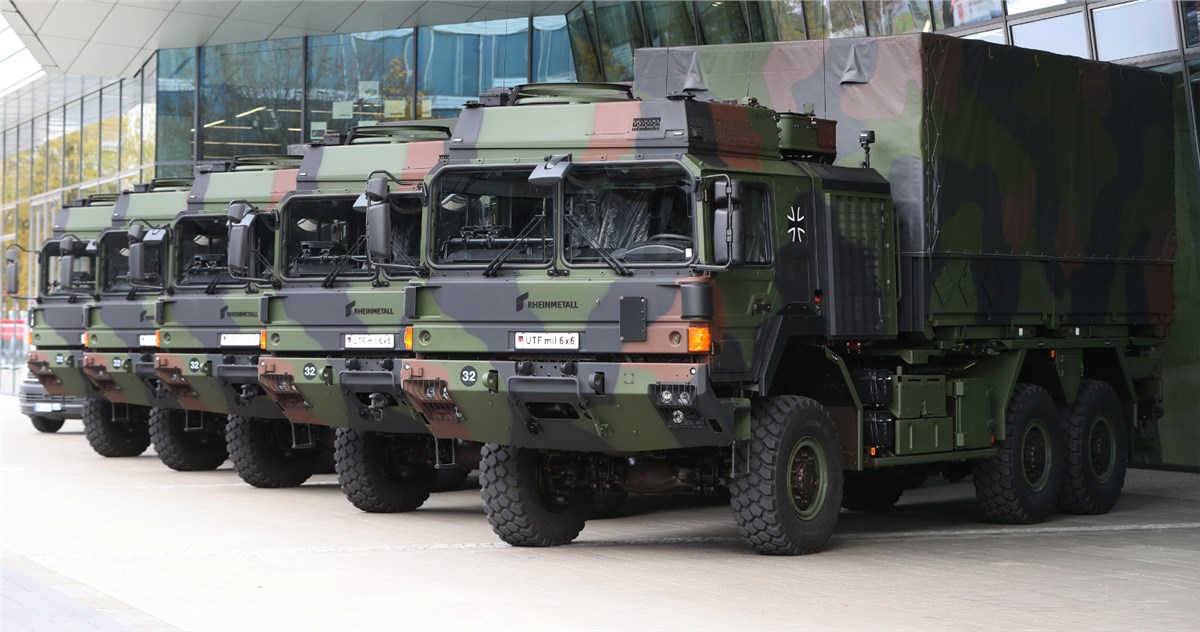
Showing posts with label Logistics. Show all posts

Monday, April 11, 2022

Rethinking the Logistics Challenge after Looking at Ukraine from the German Point of View


Unloved logistics ... when you ignore her, she will let you stew until you need her, and then she will let you panic in flop-sweat.

The Cult of Efficiency ... it make you feel smart at peace - but at war she will put you at strategic risk and deal you the unnecessary death of untold number of your people.

As war comes again at scale in Europe, you have to hope that for our friends, the good people in hard jobs are quick learners and are in institutions/nations that are equally able to adjust.

Germany is the key for continental NATO. Geographically, economically, and demographically - you cannot avoid that fact. While the political will and the money that follows it are an open question, what about the German military?

There is reason for confidence there at least. Take some time to see this interview via the Bundeswehr's YouTube Channel by Kapitän­leutnant Nana Ehlers, German Navy, with Luftwaffe Lieutenant General Martin Schelleis, Inspector of the Armed Forces Base (Inspekteur der Streitkräftebasis).

Watch the whole thing, but to save you time I've started the video below at the meat of the logistics discussion.

This snippet left me impressed as in under two months of war you have such a senior officer take the correct lessons - as learning institutions do. He points out well meaning but wrong decisions made in the past influenced by the Cult of Efficiency that did not survive contact with reality, and then proposes a correct return to sound and established practices.

"The current structure of the Bundeswehr, as it is currently structured in the capabilities, in the structures, is actually based on a different picture of war, not on national defense and alliance defense, but on international crisis management, as we say today, "out of area" operations. That's why we reduced our own forces in strategic transport, including tactical transport, because we assumed we could definitely do it (transport and logistics) with cheaper civilian service providers. Well, with the refocusing on national defense, we have a different picture, so we have to  insource some of what we outsourced for reasons of secured availability in case of need..."

Imagine if we could do this with regards to known deficiencies in our "unsexy" but important support,  maintenance, logistics ships, and facilities we know will be needed in any war in the western Pacific ... but still refuse to take steps to address the requirement now before war comes.  You can add in tugs, salvage, tenders, auxiliaries ... etc. 

Note: this interview is in German. If your German is not up to where it should be, just click the settings part of the video in YouTube, then subtitle/cc, then autotranslate, then English, and that will work for you just fine.

A final note, if you don't subscribe to the Bundeswehr's YouTube channel, you need to now. Especially with autotranslate, there's no excuse. Simply outstanding stuff here.

Instead of the, to be frank, fried air and totally ignorable content we find a the US Navy channel, imagine if we had the institutional confidence to do what the Germans do here? Yes it is controlled, but the questions are serious ... and are JOs asking GOFO.



NB: if you are hoping the US Navy has as much of a smart social media presence as the Germany Army ... well, as I pointed out last night on twitter, don't get your hopes up.

Sunday, April 03, 2022

War, Pestilence, and Famine - the World's Logistics Falters - with Ross Kennedy on Midrats


If it's April, it's time for a return visit by Ross Kennedy to Midrats!

A little under a year ago, we had Ross on to discuss the impact of COVID and related structural issues to the global supply chain. A year later, we find conditions have not just remained, but with war in Ukraine and a new COVID variant working its way through coastal China, in many ways the global trade in essential items has turned for the worst.

If you are worried about the cost and availability of fuel, food, and everyday items you've spent the last decade assuming were always going to be there at a price you're happy with, then you need to join us from 2-3pm Eastern this Sunday.

Ross is a U.S.-based logistics and supply chain expert with more than fifteen years in international transportation, procurement, and analysis. His unique blend of operations, sales, and strategic planning allows him to provide creative, agile solutions for his public- and private-sector clientele.

Join us live if you can
, but it not, you can get the show later by subscribing to the podcast. If you use iTunes, you can add Midrats to your podcast list simply by clicking the iTunes button at the main showpage - or you can just click 
here. You can find us on almost all your most popular podcast aggregators as well.

Monday, September 20, 2021

Shippings Flock of Swans

Most readers here are aware of the fleets parked off major ports on both coasts; 
The number of container ships at anchor or drifting in San Pedro Bay off the ports of Los Angeles and Long Beach has now blown through all previous records and is rising by the day.

There were an all-time-high 65 container ships in the queue in San Pedro Bay on Thursday, according to the Marine Exchange of Southern California. Of those, a record 23 were forced to drift because anchorages were full.

Theoretically, the numbers — already surreally high — could go a lot higher than this. While designated anchorages are limited, the space for ships to safely drift offshore is not.

“There’s lots of ocean for drifting — there’s no limit,” Capt. Kip Loutit, executive director of the Marine Exchange of Southern California, told American Shipper.

“Our usual VTS [Vessel Traffic Service] area is a 25-mile radius from Point Fermin by the entrance to Los Angeles, which gives a 50-mile diameter to drift ships. We could easily expand to a 40-mile radius, because we track them within that radius for air-quality reasons. That would give us an 80-mile diameter to drift ships,” said Loutit.


Over at Splash247, they have a few interesting points to consider; 
“What you see today is not only a black swan event, but in fact an entire bevy of black swans, and one which grows larger by the day, as more and more weak strands in the supply web snap,” Jensen says.

The US is indeed the real origin of this fiasco, the Dane agrees. Yet, he has answers to why warehouses are so full.

According to Sea-Intelligence research, many industries in the US are actually dangerously low on inventory.

Another explanation is the very real shortage of drivers to take goods from those warehouses that are actually full, to the consumers.

A game of musical chairs

Steve Ferreira, CEO of New York-based Ocean Audit, describes today’s clumped box situation as like a game of musical chairs.

“You don’t want to be left standing without a seat, and it’s a self-perpetuating cycle,” Ferreira says, giving a couple of recent examples such as Walmart ordering 149 containers of garbage cans on one single vessel or a French tire manufacturer inking a new charter to Houston.

“How are Michelin’s tires going to supply cars you can’t buy due to a chip problem?” Ferreira muses.

Andy Lane from CTI Consultancy, a container advisory, cites both archaic US logistics infrastructure as well as the near impossibility for retailers to have prepared for such a see-saw in demand as Covid presented as the two largest factors in today’s snarled container situation.
For decades, technology helped generations of MBAs design exquisite global supply chains built on incredibly delicate assumptions. As long as the models worked, it gave you the ability to save micro-cents to hundreds of dollars per unit as opposed to more robust but inefficient domestic supply chains.
The sand-cascade failures that we are starting to see in isolation can, if they cannot be controlled, combine in to significant economic dislocation - and with it - any chance for a sustainable recovery.

I think this will be the story of the next year. After an orgy of money printing and once in a century pandemic responses - injecting huge inefficiencies in to economies not designed for them - how will this settle out?

As I mentioned on Sunday's Midrats - you can't shoot up the horse forever.

So far, not so good. 

Don't quit your day job.

 H/t Sal.

Sunday, April 25, 2021

The Lessons of Service Squadron TEN, with Ryan Hilger - on Midrats


Home is thousands of miles away on the other side of the great Pacific Ocean. A deadly and relentless enemy is challenging ships and sailors for every island, cove, sea and shipping lane.

There is no time – or yardspace – for damaged ships for travel home for repairs or resupply. Large shore facilities and ports anywhere near the fight are either under enemy control, or too dangerous and damaged to be useful.

How can the US Navy fight and win under these circumstances? We know the answer. We’ve been here before.

How can the war games of a century ago, and the war they helped win less than two decades later, help us today as we face another rising power in the Western Pacific?

For the full hour this Sunday from 5-6pm Eastern to discuss this and related questions, will be Lieutenant Command Ryan Hilger, USN. We will use as a starting point for our conversation his recent article over at CIMSEC, Service Squadron TEN and the Great Western Naval Base.

Ryan is a Navy Engineering Duty Officer stationed in Melbourne, Florida. He has served on USS Maine (Gold) and USS Springfield as Chief Engineer. He holds a masters degree in Mechanical Engineering from the Naval Postgraduate School. 

If you use iTunes, you can add Midrats to your podcast list simply by clicking the iTunes button at the main showpage - or you can just click here. You can find us on almost all your most popular podcast aggregators as well.

Sunday, April 11, 2021

The Supply Chains that Bind Us, with Ross Kennedy - on Midrats

Our comfortable, modern life exists on a delicate fabric of global transportation, laws, and lines of communication supported by assumptions of stability, peace, and professional competence. 

Over the last twelve months, from COVID-19 to EVER GIVEN in the Suez, the delicate nature off the global system of trade that allows affordable technology, food, and the full spectrum of consumer goods has broken in to the open for everyone to see. 
 
Is the global system of trade as delicate as it seems? Where are its weakest points, and how robust is it to various disruptions? 
 
Our guest this Sunday from 5-6pm Eastern for the full hour to discuss this and related topics will be Ross Kennedy Ross is a U.S.-based logistics and supply chain expert with more than fifteen years in international transportation, procurement, and analysis. His unique blend of operations, sales, and strategic planning allows him to provide creative, agile solutions for his public- and private-sector clientele.

If you use iTunes, you can add Midrats to your podcast list simply by clicking the iTunes button at the main showpage - or you can just click here. You can find us on almost all your most popular podcast aggregators as well.

Wednesday, December 30, 2020

CNO Goes Salamander?


OK, that may be a stretch but we may have an opening to discuss the logistics and maintenance holes that everyone else was ignoring this century.

I'm not a fan of all he has plans for 2021, but I am encouraged by a recent statement.

Details over at USNIBlog.

Come on by and tell me your thoughts. 

Wednesday, December 11, 2019

REFORGER is Back; New Name - Same Awesomeness

It's been a quarter century ... but we're getting back in the game in support of our natural state; a maritime and aerospace power positioned to have global reach.

We can say it ... but to do it we have to practice it.

More over at USNIBlog.

Head on over and gloat with me.

Monday, May 20, 2019

OK SECNAV, Show us the Money

Will May 2019 be seen in hindsight as the month that the very real crisis in our merchant marine - decades in the making - finally broke above the background noise?

If you have not already, listen to yesterday's Midrats with gCaptain's John Konrad, read his recent editorial and ... it appears ... read the recently published CSBA report on maritime logistics.

In the fight for money we have, at the moment, the weather gage;
The Navy’s current and planned maritime logistical force “is inadequate” to support the new National Defense Strategy and major military operations against China or Russia, and failure to correct that deficiency “could cause the United States to lose a war,” an in-depth study by the Center for Strategic and Budgetary Assessment warned May 16.

Navy Secretary Richard V. Spencer praised the CSBA study and declare: “We really have to get after it.”
OK SECNAV, let's make sure we carefully and exactly define who "we" are, and trace that back to a funding line, because ...
... “decades of downsizing and consolidation” have left the maritime logistics forces “brittle” and contributed to the decline of the U.S. shipbuilding industry and the Merchant Marine,” which is expected to carry the bulk of military material and equipment for an overseas contingency.

“Failing to remedy this situation, when adversaries have U.S. logistics networks in their crosshairs could cause the United States to lose a war and fail its allies and partners in their hour of need. An unsupported force may quickly become a defeated one,” the report warned.
We need more than reports. We need more than holding-action words from senior leaders in suits - we need advocacy from those in uniform and have those words followed up with funding lines from Congress.

Everyone has to be dancing the same waltz; 
Spencer noted that the weakness of the Navy’s maritime logistics was brought up by members of Congress during a visit to Capitol Hill the day before. He said a member of the Senate Armed Service Committee who was particularly strong on the issue told him the Navy was not funding what was needed. “And I said, ‘you’re exactly right, and we have to get after this’.”

He promised that the audience was going to hear him and the new chief of naval operations “talking about the battle. And it’s not steaming to the battle. Our first battle is getting off the pier. And we have to start addressing this in earnest.”
Having trouble finding the money right now? OK, here's some seed money. Mothball two of the three ZUMWALT DDG and take that money to start cutting steel.

Talk is cheap. We need action.

Tuesday, February 13, 2018

What the Pros Study

Come on people ... I know you love you some logistics!

Don't run away ... David Beaumont has a very good and readable post up titled, HOPING AND PLANNING FOR THE BEST: UNDERSTANDING WAR WITHOUT LOGISTICS, that is well worth your time as he kicks off a full year of logistics.

No, seriously ... it is what he does.

Of note;
Security is being recast as international logistics systems and supply chains contribute to the reshaping of the global order, and strategic policy intertwines itself with economics and industrial power to create objectives for the military forces protecting national interests (it has, of course, been ever thus). The growing logistics needs of combat forces creates pressures at a time where ‘small wars’ are being fought on a shoestring budget, where the increasing outsourcing of military activities binds operational success with the fortunes of commercial opportunity, and the growing complexity and diversity of supply creates troubling issues for military security.
...
There is little discussion – nearly a complete absence – of how logistics shaped the Western counter-insurgency operations which followed. With forces ‘hoping for the best, and planning for the best’, small logistics footprints and inadequate strategic consideration severely curtained British Army operations in Basra in the early years of its deployment in Iraq. The need to secure supply-routes and distribution tasks restricted the frequency of combat patrols, and entrenched forces into ‘forward operating bases’ thus reducing the tactical mobility of the force. Similar experiences in Helmand, Afghanistan, were encountered. More and more significant resources had to be directed to logistics missions, drawing upon helicopters to overcome lacking equipment and the state of lowering materiel readiness as the supply chain failed to keep up.
Keep an eye on him for logistics with an Aussie accent. Hopefully, with very little slang.