Showing posts with label Balkans. Show all posts

Tuesday, April 24, 2018

No Balkan Holiday

Only a fool thinks there will be peace in the Balkans forever. Especially with the patchwork of frozen conflicts left by NATO through the 1990s, it is only a matter of time until it heats up again. As always, the concern is who else will get caught up in it?

Over at WOTR, Michael Carpenter and Mieczysław P. Boduszyński are tapping us on the shoulder to remind us that history is a jealous mistress;
With nationalist-populist forces threatening to reverse decades of European integration across the continent — from Brexit in the United Kingdom to Catalan separatism in Spain to Lombard regionalism in Italy — European and American policymakers can no longer take for granted the security and stability of the Balkans, or Europe for that matter. The Balkans are too often ignored in the West on the naïve assumption that the region has permanently transitioned from a net “consumer” of security assistance to a net “provider.” However, history is not linear, and the region’s security troubles are not permanently behind it. The ghosts of the past — ethno-nationalism, admiration for strongmen, a belief in illiberal democracy — are appearing with greater frequency across Europe, and the Balkans are no exception.
...
Throughout the 1990s and the early 2000s, Russian influence in the Balkans was relatively weak. Moscow may have backed Serbian strongman Slobodan Milošević in the 1990s, but when push came to shove it was unwilling to go to bat for the embattled dictator, who was ousted in popular protests in 2000 and eventually tried in an international criminal court. Russia opposed the 1999 NATO air war over Serbia and Kosovo, but after initially trying to contest the U.S. military presence in Kosovo during the famed standoff at the Pristina airport, the Russians eventually backed down. In 2003, Russia pulled its “blue helmet” peacekeepers from Bosnia and Kosovo, removing a potential source of leverage. Afterward, Moscow seemed content to limit its Balkan engagement to energy diplomacy, such as pushing for the ill-fated South Stream pipeline.

What a difference a decade makes. By 2015, an assertive Russia, led by an increasingly emboldened Vladimir Putin, feeding off resurgent Balkan nationalism, local victimhood narratives, frustration with stalled E.U. enlargement, and historical ties to Orthodox Slavs in the region, was actively undermining democracy in the region. Moscow’s well-honed propaganda and disinformation campaigns have become a staple in Macedonia, Serbia, Montenegro, and the Serbian regions of Bosnia and Herzegovina. Drawing from a playbook it has tested in Ukraine, Moldova, Georgia, and the Baltic states, and bolstered by its successes backing Bashar al-Assad in Syria, Moscow has sought to sow mistrust of Western motives and internal divisions among Balkan publics.
We should ask ourselves this question; what is in the American interest?

We are now in an alliance with Slovenia, Croatia, Montenegro, and Albania - with other bits begging to get in - so the odds of getting pulled in are larger than some think. On balance though, this is an European issue and they should be in lead, if anyone.

I don't claim to know what direction this will go. I do respect its instability. I've participated in attacks in the Balkans, I've spent a couple of weeks there, and my daughter a couple of months. I've served with a few Croatians and Macedonians. I work with and live around Bosnian refugees. I have no illusions that the story there is not over.

War in the immediate future doesn't have to take place. Plenty of off ramps and the authors do see hope. Sadly, their plea at the end has more hope than promise;
The time to focus on the Western Balkans is now, while the European Union and United States still have the combined resources to incentivize reforms and strengthen rule of law. On the Macedonia name issue and the Serbia-Kosovo dialogue, deft diplomacy and the right incentives can steer these seemingly intractable problems towards lasting resolutions. Containment of separatist threats in Republika Srpska and ultimately reform of Bosnia and Herzegovina’s governing institutions can stem and even reverse a slow slide towards ethnic fragmentation.

As we learned from the Balkan wars of the 1990s and from Russia’s more recent wars against Georgia and Ukraine, it is better for the West to deal with looming issues before they devolve into dangerous security dilemmas and conflicts. Finally, it is important to remember that the overwhelming majority of Western Balkan citizens want to be part of the West. The European Union and United States can harness those aspirations with a credible Euro-Atlantic perspective for the countries of the region, keeping alive the postwar dream of a Europe whole, free, and at peace.

Thursday, September 01, 2016

R2P does not age well

For those of us who have the Kosovo campaign in their CV, besides that little blue bit of NATO ribbon, there isn't all that much we got out of it besides an ongoing contempt for Wesley Clark.

Aidan Hehir over at The National Interest reminds us, the track record in the Balkans is not all that great.

There is something to be said for letting wars burn themselves out - in a way what we are in mid-process of doing in Syria - or otherwise you are just creating another "frozen conflict" that will only blow up in someone else's face at an undetermined point in the future. You also find yourself expending blood and treasure for something that simply is not in your national interest - only in someone's personal pseudo-psychological interests.

There is no small measure of the internationalist narcissism in play here and other places. Kosovo is just a datapoint;
despite the hyperbole and the extraordinary scale of the state-building project, Kosovo currently suffers from a crippling array of problems, and bears the hallmarks of a failed state. This could be verified by consulting the Failed State Index but for the fact that—illustrative of its contemporary predicament—Kosovo is not considered a “recognized sovereign state.”

As a consequence of the massive investment of economic and political capital, perpetuating an image of Kosovo as “multiethnic,” “democratic” and “peaceful” has become vital to liberal internationalism’s image. Preserving this image, however, has led to the imposition of a national identity which simply does not equate with the reality on the ground in Kosovo. More damagingly, the determination to artificially contrive a facade of peace and stability within Kosovo has led external actors to tolerate, and at times support, corruption and intimidation perpetrated by Kosovo’s powerful criminal network. Paradoxically, therefore, Kosovo’s people have been forced to endure profoundly illiberal practices orchestrated by the various “internationals” who micromanage the country so as to maintain its image as their success.
...
Unemployment amongst fifteen-to-twenty-four-year-olds in Kosovo is a staggering 60.2 percent, a global low according to the World Bank. Average unemployment in the EU is 10.1 percent, yet in Kosovo overall unemployment stands at 35.1 percent, worse than in Yemen and Palestine. Prospects of economic growth are not helped by the fact that foreign direct investment in Kosovo is declining
...
Visitors to Kosovo will soon notice that while the Albanian flag is ubiquitous, Kosovo’s official flag is something of a rarity. The official flag has failed to resonate with much of the population—hardly a surprise, given that it was imposed by external actors keen to manage Kosovo’s image. Comprising a blue background with a gold map of Kosovo surmounted by six white stars, the flag is designed to convey two messages: Kosovo is European, and Kosovo is multiethnic. Describing the flag as something that “could easily have passed for a towel in a hotel in Turkey,” veteran Kosovar journalist Veton Surroi notes it is “lacking any aesthetic criteria” and “was selected because of its bureaucratic vocabulary.” The color scheme and stars are clearly an attempt to echo the EU’s flag. Likewise, Kosovo’s national anthem is titled “Europa” and has no lyrics, owing to a determination to avoid nationalistic language disputes.
...Albanians as making up 92 percent of the population. ... Kosovo’s constitution—also imposed by external actors, particularly the United States—refers to it “multi-ethnic” character no less than seven times.
...
Kosovo’s constitution promised that the newly independent state “will contribute to stability in the region and entire Europe.” Given the huge number of Kosovars seeking asylum across the EU, and the fact that the current president has been accused by the Council of Europe of leading a continent-wide criminal network involved in human trafficking, the sex trade and heroin distribution, this goal has clearly not been met.

Ultimately, Kosovo highlights the perils of unaccountable power and liberal zealotry. Beneath Kosovo’s veneer of “liberty” and “multiethnicity” there lies a disturbing confluence of corruption among and between the internationals and local criminal networks.
The Balkans have always created more history than can be consumed locally - but mostly when external actors decide they "need" to get involved.
Kosovo thus evidences a potentially explosive mixture of widespread and deep social disquiet combined with a lack of faith in the democratic system; popular anger is building and more violent civil unrest is a distinct possibility. Kosovo may soon return to the spotlight for all the wrong reasons.
The Balkans will at some point devolve in to bloodshed as the people there are want to do in that ethnic and religious zone of conflict. Perhaps this time we should just let them work it out amongst themselves - unless that is - you think the Balkans are worth the bones of anyone.

Tuesday, October 27, 2015

Black Swan Tuesday: The Bones of a Pomeranian Grenadier

The Europeans are inwardly focused on the hundreds of thousands of military age Muslim men on the march throughout the European Union and pressing on its borders.

The United States is in an election year and continues to blink at any real threat.

Russia is renewed.

The Balkan wars have not ended - they will not end - there is work to do. If one were to make trouble;
Nov. 21 marks the 20th anniversary of the Dayton peace agreement, which ended three-and-a-half years of brutal war between Serbs, Croats, and Bosniaks. In Dayton, Ohio, U.S. envoy Richard Holbrooke achieved a major diplomatic victory that ended the conflict and established the foundations of a viable state. The Dayton agreement also created an internationally backed overseer called the high representative to implement the peace accords. To this day, Bosnia is a rare success story in post-conflict state-building. The anniversary should be a time for celebration.

Unfortunately, it may not turn out that way. The Dayton agreement created two highly autonomous entities inside Bosnia: the Bosniak-Croat majority federation and the Serb majority Republika Srpska. Milorad Dodik, president of Republika Srpska, plans to rain on the Dayton anniversary parade by openly violating the agreement on Nov. 15 in a move that many see as a thinly veiled independence referendum.

The scheduled plebiscite has only one question: “Do you support the unconstitutional and unauthorized imposition of laws by the High Representative of the International Community in Bosnia and Herzegovina, particularly the imposed laws on the Court and Prosecutor’s Office of [Bosnia-Herzegovina] and the implementation of their decisions on the territory of Republika Srpska?” Such a biased and leading question offers only one right answer. The referendum will give Dodik political and legal cover to order Republika Srpska institutions — from government administrators to tax collectors — to stop obeying state court orders, verdicts, and rulings, and to obstruct the work of the prosecutor’s office. This would undo 20 years of progress and commence the destruction of Bosnia’s legal order. While the referendum only addresses the judiciary, its destructive intentions make it a de facto declaration of independence. Lest anyone doubt Dodik’s intentions, in April he announced that Republika Srpska will hold an independence referendum in 2018.
Is NATO ready to go to war again to prevent a greater Serbia?

Is the USA ready to enforce the Dayton Accords?

Is Russia going to sit passively by again as the Serbs are knocked around.

Timing. Everything is timing.

Friday, July 17, 2009

Fullbore Friday


What is guaranteed? What is given? What is honor? What is gained and lost? In the end, what matters?

Consider this war record.

In 1894, [he] followed his father's career into the Austro-Hungarian Navy, entering the naval academy at Rijeka (Fiume). He graduated four years later and completed two years of follow-on training voyages including a trip to Australia. In 1900 he was assigned to the armored cruiser Kaiserin und Königin Maria Theresia and was decorated for his performance during the Boxer Rebellion. In 1902 he passed the officer's examination.

[He] was fascinated by submarines, and in 1908 he seized the opportunity to be transferred to the newly-formed U-boot-Waffe. In 1910 he was given command of the newly-constructed U-6, which was christened by Agathe Whitehead, granddaughter of the Englishman Robert Whitehead, inventor of the torpedo.[2] He commanded U-6 until 1913.

On April 22, 1915, [he] took command of U-5 and conducted nine combat patrols. While in command of the U-5 he sank:

  • The French armored cruiser Léon Gambetta at 39.30N, 18.15E on April 21, 1915, 15 miles south of Cape Santa Maria di Leuca

He captured:

  • The Greek steamer Cefalonia off Durazzo on August 29, 1915

... June 8, 1916 [he] was transferred to the U-14.

On October 14, 1915 he was transferred to the captured French submarine Curie, which the Austrian Navy redesignated U-14. While in command of the U-14, he sank:

  • The British tanker Teakwood at 36.39N, 21.10E on April 28, 1917
  • The Italian steamer Antonio Sciesa at 36.39N, 21.15E on May 3, 1917
  • The Greek steamer Marionga Goulandris at 35.38N, 22.36E on July 5, 1917
  • The French steamer Constance at 36.51N, 17.25E on August 23, 1917
  • The British steamer Kilwinning at 35.26N, 16.30E on August 24, 1917
  • The British steamer Titian at 34.20N, 17.30E on August 26, 1917
  • The British steamer Nairn at 34.05N, 19.20E on August 28, 1917
  • The Italian steamer Milazzo 34.44N, 19.16E at on August 29, 1917
  • The British steamer Good Hope at 35.53N, 17.05E on October 18, 1917
  • The British steamer Elsiston at 35.40N, 17.28E on October 18, 1917
  • The Italian steamer Capo Di Monte at 34.53N, 19.50E on October 23, 1917

He conducted ten more war patrols, until, in May 1918, he was promoted to Korvettenkapitän (equal to Lieutenant Commander) and given command of the submarine base in the Gulf of Kotor.

At the end of World War I, [his] wartime record stood at 19 war patrols, 11 cargo vessels totalling 45,669 tons sunk, 1 cargo vessel captured, the French armored cruiser Léon Gambetta (12,600 tons) and the Italian submarine Nereide (225 tons). Among other honors, he received the Knight's Cross of the Military Order of Maria Theresa.

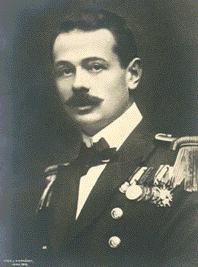
What a great movie that career would make. Of course, you all know who he is don't you?
Georg Ludwig Ritter von Trapp was born in Zadar, Dalmatia, then part of the Austro-Hungarian Empire, now in Croatia. His father, Fregattenkapitän August Trapp, was a naval officer who had been elevated to the Austrian nobility in 1876 which entitled him and his descendants to the style of Ritter von in the case of male and von in the case of female offspring. August Ritter von Trapp died in 1884, when Georg Ludwig was four. His mother was Hedwig Wepler. von Trapp's older sister was the Austrian artist Hede von Trapp. He also had a brother, Werner von Trapp, who died in World War I in 1915.

Korvettenkapitän Georg Ludwig Ritter von Trapp (April 4, 1880 – May 30, 1947) headed the Austrian singing family portrayed in the heavily-fictionalized musical The Sound of Music. His exploits at sea in World War I earned him numerous decorations, including the prestigious Military Order of Maria Theresa.
Too bad we only have this movie instead.

There are many lessons you can take from the good LCDR, but running from hopeless political problems isn't one of them. We don't have a George Ludwig von Trapp option.

Mark Steyn
is right - this is where you make your stand. You have nowhere else to go.

Sunday, February 17, 2008

History returns to the Balkans


Interrupting our Sunday quiet; UDI. Unilateral Declaration of Independence.

Womb warfare over the last century has given Kosovo, home to the Serbian people, to the Albanians. Today Kosovo, tomorrow Malmo - I guess.

Interesting precedent in its own, but let's look at it in the 2008 context.

Russia is trying to return to the stage. They don't like what is being done to their historical little Slavic brother Serbia.

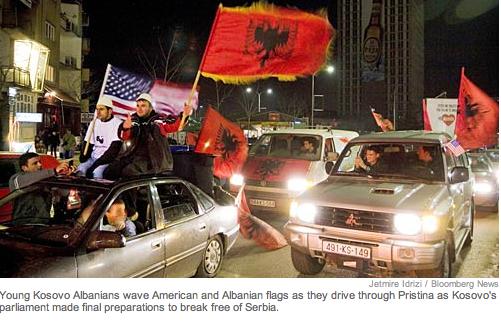
Note all the flags you see in Pristinia (and in Mitrovica's Serbian enclave). Those are not Kosavar flags. Those are mostly Albanian flags....in what is Serbia.

Also note all the American flags in the crowd. That little salt does not help the pain in the Russian wounds.

Just watch.


What an ugly part of the world. I know what I would feel if I was a Kosovar Albanian, but still. Ungh.

The Balkans, always produces much more history than it can consume locally. Think the Russians will let this slide with only a whimper? 50/50 for the optimist.

Friday, December 28, 2007

Wars have started for less

Every nation has its limits. You can almost taste the fact that the Serbs don't want to go down that road of war - but they are being painted in a corner. This from the last week in DEC.
Serbia's parliament overwhelmingly adopted a resolution Wednesday that threatens to halt the country's integration into the European Union and cut off diplomatic ties with Western countries if they recognize Kosovo's independence.

The resolution — passed with 220 votes in favor, 14 against and three abstentions — also obliges Serbian officials to reject Kosovo's statehood and denounces NATO for allegedly supporting the separatist Kosovo Albanians.

Ethnic Albanians, who account for about 90 percent of Kosovo's 2 million people, have said they would proclaim independence early next year.

The U.S. and several EU states have said they would recognize Kosovo's independence because it has not been under Serbia's control since 1999, when NATO intervened to stop former Serbian President Slobodan Milosevic's military crackdown against the separatists.

Serbia, backed by Russia, insists Kosovo — considered the cradle of Serbia's medieval state and religion — should remain part of its territory, and has urged more negotiations with Kosovo Albanians.

During a fiery debate in Parliament, Prime Minister Vojislav Kostunica accused the U.S. of blocking efforts to find a compromise with ethnic Albanians by its open support of Kosovo's independence.

"America is openly striving for the destruction of the international order," Kostunica told the parliament. "America, which once seemed like a symbol of freedom, now advocates the policies of force."
The Kosovar Albanians want independence. They have been emboldened. They won the war of the cradle, now they want their own bit of land. Malmö, call you office. The Serbs now feel they have the backing of Russia. This whole soup is thick. Do you know what the Kosovo flag is? Ahem; it is the Albanian flag. The precedent this sets should make all stop and think; is the USA, Canada, and the EU ready go to war over this - again?

Monday, November 26, 2007

Serbia's window

Most, and I agree with them BTW, feel that cooler head will prevail in Kosovo - and no one is going to declare independence unilaterally and no one in Serbia is going to roll tanks - but I have been wrong before as have most who think they can either predict or know what is going to happen in the Balkans. Back during Wesley's Folly - there was one thing Serbia understood; blunt force. Mostly US, but with British and Dutch and a smattering of others (sound familiar) helping in - we pounded Serbia from high and far mostly due to Russia still being down hard and wheezing. Russia under Putin is flexing. The US is about war'd out. Due to most of Europe being less than helpful to the point of being negative help in Afghanistan - the American people will have a hard time being sold that we should help Europe clean up its own yard. Serbia though must still think about how hard they will be hit if they say "no" to Europe and North America (a nod to my Canadian friends) about Kosovo wanting to break away? America is fully employed right now and not in the mood to play in the Balkans. How about Germany? How are they doing in Afghanistan right now?
THEY are on the front line of the war on terror, but German pilots facing the Taliban are insisting they stop at tea time every day to comply with health and safety regulations.

The helicopter pilots, who provide medical back-up to Nato ground troops, set off for their base by mid-afternoon so they can be grounded by sundown.

Their refusal to fly in the dark is hampering Operation Desert Eagle, an allied offensive, which involves 500 Nato-led troops plus 1,000 Afghan troops and police.

Although Germany has sent 3,200 troops to Afghanistan, they operate under restrictive rules of engagement.

They spend much of their time in an enormous base, complete with beer halls and nightclubs, in Mazar-e-Sharif, a 90-minute flight from the fighting. They also have a base at Kunduz.

Germany, which has lost 25 soldiers in Afghanistan to suicide attacks and roadside bombs, commands the Nato-led International Security Assistance Force (ISAF) in the north. But its men are not allowed to travel more than two hours from a “role two medical facility” - a hospital equipped for emergency surgery.

The restrictions have fuelled tensions among allied troops. Norwegian soldiers, who were fighting to stem a growing Taliban insurgency in this remote stretch of Afghanistan’s northwest frontier, were forced to desert their Afghan comrades midway through a firefight when German medical evacuation helicopters withdrew.

One Norwegian cavalry officer, who was engaged in a day-long fight with more than 40 Taliban near Jari Siya in Badghis, said: “It’s hopeless. We were attacking the bad guys, then [at] three or four o’clock, the helicopters are leaving.

“We had to go back to base. We should have had Norwegian helicopters. At least they can fly at night.”

Abandoned by their western allies, the 600 men from the Afghan army’s 209 Corps were forced to retreat until a convoy of American Humvees arrived the next day to reinforce them.
OK. Is that isolated? Hundreds of thousands are dead in Sudan, are the German, Italian and French powers (sic) doing any better there?
Yet, as the Associated Press tells us, the launch of the Eus peacekeeping could (yet again) be delayed, while the force commander Gen. Henri Bentegeat waits for firm commitments on the supply of vital helicopters.

All the man wants is a meagre dozen transport helicopters, which are absolutely essential to the mission as force multipliers to move peacekeepers quickly along the vast, sparsely populated borderlands west of Darfur.

Bentegeat says he is "very confident" nations would come up with around one dozen transport helicopters during the meetings in Brussels starting Monday but the very fact that the mission is supposed to start in December and he is still having to hand round the begging bowl tells you everything you need to know.
Not that there are many more to save now anyway. OK, how about the belligerent Brits?
So, which is it: a memorable or shameful moment for the Brits?

It’s neither. The withdrawal is better understood as a tightly-controlled PR stunt designed to make the British elite’s lack of political will for staying in Iraq look like something more meaningful. The movement of the last-remaining British troops from the centre of Basra to the outskirts of Basra doesn’t represent a break from Britain’s strategy in Iraq, in the form of a final victory or a crushing defeat. Rather, the withdrawal only makes the political reality – which is that in spirit the British pulled out of Iraq long ago – into a formal reality, too.

All the talk of victory or defeat overlooks the fact that the British army has not been fighting a war in Basra. British soldiers effectively withdrew from the streets of Basra two years ago and have spent much of the time since hunkered down in their barracks.
OK, they have their fill. How about Afghanistan?
The former United Nations High Representative for Bosnia and Herzegovina delivered his dire prediction after being proposed as a new "super envoy" role in Afghanistan.

Lord Ashdown said: "We have lost, I think, and success is now unlikely."
Sure America is out? Well, it has a significant part of the 15,000 NATO boots-on-the-ground, but.... If Kosovo UDIs (Unilaterally Declares Independence) and the Serbians say no; is NATO going to go kinetic on them? If each KFOR base has a nice polite Serbian Army Colonel drop by to say, "We are here to take our country back - the locals broke the agreement. Please stay here while we take care of our business. Thank you." What do you do? KFOR goes toe to toe with Serbian armor and infantry? The Capitol area is manned by Swedes, Finns, Czechs, and Irish. Yes, the Irish.

In the end; what a mess. Bosnia is bubbl'n as well. Let's be honest, do we want to fight here too? This is Europe's backyard, but do they have the ability and will to do it? What is Russia decides in the beginning of winter to cut back on energy supplies to Western Europe if they start bombing Serbia again? Ungh.

If they are smart, patient, and careful, the Serbians have a window to take back their Virginia if they want to take it. Could they get away with it? Ask those in Darfur. Ask the secularists in Basra. Ask the Danes taken by pirates off Somalia. Ask the terrorists released by Spain. Happy New Years early Serbia. Many may - but I don't underestimate you.

Saturday, November 24, 2007

The Balkans rumble...

If you have not yet received the hint that history is about to kick you in the backside - here is another reminder from the place that produces too much history to consume locally.
As negotiations go nowhere fast, an independent Kosovo is widely being accepted as inevitable. But the consequences will be far-reaching, not just for the Balkans, but for the EU, the UN and relations between the West and Russia.

If the path to hell is paved with good intentions, then the way to political irrelevance may well be paved with pointless negotiations that everyone knows will fail.
...
Few have any illusions about what that situation might look like. Kosovo has remained nominally part of Serbia since the war ended in 1999, but the small, ethnic-Albanian province has long made it clear it will be happy with nothing short of independence. Both the EU and the US have been supportive of that ultimate goal. Serbia, though, refuses to give up control of Kosovo and has consistently been backed by Russia. Kosovo's potential United Nations path to independence -- as outlined by special envoy Martti Ahtisaari this spring -- has been blocked by Russia's Security Council veto.

Absolutely No Alternatives

Now, with former rebel leader Hasham Thaci winning elections in Kosovo last Saturday, it is no longer a question of whether Kosovo will declare unilateral independence. It has become a question of when.

"Our vision and our stance are very clear," said Kosovo's President Fatmir Sejdiu following the most recent meeting of the troika on Tuesday. "It's the independence of Kosovo and its recognition. There are absolutely no alternatives."
My visions involve the EU looking the other way as Serbian tanks move to finish the job with the Russians playing "Big Brother will protect you from the kids from Strasbourg" part.
Kosovo issue has already become yet another irritant in relations between the West and Russia, and it threatens to erupt into all-out diplomatic conflict. On Wednesday the Russian member of the troika spoke out against US policy in the region. "The Americans believe that Kosovo's de facto separation has already taken place," Alexander Botsan-Kharchenko told Russia's Izvestia newspaper. "We look at the situation from the point of view of international law, not pseudo-reality."
...
His comments come just days after Holbrooke lobbed a verbal grenade in the other direction. "The Russians have decided to act very unpleasantly," Holbrooke told the Süddeutsche Zeitung. "Vladimir Putin's government wants to bury the Dayton Accords, for one reason: Russia wants to use every means to be a world power again."

Reljic, for his part, thinks the Russians are right to be upset. "If you look at Russia's position, even since 1999, not for a single moment did the Russians indicate they would play along with this. It was a policy of 'eyes wide shut' not to look at what Russia was saying all the time."

But no matter who is right, the result might be a bad one for Europe. Serbia is rapidly losing faith that the European Union will invite it to join any time soon. Its close alliance with Russia could develop into a weakness for EU security policy in the region. That, at least, is the future Reljic sees for the region.

"History does not stop the day the US recognizes the independence of Kosovo. A new phase, even more complicated phase might start," Reljic says. "We are not seeing any kind of endgame in the Balkans ... it could throw back the region for many years."
Also keep this in mind. 60 years ago, Serbians were a majority in Kosovo. Muslim Albianians, in fact, simply out-bred the Serbians in their own heartland. History belongs to those who show up. If a Serbian woman only has 2 kids and starts her family in her 30s, while her Albanian neighbor has 6 kids starting at 18 - the demographic math is telling. Now we find Kosovo with a significant Albanian Muslim majority (helped by the ethnic cleansing of ethnic Serbs overseen by EU soldiers with the US looking the other way) wanting to break off and be its own country. Is that the precedent that Europe wants to set? By 2050 I can see the same thing in Brussels, BE - Malmo, SW - Rotterdam, NL - a few choice places in France, and so on. Be very careful, Europe, what standard you set or what tut-tuting you give to the Serbs. You're next. Don't forget the warning the Italians received the other day. Halal sausage, I am sure.

Wednesday, November 21, 2007

Wesley's folly

More of Clinton's bills are about to come due. We already talked about Bosnia a bit, time to dust off your Kosovo maps some more.
It appears to many American observers that Moscow has been gravitating toward Cold War behavior without any rationale. This would certainly be puzzling behavior, given that, as some astute observers have pointed out, this is a Russia that recalled the Red Army from everywhere outside Russian borders, a Russia that allowed its satellite states to be thrown out of power, a Russia that recently embraced freedom and capitalism and let us show them how to do it

But soon after, the U.S. did something to sabotage, and ultimately reverse, this progress, making Russia legitimately wary of U.S. “interests” and leading it — and other nations — to conclude America is capable of being as mischievous as Russia. We bombed Europe. Specifically Serbia, for the crime of launching a counteroffensive against a terrorist insurgency in Kosovo whose aim was to snatch 15 percent of the country's land. And now the United States supports severing Kosovo from Serbia via a precedent-setting unilateral declaration of independence next month by the province's terrorist masters — over Moscow's logical objections. One of those terrorist masters, Agim Ceku — the province's “prime minister” — made the terrorist case in last week's Wall Street Journal.

To this day, almost no one grasps the significance of the damage the 1999 intervention single-handedly did to American standing and American credibility, when the United States turned NATO into an aggressive body, attacking a sovereign nation fighting none other than Islamic-financed separatists within its borders.
Not sure what the full story is? Read the whole thing.

Thursday, November 08, 2007

The country no one wants

Ah, the Balkans - the gift that keeps on giving. Methinks this story is long from over.
A week into the political turmoil caused by reactions from Banja Luka and Belgrade to High Representative Miroslav Lajčak's latest measures, Mesić told Croatian Radio that the Republic of Srpska (RS) leadership wished to see disintegration of Bosnia-Herzegovina.

Ethnic Serbs and Croats, as well as Bosniaks, are the three constituent nations in the two entities the country has been divided into after the end of the 1992-1995 war there.

"This is a serious gamble with Bosnia's and with their own future, since the international community cannot in any case accept the breakup of Bosnia-Herzegovina," Mesić said.
First week in DEC will be a big one for you old Kosovo hands. May need a new Balkans tag. Hey, there it is.