Showing posts sorted by relevance for query Fleming. Sort by date Show all posts

Thursday, September 19, 2013

How to Troll USNA

Well, you have to give Professor Bruce Fleming credit, he knows what he's doing.

First, a poem.
Kong Looks Back on His Tryout with the Bears
William Trowbridge

If it had worked out, I’d be on a train to Green Bay,
not crawling up this building with the Air Corps
on my ass. And if it weren’t for love, I’d drop
this shrieking little bimbo sixty stories
and let them teach me to mambo and do imitations.
They tried me on the offensive line, told me
to take out the right cornerback for Nagurski.
Eager to please, I wadded up the whole secondary,
then stomped the line, then the bench and locker room,
then the east end of town, to the river.
But they were not pleased: they said I had to
learn my position, become a team player.
The great father Bear himself said that,
so I tried hard to know the right numbers
and how the arrows slanted toward the little o’s.
But the o’s and the wet grass and grunts
drowned out the count, and the tight little cheers
drew my arrow straight into the stands,
and the wives tasted like flowers and raw fish.
So I was put on waivers right after camp
and here I am, panty-sniffer, about to die a clown,
who once opened a hole you could drive Nebraska through.
This is perfect. The job of the liberal arts is to make you think. The job of the English Professor is to show you the power of the written word.

Results?
Bruce Fleming, an English professor at the United States Naval Academy, is returning to teaching following a two-day period out of the classroom while officials conducted an investigation into the charges several midshipmen brought against him.

"The investigation concluded and determined that Professor Fleming should return to his normal teaching duties," Naval Academy spokesman Cmdr. John Schofield said, while declining to discuss the details of the charges, claiming it would be inappropriate to do so.

Fleming, however, was very willing to discuss the details of the allegations and the investigation. In an email to Military.com, Fleming wrote that several weeks ago two female midshipmen -- a junior and a senior -- took exception to some criticisms he made of the academy's sexual assault prevention program, in particular relative to the recent sex scandal involving members of the Navy football team who were accused of raping a female midshipman at an off-campus party.

The two female midshipmen in Fleming's class took their complaint to the Academy's Sexual Assault and Response (SAPR) office, saying that they had been offended by a poem Fleming had chosen to teach as a metaphor for elements of the sex scandal. On his Facebook page, Fleming identified the "offending poem" as "Kong Looks Back on His Tryout with the Bears" by William Trowbridge.
This isn't just a troll, this tells a much larger truth, which is exactly the point the good Professor was trying to make. He just had no idea his students would take it to a whole other level.

Well played. Well played.


UPDATE: In the spirit of Professor Fleming's troll ... I have to apologize to the front porch ... I did a little trolling too.

A double apology to my STEM friends - though some known engineer types did quite well - it isn't fair to throw poetry and a thousand years of English literary tradition your way - but it needed to be done.

MS, however, fell right in to my troll. Sorry Shipmate, but you made my and Professor Flemings point, in a fashion. Let me help out a bit by having the author speak;
I wrote my first Kong poem, “Kong Looks Back on His Tryout with the Bears,” with no intention of writing any more. But that poem gave me an idea for another and the next yet another. Motivated partly by my attraction to the old 1933 version of the film and partly by a sense that Kong embodies something very human, I wound up with 25 or 30 pages of Kong poems. X.J. Kennedy, in an essay called “Who Killed King Kong,” persuasively argues that Kong is an example of the pitiable monster archetype, a figure who’s good or at least well meaning inside but is trapped in a monstrous body, which hides that goodness from the world. I found in Kong yet another figure in which to combine seriousness with comedy. Like Quasimodo, the Frankenstein monster, the beast in Beauty and the Beast, that monster must suffer and eventually die alienated from fellow creatures. Once again, this figure becomes an archetype because he reflects something in us, who sometimes feel the world doesn’t see the beautiful person deep inside our unbeautiful exterior. Kong may be a monster, but he is as vulnerable and lonely as any of his human counterparts. I didn’t make the Kong poems into a book till about 15 years after I’d written the original poems. It somehow took that long to make me realize that, if I wrote 15 or 20 more, I’d have a book.
Yes, there is a book.

And the author? Big race baiter, eh?
The current Poet Laureate of Missouri, William Trowbridge holds a B.A. in Philosophy and an M. A. in English from the University of Missouri-Columbia and a Ph.D. in English from Vanderbilt University. His poetry publications include five full collections: Ship of Fool (Red Hen Press, forthcoming), The Complete Book of Kong (Southeast Missouri State University Press, 2003), Flickers, O Paradise, and Enter Dark Stranger (University of Arkansas Press, 2000, 1995, 1989), and three chapbooks, The Packing House Cantata (Camber Press, 2006), The Four Seasons (Red Dragonfly Press, 2001) and The Book of Kong (Iowa State University Press, l986). His poems have appeared in more than 30 anthologies and textbooks, as well as in such periodicals as Poetry, The Gettysburg Review, Crazyhorse, The Georgia Review, Boulevard, The Southern Review, Columbia, Colorado Review, The Iowa Review, Prairie Schooner, Epoch, and New Letters. He has given readings and workshops at schools, colleges, bookstores, and literary conferences throughout the United States. His awards include an Academy of American Poets Prize, a Pushcart Prize, a Bread Loaf Writers' Conference scholarship, a Camber Press Poetry Chapbook Award, and fellowships from The MacDowell Colony, Ragdale, Yaddo, and The Anderson Center. He is Distinguished University Professor Emeritus at Northwest Missouri State University, where he was an editor of The Laurel Review/GreenTower Press from 1986 to 2004. Now living in Lee's Summit, MO, he teaches in the University of Nebraska low-residency MFA in writing program. His web site is http://williamtrowbridge.net.
You can even listen to him if you wish.

From those two MIDN to MS in comments and to everyone else who is reaching for the smelling salts, you need to step back a bit and think why you have a knee jerk reaction to something without doing the intellectually honest thing - and something your education should lead you to - and take a moment to research a bit. Look deeper, read deeper, think deeper. Know that - something great literature and poetry does - your initial response is often wrong. What seems up front is actually not there; what is important is often only found upon reflection and re-reading.

This whole exercise is a superb example of how we let people acting like their own version of Red Guards stomp around the intellectual landscape smashing with their ignorance anything that does not match their blinkered view, or that may be construed to conflict with their fragile worldview.

Cultural Marxism - yea, it's a thing ... and there it is red in tooth and claw.

You don't have to agree with Professor Fleming on everything - I don't - you don't even have to like him - I do - (I like a lot of people from one end to the other, especially the interesting ones as life is short and not meant to keep you comfortable, that is why I like MS as well) --- but you have to respect what he has done here.

What a great educational opportunity for the MIDN. Not only does it demonstrate the power of good poetry, but perfectly demonstrates the use of the archetype (something the eldest Wee Salamander in her 2nd year of AP English knowitallness will prattle on about over dinner) - but it also demonstrates how the non-political can be made political simply by desire.

One downside note - and something Professor Fleming has demonstrated here - these little Red Guards are not harmless. By causing a Professor to be suspended for a few days over a complaint that anyone with even a basic review of the poem in question would know is a bogus claim founded on ignorance - they have created a chill in the air. The weaker mortals will not challenge. Will second guess every word, every 4th level possible interpretation of a work.

Those familiar with Critical Theory will quickly see the problem. Almost any work can be torn apart as racist, sexist, or homophobic. People cut their PhD's creating such alternative universes. If you fear that someone could make such a claim simply because they want to - and that could lead to a suspension - then they will rapidly narrow the authors they will use. They will pull back from any challenging boundaries. People become less educated, less curious, more close minded. Is that what we want? Hang one; terrorize a thousand dontchaknow.

For now though, I will continue to laugh as the cat continues to paw-about with the mice.

Wednesday, July 24, 2019

Professor Fleming Returns to Annapolis

Regular readers here are familiar with Professor Bruce Fleming from USNA.

He's had a rough run of things the last couple of years, but the wheels of justice have finished grinding ... and he's emerged on top.

Via Lauren Lumpkin at the Baltimore Sun;
A controversial Naval Academy professor, who Navy officials said emailed partially clothed photos of himself to students and used “demeaning” language in the classroom, will be reinstated by the end of the summer, according to a ruling issued Wednesday by the U.S. Merit Systems Protection Board.

Bruce Fleming was removed from the Annapolis institution in August after a seven-month long-investigation into his conduct. A tenured civilian professor, Fleming appealed his removal and made the case for reinstatement in front of an administrative judge in May.

The Merit Systems Protection Board, which adjudicates personnel actions for federal employees, reversed Fleming’s removal and ordered back pay. Fleming is one of the Naval Academy’s most senior professors and earned $130,000 a year.

Fleming called the ruling “a moment of triumph."
Read the full article if you wish, but I wanted to share with you some primary source documentation as well.

Here is the decision dated 24 July 2019 from the Merit Systems Protection Board. If you really want to see what was going on at Annapolis and want to decide for yourself, read it.


Thursday, October 08, 2009

Leaning into the punch ...

Up another notch.

Professor Fleming is setting an outstanding example for his MIDN.

He is standing by principle, intellectual fair play, and will not submit to bureaucratic bullying. BZ to him. I have a feeling a lot more will follow.
A professor at the U.S. Naval Academy has filed a federal whistle-blower complaint alleging that the institution improperly denied him a deserved pay increase for publicly accusing it of illegally operating a separate admissions track for minority students.

Bruce E. Fleming, a professor of English and civilian employee of the Naval Academy, said he filed a formal complaint last month with the U.S. Office of Special Counsel, which investigates whistle-blower accusations by federal employees. He alleged in the complaint that top academy officials denied him a merit pay raise to which he was entitled, in retaliation for his public assertions that the institution's race-conscious admissions policies are so heavy-handed they probably violate federal civil-rights laws.
...
The college's policies call for academic departments to give civilian faculty members scores based on their performance, rank them based on their scores, and then, based on their scores and rankings, recommend giving them either an increase of one or two steps on the academy's pay ladder, or no increase at all.

Based on the recommendations of a committee of English Department faculty members, the chairwoman of that department, Allyson A. Booth, gave Mr. Fleming a good review and recommended him for a two-step increase. Instead, Mr. Fleming's letter to the AAUP says, Mr. Phillips, the academic dean, treated him as if he had received a bad evaluation from his department and gave him no pay increase at all.

When interviewed on Wednesday, Mr. Fleming, who has written essays critical of the Naval Academy and about his own field for The Chronicle Review, said he is deeply committed to his institution but believes "taxpayers have a right to know how we operate."
There is a price sometimes for standing up for truth. Sometimes it is money, time, employment, or "friends." Often, all of the above - sadly too often a much steeper cost.

Thing is - none of those things are worth what that man in the mirror tells you every morning.

That is the lesson for his MIDN. Speak the truth, do what is right, and do a "mirror check" every AM.

Thursday, November 25, 2010

Diversity Thursday

Via email and comments you said you wanted me to cover it - so let's cover it.
“I stand before you today, the person you talk about in writing,” Rear Adm. Julius Caesar told Fleming before a few dozen alumni during the question-and-answer period that followed Fleming’s remarks. “I’m so glad that you didn’t sit on my admissions board.”

In a civil tone, Caesar, who is black, took issue with Fleming’s sole focus on admissions metrics — what Fleming called “predictors” — and criticized him for not examining whether the academy was producing better officers.

“Some of those kids, who didn’t have predictors, did make it,” Caesar said. By his own account, he had been one of them.

Caesar, a ’77 grad, grew up in what he called the “inner city” of Cleveland and lacked stellar test scores and grades. He attended the year-long Naval Academy Preparatory School and played football for Navy. Caesar is a vice director at Joint Forces Command.

“When you talk, I want you to look around at some of those folks who have made it,” he told Fleming. “There are people out there — and there are a lot of them — that have gone on to command ships, that went on and [have] done things in business and everything as well, and I’ll just caution you to think about those.”
He made a point, but not the one he thinks.

First of all - let's go back to Leadership 101; sir, it isn't about you.

Our friend Professor Bruce Fleming responded as he did - but as I have the time to research and ponder, from this seat I would have handled the issue differently. I would have turned the discussion back at RADM Caesar, USNR. He wants to be the subject - then OK; he's the subject.

When it comes to race, he is a perfect example of Generational Dissonance. He can't shift his racial mindset out of the 1970s.

The incoming MIDN this year more often than not were born nine years after Caesar left active duty. Nine years. 15 years after he was a Plebe.

What does his experience a decade and a half before they were born have to do with any of these young men and women? Does he really think our nation has remained static in his thinking - or has he remained static?

As a secondary and more personal point - let's go back to this comment Caesar made.
“Some of those kids, who didn’t have predictors, did make it,” Caesar said. By his own account, he had been one of them.
If his concern is predictors - then where is his support for bringing in the Scot-Irish from Appalachia? Why the urban-only focus?

But again - let's focus on what the Navy got for its sacrifice (in a zero-sum game, they turned down a better objectively qualified person) to bring Caesar on board.

First of all - we should thank him Caesar his service; one way or another - he served his nation in the manner that was asked of him more than most of his countrymen. However, before he places himself up as the best example to follow; let us review his bio in full.
Rear Admiral Julius S. Caesar is a 1977 graduate of the U.S. Naval Academy. He earned a Masters of Business Administration from the Executive MBA Program at the College of William & Mary. He is a Massachusetts Institute of Technology Seminar XXI Fellow in Foreign Politics, International Relations, and the National Interest.

During his period of initial active service, his sea duty assignments included USS Dale (CG 19) where he qualified as a Surface Warfare Officer and USS John F. Kennedy (CV 67). He served in the engineering, weapons, and operations departments during these assignments.

Caesar transitioned to the Reserve Component in 1983. He has held a variety of assignments including Battle Watch director in Commander, 2nd Fleet, Area Air Defense commander, Atlantic and deputy commander, Navy Reserve Readiness Command, Mid-Atlantic. He has commanded four reserve units including: Personnel Mobilization Team 3106, Surface Warfare Development Group, OPNAV Surface Warfare N86, and Naval Inspector General Detachment 106.

Active duty assignments include: Commander, Navy Installations Command, Commander, 2nd Fleet, Joint Task Force Exercises, Battle Group In-Port Exercises; Naval War College, OPNAV N86, Fleet ASW Training Center, Atlantic and NATO exercises in Europe and the Pacific.

Caesar has been assigned as vice director, Joint Concept Development and Experimentation, J9, U.S. Joint Forces Command, Suffolk, Va.

Caesar previously served as Reserve deputy commander, Navy Installations Command, Washington DC.

His personal decorations include the Legion of Merit, Meritorious Service Medal (two awards), Navy Commendation Medal (three awards), and Navy Achievement Medal. Caesar was awarded the Blacks in Government Meritorious Service Award. He is a member of the Secretary of Defense Reserve Forces Policy Board.
6 years on Active Duty, the rest in the Reserves. I'm assuming that he is still USNR - again hard to tell - but his bio says he transitioned to the reserve component in 1983 ... and the active duty assignments may have been short recalls - or just his Reserve Billet assignment. Hard to tell - again. All service is good .... but ...

We have been a Navy at war for over nine years. I see no record of any combat experience or service. Read his bio, look at his salad bar - no wartime service at all
since 1977. None. I think of all the USNR types I served with since 2001. It boggles the mind.

A Navy at war promoted him to O-8. Rear Admiral - the 2-star version. Noted.

Quod erat demonstrandum.

Moving on.

If still USNR, he is a civilian - really. A good and honorable, yet lower-tier for a Navy at war Reservist. His full-time gig now days is at SAIC from what I can find out online. When you do a google search for "
Julius Caesar SAIC" to see what his greatest or most well known civilian achievement while there is .... ungh .... you get this.
Science Applications International Corporation (SAIC) announced today that Julius “JC” Caesar, senior vice president for product development in the Research, Development, Test and Evaluation (RDT&E) Group has been given the prestigious Blacks in Government (BIG) Meritorious Service Award for personal achievement.

The BIG Meritorious Service Award recognizes outstanding military service members and civilians who have distinguished themselves through significant contribution to their service in the global war on terrorism, the advancement of African-Americans, and the promotion of diversity and equal employment opportunity in the Department of Defense.
I tried to find more about him over at SAIC's site - but he's not there on the highly diverse leadership team, and on their site-search 2 out of 3 articles are about his BIG award with the third being when he was hired. As a matter of fact - his trail at SAIC seems to go cold at about 2006. Is his gig at JFCOM a full time job now, as in pulled back on active duty for a stint? Bnet says he is still at SAIC. Hard to tell one way or another ... and doesn't really matter.

Oh, the the BIG award ... ummm? Was it in his status as Vice Director of J9 at a command deemed by SECDEF as the low-hanging-fruit of redundancy what got him that award? Really? No.

Oh, wait; my bad - he got that in
2006, - when he was working for a civilian company doing business with DOD.....OK.
Reserve Deputy Commander for Commander, Navy Installations Command, Rear Adm. Julius Caesar was awarded the 2006 Blacks in Government (BIG) Meritorious Service Award Aug. 25 in New York.

The BIG Meritorious Service Award is presented to a military member who has significantly contributed to the global war on terrorism while creating opportunities that support and contribute to the mentorship or development, and advancement or retention of African Americans in government service consistent with merit principles.

Nominated by Chief of Navy Reserve/Commander, Navy Reserve Force, Vice Adm. John G. Cotton, Caesar was recognized for his dedication to the superlative values of honor, courage and commitment. A board of his peers endorsed Caesar’s nomination because of his extensive mentoring of minority Reserve Officer Training Corps (ROTC) and Naval Academy Midshipmen. His personal mentoring of minority and underprivileged youths has promoted diversity in the naval service and enriched lives in the surrounding communities.

Caesar was also chosen for his outstanding support of the Individual Augmentation of personnel mobilized in support of the global war on terrorism.

“His leadership and unwavering support of African Americans in the Navy resulted in a better understanding of the cultural differences,” said Cotton.
If you say so. I always thought that in the history of nations, having Flag Officers and General Officers who promoted sectarianism never led to any good. Oops.

Caesar is a smart guy with an exceptional professional record. Before going to SAIC, he was a sector vice president of professional and engineering services at EDO Corporation, an engineer for TRW, Inc., and at Booz Allen Hamilton he worked primarily in strategic integrated underwater surveillance systems.

It is a shame that in the end of everything, when you try to do a simple search for the man's accomplishments, it seems that he is someone who wishes more than anything else to be defined by the color of his skin, and not the content of his character. After 33 years Active and Reserve Duty - that is it above the fold. If he looks at himself like that - how does he view others?

I do think though, that before he starts pointing a race focused finger at Fleming, he may want to do a little more self reflection. This isn't about him or his generation - this is about young men and women born in the Clinton Administration. Two Presidential Administrations after he left active duty and three after he graduated from Annapolis.

He should know that he cannot apply his individual experience in the 1970s towards the general experience of others in the second decade of the 21st Century; but there you go - he is.

On this Thanksgiving, what am I thankful for? After the many blessings of God's grace, my family, and the sacrifices of others that allowed my children to grow up in this nation - that and other important things - on another level I am thankful that I do not have to convince non-African-American Sailors competing with African-American Sailors who RADM Caesar in any way controls their rankings, that they are being evaluated on merit alone.

Even with the assumption that Caesar is the most fair and color-blind person in uniform - that is a tough sell.

Don't blame me; he wanted to be the focus.

Monday, October 05, 2009

Going Beyond “He Said, He Said” on Race-tracking

[Editors Note: In a Diversity Thursday posted in late July, we discussed an impasse on the ground truth concerning admissions policy at Annapolis between the CNO and Naval Academy Professor Bruce Fleming. If you need to catch up on the coverage here; just click the USNA and/or Diversity tags.

Professor Fleming was kind enough to accept my offer to present his response here. The rest of the post is from Professor Fleming.]


In its response to my recent articles about our two-tracked race-based admissions, the USNA administration, and according to reports the CNO as well, are currently in the “deny deny” stage that precedes admission of uncomfortable truths. This is the mode the Army was in with respect to the “friendly fire” death of Pat Tillman—until they had to abandon that and admit that, well yes, he’d died from friendly fire. And yes, they, um, misrepresented the truth before that. This is the Navy that is “held to a higher [moral] standard,” you remember. I’d be happy if they would just admit outside the walls what they make clear inside it.

The Pentagon, we hear, claims that Prof. Fleming “has his facts wrong.” Not so. To be sure, details of the admissions process change all the time: weightings on the Whole Person Multiple change every year, for example. But the fundamentals don’t depend on me being the source; they’re spelled out in current USNA documents. The fundamentals are that we identify, admit by fast-track, and actively promote by racial categories minority candidates whose predictors are far lower than those required for white candidates to be competitive, thus filling a slot for which a much better (white) candidate is rejected.

You don’t have to be an insider to realize how illogical it is for USNA to say loud and clear that “diversity is our number one priority” and still insist it doesn’t put its thumb on the scales. Of course it does. It’s come up with what its official “diversity” slide show calls in Orwellian fashion a “streamlined” admissions process for minorities, which means they are direct admitted or sent to NAPS with predictors that get white applicants rejected. And once they’re here, we create pre-college and low-track courses for them.

You don’t even have to know how the admissions system works, or the difference between “direct” admit—for minorities and athletic recruits (given a pro forma “nomination” from a pot, most typically Secretary of the Navy nominations) vs. admission by competition to win a “slate” of up to ten nominations (most typically given by congresspeople)—white high school senior applicants. Nor need you actually teach the result when it arrives at Annapolis, as I do. For the last few years I have taught many classes of remedial English. Recently I considered one from last semester at random to show the lengths we go to get racial (and athletic) recruits. Out of 18 students, 16 came from NAPS (i.e. they had already had two semesters of remediation and they still needed a pre-college English course, and following on that low-track English—the same is true in math and sciences). 100% of the students were either racial minorities or recruited athletes, half minority and half white. Many ended up on probation or got D grades, not just in my course.

Who would be dumb enough to believe that by “making diversity our number one priority” we mean merely scaring up applications, and not treating them differently once we get them, or the students, once admitted? (Actually we don’t get 10 viable applications for every slot, only requests for information from what may be 7th graders—but saying we do makes our ratings go up, so we do.) That’s as silly as saying that we identify the quarterback we want, wine and dine him, and then throw his application into the pot with the ten other guys we say want his slot. Of course we don’t, and we don’t with minorities either. We direct admit these, which means that racial minorities go to the head of the line and white applicants with higher predictors duke it out for the remaining slots.

I don’t approve of a separate door for athletic recruits (we could have fine teams with walk-ons without compromising our standards), and have written about that (yes, it made me unpopular). But that’s not the issue here. Athletic prowess is a skill. Being Hispanic isn’t. Giving preferences merely for race is illegal.

The Naval Academy’s official 2008 PowerPoint “Diversity Presentation” makes our two tracks clear. The “Strategic Goal” (slide 8) is to “Provide a streamlined candidate identification and selection process” for non-white groups, listed in Slide 4: Hispanic, African-American, Asian/Pacific Islander.

“Streamlined” turns out to be a euphemism for the separate track for minorities. Slide 41, Minorities Inducted, makes clear that minority students divide into only two categories, USNA direct (class of 2010: 161) and NAPS (class of 2010: 111). This is the “streamlining.” Either they come direct to USNA—i.e. do not have to compete to win a “slate” of up to ten (most typically) congressional nominations (higher-performing minority applicants come “direct,” though they don’t have to be as high-performing as whites)—or are sent to NAPS. NAPS is the answer for minorities with lower predictors, where almost all come to USNA the next year (114 out of 124 who attended for the class of 2012, 202 NAPSters total—Slide 44). The Class of 2013 had 244 from NAPS, about 20% of our class. So the majority of NAPS students are low-performing minorities. Low-performing white applicants not also athletes or priors are rejected.

Sending sub-par minority students to a federally-funded program and not comparable white students (unless recruited athletes) is illegal. Until a year or so ago, the focus on minorities was written into the NAPS charter; JAG officers made them take it out of the de jure version of NAPS, still it is central to the de facto use of NAPS. As Slide 14 makes clear, “Initiatives to Achieve Minority Representation” include: “Increasing minority applications, reducing minority attrition [i.e. tutoring and systemic protecting at USNA], structuring NAPS to best support USNA admissions goals (Example: NAPS 2007: 118 minorities, 64 prior enlisted, 93 athletes),” and “Increasing number and position/seniority of minority role models –Example 1/6 Battalion Officers, 7/30 Company Officers, 5/30 Senior Enlisted, new Director of Admissions.” In other words, by USNA’s own admission, we picked the Director of Admissions for race, we pick our student leaders for race, we send students to NAPS for race. This is the two tracks: sub-par minorities come to USNA through NAPS or “direct” (as white non-athletes do not) and are coddled and artificially placed in leadership positions.

USNA, NAPS, and of course the armed forces are funded with federal money, and this is America: race-tracking is illegal. So let’s try to understand why they’d do it. The slide show opens with oohrah exhortations from the very top, Chairman of the Joint Chiefs ADM Mike Mullen, who says: “I’m telling our leaders that I expect them to figure out a way to make diversity a priority in all your lives, all your organizations.”

The next slides give CNO “talking points”: “In ten years the country will be 40% minority. Today, our Officer force is less than 19% minority. We are only as strong, unified, and credible as the degree to which we match society. … To stay competitive in recruiting and retention, we must engage now.”

So skin color is the only thing worth talking about? Not gender, not smarts, not competence, not dedication—but skin color? Remember: “minority” here means only skin color, not minority in religion or sexual orientation or creativity (though many Hispanics are white, and Asians are given preference when they’re a small % of the armed forces: apparently non-Caucasians are all alike—this year we direct-admitted as many Asians as blacks, 10% in each case). Why do we have to have an officer corps that exactly reflects the skin color of the enlisted and correlates to no other quality? By this logic, we’d have a law that says the next four presidents of the US have to be black because blacks are now about 12% of the population and we’ve only had one half-black one so far. Do symphony orchestras have to be 40% minority? Doctors? (actually there are now a lot of Indian doctors in the US, and they’re non-white—does that make African-Americans happy?) Do all chefs have to be 40% non-white? Does this parity have to be overall, nationally? Or locally too? Perhaps this means the mayor of New York has to be a certain % black, a certain % Hispanic, and a certain % Asian (as well as white)?

Everybody agrees we can’t exclude officers of color. But this doesn’t mean it’s necessary, a good idea, or legal to pick them because of their skin color either. Does the CNO think black soldiers need black officers to follow orders willingly? If so, does this mean white ones need white officers? We seem to lump all non-whites into one category. But is one “minority’ the same as another? Will a black male soldier relate better to a Hispanic or Asian female than to a white male? If I’m black and the black officer is in another unit is that somehow okay? Or do I have the right to have one right here?

I’m a civilian, but I work with and for the military, and I’ve been doing it for more than a military career of twenty years. Check out my books on the military and its place in the civilian world it works for and exists to defend. Besides, I understand human nature, and I talk with the guys and gals in the military. They’re insulted at the suggestion that they need or want officers whose only similarity with themselves is the same skin color. They’re savvy enough to smell a fake, a weak officer, or a system that has artificially promoted someone for his or her skin color. Now that’s a morale problem.

It won’t do to justify this frenetic push of recent years with talk about Vietnam-era problems with white officers and black soldiers in Vietnam. (See the “amicus briefs” in the 2003 University of Michigan case, which said it was illegal to run two tracks for admissions—just what we do). That was the racially tense 60s, in a bad war. And who says the problems in Vietman were racial and not just frustration in general? This ain’t Vietnam any more. Who says we have a problem now that justifies any sort of remediation, much less this “diversity at any cost and damn the consequences” one we’re currently implementing? If we do, who says this brutal, mendacious, racist way to deal with it is right? It’s certainly not legal.

The USNA administration has repeatedly claimed to JO JAGS “reviewed the policy and found it constitutional.” Now it seems nobody can document this review, if it ever happened. Anyway: huh? JOs saying that a military policy is “constitutional”? Let’s have the Supreme Court in on this one.

USNA has been race tracking for some time now: I wrote about this as a problem in 2005. But this is the year that the brass finally seemed to kick it up several notches: now it’s “damn the torpedoes, full speed ahead.” This is the year that absolute SAT scores have disappeared from the Press Briefing between the classes of 2012 and 2013. For 2012 the briefing was still willing to admit that 30% of verbal SAT scores for the class were below 600 and 18% of math SAT (without noting that these scores are routinely allowed for the direct-admit groups of minority students, recruited athletes, and priors, but only as individual exceptions for white students). Now we've gone back to apartheid-era South Africa, reporting SAT scores only within racial groups: so-and-so % by blacks compared to black SAT takers, so-and-so % for Hispanics compared to Hispanic SAT takers. Aside from disguising the fact that this places the average SAT scores of both groups in the "not qualified" territory for white applicants (black SAT takers have an average scores of about 440 on the SAT vs. 540 for whites), it's illegal to take the “best blacks” we can get or the “best Hispanics,” considering them as separate categories. And the bizarre thing is, the brass seems to be proud of what it’s doing.

Look at the slide show. Stand by for the lawsuit.

To end on a personal note: I grew up on the Eastern Shore of Maryland, i.e. the South. It drove me wild that blacks were condescended to. I sang “We Shall Overcome” at the NCCJ camp with the black kids, and put on a school play about MLK Jr’s death (it involved blowing out a candle and wearing a black veil—embarrassing now). I ended up in Rwanda as the American professor in a country where everybody was black. The president was black, prisoners were black, professors were black (except me and about three white Frenchmen), peons were black. All my students were black, and so was the young man who cleaned my house. (So was the University Dean. And the Director of Admissions.) The language I spoke to them in was French, as well as vestigial Kinyarwanda. And after I left, one group started killing the other.

Black people come in all kinds. So do white people. But according to the military, a black person is apparently more like any other black person than he or she is like any white person. That’s his group, and that’s how he’s going to be admitted, treated, and promoted.

Anybody but me outraged?

Saturday, December 18, 2010

A very Fleming Christmas; 2010

There is still plenty of time to get the right present for Christmas ... books!

We're going to finish up with our first guest from
last Sunday's Midrats after our second guest, Naval War College Professor Robert C. "Barney" Ruble, CAPT USN (Ret), gave us his list of Christmas book recommendations last week.

As he did for us
last year - this season United States Naval Academy Professor Bruce Fleming offers up an exceptional reading list.

Professor Fleming; over to you!


Kim by Rudyard Kipling. This one is fun, but it’s also got substance. It’s the story of a wily teen-aged boy who, though actually the son of a British soldier in Raj India, has been brought up to speak all Indian languages, wear all disguises, and pass as anything he chooses. He plays the game better than those he lives with and loves, and has fabulous adventures that keep the reader rooting for him to pull it off one more time. The substance? It’s about being true to yourself, finding what matters—in Kim’s case, it’s absolute loyalty to a spacey (and hence borderline ridiculous, i.e. non-studly) Buddhist holy man whose disciple he agrees to become. Kim is the perfect combination of actor in the world and fully developed inner being. For me, that’s the definition of a successful person, especially a great warrior.

The Bhagavad-Gita. Part of the authorless Sanscrit epic called the Mahabarata that exists in countless versions and dates from thousands of years before Christ in one form or another, this central and usually excerpted section is central to the issue of what a warrior is, and why. The hero Arjuna finds himself in battle against members of his extended family. Understandably, he doesn’t want to fight. His charioteer, conveniently for the story, is none other than the god Krishna, an avatar of the even more fundamental god Vishnu. Krishna tells Arjuna it’s his duty to fight because that’s what he does and who he is, being a member of the Kshyatria caste. We don’t have birth castes in democratic America; rather each person has to figure out who he or she is—in a sense, what caste we belong to. If you figure out you’re a warrior, then fighting is who you are and what you do. That’s why you fight.

Confessions by Saint Augustine. Augustine is one of the great Fathers of the Church, a towering intellect who provided an answer to the question, How can a good God allow evil? (His answer is sort of a sleight-of-hand: evil, according to Augustine, isn’t a real thing, it’s just the absence of good.) But it’s the record of his misspent youth, lying, stealing, and fornicating before turning it around, that has endeared him to centuries of readers. The story of his theft of pears is a classic; my personal favorite is his explanation of why men have nipples. It’s the classic reminder that the way a person is at the time we meet them isn’t necessarily the way they will be. We humans are limited in our knowledge of what’s lurking within others. For leaders, the moral seems to be this: cut others some slack; guide where you can but then at some point, you have to back off. I see it as a warning to leaders that our ability to change the world right here and now is limited: model the behavior you want, but be aware that the largest patterns of human development may be beyond your control. Lead, in short, with love and humility.

The Leopard by Giuseppe di Lampedusa. A melancholy classic about change and the necessity to adapt—something that all old people, and some young—and specifically old warriors who have risen in rank in a specific world—need to hear. The title character is a Sicilian aristocrat in the time of Garibaldi who has the breadth of vision to see that his apparently timeless feudal world is in fact changing. He also realizes that in order to keep the values that underlay that world alive, he has to go along with changing the warp and woof of life—welcoming a non-aristocratic bride for his protégé and nephew, who has decided to fight for the cause that will bring an end to the Leopard’s lifestyle. It’s a parable for the necessity to accept change and the fact that the privileged of the Earth are the ones who have to lead the way, rather than becoming defensive and crusty. The inability to lose sight of the spirit in blind adherence to the letter is a huge problem for another authority-driven clan of alphas, not just the feudal aristocracy of Sicily: the military.

Bridging the Military-Civilian Divide: What Each Side Must Know About the Other - And About Itself, by Bruce Fleming. I was told to include this, but of course I like it because it’s my most recent book and we’re living the situation it describes and analyzes. In brief, the military is tiny these days in the US, and all-volunteer, and involved in such dicey undertakings. The result is that most civilians have turned away from it or just don’t care. This, understandably, annoys the military that puts its collective behind on the line. What are we doing this for? they say. The result is mutual ignorance and distrust in our society as a whole. I propose changes for both sides, because we can’t have a world where the warriors feel aggrieved and the civilians ignore them. The civilian world first: briefly, liberals have to acknowledge the military more and consider it as a career (= more ROTC at Ivies). Conservatives have to stop kowtowing to anything the Pentagon asks for. The military: because the military serves the civilian world and not the reverse, the biggest changes will be here. In brief, the military has to stop defining itself by contrast with the civilian world and accept another sort of definition (what I call “military metaphysics”). Now, the military gets its sense of itself by saying it’s superior to the civilian world: more virtuous (“held to a higher standard”), harder (look how fat they are), more loyal and self-sacrificing (we put out behinds on the line). But if you have to denigrate the people you defend to get a sense of who you are, why defend them? This line of thought leads to banana republics, juntas of colonels. Instead the military has to understand that it’s a specific niche profession that attracts people who are drawn to it. Civilians pay for them to be who they are, do what they were born to do (see the Bhagavad-Gita). That has to be good enough in terms of acknowledgment. Stop asking for hugs on the street: the profession has to be its own reward. If it isn’t, you’re in the wrong line of business.
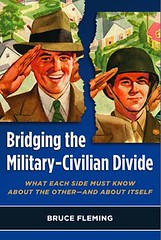
Also, make sure and follow the Midrats link above to hear an extended discussion of his latest book. You can also see an interview Professor Fleming did on C-SPAN.

Thursday, December 15, 2011

So that is where our FITREP concept comes from ...

I had to read this article by Sam Fellman at NavyTimes twice. Surely this is a mistake.
The Naval Academy is artificially inflating its number of applicants to boost its status among other colleges, according to an academy professor who based his accusations on the school’s own documents.

Specifically, the academy counts as “applicants” people who have not completed an application but have shown an interest through other means, such as applying to the school’s weeklong Summer Seminar or beginning an online application, the documents show.
Come on - surely we have at least the same standards for proper accounting of what is and is not complete for USNA as we do for Seaman Timmy's PQS.
An academy admissions official Dec. 5 used this standard to boast that the school had 18,651 applicants so far this year, saying it put the school on track for a record year for the Class of 2016.

The academy’s number of completed applications is much lower. For example, the Class of 2015, which began training during the summer, had 5,720 completed applications; the academy cited its applicant number as 19,145 — more than three times the number of completed applications.
YMBFKM. Can't you go to mast for sea lawyering/gundecking PQS?

Does US News have UCMJ procedures ... they should as it reads like someone needs to press their dress whites.
An official with U.S. News & World Report, which ranks colleges annually, said it’s “very atypical” for schools to use such a benchmark.
Here is what burns me a bit; shouldn't the press have broken this story? They don't expect mild mannered English professors to do this kind of inquirey ... or do the?
Bruce Fleming, an academy English professor and frequent critic of the school’s admissions process, filed a Freedom of Information Act request on how the academy counts applicants and provided the results to Navy Times.
Yep, our friend Professor Bruce - doing the job the press won't; wait, that isn't fair - he did the prep work and Sam did the rest.

This is nothing new.
The documents Fleming received from the academy show that the school’s total number of applicants includes every high schooler who applied to participate in Summer Seminar, regardless of whether the prospective student later completed an official academy application. It also includes high school juniors and seniors who initiated an application online, according to the documents.

An academy official said the practice of counting applicants this way has been in effect for at least 20 years.
Whoa. If you ain't cheating, you ain't trying - I guess.
The documents Fleming received from the academy show that the school’s total number of applicants includes every high schooler who applied to participate in Summer Seminar, regardless of whether the prospective student later completed an official academy application. It also includes high school juniors and seniors who initiated an application online, according to the documents.

An academy official said the practice of counting applicants this way has been in effect for at least 20 years.
You need to read it all - as it gets very complicated from there.

Not everyone is doing the same thing.
Similar to Annapolis, both the Air Force Academy and the U.S. Military Academy report the total number of applicants as anyone who has started an application. However, both of these academies also provide the total “qualified” applicants — a figure that Annapolis doesn’t provide. The Coast Guard Academy bases its acceptance rate on the number of qualified applicants.
This is important as it is a matter of integrity and transparency - critical for a military institution in a Representive Republic. We shouldn't be playing games like this. When we do, we don't just hurt our institutional reputation, but that of our MIDN - who as anyone can tell you - represent the best our nation has to offer - but this just puts a cloud over them. Uncalled for.

We should be able to hold our own - and if we don't we should take defendable steps to raise our game. Really.
In the 2011 U.S. News rankings, Annapolis and West Point were in a three-way tie for 14th among liberal arts colleges nationally alongside Vassar College, a private college in Poughkeepsie, N.Y.

Yet Vassar counts only completed applications when reporting admissions statistics.

“The only applicants we count are the ones who we get a completed application from, certainly not anyone who begins an application,” said Vassar spokesman Jeffrey Kosmacher. “Basically, you won’t even be considered for admission if your application were incomplete.”

Still, Kosmacher stopped short of blaming the academy for misreporting its statistics.

“I think the onus is on U.S. News to be sure that if they’re measuring the Naval Academy against any other undergraduate institution, that the way that data like this is being gathered is consistent,” Kosmacher said. “Otherwise, there’s no validity to comparing one school to the other.”
Vassar has more integrity than the Navy? Vassar? Please tell me this is just all a misunderstanding.

How about this. Assuming there isn't a double-secret protocol that no one knows about and USNA didn't throw out with a dismissive, "Take that Fleming!" that makes all the above a sad misunderstanding; in the future let's hold ourselves to the same level of integrity we demand of our junior enlisted's PQS books ... or at least meet the same standard as the bloody Coast Guard.

We're better than that; and I know our MIDN are.

Thursday, November 26, 2009

Diversity Thursday

This Diversity Thursday will be a 3-parter. Part I will be by a new guest blogger, USNA alumnus Dave Quint, ‘87. Part II will be a detailed discussion of the "Whole Person Multiplier" by Professor Bruce Fleming. Part III with be a brief reminder of what this all means for the Fleet - and for those who are being used as someone else's toys.

He is an SPHR certified human resources professional. In his day job, he is the HR Director for a company of 5000+ employees at 200+ locations in 11 states.

In his post, this quote stood out and you will see it again at the bottom of his post.
I have never seen anything even close to this kind of a disparate impact on one race, ever. As an HR professional, these numbers are horrific. As a USNA graduate, I am embarrassed that several administrations have put a nice label, “Diversity”, on a very bad practice – blatant racial discrimination.
This post is not a Salamanderesque "Bachelor of Arts" babblefest of theory. No, Dave has done the 100# heavy lifting here that even a Surface Nuke would respect.

This is a serious post in tone, fact, and effect. Its importance demands your time. His method is sound, his delivery air-tight, and his numbers will leave you gobsmacked.


PART I

Professor Fleming alleges racial discrimination in the admissions process at USNA.

I have just received proof over the weekend via a FOIA request.


Let’s take the most recent data – the Class of 2013:

Overall % of SAT scores below 600 (verbal): 33.6%

This figure represents the entire class of 2013, all races, all genders, etc. Everyone.

Keep that 33.6% figure in mind because once we break it down between blacks and whites, the % figure for each race shouldn’t stray very far from that average of 33.6%.

Whites: Overall % of SAT scores below 600 (verbal): 25.7%

This figure is off the average by 7.9% . . . more than I would have expected. But, this figure could be deemed “reasonable” if the figure for blacks is off the average by a similar amount. Not that it would be, but it could be. Add that 7.9% to 33.6% and we come up with 41.5%. While it’s actually a stretch to take a 25.7% acceptance rate for one race and 41.5% acceptance rate for another race, the evaluation becomes irrelevant when we look at the actual data. (Side note: I believe this would-be notion falls apart quickly with actual statistical measures including standard deviation, etc.)

Blacks: Overall % of SAT scores below 600 (verbal): 70.7%

This figure is off the average by 37.1%!

There is no plausible explanation for this other than racial discrimination.

Proof: If you took the SAME data and switched the races, what would it look like?

Other-way-around view: 70.7% of whites get into USNA with a verbal SAT score below 600, while only 25.7% of blacks were admitted. Wow!

If it qualifies as discrimination for one race, then it qualifies as discrimination for ANY race.

If this ever occurred there would have already been a relentless storm of protests.

The SAT scores for math for the Class of 2013 display the Disparate Impact is even worse.

Overall % of SAT scores below 600 (math): 22.3%

Whites: Overall % of SAT scores below 600 (math): 14.4% That’s 7.9% off the average.

Blacks: Overall % of SAT scores below 600 (math): 71.7% That’s 49.4% off the average.


So, how did this Disparate Impact occur without notice, much less a protest? It’s called “Diversity”. You let the Sup declare “Diversity” as his #1 objective and all his staff (if they know what’s good for their career) will step up and deliver. The problem is, what they have delivered is racial discrimination, plain and simple.

Dean Latta, Director of Admissions says that he believes their process is legal. Apparently, he’s not that proud of it though. When a taxpayer like myself asks for something as basic as SAT scores listed by race, he refuses to provide the information. Instead, Dean Latta insists on forcing me to use the FOIA request process, and he charged me $59.72 for the information. Therefore, I believe it is very unlikely that Dean Latta would be very inviting of anyone else who asks too many admissions-process-questions of this “man behind the curtain”.

I have never seen anything even close to this kind of a disparate impact on one race, ever. As an HR professional, these numbers are horrific. As a USNA graduate, I am embarrassed that several administrations have put a nice label, “Diversity”, on a very bad practice – blatant racial discrimination.

- Dave Quint ‘87

Phib back here.

One thing that is often brought up in admissions discussions is what at USNA they call the "Whole Person Multiplier," or just WPM.

To try to get ahead of the emails this time, I have decided to tap into my WPM SME, USNA Professor Bruce Fleming. He kindly offered to describe, in detail, what the WPM is and what is does - and more importantly does not - have to do with the Diversity side of admission.

Professor Fleming - over to you.

PART II

The logical question on looking at what is clearly a system rigged to admit non-white applicants—shown by a huge proportion of non-white (especially African-American) midshipmen with SAT scores below the level of 600, which is the with-some-exceptions LOWEST limit for competitive (white) applicants—is, how do they do it? Let me explain. I was on the Admissions Board in 2002-2003, and have confirmed from more recent members that these practices are unchanged, though some details have altered (for instance now Asians are a special racial group, as they were not 7 years ago).

First, this. The assumption of the outside world is liable to be that whatever the mechanism, it has to be legal, or the US Naval Academy (and the other service academies) wouldn’t be doing it. This is like saying, Pat Tillman can’t have died as a result of friendly fire, because the US Army is saying he didn’t. The Army was lying; Pat Tillman did die of friendly fire. The military misleads its civilian paymasters all the time. Similarly, when the inevitable lawsuit against USNA like the lawsuit against the University of Michigan in 2003 finally gets going, the ruling will have to be that what USNA (and other service academies) have been doing for years is quite illegal.

But how do they do it? Many people will assume that what papers over this racist and un-Constitutional practice is the thing called, at Annapolis, the WPM, Whole Person Multiple. This assumption probably comes from the fact that the Supreme Court held in the 2003 U of Michigan case that race could be considered not separately (as we do it) but as part of a whole package, just the way playing the ‘cello could be considered a positive commodity. (The assumption still was that, say, “African-American” means you see the world in a specific, and interesting, way, that will be enlightening to your fellow classmates: in an age of middle- and upper-class African-Americans this is highly questionable.) It fact it doesn’t; “how they do it” is precisely to essentially disregard the WPM for racial minorities and bring them a) over a lowered bar and b) through a separate door, called “direct” admissions. The WPM is in fact the good guy, and my argument has always been we should let it do its job for more than half the class.

What is the WPM? When someone applies to USNA the computer generates a WPM, in the days before women (i.e. pre-1976) called the WMM, Whole Man Multiple. This is a sophisticated algorithm that gives points via the computer for high school athletics, academics, and leadership, calibrated in a way a computer can calibrate: so many points for a certain GPA, so many points for upper 5% of class, so many points for a good high school (shown by the % of students going to 4-year colleges), so many points for team membership and more for captain, so many points for club membership and more for president, so many for Student Council or Government membership and more for office, so many points for SAT. Math is rated higher—it’s been given as much as 3x the weighting of verbal but I believe now is “down” to 2x, on the grounds that “we are an engineering school”—as we sometimes still hear. Yes, this is suicidal in the age of a brain-based counter-insurgency war, but we still do it. You get 500 points for being the child of an alumnus or an active duty service member, 500 points for a super essay, 500 points for a grade of l during USNA Summer Seminar. For competitive (white non-athletic recruit) students, the lowest we’re supposed to vote “qualified” is 58K (though the Superintendent can make any exception he chooses); a truly stellar WPM score is 70K (so 500 points isn’t much).

In fact we disregard the WPM for half the class: we generate it for all, then set it aside as irrelevant for the students we’re desperate to get. Athletic blue-chips and non-white minorities have a WPM but they are offered DIRECT admission typically with WPMs that would have resulted in white applicants being voted “not qualified.” The WPM does not have a “racial multipler”: it doesn’t have to, because it’s simply ignored for non-whites and team members.

The more important factor is that, in the briefing session at the Admissions Board, a self-identified minority applicant will probably be voted “qualified” for grades of largely Cs, with SAT scores down into the low 500s (remember 600 is usually the lowest score to get a vote of “qualified” for whites whereas a white applicant with the same scores will almost l00% of the time be voted “not qualified”). The minority applicant’s WPM doesn’t actually even matter, though it’s liable to be low 50Ks with these scores. They’re in. Even lower, and they’re in via a year at the hand-holding remedial school NAPS—which is filled with racial minorities with scores down to about 400 SAT, recruited athletes (same profile), and a handful of priors—and an even smaller handful of whites put into NAPS for political reasons. To repeat: low-performing whites are simply rejected: a white applicant with 450 SAT scores and not, say, a football player, will be rejected. NOT sent to NAPS. So NAPS (this year about 20% of the plebe class, 260 up from 204 the year before) is the other answer to “how do they do it?” If you say you’re Hispanic and can get 400 SAT scores and C grades (with no necessary athletics or leadership) you are coming to Annapolis via NAPS.

NAPS has become an embarrassment as the push to get in non-whites has intensified. In 2008 a whole trimester’s worth of (low) grades was thrown out because they would have doomed the students to a GPA of lower than 2.0, the minimum guaranteeing Annapolis acceptance. Besides, the 2.0 is regularly lowered either for the entire class or for individuals: once again Admiral Fowler, the current USNA Superintendent, has absolute deciding power on whether somebody comes to Annapolis or doesn’t, regardless of his GPA at NAPS. He personally goes to Newport to cook the books: he can’t be over-ruled, whatever his decision. NAPS had to introduce an even lower remedial level last year, and the CAPT in charge at NAPS was relieved of command; now the Academic Dean at NAPS has not had his contract renewed. Clearly they couldn’t make silk purses out of sow’s ears, so the USNA administration “lost confidence” (as the press reports had it) in them.

So, what use does the WPM have, except to eliminate low-level whites as not “qualified”? White candidates who are not also athletes or priors are never offered direct admission. Being voted “qualified” only means they are allowed to compete to win a “slate” of up to ten other applicants that (most typically) a Congress(wo)man has awarded nominations to. (Getting a nomination is a necessary but not sufficient condition of coming to Annapolis: we simply hand Secretary of the Navy “noms” to NAPSters and minorities direct-admitted; whites have to compete for them.) About half the time, the Congress(wo)man can name the winner of a slate (no reasons need be given, though many of them have their staff conduct interviews). In the other half of the cases, the highest WPM wins. So a white applicant with, say, a 62K WPM from a competitive state will still be rejected by not winning his or slate, while the self-identified (say) Hispanic with 52K got direct admission to USNA.

USNA hates to share this information: I was punished (I’ve filed a whistleblower complaint) for sharing this information with the world—and I’m tenured. Those in uniform or untenured civilians can’t open their mouths. It took a FOIA demand even to get the stats that show the clear two tracks based on race, above.

The WPM is the good guy. It gives points for smart studs with charisma (that’s the idea behind the three categories, anyway). But since we’ve already filled about half the class with team members and racial minorities (handful of priors too), they only have about 600 slots available to them. Since we get many more smart studs applying than 600, the others are rejected.

Bottom line: USNA works on a two-track admissions system which includes race as an absolute determiner. We have two sets of standards, two doors, and a taxpayer-supported remedial school, NAPS, that is not awarded to lower-track whites, who are simply rejected—and even higher-track whites, who come from competitive states and fail to win their Congressional slate.

Final point: the Commandant tried to explain the sudden increase in non-whites (27% to 35% between the Class of 2012 and the Class of 2013 as something beyond USNA’s control: as the result of the necessity for geographic diversity and the fact that Congress(wo)men can say who wins their slate. This is a total fabrication: minority candidates do not have to win their Congress(wo)man’s slate; they’re offered direct USNA admission or admission to NAPS. Minority admissions can all be from, say, El Paso and Oakland: there’s no necessary geographical spread in this at all. If you check one of the racial boxes and can write your name, you’re in, regardless of where you’re from. So that’s a lie too. Unless the Commandant really hasn’t been briefed on how it works?

So now we know “how they do it.” Why do they do it? I’ve speculated: they’re dinosaurs who think they’re being progressive in admitting and promoting to race, as if this were l968. My conservative friends assume that the conservative military would never do something like this on its own, but is either acting as a result of Congressional (i.e. liberal, bad) pressure, or to curry favor before the fact with that same liberal (bad) Congress. I don’t see this, and the military insists that this “sea change” belongs to them alone. What’s clear is that it’s decimated morale in the ranks and raised hackles against minority officers, now that the assumption now is (understandably) that they’re where they are because of their skin color: it’s a hugely destructive “solution” to an imaginary problem, namely the fact that about 40% of the enlisted corps in this time of an all-volunteer military and a bad economy are non-whites, and “only” 20% of officers are. So? We hear that volunteer military people only want competence, not skin color. Which—not to forget—is not a Constitutional reason for admitting or promoting.

The overall point to grasp is: in making its decisions, even if they’re illegal and destructive—as this race-based admission and retention policy is—the military thinks of itself as a special interest group whose livelihood is guaranteed by putting positive spin on events. It’s acting like a political party rather than the military of the entire society. For the record, this is a bad attitude, and hugely self-destructive, because it reduces civilian confidence in the military when the scandals finally break—as this one of race-based admission and retention finally has done. The military is once again “circling the wagons”—against the people they’re supposed to be protecting, and who pay their bills. Still, this “us vs. them” mentality with respect to the civilian world seems endemic to the military as currently constituted, and the defensiveness it engenders the source of the military’s greatest weakness (this is the subject of my upcoming book Bridging the Military-Civilian Divide).

But yes. Treating people differently based on their race is quite illegal. The Constitution says you can’t do it, and we’re doing it. And lying about it. With your tax dollars paying them to do it. Write your Congress(wo)man now. Write the Superintendent of the US Naval Academy. Write Senators McCain and Webb. And write to CDR Salamander.
Happy Thanksgiving!
PART III

Now some final thoughts. As is my nature and training, let's talk about just a few of the second and third order effects of all this.

Second Order Effects:
- When you break a peer group into different cohorts that have different average indicators of future success from each other, those different cohorts will, on average, perform at different levels going forward. Those cohorts that have higher indicator levels will perform better. Those with lower indicators will perform worse. As a result, in a zero sum game the only way to ensure that all cohorts receive equal outcomes is to discriminate against higher performing cohorts. If you want to maintain parity between each cohort, you must actively intervene at each career milestone. If you do not, you will create the appearance of inequality - because in a system with objective criteria, the cohort with lower indicators will always, on average, perform worse - and therefor will promote at lower rates in such a way that the identifiable cohorts will have drastically different outcomes. If all had equal outcomes at point 1 - and then don't at point 2 - then you have to explain why. Again, to avoid different outcomes between cohorts - you have to remove or work around objective criteria - if you don't then you have to admit your prior discriminatory behavior, or blame someone else.

- If you reach a career milestone (Commissioning, FITREPS, promotion boards, Command screen boards, etc) where active discrimination to ensure cohort parity is stopped and career progression is permitted to proceed on a meritocracy basis, then you will reach a point where others will have to make the quality cut. You pushed honesty and fairness to the right. The music will stop - only the quick get the chair.

That is the narcissistic selfishness of Diversity. It pushes the decision to someone else. Sure, you are may get your "minority accession goals" because you used different criteria for different cohorts - but at some point, when lives are at risk and the luxury of do-good-feel-goodism is no longer a smart thing - the breakout will have to take place. That of course, assumes that such behavior is allowed. See first point. In the case where cohort equal outcomes is paramount, the organization has accepted that Diversity is more important than lives, ships, aircraft, and nuclear reactor safety. Interesting world view - but not uncommon it seems.

Third Order Effects:
- Some, if not most, of the cohort that received special consideration beyond objective success indicators would be more than capable of being accepted under the objective criteria alone like their peers in the unprotected cohort. Those individuals with the highest success indicators will still be rewarded well beyond their peers of equal success indicators in the unprotected cohort, however. Middle-range protected like high-range unprotected, and so on.

What will always bother these individuals who would make it on their own merits, however, is that they will be forever tainted by being thrown in with the special consideration cohorts. They will forever be in a cloud of suspicion by their peers because a system has been set up to ensure that there will always be a question if they could have succeeded in a meritocracy, or if they were just another person's pet project.

- Being an officer in the Navy is not an easy job. It is not for everyone. An average Navy officer would most likely have an outstanding future in another field of work that better matched their skill set. When other people decide to artificially inject people into a career field where, by the demands of the field and its different success indicators, they are not qualified for - then the vast majority of those people selected under special consideration will expend their finite time pursuing a career path that they are ill-suited for and will not excel in. They will become frustrated with their job, and resented by their peers who have to make up for their shortcomings. Qualified watch standers are needed for the watch bill. Instructor pilots are needed to instruct. Short notice taskers require those who can perform quickly under pressure. We all know how this goes.

The narcissistic selfishness comes into play again. You only have a few short years in your life to set yourself up when you are young. Older leaders are using younger people's lives to meet their own desired PPT slides and talking points. As a result of a 50-something's desire to pursue a unicorn and enrich their own career prospects - they consume other's youth.

The inherent vampirism of Diversity. Sad.

Gobble, gobble.

Thursday, July 23, 2009

Diversity Thursday III: Ironic Schadenfreude


This is too good not to post - though I wanted to avoid the topic of the Kabuki dance going on in Mass. right now.

Why do I call them Diversity Bullies? Well, this should explain a lot.
The white police sergeant criticized by President Barack Obama for arresting black scholar Henry Louis Gates Jr. in his Massachusetts home is a police academy expert on understanding racial profiling.
Cambridge Sgt. James Crowley has taught a class about racial profiling for five years at the Lowell Police Academy after being hand-picked for the job by former police Commissioner Ronny Watson, who is black, said Academy Director Thomas Fleming.
"I have nothing but the highest respect for him as a police officer. He is very professional and he is a good role model for the young recruits in the police academy," Fleming told The Associated Press on Thursday.
The course, called "Racial Profiling," teaches about different cultures that officers could encounter in their community "and how you don't want to single people out because of their ethnic background or the culture they come from," Fleming said. The academy trains cadets for cities across the region.
Obama has said the Cambridge officers "acted stupidly" in arresting Gates last week when they responded to his house after a woman reported a suspected break-in.
Crowley, 42, has maintained he did nothing wrong and has refused to apologize, as Gates has demanded.
...
Fellow officers, black and white, say Crowley is well-liked and respected on the force. Crowley was a campus police officer at Brandeis University in July 1993 when he administered CPR trying to save the life of former Boston Celtics player Reggie Lewis. Lewis, who was black, collapsed and died during an off-season workout.
Gov. Deval Patrick, who is black, said he was troubled and upset over the incident. Cambridge Mayor Denise Simmons, who also is black, has said she spoke with Gates and apologized on behalf of the city, and a statement from the city called the July 16 incident "regrettable and unfortunate."
The sectarianism spawned by an inability of a people to act and speak in a colorblind manner. A sectarianism promoted by the archaic theories of the Diversity Industry, racists, and intellectual cowardice.

Sometimes a cigar is a cigar: sometimes
a person being abusive to a police officer is a person being abusive to a police officer.

In the end though, this is just sad. Sad for Professor Gates, sad for Officer Crowley, and sad for the CINC. Each in their own way, but sad.
UPDATE: You can see the police report here. Pull quote:
...when asked by Crowley to speak with him outside the residence, Gates replied, "ya, I'll speak with your mama outside."
Yes, at Harvard, they will start to talk about yo mama.

Tuesday, November 24, 2009

A Very Fleming Christmas


This week's book recommendations come from United States Naval Academy Professor of English, Bruce Fleming. If you want to know what he wants bouncing around the nogg'n of tomorrow's leaders in the Navy and Marine Corps, well here is your chance.

Prof. Fleming's personal top five book suggestions for leaders and wannabe leaders, and perhaps all alpha types:


l. THE QUIET AMERICAN, by Graham Greene.
This is the novel, published in 1954 (the year of the French defeat at Dien Bien Phu) that, if read and taken on board by the right people, could have prevented the American disaster in Vietnam by keeping us home. The narrator is a burned-out British journalist without much going for him except that he sees through the bumptuous, destructive idealism of the young American of the title. This fellow has been sent by Washington to Saigon (probably he's SpecOps, or CIA--it's unclear) to propagate the American illusion of a "middle way" between Communists and traditionalists in French Indochina. The American (played tellingly as a smart-dumb hunk in the movie version by "George of the Jungle"/ "GI Joe" Brendan Fraser) is convinced he's right and the illusions-gone-but-fighting-anyway French are simply just not good enough: his theories are based not on experience, but on books written by a man who spent a few weeks in the country and concocted a theory Washington liked to hear. All in all, this book is a reminder: that the people who have been there before might actually know something (think of Afghanistan), that Americans see through their own filter, and that "All-American" buffed up smart guys aren't necessarily right, though they will always have the tendency to think they are. Sometimes the ones who are right are the broken down opium-addicted journalists who live there, like the narrator. Or the French. Gulp.

2. ALL QUIET ON THE WESTERN FRONT, by Eric Remarque.
The best war novel ever written. It's all here, folks: the carnage of battle, the reduction of the fighting man (or boy, and now perhaps woman or girl) to a kind of bestial state focused only on killing, eating, and defecating, the fact that soldiers fight not for an airy principle but for their buddies, who in turn are fighting for them (NB: this is circular), the fact that the brass are distant and frequently clueless, the fact that soldiers are more like other soldiers (say, on the other side) than they are like anybody else, the fact that soldiers do not "fall on the field of battle," they die from a bayonet or from bleeding to death after their legs are blown off. Think about it the next time you hear politicians getting revved up about "kicking some enemy butt" with our military. The enemy aren't the only ones who die, and even so, all of them are just like us. This is, after all, told from the POV of the bad guys in WWI, the Germans.

3. HEART OF DARKNESS, by Joseph Conrad.
On the surface, an adventure story about Africa, colonialism, and the strange scenarios to which the "white man's burden" can lead. But its relevance for the military is suggested by the fact that Coppola's Vietnam war movie "Apocalypse Now" is based on this book. For military types, HEART OF DARKNESS is most interesting as an admission that, at some level, war is fun. Okay, okay, it's not fun. But at least it's an adventure, and men today still see it that way. It's different, it's not sitting behind a desk, it's (we still say this) the ultimate test of manhood; it's a break from routine. Plus for Westerners, it's frequently far away, which means you get to act out without worrying that somebody is doing a similar number on your wife and kids. (You're doing the number on theirs.) In those far-away places, you can do things they told you not to do when you were in kindergarten. Thus they're frequently things the folks back home don't want to know about, as the too-successful ivory merchant Kurtz, whom the narrator has been sent to find at the bend of the Congo River, seems to be doing (apparently human sacrifices and allowing himself to be worshipped as a god). Still, it works. And it may be the fundamental human desire: to do things that we aren't allowed to do at home. Going beyond the pale is always justified on the ground that it works. The heck with the Geneva Conventions: we have a job to do, many infantry troops want to say to the uncomprehending civilians back home. Let us do it, and say thank you. After all, do the folks back home really want to know? Conrad seems to say they don't, though they say they do.

4. OTHELLO, by William Shakespeare.
Finally, a play. The title character, a mercernary admiral for Venice (all Venetian military figures were from out of town, and worked for money; no shame here), is a "stud" on the battlefield and an absolute zero in society. He's been with the guys since he was seven, he tells the Venetian senators gathered to find out if he's really eloped with the daughter of his drinking buddy: he has. Othello makes the fatal mistake of putting all his trust in the "band of brothers," exemplified by his XO Iago, who tells him his wife is cheating on him. She has to be, says Iago: Othello is old, he's not Venetian, and he's African (if not black by our standards, darker than the Italians: they call him "the thick-lips" when they want to insult him). And besides, it's a his military subordinate telling him: this has to be the truth, Iago insists, and Othello accepts. Othello has absolute faith in his male XO, who's going to "explain" women to him (Iago says all women are whores), and no faith in his wife--he feels absolutely ignorant of the rules of domestic life. As a result he believes Iago and serves as judge, jury, and (literally) executioner for his wife, who turns out to have been innocent. A lesson against putting too much trust in the buddies, in being hot-headed and sure you're right, and in the dangers that come from being too much the career military man. Leave it at the office, men. You have to learn to switch gears.

5. PRIDE AND PREJUDICE, by Jane Austen.
This one is my long shot. Male midshipmen hate this book, which is why it's good for them to read, and for all alpha types of whatever age. Still, I admit, it's not promising at first glance: it's about five young women, sisters, who are looking for husbands. Not exactly what a self-respecting stud or even studette would be caught reading, you'd think. But wait. It's really a story about powerlessness: the main characters have to do what they're told, can't contradict those setting the rules, and have to simply eat being misunderstood. Sound familiar? It's the military, or any top-down "you do what I say" organization. Inside they're seething, or at least the main character, Elizabeth Bennett is, caught in the shackles of her position. Of course, she's the best of the lot. The military attracts alpha types--who probably would identify more readily with the men in this book than with the women: men here are free to come and go, have incomes, can look for a wife (or not), while the girls wait for the men to appear and try to catch them. That's the way alphas see themselves, as individualists, Rambos all. But the paradox is, many of the alpha types drawn to the military find that they're more in the position of the women in this book than of the men: forced to hurry up and wait, unable to speak out directly, and the victim of other people's decisions. For many people in the military this is a rude awakening, and the cause of disillusion. If they'd read about it first in Jane Austen, the disillusion might at least be tempered.

Happy Holidays!


In case you missed them; my list is here and Barney's is here.

Editor's note: Yes, there is an extra book in the carousel - you need six to make it work - I added that book by Professor Fleming, and recommend it. You may also wonder what that book is in the upper-right hand corner of the post. Well, that is his next book, due out next year. When you can pre-order it on Amazon, I'll let you know.