Sunday, October 16, 2022

Can You be Realistic About the Real World - with Emma Ashford on Midrats


A nation’s foreign policy is driven by more than just the whims and desires of the Chief Executive. Through government, academia, institutions, and individuals of influence there are a variety of different schools of thought on what should underpin the decision making process.

Well known general descriptors of these schools include “interventionist,” “isolationist,” “internationalist,” and even well known sub-species of the major schools who are known by the actions they wish to take - usually that involve the use of military power - “Responsibility to Protect,” to “Nation Building” to the old saw from over a century ago, “Make the World Safe for Democracy.”

One long-standing school that has gained attention and influence after the experiences of the last two decades from Afghanistan to Ukraine is, “Realism.”

What is the history of a “realist foreign policy,” its advocates, its intellectual foundations, and what does it have to offer the United States today?

Our returning guest for the full hour Sunday from 5-6pm Eastern is Emma Ashford.

Emma is a Senior Fellow with the Reimagining US Grand Strategy program at the Stimson Center. She is also a nonresident fellow at the Modern War Institute at West Point, and an adjunct assistant professor in the Security Studies Program at Georgetown University. 

Her first book, Oil, the State, and War: The Foreign Policies of Petrostates, was published by Georgetown University Press in 2022.  

She was previously with the Atlantic Council’s New American Engagement Initiative, and the Cato Institute. She holds a PhD in Foreign Affairs from the University of Virginia. 

Join us live if you can
, but it not, you can get the show later by subscribing to the podcast. If you use iTunes, you can add Midrats to your podcast list simply by clicking the iTunes button at the main showpage - or you can just click here. You can find us on almost all your most popular podcast aggregators as well.

Friday, October 14, 2022

Fullbore Friday


Resupply through thousands of miles of hostile waters to your forces well inside the enemy's aircraft reach and a day's sail or two from their home bases. 

Your navy intends to bring and keep the fight in to the enemy's backyard, stay there, and defeat them at sea in order to give your nation dominance in their enemy's backyard.

One force has well over a century of dominance in all the world's oceans. A superb tradition of training and combat excellence in these exact waters. They have fewer, but larger ships ... but as well trained as their crews are, they are also under the stress of constant threat and being far away from home waters.

The other force also has a tradition at sea, but at a more distant time. They have good equipment, but in the intangibles, may or may not be a match. Their ships, at least for this engagement, are more numerous, but smaller. Still deadly and with more than the ability to engage the other force - and they are in their backyard.

Am I setting a framework for the Western Pacific and the USN v. the PLAN?

No, not at all. As part of the long-running series of battles to keep Malta supplied, today's FbF is about a lesser known batter between Britain's Royal Navy and the Regia Marina Italiana at the Battle of Cape Passero off the southeast tip of Sicily in 1940. There are a lot of things to ponder here that do have lessons for what we may face west of Wake.

Via Vince O'Hara;

On October 8 the full weight of the Mediterranean fleet, four battleships, two carriers, a heavy cruiser, five light cruisers and sixteen destroyers, departed Alexandria to provide distant cover for a Malta bound convoy of four steamers. Hidden in part by heavy weather, the convoy made port on October 11 undetected by the Italians. That same day, however, an Italian civil aircraft flying to Libya reported elements of the Mediterranean fleet about 100 miles southeast of the island where they were loitering, waiting to escort three empty cargo vessels back to Alexandria that night. Supermarina had reservations about this sighting because no military aircraft confirmed it; nonetheless, they dispatched several groups of light units to patrol potential transit areas.

They ordered the largest group, 11th Destroyer Flotilla Artigliere, Aviere, Geniere and Camicia Nera, under Captain Carlo Margottini, supported by the 1st Torpedo Boat Flotilla Airone, Alcione and Ariel, under Commander Alberto Banfito to guard the waters east of Malta. Admiral Cunningham, sailing aboard his flag Warspite, established a scouting line of cruisers extending north from his force. The wing ship, light cruiser Ajax, Captain E. D. B. McCarthy, was zig-zagging at 17 knots about seventy miles north of the convoy and about the same distance east, northeast of Malta.

The weather was moderating from earlier thunderstorms. The moon was up and very bright, just four days short of full. The 1st Torpedo Boat Flotilla was proceeding at 17 knots in a long line of bearing with each ship about 5,000 meters or 5,400 yards apart. Alcione saw Ajax first at 0135 hours on October 12 from about 18,000 meters (19,600 yards). Undetected by the cruiser Alcione reported her contact, requested assistance and proceeded directly to the attack. At 0142 Airone, followed shortly thereafter by Ariel, sighted the cruiser and followed their flotilla mate in. Alcione approached Ajax undetected and fired two torpedoes at Ajax's port side from a range of just 1,750 meters (1,900 yards). She then turned away to attack from another direction.

Her half salvo missed its target. At 0155 Ajax finally spotted two strange vessels silhouetted against the bright moonlight, one on either side of her bow just several thousand yards off. These vessels were Airone and Ariel. One minute later Airone fired two torpedoes from a range of only 2,000 yards. Ariel followed at 0157 with two more. Ajax flashed a challenge, and, receiving an inappropriate reply, increased speed and altered course. The four torpedoes all ran wide, although at this point Ajax was still uncertain whether or not she was under attack.

Airone, closing rapidly, fired off another pair of torpedoes from 750 yards (also wide) and resolved Ajax's confusion by opening fire. She snapped off four quick salvos hitting Ajax twice on her bridgeworks and once six feet above her waterline, igniting a fire in a storeroom. The range was down to slightly more than 300 yards when Ajax finally returned fire. Her 112 pound shells smashed the Italian torpedo boat and left her dead in the water. The two antagonists were so close, Ajax's machine guns could sweep Airone's deck. Ajax reduced speed to 25 knots and shifted heading constantly to avoid torpedoes and gunfire. She fired two torpedoes of her own, one of which might have hit, adding to the misery of Airone's crew.

With Airone in a sinking condition, Ajax turned the attention of her main batteries to Ariel, returning her fire and quickly scoring one hit from 4,000 yards. This may have penetrated a magazine because Ariel blew up and sank within a few minutes, taking most of her crew with her. The time was 0214. When Alcione finally returned from her extended maneuver she found the British ship gone, Ariel sunk and Airone on fire and slowly following. She could do nothing but rescue survivors, saving 125, about half the complement of the two ships. Airone finally went under at 0235.

Meanwhile, the 11th Destroyer Flotilla, alerted by Alcione's original message of forty-five prior was hurrying to the battle in an extended column with Artigliere leading followed by Aviere, Camicia Nera and Geniere. Aviere found the British light cruiser first, but Ajax was fully alert and, at 0218, she hit Aviere lightly on her bow before the Italian could fire any torpedoes. Aviere turned and lost contact. Artigliere, the flotilla flagship, came in next. Maneuvering at high speed she fired a single torpedo at Ajax's starboard side, which missed, and began trading gunfire with the cruiser. Initially the Italian, steaming at a high speed and zig-zagging got the better of the exchange, hitting Ajax four times, putting out her radar and knocking out one of her 4" secondary battery.

The moon had just set; reducing the general illumination and depriving Ajax of the backlight that made the Italian ships, stand out. Not equipped with flashless gunpowder, the repeated flashes from Ajax's guns blinded her crew with every salvo. Nonetheless, at 0230 Ajax's gunners finally hit the elusive Artigliere and hit her hard, killing the flotilla commander, Captain Margottini and bringing her to a halt. By 0232 Artigliere was dead in the water and her guns silent. The other two destroyers of the flotilla remained in the offing. Camicia Nera and Ajax exchanged ineffective salvos from about 5,500 yards. Ajax believed she was facing two cruisers, so when Nera disappeared into a smoke screen of her own devise, Ajax used the opportunity to break contact and turn toward the fleet. Geniere, following at some distance, never entered action.

The remainder of Ajax's squadron concentrated on Ajax's position, but arrived to late to see any action. Ajax suffered 13 killed and 22 wounded in this action. She expended 490 6" shells and 4 torpedoes. Ajax's damage was patched up in a couple of weeks and she was back in action by November 5. Camicia Nere took Artigliere in tow, but she was forced to abandon the damaged ship the next morning when two British cruisers and four destroyers approached. The British heavy cruiser York finished off Artigliere at 0905 with torpedoes. Italian reinforcements of three heavy cruisers and three destroyers sailing from Messina arrived too late to save Artigliere or to engage the York group.

O'Hara's analysis is superb and I encourage you to read it in full, but this part is the core;

The Italian destroyers and torpedo boats were supposed to be highly trained, almost elite units. In their attack on the Ajax they enjoyed every possible advantage. They achieved surprise and aggressively pressed their attacks to close range, but accomplished nothing with their principle weapon, the torpedo. The analysis of Marc' Bragadin rings true of the conclusions Supermarina must have drawn at the time and is worth quoting at length: "The reports about the battle gave reason for much reflection. The enemy had escaped with only a few hits scored by the guns of the Airone and the Ariel, damage about equal in all to that suffered by the Aviere alone. The Italians, on the other had, had lost a destroyer and two destroyer escorts; yet the Italian ships were among the more efficient in the Navy, and their commanders were outstanding

...

Each side drew the opposite conclusion. For the Italians night actions were to be avoided. For the British night actions were to be courted. In a way, both Supermarina and the Admiralty used the results of this action to endorse and confirm prewar decisions they had made regarding nighttime operations. Although the Italian Navy conducted night practices during the twenties, in the next decade "a decision was made for the battle fleet to decline night engagements." (7) And guns of 8" and above were not supplied with flashless powder. The Royal Navies, on the other hand trained to fight at night and their doctrine endorsed seeking out and engaging the enemy at night (although, they did not supply even their light forces with flashless powder). These were the lessons drawn from the Action of October 12. But were they the right lessons?

Expectations in the face of reality. Perceived capability compared to relative capability. Well, that and a bit of technology and that critical force multiplier; luck.

You can't wargame morale very well. It is also hard to wargame professional and tactical excellence in the face of an enemy with agency. 

The difference in the end is 13 Sailors who won't come home vs 325; one damaged ship on one side, three sunk one damaged on the other.

Thursday, October 13, 2022

Diversity Thursday


Another DivThu that is somewhere between a Rorschach test and "it speaks for itself."

Like so many of these "DEI" conferences, I would first have you note that they in no way actually reflect either "what the fleet looks like" or what the nation "looks like" - two otherwise meaningless measures of effectiveness that they demand of everyone but rarely meet themselves. They are some of the least diverse and inclusive gatherings you can find.

Though they can be found almost anywhere leaching funds from various location in DOD, the most cringy are usually found at the service academies where institutional capture or fear lets their branch of the diversity industry pretty much do what they want.

As you ponder this two-day event, think about the costs to make this happen. Not just the opportunity costs of everyone attending this fried air, but the facilities, support, and travel. Just worthy of a note next time some barracks maintenance or travel funds run short, that's all.

The latest at USNA - the third (yes, this started in the Trump Administration, so do be careful trying to make this a partisan thing - it is a Potomac Flotilla project through and through) has a couple of interesting twists. 

First, the subtitle for this year, "Challenging the Status Quo."

I'm sorry, but complete fealty to the Cultural-Marxist structures of the DEI industry is about as status quo as can be. 

Second, there is actually about 50-minutes of real substance here, the panel on "Evacuating Saigon" in the middle of day-2. Heck, I'd show up for that. Looks like a good, substantive panel discussion, but ... what does that have to do with "diversity" and what does that have to do with "challenging the status quo?"

Sure, anyone can force mode almost any topic in to their religion --- but this is a bit of a stretch. Just, no.

I guess they had to find something to draw people in...but they want to kick things off with an insult and an assumption. The religious undertones are - again - hard to avoid. Original sin is alive and well, "Overcoming Your Bias"

Anyway, you're paying for it. So pull up a chair sinners, at least check out the POA&M.


Wednesday, October 12, 2022

Remember the Great Green Fleet?


There is a long and not so glorious tradition of the US Military being used - both their people and their money - by politicians to pursue non-military agenda items either due to ideology or in order to take advantage of one of the military's unusual characteristics: we follow orders.

Leverage that feature/bug with the deep well of institutional good will those in uniform have ... and you can see why all sorts of pet projects/agenda items/supporter payoffs are spot-welded on to DOD.

The neo-pagan religion of "climate change" (no different than moon worship as it is always there, always will be there, cannot be stopped or encouraged to any significant degree by mortals) is no different.

How is the Army doing?

...preparing installations to use less energy and stand up to extreme weather will cost the Army a total of $5.2 billion through fiscal year 2027. The strategy’s acquisition and logistics line of effort is estimated to cost $1.6 billion. Training comes to a budget-friendly $1 million.  

What the implementation plan lacks, however, is the technology to carry it out—because that technology does not exist. 

“Many of the objectives in the strategy reach out into the 2030s, 2040s, some even all the way up to 2050. Because the long-term goals we have to accomplish…we don’t know how we’re going to accomplish them yet. The technology is going to continue to evolve,” Farnan said at a Center for Strategic and International Studies event. 

The climate implementation plan includes some familiar ideas, like microgrids and electric vehicles. But exactly how the Army will electrify all its vehicles, especially the heavy-duty ones, is unknown. 

“The honest answer is: I don’t know,” Farnan said. “And that’s why the goal is up to 2050. Because we don’t know how we’re going to get there yet. The technology is not there to give us full electrification of tactical vehicles.” 

“I don’t know how we’re going to do battlefield charging yet. Nobody knows that,” Farnan said. 

Not to be outdone, how about the USAF?

The Air Force’s Climate Action Plan touts itself as “instilling a culture in which Airmen and Guardians understand the implications of climate change.” But reading the 20-page guide reveals a plan for the Air Force so much more ambitious than that.

The plan aims to spend $100 million of the Air Force’s annual budget by 2027 on “base resilience” to climate change.

Critics necessarily retort that this amounts to $100 million taken from the Air Force’s mission to make the world safe for all pronouns.

What that actually represents is $100 million for projects to protect from extreme weather - something our species has done since we built our first lean-to - but that isn't as sexy. 

Does any of this help us with China's rising challenge west of Wake?

No, of course it doesn't. 

Follow the money.


Monday, October 10, 2022

The Anglo-Saxon War in the Hetmanate

For centuries, since first in England and then in the United Kingdom, there was a habit/tradition in the English speaking world of getting involved in wars on the continent, directly or indirectly, for the simple reason of wanting to ensure a balance - or at least - a disaggregated power on Continental Europe. 

There is also a strong connection more than just language in the "Five Eyes" nations of Great Britain, the United States, Canada, Australia, and New Zealand. We all share a certain view of our place in the world we helped create. 

The rebellious child of the USA can be late to the game on occasion, but when the Mother Country goes to war, CAN, AUS, NZL go with her. In the modern world - just sticking to Europe here and keeping this very basic - GBR entered WWI on behalf of Belgium's neutrality, and CAN, AUS, and NZL went with her. In WWII, it was about Poland. Same pattern.

In both wars, the USA was a great supplier of military equipment before jumping in with both guns blazing. In recent history, all Five-Eyes fought together in IRQ and AFG and work hand in glove. From Suez to Malay to Vietnam to The Falklands, on occasion one or the other nation may demure, but on balance we align. 

We tend to see the world a certain way - at least with the global order that was crafted and enforced over the last two centuries by the Anglosphere.

Others nations and cultural groups? Spotty record, at best.

That strange family is again manifesting its world view in the Russo-Ukrainian War. Entire books will be written on this, but as data point, let's look at this little snapshot from GoodiesForUkraine.

Yes, this is just a snapshot. Yes, this is just one airhead. Yes, this does not represent aid coming by rail and road. All that being said, this does tell a story.

That is 29 flights. Of those 29, 24 came from the Anglosphere; 83%. One of those flights is "NATO." When you consider that the Anglosphere contributes well over half the fighting power of NATO, we'll take that too. That makes it 25/29 = 86%.

86%.

Where is the action from all the talk about "European Values" from other parts of Europe? It would be helpful to push back against Russia's smear of an "Anglo-Saxon War" if, oh I don't know, it didn't look like ... it was.

At some point there will be a real solid summary of the logistics of Western support for Ukraine in their war against Russian aggression. That will account for a lot more aid coming from Central Europe, especially the heavy stuff by rail/intermodal.

Still interesting snapshot.

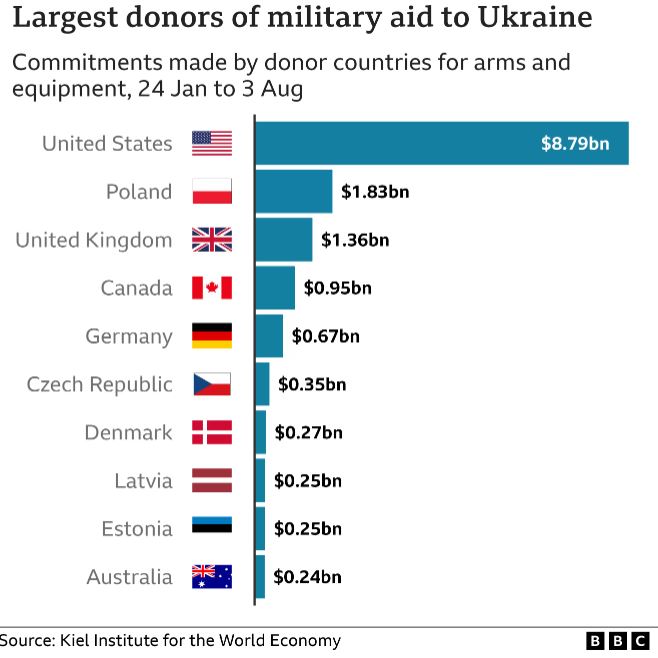
This August graph from the BBC gives a more rounded view;


That is 76% ($11.34/$14.96) from the Anglosphere - none of these nations are even physically connected to Continental Europe (sit down Gibraltar...).

The % of GDP gives a measure of concern as well. The nations who know Russia best are speaking for themselves, but it is telling that of the Top-10, all the nation are either former Soviet Republics, Warsaw Pact members, share a border with RUS, or part of the Anglosphere.


I think about this a lot. You should too - and think about the most important word in the English language; "why."

Friday, October 07, 2022

Fullbore Friday

Ordinary men often find themselves in extraordinary times, become extraordinary, and then return to ordinary.

That does not prevent us from remembering them.

On the eve of the Second World War if you found yourself in Birmingham, England you may have found yourself in the company of a middle aged optician Edward John Hicks and his wife Ethel. Perhaps their 19-yr old daughter Barbara or 15-yr old Pamela, born a few years after what they would call "The Great War," might make an appearance.


They lived in a simple duplex at 46 Brompton Road. That one on the right.

You wouldn't know that your neighborhood optometrist who makes your glasses was also this man.
Say hello to Lieutenant Edward John Hicks, MC, British Army, 2nd Hampshire Regiment. He was awarded the Military Cross for bravery at the Battle of Passchendaele in 1917. After fighting for the first two years of the war as an enlisted man, he was brought up from the ranks and completed officer training in 1916.

Clearly a good soldier and leader to be brought up, and he knew what that meant. Second Lieutenants only had a short lifespan on the Western Front. You needed luck...but more than that, you needed to be good. Better than good.

In WWI, the MC was the second highest award after the Victoria Cross. Roughly the equivalent to a Navy Cross in the USN.
The Battle of Passchendaele, sometimes called the Third Battle of Ypres, took place from June through October 2017. Yes, for the third time in as many years, there would be a major battle over the same bit of ground.

If you have seen this picture from WWI, it is from Passchendaele. This is where they fought.

When it was all said and done, the British Empire, French, and Belgians suffered over 300,000 casualties, and the Germans nearly that much. Both sides may have had more, no one really knows. Such was that war.

So, we have Edward. Halfway through the battle on September 2nd,1917 he joined the 2nd Hampshire Regiment.
Six weeks later, there he was, in the thick of it. 
The 2nd Hampshire, who left Parroy Camp at 9 .15 p.m. on October 8th, found moving up into the assembly positions more than usually difficult : the expanded Steenbeek had to be crossed, the German shelling was fairly heavy and caused both W and X Companies several casualties, while it rained hard all the time ; but if conditions could hardly have been worse,' somehow the positions were duly taken up, and at 7 a.m., 100 minutes after ` Zero ', the battalion started forward in ' artillery formation '. The fire was heavy, but it was some compensation for the mud that it partly smothered the shell-bursts, direction was well kept, thanks partly to having the railway line to go by, and before long the Hampshire were digging in on the Namur Crossing Line, which the Worcestershire had taken well up to time, subsequently going forward again. Advancing again at 8 .50 a.m., the Hampshire were heavily shelled but, admirably directed by Colonel Spring, established themselves just behind the second objective, which also the Worcestershire had duly secured despite stubborn opposition, taking 200 prisoners. On this line they dug in, 2/Lt. Hicks, though wounded and then buried by a shell-burst near him, set a splendid example, continuing at duty and holding on to his post. Then, about 4 p.m., counter-attacks from the NE. forced the Newfoundlands back from the third objective, which they had reached, their left being pushed back across the Poelcapelle—Cinq Chemins road. They rallied, however, and Colonel Spring was prompt to reinforce them and fill up any gaps in their line, while 2/Lt. Scutt formed a defensive flank on the left with his platoon, rallied officer less men who were retiring and restored the situation. After dark the Hampshire relieved the Newfoundlands in what was now the front line, running about NW. from near Tranquille Farm across the Poelcapelle—Cinq Chemins road,' the relief being smoothly effected. During the night, while patrols successfully located the enemy, taking several prisoners, the line was consolidated, with support and reserve lines behind it. Sergeant Sillence, acting as C.S.M., who had been conspicuous during the advance in assisting his officers and setting a fine example, was now much to the fore in directing the consolidation despite heavy shelling. The enemy's snipers were active, especially from Taube Farm to the right front, causing several casualties, and during the night several times fighting patrols approached our lines, two of about 30 each being dispersed by Private Bray, who was out with a Lewis-gun in front of our line, while Sergeant Martin beat off another and Lance-Corporal Jerram and Private Smith did useful work in scouting and detecting the enemy's efforts to advance. Except for barraging a line the battalion was not holding, the German artillery was inactive, and though such wet ground made the work difficult, real progress was made next day with the consolidation, very good work being done by the battalion runners in keeping up communications. Early in the afternoon the Brigade Major reached battalion head- quarters, now at Pascal Farm, East of Koekuit, with orders for the capture of a troublesome ` strong point ' to the left front near Cairo House. There was barely time to organize an attack before the barrage came down, but Lt. Colonel Spring went forward through a heavy barrage to W Company's head-quarters to arrange the attack, and W was just ready before our barrage began at 5 .30 p.m. Advancing with two platoons in a front wave and one supporting, the company, well led and skilfully directed by Captain Cuddon, who was well backed up by Sergeants Trethewy and Parker, mastered its objective, despite stubborn opposition. Many Germans were accounted for, a Lewis gunner, Private Gosling, dispersing one party of 30 single-handed, and a good line was established 50 yards NE. of the buildings and linked up to the rest of the line. That evening the 7th Lincolnshire (Seventeenth Division) arrived to relieve the Hampshire. A dark night made this difficult, but thanks to good arrangements for guides everything went off smoothly and by 8 a.m. next day (October 11th) the Hampshire were back at Elverdinghe . 2/Lt. Lloyd and 18 men had been killed and Captains C. T. Ball and Mudge, Lt. A. G. Smith, 2/Lts. Cutmore and Hicks and 74 men wounded. One noticeable feature of the action had been the increased expenditure of rifle ammunition; in bringing up reinforcements the enemy had given better targets than of late and, with more chances of using the rifle, battalions which had been careful to maintain their standards of musketry had reaped the benefit.

A Military Cross is not just mailed in. Six months later;
The King. King George V, grandfather of the recently passed Queen Elizabeth II, and great-grandfather to King Charles III.

Sadly, we don't know the details of Edward's wounds, but it would be 10 months until he could rejoin his regiment.

In the days before antibiotics and CASVAC, one can only imagine;
He was wounded a second time the first week of September 1918 a few kilometers north of Armentières, Belgium.

In two more months, the war was over. Then he went home as millions of other survivors of that horribly bloody war. The came home and helped make the world we live in today.

Edward fought as an infantryman - both enlisted and as an officer - for the entire length of the war from 1914 to 1918. The United Kingdom had almost 1-million men killed in the war, another 250,000 or so from her Empire. 

Wounded twice, Edward was one of them who made it home and had to do his best to make a future worthy of their sacrifice. He came home to industrial Birmingham to be an optometrist. He started a family, and there is how he found himself to The Front Porch.

Edward is the great-grandfather of friend to the blog and guest of Midrats, Emma Salisbury. I saw her note about her great-grandfather on twitter and she was kind enough to share with me the exceptional summary of Edward's records provided to her by The Royal Hampshire Regiment Museum where most of the above information was taken from.

Thank you Emma, and to your great-grandfather and all the men like him of his generation - fullbore. 


Thursday, October 06, 2022

Diversity Thursday


Anyone who has studied the left's march through the institutions and the regular examples of the O'Sullivan's Law in action, knows the drill knows what happens to previously non-political or even conservative institutions.

The signs of their socio-political presence shouldn't be a shock to anyone. They are just less bloody versions of what Orwell, Huxley, Dith Pran, and others warned us about.

While you were paying attention to other things, their world view is already deep in our military institutions of higher learning, specifically today the U.S. Army War College in Carlisle, PA.

What already is well past the nose in the tent involves in not just narrowing the Overton Window of acceptable speech, but in now compelling speech through membership filtering, fear, and humiliation.

It demands written and spoken self-criticisms - and later (see any of the required DEI training events) often confessions of crimes you did not commit. Like the religious original sin, it is something you simply have by being and must atone for and perhaps never wash the stain away.

Yes, it is socio-political, but mostly political. It is its religious aspects that folds in to the compelled speech - you have to say certain words in certain ways in order to be accepted. A leftist Shahada, in a fashion. 

As we have warned here for over a decade and a half, the vanities, trends, and sociopolitical fads of academia are seeping in to our military's higher education system. Each passing year our war colleges have been trying to be more like a college and less about war. Our service academies are well down that path as we will show again next week, but what about our war colleges? 

Today we'll take a gander at the gates of Carlisle.  

Let's say you were interested in applying for a job as a Professor of Military Studies at the U.S. Army War College Department of Military Strategy, Planning and Operations over in that beautiful part of America in Carlisle, PA.

Looks good. You have all the requirements, what documents do you have to provide with your application?


How about that last little bit again?
"A short narrative of one page or less that describes how you would contribute to an atmosphere of diversity at the U.S. Army War College through teaching, scholarship, and/or service."
If you aren't familiar with this Orwellian experience, well ... you showed up on The Front Porch on the right Thursday.

You can google "sample diversity statement" and get untold numbers of examples. This is such a rote exercise that some universities like UNC even give you examples about what they expect you to say. They don't care if you actually mean anything you say, they just require you to say it.

As will be outlined below, it is a useful gatekeeping function. 
- If you are gullible enough to think these ideologs are not serious, then you will not say the right things: you go in the "no" stack. You might be difficult to control.
- If you don't believe them but are easily intimidated by careerist or simply needing to feed your family, you will say what they want you to say: you go in the "yes" stack. You are easily controlled.
- If you don't believe that this has anything to do with the job and respond incorrectly: you go in the "no" stack. You are not of the same confession and won't be a good fit and will be difficult to control.
- If you are a true believer, you will say all the right things: you go in the "yes" stack. You will be an asset.

There is another category. Those who do not wish to be part of an organization that is so clearly worm-ridden with a hostile, rigid socio-political ideology completely unrelated to the subject you spent years of your life learning and desire to teach. You won't apply. They won't even know these people exist.

That is how, over time, you lose an institution. It starts with leadership that is either a true believer or is of the mindset that if they feed the lions today hoping they will eat them last. Then years of filtering will distill an institution's cadre whose center culture will not just be left, but hard-left - if not in absolute terms, then at least relative to the population they serve. This trend is so well known, there is no need to outline it here. In the unlikely event you are not up to speed, you can start your understanding here

So, back to the topic at hand. What is so bad about "diversity statements?"

These requirements are not unusual;

A recent American Association of University Professors survey found that DEI criteria are included in consideration for tenure at 21.5 percent of colleges and universities, and at 45.6 percent of large institutions of higher education.

"In many cases, these policies threaten to restrict employment or advancement opportunities for faculty who dissent from the prevailing consensus on DEI-related issues of public and academic interest," warns the Foundation for Individual Rights and Expression (FIRE). "These policies may even negatively impact faculty who broadly agree with their institution's DEI values but disagree on some of the specifics, or who simply cherish the right to speak without compulsion."

FIRE acknowledges that private institutions have the right to adopt any ideological requirements they wish (public institutions are bound by the First Amendment). But it says DEI mandates threaten the commitments to free speech and academic freedom that most universities espouse.

"Academics seeking employment or promotion will almost inescapably feel pressured to say things that accommodate the perceived ideological preferences of an institution demanding a diversity statement, notwithstanding the actual beliefs or commitments of those forced to speak," agrees the Academic Freedom Alliance in a statement released last month.

It is infecting not just universities, but surrounding institutions. At last, some are taking a stand;

Last week the New York University (NYU) psychology professor announced that he would resign at the end of the year from the Society for Personality and Social Psychology, his primary professional association, because of a newly adopted requirement that everybody presenting research at the group's conferences explain how their submission advances "equity, inclusion, and anti-racism goals." It was the sort of litmus test against which he has warned, and which he sees as corroding institutions of higher learning.

"Telos means 'the end, goal, or purpose for which an act is done, or at which a profession or institution aims,'" he wrote in a Sept. 20 piece published on the website of Heterodox Academy, an organization he cofounded that promotes viewpoint diversity on college campuses, and republished by the Chronicle of Higher Education. "The telos of a knife is to cut, the telos of medicine is to heal, and the telos of a university is truth."

"The Society for Personality and Social Psychology (SPSP)—recently asked me to violate my quasi-fiduciary duty to the truth," he added. "I was going to attend the annual conference in Atlanta next February to present some research with colleagues on a new and improved version of the Moral Foundations Questionnaire. I was surprised to learn about a new rule: In order to present research at the conference, all social psychologists are now required to submit a statement explaining 'whether and how this submission advances the equity, inclusion, and anti-racism goals of SPSP.'"

Such diversity, equity, and inclusion (DEI) statements have proliferated at universities and in academic societies, he notes, even though "most academic work has nothing to do with diversity, so these mandatory statements force many academics to betray their quasi-fiduciary duty to the truth by spinning, twisting, or otherwise inventing some tenuous connection to diversity."

By design, this movement has gone beyond well intentioned feelgoodism;

Almost all of the publicly available rubrics used by recruitment search committees resemble the University of California, Berkeley’s “Rubric for Assessing Candidate Contributions to Diversity, Equity, Inclusion, and Belonging,” which dictates that applicants should receive a low score if they “[discuss] diversity in vague terms, such as ‘diversity is important for science,’” or if they “state that it’s better not to have outreach or affinity groups aimed at particular individuals because it keeps them separate from everyone else, or will make them feel less valued.”

Most notably, the Berkeley rubric explicitly punishes any candidate who expresses a dislike for race-conscious policies, requiring a low score for anyone who “states the intention to ignore the varying backgrounds of their students and ‘treat everyone the same.’” Conversely, it rewards those most committed to the cause: Candidates receive a high score for “discuss[ing] diversity, equity, inclusion, and belonging as core values that every faculty member should actively contribute to” and “convincingly express[ing] intent, with examples, to be a strong advocate for diversity, equity, inclusion, and belonging within the department/school/college and also their field.”

The rubric published by the University of Colorado Denver mimics parts of Berkeley’s rubric verbatim, but also takes it a step further: In one category, candidates receive a middling score for espousing the “golden rule” (“I will treat others as I want to be treated”) but the highest score for espousing the “platinum rule” (“I will treat others as they want to be treated”). Meanwhile, some institutions employ even more overtly ideological language. At Western Oregon University, high-scoring statements provide “at least two or more strategies for contributing to advancing racial equity and eliminating systemic racism” and identify “at least three inequities and … how they would address those inequities if employed at WOU.”

The left isn't just creating a filtering mechanism for only their fellow travelers - they are effectively eliminating alternative points of view from even trying to have a career ... or like we have seen ... compel speech;

DEI criteria have become increasingly dominant not only in hiring practices, but in tenure decisions. In the American Association of University Professors’ recent survey of tenure practices, 21.5% of all surveyed institutions reported including DEI criteria in their tenure standards, and 38.9% reported that they were considering adopting such criteria. For large institutions, 45.6% had adopted the criteria, and another 35.5% were considering them. Only 18.8% of the large universities surveyed had not implemented DEI promotion and tenure criteria and were not considering doing so in the future. Presumably, some number of them will eventually flip.

That the policy is an open question at so many universities underscores an important point: DEI measures tend to inflate. Large fleets of university diversity officers need a raison d’être, which is why universities are adopting DEI strategic plans, and ennumerating dozens of new policies created by and for DEI officers, at accelerating rates. The universities that have not yet done so face mounting pressure. In April of this year, Ohio State University’s Task Force on Racism and Racial Inequities released a report with a laundry list of “Grand Challenges and Priority Action Steps,” recommending the creation of an institutionwide diversity action plan. If that plan looks like the College of Engineering’s Racial Equity and Inclusion Action Plan, it will include establishing language in its promotion and tenure manual “concerning the assessment of equity and inclusion in annual reviews.”

Given the public health disaster of the last two-and-a-half years, and the gravity of the discipline, it’s particularly jarring to see this development unfold in the medical field. The Oregon Health and Science University School of Medicine was recently reaccredited, but the Liaison Committee on Medical Education (LCME), which accredits medical schools, found it lacking in faculty diversity. In response, the medical school released its DEI strategic plan, which was created “in alignment with accreditation requirements,” and which promises not only “consequences” for faculty who don’t get on board but also to “develop and incorporate DEI, anti-racism and social justice core competencies in performance appraisals of faculty and staff.”

The UNC School of Medicine likewise created a Task Force for Integrating Social Justice Into the Curriculum, which recommended, among other measures, adding social justice criteria to the school’s promotion and tenure policy. As of May 2021, the school’s promotion and tenure guidelines require faculty to submit a diversity statement and list DEI contributions, examples of which include “Application of material learned in DEI trainings (e.g., Safe Zone, Unconscious Bias, Implicit Bias, etc.) to promote an environment of cultural awareness, knowledge, and sensitivity.”

All of this is well within the lifelines of the US military's institutions of higher learning. It has been a long, slow, march allowed under the noses of all political parties. 

There are a few cornerstones to our republic that have - in fits and starts - served it well.

First is no religions test, second is a military free of partisan politics.

At the core, the Diversity, Inclusion, and Equity agenda isn't just political - which it clearly is - it is a world view that people should first and primarily be judged by their race, creed, color, or national origin - and done so in a 19th and early-20th Century "one drop" world view that requires officially sanctioned sectarianism.

At no time in human history has a military or a nation prospered under such a structure. In the end it degrades good order and discipline, promotes conflict at the personal and institutional level, and never moves the ball towards equality. 

It never reaches that point because that isn't the goal. The goal is sectarian division because it is from that division that you can better control a people and promote your own desire for power.

The lust for power, money, and sex; the primary drivers of corruption and conflict in our species - and they're all being spot welded on to a discipline whose performance is degraded by all three.