Wednesday, March 03, 2021

An Abandonment of Stewardship


Since 17 of our Sailors drowned in berthing after the collisions of the summer of 2017 to now - we have covered almost the time it took from the attack on Pearl Harbor to victory in Tokyo Bay ... and yet ... what have we really done?

Look at the metrics.  

That's what I did over at USNIBlog.

Come and see.

Tuesday, March 02, 2021

Australian Submarine Program Stumbles


For a whole host of reasons, Australia needs a potent and numerous submarine force. Geography and potential opponents make the case pretty straight forward.

It looks like they are not on a smooth path;

As this is written, the head of the French naval construction company Naval Group, Pierre Eric Pommellet, is in Australia meeting federal ministers in an attempt to rescue the contract. Tragically for Australia – and for Monsieur Pommellet – not one of those ministers has the experience or competence to wrangle a successful result. Many informed commentators in France, Australia and elsewhere now expect the much-celebrated deal to be abandoned. If that happens, replacing the current ageing submarines would be delayed many years, depending on the timing of the change of government to a capable administration.
...
Several of Australia’s specifications were plain foolish, as Binoy Kampmark summarised for IA. A nuclear submarine with a diesel-electric engine is a fail. An American combat system won’t work in a French vessel because the Americans and the French do not talk. Lead-acid batteries will be obsolete well before the subs are delivered. 

France’s original tender documents put the cost of the project at between $20 billion and $25 billion. The cost in the initial agreement signed in late 2016 was $50 billion.

There were other options than what the French were offering, but here we are.

What Australians and her allies need to be careful about - and push back hard on - is thinking like this;

 Replacing the current six Collins-class vessels is certainly justifiable and possibly increasing that to seven or eight.

Comparisons with other countries suggest 12 is excessive.

Taiwan with a similar population to Australia’s and much greater defence vulnerability has four. Canada with a much higher population also has four. Argentina and Spain with roughly twice Australia’s population each have two. Germany which has a population more than three times Australia’s and is a major submarine manufacturer has six. Brazil with eight times the population has six. Mexico with five times the population has none. New Zealand with arguably the same defence vulnerability as Australia has none.

Twelve is thus excessive, especially as this Government has borrowed $73 billion on average each year for the past seven years – a total debt blow-out of $541 billion – while all well-managed economies have substantially reduced their debt.

I invite everyone to get a globe and look where those nations are, who their neighbors are, how big they are, how close their nearest allies are ... and then read the above again.

If you have a spare prayer, send one down under. They ... and we ... need this to work. 

Monday, March 01, 2021

Where are we Heading? Watch DepSecDef Hicks


What is the reality of 2021 for those concerned with the direction of our nation's defense? With no constituency of any significant power in the Executive or Legislative branches of government willing to expend political capital for a larger defense budget, much less a larger Navy, everyone should accept that through at least mid-decade there will be flat to decreasing DOD budges.

If you want to know where the low hanging fruit is from the perspective of those in the Biden Administration given responsibility for making policy in DOD, keep an eye on Deputy Secretary of Defense Kathleen Hicks. She knows her business.

This summary by Paul McCleary at Breaking Defense is solid I&W. 

In the (Feb. 17th) memo, Hicks wrote that “due to the limited amount of time available before the Department must submit its FY 2022 President’s Budget request, the process to re-evaluate existing decisions will focus on a very small number of issues with direct impact on FY 2022 and of critical importance to the President and the Secretary.”

...

The Pentagon will focus on shipbuilding, low-yield nuclear weapons, Central Command funding and force posture and building capacity in the Pacific as it rushes to write its 2022 budget, a memo obtained by Breaking Defense says. 

If you need some more detail, these six bullets are worth your attention as well. Feel free to stamp the last two as sops to the political agenda, but the first four are the meat of the matter.
She directed the Office of the Director of Cost Assessment and Program Evaluation (CAPE) to review a handful of critical acquisition efforts:
— Shipbuilding: current FY 2022 shipbuilding additions 
— Nuclear Enterprise/Nuclear Command, Control, and Communications (NC3): lower-yield weapons and select NC3 topics 
— Long Range Fires: current FY 2022 long range fires additions 
— Aircraft: F-35, Air Force tanker aircraft, and MQ-9 
— Climate: initial options for investment and set ground work for additional investments during the FY 2023 to FY 2027 review cycle 
— Build Back Better: extant FY 2022 investments and FY 2023 opportunities 
One little note - if the first four get too hard, then efforts will shift to the last two. Like the farcical "Great Green Fleet," such actions in the 5th bullet make political friend for those who see DOD as just a money source and place where the workers are easily ordered around and compliant. You can seem to be doing "a lot" with the right people with little expense of political or personal capital. 

The 6th bullet ... if you want to flex it as much as you want ... well ... 'thar be dragons.

Sunday, February 28, 2021

The Future of European Naval Power with Jeremy Stöhs - on Midrats

Where is European naval power in 2021, what is shaping it, and where is it going? 

This week returning guest Jeremy Stöhs is with us to review the above issues as outlined in an exceptional report he produced for the Centre for Military Studies at the University of Copenhagen., "How High? The Future of European Naval Power and the High-End Challenge."

Jeremy is the Deputy Director of the Austrian Center for Intelligence, Propaganda and Security Studies and the editor for their journal, JIPSS.

After service in the Austrian Federal Police in 2005-2010, he studied History and English/American Studies at the Universities of Graz, St. Petersburg (USA) and Marburg (GER) 2009-2015. He was a Defense Analyst at the Institute for Security Policy at Kiel University (ISPK) 2016-2019 and received his PhD in political sciences from Christian-Albrechts University Kiel, 2019. He is the author of "The Decline of European Naval Forces: Challenges to Sea Power in an Age of Fiscal Austerity and Political Uncertainty” (US Naval Institute Press, 2018).

His research focuses on International Relations, Strategic Studies, U.S. and European Security and Defense Policy, Maritime Strategy and Security, Public Security. 

If you use iTunes, you can add Midrats to your podcast list simply by clicking the iTunes button at the main showpage - or you can just click here. 

Friday, February 26, 2021

Fullbore Friday

25 FEB 1852.

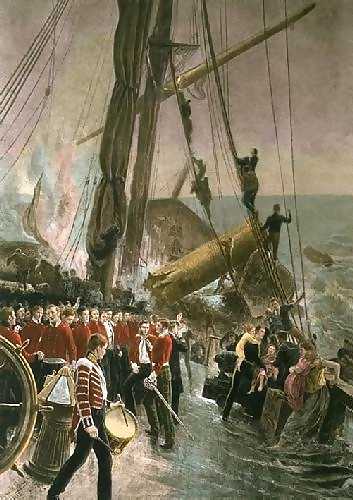
Discipline. Honor. Sacrifice - and steadfast leadership. Do you really know what they mean? How do you know you, as well as the men and women under your command, can do what is needed - and do it with cold firmness? Are you ready for the Birkenhead Drill?
To take your chance in the thick of a rush, with firing all about, Is nothing so bad when you’ve cover to ’and, an’ leave an’ likin’ to shout; But to stand an’ be still to the Birken’ead drill is a damn tough bullet to chew, An’ they done it, the Jollies—’Er Majesty’s Jollies—soldier an’ sailor too! Their work was done when it ’adn’t begun; they was younger nor me an’ you; Their choice it was plain between drownin’ in ’eaps an’ bein’ mopped by the screw, So they stood an’ was still to the Birken’ead drill,2 soldier an’ sailor too!
A little bit from Kiplings "Soldier an' Sailor too!" Here is the background.
At 2 a.m. the following morning, the Birkenhead struck an uncharted rock at 34°38′42″S 19°17′9″E / -34.645, 19.28583 near Danger Point (today near Gansbaai, Western Cape). The barely submerged rock is clearly visible in rough seas, however it is not immediately apparent in calmer conditions. The initial impact ripped open the forward watertight compartment between the engine room and the fore peak, immediately flooding it and drowning over 100 soldiers in their hammocks. A second impact ripped open the bilge in the engine room, resulting in the two largest watertight compartments in the vessel being been flooded. The surviving officers and men assembled on deck, where Lieutenant-Colonel Seton of the 74th Regiment of Foot took charge of all military personnel and stressed the necessity of maintaining order and discipline to his officers.
Almost everybody kept silent, indeed nothing was heard, but the kicking of the horses and the orders of Salmon, all given in a clear firm voice.
Distress rockets were fired, but there was no assistance available. Sixty men were detailed to man the chain pumps, sixty more were assigned to the tackles of the lifeboats, while the rest were assembled on the poop deck, in order to raise the forward part of the ship. Poor maintenance and paint on the winches resulted in only a few of the ship's lifeboats being launched, and the two large boats, with capacities of 150 men each, were not among them. Eventually two cutters and a gig were launched, onto which all the women and children were placed and rowed away for safety. Only then did Captain Salmond order that those men who could swim should save themselves by swimming to the boats; Lt-Col Seton, however, recognizing that rushing the lifeboats would risk swamping them and endangering the women and children, ordered the men to stand fast. The cavalry horses were freed and driven into the sea in the hope that they might be able to swim ashore. The soldiers did not move, even as the ship broke up barely twenty minutes after striking the rock.
Ponder that for a bit. FYI, that is where the phrase "women and children first" originated. Hat tip CO-ED Combat.

First posted in FEB 2008.

Thursday, February 25, 2021

Diversity Thursday

This is the 4th and a half draft of this week's DivThu ... a much more simplified version. I did have a very long post, but decided that was unnecessary. It was better, especially with Part 2 - the Navy's Reading List - added below, to keep this rather simple as I think it speaks for itself.

Let's go.

Part 1: Navy Task Force One.

If you were going to try to get the temperature of race relations in our nation, probably the worst time to do it in the last 35 years would have been over the summer and fall of 2020. 

As our Navy reflects the society it comes from, it would be only natural that the high emotions, cultural climate, and all that happened in that time period would come in to the study as you took the temperature.

If you were looking at a worst case snap shot, you would be hard pressed to pick a more opportune time. Keep that in mind and adjust accordingly. 

To add to that, you had leadership in self-preservation mode decoupling themselves from the people they assigned to Task Force One and were unlikely to push back on any of the overreach. 

We have what we have. I think it would be best if you read the entire thing for yourself, but I wanted to put just one screen capture out there to outline to you where I stand. 

The Pledge:


There are five points to the pledge. The 1st, 3rd, and 4th are fairly harmless, but the 2nd and 5th are poison pills.

I pledge to advocate for and acknowledge all lived experiences and intersectional identities of every Sailor in the Navy.

Nope. Never. You have to understand the terms "lived experience" and "intersectional identities." 

For me, this spoils the whole thing. Pick a few good items, but dismissing the rest as the political exercise it is.

Regular readers here understand the term, "Cultural Marxism." Well, as I warned you years ago that it was coming - here it is, red in tooth and claw.

First, "lived experience":

 ...the first google result on difference between “experience” and “lived experience” comes from Geek Feminism Wiki: “The term lived experience is used to describe the first-hand accounts and impressions of living as a member of a minority or oppressed group.”

Anytime there’s language employed almost exclusively by adherents to a certain set of ideas, there’s a two-fold danger. The first is that those who are inclined to object to the perspective will not understand what is being gotten at by the terminology (i.e. they’ll assume redundancy and just replace “lived experience” with “experience” in their minds) or worse not take it seriously (i.e. scoff “as if there’s a kind of experience that isn’t lived!”). On the other hand, there’s the risk of those who use it to take it so much for granted that they don’t scrutinize what claims its rhetorical force is masking (e.g. a few recent titles I quickly scanned through on google books about “lived experience” never define what is meant by the term).

So in this post I want to try to give a brief history of the word. A disclaimer is that this (and everything I write here) should be taken as a first draft and nothing should be taken on authority as it comes from just googling for a couple of hours. The main service, though, that I hope to accomplish is to convince you that there is a very simple reason why people use the term “lived experience” and thus that it shouldn’t be dismissed offhand as “just one of those in-words SJWs say.” A secondary aim is that learning a bit about the various ways the word “lived experience” has been viewed over time might suggest some ways of thinking about how it should be viewed today. This is important because the way we think and talk about “lived experience” today raises many difficult questions about the status of knowledge, representation, and agency in what we hope is the creation of a more just society.

In other words, it is not fact based. It is opinion based. It is a point of view. So, the Navy wants everyone to accept, without question, something that may be false when faced with facts. No, worse than that, the Navy wants you to advocate for it.

Nope. Non-concur. 

Next, "intersectional identities":

Intersectionality is the buzzword to end all buzzwords, the term that launched a thousand hot-takes, a discursive sinkhole where political disputes go to die. Depending on who you ask, it’s the most important theoretical innovation in feminist history; the cancer that’s killing the left; a critical tool in on-the-ground organising; or a totally meaningless liberal shibboleth. I am not overly invested in trying to claw back some kind of clarity on what intersectionality “means”. Like much of the work done by feminists and queer theorists around the same time, there is a certain ambiguity to intersectionality, if only because many of the people interpreting it come from this poststructuralist milieu.

...

Back in the good old days we had simple, honest labour movements, the kind of vulgar Marxist or social-democratic workerism that anyone could understand. Some time in the 1970s postmodernists and other wreckers took over, junked the notions of universality and the totality of social relations that powered labourism, and replaced them with a weak, defeatist politics of difference and contingency.

Intersectionality is like flypaper for this kind of analyst. A hefty seven-syllable academic megalith intended to do the work of reform under capitalism, beloved by rich liberal college students and the extremely woke and incredibly online: if it didn’t exist, they’d have to invent it.

Nope. Never. Not going to pledge to get involved in that socio-political swamp and would never ask anyone to do so.

The entire report is below, or at this link. 

Read it all if you want. I think if you did, you might be a step ahead of Navy's uniformed leadership. Well, perhaps that is an unkind assumption on my part, but that would be about the only acceptable excuse for putting your name on this. If they did read it and put their name to it afterwards, well, that tells you about all you need to know.  


Part 2: The Navy Reading List: I know it is no longer called the "CNO Reading List" or somesuch, but a Navy reading list is his reading list, so let's run with it.

I want you to look at the bottom of the list, on "Sailors"

It's below or at this link;


As this has become kind of my wheelhouse, I'll go there. 

Why in the hell are we injecting the poison of Critical Race Theory and sectarian political fads in to our fleet? 

"How to be Anti-Racist" by the highly problematic Ibram X. Kendi as "Foundational?" 
The most threatening racist movement is not the alt-right’s unlikely drive for a White ethnostate but the regular American’s drive for a “race-neutral” one… there are ideas that express hierarchy and inequality. There are policies that create equity and inequity. The other aspect of it that is troubling is that there’s no such thing as a “not racist.” There is only racist and antiracist.
Then for "Advanced" the CNO wants to inject "Sexual Minorities and Politics" by Pearson in their heads?

"Capstone" it all with "The New Jim Crow" by Alexander?

Well, there you go.

This is political. This is taking a side. At least we know.

Captain Second Rank Ivan Yurievich Putin is watching.

Wednesday, February 24, 2021

What is One Word That Will Terrify an Entire Ship?


They are ugly, boring, quiet, sedentary, misunderstood, ignored, disrespected ... yet in crisis - surprises & terrifies everyone.

They are also something we need to be ready to use immediately if we are serious about confronting China.

I'm pondering things that go bump in the night over at USNIBlog.

Come by and ponder with me for a bit.