skip to main |
skip to sidebar
As reported by Chris below, it looks like Fincantieri Marinette Marine won the first 10 FFG(X).
Yes, once again - the Navy chose the Salamander Option. Wise move.
It almost seems like the Navy has done something very wrong to the Old Gods, and they are very angry.
We are being punished by our own hand.
If you think the latest wave revolving around the relief of Captain Crozier, USN and COVID-19 will fade soon ... you are sadly mistaken.
Details over at USNIBlog.
Come on by and behold with me.
If you haven't had a moment to consider a point EagleOne and I have discussed here and there on the last two Midrats - how COVID-19 is going to change national security assumptions and priorities - then as we start the downslope of the first wave of infections, you may want to start investing some of your ponder-time on the topic.
Over at WOTR, Lt. Gen. David W. Barno, U.S. Army (ret.) and Dr. Nora Bensahel have been giving it a thought in a recent article, Five Ways the U.S. Military Will Change After the Pandemic.
The number of Americans killed by the virus is about to exceed the number of U.S. troops killed in Vietnam, unemployment is higher than it has been since the Great Depression, and the social and human toll is simply incalculable. The ultimate damage will be so great that after the pandemic, the urgent need to defend the American people from devastating threats inside the homeland will quickly displace foreign threats atop the hierarchy of national security concerns.
I'm in alignment with three of their five points, but not with two. Read it all for the details, but here's a brief outline.
Let's look at the three I agree with them on.
First:
Reliance on Forward Defense Will Diminish
... the United States will continue to defend its most vital interests overseas: keeping NATO alive, protecting Eastern Europe from Russia, supporting Israel, and deterring conflict in Asia. But U.S. forces across the Middle East, Afghanistan, Africa, and even in some parts of the Pacific are likely to be drawn down if not withdrawn completely.
The economic crisis may also require changes to U.S. force posture in the places where military forces remain, since the sprawling network of overseas bases remains expensive.
Yes, that is a bit self-serving for me as this "withdraw from empire" call aligns with what I have wanted to do for the last two decades, as regulars of the Front Porch know. Now more than ever it makes sense from a reactive response, vice a long term strategic move ... but that is OK, eventually everyone goes Salamander and they are welcome to the party.
Next:
The Reserve Component Will Become Much More Important
The increasing primacy of homeland defense means that the reserve component of the U.S. military may become equally if not more important to the nation than the active component, which would completely invert the traditional relationship between them. The vast majority of the military capabilities that have been used to respond to the pandemic, and that will be needed for future homeland crises, reside in the reserve component (which includes the National Guard and the reserve forces of the individual military services).
Like the first point above, this aligns with my long-term call to invest on what is our comparative advantage as a maritime and aerospace power. The vast majority of our land forces should be in the reserves and National Guard with a smaller more expeditionary focused active component for our land forces. Extra bonus - it will be harder to knee-jerk our way in to land wars in Asia if we have to mobilize significantly.
Final point of agreement:
Legacy Programs and End Strength Will Be Cut — By a Lot
As we’ve argued, the massive economic crisis and growing political pressures for greater domestic spending mean that the defense budget will likely plummet — and may even make the sequestration-era cuts look rosy by comparison. The combination of sharply declining budgets, less emphasis on the land, sea, and air domains, and diminishing forward presence means that expensive conventional platforms like aircraft carriers, amphibious ships, and manned fighters will likely face severe cuts. Major legacy modernization programs that were already reaching unaffordable levels (like the F-35 fighter and the Ford-class aircraft carrier) will inevitably have to be significantly scaled back, and some may be canceled outright.
Welcome to the Terrible 20s folks.
Now for the "others," those two points where I disagree with the authors.
First:
Cyber and Space Will Be Higher Priorities Than Land, Sea, and Air
The U.S. military currently recognizes five warfighting domains: land, sea, air, cyber, and space. After the pandemic, external threats to the United States from the land, sea, and air will become much lower national security priorities than protecting against threats to the homeland from newly emerging and unconventional dangers. For the Department of Defense, that means a much greater emphasis on the cyber and space domains.
This is a mistake that pre-dates COVID-19. It is easy to want supporting domains, such as cyber and space, to be the supported domains of the future. It is easy because it excuses you from having to accept that war was and what it has always been, will be again - a nasty, bloody business that isn't won until young armed men and women stand athwart the enemies land and say, "this is no longer yours, it is mine." Hard power will always be the deciding factor, no matter how many think-pieces you write trying to make the icky go away. Those who forget that will lose the next war, and the one following that.
Finally:
The Prestige of the U.S. Military Will Be Dimmed
The U.S. military will also face a profound cultural challenge after the pandemic, as its place in American society inevitably shifts. Since September 2001, the United States armed forces have been uncritically revered by the American people. The amount of deference and praise heaped on the all-volunteer force fighting overseas for almost two decades has been enormous, and largely warranted. But it has grown so excessive that even some in uniform now find it a source of embarrassment. Every year has brought new pay raises, more benefits, and greater visibility, which has sometimes raised expectations of ever more prestige and perquisites.
No, not really. That thought/wish has been true for some intellectually and culturally isolated segments of our society for a long time and it not new - but for the American people as a whole, no, that won't happen. I know a lot of the usual suspects want it to happen and look forward to it - but it won't. At least in my blessed corner of the country.
On balance, nice article that should encourage everyone to think about the topic.
Three out of five ain't bad.
Great overview over at FT of the problem getting hold of the death toll from COVID-19.
The death toll from coronavirus may be almost 60 per cent higher than reported in official counts, according to an FT analysis of overall fatalities during the pandemic in 14 countries.
Mortality statistics show 122,000 deaths in excess of normal levels across these locations, considerably higher than the 77,000 official Covid-19 deaths reported for the same places and time periods.
If the same level of under-reporting observed in these countries was happening worldwide, the global Covid-19 death toll would rise from the current official total of 201,000 to as high as 318,000.
...
According to the FT analysis, overall deaths rose 60 per cent in Belgium, 51 per cent in Spain, 42 per cent in the Netherlands and 34 per cent in France during the pandemic compared with the same period in previous years.
Some of these deaths may be the result of causes other than Covid-19, as people avoid hospitals for other ailments. But excess mortality has risen most steeply in places suffering the worst Covid-19 outbreaks, suggesting most of these deaths are directly related to the virus rather than simply side-effects of lockdowns.
David Spiegelhalter, professor of the public understanding of risk at Cambridge university, said the daily counts in the UK, for instance, were “far too low” because they only accounted for hospital deaths.
The thing is, this is just covering those fully developed nations (+Indonesia) who have exceptional health care systems from a global perspective, and relatively good and transparent reporting systems.
What about the rest of the world from Africa to South Asia?
We really have no idea.
 Last week, we could have gone another hour, so we thought the easy thing would be to bring it forward to this Sunday from 5-6pm.
We will cover the waterfront as the Navy continues to struggle to get past COVID-19's dominating Navy news, not just with the TR, but now the USS Kidd and everything from boot camp to the Naval Academy.
Throw in a pick up game presence missions in the South China Sea, and the Russians ditching their future surface fleet ... and there is more than enough to make a fast hour.
Open topic and open mic.
You can listen to the show at this link or below, but remember, if you don't already, subscribe to the podcast at Spreaker or any of the other podcast aggregators.
If you use iTunes, you can add Midrats to your podcast list simply by clicking the iTunes button at the main showpage - or you can just click here.
Hidden behind all the COVID-19 news this week is another standoff in the South China Sea that had a bit more energy than usual.
Via Sam LaGrone at USNINews;
On Monday, USNI News first reported USS America (LHA-6) was operating in the vicinity of the site of a tiff between China and Malaysia over mineral-rich territory in Malaysia’s Exclusive Economic Zone. The region has been marked by the increased presence of naval and paramilitary ships from China, Vietnam and Malaysia since Malaysian drillship West Capella began exploring the region in October. Currently, the Chinese survey ship Haiyang Dizhi 8 has been operating in Malaysia’s EEZ since April 16 with an escort of China Coast Guard vessels.
Chinese officials typically call out U.S. actions in the South China Sea that conflict with Beijing’s interests. However, during a Tuesday press conference, the foreign ministry presented a toned-down response to questions about U.S. ships near the territorial dispute.
We seem to have put together a team to make a point;
“USS America (LHA-6) and USS Bunker Hill (CG-52) are forward-deployed to the region and are currently operating in the South China Sea,” U.S. Indo-Pacific Command spokeswoman Lt. Cmdr. Nicole Schwegman said in a statement to USNI News.
...
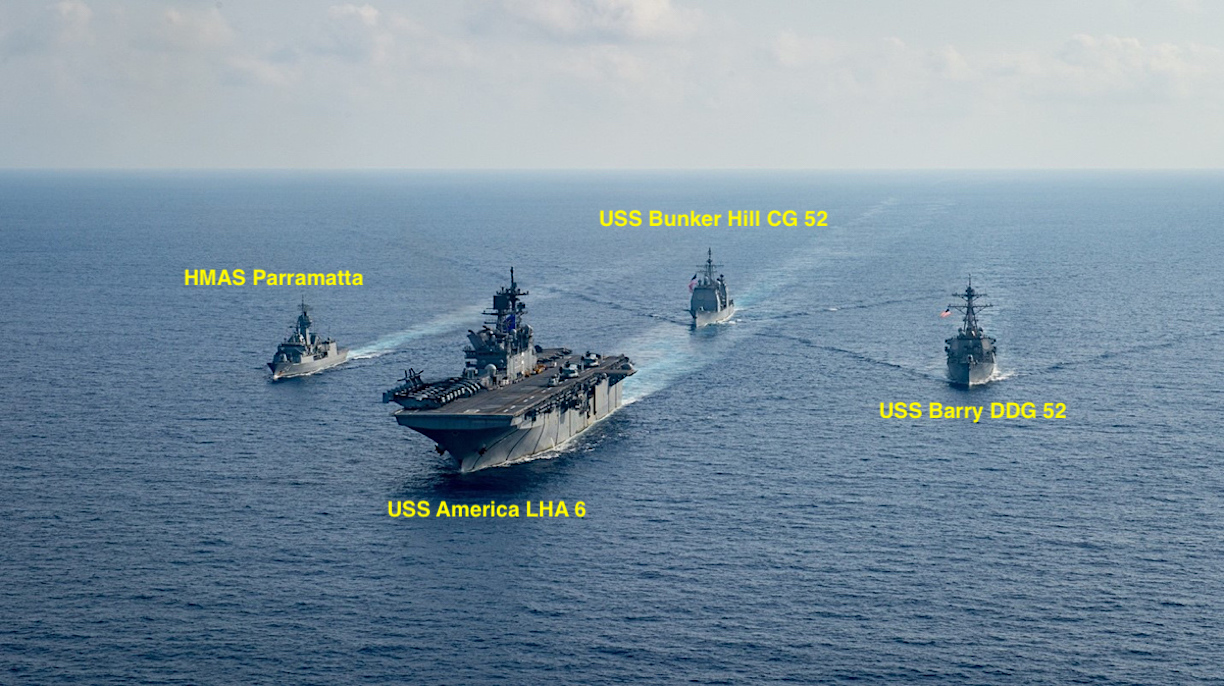
America and Bunker Hill are operating in concert, with the cruiser serving as an air defense escort for the amphibious warship. Guided-missile destroyer USS Barry (DDG-52) is also operating in the region.
Then look who came out to play;
HMAS Parramatta (FFG 154) began sailing with Ticonderoga-class guided missile-cruiser USS Bunker Hill (CG 52) then rendezvoused with amphibious assault ship USS America (LHA 6) and Arleigh-Burke class guided missile destroyer USS Barry (DDG 52) April 18.
Isn't this a great view?
That is the way it is done. I think we need to get the Australians a properly sized battle-flag, but that is a minor quibble.
Photo credit, IPN.