3 hours ago
Friday, August 30, 2019
Fullbore Friday
The United Kingdom and her Empire were fighting WWII for over two years before we entered the war. Her Navy was fighting Germans from the North Cape to the South Atlantic, from the Grand Banks to eastern Indian Ocean while we sent a cruiser to South Africa to load up on her gold to buy weapons.
80 years and a day ago in 1939 the Admiralty ordered the mobilization of Royal Navy. Just five days later, she would be at war with Germany.
She started the war with a fleet 332 strong. Before the end of the war, she would have 885 ships serve under her flag. She lost 278 of them.
At the start of the war, the United Kingdom herself had a population of 47,550,000. Between her navy and merchant marine, by war's end she would suffer 81,006 dead.
To put that in perspective, in 1939 the USA had a population of 130,900,000. Our navy and merchant marine suffered deaths of 68,276. To understand fully the British losses at sea, if you adjust by population size, for the USA to have as many killed at sea, our number would be 261,800 souls.
Fullbore.
Hat tip @OnthisdayRN, photo credit burritojustice.
Thursday, August 29, 2019
A Breach of Faith: The Navy Must Fix the Way it Pays Mobilizing Reservists
When I arrived in Kabul for my last deployment, one of the first things I noticed was a shockingly high percentage of the USN cadre there was USNR. The months that followed was the first time in two decades on active duty that I started to fully appreciate the unnecessarily Byzantine bureaucracy they had to exist in – almost designed to make people not want to be in the USNR.
Today’s guest post outlines to those outside the USNR lifelines a few of the unnecessary processes our reserve component has to deal with. Many of these exist for one reason only; we allow them to.
Blake, over to you.
The US Navy Reserve is failing its deploying Sailors by sending them forward into harm’s way with administrative burdens that damage financial standing, negatively impact their families at home, and detract from readiness. These problems begin at the outset of reserve mobilization and continue through to the day upon which reservists are demobilized and sent home and, in some cases, beyond. Intervention is required if the Navy Reserve is to execute its stated vision of providing transparent and seamless administrative systems in support of its deployed force.
Most US Navy Reserve Sailors are familiar with a certain degree of extra administrative burden that is not felt as strongly by active duty Sailors. Reservists must learn the administrative system intimately and be prepared to shoulder responsibility for requirements that would be handled by personnel and pay departments in the fleet. It is a common joke that serving as a Selected Reservist (SELRES, or drilling reservist) is like having a second full time job for which you are paid one weekend a month. Reservists, in my experience, accept that responsibility with good humor and understanding in most situations.
When a reserve member is mobilized, however, the issues commonly snowball to an unacceptable level beginning on the day they report to the Expeditionary Combat Readiness Center in Norfolk, Virginia. During the first morning, reservists are told that “due to 1’s and 0’s issues” their allowance for lodging is not the US Navy’s official rate for their geographic location. Instead it is a lower total, set as part of the Integrated Lodging Program Pilot (ILPP). Most reservists will have made their lodging reservations months in advance and, due to Norfolk being a fleet concentration area, many will have been forced to obtain Certificates of Non-Availability (an official document certifying that DoD lodging was unavailable and authorizing the sailor to make arrangements elsewhere) and make reservations in non-DoD lodging, oftentimes at a higher rate than otherwise allowable. The gathered Sailors are informed that their CNA’s will not be honored due to incompatibility between the Navy’s travel management system and the new program. In layman’s terms, this means any sailor in lodging above the ILPP limit, even if unable to obtain any other DoD-approved lodging, will personally bear the cost of any overage and will not be reimbursed during the travel claim process. A large number of deployers leave at lunch on the first day to find new lodging. Those that are unsuccessful in finding lodging within a reasonable distance are left with the bill, regardless of their rank.
In the same morning, Sailors are informed that their travel claims (the document detailing all costs incurred by the sailor from the time they leave home until they reach their gaining deployed command) will not be reconciled within the Congressionally-mandated timeline of 30 days. These travel claims include air travel (procured at inordinately high rates via the DoD’s contracted travel service), weeks of lodging, and per diem allowances totaling several thousands of dollars. Most of these costs are incurred on each sailor’s Government Travel Credit Card (GTCC). For those unfamiliar, every member is required to apply for and employ a GTCC for any travel expenses incurred during duty status, and those cards are linked to each member’s personal credit rating. Members are advised that travel claims may take three to six months to be serviced but that the issue is “receiving flag-level attention.” Many members, to avoid late penalties and damage to personal credit, use their personal savings to settle the government’s bill or place the mobilization-related bills on personal credit cards – a direct violation of DoD policy and putting members at risk of disciplinary action. The issue, at best, depletes members’ savings or, at worst, negatively impacts members’ credit ratings, as the navy fails to reimburse Sailors for costs it has directed them to incur without an effective method of repayment. As a currently-deployed reservist, my detachment recently relieved a group of Sailors that had at least one sailor de-mobilizing (going home) after 270 days deployed whose travel claim still had not been reconciled. With three weeks to go until re-entering the civilian sphere, that sailor was still bearing a burden of thousands of dollars without any sign of resolution.
Pay issues, a problem not unfamiliar to both active duty and reserve Sailors, becomes a nightmare for mobilizing reservists. When Sailors are mobilized, they pass through multiple commands via intermediate stops (I-stops) delineated in their mobilization orders. Their Navy Operational Support Centers (NOSC’s) at home release them administratively and the fleet picks them up in a process that begins at ECRC. The administrative personnel at ECRC work hard, but are faced with processing dozens, sometimes over 100, Sailors each week. Each sailor is warned during their first week of mobilization that they will likely experience pay issues. While it is appropriate to warn deployers of this, it’s simply unacceptable and the warning of “pay issues” does not remotely approach an accurate description. More apt would be a warning that Sailors cannot rely on their employer, the US Navy, to compensate them sufficiently to pay their bills for a period of time that may be counted in months.
This practice of allowing known pay issues to languish would result in immediate dismissal for the parties responsible in any enterprise outside the DoD. For those that would rebut this allegation with the fact that the US Navy will eventually make those Sailors whole via backpay, that point is acknowledged but who pays Sailors’ bills in the interim? I have rented lodging my entire adult life and have yet to encounter the landlord that accepts IOU’s for months on end, nor the utility company that provides power on the promise of reimbursement, nor the grocery store that offers food on credit. Approaching our fifth month of deployment, my small detachment of five has one sailor being paid correctly. In the last pay period, I received $0.30 as my housing allowance for a month. My rent, for an average apartment - admittedly in one of the most expensive cities in the world, is over $3,000 (well-within the allowable limit for the locale). My Sailors come to me with concerns that they will be unable to support their wives at home or pay their mortgages. We’ve been told that the Personnel Support Detachment responsible for our unit is below 50% manning but they’re hiring and training the required staff to get our issues sorted out. If the DoN is paying those employees half of what they agreed to in their contracts, it is no wonder that they lack the necessary manpower to execute the required tasks. The one thing PSD has definitely accounted for are debts, any overages or incorrect allowances have been withdrawn within one pay period. These are not isolated incidents. Other reservists report their final paychecks were held by the Defense Finance and Accounting Service for 100 days beyond their re-deployment dates, exponentially multiplying the stress of re-integration at home. It is not only egregiously wrong, it degrades personal and unit readiness. Members are being plucked from their homes and workplaces and placed into a position of financial instability, draining personal savings and causing insecurity in families. Sailors’ minds are understandably divided between their deployed duties abroad and ensuring their loved ones are not put out into the street at home.
With regards to travel claims, I propose a mobilization stand-down until the timeline for reimbursement can be brought back within the 30 day requirement set forth by Congress. During the stand-down, an impartial third party should be engaged to conduct a thorough review of policies and business rules that allowed this vast backlog of debts to Sailors. While this is an extreme response, perhaps that extremity might offer motivation to self-assess rapidly and institute solutions, rather than simply briefing our deployers that they might not be repaid until after their 9-12 month deployments conclude.
In terms of fixing the pay system, it is past time to modernize. I know all Sailors reading this will be familiar with handwriting checking account information into a poorly-copied, off-center reproduction of the Navy’s electronic funds transfer form. I am also confident that most Sailors reading this have faced the issue of incorrect pay and fixes that take months to effect. Looking at Navy pay programs and websites is akin to taking a guided tour of the internet of the 1990’s. There are effective, modern solutions to paying personnel. Navy leadership need to choose one and implement it, preferably before the private sector jumps forward another generation in technology and leaves us even further behind.
If the language in this article seems impassioned, or perhaps accusatory, I suppose that is the case. The DoD owes better to its Sailors, and especially those it deploys into harm’s way. It is not enough to tell them that flag level officers are aware of their problems when those problems are damaging their personal credit, depleting their savings, and distressing their families. When we talk about personal sacrifice, are we acknowledging that in addition to leaving spouses and children, missing births and first days of school, and doing dangerous jobs in dangerous places, we’re asking Sailors to do those things without being adequately paid? As Claude Berube detailed for War on the Rocks earlier this year, the USNR has been plugging gaps in our force with reservists for the duration of the Global War on Terror, nearly two decades, but we’re still incapable of getting the right paycheck to those Sailors?
The Navy Reserve’s website proudly proclaims “Our Strength is our People...Every Sailor Matters.” The Expeditionary Combat Readiness Center’s motto is “Nauta Primoris...Sailors First.” It is hard to reconcile those proclamations with the accepted standard. I have no doubt that the staff of the ECRC are dedicated to their mission and doing their best, but they are hamstrung by a system that is not optimized to support a deployed reserve force. As a service, we must do right by our reservist deployers. Assume responsibility for the financial outlay of deploying Sailors, stand down mobilizations until Sailors are being reimbursed within the required timeline, and modernize our pay system to let Sailors focus on the jobs they are deployed to execute. To continue to fail in addressing this known issue is not just a readiness issue, but a breach of faith.
Lieutenant Blake Herzinger is an intelligence officer in the U.S. Navy Reserve, deployed to the U.S. Fifth Fleet, whose landlord won't accept flag level attention in lieu of rent. The views expressed in this article are those of the author alone and do not represent those of his civilian employer, the U.S. Navy, Department of Defense, or the U.S. Government.
Today’s guest post outlines to those outside the USNR lifelines a few of the unnecessary processes our reserve component has to deal with. Many of these exist for one reason only; we allow them to.
Blake, over to you.
The US Navy Reserve is failing its deploying Sailors by sending them forward into harm’s way with administrative burdens that damage financial standing, negatively impact their families at home, and detract from readiness. These problems begin at the outset of reserve mobilization and continue through to the day upon which reservists are demobilized and sent home and, in some cases, beyond. Intervention is required if the Navy Reserve is to execute its stated vision of providing transparent and seamless administrative systems in support of its deployed force.
Most US Navy Reserve Sailors are familiar with a certain degree of extra administrative burden that is not felt as strongly by active duty Sailors. Reservists must learn the administrative system intimately and be prepared to shoulder responsibility for requirements that would be handled by personnel and pay departments in the fleet. It is a common joke that serving as a Selected Reservist (SELRES, or drilling reservist) is like having a second full time job for which you are paid one weekend a month. Reservists, in my experience, accept that responsibility with good humor and understanding in most situations.
When a reserve member is mobilized, however, the issues commonly snowball to an unacceptable level beginning on the day they report to the Expeditionary Combat Readiness Center in Norfolk, Virginia. During the first morning, reservists are told that “due to 1’s and 0’s issues” their allowance for lodging is not the US Navy’s official rate for their geographic location. Instead it is a lower total, set as part of the Integrated Lodging Program Pilot (ILPP). Most reservists will have made their lodging reservations months in advance and, due to Norfolk being a fleet concentration area, many will have been forced to obtain Certificates of Non-Availability (an official document certifying that DoD lodging was unavailable and authorizing the sailor to make arrangements elsewhere) and make reservations in non-DoD lodging, oftentimes at a higher rate than otherwise allowable. The gathered Sailors are informed that their CNA’s will not be honored due to incompatibility between the Navy’s travel management system and the new program. In layman’s terms, this means any sailor in lodging above the ILPP limit, even if unable to obtain any other DoD-approved lodging, will personally bear the cost of any overage and will not be reimbursed during the travel claim process. A large number of deployers leave at lunch on the first day to find new lodging. Those that are unsuccessful in finding lodging within a reasonable distance are left with the bill, regardless of their rank.
In the same morning, Sailors are informed that their travel claims (the document detailing all costs incurred by the sailor from the time they leave home until they reach their gaining deployed command) will not be reconciled within the Congressionally-mandated timeline of 30 days. These travel claims include air travel (procured at inordinately high rates via the DoD’s contracted travel service), weeks of lodging, and per diem allowances totaling several thousands of dollars. Most of these costs are incurred on each sailor’s Government Travel Credit Card (GTCC). For those unfamiliar, every member is required to apply for and employ a GTCC for any travel expenses incurred during duty status, and those cards are linked to each member’s personal credit rating. Members are advised that travel claims may take three to six months to be serviced but that the issue is “receiving flag-level attention.” Many members, to avoid late penalties and damage to personal credit, use their personal savings to settle the government’s bill or place the mobilization-related bills on personal credit cards – a direct violation of DoD policy and putting members at risk of disciplinary action. The issue, at best, depletes members’ savings or, at worst, negatively impacts members’ credit ratings, as the navy fails to reimburse Sailors for costs it has directed them to incur without an effective method of repayment. As a currently-deployed reservist, my detachment recently relieved a group of Sailors that had at least one sailor de-mobilizing (going home) after 270 days deployed whose travel claim still had not been reconciled. With three weeks to go until re-entering the civilian sphere, that sailor was still bearing a burden of thousands of dollars without any sign of resolution.
Pay issues, a problem not unfamiliar to both active duty and reserve Sailors, becomes a nightmare for mobilizing reservists. When Sailors are mobilized, they pass through multiple commands via intermediate stops (I-stops) delineated in their mobilization orders. Their Navy Operational Support Centers (NOSC’s) at home release them administratively and the fleet picks them up in a process that begins at ECRC. The administrative personnel at ECRC work hard, but are faced with processing dozens, sometimes over 100, Sailors each week. Each sailor is warned during their first week of mobilization that they will likely experience pay issues. While it is appropriate to warn deployers of this, it’s simply unacceptable and the warning of “pay issues” does not remotely approach an accurate description. More apt would be a warning that Sailors cannot rely on their employer, the US Navy, to compensate them sufficiently to pay their bills for a period of time that may be counted in months.
This practice of allowing known pay issues to languish would result in immediate dismissal for the parties responsible in any enterprise outside the DoD. For those that would rebut this allegation with the fact that the US Navy will eventually make those Sailors whole via backpay, that point is acknowledged but who pays Sailors’ bills in the interim? I have rented lodging my entire adult life and have yet to encounter the landlord that accepts IOU’s for months on end, nor the utility company that provides power on the promise of reimbursement, nor the grocery store that offers food on credit. Approaching our fifth month of deployment, my small detachment of five has one sailor being paid correctly. In the last pay period, I received $0.30 as my housing allowance for a month. My rent, for an average apartment - admittedly in one of the most expensive cities in the world, is over $3,000 (well-within the allowable limit for the locale). My Sailors come to me with concerns that they will be unable to support their wives at home or pay their mortgages. We’ve been told that the Personnel Support Detachment responsible for our unit is below 50% manning but they’re hiring and training the required staff to get our issues sorted out. If the DoN is paying those employees half of what they agreed to in their contracts, it is no wonder that they lack the necessary manpower to execute the required tasks. The one thing PSD has definitely accounted for are debts, any overages or incorrect allowances have been withdrawn within one pay period. These are not isolated incidents. Other reservists report their final paychecks were held by the Defense Finance and Accounting Service for 100 days beyond their re-deployment dates, exponentially multiplying the stress of re-integration at home. It is not only egregiously wrong, it degrades personal and unit readiness. Members are being plucked from their homes and workplaces and placed into a position of financial instability, draining personal savings and causing insecurity in families. Sailors’ minds are understandably divided between their deployed duties abroad and ensuring their loved ones are not put out into the street at home.
What if I can't pay my bill because I haven't received my reimbursement?
- Cardholders are responsible for paying their monthly billing statement in-full, excluding any disputed transactions, by the due date indicated on the statement. Unpaid accounts are considered past due at 30 days beyond the billing date, and delinquent at 60 days beyond the billing date. Cardholders are responsible for payment regardless of the status of their travel reimbursements. If your due date is approaching and you’ve yet to receive reimbursement, please contact your travel approving official immediately.
As a starting-out proposition, reserve mobilization should be entirely funded via centrally-billed account (CBA) aligned to the Expeditionary Combat Readiness Center. It is inappropriate to force members to incur expenses via GTCC without a timely expectation of repayment. This issue is not anecdotal, nor confined to one small detachment. It is endemic and at this point has been reduced from a crisis to a planning consideration.- Defense Travel Management Office GTCC Frequently Asked Questions
With regards to travel claims, I propose a mobilization stand-down until the timeline for reimbursement can be brought back within the 30 day requirement set forth by Congress. During the stand-down, an impartial third party should be engaged to conduct a thorough review of policies and business rules that allowed this vast backlog of debts to Sailors. While this is an extreme response, perhaps that extremity might offer motivation to self-assess rapidly and institute solutions, rather than simply briefing our deployers that they might not be repaid until after their 9-12 month deployments conclude.
In terms of fixing the pay system, it is past time to modernize. I know all Sailors reading this will be familiar with handwriting checking account information into a poorly-copied, off-center reproduction of the Navy’s electronic funds transfer form. I am also confident that most Sailors reading this have faced the issue of incorrect pay and fixes that take months to effect. Looking at Navy pay programs and websites is akin to taking a guided tour of the internet of the 1990’s. There are effective, modern solutions to paying personnel. Navy leadership need to choose one and implement it, preferably before the private sector jumps forward another generation in technology and leaves us even further behind.
If the language in this article seems impassioned, or perhaps accusatory, I suppose that is the case. The DoD owes better to its Sailors, and especially those it deploys into harm’s way. It is not enough to tell them that flag level officers are aware of their problems when those problems are damaging their personal credit, depleting their savings, and distressing their families. When we talk about personal sacrifice, are we acknowledging that in addition to leaving spouses and children, missing births and first days of school, and doing dangerous jobs in dangerous places, we’re asking Sailors to do those things without being adequately paid? As Claude Berube detailed for War on the Rocks earlier this year, the USNR has been plugging gaps in our force with reservists for the duration of the Global War on Terror, nearly two decades, but we’re still incapable of getting the right paycheck to those Sailors?
The Navy Reserve’s website proudly proclaims “Our Strength is our People...Every Sailor Matters.” The Expeditionary Combat Readiness Center’s motto is “Nauta Primoris...Sailors First.” It is hard to reconcile those proclamations with the accepted standard. I have no doubt that the staff of the ECRC are dedicated to their mission and doing their best, but they are hamstrung by a system that is not optimized to support a deployed reserve force. As a service, we must do right by our reservist deployers. Assume responsibility for the financial outlay of deploying Sailors, stand down mobilizations until Sailors are being reimbursed within the required timeline, and modernize our pay system to let Sailors focus on the jobs they are deployed to execute. To continue to fail in addressing this known issue is not just a readiness issue, but a breach of faith.
Lieutenant Blake Herzinger is an intelligence officer in the U.S. Navy Reserve, deployed to the U.S. Fifth Fleet, whose landlord won't accept flag level attention in lieu of rent. The views expressed in this article are those of the author alone and do not represent those of his civilian employer, the U.S. Navy, Department of Defense, or the U.S. Government.
Wednesday, August 28, 2019
The Moran Defenestration IG Report is Out
No, there is nothing here to make you feel better.
There is nothing here that will make you feel better about your Navy.
IMAO, a great wrong has been done, and done for the most useless of reasons.
Bask in it over at USNIBlog. I'm going to get a beer.
There is nothing here that will make you feel better about your Navy.
IMAO, a great wrong has been done, and done for the most useless of reasons.
Bask in it over at USNIBlog. I'm going to get a beer.
Tuesday, August 27, 2019
NNN - a New Acronym the Navy Does Not Need
Before we get to substance, I want to ride one of my hobby horses first; style.
We cannot expect to be able to effectively tell our Navy's story - and build public support for our Navy - if we cannot communicate in clear, understandable, and consistent terms.
Both inside our lifelines, and especially outside our lifelines, one of the most significant self-generated barriers we have to effective communications is the self-parody level of acronym use. It seems that we feel the need to create new rafts of idea-choking acronyms every FITREP cycle.
It seems we're doing it again. In an critical document we would want a broad spectrum of people to read, quote, and discuss, Report to Congress on the Long-Range Plan for Maintenance and Modernization of Naval Vessels for Fiscal Year 2020, we auto-chaff our message with this unnecessary cloud;
Someone at NAVSEA needs to be put in the time-out chair.
I think we are moving away from 355 anyway, so we'll see what the report for 2021 says - ringing in the Terrible 20s.
I stand that we will never see 355 outside Chinese expansion east, but here is the vision:
Now let's look to the substance of the report. As we discussed before, it is fun to talk about ship numbers and programs etc ... but that isn't where the greatest challenge is. You can buy all the fancy new things you want, but if you can't maintain them properly, they become tied to the pier and combat ineffective.
We have a significant issue right now.
Yes, I'm a spreadsheet guy - I think the numbers speak just fine for themselves;
If I were in Congress - and thank you Buddha I am not - this would get first billing.
It is the adult thing to do. It is the long-term thing to do ... and you know what - there are A LOT of very good jobs that come with shipyards and maintenance.
A lot.
Oh, and for (R) and (D) politicians who mean well and the best for their Navy; it is the right thing to do.
We cannot expect to be able to effectively tell our Navy's story - and build public support for our Navy - if we cannot communicate in clear, understandable, and consistent terms.
Both inside our lifelines, and especially outside our lifelines, one of the most significant self-generated barriers we have to effective communications is the self-parody level of acronym use. It seems that we feel the need to create new rafts of idea-choking acronyms every FITREP cycle.
It seems we're doing it again. In an critical document we would want a broad spectrum of people to read, quote, and discuss, Report to Congress on the Long-Range Plan for Maintenance and Modernization of Naval Vessels for Fiscal Year 2020, we auto-chaff our message with this unnecessary cloud;
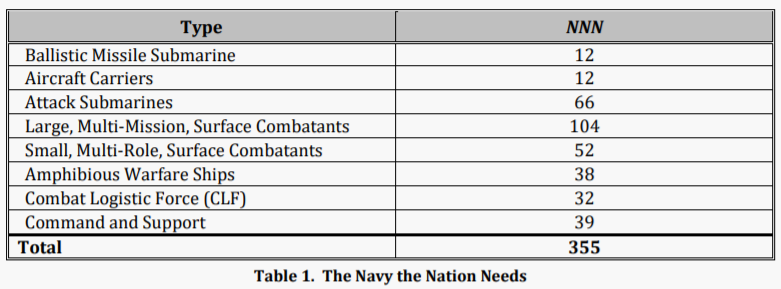
The National Defense Strategy provides the overarching guidance and high-level requirements for sustaining the Navy the Nation Needs (NNN).It appears that someone spawned this about 18-months ago, and I really wish we would stop trying to make NNN happen. I know it has become shorthand for 355, but stop. What do we do next in this farcical dance, abbreviate it to "3N?"
Someone at NAVSEA needs to be put in the time-out chair.
I think we are moving away from 355 anyway, so we'll see what the report for 2021 says - ringing in the Terrible 20s.
I stand that we will never see 355 outside Chinese expansion east, but here is the vision:
Now let's look to the substance of the report. As we discussed before, it is fun to talk about ship numbers and programs etc ... but that isn't where the greatest challenge is. You can buy all the fancy new things you want, but if you can't maintain them properly, they become tied to the pier and combat ineffective.
We have a significant issue right now.
Sustaining the 355-ship fleet will require changes to both public and private industrial capability and capacity. Current infrastructure will require update and refurbishment to support modern classes of ships and repair. Likewise, additional dry docks will be needed to address the growing fleet size. Navy and industry partners must create work environments where talented Americans will want to work and contribute to the national defense. This includes investments in updating facilities and capital equipment, and as well as providing that workforce training that is both modern and relevant and compensation commensurate with the skill required to repair Navy ships. Finally, we must avoid feast and famine cycles that erode both the repair industrial base and the underlying vendor supply base. Consistent funding matched to steady demand for work will enable the repair base, public and private, to grow to meet the needs of the 355-ship Navy.Read the whole report with the commentary to the numbers ... but this just screamed out to me as the above the fold issue. We can't service what we already have in the fleet.
Yes, I'm a spreadsheet guy - I think the numbers speak just fine for themselves;
If I were in Congress - and thank you Buddha I am not - this would get first billing.
It is the adult thing to do. It is the long-term thing to do ... and you know what - there are A LOT of very good jobs that come with shipyards and maintenance.
A lot.
Oh, and for (R) and (D) politicians who mean well and the best for their Navy; it is the right thing to do.
Monday, August 26, 2019
Nuclear Nations at Total War with Each Other - but Don't Use Nukes?
Of all the bloodshed and slaughter of WWII - though all sides had chemical weapons - they were not used at all. Not even at the very end.
What about nuclear armed nations today? If two nuclear powers go to war, is going nuclear inevitable? Does having nukes help you avoid war?
Maybe not. An interesting theory is that MAD is something that works until it doesn't.
Over at Small Wars Journal, Mangesh Sawant has a few observations about one flash-point many think has the greatest odds of going nuclear; India and Pakistan.
What if conventional wisdom, as it often can be, is wrong?
What about nuclear armed nations today? If two nuclear powers go to war, is going nuclear inevitable? Does having nukes help you avoid war?
Maybe not. An interesting theory is that MAD is something that works until it doesn't.
Over at Small Wars Journal, Mangesh Sawant has a few observations about one flash-point many think has the greatest odds of going nuclear; India and Pakistan.
What if conventional wisdom, as it often can be, is wrong?
MAD is ineffectual in the sub-continent. Deterrence worked during the cold war as both the adversaries were armed in terms of nuclear weapons and delivery platforms. Soviet Union and the US had advanced military capability to destroy each other in a nuclear conflict. The arms buildup between the Soviet Union and the US led to the realization of nuclear annihilation having ramifications across the world. This threat led to both the nations signing the START and SALT agreements.So, like in WWII with chemical weapons - does it become a conventional slugfest?
Nuclear deterrence theory and MAD will not work in South Asia due to the following:
The quality of weapons delivery platforms is important for the delivery of nuclear weapons. Technologically Pakistan’s weapons are antiquated and inferior. Most of its weapons systems are imported from China which reverse engineers them from Russian weapon systems.[iv] The Chinese weapons systems are not tested in any battles or wars. In an era of 4th and 5th generation warfare Pakistan still operates the 1st and the 2nd generation of combat aircrafts, naval ships and army weapons systems. India has inducted state of the art 4th generation weapons systems like SU 30 MK1, T 90 tanks, Vikramaditya aircraft carrier, nuclear attack submarine INS Arihant and ICBMs. Technologically advanced weapons will be used by India in conventional warfare to wipe out Pakistan’s military establishments and nuclear facilities in a preemptive strike. The quantity and lethality of conventional weapons in the arsenal is crucial to project the destructive capabilities on the adversary. Pakistan lacks in this aspect as its weapon systems are antiquated and this is the reason it has resorted to the strategy of unconventional warfare through terrorism. Therefore, in South Asia the conventional superiority of India outweighs the nuclear weapons systems capability and empty threats of Pakistan.MAD is only possible if there is parity in nuclear bombs and weapon systems. MAD is not possible in South Asia due to the overwhelming Indian nuclear second-strike capability and superior conventional weapon systems.
Small nuclear powers like Pakistan and North Korea resort to belligerent posturing and blackmailing the international community by threatening to use nuclear weapons under the doctrine of first nuclear strike. But there is a tacit understanding between the politicians and the military in both countries about the power of conventional war, preemptive strikes and total nuclear annihilation by India and the US. It’s the age of unrestricted warfare for technologically advanced militaries in conventional warfare environment with nuclear armed adversaries. This is the new normal.A final note. The author really should have saved this for another article - but I find this something worth a long night's drinking and arguing over. Indian vs. Pakistan would be Clausewitz vs. Sun Tsu?
Classical warfare strategies have been followed by nearly every country. The differentiating factor remains the type of governing systems. Democracies have been practicing Clausewitz while dictatorships and one-party systems have been practicing Sun Tzu. Pakistan has been following Sun Tzu’s art of warfare which is exemplified by concealment, unconventional warfare, unrestricted warfare, deception and manipulation.
India has been following the Clausewitz strategy which is characterized by restricted and classical conventional warfare. Today Pakistan is the only country in the world which has fused the unconventional and hybrid warfare strategy with a nuclear deterrence doctrine of first strike. Pakistan has been sponsoring and fomenting terrorism in India since the last 3 decades. India has not penalized Pakistan due to the threat of nuclear retaliation to an Indian conventional attack.
Sunday, August 25, 2019
Missile Defense at Sea and Ashore with Tom Karako, on Midrats
Not since the last decade of the Cold War have ballistic missile defense, land based cruise missiles, as well as short, intermediate, and medium range ballistic missiles received this much attention outside the compartmentalized and esoteric warfare specialities they belong in.With the realities of our century bidding farewell to the previous century's INF limitations, you shouldn't expect the topic to fade away anytime soon.
Shipboard and land based missile defense are rising to meet the threat - using both established capabilities and new ones emerging from the lab.
For the full hour this Sunday from 5-6pm to discuss these and related topics, our guest will be Dr. Thomas Karako.
Tom is a senior fellow with the International Security Program and the director of the Missile Defense Project at the Center for Strategic and International Studies (CSIS), where he arrived in 2014. His research focuses on national security, missile defense, nuclear deterrence, and public law. For 2010–2011, he was an American Political Science Association Congressional Fellow, working with the professional staff of the House Armed Services Committee and the Strategic Forces Subcommittee on U.S. strategic forces policy, nonproliferation, and NATO.
He is also currently an adjunct professor in the Strategic Studies Program in the School of Foreign Service at Georgetown University, and a fellow with the Institute for Politics and Strategy of Carnegie Mellon University. He received his Ph.D. from Claremont Graduate University and his B.A. from the University of Dallas.
Join us live if you can, but if you miss the show you can always listen to the archive at Spreaker.
If you use iTunes, you can add Midrats to your podcast list simply by clicking the iTunes button at the main showpage - or you can just click here.
Thursday, August 22, 2019
The Enemy Within
One of the worst kept secrets in academia is that China isn't just using our colleges to train their elite to compete against us, but they are also using them to steal intellectual property and national security secrets - all for a few more pieces of silver.
Paul Bedard over at the Washington Examiner outlines the problem well;
Not just for national security reasons either; we need to educate our own. When major research institutions have more foreign students than out of state students - we're doing things wrong.
Paul Bedard over at the Washington Examiner outlines the problem well;
Several foreign nations, notably China, push students flooded into U.S. colleges and universities to steal trade and defense secrets “whenever the opportunity presents itself,” according to a new report that highlights the threat to national security posed by foreign students.Only a small portion are a threat - indeed my kids have talked to many who have fallen in love with the USA and do not want to go back to China - but we need to better control who is and is not here.
...
It said that the explosion of student visas to STEM schools takes positions that U.S. students can use and puts potential spies inside institutions that have key national security ties to the U.S. government.
...
The report said that nearly 70,000 foreign students overstayed their visas in 2017. Chinese students were first, with 18,075.
Not just for national security reasons either; we need to educate our own. When major research institutions have more foreign students than out of state students - we're doing things wrong.
Subscribe to:
Posts (Atom)