Proactively “From the Sea”; an agent of change leveraging the littoral best practices for a paradigm breaking six-sigma best business case to synergize a consistent design in the global commons, rightsizing the core values supporting our mission statement via the 5-vector model through cultural diversity.
As the Islamic State Caliphate's territory in Syria is shrinking to just a few isolated pockets, rebel force opposing Assad lose more an more ground, and Kurdish led forces solidify lines, another chapter in the Syrian civil war is about to begin. Time will tell, but the Turkish move in to Afrin may have been the opening. What is Turkey trying to accomplish, and how does this complicate the interest of the Kurds and their American, French and other partners, Russians, Iranians, and the Syrians supporting Assad? For the full hour this Sunday from 5-6pm Eastern our guest to examine this question and related issues will be Michael Goodyear. Michael is a law student at the University of Michigan Law School and holds degrees in History and Near Eastern Languages and Civilizations from the University of Chicago. His research focuses on the history, culture, and politics of the Balkans and the northern Middle East. As a starting point for our conversation, we will reference his recent article in Small Wars Journal, Paradigm Shift in Syria After Afrin.
Boil down your duty to its essence. Not the rah, rah, kind of duty. Not the duty some preen to themselves about. No, duty. That duty that stands against every instinct you have for self-preservation. That instinct to flight. That duty that stands, calm and determined. Do you have faith in your duty? What about those next to you? What about those who count on your sense of duty?
After holding out for eight days and taking hundreds of casualties, the remaining British troops evacuated across the Rhine river before the Germans overran their positions.
Selfless Sgt Clarke passed up the chance to escape with them and instead remained at the aid station to carry on giving treatment and comfort to wounded and dying comrades.
In doing so he knew full well he would be taken prisoner.
Sgt Clarke, a glider pilot, spent the rest of the war in a PoW camp in Sagen, Poland, until February 1945 when the Russians advanced from the east.
That is a measure any man would hope to meet. Staff Sergeant Peter Clarke, OBE, British Army was that measure. He recently passed at age 96, a life well lived.
Sgt Clarke died on Tuesday at his home in Abingdon, Oxfordshire, following a short illness.
His wife Jean died in 2016 and he leaves two daughters.
Tributes flooded in yesterday (thu) for Sgt Clarke.
...
Dr David Pasley, secretary of the society, added: "There were so many acts of heroism at Arnhem but Peter's was the one that stuck out for me.
"He didn't think it was special, he was just doing what was right.
The French get a fair bit of grief, some deserved, most not. Most of it has to due with some of the unpleasantness from WWII, but in a certain way it is because it takes one to know one. The French are more like Americans than either nation would be willing to admit. You can't take away the fact that they are one of the finest militaries in the world. When taken from a long view, they have an impressive military record in wars both large and small. Their national character - still dented from being bled white in WWI - is still there as it has been since Charles Martel. Especially in Africa, they have been critical players in the Long War. If you need a catch up, check out Michael Shurkin over at Politico.
There is a French way of warfare that reflects the French military’s lack of resources and its modest sense of what it can achieve. They specialize in carefully apportioned and usually small but lethal operations, ...
...
Emblematic of the French approach was France’s military intervention in the Central African Republic in March 2007. To stop a rapidly moving rebel advance into the country from the Sudanese border, the French attacked using a single fighter plane and two waves of paratroopers totaling no more than a “few dozen” who dropped into the combat zone in the Central African town of Birao. In military terms, what the French did was a pinprick, yet it was sufficient to break the rebel advance like placing a rock in the path of a wave. It was, moreover, a risky thing to do: Airborne assaults are intrinsically dangerous, all the more so when one has little capacity to reinforce or withdraw the lightly armed soldiers in an emergency. The first wave of “less than 10” soldiers reportedly made a high-altitude drop. The French military, moreover, did all this quietly, with the French press only learning of the intervention a few weeks after the fact.
...
France’s intervention in Mali in January 2013 also illustrated these attributes amply.
...
They did so, moreover, with a scratch "pick-up team" consisting of bits and pieces of a diverse array of units cobbled together in great haste and on the fly. Some of these could be considered elite, but most were not. In addition, the French put this ad hoc force up against a dangerous enemy that was operating in the worst imaginable physical environment–all with barely enough supplies simply to keep French troops from dying of thirst and heat exhaustion. French soldiers’ boots literally fell apart because the glue holding them together melted from the heat. The French went places their enemies assumed they would never dare go, fighting hand-to-hand among caves and boulders deep in the desert.
...
What makes the French way of war distinct from, say, the U.S. way of war has to do with scarcity. The French military is highly conscious of its small size and lack of resources.
Read the rest for the details. We could learn a lot from the French.
As we have covered here over the years, it seems that the institutional problem with long and often wrong IG investigations seem more about the process itself than anything else. You are treated guilty until your innocence is proves ... long after it even matters anymore. Another example over at USNIBlog.
A navy ship represents her nation. That is why throughout history, nations use their navy as diplomatic mediums to show the flag around the world as representatives of the nations they serve. There is a reason why the phrase "ship shape" means clean and orderly. It is what navy ships are supposed to be. Why? Because they represent the pride of their nation. A ship that is manned properly to maintain herself is also an indication that a ship is manned properly to fight and win at war. A nation's warship is often the only thing foreigners see of that nation. The condition, size, seamanship, and the behavior of the crew in peace and war are seen as indicators of their host nation nature and status. This is fair and it is usually accurate. But ... again ... we have to revisit this simple concept in light of the dog's breakfast that is LCS. In Monday's comments you sure looked like you were ready for an old school LCS post, so you're going to get it. The unstoppable rolling failure of LCS must be drawn out from under the pier and gibbetted for all to see on a regular basis. If Big Navy is going to tee up the ball, we might as well take a swing at it. Over and over and over. Unending until the last LCS is sunk towards the end of this century in a SINKEX. Let the entire class be examples to future naval professionals what not to do. Good googly moogly, just look at her! Your monthly reminder that the Little Crappy Ship really isn't that little, is quite crappy, and is one nasty looking ship. The even-hulls are bad in their own right, but here is your newly commissioned odd-hull, USS LITTLE ROCK (LCS 9) - most recently of ice princess fame, at last trying to escape the grip of the Dominion of Canada. Our friend Chris Cavas has a nice series of pics on her cruising through the mostly ice free St. Lawrence,
More photos of USS #LITTLE ROCK #LCS9 coming down the St Lawrence Sat after lvng #Montreal. Note virtually complete absence of ice - the reason the ship was "trapped" in LesHabsVille for 3 mos. Seen at Sorel (R Beauchamp), Trois Rivieres (J Gauthier), Lotbiniere (L Morissette), pic.twitter.com/lnVXUZxwvS
A decade after the commissioning of Hull-1, not only can we not decide what frack'n shade of grey we want to get underway with - we can't stick with the simple "dazzle" paint job that hides the horrible design of the exhausts. Again, just look at her. This tramp steamer sure sends a message about the USA to every port she sails in to, and it isn't what you want. What is there in this picture for any nation to take pride in? The poor officers and enlisted personnel assigned to these ships. This is not their fault. The design almost demands neglect. The manning concept is based on no one having time to do anything but their job and a bit of another person's job instead of sleeping. The Navy is so ossified that it cannot to this day ensure that what we know is going to be up front in the face of the world is something our friends can be proud of and our enemies see with respect. Stop kidding yourself. Enlarge the picture. Look at the soot. Relish the rust. Bask in the poorly patched seems in the superstructure. Zoom in and find them yourself. Behold the mighty superpower's Navy!
"I met a photographer from the Great White North,
Who said—“Three vast and dank smears of soot
Stand in the St. Lawrence. . . . Near them, on the water,
Half sunk in rust lies, whose anchor,
And ill-shaded fiberglass, and sneer of the minimally manned,
Tell that its program manager well those passions showed
Which yet survive, stamped on these dented things,
The hand that mocked them, and the heart that fed;
And on the quarterdeck, these words appear:
My name is LCS, Princess of Ice;
Look on my Hull, ye PLAN, and despair!
Nothing beside can be made FMC. Round the decay
Of that colossal Wreck, boundless and bare
The lone and level water stretch far away.”
As the end game – whatever that might wind of looking like – in Syria is getting closer, we are seeing a lot of tonal disconnect between what the world is, and what some people think it should be. Clear thinking is being side-stepped for The Narrative;all things that are not in aligned to The Narrative must be warped to fit in it. The source of much of the disconnect involves Russia. Russia, that wonderfully peculiar nation, once again finds itself being used by others in our crass and petty domestic politics, warping our international perspective and preventing clear understanding of what is in play. Even our best and brightest are caught up in an unnecessary lack of consensus and are strewing about a theme of a nation's natsec community embarrassingly lacking seriousness and continuity. I don't think Russia is that good, I just think we've become too petty. We’ve gone from the early Obama’s administration’s “Bush43 was unnecessarily rough on you Russia, we need a “reset” (nee overload) of our relationship…” to the mid-Obama collusion, “Tell Vladimir I will have more flexibility after the election” and "the 1980s called" silliness to the post 2016 “Ermergherd, Russia!” squid ink that is clouding everyone’s thinking in the beltway. Trump's Russia policy? The O2 is being soaked up in a failed probe and a pouting establishment to the point that serious people can't get airtime. We've turned a standard issue Russian INFO OPS campaign that they play during all democratic elections in my lifetime, in to something way out of proportion to what it actually is. As if we are actively trying to help the Russians, we've empowered their mischievousness way beyond their wildest exceptions ... mostly for petty domestic politics.
Sadly, our click-bait focused media isn't looking for serious people to come on and talk like adults. Instead we get the tin-foil types, partisanship-uber-alles types, and the unhinged. There is a group of people out there who do get it. Thankfully this fever isn’t impacting the professionals from all sides of the political aisle who kept an eye on Eternal Russia for decades. This group did not join the natsec cats chasing the latest fad's laser pointer while spewing buzzwords … but they are hard to find in the chaos. Our national dialog about Russia is clouded by the click-bait and cats, and it is not a benign clouding. It is birthing bad and dangerous ideas. Not an extreme case, but you can see the clouding in the response you can find to the Army University Press's Military Review, article by Michael Kofman and Matthew Rojansky. The authors have done good work here, but for some reason smart people think that if Russia gets a win, that is somehow bad for the USA. The authors are not really making that case, but some are taking it that way. You can get a vibe in the article of an ill-comfort with Russia possibly getting a win - but not that bad. It is enough for others to start to focus on that. Russia getting a "W" in Syria is not necessarily a bad thing for the USA.
No, not really. Look at all the possible outcomes of the Syrian Civil War. Rack and stack them. We actually are not in that bad of a spot in a sea of bad spots. In such a bloody civil war, our intervention has not cost us much blood, nor in relative terms, treasure. Russia has her own goals, we have ours. As long as we deconflict, we should be OK. Back to the article. Read it all, but here's what caught my eye;
While it is far from assured that any settlement acceptable to the principle domestic and international players can be struck, for now the main outcome of this war is that President Bashar al-Assad will stay, but the Syria that existed before the war is gone.
The natural question is whether Russia has, in fact, won a victory. The answer to that question depends first on what Moscow intended to achieve—in other words, how did and does Russia define victory in Syria, what are its continuing interests there, and have those interests been secured or advanced?
...
In sum, Russia appears to have won at least a partial victory in Syria, and done so with impressive efficiency, flexibility, and coordination between military and political action. On the one hand, Russia’s embrace of the Assad regime and its Iranian allies, its relative indifference to civilian casualties, and its blanket hostility to antiregime opposition groups are fundamentally at odds with widely held U.S. views on Syria. On the other hand, Russia’s “lean” strategy, adaptable tactics, and coordination of military and diplomatic initiatives offer important lessons for the conduct of any military intervention in as complex and volatile an environment as the Middle East. More than a decade and a half into the U.S. involvement in Iraq and Afghanistan, with ongoing fighting in Libya and Yemen, and countless other tinderboxes that could ignite wider regional conflict threatening U.S. interests, Washington should pay close attention to the Russian intervention and how Moscow achieved its objectives in Syria.
There is no reason why Russia can't call a "win" in Syria and at the same time the USA can't call a "win" in Syria. We had mostly different goals. As long as we respect each other's goals and don't get sucked in to undermining each other, we should be good to go. The Operational Center of Gravity for ISIS was their capital. We along with our allies (mostly Kurd) have taken that. ISIS's Strategic Center of Gravity is the religious foundation of their existence. Only the Muslim world will be able to take care of that - but taking care of this major operation is a critical step in that direction, and about all we can directly do. As we've outlined here for years, there is only one significant interest the USA has in Syria; the elimination of the Islamic State's caliphate and the extermination of as many of their fighters we find on the battlefield. We are almost there. Russia's goals overlap some of ours. Others we really shouldn't care about. Syria has never been in our sphere of influence. It actually has been in the Russian (nee Soviet) sphere of influence if anyone's (honorable mention to France & Turkey). Syria has never been a friend. With the exception of fighting along side of us during DESERT STORM, they have been a problem best managed to the side. Who does or does not run that mixed up chunk of land is of secondary importance to us. We have almost completely achieved what we need to achieve in Syria. As they provided the balance of the ground forces for us to achieve our goals, we need to make sure that whatever post-war settlement is made, the Kurds are respected. We have to do that or we may have trouble getting allies in the future. After killing a few hundred Russian mercenaries last month, I think we've made our point for Russia to stay on her side of the sandbox. The Turks, as is there nature, have complicated things recently. The French, to their great credit, have moved to block our mutual NATO ally to the NW, while we should help enforce the Kurd’s frontier to the center and south as we clean up what remains of Islamic State territory. From there, it is up to the warring parties to work out the post-war details. Lines are starting to stabilize. That is one of the requirements for parties to come to the table. Where can it go wrong? So many places, but the worst thing we can do is to feel that we can't call a win unless Russia has to call a loss, or the other way around. Nothing in Syria is worth a wider war. It makes no strategic sense, and the American people have no appetite for it. If you simply cannot see the nuance required to get a "good enough" in Syria, stop studying the Cold War and start watching Game of Thrones.
NB: If you have not already, click the "Syria" tab and review PLAN SALAMANDER and PLAN SALAMANDER Rev.(1).
We always remember Pearl Harbor - but that second week of DEC 1941 war was breaking out all over the Pacific. Something different for Pearl Harbor. Capt. Colin Kelly Jr., early leadership example.
The war exploded all over the Pacific that day, and in the focus on Hawaii, the other stories often get forgotten. Let's look at some events in Skippy's favorite Old School liberty area - The Philippines.
On the morning of Dec. 10, 1941, six B-17Cs of the 14th Bomb Squadron, 19th Bomb Group, sat in the rain at a rough landing strip near San Marcelino on the Philippine island of Luzon. The crews had spent the night without food, sleeping in or under their planes. Of the war situation they knew little except that Japan had attacked Clark Field and other installations near Manila on Dec. 8--Pearl Harbor on the 7th--and some 400 Japanese aircraft had destroyed most of the US B-17s and pursuit planes.
Squadron Commander Maj. Emmett "Rosy" O'Donnell Jr., had flown to Clark before daylight to get orders for his squadron. He radioed his pilots to proceed to Clark at daybreak. Only three of the B-17s were allowed to land. They were flown by Capt. Colin P. Kelly Jr., and Lts. George E. Schaetzel and G. R. Montgomery. Captain Kelly, a 1937 graduate of the US Military Academy and a former B-17 instructor, was one of the most experienced and respected pilots of the 19th Bomb Group.
An imminent air attack sent the three bombers off to their respective targets before refueling and bomb loading were completed. Captain Kelly had only three 600-pound bombs aboard and orders to attack airfields on Formosa (Taiwan), some 500 miles north of Clark. The mission would earn Colin Kelly a place in American history and legend.
In the confusion of the early days of the Pacific war, Kelly was credited with sinking a Japanese battleship and with award of the Medal of Honor. Overnight he became a national hero. It later was determined that Kelly and his crew did not sink a battleship, nor was he awarded the Medal of Honor, although some still believe both. In fact, Colin Kelly was recommended for the Medal of Honor by Maj. Gen. Lewis H. Brereton, commander of the US Far East Air Forces. The award he received was the Distinguished Service Cross, on the orders of Gen. Douglas MacArthur's headquarters.
This is what actually happened, as told in mission debriefings by members of Kelly's crew and in an official report of the mission prepared in February 1942.
For Captain Kelly and his crew, it was a solo mission deep into territory where the Japanese held absolute air superiority. They had no fighter escort. By Dec. 10, there were only 22 flyable P-40s and a few obsolete P-35s left. As they flew north toward Formosa, Kelly and his crew passed over a large Japanese landing in progress at Aparri on the north coast of Luzon. The presence of an enemy carrier in the vicinity had also been reported.
Kelly radioed Clark Field for permission to attack the landing force, which was supported by several destroyers and a large warship, thought to be a battleship, bombarding the coast from several miles offshore. After two calls to Clark that brought only a response to stand by, Kelly told the crew they were going ahead on his decision to attack the battleship--actually a cruiser. Kelly made two dry runs at 20,000 feet, giving bombardier Sgt. Meyer Levin time to set up for an accurate drop.
On the third run, he told Levin to release the bombs in train. As best the crew could tell, two of the three bombs bracketed the ship with one direct hit. Smoke prevented more accurate assessment. The B-17 then headed for Clark Field, its bomb bay empty.
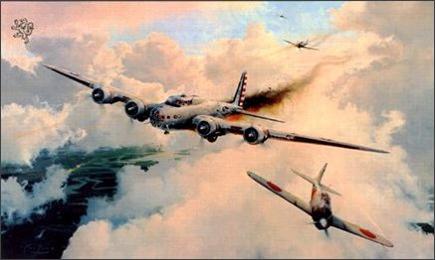
As it approached Clark, the bomber was hit by enemy fighters.
The first attack killed TSgt. William Delehanty, wounded Pfc. Robert Altman, and destroyed the instrument panel. A second attack set the left wing ablaze. The fire spread rapidly into the fuselage, filling the flight deck with smoke.
Captain Kelly ordered the crew to bail out while he still had control of the doomed bomber. Fire began to engulf the flight deck. SSgt. James Halkyard, Pfc. Willard Money, and Private Altman went out the rear. Navigator 2d Lt. Joe Bean and Sergeant Levin, after a time-consuming struggle, pried open a stuck escape hatch and took to their chutes.
The nose of the aircraft was now an inferno. Colin Kelly remained at the controls as copilot 2d Lt. Donald Robins moved to the upper escape hatch. At that moment, the bomber exploded, hurling a badly burned Robins clear of the aircraft.
The B-17 crashed about five miles from Clark Field. Colin Kelly's body was found at the site. The early report of his heroism, which inspired a nation in shock, is in no way diminished by the actual events of that December day in 1941. Alone and far from friendly territory, he attacked and damaged a heavily armed ship, then sacrificed his own life to save his crew.
As is not too uncommon, in the rush to make a legend, good people with good intentions try to make an already great story of heroism and honor even better - and ruin it.
NB: when in doubt, ignore emotions than tell the truth. History will find it out later. You can dig around the refs and links to see what I am talking about, but here is the truth and the two big lessons we should take away from Capt. Kelly. Oh, remember....this was less than 72 hours after the start of the war with a early mod of the B-17.
BTW, one of the men attacking Kelly's bomber that day was Saburo Sakai. He was a great man, great pilot, and a hero to anyone who takes the time to try to know what he did with his life. First posted DEC07