Wednesday, March 16, 2022

Battle of Odessa Starting?

For obvious reasons, the navalists amongst us (guilty) have an ear out for Odessa.

Not only is it the last significant port on the Black Sea under the control of Ukraine, it has a history from the dawn of time as the key to any conflict in this area.

The Russians must take it during this campaign.

As such, this got my attention today;

The Ukrainian military is reporting Russian warships in the Black Sea are shelling villages near the coast close to the nearby port city of Odesa.

These attacks specifically targeted the settlements of Lebedivka, Sanzheika, Zatoka, and Bilenke, according to a Wednesday Facebook post from Ukraine’s General Staff of the Armed Forces. These villages are approximately 18 miles south of Ukraine’s third-largest city.

Why these small towns to the southwest of Odessa, on the other side of the main drive to invest that critical city?

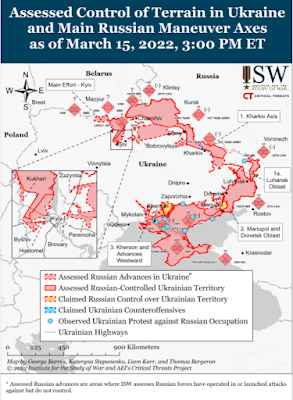
Could be a few things. On the low end, it could just be the Russian Navy doing something to appear to be part of helping this operation, but when you look at the map - which you always must do - something else comes to mind;


The Ukraine-Romanian border is in the southwest corner of the map. The four towns shelled by the Russian Navy are the triangles. That large bay/lake looking body of water is the bay and estuary the Dniester River empties to. That small road at the top of the estuary is the border to Moldova. There is a small road across the estuary, well within range of the Russian forces in the Transnistria.

I have no idea why they shelled poor, isolated, sleepy village of Lebedivka (that would be like attacking Namskaket, MA) but if you need to move supplies in to Odessa from Romania, you would need to use the roads that go through the other three towns. Zatoka also has the rail line go through it.

Does that mean a move on Odessa is imminent? I don't think so...but would shelling those towns be a preparation for one? Probably. 

Then again, I can see the Russian General Staff looking at the Russian Navy senior member and asking, "Exactly what use are you? What have you done today?"

It could be that.


First map credit to ISW Second is mine.

Tuesday, March 15, 2022

Good Staffs Matter

As a former recidivist staff weenie, one thing that I keep thinking about when it comes to watching the performance of the Russians in Ukraine is the clearly deficient staff work.

I've touched on it a bit here, over on Midrats and my visit to Bill Roggio's podcast, so regulars here are familiar with my take; this is a textbook case of the real world impact of a dysfunctional staff culture.

No staff can do their job without clear and well thought out Commander's Intent and higher Direction and Guidance, but more importantly, the staff needs to be able to produce an honest Estimate of the Situation and Joint Intelligence Preparation of the Battlespace.

These cannot be allowed to be skewed or shaped by external biases and other kind of "forcemoding."  You can see this in exercises on a regular basis or "bespoke" wargames, but the bad habits of exercises cannot be allowed to transfer over to real-world operations.

War does not care if you are scared of your principal, or you have a pet theory to validate. If you shape all you do to artificially meet the desires of the Chief Executive - and it doesn't matter if you are invading Iraq or Ukraine - you will soon find reality revealing your poor staff work.

Over at Real Clear Defense, Taft Blackburn, Keith Detwiler & Alex Shykov have a nice, efficient breakdown of the Russian Army's performance so far. 

I especially liked their comments on the staff work;

Given the sheer number of units pulled from across Russia for the invasion, planning for the operation would have been a central military task for the General Staff. However, as the war grinds on, we are beginning to see cracks in the Russians’ planning. The opening air and missile attacks appear to have failed to defeat the Ukrainian air force and air-defense forces. Russian logistics planning may not have accounted for fuel shortages stemming from combat losses of transport vehicles or soldier indiscipline. Russian planners also seem to have underestimated the will of the Ukrainians to fight, the effectiveness of Western anti-tank and man-portable anti-aircraft weapons, and the will of the European nations to continue arming a defiant Ukrainian state.

Viewed collectively, these shortcomings likely point to insufficient training or experience in military staffs. Past large-scale exercises were often scripted. This may be the first time many of the Combined Arms Army and lower echelon staff have planned such a complex operation. While many of the Russian commanders and surely select staff officers have combat experience in Syria, the majority of the staff likely do not. Deploying individual officers or select tactical units does not directly translate into experienced, functioning staff able to plan and execute combined arms combat operations, often while on the march.

Before drawing final conclusions on the Russian military performance, it will be imperative to fully understand the impacts of the unique conditions in this war. One should always be cautious about underestimating the enemy. 

All the military education and experience in the world won't help you if your readiness reporting is fake, your command culture squashes contrary ideas, and your principal lacks humility.

A story as long as war.

Map credit to Institute for Defense Analyses Media Team.

Monday, March 14, 2022

Yes Ukraine and Russia - but the Varsity Game is China


The longer this war goes on, the more dangerous it is not just for Putin's hold on power, but for the hope the conflict can be contained. For those keeping an eye on the big picture, the question is how this effects China.

Located on the other side of the Eurasian landmass, China is looking west to see not just how they can work this to their advantage, but also how they can maneuver themselves so that Russia's adventures do not derail China's plans and priorities.

She is on cusp of greatness and she knows it. She has been given a small taste of primacy and she wants all of it. The Russo-Ukrainian War will either be a catalyst for an accelerated grasp on global power for China, or an unexpected headwind for what she sees an an inevitability. 

Irrespective of what is happening on the ground, the great power dislocation the invasion of Ukraine by Russia this winter is bringing out all the China watchers to see who can read the tea leaves best.

Two articles - both from different perspectives - this weekend had me pondering all sorts of different options. About all I came away with in the end was that almost no one really knows how this will impact China and the US/Europe-China competition for the global stage. We all have a variety of scenarios we can come up with, but really it is still early in this conflict to see firmly where things are headed. If anything, there are more possible futures now than there were in the already chaotic international world of January 2022.

One thing in common is that most people are trying to construe some outcome other than an expanded global conflict that brings in all the major powers. We are not out of those woods yet. Remember, WWI began with a conflict between a 2nd-rate power, the Austro-Hungarian Empire, and a 3rd-rate power, Serbia.

Russia is a 2nd-rate power. Ukraine is a 3rd-rate power. We've seen this game before. The only thing giving everyone some time here is neither party has entangling alliances so the diplomats and luck have a chance to slow things down to a human scale. 

For those too focused on military issues, it is very easy to come up with a whole host of reasons this war will spin out of the control of any well meaning people, but is that the most likely outcome?

No one knows. I lean towards the conflict being contained with some kind of diplomatic outcome involving border and status changes, but I know that I lean that way simply because the other option, expansion of the conflict, it something I simply do not want to imagine.

I'm not alone. 

Let's look over at something that is a little Eeyore-ish from China - but in the end sees an opening for something positive. I had to read it a couple of times and the best I can come away with is the author is suffering from something I am struggling with as well - trying to find some way to believe this can be contained because to think the opposite is to invite all sorts of horrors in to your mind.

I see nothing good for the USA and the West coming out of this getting out of control, and the first author sees nothing good for China either.

The Carter Center's (yes, that Carter) U.S.-China Perception Monitor  has a translation of an article written on March, 5th 2022, Possible Outcomes of the Russo-Ukrainian War and China’s Choice, by Hu Wei, vice-chairman of the Public Policy Research Center of the Counselor’s Office of the State Council, the chairman of Shanghai Public Policy Research Association, the chairman of the Academic Committee of the Chahar Institute.

Some of the below I'm not aligned with - though I do enjoy the "West will win" Sino-pessimism - but it is worth a read. An interesting perspective.

... Even if the Russian army were to occupy Ukraine’s capital Kyiv and set up a puppet government at a high cost, this would not mean final victory. At this point, Putin’s best option is to end the war decently through peace talks, which requires Ukraine to make substantial concessions. However, what is not attainable on the battlefield is also difficult to obtain at the negotiating table. In any case, this military action constitutes an irreversible mistake.

...

As people’s livelihoods are severely affected and as anti-war and anti-Putin forces gather, the possibility of a political mutiny in Russia cannot be ruled out. With Russia’s economy on the verge of collapse, it would be difficult for Putin to prop up the perilous situation even without the loss of the Russo-Ukrainian war. If Putin were to be ousted from power due to civil strife, coup d’état, or another reason, Russia would be even less likely to confront the West. It would surely succumb to the West, or even be further dismembered, and Russia’s status as a great power would come to an end.

...

At present, public opinion believes that the Ukrainian war signifies a complete collapse of U.S. hegemony, but the war would in fact bring France and Germany, both of which wanted to break away from the U.S., back into the NATO defense framework, destroying Europe’s dream to achieve independent diplomacy and self-defense. ... With Nord Stream 2 put on hold indefinitely, Europe’s reliance on US natural gas will inevitably increase. The US and Europe would form a closer community of shared future, and American leadership in the Western world will rebound.

...

 The unity of the Western world under the Iron Curtain will have a siphon effect on other countries: the U.S. Indo-Pacific strategy will be consolidated, and other countries like Japan will stick even closer to the U.S., which will form an unprecedentedly broad democratic united front.

3. The power of the West will grow significantly, NATO will continue to expand, and U.S. influence in the non-Western world will increase. After the Russo-Ukrainian War, no matter how Russia achieves its political transformation, it will greatly weaken the anti-Western forces in the world. The scene after the 1991 Soviet and Eastern upheavals may repeat itself: theories on “the end of ideology” may reappear, the resurgence of the third wave of democratization will lose momentum, and more third world countries will embrace the West. The West will possess more “hegemony” both in terms of military power and in terms of values and institutions, its hard power and soft power will reach new heights.

4. China will become more isolated under the established framework. For the above reasons, if China does not take proactive measures to respond, it will encounter further containment from the US and the West. Once Putin falls, the U.S. will no longer face two strategic competitors but only have to lock China in strategic containment. Europe will further cut itself off from China; Japan will become the anti-China vanguard; South Korea will further fall to the U.S.; Taiwan will join the anti-China chorus, and the rest of the world will have to choose sides under herd mentality. China will not only be militarily encircled by the U.S., NATO, the QUAD, and AUKUS, but also be challenged by Western values and systems.

...the primary goal of the U.S. is to contain China from becoming the dominant power in the Indo-Pacific region. Under such circumstances, China’s top priority is to make appropriate strategic adjustments accordingly, to change the hostile American attitudes towards China, and to save itself from isolation. The bottom line is to prevent the U.S. and the West from imposing joint sanctions on China.

4. China should prevent the outbreak of world wars and nuclear wars and make irreplaceable contributions to world peace. As Putin has explicitly requested Russia’s strategic deterrent forces to enter a state of special combat readiness, the Russo-Ukrainian war may spiral out of control. A just cause attracts much support; an unjust one finds little. If Russia instigates a world war or even a nuclear war, it will surely risk the world’s turmoil. To demonstrate China’s role as a responsible major power, China not only cannot stand with Putin, but also should take concrete actions to prevent Putin’s possible adventures. China is the only country in the world with this capability, and it must give full play to this unique advantage. Putin’s departure from China’s support will most likely end the war, or at least not dare to escalate the war. As a result, China will surely win widespread international praise for maintaining world peace, which may help China prevent isolation but also find an opportunity to improve its relations with the United States and the West.

Next let's go over to Steven Lee Myers and Chris Buckley at NYT who see something I am more aligned with - that the smart money has the war in Ukraine will be significantly to China's advantage;

In the end, China’s leadership has calculated that it must try to rise above what it considers a struggle between two tired powers and be seen as a pillar of stability in an increasingly turbulent world.

“This means that as long as we don’t commit terminal strategic blunders, China’s modernization will not be cut short, and on the contrary, China will have even greater ability and will to play a more important role in building a new international order,” Zheng Yongnian, a professor at the Chinese University of Hong Kong, Shenzhen, who has advised senior officials, wrote after the invasion in a widely circulated article.

…

“All the difficulties and all the balancing and all the embarrassment that we’re talking about, those are short-term,” said Yun Sun, the director of the China Program at the Stimson Center in Washington, who has studied Beijing’s actions in the lead-up to the war. “In the long run, Russia is going to be the pariah of the international community, and Russia will have no one to turn to but China.”

China’s path ahead is by no means certain. Drawing too close to Russia would risk entrenching animosity toward China in Europe and beyond, a possibility that worries Mr. Xi’s government, for all its bluster.

And if Germany, France and other allies build up their defenses as promised, the United States could ultimately be freed up to shift more of its military resources toward countering China. Mr. Biden has vowed to rally an “alliance of democracies,” while American military leaders say they will not let Ukraine distract them from China.

“We also feel very, very anxious because the Russia-Ukraine war will force Europe to lean to the U.S., and then China will be dragged deeper into a dilemma,” said Zhu Feng, a professor of international relations at Nanjing University. The United States’ allies in the Pacific, including Japan and Australia, “will also adopt a stronger military posture. So it all seems unfriendly to China.”

…

Aleksandr G. Dugin, has written extensively on what he sees as a growing clash between the liberal, decadent West and a conservative Eurasian continent with Russia as its soul.

...

“The West should not have become a hegemon in defining universal standards because the West or Europe, or the West in general is only part of humanity,” Mr. Dugin told a Chinese state television interviewer in 2019. “And the other part, a majority of human beings, live outside the West, in Asia.”

…

“The old order is swiftly disintegrating, and strongman politics is again ascendant among the world’s great powers,” wrote Mr. Zheng of the Chinese University of Hong Kong, Shenzhen. “Countries are brimming with ambition, like tigers eyeing their prey, keen to find every opportunity among the ruins of the old order.”

That quote from Zheng is sticking with me. The "old order" really was a historical exception to the normal course of human events and experience. The new order he sees as ascendant is, really, a regression towards the mean.

Free nations need to prepare for that.
Saturday, March 12, 2022

It's a Mid-March Midrats Melee


With the Russo-Ukrainian War in its 3rd week, everyone is starting to see a new normal emerging in Europe, our alliances, and global posture. What are the assumptions time has left behind, what concepts are playing out well, and what surprises at sea and ashore have been a surprise?

What will the next phase look like?

This Sunday from 5-6pm Eastern EagleOne and Sal are bringing back the melee format with an eye on Ukraine. 

Open topic, open phones, green range ... bearings free.

Join us live if you can, but it not, you can get the show later by subscribing to the podcast. If you use iTunes, you can add Midrats to your podcast list simply by clicking the iTunes button at the main showpage - or you can just click here. You can find us on almost all your most popular podcast aggregators as well.

Friday, March 11, 2022

Fullbore Friday

Late. Everything is late.

Just a little more time. All that was needed was a little more time. A few more bits of kits. A few better leaders up the chain, but mostly, just more time.

The war drums could be heard, but people waited too long to accept what the sound was. Once it was accepted, all the right things were done, just not soon enough.

Just a little more time. Just a bit.

Then it came. A message. A pause. Then reports. Then you realize, time no longer matters. You have what you have. You will fight for your island with what you and your Sailors and Marines have. Nothing more. 

Promises and hopes are for fools in war. You do what you can with what you have and let the fates do what they will with it.

Then on the horizon...

Wake's lookouts, like Triton's, had seen flickering lights in the distance. Gunner Hamas, on duty in the battalion command post, received the report of ships offshore from Captain Wesley McC. Platt, commander of the strongpoint on Wilkes, and notified Major Devereux, who, along with his executive officer, Major George H. Potter, stepped out into the moonlight and scanned the southern horizon. Hamas also telephoned Cunningham, who ordered the guns to hold fire until the ships closed on the island.

Cunningham then turned to Commander Keen and Lieutenant Commander Elmer B. Greey, resident officer-in-charge of the construction programs at Wake, with whom he shared a cottage, and told them that lookouts had spotted ships, undoubtedly hostile one, standing toward the atoll. 


At 0522, the Japanese began shelling Wake.

The Marines' guns, however, remained silent as Kajioka's ships "crept in, firing as they came." The first enemy projectiles set the oil tanks on the southwest portion of Wake ablaze while the two converted destroyers prepared to land their Special Naval Landing Force troops. The column of warships advanced westward, still unchallenged. Nearing the western tip of Wake 20 minutes later, Kajioka's flagship, the Yubari, closed to within 4,500 yards, seemingly "scouring the beach" with her 5.5-inch fire. At 0600, the light cruiser reversed course yet again, and closed the range still further.

The Yubari's maneuvering prompted the careful removal of the brush camouflage, and the Marines began to track the Japanese ships. As the distance decreased, and the reports came into Devereux's command post with that information, the major again told Gunner Hamas to relay the word to Commander Cunningham, who, by that point, had reached his command post. Cunningham upon receiving Hamas' report, responded, "What are we waiting for, open fire. Must be Jap ships all right." Devereux quickly relayed the order to his anxious artillerymen. At 0610, they commenced firing.

Barninger's 5-inchers at Peacock Point, Wake's "high ground" behind them, boomed and sent the first 50-pound projectiles beyond their target. Adjusting the range quickly, the gunners soon scored what seemed to be hits on the Yubari. Although Barninger's guns had unavoidably revealed their location, the ships' counterfire proved woefully inaccurate. Kajioka's flagship managed to land only one shell in Battery B's vicinity, a projectile that burst some 150 feet from Barninger's command post. "The fire ... continued to be over and then short throughout her firing," Barninger later reported. "She straddled continually, but none of the salvoes came into the position. "It was fortunate that the Japanese fire proved as poor as it was, for Barninger's guns lay completely unprotected, open save for camouflage. No sandbag protection existed!

...

Platt carefully scrutinized the Japanese ship movements offshore, and noted with satisfaction that McAlister's 5-inchers sent three salvoes slamming into the Hayate. She exploded immediately, killing all of here 167-man crew. McAlister's gunners cheered and then turned their attention to the Oite and the Mochizuki, which soon suffered hits from the same guns. The Oite sustained 14 wounded; the Mochizuki sustained an undetermined number of casualties.

First Lieutenant Kessler's Battery B, at the tip of Peale, meanwhile, dueled with the destroyers Yayoi, Mutsuki and Kisaragi, as well as the Tenryu and the Tatsuta, and drew heavy counterfire that disabled on gun. The crew of the inoperable mount shifted to that of a serviceable one, serving as ammunition passers, and after 10 rounds, Kessler's remaining gun scored a hit on the Yayoi's stern, killing one man, wounding 17, and starting a fire. His gunners then sifted their attention to the next destroyer in column. The enemy's counterfire severed communications between Kessler's command post and the gun, but Battery B—the muzzle blast temporarily disabling the range finder—continued with local fire control. As the Japanese warships stood to the south, Kessler's gun hurled two parting shots toward a transport, which proved to have been out of range.

...

The Yubari's action record reflects that although Wake had been pounded by land-based planes, the atoll's defenders still possessed enough coastal guns to mount a ferocious defense, which forced Kajioka to retire. 

...

Wake's dogged defense caused Vice Admiral Shigeyoshi Inoue, Commander, South Seas Force (Fourth Fleet), to seek help. Admiral Isoroku Yamamoto, the Commander in Chief of the Combined Fleet, responded by assigning a force under the command of Rear Admiral Hiroaki Abe, Commander, 8th Cruiser Division, consisting of carriers Hiryu and Soryu and escorting ships, to reinforce Inoue. At 1630 on 16 December, the two carriers (with 118 aircraft), screened by the heavy cruisers Tone and Chikuma and the destroyers Tanikaze and Urakaze, detached from their Pearl Harbor Striking Force, and headed toward Wake.

...

At 0415, however, a report came into the detachment commander's command post, telling of an enemy landing in progress at Toki Point, at the tip of Peale. Devereux alerted the battalion. Kessler, in the meantime, dispatched a patrol up the lagoon beach toward the PanAm facility, which met a patrol from Battery D. Neither had anything to report. On Wilkes, Captain Platt directed Battery L to move the men of two 5-inch gun sections (equivalent to two rifle squads) to the shore of the lagoon, west of the area of the new channel being dredged across the island. The rest of the men of the battery—fire controlmen and headquarters men under McAlister, who had established his command post near the searchlight section of the battery—moved into positions they had readied along the south shore of Wilkes, between McKinstry's Battery F and the new channel.

...

Other Special Naval Landing Force troops, however, probed westward, toward the 5-inch guns that had so humbled Kajioka's force on the 11th. They ran into heavy fire from gun no. 9, a well-camouflaged .50-caliber Browning, handled skillfully by 20-year old Private First Class Sanford K. Ray and situated some 75 yards west of where the Takano Unit had first swarmed ashore. Ray's fire prevented the enemy from advancing closer than 40 or 50 yards from his sand-bagged position, and his proximity to the beach allowed him not only to harass the enemy but also to report enemy movements. Although Japanese troops had severed most wire communication lines, Platt remained in touch with developments at the shoreline by reports from Ray.

...

Having received a report of Japanese destroyers standing toward Wake's south shore (and well inside the range of the 5-inch batteries that had so vexed the enemy on 11 December), Second Lieutenant Robert M. Hanna, who commanded the machine guns emplaced at the airstrip, clearly perceived the threat. Accompanied by Corporal Ralph J. Holewinski and three civilians, Paul Gay, Eric Lehtola, and Bob Bryan, Hanna set off at a dead run for the 3-inch gun that had been emplaced on the landward side of the beach road, on a slight rise between the beach road and the oiled tie-down area at the airstrip. Up to that point, Major Putnam's grounded airmen, their ground support unit, and the volunteer civilians, had been awaiting further orders. As Hanna and his scratch 3-inch crew sprinted to the then-unmanned gun, Devereux ordered Putnam to support the lieutenant.

...

Hanna and his men, meanwhile, reached the 3-inch gun and set to work. Anxious hands fumbled in the darkness for ammunition while Hanna—since the gun lacked sights—peered down the bore to draw a bead on the beached and stationary Patrol Boat No. 33 that lay less than 500 yards away. The first round tore into the ship's bridge, seriously wounding both the captain and navigator, killing two seamen, and wounding five. Hanna's gun hurled 14 more rounds on target. Some of his projectiles evidently touched off a magazine, and the beached warship began to burn. The illumination provided by the burning ship revealed her sistership, which Hanna and his hard-working gunners bombarded, as well. A short time later three Special naval Landing Force sailors attacked Hanna's exposed position. In the ensuing fight, Hanna coolly shot and killed all three enemy sailors with his pistol and resumed the operation of his 3-incher.

That is just part of the coastal defense battle as outlined in the superb report of The Battle of Wake Island by Robert J. Cressman for the National Park Service linked above. Read it all.

Next week's FbF will have another story of what is a regular occurrence at war - an underestimated and under resourced defense against threats from the sea.

Thursday, March 10, 2022

A Full Hour on the War in Ukraine with FDD's Bill Roggio

Earlier this week I had the pleasure of sitting down with Bill Roggio as a guest on his podcast over at FDD, "Generation Jihad."

Listeners to Midrats will recognize Bill as a regular guest there over the years, usually on the topics of international terrorism and Afghanistan, but we've turned the table around this time not only as host/guest, but topic.

Bill and I spent the hour discussing the war in Ukraine in a very broad manner. Give it a listen.

I hope you enjoy the podcast as much as I did being Bill's guest.


Wednesday, March 09, 2022

How Do You Punch a Ship in the Mouth?


Did the Ukrainians manage to hit a Russian navy patrol boat with Grad rockets?

I'm sure regulars here have been tracking this for a few days;
You need to be careful in this war and when something sounds too good to be true, often it is. Sometimes, it isn't.  Hard to tell;
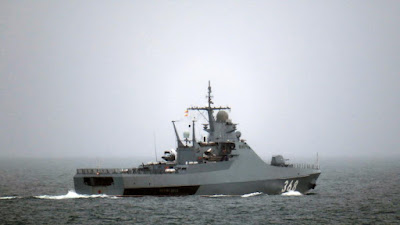
One of two Russian warships made famous for its attack on Snake Island in the Black Sea last month has been destroyed, according to Ukrainian military officials.

A patrol corvette, identified as the Vasily Bykov, appears to have been hit during a battle early Monday morning near the port city of Odessa. The destruction of the ship, which was commissioned in 2018, has not been independently verified.

As of today, you can find reports that it did and that it did not happen. As for me, I will assume that it did not until we have something a bit more firm ... and if I had to bet $20 I'd say we'll see Vasily floating pretty as can be sooner or later.

That being said, as we are all looking for ways to attack surface ships from shore west of Wake with what we have at hand - smart people were scratching their head if such a cheap and mobile system may be worth looking at...not after this, but years ago.

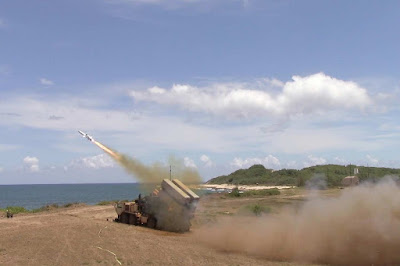
Back in 2020 we already experimented with the concept with our HIMARS in ... the Black Sea of all places;

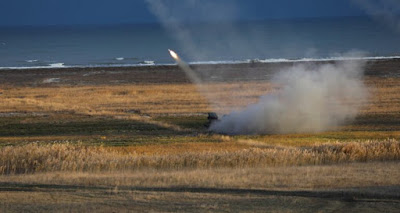
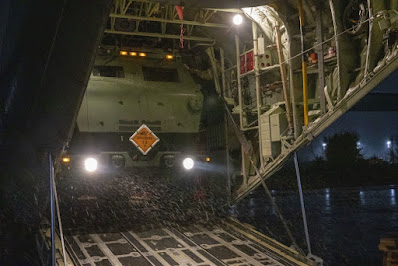
“U.S. and Romanian Forces gather in the staging area after the firing of a U.S. High Mobility Artillery Rocket System and Romanian Multiple Launch Rocket System into the Black Sea as part of Exercise Rapid Falcon Nov. 19, 2020 [see photo above]. This was 1st Battalion, 77th Field Artillery Regiment’s second live fire event since reactivation just 90 days ago and was the first time U.S. forces ever fired HIMARS from land into the Black Sea in cooperation with Romanian allies.”
Was that against a surface ship target? Does not seem so, however...the equipment ...
Two U.S. Army M142 6×6 High Mobility Artillery Rocket Systems (HIMARS) flew from Ramstein Air Force Base, Germany, on Thursday, November 19, 2020, aboard two U.S. Air Force Special Operations Forces (SOF) Commando II MC-130Js, the stretched version of the venerable C-130, and the HIMARS fired their rockets off the coast of the Black Sea that same day. 
If you need to get things on an off small islands, a C-130 is the way to do it.


But is the HIMARS rocket what we're looking for? No, not really - something a bit more, well, you remember...NavalNews sniffed it out too;
With future land-based Anti-Ship Precision Guided Weapons in development and available now, such as the Naval Strike Missile, the U.S. Army’s tracked MLRS, 6×6 HIMARS, and 8×8 Heavy Expanded Mobility Tactical Truck (HEMTT), and the U.S. Marines’ 8×8 Logistic Vehicle System Replacement (LVSR) and HIMARS, when modified and outfitted as Anti-Shipping rocket or missile launchers, are poised to become the “Go to” system for LBASM and LRPFs to prevent enemy ships and amphibious assaults on allied-protected islands and shores.

That was 5-yrs ago. Perfect? No, but something beats nothing and these sure are something. One problem I have is I'm not sure the LVSR in the above pic can fit on a C-130. If we want to have the maximum ability to make every island a porcupine and to have the flexibility to use USA or allied transport to move what we need where it is needed - I would think we would want it C-130 transportable. 

Marines don't have C-17s...

Fix that problem. Find a way to marry NSM to the Army's M142 and I'll take as many as you can produce. Those we don't need, we can sell at cost to our friends.

Time is short...and you know the Ukrainians wish they had a half dozen or so.


UPDATE: A helpful fan of the blog just knocked me on the back of the head with something from just 6-months ago...this. Yes this.
In August, the service was able to demonstrate NMESIS — full name Navy Marine Expeditionary Ship Interdiction System — during the Navy’s Large Scale Exercise off the coast of Kauai in Hawaii. Marines twice fired and hit a decommissioned vessel, as well as practiced loading and unloading NMESIS aboard a C-130 aircraft, according to Joe McPherson, program manager for long range fires at Marine Corps Systems Command.
...
NMESIS is a combination of several proven capabilities, a key reason why the service has managed to bring it online so quickly. The weapon itself uses the anti-ship Naval Strike Missile made by Kongsberg; a control system operated remotely, dubbed ROGUE-Fires; and the chassis of a Joint Light Tactical Vehicle. 

 “Marines can control the ROGUE-Fires with a game-like remote controller or command multiple launchers to autonomously follow behind a leader vehicle,” according to a recent Marine Corps statement. “The ROGUE-Fires vehicle, built on a Joint Light Tactical Vehicle platform, provides the Corps with a robust expeditionary system capable of operating anywhere.”
I've been told you can only get 1 JLTV in a C-130 at a time due to weight. I wonder if it can take the missiles in the same 130, or you need a second?

Anyway, this will work as MOD-0. 

Faster please.

UPDATE: Looks like Vasiliy is OK.