skip to main |
skip to sidebar
Well, this is fun;
The look at other hulls – potentially foreign designs – could bring in additional competition beyond the two yards. While the U.S. has not focused on traditional small naval ship designs, Western European shipbuilders have designed several guided-missile frigates that could partner with U.S. companies for a new frigate bid.
The new study and the expansion of the hulls under consideration call into question when the service will release the final Request for Proposal for the final frigate design, which was due sometime this year.
“While the design for the frigate matures, the Navy remains firmly committed to execution of the current LCS program of record, in order to maintain the viability of both shipyards, maximize competition for future ship contracts and deliver critically needed capability to the fleet as quickly as possible,” read the statement from the service.
The following was the complete statement from the Navy on the ongoing frigate study provided to USNI News.
As a result of the Navy’s 2016 Force Structure Assessment, increased emphasis on Distributed Maritime Operations, and increasingly complex threats in the global maritime environment, the Navy continues to assess the capabilities required to ensure the Frigate outpaces future threats. Therefore, the Navy is pursuing an update to the analysis performed by the 2014 Small Surface Combatant Task Force (SSCTF) to reassess Frigate requirements and capabilities. The Navy Frigate Requirements Evaluation Team (FFG RET) will update the SSCTF analyses to investigate the feasibility of incorporating additional capabilities such as Local Air Defense and enhanced survivability features into the current LCS designs, as well as explore other existing hull forms. The result of this update will inform PB18 deliberations, and will be briefed to OSD leadership and the Congressional committees once completed later this spring. Our goal is to get the best capability possible in our future Frigate, at an affordable price, and with a mature design that will ensure a relevant platform for decades to come.
While the design for the Frigate matures, the Navy remains firmly committed to execution of the current LCS program of record, in order to maintain the viability of both shipyards, maximize competition for future ship contracts, and deliver critically needed capability to the Fleet as quickly as possible.
I really should never have to buy a beer in the Beltway ever again.
Just have an open tab at Kelly's Irish Times and we'll call it even.
With the new LCS report out, I think it is time to kick LCS around a bit.
I'm getting pull quotes all over the place at USNIBlog.
Come by and see what's what.
Do you ever read a headline, nod, and move along to read something else for a few minutes ... and then pause ... tilt your head a bit ... and ask, "What the hell was that again?"
Many navalists were having one of those moments to start the week, especially those of us old enough to remember the Cold War.
Here's the quote in question;
Recent Russian naval activity in Europe exceeds levels seen during the Cold War, a top U.S. and NATO military officer said, voicing concern that the distributed nature of the deployments could end up "splitting and distracting" the transatlantic alliance.
Navy Admiral Michelle Howard, who heads NATO's Allied Joint Force Command in Naples and commands U.S. naval forces in Europe and Africa, said Russia had clearly stepped up its naval actions in recent years although the size of its navy was smaller now than during the Cold War era.
"We're seeing activity that we didn't even see when it was the Soviet Union. It's precedential activity," Howard told Reuters in an interview late on Saturday during a missile defense conference.
Howard cited a wide range of activities, including Russia's deployment of its Admiral Kuznetsov aircraft carrier to the Mediterranean, increased patrols in the north Atlantic and Arctic region, significant out-of-area submarine deployments, and submarine movement in the Black Sea.
I'm sorry, but time to be a skunk at the "Ermahgerd Russians!" party.
I knew the Soviet Navy in the Cold War, and as a young JO, cut my teeth chasing the last few of them around the Med .... and the Russian Navy is not the Soviet Navy.
Let's just run the numbers. First of all, let's define the "Cold War." Plus or minus an American election cycle, can we agree that the classic years of the Cold War from a naval perspective were from 1965 to 1985? OK, then lets look at the numbers, shall we?
Referencing Gordon H. McCormick's 1987 RAND study, "The Soviet Presence in the Mediterranean," what were the average number of Soviet ships in the Med each day?
That is an average daily strength in the Med of about 45 ships. At the most, what did the Russians have in the Med in the last year, 10? 12?
Heck, as our friend Bryan McGrath pointed out, at the peak of the Yom Kippur War, things in the eastern Med were a bit sporty.
Lyle J. Goldstein and Yuri M. Zhukov point out in their 2004 Naval War College Review article, "A TALE OF TWO FLEETS: A Russian Perspective on the 1973 Naval Standoff in the Mediterranean," that in the Med in 1973 it was quite the, "Happy Halloween there Shipmate!"
The Fifth Eskadra’s force strength peaked on 31 October at ninety-six units, including thirtyfour surface combatants (five armed with SSMs) and twenty-three submarines (at least seven with SSMs), constituting a force capable of launching eighty-eight SSMs in a first salvo.
The sixty U.S. ships then present, including three attack carriers, two amphibious assault helicopter carriers, and nine attack submarines, found themselves in an increasingly uncomfortable position, in which a preemptive strike seemed the most attractive option should combat seem inevitable. Around each carrier were three Soviet ships—two destroyers (one carrying surface-to-surface missiles, the other surface-to-air) and one “tattletale” AGI capable of providing midcourse guidance to SSMs fired from elsewhere.
If the situation ashore had been defused, the crisis at sea not only persisted but now reached its most dangerous stage. The four U.S. task groups were constantly targeted for a Soviet attack. The three anticarrier groups trailing the U.S. carrier groups could have launched first salvos of at least thirteen SSMs each against their respective targets. Four Soviet cruise-missile submarines were on submerged patrol nearby. The U.S. amphibious task force south of Crete was likewise shadowed by a group of five Soviet warships, some equipped with SSMs.
I don't think such exaggerated hyperbole coming out of a 4-star is doing anyone any good. It distorts historical perspectives and unnecessarily puts everyone on edge.
When you increase emotion, decrease historical perspective, and blinker nuance - you limit the flexibility and decision making processes of everyone.
Unmoored hyperbole increases the odds of bad decisions and even worse - when such statements are easily debunked with 5-minutes on google - it degrades the standing of US military leadership and the nation it serves.
Let's try to keep such hyperbole and abuse of the English language to our FITREPS, and out of our national security discussions.
Hat tip McGrath.
Let's go back to the summer of 2014 and the article by Christian Bueger in The Georgetown Journal of International Affairs;
The pirates of Somalia have gone silent. There have been no successful Somali pirate hijackings reported in the past two years. Hollywood movies like Paul Greengrass’s Captain Philips, rather than news of actual attacks and ransom negotiations, now make the headlines. But is the threat of Somali piracy truly over? In May, the international Contact Group on Piracy off the Coast of Somalia held its 16th plenary meeting at the United Nations in New York to discuss the endgame of the fight against piracy. The group, which is the central global governance entity organizing counter-piracy efforts, discussed how to restructure its counter-piracy response mechanisms and what measures will be required in the future. But as the Contact Group deliberations have made clear, the international community should not be so quick to declare victory in the war against Somali piracy. Although incidences of piracy in the region have decreased, sustained local and international efforts are still needed to prevent this trend from reversing.
At that time he outlined three reasons for the quiet on the piracy front off HOA;
First, the shipping industry has improved its self-defense measures. Commercial vessels now sail at higher speeds through high-risk areas, post additional watches, are protected with barbed wire, and follow the procedures of the so-called international Best Management Practices. Additionally, the majority of these ships employ armed guards on board.
...
Second, the international naval missions launched by NATO, the European Union, or unilaterally by individual nations have become more effective since the early days of counter-piracy operations. International cooperation between different missions works well, and national navies have become more experienced in conducting joint counter-piracy operations and handling piracy suspects. Until 2010, many piracy suspects were released after being apprehended. Now, however, naval personnel are skilled in arresting, collecting evidence on, and handing over piracy suspects.
...
A third factor contributing to this decline has been the rejection of piracy by local Somali communities, who have increasingly begun to view it as an illegitimate activity. The first generations of Somali pirates gained local support by presenting themselves as guardians of the coast and protectors of the Somali seas. Somali coastal communities no longer consider this justification valid. Indeed, many villages, including Eyl, the former pirate stronghold, have seen open protests against piracy. Community support is vital to pirates not only for recruitment but also to support the logistics of piracy operations, which require, for instance, the provision of food and water during lengthy ransom negotiations.
As spring of 2017 comes, where do we stand?
As reported by Jason Patinkin at FP;
After being all but stamped out by international naval forces following its late-2000s heyday, piracy has made a sudden return to the Horn of Africa. In the past month, there have been six suspected piracy incidents near Somalia, five of them successful, including three in the last week. That’s compared with zero successful attacks in 2016.
Three more murky maritime incidents off the coast of Somalia’s Galmudug state, where suspected illegal fishing vessels paid “fines” that may in fact have been ransoms, suggest that piracy has rebounded on a scale even larger than previously reported.
What happened? Well, go back to Christian's Three;
The resurgence of piracy in the Horn of Africa’s busy transport corridor comes when both anti-piracy forces and shipping companies have let down their guard. A NATO naval force pulled out of the Horn in December, citing the decline in pirate attacks, though a European Union force remains. Lawellin said that many cargo ships plying Somalia’s waters have also stopped taking basic precautionary measures, such as hiring armed guards on their ships and sailing at higher speeds farther from shore.
That's a start.
It is becoming clear that we only addressed the symptoms, but did little to mitigate the root cause. There actually is very little the West has the desire or innate ability to do to address the root cause, so perhaps there just needs to be a mowing of the grass and a longer lasting effort.
But with what and by whom?
As Russia has NATO's (and naturally the EU's) navies looking to play catch-up, who will return to push the pirates back?
An opening and opportunity almost from central casting is in the offing and doesn't come along all that often on the international scene.
PLAN ... call your office. The US Navy cut its international teeth on Muslim pirates. There is a certain rhyme to it.
Imagine a ship that had the following life;
(She) reported to Admiral "Bull" Halsey's Third Fleet and participated in task force strikes on the Japanese mainland near the close of World War II. On August 9, 1945, she fired the final salvo on the home islands of Japan. She rescued two British POWs just before entering Tokyo Bay for the surrender ceremonies on September 2, 1945. From November 1945 until early 1946, she was anchored off Shanghai, China as the flagship of Task Force 73.
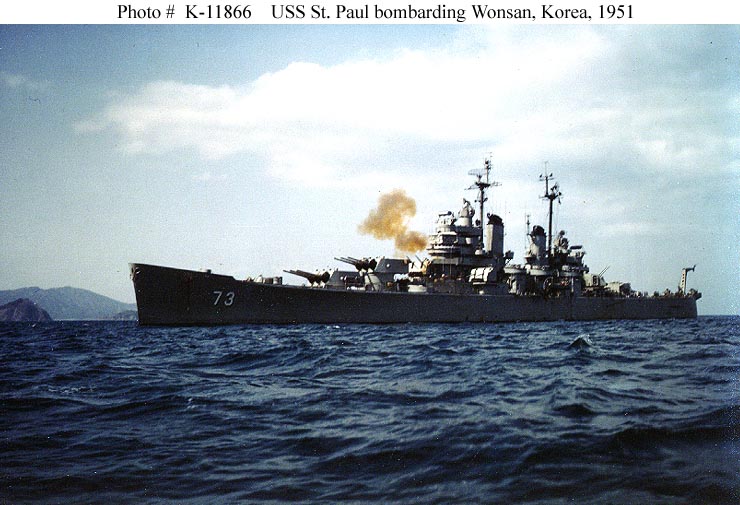
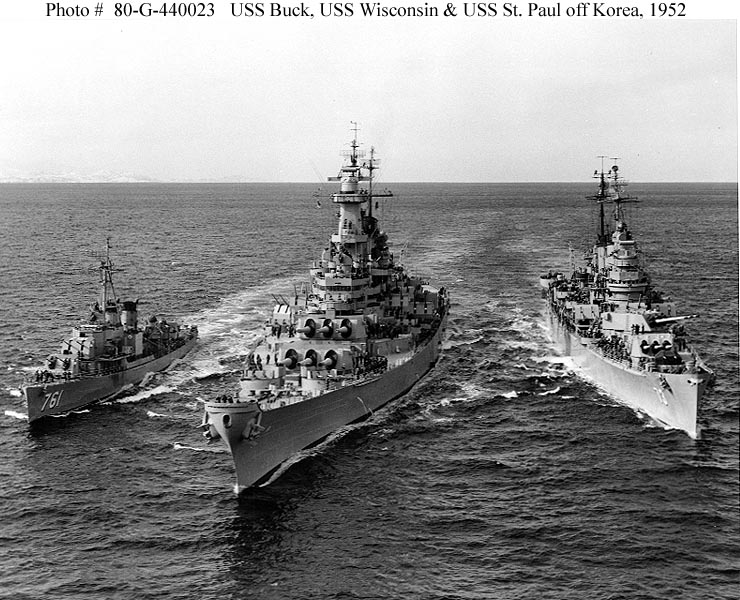
During the Korean War, (She) supplied close gunfire support for United Nations troops, conducted gun strikes against enemy supply lines, and rescued downed pilots. She participated in the drive to Chongjin, the Inchon invasion, Wonsan, and the Hungnam evacuation. On July 27, 1953, (she) fired the last salvo of the war, just two minutes prior to the cease fire.
...
(She) became the first heavy combatant to be permanently homeported in the Orient since the pre-World War II days of the Asiatic Fleet. She operated from Yokosuka, Japan as the Commander Seventh Fleet flagship for more three years. In June of 1960, President Dwight D. Eisenhower embarked on (Her) for a trip from the Philippines to Taiwan. Three weeks later, she became the first Navy ship to raise the new 50 -star flag. She hosted nearly a quarter million visitors during this extended Far East assignment.
...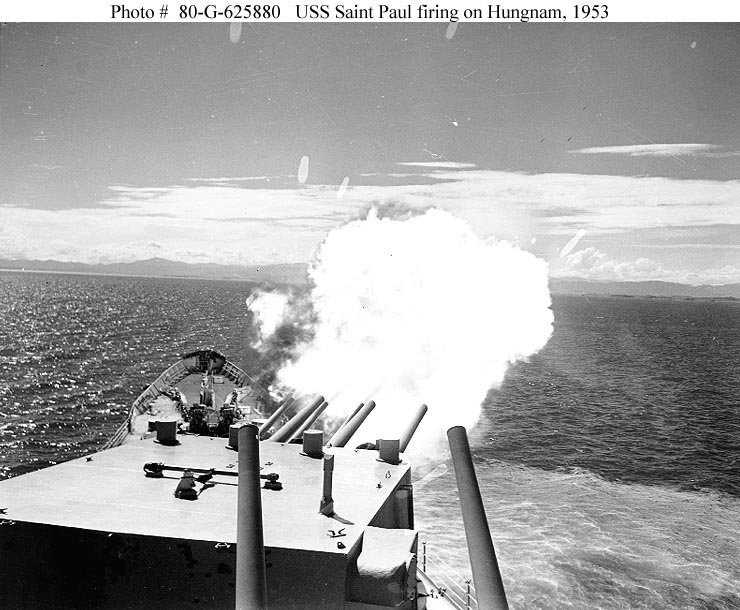 On 17 November, she provided gunfire support to the United Nations troops advancing on Chongjin. That day, shrapnel from a near miss by a shell from a Communist shore battery injured six men at gun mount stations. The cruiser destroyed the enemy emplacement with counter-battery fire and continued her support mission.
As the Chinese Communists began massive attacks late in November, United Nations forces commenced a general withdrawal to consolidate and hold south of the 38th parallel. She provided close support for the Republic of Korea I Corps on their east flank as they withdrew from Hapsu, and along the coast, as they retired from Chongjin. On 2 December, she moved north again, conducted night harassing missions above Chongjin, then moved south to support the withdrawal of the Republic of Korea Capital Division to Kyongsong Man. She entered the harbor at Wonsan on 3 December to provide a curtain of shellfire around that city as United Nations forces and equipment were moved to Hungnam; then followed the forces there, and remained to cover the evacuation of that city and harbor between 10 December and 24 December.
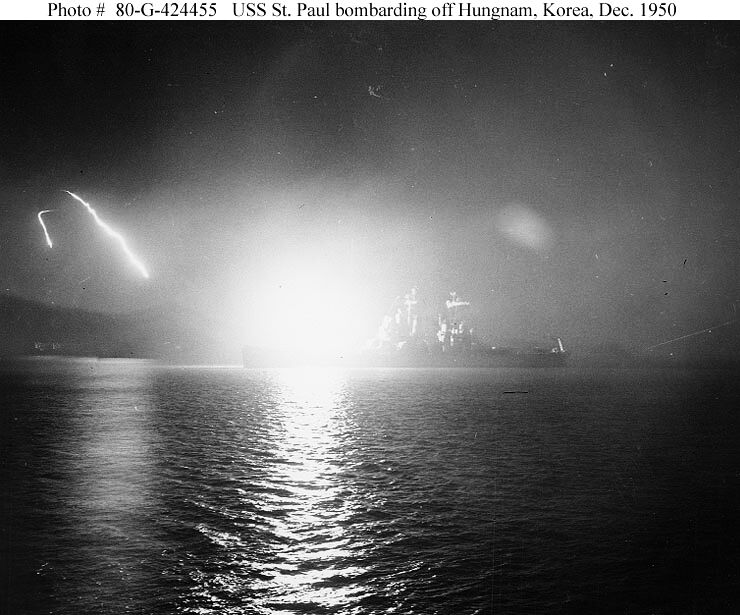 From 21 January to 31 January 1951, She conducted shore bombardment missions north of Inchon where, on 26 January, she was again fired upon by shore batteries. On 7 April, in special TF 74, with destroyers Wallace L. Lind (DD-703), and Massey (DD-778), landing ship dock Fort Marion (LSD-22) and high speed transport Begor (APD-127), She helped to carry out raids on rail lines and tunnels utilizing 250 commandos of the 41st Independent Royal Marines. These highly successful destructive raids slowed down the enemy's resupply efforts, forcing the Communists to attempt to repair or rebuild the rail facilities by night while hiding the work crews and locomotives in tunnels by day.
She returned to the United States for yard work at San Francisco, California, from June to September, then conducted underway training before sailing on 5 November for Korea. She arrived off Wonsan on 27 November and commenced gun strike missions. During the following weeks, she bombarded strategic points at Hungnam, Songjin, and Chongjin. In December, she served as an antiaircraft escort for TF 77, and, following a holiday trip to Japan, returned to operations off the coast of North Korea. In April 1952, She participated in combined air-sea attacks against the ports of Wonsan and Chongjin. On 21 April, while the cruiser was engaged in gun fire support operations, a sudden and serious powder fire broke out in her forward eight-inch turret. Thirty men died. Before returning to Japan, however, she carried out gunstrikes on railroad targets near Songjin, during which she captured nine North Koreans from a small boat. Following a brief stay in port and two weeks on the gun line, she headed home and reached Long Beach, California, on 24 June.
On 28 February 1953, She departed the West Coast for her third Korean tour and was in action again by April. In mid-June, she assisted in the recapture of Anchor Hill. With battleship New Jersey (BB-62), she provided close support to the Republic of Korea Army in a ground assault on this key position south of Kosong. The cruiser was fired upon many times by 75 mm and 105 mm guns, and observed numerous near misses, some only ten yards away. But on 11 July at Wonsan, she received her only direct hit from a shore battery. No one was wounded, and only her three-inch antiaircraft mount was damaged. On 27 July, at 2159, she conducted her last gunstrike and had the distinction of firing the last round shot at sea in the war. The shell, autographed by Rear Admiral Harry Sanders, was fired at an enemy gun emplacement. The truce was effective at 2200. She then commenced patrol duties along the east coast of Korea.
...
In 1963, she was visited by the Secretary of the Navy, the Commandant of the Marine Corps, and the Commandant of The Coast Guard. John Wayne and Kirk Douglas filmed scenes for the movie "In Harms Way" as she steamed from Seattle to Hawaii in 1964.
...
(Her) second Vietnam deployment began April 3, 1967 when she steamed west from San Diego. It would be seven months and 20,000 rounds later before the Fighting Saint would return. In her 1966 deployment, she had fired more than 10,000 rounds in support of allied troops south of the DMZ. Prior to that it was in Korea that CA-73 had last fired her big guns at hostile forces; and more than 20 years since the "Snooky Poo Maru", as she was affectionately known to her crew, had participated in World War II.
...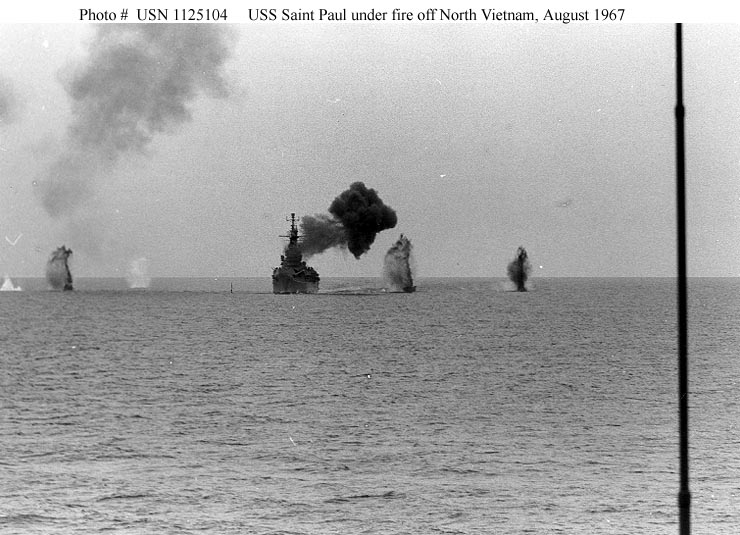 On September 1, 1967, she engaged in her toughest battle of the deployment. Accompanied by two destroyers, she moved in to attack waterborne logistics craft when about 25 coastal defense sites opened fire. She immediately returned the enemy fire and a running batle ensued with shells falling all around the ship.
More than 500 rounds were fired at Her that morning, and one round found its mark. A shell entered near the starboard bow and damaged a storeroom and several staterooms. There were no personnel casualties. Continuously firing, the ship maneuvered to safety and retired to sea for repairs. Working all, night, crewmembers pumped the damaged area dry and welded a patch over the hole. The patch held during high-speed turns, and the next day, "The Fighting Saint" returned to the gunline.
The ship later steamed to Subic Bay for permanent repairs. (She had been in Subic Bay just a month earlier to have all of her 8" guns replaced.) She returned to Sea Dragon where she destroyed six more waterborne craft, two concrete blockhouses, and two costal defense sites. She also heavily damaged railroad yards at Cong Phu and the shipyards Phuc Doi. She was relieved by USS NEWPORT NEWS CA-148 in October and headed to San Diego.
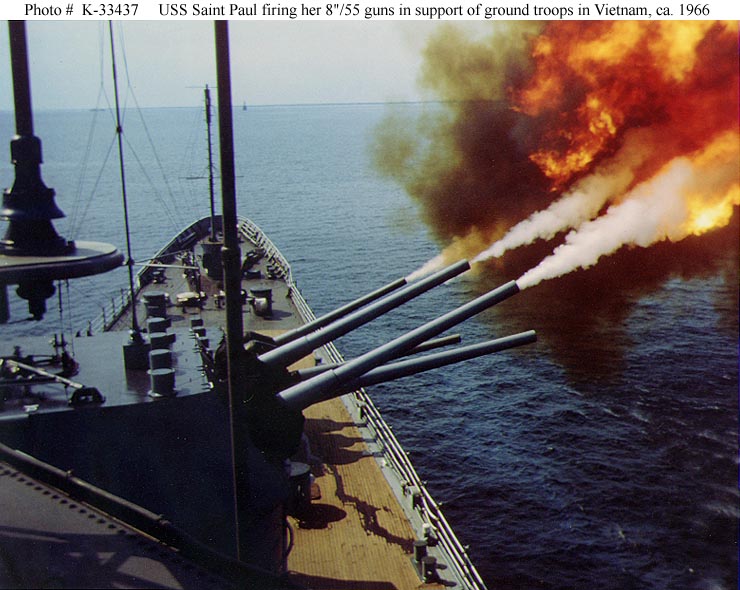 In May 1968, on her third Vietnam deployment, (she) returned to Sea Dragon operations. She picked up right where she had left off, shelling enemy targets on call-fire missions on a round-the-clock basis. She silenced North Vietnamese Army gun positions and sank three 30-foot logistics craft while damaging two 50-foot motorized tugs. The ship again took a brief mid-deployment break for regunning in Subic Bay. In over 1300 missions, she was credited with 380 enemy killed and 800 military structures destroyed or damaged. She was relieved in October by USS NEW JERSEY BB-62 before pointing her bow eastward for San Diego.
During her 130 days on the gunline on this deployment, "The Fighting Saint" fired a total of 64,055 rounds, making a total for the Vietnam conflict of more than 93,000. These figures established the 23-year old CRUISER as "Top Gun", having fired more rounds during a single deployment, and more rounds in all of her deployments, than any other warship.
...
Although "The Fighting Saint" had been decommissioned by the time the Vietnam conflict ended, she holds the distinction of two famous gunfire "lasts". As a member of Admiral 'Bull' Halsey's Third Fleet, she fired the final round on main home islands of Japan on August 9, 1945. She followed up that notoriety by letting go the last salvo of the Korean War on July 27, 1953, just two minutes before the armistice took effect. In more than a quarter century of service to her country, She earned 18 battle stars and fired more rounds of ammunition than any other United States crusier in history. She hosted eight heads of state. A total of 18 of her commanding officers and executive officers ascended to flag rank.
 What a girl.
You know my bias, and the story of the ST PAUL just makes it stronger. Think about the bang for the buck we got from the ST PAUL. Then think about the limited gene pool of a fleet we have now. Think about Somalia, Pakistan, SE Asia, China, South America - anywhere there is a shore line. Look at the mission she did and the firepower, and ability to take a hit, she took with her. Littoral? Yea, she has that. Range? Ditto? You can go on and on.
Here is the point to ponder, did we take the wrong fork in the road when we left the gun cruiser behind? Don't talk to me about the 5" guns we put on our CLG (which is what a Tico class is) or the Arleigh Burke class (which are a CLG as well - I don't care what you call them).
The dirty little secret here is that the Navy has realized that it did make a mistake when it decided to go all missile and pop guns, and left the MK-71 behind. DDG-1000 proves my point.
155mm = ~6.1". DDG-1000 is the size of a WWII Pocket Battleship. It may be a lot of things, but it is not a DDG. It is another CLG. One with 6.1" instead of 5", but a CLG none-the-less. The problem though, was the execution. Instead of doing what the USAF is doing with the B-3 Bomber (proven technology that is evolutionary not revolutionary), we fell in love with the theory, the bleeding edge of what might be able to be done if we just throw enough money at it. Everyone wants to be part of something cosmic, not pedestrian. Some people join Comet Cults, some people build warships that work. As a result, the Comet Cult has bought us an expensive bucket of unproven technology in one unaffordable short run of a half-dozen ships, if we get that. All on the promise of the CGX, which is really going to be a CBX. Right answer, wrong execution. Enough of that, just look at the ST PAUL and say, Bravo Zulu. Fullbore.
 First posted June 07.
A few thoughts about the recently announced strike tonight against Syria.
It is early, but I have a full day tomorrow and wanted to make a few points.
When I heard it was "a few dozen TLAM" I figured I would dust off my old TLAM background for a quick overview.
Here is what we know now;
The United States launched dozens of cruise missiles Thursday night at a Syrian airfield in response to what it believes was Syria's use of banned chemical weapons that killed at least 100 people, U.S. military officials told NBC News.
Two U.S. warships in the Mediterranean Sea fired 59 Tomahawk missiles intended for a single target — Ash Sha'irat in Homs province in western Syria, the officials said. That's the airfield from which the United States believes the government of Syrian President Bashar al-Assad fired the banned weapons.
59 from two ships sounds about right. Depending on the loadout, and the usual "Primary, Backup, Ready-Spare" that leaves us a few more to play around with if needed.
We should at some point find out which ships fired the TLAM, but assume they were some of the Arleigh Burke DDG we have in the Med.
FLT I have 90 VLS Cells and FLT II and IIA have 96. Not all those will have TLAM loaded but enough do.
The target:
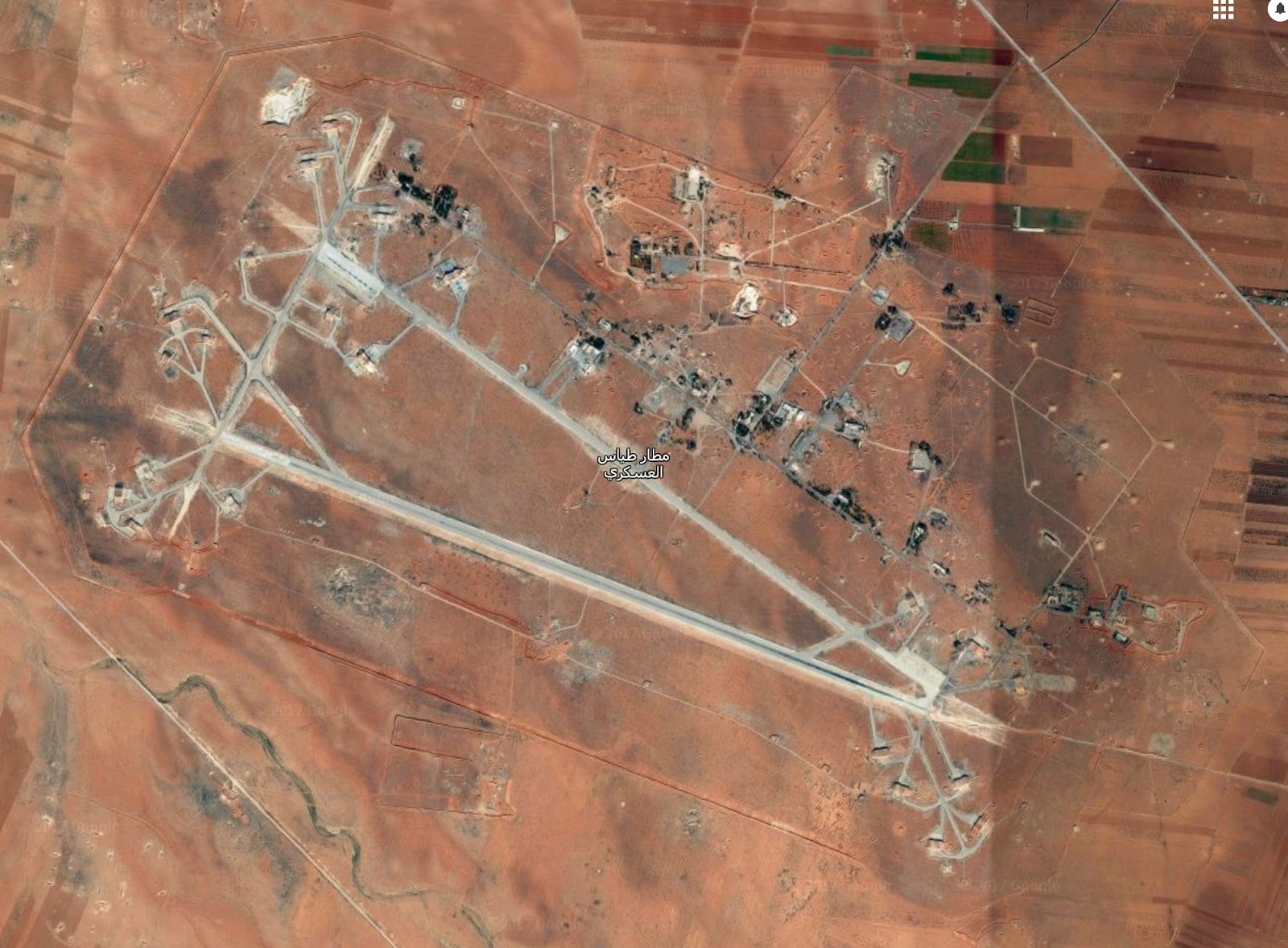
- Ash Aha'irat (Al Shayrat) airbase is about 25 miles SE of Homs City.
- That is a photo of the base above. Just about a perfect place to attack with TLAM. The targeting is almost school-house training classic.
- It is well away from most Russian forces, and the approach to the target given the range gives you enough options to avoid even flying over their main units with a wide separation.
- It makes a point.
- It will not interfere with operations against ISIS - which is the primary effort.
- No USA lives are directly put in danger. Besides the odd advisor or training team - should not threaten Russian or Iranian forces either.
- Based on what has been said by the US government over the last 24-hrs, we had to do something.
- If we had to do something, this was the right call.
- For a point of scale for TLAM punitive expeditions; in Desert Fox against IRAQ in 1998, we shot over 330 TLAM over three days in addition to airstrikes.
- This is a focused strike. Proper COA selection, IMAO.
This should check a few boxes and hopefully this will be it for now.
We have enough fighting in this horrible part of the world right now. We don't need more.
UPDATE: Lucas Tomlinson is reporting that the ships were the USS ROSS (DDG 71) and USS PORTER (DDG 78).
UPDATE II - Electric Boogaloo:
As we are always hearing, "Wow! Six months ago no one saw that coming...." and then eventually we find that, well, some people actually did.
I'm always looking for that first pop above the ambient noise, especially in those areas that seem counter to the conventional wisdom.
Over the years, when we've done a Midrats show on China, we always spend a few minutes discussing that China has significant structural economic issues, but that are not talked about often.
Over at TheNationalInterest, Gordan Chang has your must read for today;
Beijing, which once thought it would dominate the world, has been playing defense for the last year and a half as almost no economic trend has been going its way.
We start on the 14th of this month, when Janet Yellen inadvertently highlighted China’s fragility. The Federal Reserve’s hawkish comments on interest rates—the central bank signaled three rate increases next year instead of the expected two—along with the quarter-point rise in rates forced bond prices down across the world. In China, the damage was historic.
Last Thursday, just a few hours after the Fed’s announcements, futures on China’s benchmark 10-year obligation stopped trading when they hit the daily down limit, the first time that has ever occurred. Trading on the five-year also was halted, another first. The People’s Bank of China, the central bank, injected the equivalent of $22 billion in short-term money, and that allowed trading to resume.
The next day, bond prices recovered in China, but only because the PBOC injected more than $57 billion. Beijing, by brute force, was able to stabilize the bond market, already rocked by defaults and cancelled offerings.
And the Chinese central bank has also muscled the currency markets by orchestrating rescues. The renminbi is ailing, down 6.9% this year against the dollar. Beijing once had ambitions of the “redback” replacing the greenback as the world’s reserve currency, but now it is merely trying to stage an orderly descent.
Even if you aren't an econ geek, read it all.