Proactively “From the Sea”; an agent of change leveraging the littoral best practices for a paradigm breaking six-sigma best business case to synergize a consistent design in the global commons, rightsizing the core values supporting our mission statement via the 5-vector model through cultural diversity.
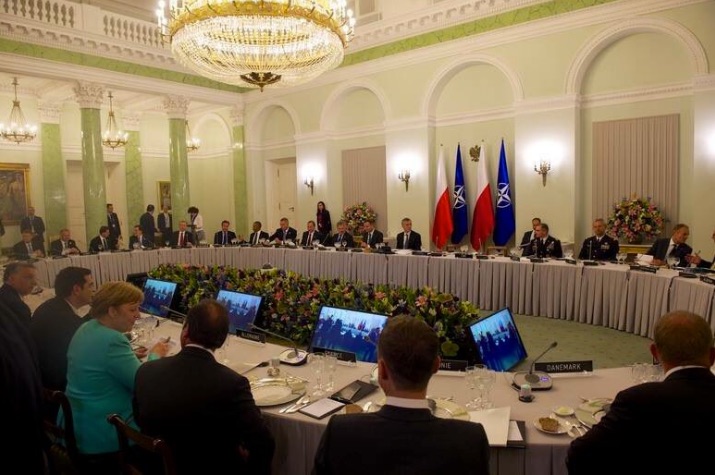
Let's start this week on an upbeat note. There is actually a lot to be proud of. There are actually some things on the national security front that make 2016 a safer and more predictable year than most in our recent history. Through all my formative years, college, and my early JO years, the world was always 30 minutes away from global nuclear war. The soul crushing political cult of Communism was seen as inevitable and the fact it could implode with little blood and turmoil like it did in the early 90s was not even thought a possibility in "polite" society. No one predicted what would happen would happen. From the fellow travelers and useful idiots on the Left like those who wrote for The Nation who were positioning and signaling so they would have a power role when the USA fell, to old Cold Warriors like George Bush the Elder who - even to the end with the "Chicken Kiev" speech - couldn't see what was going on; no one saw it. What a glorious victory for The West and the fruits of The Enlightenment. Not a full victory, and we have different challenges now - as humans always will - but this was a great victory we should all remember and look at now and then. I'll take today's challenges on a global scale than those of my youth. Enough words, let's just savor the picture. Two periods of time. One room in Warsaw, Poland. The founding of the Warsaw Pact in 1955.
As China continues to slowly use a variety of tools to claim portions of her maritime near-abroad in the South China Sea and elsewhere, part of their effort includes what can almost be considered naval irregular forces - a Maritime Militia. What is China doing with these assets, why are they being used, and what could we expect going forward as she taps in to a variety of assets to attempt to establish her authority? Our guest for the full hour this Sunday from 5-6pm Eastern to discuss this and more will be Dr. Andrew S. Erickson. Dr. Erickson is Professor of Strategy at the U.S. Naval War College (NWC)’s China Maritime Studies Institute (CMSI). Since 2008 he has been an Associate in Research at Harvard University’s John King Fairbank Center for Chinese Studies, and is an expert contributor to the Wall Street Journal’s China Real Time Report, for which he has authored or coauthored thirty-seven articles. He received his Ph.D. and M.A. in international relations and comparative politics from Princeton University and graduated magna cum laude from Amherst College with a B.A. in history and political science. He has studied Mandarin in the Princeton in Beijing program at Beijing Normal University’s College of Chinese Language and Culture; and Japanese language, politics, and economics in the year-long Associated Kyoto Program at Doshisha University. Erickson previously worked for Science Applications International Corporation (SAIC) as a Chinese translator and technical analyst. He gained early experience working briefly at the U.S. Embassy in Beijing, the U.S. Consulate in Hong Kong, the U.S. Senate, and the White House. Proficient in Mandarin Chinese and conversant in Japanese, he has traveled extensively in Asia and has lived in China, Japan, and Korea.
Join us live if you can with the usual suspects in the chat room and offer up your questions for our guest, but if you miss the show you can always listen to the archive at blogtalkradio or Stitcher. If you use iTunes, you can add Midrats to your podcast list simply by clicking the iTunes button at the main showpage - or you can just click here.
It is a beautiful place today when you drive by it, but then you notice a curious red dragon facing a wood.
The Welsh soldiers were just seven months out of training when they entered into combat at Mametz Wood. Many had never fired a round in combat, and used broomsticks rather than rifles at drill practice.
In sharp contrast they faced the elite Lehr Regiment of Prussian Guards - highly-trained professional soldiers who were deeply entrenched in the dense woods.
Their trenches were dug into chalk and thick wire stretched through the battleground, while the wood was heavily fortified with machine guns.
Mametz Wood was the objective of the 38th (Welsh) Division during the First Battle of the Somme. The attack was made in a northerly direction over a ridge, focussing on the German positions in the wood, between 7 July and 12 July 1916 . On 7 July the men formed the first wave, intended to take the wood in a matter of hours.
The British system was exceptionally hard on the homefront. Like the regiment my ancestors fought in during the American Civil War, the guy to the left and right of you was your neighbor, your brother, your cousin, your co-worker, your classmate, your friend.
Lord Thomas of Gresford recently highlighted the role of the Division in the House of Lords, describing the loss of men in the battle as a "huge tragedy for the whole of Wales".
He said 1,000 men from the Rhondda Regiment went in to battle that day, but only 135 men answered the roll call the following day. ... 3,993 killed or injured there.
In the first day, over 400 men were killed just trying to get from that red dragon to the treeline.
The poet Robert Graves fought in the battle and, having gone back into the wood once the battle was finally over, wrote:
"It was full of dead Prussian Guards, big men, and dead Royal Welch Fusiliers and South Wales Borderers, little men. Not a single tree in the wood remained unbroken."
Take some time to follow the links above and read up on this little snapshot of the sacrifice from WWI years before the USA threw its hat in the ring - especially this one about what a walk in the woods is like today.
I've joined forces with our buddy Lucien to connect life, the universe, and everything from the multiverse to LCS to why we may keep just digging through our problems. Caution; your noodle may hurt a bit at the end. Head on over to USNIBlog and give it a read.
Good news; LCS didn't sink. Bad news, it is going to cost you hundreds of millions of dollars to get that warm glow of "success."
On July 4, following last month’s shock trials for the Independence-class littoral combat ships, Austal announced that costs for modifying the vessels to meet Navy shock standards would average roughly $10 million per hull.
"Design modifications and significant re-work of construction already undertaken..."The military shock standard and US Naval Vessel Rules has driven a significantly higher level of modifications to the ship design and cost than previously estimated." (Austal)
I'm not sure what the number is this week, but let's run with a low even number; 40. Throw another $400 million minimum on the transformation pile.
The trial vessel, the USS Jackson, has completed two of three shock blasts and Austal says that she is performing as expected. Austal has recently been awarded an additional $11 million contract modification to cover the cost of repairs following each shock trial.
It's OK to laugh, as you may have a few more chances to get paid ... wait ... feel smug ... wait ... find out more about our exquisite little Tiffany jewel;
The next and final blast in the series will be progressively closer to the vessel, increasing the severity of shock to the hull.
A separate set of shock trials for a ship representing the second LCS series, the Lockheed-built Freedom class, is scheduled for August and September.
Remember, LCS-1 was commissioned eight years ago. Over two WorldWars ago. Shouldn't we expect better?
In the flutter of breathless articles post Brexit, if you've tried over the week to get your head around who is connected to whom via a scrap of parchment over in Europe, via WaPo, we have a nice outline in a pic. As usual, Europe is as it has always been - a bit of a bother and mess. The Executive Summary: it is a lot more complicated than an American thinks.
... , July 1, is the ... anniversary of the first day of the Battle of the Somme, the bloodiest day in the history of the British Army. They took 60,000 casualties, of whom nearly twenty thousand were killed. The Tommies were to get out of their trenches and advance across No Man's Land towards the enemy trenches. This maneuver was to be preceded by an artillery barrage on the enemy lines. The following is from Paul Fussell's 1975 classic The Great War and Modern Memory:
Every day still the Times and the Telegraph print the little "In Memoriam" notices — "Sadly missed," "Always in our thoughts," "Never forgotten," "We do miss you so, Bunny" — the military ones dignified by separation from the civilian. There are more on July 1 than on other days, and on that date there is always a traditional one:
9th AND 10th BNS., K.O.Y.L.I. — To the undying memory of the Officers and Men of the above Battalions who fell in the attack on Fricourt (Somme) on July 1, 1916. "Gentlemen, when the barrage lifts."
B.H. Liddell Hart, who was in the 9th Battalion of the King's Own Yorkshire Light Infantry, explains. Just before the Somme attack, "the officers assembled in the headquarters mess, in a typical Picardy farmhouse. Recent strain between the commanding officer and some of the others led to an embarrassing pause when the senior company commander was called on to propose a toast to the C.O. On a sudden inspiration, he raised his glass and gave the toast with the words: 'Gentlemen, when the barrage lifts'."
The battalion attacked with some 800 men. Twenty-four hours later its strength was 80 men and four officers.
To understand the British military from Churchill to today - you need to know the Somme. As Churchill said,
..it was at Somme, the hinge of popular opinion on the nature of war changed and forever altered our perceptions of war.