Monday, May 25, 2009

Winona Memorial

A best of perhaps; going back to 2005 and one of my favorite Memorial Day Posts.

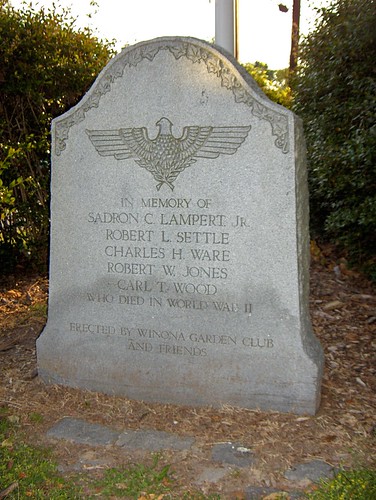
With Veterans Day, it is a good time to focus again on something I ran into this summer; something everyone has, I hope; a local personal memorial to those who died in service to their country. In this case it is a small little memorial in Norfolk, VA in an neighborhood called Winona Park.

As a byproduct of my original posting, the family of one of the men on the memorial, Sadron Lampert Jr., has been kind enough to send along some more details on Sadron Lampert Jr. that adds depth to the name. I'll quote from some of their emails below, taking out the names. A reminder that these were real people, with real families, real futures, real desires, real hopes. Everyone that leaves early, sacrifices a lifetime.

Nothing dramatic here, but next time you hear or see a name, remember each one has some kind of connection - some history - some grieving family. War is an expensive undertaking - and money isn't the currency.

Dear CDR Salamander:

I happened to Google Sadron Lampert and found your article on the WWII memorial in Winona. My name is XXXX. I live in Norfolk, and my father, XXXX, is Sadron's brother. I would like to add to and clarify some of your information regarding the five young men from Winona who gave their lives serving their country.

The only person among the five that my father did not know was Robert W. Jones. Three of the families literally lived next door to each other: the Lamperts, Settles, and Woods. In fact, my grandmother, XXXX Lampert, was next door consoling Mrs. Settle on the death of her son, not knowing that her own beloved Sadron had already been killed.

By the way, my grandparents had already lost a little girl, Doris, when Sadron died, and my father, who was five years younger than Sadron, had gone into the Army before Sadron and was in New Mexico training to go overseas when he heard of his dear brother's death. My father--my hero--went on to fly more than his share of missions over Japan, flying out of Tinian. The siblings had another brother, Ralph, who died at age 56 of a massive heart attack.

To clarify Sadron IV's e-mail, Sadron III was two when his father was killed. Sadron III, of course, is my first cousin.

Sadron, Jr. entered Yale at age 16. He graduated at age 20. He was on a special football team--the 150 lb. varsity team--because of his slender stature.

Sadron, Jr., .... met his wife, Edith, (while she) was working at Farmer's, Inc., my grandfather's company, as a secretary when Sadron, Jr. met her. She was from South Norfolk. ...... After Sadron and Edith married, they moved to New York, where Sadron was the manager of marine and war risk insurance at Johnson and Higgins on Wall Street.

Sadron and Edith were married at Rosemont Christian Church in South Norfolk. The church was on Bainbridge Blvd., the same street where Edith's family lived. Her maiden name was Edith Herbert. Again, Sadron and Edith were a lovely couple. My mother and father can still picture them attending their church, First Methodist, Edith dressed to the nines and Sadron perfectly outfitted in a gorgeous white summer suit.

Sadron, Jr. was actually drafted in early 1944. He was drafted as part of Roosevelt's Limited Service Act because of his nearsightedness. Instead of the Army using his vast intelligence and putting Sadron where he could have made a weighty difference, the Army sent him straight to North Africa and then to Italy. .... He died on September 14, 1944, three days before my father's 21st birthday, because he and a boy from Wisconsin caught a mortar in their foxhole at Futa Pass, Italy, which killed both of them instantly.

Although Sadron Lampert was at Futa Pass at Highway 65 in Northern Italy on September 14, 1944, several WWII websites list incorrect information. For example, one lists him as "Lambert" and another lists his date of death as Sept. 29, 1944. Both are incorrect. Sadron Lampert died on Sept. 14, 1944.

I know that the fighting between Sept. 2 and Sept. 25, 1944, along highway 65 through Futa Pass--known as the Gothic Line--was intense. Between Sept. 10 and Oct. 26, four U.S. divisions suffered over 15,000 casualties. Some sites even suggest that the Futa Pass activity in September 1944 was a diversionary sacrifice to draw enemy fire away from other strategic points.

Sadron was dashing and extremely intelligent; everyone admired him. My mother also grew up in Winona and remembers seeing Sadron and Edith together and thinking what a perfectly beautiful couple they were. They had the aura of movie stars. My grandparents continued to live on Morris Crescent until their deaths. My grandfather, Sadron, Sr., died in 1983. I was lucky enough to know him well into my adulthood. My mother's parents lived on Huntington Crescent until their deaths (with my grandmother living almost to age 97). My uncle and my brother and his family still live in Winona, so my attachment to the neighborhood is quite strong.

Charles H. Ware went by Hal. He and my dad were the same age and were on the high school football team together. My dad believes that he was in the Army Air Corps.

Carl Wood was drafted rather late in life. He was 6 or 8 years older than Sadron. He was the first husband of another long-time Winona resident, Winnie (Mrs. William) Scullion, who died several years ago. Her sons (by her second husband) are still in the area.

Robert Settle was an Annapolis grad. He took Naval Flight Training and was killed in a crash stateside.
.....
Just last year, the Lafayette/Winona Civic League held a special Memorial Day service and dedicated the memorial site with new lights. My mother has photographs of the original dedication service, held in the early 1950s, complete with shots of Sadron, Sr.; his wife, Elizabeth; and their grandson, Sadron III.
.......

To the family of S.L. Jr., thanks again for the email and putting the person behind the name.

Every name has a story like S.L. Jr. Every memorial is huge, even if smallish and in a small park; like the one that should be remembered on the 11th hour, of the 11th day, of the 11th Month. Armistice Day.
UPDATE: Ninme has a nice tribute to Colonel Bolling from WWI.

Editorial note: the Stavridis post that was up this AM will be back tomorrow.

USS AMERICA (LHA-6) - you saw it here first ..

Keel earlier this month.


Hat tip A Spy.

Sunday, May 24, 2009

Sunday Funnies


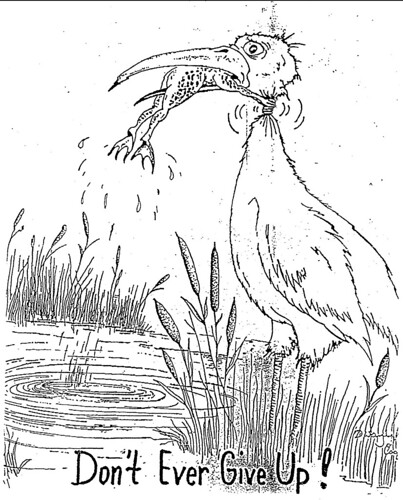
Best cartoon a Chief ever gave me (that I can publish here) - funny what you can find at the bottom of a box that has made three PCS untouched.

Friday, May 22, 2009

Fullbore Friday


When you walk around a static display aircraft - make sure and look at the plaque or note about its background. You never know what you will find out.
At the ceremony, Pensacola NAS personnel also dedicated a Vietnam-era attack aircraft to Navy Lt. Peter Russell, who was killed during a mission over North Vietnam.

Russell was part of a special "Black Pony" attack team, tasked with providing close air support for troops on the ground.

On May 25, 1969, Russell dove his OV-10 to attack a group of enemy soldiers firing on a Navy Riverine Patrol Boat in the Mekong Delta. A single bullet shattered through the canopy and killed Russell in the pilot seat.

Russell's back-seater, Navy pilot Jeff Johnson, took control of the airplane and pulled it out of the dive, moments before it crashed into the river.

The plane survived the war, and is on display at Pensacola NAS.

"I'll never forget Pete," said retired Navy Capt. Marty Schuman, who knew Russell well and was his commander when he was killed. "I was fortunate enough to have two wonderful sisters, but I never had a brother. But if I did, I wished he would be one just like Pete."


That is LT Russell with another aircraft he flew, A-1H Skyraider, that you smart guys will know will be a subject for another FbF.....

Thursday, May 21, 2009

Diversity Thursday

An oldie but a goodie - from the AUG 2005 (Oops, my bust. Correction; 1995) USNI Proceedings.

Reflections on a Naval Career

Larry Di Rita

On board thc USS Boorda (CVN-80). The ship is off the coast of Brazil, conducting rain forest preservation research as flag-ship for Commodore N. Singh Nifighandi, Bangladeshi Navy, Commander. U.N. Environmental Task Force 161.

Captain Will Keith drew on his cigar and let the smoke drift from his mouth. He knew he shouldn't be smoking; his cabin was on the same ventilation system as the crew nursery and the filters wouldn't catch everything. But he had a reason not to care. There was a surprise in the message traffic today: his relief's orders. Keith could start counting down the days until he retired. Funny, he thought, command wasn't supposed to be like this.
–
When he'd left Annapolis in 1980, carrier command seemed about as likely as spaceship command. His only aspiration was those wings of gold. Only one thing could top the feeling of pinning on those wings: Tomcat. And the hard work paid off; in two short years, Keith was doing touch-and-gos from the deck of the USS Kitty Hawk (CV-63) in the Free World's baddest plane.

“Captain! Sir, are you down there? The muffled voice of the officer of the deck wafted down the voice tube above Keith's head. As he cleared his thoughts, he was struck with the irony of this quaint form of communication," which Lord Nelson himself had used," on board a nuclear aircraft carrier. He took comfort in the tradition as he yelled back up the tube. "Bridge, Captain. What's up?"

"Sir, the Commander of the Peacekeeping Detachment is finished with training on the flight deck. She's releasing it to you for flight operations."

"Great. Have the Executive Officer meet me in my cabin." Damn peacekeepers, thought Keith. Always fouling the deck with mock hostage situations and crowd-control training. Getting hard to remember this is a warship. It was important, though. Once back home, the ship would be sending peace-keepers to the Commander of the U.S. Internal Security Force in Miami. Keith was determined to send well-trained troops, even if it was a mission he didn't like: U.S. military forces deployed against U.S. citizens. Still, after the second Haiti occupation in '96, when General Colin Powell was named U.S. Governor General, it seemed less bizarre. Things sure had changed since Desert Storm, though....

"This thing is going down!" Lieutenant Commander Keith whispered to his wingman as the squadron listened to the mission brief. The air in the ready room was electric. It was going to be war after all. Years of training had come to this. Looking around, Keith saw the same mix of resolve, anticipation, and fear in the faces of every one of his shipmates. What could they expect he wondered.

He'd seen the so-called experts on television in the weeks since Desert Shield had begun. They were predicting thousands of American dead. They talked about chemical warfare, cruise missiles, mines, and the fourth-largest army in the world. To hell with all of them, thought Keith. All the "experts" knew were charts and tables and statistics. They knew nothing about the only things that mattered: the faces of his fellow fliers and the sound of Tomcat engines winding up on the flight deck. The ship continued her full-speed rendezvous with war through the cool Persian Gulf evening....

Knock! Knock! Knock! The pounding on his cabin door brought trim back to the rain forest. "Who is it?” he demanded.

"XO sir. The OOD said you waned to see me."

"Come in. XO." Keith looked up. I want to conduct some flight operations. We've been out here a week without any flying. I might even suit up myself."

“What do you mean, sir? After all, we send a couple of V-22s to the beach every day to drop off and pick up the Environmental Control Team."

“Very funny, XO. We haven't done a cat shot since we’ve been here. We've got the last Tomcat squadron in the Navy on board, and I'm determined to ride it hard."

"Just one problem, Skipper. I've scheduled our Diversity Stand-Down for this afternoon."

“You remember, sir. The Chief of Maritime Services ordered it to remind all hands about the strength the Navy draws from their diversity. All because of that business on the Schroeder.” Keith winced. After eight years, he still hadn't gotten used to the redesignation of the Chief of Naval Operations as the Chief of Maritime Services. It happened back in '97, when the United States occupied Venezuela to restore democracy after a military coup. The U.N. Secretary General had convinced the President that "Chief of Naval Operations" sounded too "war-like," since the U.S. intervention in Venezuela, Nigeria, Haiti, and Somalia had been conducted for peaceful purposes.

He recalled the incident on board the Schroeder, the new Aegis battleship. After being denied an advancement, a seaman of Indo-Ugric heritage sued his Master Chief. The charge was "insensitivity to diversity," a grievance some of the old-timers were having a hard time adjusting to after spending so many years learning that individuality had nothing to do with military readiness. The sailor claimed that the Master Chief was insensitive to his Indo-Ugric traditions, which required him to spend each Wednesday and Friday afternoon in quiet reflection "away from his normal place of work." The Master Chief thought that sounded like an excuse to goof off twice a week, with the rest of the division carrying his load. But the court ruled that the Chief had shown "reckless disregard for the importance of diversity in defending the national interests of the United States." The Navy-wide Diversity Stand-Down was the result.

"Anyway," the XO continued, "we won't be able to conduct flight operations today. “Skipper, you still with me?” But Keith was in another time and place, thousands of miles away. When everything had begun to change.

He’d been in Las Vegas that week; he'd even been on the third floor that night. And he had lied about the whole thing under oath. He wasn't proud of his behavior; never had been. But it was every man for himself right from the start. The flags were the first ones: trudging up to Capitol Hill to admit that the Navy had serious problems and that things would have to change; agreeing to just about anything to avoid losing their jobs; and denying that they knew what went on in Las Vegas. In thc end, everyone got off. But everything changed. Sensitivity training, diversity stand-downs, women on combat ships, women in combat aircraft, and after the second Gulf War, women in body bags.

And then there was the Arthur affair. Admiral Arthur, the commander of Desert Storm naval forces, had his career short-circuited in '94 when a j.g. who had washed out of flight school complained to a senator about a "climate of sexual harassment" at Pensacola. As Vice Chief of Naval Operations, Admiral Arthur had reviewed her record. He reprimanded her instructors for inappropriate comments, but stood by their decision to deny the woman wings on the basis of poor performance. Wrong answer. He had been nominated to be Commander-in-Chief Pacific, but that was not to be.

The whole thing had a perverse logic. That this wartime leader should be lost because of "insensitivity" reflected a turning point for the Navy that had started somewhere between the deserts of the Middle East and the deserts of Nevada. Anyway, the lesson was clear to mid-grade officers like Keith: If flag officers could watch Arthur go down with nary a whimper, what could a lieutenant commander with kids and a mortgage hope to achieve by speaking out?

"Skipper, did you hear me?” intoned the XO. "I saw your relief s orders. Do you know her?"

"Met her once," said Keith. "Year behind me at Annapolis. CH 46 pilot; had the during the Jamaican Drug War."

Keith had missed Jamaica in '01. He was pulling a U.N. tour in Sudan. U.N. assignment was critical for anyone with flag aspirations; back then Keith still saw stars. He worked for an Indonesian two-star as Chief of Police for the U.N. government in Sudan. Keith never had given much thought to disarming private citizens, distributing food, and patrolling the streets. But he had to admit that it did prepare U.S. forces for the kinds of missions they were doing in Miami, Los Angeles, and Chicago. Keith always had sensed a vague connection between Tailhook and these strange new missions. The Navy brass already had been concerned about the budget cuts at the end of the Cold War and were willing to sign up to just about anything to keep the money coming. And after Tailhook and Arthur and all that, they weren't in a very good position to choose the good missions and reject the bad. After a while, patrolling the streets of U.S. cities didn't seem much different from catching drug runners at sea and occupying Third World countries.

"Captain to the bridge!" blasted the speaker. Thoughts of an imminent collision raced through his mind as Keith bolted out of his cabin. The OOD must need him up there bad if he didn't have time to call himself. When he arrived, he saw Commodore N. Singh Nifighandi sitting in the commanding officer's chair. These U.N. types always ignore military tradition, he thought." Even the sanctity of my bridge chair. "Yes sir,"
he saluted.

"Good morning, Captain," began the Commodore in his curious British accent. "I just saw your Marine detachment holding close order drill on the hangar deck. We are on a peaceful U.N. mission here. Please have them stop."

"But, "sir," began Keith, his jaw tightening. "Those men must stay sharp. That's what they're trained to."

"Thank you, Captain," clipped the Commodore. "That is all."

"Aye-aye, sir." Keith realized it was more despair than anger that he felt. As he turned to leave the bridge, the bos'n handed him the phone.

"XO for you, sir."

"Yeah XO, what is it?"

"We just got an order modification on your relief. She'll be here three months late. Turns out she's expecting; taking mandatory family leave. You know the regs. Skipper, you there?”

He wasn't. He was back at Annapolis, tossing his cap in the air. He was pulling Gs at 30,000 feet, locked on to a bogey with weapons free. He was feet dry over Kuwait and itching to splash an Iraqi fighter. Something had changed, and it wasn't him. Maybe it was better, probably not. He didn't know for sure, but he knew it wasn't fun anymore. And it had stopped mattering.

Mr. Di Rita, a former naval officer who served in Desert Storm, is Issues Director for Senator Graham's presidential campaign.

Hat tip Jim.

CDR Doran ... off the Christmas Card list ...

Ungh. No history merit badge for you.
Take, for example, refueling at sea. A regular warship matches speed with an oiler by syncing up the revolutions per minute of the ships’ propellers. The problem? Freedom doesn’t have propellers.
...
This is a revolution, not an evolution, for the Navy,” said Cmdr. Mike Doran, captain of Freedom’s Gold Crew, which rotated onto the ship in March. “The normal way the Navy does things today doesn’t work for my ship.”
Just ungh. I blame the way we write FITREPS. Words mean everything, therefor words mean nothing.