
11 hours ago
The house next door to you is sold, and the people who move in are white supremacist skinheads. You discover that they’ve started up a methamphetamine lab in their basement. You think about calling your County Sheriff’s Department, but you’re not so sure. The cops strike you as generally overweight and none too swift. The only time you ever see them is in the mall, two cruisers parked side by side, the deputies gossiping and waiting for the next radio call instead of being on patrol. You’re afraid that if you tell them about your neighbors the news will leak out and you’ll get your house burned down one night. After all, you have a wife and kids and a mortgage.
But one day the SWAT team shows up to serve a warrant and kicks down the neighbor’s door and drags them off to jail. You’re incredibly pleased and highly relieved. You vow that the next time the Department is doing some charity work you’ll write a check. And you tell one of the deputies that if he sees you out in the yard to stop and you’ll let him know what’s going on in the neighborhood.
Now let’s shift that scenario to a slightly alternate universe where the Bill of Rights doesn’t apply. The Sheriff’s Department gets the word that someone in the neighborhood is cooking meth. They don’t know who, but since no one in the neighborhood is telling them anything they think everyone might be white supremacists. So one night they kick down your door looking for the meth lab. They point guns at your kids and your wife and scare them half to death. While searching your home they break your furniture and throw your belongings everywhere. And they slap you around trying to get you to tell them where the meth lab is. By now you’ve forgotten all about your scary neighbors—you just want to get even with those cops.
Even worse, let’s say that the cops find out exactly where the meth lab is. But they’re afraid of the neighborhood, and they don’t want to get shot at taking down the lab. So they call in a fighter bomber and drop a 500 lb guided bomb on your neighbor’s house. That takes care of the meth lab, but it also blows down one wall of your house, breaks every window, and destroys the car you need to get to work every day. You don’t know what you’re going to do.
A couple of nights later, another neighbor comes to your door and says he’s making a bomb to blow up the next patrol car that comes down the road. And would you help him dig the hole for $100?
You’d probably do it for nothing, wouldn’t you?


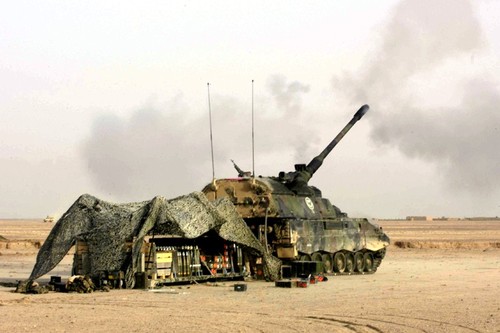
Open source information about 1 (NLD/AUS) Task Force Uruzgan, the combined Dutch/Australian contribution to NATO's deployment in Southern Afghanistan, also known as Stage III of ISAF, the International Security Assistance Force. Older reports (1000+) can be found in their respective Categories; also a search function ('Zoek') is available.Or, for Outlaw Mike;
Openbare informatie over 1 (NLD/AUS) Task Force Uruzgan, de Nederlands-Australische bijdrage aan Fase III van ISAF, de door de NAVO geleide International Security Assistance Force. Ruim duizend oudere berichten zijn te vinden in hun desbetreffende categorie; bovendien zijn berichten op trefwoord te vinden via het zoekvenster.If you are a regular reader here or at Argghhh!!!, you've seen her before!
YMBFKM.
- James A. Baker - 76
- Lee H. Hamilton - 75
- Lawrence S. Eagleburger - 76
- Vernon E. Jordan, Jr. - 71
- Edwin Meese III - 75
- Sandra Day O’Connor - 76
- Leon E. Panetta - 68
- William J. Perry - 79
- Charles S. Robb - 67
- Alan K. Simpson - 75
That said, how can these bleary eyes be considered remotely fresh? There is something to be said for times changing and failed ideas of the past being rejected for a different sort of approach and solution. These men (and one woman, cryptically a judge - she is an expert on foreign policy now? Was Elizabeth Dole not available?) have had their chance in the past to deal with, confront, and handle the issues we're facing now. They had their day of power, their time to solve the trouble we face.J-Pod has a nice comment, snicker, as well.
Almost without exception they are members of former administrations, administrations that to a man failed to deal with the issue of terrorism or contributed to their rise, power, and confidence. It's not that they are old, it's that their age is iconic of their past and their previous failures. These aren't fresh eyes, they are failed, discredited eyes.
This is the consensus view of the Iraq Study Group, which is very proud that it reached consensus.
Its members also reached a consensus view that Depends is a really fine brand of adult diaper, and that they love reruns of "Murder, She Wrote."
What's going on at the Pentagon?And yes, I know the military is not perfect, never is. You can only be perfect in hindsight. Ahem. As the military continues to strive for victory within the boundaries they are allowed to, expect the attacks to increase.
Are the joint chiefs indeed set on "winning" the Iraq war, a war that everyone else on the planet knows the ending of? Or are the chiefs bobbing and weaving like the rest of Washington to position themselves for the post-war era?
I ran into a friend yesterday at the store and as we were chatting. The subject of Iraq came up.
My friend, who isn't a military specialist but is a thoughtful Bush-hater, made a comment that somehow the military was denied the forces they thought they needed, both in 2003 and today.
I said, look, the military itself bought into the small force logic and the quick in and out illusion.
The small force appealed to their vanity, that is, that the magnificent U.S. military didn't need a larger force to defeat the Iraqi Army on the battlefield.
The Bush administration is deliberating whether to abandon U.S. reconciliation efforts with Sunni insurgents and instead give priority to Shiites and Kurds, who won elections and now dominate the government, according to U.S. officials.There is a lot being leaked out to remind everyone the seriousness of this world.
The proposal, put forward by the State Department as part of a crash White House review of Iraq policy, follows an assessment that the ambitious U.S. outreach to Sunni dissidents has failed. U.S. officials are increasingly concerned that their reconciliation efforts may even have backfired, alienating the Shiite majority and leaving the United States vulnerable to having no allies in Iraq, according to sources familiar with the State Department proposal.
Some insiders call the proposal the "80 percent" solution, a term that makes other parties to the White House policy review cringe. Sunni Arabs make up about 20 percent of Iraq's 26 million people.
Until now, the thrust of U.S. policy has been to build a unified government and society out of Iraq's three fractious communities. U.S. officials say they would not be abandoning this goal but would instead leave leadership of the thorny task of reconciliation to the Iraqis. The officials spoke on the condition of anonymity because of the sensitive nature of the deliberations.
The proposal has met serious resistance from both U.S. Ambassador Zalmay Khalilzad and military commanders in Iraq, who believe that intensive diplomatic efforts to bring Sunni insurgents into the political process are pivotal to stabilizing the war-ravaged country, the sources said.
U.S. officials say they have found smoking-gun evidence of Iranian support for terrorists in Iraq: brand-new weapons fresh from Iranian factories. According to a senior defense official, coalition forces have recently seized Iranian-made weapons and munitions that bear manufacturing dates in 2006.The Iraq Studies Group seems to be setting itself up for a battle with the military,
Iranian-made munitions found in Iraq include advanced IEDs designed to pierce armor and anti-tank weapons. U.S. intelligence believes the weapons have been supplied to Iraq's growing Shia militias from Iran's Islamic Revolutionary Guards Corps, which is also believed to be training Iraqi militia fighters in Iran.
The bipartisan Iraq Study Group reached a consensus on Wednesday on a final report that will call for a gradual pullback of the 15 American combat brigades now in Iraq but stop short of setting a firm timetable for their withdrawal, according to people familiar with the panel’s deliberations....and the President..
...
The report leaves unstated whether the 15 combat brigades that are the bulk of American fighting forces in Iraq would be brought home, or simply pulled back to bases in Iraq or in neighboring countries. (A brigade typically consists of 3,000 to 5,000 troops.) From those bases, they would still be responsible for protecting a substantial number of American troops who would remain in Iraq, including 70,000 or more American trainers, logistics experts and members of a rapid reaction force.
...
The report leaves unstated whether the 15 combat brigades that are the bulk of American fighting forces in Iraq would be brought home, or simply pulled back to bases in Iraq or in neighboring countries. (A brigade typically consists of 3,000 to 5,000 troops.) From those bases, they would still be responsible for protecting a substantial number of American troops who would remain in Iraq, including 70,000 or more American trainers, logistics experts and members of a rapid reaction force.
...
While the White House reviews its strategy options, Pentagon planners are also looking beyond the immediate reinforcements for Baghdad to the question of whether they will need to draw more on reserve units to meet troop requirements in the Iraqi capital, military officials said. In particular, the Army is considering sending about 3,000 combat engineers from reserve units.
"I know there's a lot of speculation that these reports in Washington mean there's going to be some kind of graceful exit out of Iraq," the president said during a joint news conference with Mr. Maliki, referring to the panel's reports that are expected next week. "We're going to stay in Iraq to get the job done so long as the government wants us there."
It’s imperative the United States, its allies and the Iraqi Government stop Islamic extremists from achieving their goal of controlling Iraq and the surrounding region, a senior U.S. military officer said on CBS’s “60 Minutes” Sunday.Like I said yesterday, we can win this. It just takes courage and hard work - by our civilian bosses and the "loyal opposition."As usual, Victor Davis Hanson puts in a good closing word.
“We have to stabilize Iraq and the broader regional dynamic in order to make the region less conducive to extremism, because if we don’t, the extremist values will become mainstream and we will have a much worse security situation develop in the future,” Army Gen. John P. Abizaid, commander of U.S. Central Command, told CBS reporter Lara Logan.
...
“There’s no good solution to a divided Iraq,” Abizaid asserted. “It’s got to come together. It’s got to stabilize. And, it’s going to require Iraqi sacrifice and courage and responsibility along with that of the United States and our allies.”
U.S. military commanders “don’t believe that they’ve been defeated” in Iraq, Abizaid said. His greatest concern for Iraq, he said, is that neighbors like Syria and Iran decide to further destabilize the country, rather than help it to coalesce.
The Iraqi Government has shown its desire to confront the sectarian violence, including violence committed by illegal militias, Abizaid pointed out. “They know that the militias have got to be taken on,” the general said.
A major element in stabilizing Iraq, Abizaid said, involves employing the country’s army to stop the sectarian strife.
“The (Iraqi) government must get behind its army in order to give it confidence that it can operate on the non-sectarian plain,” the four-star general said. “And, it’s a very, very complicated problem. But, it is one that can be solved.”
Five years after September 11, and three-and-a-half years after toppling Saddam Hussein, the U.S. is almost as angry at itself as it is at the enemy. Two quite antithetical views of the war on terror — and indeed, the entire American role in the Middle East — are now crystallizing.For the second time in my life, I think I can claim minority status.
Ideology and political affiliation are no longer necessarily touchstones to either opinion — not at a time when The Nation and The American Conservative share the same views on Iraq and the role of the United States abroad. Republican senators like Chuck Hagel call for withdrawal, while Democrats like a Joe Liebermann do not.
Republican realists are welcomed by liberal Democrats, who want nothing to do with the neo-Wilsonian neo-conservatives that once would have seemed more characteristic of liberal’s erstwhile idealism. It is not just that public intellectuals, politicians, generals, and journalists have different views, but their views themselves are different in almost every 24-hour news cycle. Even the Bush administration at times seems torn, gravitating between both schools of thought.
While there are dozens of variants to the following two divergent positions, they represent a clear enough picture of the present divide.
...
The Majority Opinion
The new majority school of thought — often described as the more nuanced and more sophisticated — seems to conclude that the “global war on terror” (if that’s even what it ever really was) is insidiously winding down to a police matter. Billions spent in lives and treasure in Iraq did not make us any safer; the passing of time, the dissipation of passions, and increased vigilance did.
...
The Minority Brief
We really are in a global war. Its dimensions are hard to conceptualize since our enemies, while aided and abetted by sympathetic Middle Eastern dictatorships, claim no national affinity. Indeed, the terrorists deliberately mask the role of their patrons. The latter, given understandable fears of the overwhelming conventional power of the United States military, deny culpability.
THAT WAS certainly swift. Washington has a way of quickly acculturating people, especially those who are most susceptible to derangement by the derivative dignity of office. But Jim Webb, Democratic senator-elect from Virginia, has become a pompous poseur and an abuser of the English language before actually becoming a senator.You really should read it all. Had me laughing. Lex liked it too.
...
Webb certainly has conveyed what he is: a boor. Never mind the patent disrespect for the Presidency. Webb's more gross offense was calculated rudeness toward another human being — one who, disregarding many hard things Webb had said about him during the campaign, asked a civil and caring question, as one parent to another. When — if ever — Webb grows weary of admiring his new grandeur as a "leader" who carefully calibrates the "symbolic things" he does to convey messages, he might consider this: In a republic, people decline to be led by leaders who are insufferably full of themselves.
...
In his novels and his political commentary, Webb has been a writer of genuine distinction, using language with care and precision. But just days after winning an election, he was turning out slapdash prose that would be rejected by a reasonably demanding high school teacher.

 SMS Goeben or TCG Yavuz Sultan Selim - take you pick. What you can't deny is that few ships over the last century have had more of an impact on history and the fate of the West.
 The activities of Goeben and Breslau helped to bring Turkey into the war on the side of the Central Powers. Turkey's direct military contribution was of some value, but most important was the loss of the easiest route (via the Dardanelles) for Britain and France to ship aid to their Russian allies, and for Russia to ship out its grain, one of the main sources of its foreign exchange. Combined with the German blockade of the Baltic, this to a large extent cut off Russia from the outside world, if one excepts the difficult and underdeveloped routes through Archangelsk and Vladivostok. This in turn led to great difficulties in supplying the Russian army, substantially weakening Russia as a military partner for the Allies.
The presence of Goeben in particular was a major obstacle to Russian plans in the Black Sea. As of 1914, all of the Russian Black Sea battleships were pre-Dreadnoughts. Before the arrival of Goeben, they dominated the Black Sea, and a Bosphorus landing was under consideration. The arrival of Goeben dramatically changed the situation -- and even shore bombardment had to be conducted by almost the entire Russian Black Sea Fleet, since a smaller force could fall victim to Goeben.
A decisive Russian strike south, for the Bosphorus, would have knocked out the Ottoman Empire from the war, preventing the tragedy of the Battle of Gallipoli, and possibly changing the course of the war. The presence of Goeben effectively prevented it. This presence also helped the future succes of the Bolshevik Revolution.
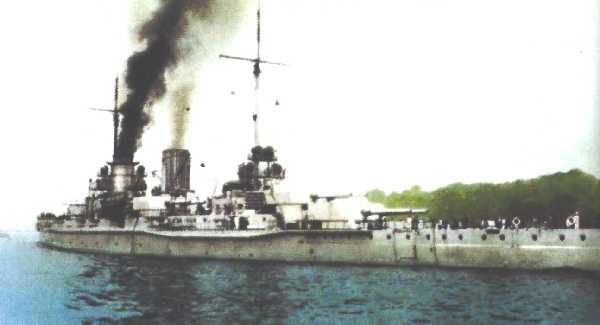
Turkey offered her back to Germany in '63 and they said no. Shame on them for that short sighted decision. Wouldn't she have been great at the Deutsches Marinemuseum (German navy museum) in Wilhelmshaven?Goeben arrived in Turkish waters on 10th August 1914, served under the Turkish flag with her German officers and crew from 16th August, and officially transferred to Turkey in November 1914, although still mainly German manned and controlled. On the 29th October 1914, 'Goeben' and light cruiser 'Breslau' (see below) took part with Turkish forces in bombardments and raids on Russian Black Sea ports and shipping before the formal declaration of war between Turkey and Russia.
Goeben, damaged 18th November 1914, northern Black Sea 20 miles off Cape Sarych, Russian Crimea - 12in shell from Russian battleship 'Evstafi' . On the 17th, the squadron of five Russian Black Sea pre-dreadnoughts - 'Evstafi' (or 'Ivstafi'), 'Ioann Zlatoust', 'Panteleimon', 'Rotislav', 'Tri Sviatitelia', bombarded Trebizond on the far eastern coast of Turkey. 'Goeben' and 'Breslau' sailed to intercept off the Crimea. Only 'Goeben' and 'Evstafi' were initially in contact during the short action before both sides disengaged. 'Goeben' hit once with an opening salvo, 'Evstafi' hit four times
Goeben, damaged 26th December 1914, Black Sea in Turkish waters, 1 mile off the outer buoy into the Bosphorus - 2 Russian mines. On the 21st December 1914, Russian minelayers laid a large field off the Bosphorus. By then 'Goeben' was escorting three transports to the eastern port of Trebizond. On the night of the 23rd/24th, the Russians attempted, unsuccessfully to block the entrance to Zonguldak to stop the transport of vital coal supplies. 'Breslau', sailing to meet 'Goeben' intercepted and sank two of the four blockships. After the two German ships met up, 'Goeben' continued on to the Bosphorus, where she was mined in the afternoon. Badly damaged, flooded and with no local dock large enough to take her, 'Goeben' was repaired with cofferdam-filled concrete, but was not operational until May 1915.
Goeben, damaged 10th May 1915, Black Sea off the Turkish coast - by 2-12in shells from Russian battleships. At the start of the Gallipoli landings in late April 1915, the Russian pre-dreadnoughts carried out a series of bombardments of the Bosphorus area. This was repeated on the 9th May. 'Goeben' sortied and at 07.50hrs was in action with three of the Russians, including the 'Evstafi'. She failed to get any hits, received two herself, but was not seriously damaged. The two other Russian pre-dreadnoughts had come up, and the by-now seriously out-gunned 'Goeben' ceased fire at 08.12hrs and escaped with her higher speed.
Goeben, damaged 20th January 1918, Aegean Sea, off and within the Dardanelles, Turkey - by 3 British-laid mines, followed by aerial bombs. Sailed from the Bosphorus early on the 19th on a sortie with cruiser 'Breslau' to attack Allied forces off the Dardanelles. Struck one mine early on the 20th on passage out and slightly damaged. Sank British monitors 'Lord Raglan' and 'M.28' in Kusu Bay, Imbros island around 07.40 hrs, but as the two ships rounded Cape Kephalo at 0830 and headed for Mudros, Lemnos island, 'Breslau' hit a mine. 'Goeben' was taking her in tow when mined again, and then the cruiser detonated four more mines in quick succession, settling fast at 0900 with most of her crew. 'Goeben' headed back for the Dardanelles, hitting a third mine, and then half way in and listing, ran hard aground at Nagara Point just before midday, still on the 20th.
Attacked by British aircraft, including Sopwith Baby seaplanes from the 'Ark Royal', a reported 270 sorties were made, but the bombs that hit were too small to cause serious damage. The only British submarine 'E-2' was unserviceable at Malta. The 'E-14' (Lt Cdr White), normally on patrol in the Otranto Straits, was despatched from Corfu, broke through to Nagara Point on the 27th, but found 'Goeben' gone, towed off the day before by Turkish pre-dreadnought 'Torgud Reiss'. The British submarine was sunk.